January 2008, Volume 23, Issue 12. http://www.jstatsoft.org/
CCA
: An
R
Package to Extend Canonical
Correlation Analysis
Ignacio Gonz´alezUniversit´e de Toulouse
S´ebastien D´ejean Universit´e de Toulouse
Pascal G. P. Martin
Institut National de la Recherche Agronomique
Alain Baccini Universit´e de Toulouse
Abstract
Canonical correlations analysis (CCA) is an exploratory statistical method to high-light correlations between two data sets acquired on the same experimental units. The cancor()function inR(RDevelopment Core Team 2007) performs the core of computa-tions but further work was required to provide the user with additional tools to facilitate the interpretation of the results. We implemented an R package, CCA, freely available from the ComprehensiveRArchive Network (CRAN,http://CRAN.R-project.org/), to develop numerical and graphical outputs and to enable the user to handle missing values. TheCCApackage also includes a regularized version of CCA to deal with data sets with more variables than units. Illustrations are given through the analysis of a data set coming from a nutrigenomic study in the mouse.
Keywords: canonical correlations, regularization, cross-validation.
1. Introduction
Canonical correlation analysis (CCA) is a multidimensional exploratory statistical method in the same vein as Principal Components Analysis (PCA): both methods lie on the same mathematical background (matrix algebra and eigen analysis) and results can be illustrated through similar graphical representations.
The main purpose of CCA is the exploration of sample correlations between two sets of quantitative variables observed on the same experimental units, whereas PCA deals with one data set in order to reduce dimensionality through linear combination of initial variables.
When performing CCA, mathematical arguments compel data to have more units than vari-ables in each set. In practice, the number of units should be greater that the total amount of variables in both sets what is not always possible. In particular, in the context of high throughput biology, a set of variables may be one set of genes whose expression has been measured by means of microarray technology (see for exampleMuller and Nicolau 2004) on few experimental units. In this case, the number of genes can easily reach several hundreds or thousands whereas the number of units to be monitored cannot be so large. Note that similar situations can be found in other fields, for instance chemistry with recent developments in spectroscopy and chemometrics (Mullen and van Stokkum 2007). When other variables are acquired on these same units in order to highlight correlations, classical CCA cannot be per-formed. One solution consists in including a regularization step in the data processing (Bickel
and Li 2006) to perform a regularized canonical correlation analysis (RCCA).
Another well known method can deal with the same kind of data: Partial Least Squares (PLS) regression (Mevik and Wehrens 2007). However, the object of PLS regression is to explain one or several response variables in one set, by way of variables in the other one. On the other hand, the object of CCA is to explore correlations between two sets of variables whose roles in the analysis are strictly symmetric. As a consequence, mathematical principles of both methods are fairly different.
Statistical softwares usually propose CCA computations (cancor() in R, proc cancorr in
SAS, . . . ). We noticed thatcancor()outputs are very limited and needed to be completed to be used in an efficient way. We developed anRpackage with three purposes: 1) to complete numerical as well as graphical outputs, 2) to enable the handling of missing values and 3) to implement RCCA.
Mathematical background of CCA and RCCA is presented in the second section: computa-tions and graphical representacomputa-tions are described in both cases. In the third section,CCAis used on one data set available in the package.
2. Canonical correlation analysis
2.1. Notation
Let us consider two matrices X and Y of ordern×p and n×q respectively. The columns ofX andY correspond to variables and the rows correspond to experimental units. The jth
column of the matrix X is denoted by Xj, likewise the kth column of Y is denoted by Yk. Without loss of generality it will be assumed that the columns ofX and Y are standardized (mean 0 and variance 1). Furthermore, it is assumed that p≤q (in other words, the group which contains the least variables is denoted by X). We denote bySXX and SYY the sample covariance matrices for variable sets X and Y respectively, and by SXY = S>
YX the sample
cross-covariance matrix betweenX andY. The notationA> means the transpose of a vector or a matrixA.
2.2. Principle
Classical CCA assumes firstp≤nand q≤n, then that matricesX and Y are of full column rank p and q respectively. In the following, the principle of CCA is presented as a problem
solved through an iterative algorithm.
The first stage of CCA consists in finding two vectorsa1= (a11, . . . , a1p)>andb1 = (b11, . . . , b1q)> that maximize the correlation between the linear combinations
U1 =Xa1 =a11X1+a12X2+· · ·+a1pXp
and
V1 =Y b1 =b11Y1+b12Y2+· · ·+b1qYq,
assuming that vectorsa1 andb1 are normalized so that var(U1) = var(V1) = 1.
In other words, the problem consists in solving
ρ1 = cor(U1, V1) = max
a,b cor(Xa, Y b),
subject to the constraint
var(Xa) = var(Y b) = 1.
The resulting variablesU1 and V1 are called the first canonical variates and ρ1 is referred as the first canonical correlation.
Higher order canonical variates and canonical correlations can be found as a stepwise problem. For s = 1, . . . , p, we can successively find positive correlations ρ1 ≥ ρ2 ≥ · · · ≥ ρp with
corresponding vectors (a1, b1), . . . ,(ap, bp), by maximizing
ρs= cor(Us, Vs) = max
as,bscor(Xa
s, Y bs) subject to var(Xas) = var(Y bs) = 1,
under the additional restriction
cor(Us, Ut) = cor(Vs, Vt) = 0 for 1≤t < s≤p .
2.3. Mathematical aspects
From a geometrical point of view, let us define
PX =X(X > X)−1X>= 1 nXS −1 XXX > and PY =Y(Y > Y)−1Y>= 1 nY S −1 YYY >
the orthogonal projectors onto the linear spans of the columns of X and Y respectively. It is well known (Mardia et al. 1979) that:
Proposition 2.1. .
canonical correlations ρs are the positive square roots of the eigenvalues λs of PXPY
(which are the same as PYPX): ρs=
√ λs;
vectors U1, . . . , Up are the standardized eigenvectors corresponding to the decreasing eigenvalues λ1≥ · · · ≥λp of PXPY;
vectors V1, . . . , Vp are the standardized eigenvectors corresponding to the same decreas-ing eigenvalues of PYPX.
2.4. Regularized CCA
CCA cannot be performed when the number of experimental units is less than the greatest amount of variables in both data set (n ≤ max(p, q)). Actually, when the number of vari-ables increases, greatest canonical correlations are nearly 1 because of recovering of canonical subspaces that do not provide any meaningful information. Therefore, a standard condition usually advocated for CCA (Eaton and Perlman 1973) isn≥p+q+ 1.
Furthermore, when variablesX1, . . . , Xp and/orY1, . . . , Yq are highly correlated,i.e. nearly collinear, matricesSXX and/orSY Y respectively, tend to be ill-conditioned and their inverses
unreliable.
One way to deal with this problem consists in including a regularization step in the calcu-lations. Such a regularization in the context of CCA was first proposed by Vinod (1976), then developed byLeurganset al. (1993). A recent reference deal with the application of the regularization to linear discriminant analysis (Guoet al.2007). A survey about regularization in statistics is proposed inBickel and Li(2006).
In this framework,SXX and SY Y are replaced respectively by ΣXX(λ1) and ΣY Y(λ2) defined
by
ΣXX(λ1) =SXX+λ1Ip and ΣY Y(λ2) =SY Y +λ2Iq.
This method rises a new problem: how to set “good” values for the regularization parameters? This problem is addressed in the next section through a rather standard cross-validation procedure.
2.5. Cross-validation for tuning regularization parameters
Let us denoteλ= (λ1, λ2). For a given value ofλ, denote byρ−λi the first canonical correlation of CCA computed from the units with rowsXi and Yi removed. Let a(
−i) λ and b
(−i)
λ be the
corresponding vectors defining the first canonical variates. We do this for i = 1, . . . , n and obtainn pairs of vectors
a(λ−1), b(λ−1) , . . . , a(λ−n), b(λ−n) .
The leave-one-out cross validation score for λ= (λ1, λ2) is then defined by Leurgans et al.
(1993): CV(λ1, λ2) = cor n Xia( −i) λ on i=1, n Yib( −i) λ on i=1 .
Then we choose the value of λ1 and λ2 that maximizes this correlation: ˆ
λ= (ˆλ1,ˆλ2) = arg max λ1,λ2
CV(λ1, λ2).
Note that ˆλ1 and ˆλ2 are chosen with respect to the first canonical variates and are then fixed for higher order canonical variates.
There are two tuning parameters in the regularized CCA, so the cross-validation is performed on a two-dimensional surface. Directly searching for a maximum on the two-dimensional parameter surface ensure to obtain the optimal value for λ, but may require intensive com-puting. An alternative consists in building a relatively small grid of “reasonable” values for
λ1 andλ2, to evaluate the cross validation score at each point of the grid, and then to choose the value ofλ= (λ1, λ2) that gives the largestCV-score (Friedman 1989;Guoet al. 2007).
2.6. Graphical representations
As in PCA, two kinds of graphical representations can be displayed to visualize and interpret the results of CCA: scatter plots for the initial variablesXj andYkand scatter plots for the experimental units. Ifd(1≤d≤p) is the selected dimension for results of CCA, graphical representations can be drawn for every pair (s, t) of axes such that 1 ≤ s < t ≤ d. For a given pair (s, t), variables plots and units plots can be considered with respect either to Us
and Ut or to Vs and Vt. If the canonical correlations are close to one, then the graphical representations on the axes defined by (Us, Ut) and (Vs, Vt) are similar.
Choosing the dimension
Like in PCA, it is advocated to choose a small value for dimensiond(1≤d≤p). In practice, this value is very often 2, 3 or 4. Note that small canonical correlations are not relevant: they do not express linear relationships between columns ofX and Y and can be neglected. For great values ofp, we suggest an empirical approach for choosing the dimension based on the joint examination of two graphical representations: the scree graph of canonical correlations and the scatter plots of variables. The scree graph is the plot of canonical correlations versus the dimension; a clear gap between two successive values suggest to select for d the rank of the greatest one. On the other hand, we consider the scatter plot of variables according to axes (Us, Us+1) for the first values of s and we neglect axes such that almost all points representing either X-variables or Y-variables are within the circle of radius 0.5 (that is correlations between variablesXj orYk and canonical variatesUs orVs are less than 0.5). Representations of the variables
The variables plot is of interest because it allows to discern the structure of correlation between the two sets of variablesX and Y. Coordinates of variablesXj and Yk on the axis defined
byUs are Pearson correlations between these variables and Us. As variablesXj and Yk are assumed to be of unit variance, their projections on the plane defined by the axes (Us, Ut) are inside a circle of radius 1 centered at the origin, called the correlation circle. On this graphic two circumferences are plotted corresponding to the radius 0.5 and 1 to reveal the most salient patterns in the ring defined between these two circumferences. Variables with a strong relation are projected in the same direction from the origin. The greater the distance from the origin the stronger the relation. The principle and interpretation are similar as the “correlation loadings” plot provided by the pls package in the context of PLS regression
(Mevik and Wehrens 2007).
Representations of the units
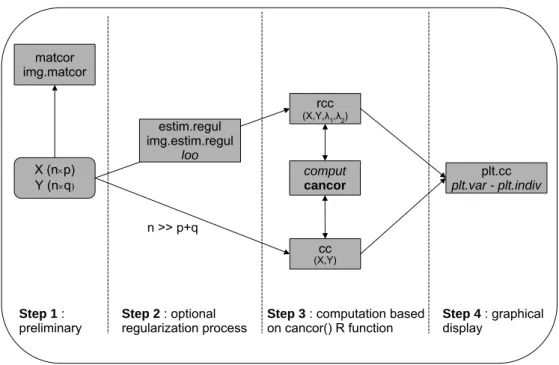
matcor img.matcor rcc (X,Y,λ1,λ2) cc (X,Y) plt.cc plt.var - plt.indiv X (n×p) Y (n×q) n >> p+q estim.regul img.estim.regul loo comput cancor Step 1: preliminary Step 2 : optional
regularization process Step 3
: computation based
on cancor() R function Step 4
: graphical display
Figure 1: Schematic view of the canonical correlation analysis process usingCCA. Functions in italic font are internal functions the user does not have to call. In bold face, thecancor()
Rfunction around which the package is built.
between variables. This representation of units is possible by using the axes defined by (Us, Ut): the coordinate of the ith unit on the axis Us is Us
i (the ith coordinate of the sth
canonical variate).
The relationships between the two plots (variables and units) drawn on the matching axes can reveal associations between variables and units.
3. Using
CCA
CCA is freely available from the Comprehensive RArchive Network (CRAN, http://CRAN. R-project.org/). Once loaded into R, CCA provides the user with functions to perform CCA and one data set for illustration purpose.
3.1. Implementation issues
Figure 1 provides a schematic view of the canonical correlation analysis process, from the data to graphical displays, using the CCApackage.
Each step is illustrated in the following sections using thenutrimousedata set.
3.2. nutrimouse data set
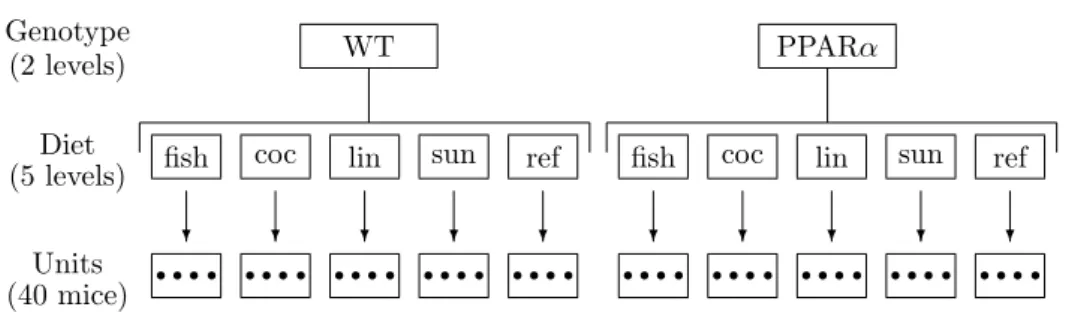
Thenutrimousedata set comes from a nutrition study in mouse (Martinet al. 2007). Forty mice were studied; two sets of variables were acquired:
Units (40 mice) Diet (5 levels) Genotype (2 levels) • • • • • • • • • • • • • • • • • • • • • • • • • • • • • • • • • • • • • • • • ? ? ? ? ? ? ? ? ? ?
fish coc lin sun ref fish coc lin sun ref
WT PPARα
Figure 2: Experimental design of the nutrition study.
expressions of 120 genes measured in liver cells, selected (among about 30000) as po-tentially relevant in the context of the nutrition study. These expressions were acquired thanks to microarray technology (Muller and Nicolau 2004);
concentrations of 21 hepatic fatty acids (FA) measured by gas chromatography. Biological units (mice) are cross-classified according to two factors (Figure2):
Genotype: study were done on wild-type (WT) and PPARα deficient (PPARα) mice.
Diet: Oils used for experimental diets preparation were corn and colza oils (50/50) for a reference diet (REF), hydrogenated coconut oil for a saturated FA diet (COC), sunflower oil for anω6 FA-rich diet (SUN), linseed oil for anω3 FA-rich diet (LIN) and corn/colza/enriched fish oils for the FISH diet (42.5/42.5/15).
This data set was used to present a survey of statistical methods applied in the context of microarray data analysis (Bacciniet al.2005). Exploratory methods (PCA, multidimensional scaling, hierarchical clustering), modeling (ANOVA, mixed models, multiple testing), learning methods (random forests,Breiman 2001) were used to highlight a small sets of “interesting” genes on which CCA were performed to explore correlations with the fatty acid data set. The data set can be loaded into the Rworkspace by data("nutrimouse"). The description of this data set is also available by callinghelp(nutrimouse).
To avoid problems in the computations, the user should convert the data into the matrix
format before performing CCA.
R> X <- as.matrix(nutrimouse$gene) R> Y <- as.matrix(nutrimouse$lipid)
3.3. Preliminary
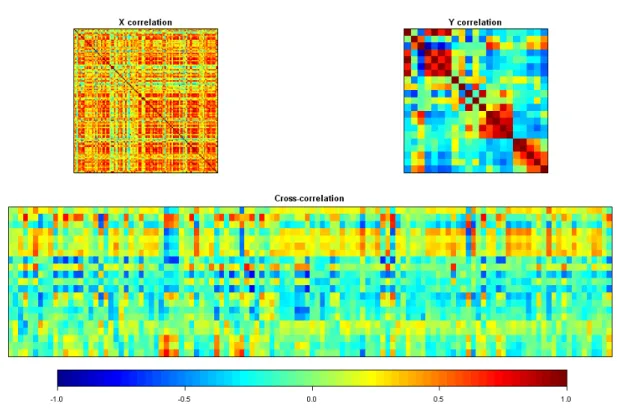
Canonical correlations analysis aims at highlighting correlations between two data sets. A preliminary step may consist in visualizing the correlation matrices. The packageCCA pro-poses two ways to obtain this kind of representation: either the whole matrix concatenatingX
andY or by expanding the 3 correlation matrices as it is done in Figure3 with the following code.
Figure 3: Correlation matrices for: X variables (upper-left), Y variables (upper-right), cross-correlation X×Y (bottom). Increasing values are translated into colors from blue (negative correlation) to red (positive correlation).
R> correl <- matcor(X, Y)
R> img.matcor(correl, type = 2)
Figure3highlights some significant correlations not only within each set of variables (squared matrices 120×120 and 21×21 at the top) but also between both sets (the rectangular matrix 21×120 at the bottom)i.e. between gene expression and fatty acids concentration.
The work must be stopped here if images obtained are uniformly in light green color corre-sponding to nearly null correlation.
3.4. Performing CCA Classical CCA
When dealing with data sets in which the number of experimental units is greater than the number of variables, the classical CCA can be performed with the cc() function. The following command lines illustrate its use with a restricted number of genes from the X data set.
R> Xr <- as.matrix(nutrimouse$gene[, sample(1:120, size = 10)]) R> res.cc <- cc(Xr, Y)
R> barplot(res.cc$cor, xlab = "Dimension",
+ ylab = "Canonical correlations", names.arg = 1:10, ylim = c(0,1)) R> plt.cc(res.cc)
The explanation of the above command lines are:
1. first, we randomly choose 10 genes among the 120 and the data are stored as a matrix in the object Xr;
2. canonical correlations analysis is performed withXr(40×10) andY(40×21); 3. the barplot of canonical correlations is displayed;
4. variables and units are plotted on the first two canonical variates (default values ford1
and d2 arguments ofplt.cc).
Similar plots will be presented and discussed in the following section when dealing with the complete case.
Regularized CCA
When dealing with the whole data set (X(40×120) and Y(40×21)), classical CCA cannot be
performed and the regularization step must be included in the data processing.
Choice of regularization parameters As mentioned in section 2.5, we opted to build a grid around reasonable values for λon which we detect the cell where the CV-score reached its maximum.
The leave-one-out cross-validation process is implemented in the function estim.regul(). The default grid on which the CV-criterion is calculated is regular with 5 equally-spaced discretization points of the interval [0.001, 1] in each dimension.
The experience can guide the user to refine the discretization-grid but one can also use the
estim.regul() function in a recursive way. First, use the default grid and locate an area where the optimal value for λ1 and λ2 could be reached and then, determine a new grid
around these first optimal values.
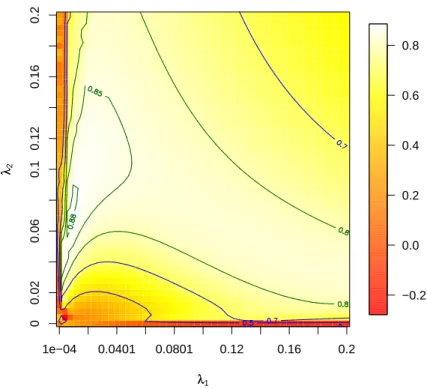
Figure 4 was obtained by calculating the CV-criterion on the 51 × 51 grid by using the
estim.regul()function:
R> res.regul <- estim.regul(X, Y, plt = TRUE, + grid1 = seq(0.0001, 0.2, l=51),
+ grid2 = seq(0, 0.2, l=51))
It enables to evaluate the optimal values for λ1 and λ2 at respectively 0.008096 and 0.064.
These values are returned by theestim.regul()function with the value of the CV-criterion.
lambda1 = 0.008096 lambda2 = 0.064 CV-score = 0.8852923
λλ1 λλ2 1e−04 0.0401 0.0801 0.12 0.16 0.2 0 0.02 0.06 0.1 0.12 0.16 0.2 −0.2 0.0 0.2 0.4 0.6 0.8
Figure 4: Image representing the CV-score for λ1 and λ2 on a 51 × 51 grid defined by
equally-spaced discretization points on the region: 0.0001 ≤ λ1 ≤ 0.2 and 0 ≤ λ2 ≤ 0.2. Two kinds of contour plots are also displayed for values equal to {0-0.5-0.7} (in blue) and to
{0.8-0.85-0.88(∗)}(in green). (*) maximal value reached on the grid.
The computation is not very demanding. It lasted less than one hour and half on a “current use” computer for the 51 ×51 grid.
Figure 4 were completed by adding contour plots on the image with:
R> contour(res.regul$grid1, res.regul$grid2, res.regul$mat, add = TRUE, + levels = c(0,0.5,0.7), col = "blue")
R> contour(res.regul$grid1, res.regul$grid2, res.regul$mat, add = TRUE, + levels = c(0.8,0.85,0.88), col = "darkgreen")
Regularized CCA computations Once regularization parameters are fixed, the user calls the rcc()function with values for the parameters lambda1and lambda2instead ofcc().
R> res.rcc <- rcc(X, Y, 0.008096, 0.064)
The scree graph of canonical correlations can be plotted as a barplot.
R> barplot(res.rcc$cor, xlab = "Dimension",
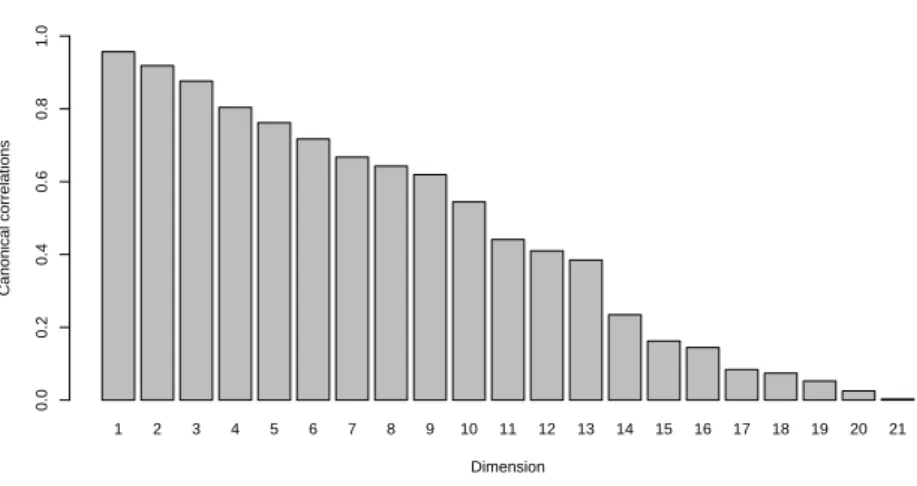
1 2 3 4 5 6 7 8 9 10 11 12 13 14 15 16 17 18 19 20 21 Dimension Canonical correlations 0.0 0.2 0.4 0.6 0.8 1.0
Figure 5: Barplot of canonical correlations.
Figure5can lead to several arguable choices ford: 3, 6 and 9 reveal larger gaps between two successive canonical correlations.
3.5. Graphical displays
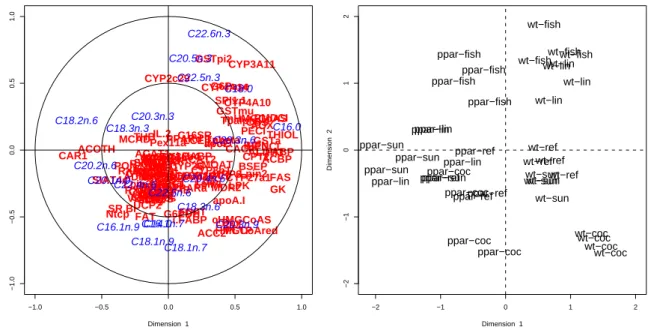
In Figure 6, we focus on the first two dimensions for illustration purpose. Plots for larger dimensions could be displayed and interpreted in a more detailed study.
R> plt.cc(res.rcc, var.label = TRUE,
+ ind.names = paste(nutrimouse$genotype, nutrimouse$diet, sep = "-"))
Argumentsvar.labelandind.names of theplt.cc()function are given to make easier the interpretation of variables and units representation.
Some biological arguments are given on the basis of Figure 6 to focus on the relevancy of graphical outputs provided by RCCA.
First, RCCA provides an integrated graphical representation of two data sets (gene expression and fatty acid composition) which interpretation is fully in accordance with all the conclusions drawn in Martinet al. (2007) by way of standard statistical methods applied separately on each data set. The following two examples illustrate well this concordance:
1. the stronger effect of the genotype versus the dietary effects (see the clear separation of the genotypes along the first canonical variate) which is mostly due to the accumulation of linoleic acid (C18.2n.6) and CAR transcript in PPARαmice and the lower expression of fatty acid metabolism genes in these animals (genes with high positive coordinates on the first dimension) was previously underlined and discussed;
2. specific effects of the diets on FA composition and gene expression were reported and are also well illustrated by RCCA through the second canonical variate. In particular, the altered response of PPARα deficient mice to diet-induced changes in gene expression is well illustrated by the less clear separations of the units corresponding to different diets for PPARα mice (see the units with negative coordinates on the first dimension, right panel of Figure 6).
−1.0 −0.5 0.0 0.5 1.0 −1.0 −0.5 0.0 0.5 1.0 Dimension 1 Dimension 2 X36b4
ACAT1 ACAT2 ACBP
ACC1 ACC2 ACOTH ADISP ADSS1 ALDH3 AM2R AOX BACT BIEN BSEP Bcl.3 C16SR CACP CAR1 CBS CIDEA COX1 COX2 CPT2 CYP24 CYP26 CYP27a1 CYP27b1CYP2b10 CYP2b13 CYP2c29 CYP3A11 CYP4A10 CYP4A14 CYP7a CYP8b1 FAS FAT FDFT FXR G6PDH G6Pase GK GS GSTa GSTmu GSTpi2 HMGCoAred HPNCL IL.2 L.FABP LCE LDLr LPK LPL LXRa LXRb Lpin Lpin1 Lpin2 Lpin3 M.CPT1 MCAD MDR1 MDR2 MRP6 MS MTHFR NGFiB NURR1 Ntcp OCTN2 PAL PDK4 PECI PLTP PMDCI PON PPARa PPARd PPARgPXR Pex11a RARa RARb2 RXRaRXRb2 RXRg1 S14 SHP1 SIAT4c SPI1.1 SR.BI THB THIOL TRa TRb Tpalpha Tpbeta UCP2 UCP3 VDR VLDLrWaf1 ap2 apoA.I apoB apoC3 apoE c.fos cHMGCoAS cMOAT eif2g hABC1 i.BABP i.BAT i.FABP i.NOS mABC1 mHMGCoAS C14.0 C16.0 C18.0 C16.1n.9 C16.1n.7 C18.1n.9 C18.1n.7 C20.1n.9 C20.3n.9 C18.2n.6 C18.3n.6 C20.2n.6 C20.3n.6 C20.4n.6 C22.4n.6 C22.5n.6 C18.3n.3 C20.3n.3 C20.5n.3 C22.5n.3 C22.6n.3 −2 −1 0 1 2 −2 −1 0 1 2 Dimension 1 Dimension 2 wt−lin wt−sun wt−sun wt−fish wt−ref wt−coc wt−lin wt−lin wt−fish wt−coc wt−fish wt−ref wt−sun wt−ref wt−sun wt−lin wt−coc wt−fish wt−coc wt−ref ppar−coc ppar−ref ppar−sun ppar−fish ppar−sun ppar−ref ppar−ref ppar−lin ppar−fish ppar−lin ppar−coc ppar−coc ppar−ref ppar−sun ppar−fish ppar−coc ppar−lin ppar−fish ppar−lin ppar−sun
Figure 6: Variables (on the left) and units (on the right) representations on the plane defined by the first two canonical variates.
4. Conclusion
In this article we have proposed an efficient way to perform canonical correlation analysis in
R. The functions provided in theCCApackage outperform thecancor()Rfunction according to several points:
the ability to handle missing values;
the processing of data sets with more variables than units through the regularized extension of the CCA;
integrated solutions for graphical outputs.
These solutions were assessed on a real data set coming from a recent nutrition study. We maintain a web page about canonical correlation analysis. It will always contain the latest release of the CCA package: http://www.lsp.ups-tlse.fr/CCA/. Future versions of CCAwill aim at providing the user with additional tools. In particular, the cross-validation procedure can be computationally improved on larger data sets by performing a K-fold version instead of the leave-one-out one already implemented. Furthermore, other multidimensional methods such as linear discriminant analysis will be included as specific cases of CCA.
Acknowledgments
The authors are grateful to Dr. Thierry Pineau for the availability of the data and for in-teresting discussions about biological interpretation of the results. This work was partially supported by grants from ACI IMPBio and ANR PNRA.
References
Baccini A, Besse P, D´ejean S, Martin PG, Robert-Grani´e C, SanCristobal M (2005). “Strat´ e-gies pour l’analyse statistique de donn´ees transcriptomiques.” Journal de la Soci´et´e Fran¸caise de Statistique,146(1-2), 5–44.
Bickel PJ, Li B (2006). “Regularization in Statistics.”Sociedad de Estadistica e Investigacion Operativa, Test,15(2), 271–344.
Breiman L (2001). “Random forests.”Machine Learning,45(1), 5–32.
Eaton ML, Perlman MD (1973). “The Non-Singularity of Generalized Sample Covariance Matrices.”The Annals of Statictics,1(4), 710–717.
Friedman JH (1989). “Regularized Discriminant Analysis.”Journal of the American Statistical Association,84(405), 165–175.
Guo Y, Hastie T, Tibshirani R (2007). “Regularized Linear Discriminant Analysis and its Application in Microarrays.” Biostatistics,8(1), 86–100.
Leurgans SE, Moyeed RA, Silverman BW (1993). “Canonical Correlation Analysis when the Data are Curves.”Journal of the Royal Statistical Society B,55(3), 725–740.
Mardia KV, Kent JT, Bibby JM (1979). Multivariate Analysis. Academic Press.
Martin PG, Guillou H, Lasserre F, D´ejean S, Lan A, Pascussi JM, SanCristobal M, Legrand P, Besse P, Pineau T (2007). “Novel Aspects of PPARα-mediated Regulation of Lipid and Xenobiotic Metabolism Revealed through a Nutrigenomic Study.” Hepatology, 54(2), 767–777.
Mevik BH, Wehrens R (2007). “The pls Package: Principal Component and Partial Least Squares Regression in R.” Journal of Statistical Software, 18(2). ISSN 1548-7660. URL
http://www.jstatsoft.org/v18/i02/.
Mullen KM, van Stokkum IHM (2007). “An Introduction to the ‘Special Volume Spectroscopy and Chemometrics in R’.” Journal of Statistical Software, 18(1). ISSN 1548-7660. URL
http://www.jstatsoft.org/v18/i01/.
Muller UR, Nicolau DV (2004). Microarray Technology and its Applications. Springer-Verlag.
RDevelopment Core Team (2007).R: A Language and Environment for Statistical Computing.
RFoundation for Statistical Computing, Vienna, Austria. ISBN 3-900051-07-0, URLhttp: //www.R-project.org/.
Vinod HD (1976). “Canonical Ridge and Econometrics of Joint Production.” Journal of Econometrics,4(2), 147–166.
Affiliation: Ignacio Gonz´alez
Institut de Math´ematiques
Universit´e de Toulouse et CNRS (UMR 5219) Universit´e Paul Sabatier
F-31062 Toulouse Cedex 9, France and
Departamento de Matem´atica Universidad de Carabobo, Venezuela
E-mail: [email protected]
S´ebastien D´ejean
Institut de Math´ematiques
Universit´e de Toulouse et CNRS (UMR 5219) Universit´e Paul Sabatier
F-31062 Toulouse Cedex 9, France
E-mail: [email protected]
URL:http://www.math.univ-toulouse.fr/~sdejean/
Pascal G. P. Martin
Laboratoire de Pharmacologie et Toxicologie
Institut National de la Recherche Agronomique (UR 66) 180 Chemin de Tournefeuille, BP 3
F-31931 Toulouse, Cedex 9, France
E-mail: [email protected]
Alain Baccini
Institut de Math´ematiques
Universit´e de Toulouse et CNRS (UMR 5219) Universit´e Paul Sabatier
F-31062 Toulouse Cedex 9, France
E-mail: [email protected]
Journal of Statistical Software
http://www.jstatsoft.org/published by the American Statistical Association http://www.amstat.org/
Volume 23, Issue 12 Submitted: 2007-03-20