Controllers for Stabilized Platforms
.
White Rose Research Online URL for this paper:
http://eprints.whiterose.ac.uk/160395/
Version: Accepted Version
Article:
Zhang, Jie, Jin, Zhaopeng, Zhao, Yanzhi et al. (3 more authors) (Accepted: 2020) Design
and Implementation of Novel Fractional-Order Controllers for Stabilized Platforms. IEEE
Access. ISSN 2169-3536 (In Press)
[email protected] https://eprints.whiterose.ac.uk/
Reuse
Items deposited in White Rose Research Online are protected by copyright, with all rights reserved unless indicated otherwise. They may be downloaded and/or printed for private study, or other acts as permitted by national copyright laws. The publisher or other rights holders may allow further reproduction and re-use of the full text version. This is indicated by the licence information on the White Rose Research Online record for the item.
Takedown
If you consider content in White Rose Research Online to be in breach of UK law, please notify us by
Design and Implementation of Novel
Fractional-Order Controllers for
Stabilized Platforms
JIE ZHANG1,2, ZHAOPENG JIN3, YANZHI ZHAO3, YINGGAN TANG2, FUCAI LIU2, AND PENGCHENG LIU4, (Member, IEEE)
1Liren College of Yanshan University, Qinhuangdao 066004, China
2
Institute of Electrical Engineering, Yanshan University, Qinhuangdao 066004, China
3
Key Laboratory of Parallel Robot and Mechatronic System, Yanshan University, Qinhuangdao 066004, China
4
Department of Computer Science, University of York, York YO10 5GH, United Kingdom
Corresponding author: Yanzhi Zhao ([email protected]). Yinggan Tang ([email protected]), Zhaopeng Jin ([email protected]).
This work was supported in part by the National Key Research and Development Program under Grant No. 2017YFE0112200, in part by the Natural Science Foundation of Hebei Province under Grant No. E2018203436, in part by the Science Technology Research of Higher Education of Hebei Province under Grant No. ZD2018024, and in part by Guangdong Province Jihua Laboratory under Grant No. Y80311W180.
ABSTRACT As a servo system to isolate disturbance or track trajectory, stabilized platform requires
high-quality control. However, conventional PID control fails to meet that requirement.In this paper, a new controller design scheme is proposed for stabilized platform based on fractional calculus. The designed controller is called fractional-order PID(FOPID) controller, which has two extra parameters compared to conventional PID controller. On one hand, it enables people have more degrees of freedom to design FOPID controller, on the other hand, its differential order and integral order provides more flexibility to tune the controller performance. Therefore, a design method of FOPID controller based on dynamic software modeling is presented. To obtain the idea controller’s parameters, the particle swarm optimization (PSO) bionic algorithm is used to optimize an objective function.In addition, software simulation platform and hardware experiment platform are built to design and test the FOPID controller. Finally, simulations and experimental results are included to show the effectiveness of the new control method.
INDEX TERMS Stabilized platform; Fractional-order PID; Tuning method; Particle swarm optimization
I. INTRODUCTION
Capable of isolating instruments and equipment from exter-nal interference in harsh environments, the stabilized plat-forms have been applied in many fields ranging from national defense and military to rescue operations [1] [2] [3] [4]. In national defense and military fields, stabilized platforms are to achieve a dynamic and stabilized strike of fire control systems in complex combat environments for many coun-tries. In industry, stabilized platforms are the top priority for dynamic rotation guidance of mining tools. In offshore oil extraction operations, stabilized platforms not only isolate the interference of the waves, but also assist the tools to complete the desired trajectory of drilling. Furthermore, in the course of rescue operation, stabilized platforms isolate the complex road conditions such as bumps, accelerations, decelerations and sharp turns during the ambulance driving
process. The on-board self-balancing ambulance platform can actively achieve dynamic stability in space and provide relatively stabilized rescue transportation for the injured sur-roundings.
The high-performance of the stabilized platforms in the above applications is mainly determined by their control methods which have become one of the recent research hotspots. M.M Abdo [5] proposed a fuzzy PID controller for a two-axis gimbal system of two axes gimbal system, which can isolate the interference of the sensor and the working environment; Jianliang Mao [6] proposed a contin-uous finite time sliding mode control method with cascade control structure in order to improve the dynamic response and anti-interference ability of the inertial stabilization plat-form; Changrui Bai [7] demonstrated an active disturbance rejection control based on least mean square for aerial remote
sensing stabilized imaging; and Jiancheng Fang [8] proposed an adaptive decoupling control system based on neural net-work to improve the tracking and stability performance of stabilized platforms.
Seen from the above researches, the conventional PID control method is widely used in the current industrial pro-cess control because of its simplicity and applicability. On this basis, more modern control theories and intelligent con-trol theories have also been applied to stabilized platforms, such as fuzzy control [5], synovial film control [6], auto-disturbance control [7], and neural network control [8], etc. [9] with improvements in the stabilization effect. However, characterized by non-linearity, time-varying and parameter uncertainty under the disturbance of multiple sources from outside, the stabilized platform, therefore, requires a control method with high accuracy and high stability in a complex environment. Xiangyang Zhou [10] added a non-linear state error feedback to his active disturbance rejection control scheme and obtained good anti-interference ability; based on a new continuous differentiable nonlinear friction model, Yuefei Wu [11] proposed an adaptive controller for the high-precision photoelectric gyroscope stabilization platform. Al-though corresponding solutions are proposed to solve the problems of model nonlinearity and time variability, the above methods often result in insufficient applicability and difficult application in practical engineering.
Compared with integer-order, the differential operators of the fractional-order calculation, an extension of integer-order calculation, are global and infinitely dimensional. Fractional-order differential can reflect not only the system information at the current time, but also the system at a certain time in history information. When describing many non-linear phys-ical systems such as the data flow in network communication [12] and the properties of non-linear materials such as rubber isolators [13], the description of fractional-order models is more accurate. Therefore, fractional-order calculations have attracted more attention with the development of computer technology. The controller designed according to fractional-order calculations has more tuning freedom, a wider param-eter range and a significant improvement in robustness.
In view of this, the research on the application of fractional-order operations in the field of machinery has also gradually increased. Compared with traditional integer-order controllers, fractional-order controllers have wider applica-tions and better performance. Wudai Liao [14] illustrated a control method based on the stability of a fractional-order single-link rotating inverted pendulum system. The controller has better switching speed and stability than an integer-order PID(IOPID) controller. Amruta Mujumdar [15] studied the application of a fractional-order theory in the control and state estimation of a class of unsteady systems and selected a single-link flexible manipulator as an experimental object. The study found that the fractional-order model can better describe system and this kind of fractional sliding mode observer can provide robust noiseless estimation for the controller. Guanghui Sun [16] proposed an adaptive
fractional-order terminal sliding mode control strategy to solve the tracking control problem of linear motors. Under the uncertain situation of the controlled system, the control with high tracking accuracy and fast response speed was obtained. Syuan-Yi Chen [17] researched an adaptive fuzzy fractional-order sliding mode control for a permanent mag-net synchronous motor system, which improved the anti-interference ability of the system and suppressed the phe-nomenon. The experiments proved that the proposed control method has good performance and robustness when driving a permanent magnet synchronous motor system. It can be seen that the fractional-order controller has better tracking and system stability in the case of controlling complex non-linear objects and has great prospects for application in the mechanical field because of its inherent advantages.
Although fractional-order theory has many applications in the mechanical field [18] [19], there is still a lot of research gap for its application in stabilized platforms. Due to more parameters of the fractional-order controllers, pa-rameter tuning is a common difficulty in controller design. The traditional trial and error method, in the case of a large number of parameters, not only takes a long time, but also may not be able to find the optimal set of parameters. Cosmin Copot [20] adopted genetic algorithm and automatic tuning algorithm to solve the parameter tuning problem for stabilized platform. However, applying FOPID controllers to engineering practice still faces many challenges. Due to the unknown external environment and the uncertainties in the motion of the controlled object, many researches are still stuck in the software simulation and fail to achieve good control effect in the actual engineering requirements. Aiming at the above problems, this paper intends to use a particle swarm optimization bionic algorithm to find the optimal controller parameters through successive iterations, design a stabilized platform fractional-order controller with fast stability and strong adaptability and put the designed controller into the practical experiment.
The rest of this paper is organized as follows: Section II introduces the configuration of stabilized platform and its three-dimensional dynamic model is constructed. Section III introduces the mathematical definition of fractional-order theory and the transfer function form of fractional-order con-trollers. The simulation model about the controller was built by simulink software and the parameters of the controller were calculated iteratively by particle swarm optimization. Section IV conducts three groups of experiment about the novel fractional controller: A comparison experiment be-tween fractional-order and integer-order PID controller and a stability effect experiment under external disturbance was performed. Finally, a hardware model of a stabilized platform was built and the feasibility in practical application was tested through the practicality experiment. Section V draws conclusions.
II. STEWART STABILIZED PLATFORMS
Stabilized platforms are generally divided into parallel plat-forms and series platplat-forms according to their configurations. Parallel stabilized platform has the advantages of high rigid-ity and strong bearing capacrigid-ity. Occupying a small space, each drive is load-balanced and is easy to achieve fast response. Compared with other parallel mechanisms, the Stewart platform has the advantages of simple and compact structure, good symmetry and easy control.
A. STRUCTURAL PRINCIPLE
In order to establish the relationship between the six servo drives and the collected posture information of the upper platform, the inverse solution of the mechanism needs to be obtained. Simplify the kinematics mechanism of the parallel stabilized platform. A dynamic coordinate system o-xyz and a fixed coordinate system O-XYZ is established at the center points of the upper and lower platforms respectively. As shown in Figure 1.
FIGURE 1. Mechanism sketch.
In this paper, the closed-loop vector method is used to obtain the inverse solution of the mechanism. The specific solution process is not repeated and the concise expression of the inverse solution is as follows:
θi= 2 arctan pz± p p2 z+W2−V2 V +W (1) Where, W =Mcosφ1i+Nsinφ2i V =l 2 2+M2+N2+p2x−l21 2l2 M =−(px+rocosφ2i−Rocos(φ1i))
N =py+rosinφ2i−Rosinphi1i
In the formula,px,py, andpzare the position of the upper
platform reference point relative to the lower platform;roand
Roare the radius of the circumscribed circle of the upper and
lower platforms; φ1i andθi are the rotation input angles of
the branch drive lever; l1 andl2 are the lengths of the two
vectors in the closed-loop vector method.
Through the establishment of the inverse solution formula for the kinematics of the mechanism, the steering angle pa-rameters of the steering gear leveling on the driving platform can be calculated in real time. Obviously, using the inverse solution formula alone cannot obtain better stability effects. It is necessary to choose a suitable control method to decide how to maintain balance.
B. DYNAMIC MODEL
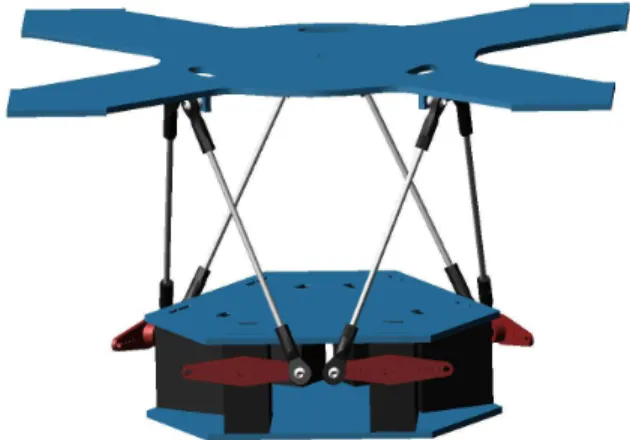
The ADMAS software is used to build a three-dimensional model of the experimental platform, as shown in Figure 2. By adding kinematic pairs and corresponding drives, a dynamic model is constructed, which cannot only co-simulate with simulink and lay the foundation for subsequent work, but also can add various types of external disturbances directly into the model.
FIGURE 2. Six degree of freedom stabilized platform ADMAS model.
Through the control plug-in in ADMAS, the three-dimensional model can be converted into an m-file format and the corresponding mathematical model can be imported into the main workspace and simulink of Matlab. After this, the dynamic model of the stabilized platform can be called by simulation experiments.
III. DESIGN OF FRACTIONAL-ORDER PID CONTROLLER
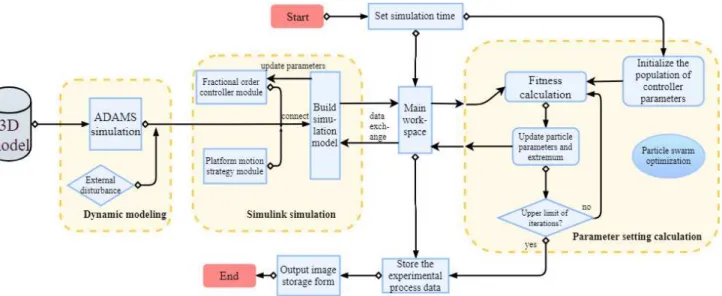
The parallel mechanism is a dimensional input, multi-dimensional output, strong coupling and highly nonlinear complex control system. In order to improve the performance of the stabilized platform, this article designs the FOPID controller by simulation. The simulation process is shown in Figure 3. The main work includes dynamic modeling based on ADMAS, simulation model based on simulink, controller parameter tunning based on an improved particle swarm optimization algorithm and simulation experiment.
FIGURE 3. Simulation flowchart.
A. MATHMATICAL BACKGROUND
1) Definition of fractional calculus
The definition of fractional calculus has already been given at the end of the nineteenth century. There are many definitions of it, the two most commonly used [21] [22] including the Riemann-Liouville definition and Grunwald-Letnikov defini-tion are introduced in this article :
First form, the Riemann-Liouville definition is given as:
aDαtf(t) = 1 Γ(m−α)( d dt) mZ t a f(τ) (t−τ)1−(m−α)dτ (2)
Second form, the Grünwald-Letnikov definition is given as: aDtαf(t) = lim h→0 1 Γ(α)hα P(t−a)/h k=0 Γ(α+k) (k+1) f(t−kh) (3) where, n r =Γ(α+k) Γ(k+ 1) (4)
The operator used in the above two formulasaDαt , where
a and t represent the upper and lower limits of calculus respectively, αis the order of calculus. A positive number indicates the differential link and a negative number indicates the integral link.
Since the theory of fractional calculus was introduced into engineering applications, its ability to accurately describe certain physical phenomena has attracted widespread atten-tion from many researchers. In the field of engineering, many related studies have proved that fractional-order has better stability and superiority than traditional integer solutions.
2) Transfer function of controller
In the design process of the controller, the relevant operator can be used to describe the model of the controller. For IOPID and FOPID controllers, the transfer function forms are as follows: Gi(s) =Kp+Kis+Kd (5) Gf(s) =Kp′ +K ′ is −λ+K′ dsµ (6)
where, λ and µ are fractional orders of integrals and derivatives.
B. SIMULATION MODEL BASED ON SIMULINK SOFTWARE
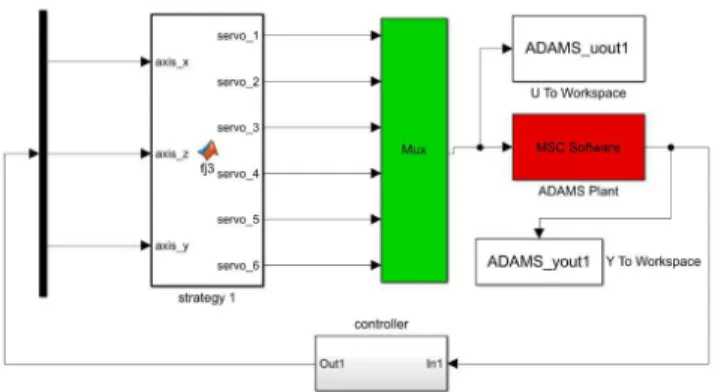
Simulink is a simulation tool in Matlab [23], which is widely used in the process of modeling, simulation and analysis of dynamic systems such as digital signal processing and control theory. The platform dynamics model established in the previous section is called in the form of Adams plant module in Simulink. The simulation diagram is shown in Figure 4.
Where, the strategy1 module is implemented by simulink programming based on the inverse mechanism formula ob-tained in Section II-A. It can calculate the steering angle required to level the upper platform.
The controller module designed in this article is encap-sulated in the controller module. The type of controller can be modified by replacing the module and the parameters of the controller can be changed by modifying the parameters in the module. The corresponding parameters of fractional-order control are defined as Kp, Ki, Kd, lamda and miu, then the data communication with the main working area of Matlab is achieved by declaring global variables, which lays the foundation for the next parameter tuning work.
FIGURE 4. Simulation diagram in simulink software.
C. PARAMETER TUNING OF FRACTIONAL-ORDER CONTROLLER
Different from the IOPID controller, the time complexity of parameter tuning is obviously greater because of the increase of parameters. Fractional differential equations are also difficult to express during simulation. In engineering ap-plications, the trial-and-error method and empirical method commonly used for IOPID are difficult to use for parameter tuning of FOPID when two unknown dimensions are added. Therefore, this article intends to use a particle swarm opti-mization intelligent bionic algorithm to tune the parameters of the fractional-order controller.
1) PSO Algorithm
The bionic algorithm is an intelligent algorithm to han-dle some nodes without gradient information or non-differentiable node transfer function. Particle swarm op-timization algorithm [24] is an algorithm established to simulate the predation behavior of bird swarms. For other bionic algorithms, the particle swarm algorithm does not have crossover and mutation operations, however, it can pass the optimal particles in the iteration and the search speed is fast. This algorithm requires fewer parameters to adjust, is relatively easy to implement and is suitable for solving engineering problems.
The PSO algorithm needs to initialize a group of random particles and updates its own speed and position by tracking two extreme points respectively during each iteration. The related formula is as follows:
Vid(t+ 1) =ωVid(t) +c1r1(0,1)
(Pid−xid) +c2r2(0,1)(Pgd−xid)
(7)
Xid(t+ 1) =Xid(t) +V(t+ 1) (8)
where, ω is inertia factor. C1 and C2 are acceleration
constant, the former is the individual learning factor for each particle and the latter is the social learning factor for each particle. Experimental research shows that, whenC1andC2
are constant, a better solution can be obtained. Generally take
C1 = C2 ∈ [0,4].r1andr2 means take a random number
on the interval [0,1].Pidrepresents the d-th dimension of the
individual extremes of the i-th variable.Pgdrepresents the
d-th dimension of d-the global optimal solution.V represents the velocity of the particles andXrepresents the position of the particles.
In addition, in consideration of the stability and applica-bility of the controller, this paper adds a set of random noise to the simulation of external disturbances during the tuning algorithm to simulate the environment of uncertainty. The PSO algorithm flowchart is shown in Figure 5:
FIGURE 5. Particle swarm algorithm flowchart.
The initial parameters of the PSO algorithm are shown in Table 1:
TABLE 1. Initial parameters of PSO algorithm
Parameter Meaning Value
ω Inertia factor 0.6
C1, C2 Acceleration constant 1
Vi1 Initial particle velocity [0,0.05][0,1][0,0.05]
Xi1 Initial particle position [0.1,1.2][2,18][0,1]
maxinum Maximum number of iterations 10
part Particle swarm size 20
narvs Number of independent variables 5
After determining the initial parameters, the next step is to determine the fitness function of the algorithm. The fitness function is an indicator used to judge the pros and cons of the results during the iteration of the particles. For different problems, flexibly specifying the corresponding fitness func-tion becomes the key to the algorithm result. This paper sets the fitness function as follows:
f itness= 0.1×Pit|e(t)|, i≤1 Pi t|e(t)|, i >1 (9) In Equation 9, e(t) is the deflection angle between the platform and the horizontal plane after simulation. Within 0 ∼ 1 second, this period is at the beginning of leveling. The rotation error of the platform is relatively large at this stage, so the weight occupied by this stage is reduced. The weight is restored after 1 second in order to consider the
performance during the leveling process. The tuning algo-rithm uses the fitness function as a criterion for stability performance and iteratively searches for suitable controller parameters.Obviously, the fitness value is a positive number and the smaller the value, the better the stability effect of the platform.
With the above algorithm programmed through Matlab and after each particle position update, the ADMAS-simulink joint simulation model established in the previous section is called. The simulation time is set to 20s, the result of each iteration is saved and the image is output after the algorithm is finished.
2) Results of iterative calculation
By selecting 20 random particles and performing ten iterative calculations, the fitness value of each group of examples during the iteration is shown in Figure 6. It can be seen that the change trend of each group is different and three of them have lower final fitness values. The fitness values are monotonically decreasing and the fitness value gradually converges as the number of iterations increases.
FIGURE 6. Particle swarm algorithm iterative tuning results graph.
The third set of data with the lowest fitness value is selected as the optimal solution for the parameter tuning of the controller. The following simulation and experiment will further verify the performance of the tuned FOPID controller.
IV. SIMULATION AND EXPERIMENTAL RESULTS
A. SIMULATED PERFORMANCE COMPARISON OF FOPID CONTROLLER AND IOPID CONTROLLER
In order to verify the performance of the FOPID controller, we first used the PID tuning tool in Matlab to tune the controller’s proportional, integral and derivative parameters based on the phase angle margin and amplitude margin. A set of relatively better parameters is selected. The parameters
of the IOPID controller are shown in Table 2. The detailed parameter selection process is not described in detail here.
TABLE 2. Two kinds of controller parameter setting results
Controller type Parameter Value
Fractional-order controller Kp 0.98 Ki 11.35 Kd -0.04 Kd -0.04 Kd -0.04 Integer-order controller Kp 0.6 Ki 6 Kd 0.1
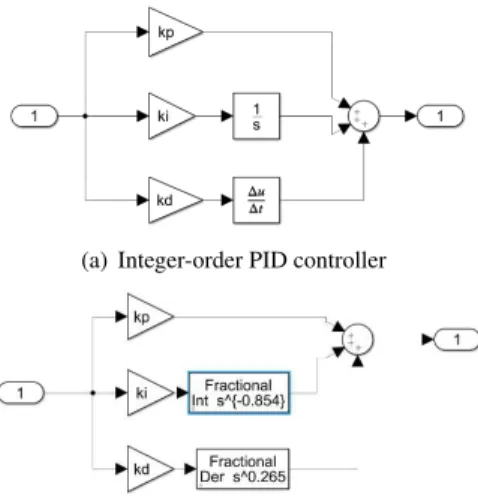
In the experimental stage, by adding a set of sine waves to the external disturbance of the stabilized platform in the dynamic model and changing the controller module in the software simulation model built in Section IV, the integer-order and FOPID controllers were used for simulation in this experiment. The internal structure of the controller is shown in Figure 7.
(a) Integer-order PID controller
(b) Fractional-order PID controller FIGURE 7. Two controller schematics
Shown as Figure 8, the stability effect of IOPID controller and FOPID controller under the same sine wave disturbance. From the figure, it can be seen intuitively that compared with integer-order controller, fractional-order controller has smaller overshoot, faster response speed and shorter stability time. The equilibrium position can be found after a single oscillation, which has a better stability effect.
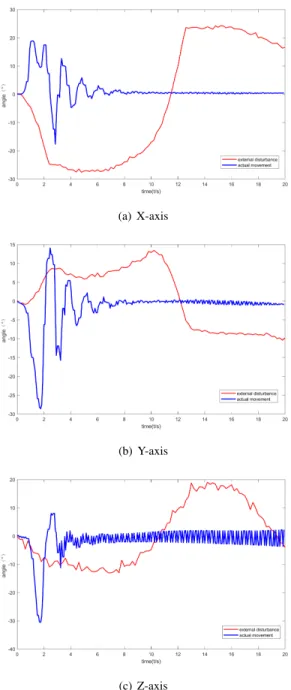
In order to further verify the performance of the FOPID controller, especially to prove that the designed controller can be applied in engineering practice.The following experi-ments will increase the complexity of external disturbances. They are added in the X-axis, Y-axis and Z-axis directions. Meanwhile, in order to simulate the uncertain factors of the actual process, a Gaussian white noise with an average value of 0 and a standard deviation of 5° is added to the above disturbances. In the current external disturbance situation,
0 2 4 6 8 10 12 14 16 18 20 time(t/s) -10 -5 0 5 10 15 20 fopid iopid (a) X-axis (b) Y-axis (c) Z-axis
FIGURE 8. Comparison of stability effects of integer and fractional PID controllers
the IOPID cannot achieve a stabilized platform. A FOPID controller is used in simulation experiments and the results are shown in Figure 9.
As can be seen from the figure, the FOPID controller can still achieve the effect of self-stabilized control under the condition of complex external disturbances. The final stabilization effect in the X-axis and Y-axis directions is good and the static stability error is very small. Although there is a certain static stability error in the Z axis, the stabilization speed in this direction is relatively fast. The above experi-ments have fully proved that the FOPID controller has better stability in the face of complex external disturbances when controlling nonlinear systems.
(a) X-axis
(b) Y-axis
(c) Z-axis
FIGURE 9. External Disturbance and stability effect curve of fractional-order controller
B. PRACTICALITY EXPERIMENT
It is difficult to get good results when the parameters of FOPID controller in software simulation are applied in practice because the hardware equipment and the external environment cannot reach the ideal condition in the actual engineering. It is also one of the difficulties for the controller to be widely used. In order to verify the feasibility of the controller design method, the tuning parameters in the third section are directly used in the real machine experiment.
1) Hardware system composition
An experimental system of stabilized platform was devel-oped, as shown in Figure 10. The ardunio control board is
selected and connected to the 16-way servo drive board and the JY-901 gyroscope by IIC communication. Six MG995 analog servos are connected to the 16-way servo drive board sockets in sequence and the 16-way servo drive board is con-nected to the external power. The inertial navigation module installed at the center of the upper platform is used as an attitude acquisition system to measure the three-dimensional rotational attitude angle of the upper platform.
FIGURE 10. Hardware schematic diagram of the prototype experimental stage.
The upper platform is composed of acrylic plates and 3D printed parts connected by bolts, while the lower platform is composed of acrylic plates and six steering gears, as well as bolted rubber columns for fixing in the middle. The related size parameters of the platform are shown in Table 3.
TABLE 3. Table of experimental platform parameters
Platform parameters Value
Hinge point circle radius of upper platform 70mm Hinge point circle radius of lower platform 85mm Initial height of upper and lower platform 120mm
Steering arm 25mm
Center distance of connecting rod 130mm
In order to realize the feedback control and the output signals of the acquisition system, it is necessary to collect the position information of the platform in real time. The data collected by the JY901 gyroscope is sent to the lower computer in hexadecimal form. The machine transfers to the upper computer to obtain the position information of the upper platform. Need to calculate its data according to the following formula:
Tumble angle (deflect around X axis):
Roll= ((RollH≪8)|RollL)/32768∗180°
Pitch angle (deflect around Y axis):
P itch= ((P itchH≪8)|P itchL)/32768∗180°
2) Experimental result
In this paper, four groups of sine waves with the same direction but different amplitude and period are selected as external disturbances, as shown in Table 4.
TABLE 4. Prototype parameters for experiments
Group number Amplitude Period
1 20° 2s
2 20° 1s
3 10° 2s
4 10° 1s
During the movement of the upper platform, the value returned by the gyroscope cannot accurately return the posi-tion informaposi-tion of each moment. For the original gyroscope data of the four experimental results, the redundant data was cleaned up and the spherical interpolation method is used to fit the curve for the discrete data in the stabilization process. The result is shown in Figure 11.
The peaks and valleys in the above curve and the time it takes for the platform to stabilize are marked in the figure. It can be seen that after a period of leveling, the platform can remain stabilized under different external disturbances, which not only proves the effectiveness of the fractional-order controller applied to the stabilized platform, but also verifies the performance of the PSO algorithm to adjust the parameters of the random disturbance.
V. CONCLUSION
To stabilize the platform, a fractional-order controller, mainly divided into simulation experiments and physical verifica-tion, is designed. There are three steps in the simulation ex-periment phase: 1) construction of dynamics-based software simulation platform. 2) the parameter tuning of the fractional-order controller using the PSO bionic algorithm Gaussian white noise was added to the external disturbance signal during the iteration process to enhance the adaptability of the parameter tuning results. 3) The performance and applica-bility of the fractional-order controller were verified through two sets of experiments: the first group is the fractional-order control comparison experiments between the controller and the integer-order controller. The second group is the ex-periments on the stability superiority of the fractional-order controller over the integer-order controller, but also the effec-tiveness of the fractional-order controller. After that, physical experiments were performed on the designed controller. The stabilized platform and the main structure of the controller were established by setting up the hardware platform and computer programming. The external signals were collected through the gyroscope and several groups of experiments were performed. Experimental proof: 1) Fractional-order controllers still have good stability effects when applied to practical stabilized platforms. 2) In the process of parameter tuning using the PSO algorithm, the introduction of appro-priate random disturbances can increase the adaptability of the controller system to a certain extent provides new ideas for the promotion of fractional-order controllers to practical applications.
0 1 2 3 4 5 6 -5 0 5 10 15 20 t=3.3s equilibrium position variation curve
(a) first group around the X axis
0 1 2 3 4 5 6 -6 -4 -2 0 2 4 6 t=3.8s equilibrium position variation curve
(b) first group around the Y axis
0 1 2 3 4 5 6 -3 -2 -1 0 1 2 3 4 5 6 7 8 t=3.3s equilibrium position variation curve
(c) second group around the X axis
0 1 2 3 4 5 6 -4 -3 -2 -1 0 1 2 3 t=3.3s equilibrium position variation curve
(d) second group around the Y axis
0 1 2 3 4 5 6 -10 -5 0 5 10 15 20 25 t=4.0s equilibrium position variation curve
(e) third group around the X axis
0 1 2 3 4 5 6 -6 -4 -2 0 2 4 6 8 10 12 t=4.6s equilibrium position variation curve
(f) third group around the Y axis
0 1 2 3 4 5 6 -6 -4 -2 0 2 4 6 8 10 12 14 t=3.4s equilibrium position variation curve
(g) fourth Group around the X axis
0 1 2 3 4 5 6 -6 -5 -4 -3 -2 -1 0 1 2 3 4 t=3.6s equilibrium position variation curve
(h) fourth group around the Y axis FIGURE 11. Experimental curve
REFERENCES
[1] Y. S. Alexandrov, V. P. Arefiev, O. A. Artemiev, V. M. Kosturev, S. G. Kucherkov, A. M. Smirnov, A. V. Sorokin, V. A. Zelinsky and A. V. Nebylov, “Precision gyro-stabilized platform on the base of gas-static supported gyros,” Control Engineering Practice, vol. 11, no. 5, pp. 579– 584, May. 2003.
[2] Z. Zhang, Z. Li, Q. Zhou, L. Zhang and D. Fan, “Application in prestiction friction compensation for angular velocity loop of inertially stabilized platforms,” Chinese Journal of Aeronautics, vol. 27, no. 3, pp. 655–662, Jun. 2014.
[3] F. Königseder, W. Kemmetmüller and A. Kugi, “Attitude control strategy for a camera stabilization platform,” Mechatronics, vol. 46, pp. 60–69, Oct. 2017.
[4] B. Rohani, Y. Yazicioglu, M. Mutlu, O. Ogucu, E. Akgul and A. Saranli, “Lagrangian based mathematical modeling and experimental validation of a planar stabilized platform for mobile systems,” Journal of Computational and Applied Mathematics, vol. 259, pp. 955–964, Mar. 2014.
[5] M. M. Abdo, A. R. Vali, A. R. Toloei and M. R. Arvan, “Stabilization loop of a two axes gimbal system using self-tuning PID type fuzzy controller,” ISA Transactions, vol. 53, no. 2, pp. 591–602, Mar. 2014.
[6] J. Mao, S. Li, Q. Li and J. Yang, “Design and implementation of con-tinuous finite-time sliding mode control for 2-DOF inertially stabilized platform subject to multiple disturbances,” ISA Transactions, vol. 84, pp. 214–224, Jan. 2019.
[7] C. Bai and Z. Zhang, “A least mean square based active disturbance rejection control for an inertially stabilized platform,” Optik, vol. 174, pp. 609–622, Dec. 2018.
[8] J. Fang, R. Yin and X. Lei, “An adaptive decoupling control for three-axis gyro stabilized platform based on neural networks,” Mechatronics, vol. 27, pp. 38–46, Apr. 2015.
[9] Z. L, K. L and W. Z, “Inertially Stabilized Platform for Airborne Remote Sensing Using Magnetic Bearings,” IEEE/ASME Transactions on Mecha-tronics, vol. 21, no. 1, pp. 288–301, Feb. 2016.
[10] X. Zhou, Y. Chao, B. Zhao, L. Zhao and Z. Zhu, “A High-Precision Control Scheme Based on Active Disturbance Rejection Control for a Three-Axis Inertially Stabilized Platform for Aerial Remote Sensing Applications,” Journal of Sensors, vol.2018, pp. 1–9, Jul. 2018.
[11] Y. Wu and Y. Dong, “Desired Compensation Adaptive Robust Control of Electrical-optical Gyro-stabilized Platform with Continuous Friction Compensation Using Modified LuGre Model,” International Journal of Control, Automation and Systems, vol. 16, no. 5, pp. 2264–2272, Sep. 2018.
[12] V. Zaborovsky and R. Meylanov, “Informational network traffic model based on fractional calculus,” presented at International Conference on Info-Tech and Info-Net, pp. A58–A63, Oct. 2001.
[13] M. M. Sjöberg and L. Kari, “Non-Linear Behavior of a Rubber Isolator System Using Fractional Derivatives,” Vehicle System Dynamics, vol. 37, no. 3, pp. 217–236, Aug. 2002.
[14] W. Liao, Z. Liu, S. Wen, S. Bi and D. Wang, “Fractional PID based stability control for a single link rotary inverted pendulum,” presented at 2015 INTERNATIONAL CONFERENCE ON ADVANCED MECHATRONIC SYSTEMS (ICAMECHS), pp. 562–566, Aug. 2015.
[15] M. Amruta, T. Bhagyashri and K. Shailaja, “Observer-Based Sliding Mode Control for a Class of Noncommensurate Fractional-Order Systems,” IEEE-ASME TRANSACTIONS ON MECHATRONICS, vol. 20, no. 5, pp. 2504–2512, Aug. 2015.
[16] G. Sun and Z. Ma “Practical Tracking Control of Linear Motor With Adaptive Fractional Order Terminal Sliding Mode Control,” IEEE-ASME TRANSACTIONS ON MECHATRONICS, vol. 22, no. 6, pp. 2643–2653, Dec. 2017.
[17] S. Y. Chen, H. H. Chiang, T. S. Liu and C. H. Chang, “Precision Motion Control of Permanent Magnet Linear Synchronous Motors Using Adaptive Fuzzy Fractional-Order Sliding-Mode Control,” IEEE-ASME TRANS-ACTIONS ON MECHATRONICS, vol. 24, no. 2, pp. 741–752, Apr. 2019. [18] H. Malek and Y. Chen, “Fractional Order Extremum Seeking Control: Per-formance and Stability Analysis,” IEEE/ASME Transactions on Mecha-tronics, vol. 21, no. 3, pp. 1620–1628, Jun. 2016.
[19] A. Maddahi N. Sepehri and W. Kinsner, “Fractional-Order Control of Hydraulically Powered Actuators: Controller Design and Experimental Validation,” IEEE/ASME Transactions on Mechatronics, vol. 24, no. 2, pp. 796–807, Apr. 2019.
[20] C. Cosmin, Z. Yu, L. C. M. and D. K. Robin, “Tuning fractional PID controllers for a Steward platform based on frequency domain and
ar-tificial intelligence methods,” CENTRAL EUROPEAN JOURNAL OF PHYSICS, vol. 11, no. 6, pp. 702–713, Apr. 2013.
[21] X. Ma, M. Xie, W. Wu, B. Zeng, Y. Wang and X. Wu, “The novel fractional discrete multivariate grey system model and its applications,” APPLIED MATHEMATICAL MODELLING, vol. 70, pp. 402–424, Jun. 2019. [22] S. Urooj and B. Singh, “Fractional-Order PID Control for Postoperative
Mean Arterial Blood Pressure Control Scheme,” Procedia Computer Sci-ence, vol. 152, pp. 380–389, 2019.
[23] M. Volodymyr and B. Taras, “Using of FOTF Toolbox and Z-transform for Fractional Control Systems,” presented at 2017 IEEE INTERNATIONAL YOUNG SCIENTISTS FORUM ON APPLIED PHYSICS AND ENGI-NEERING (YSF), pp. 50–53, Oct. 2017.
[24] G. Yang “A modified particle swarm optimizer algorithm,” presented at 8th International Conference on Electronic Measurement and Instruments, pp. 675–679, Aug. 2007.
JIE ZHANGreceived the B.S. degree in statistics specialty from College of Science, Yanshan Uni-versity, China, in 2003. Currently, she is a lecturer with Liren College of Yanshan University, and a Ph.D. candidate in Control Science and Engi-neering at Yanshan University, China. Her current research interests include system identification of fractional order system and robot control theory.
ZHAOPENG JINreceived the B.S. degree in me-chanical and electronic engineering from Yanshan University, Qinhuangdao, Hebei, China, in 2017, where he is currently pursuing the M.S. degree in mechatronics engineering. His research interests include fractional order controller and intelligent algorithm research.
YANZHI ZHAOreceived the B.S. degree in me-chanical engineering and the Ph.D. degree in mechatronics engineering from Yanshan Univer-sity, Qinhuangdao, Hebei, China, in 2003 and 2009, respectively. He is currently a Professor with the Department of Mechatronics Engineer-ing, Yanshan University. His current research in-terests include parallel multi-dimensional force sensors, theory, and application of parallel manip-ulators.
YINGGAN TANG received the B.Sc. in Instru-ment Science, the M.Sc. and Ph.D degrees in Control Science and Engineering in, respectively, 1999, 2002 and 2006 from Yanshan University, China. Currently, he is a Professor in the De-partment of Automation at Yanshan University, China. His main research interests include image processing, system modeling and computational intelligence.
FUCAI LIUreceived the B.S. and M.S. degrees from both Department of Automation, Northeast Heavy Mechanism Academe in 1989 and 1994. He received the Ph.D. degree from Department of control science and Engineering, Harbin Institute of Technology in 2003. He is now a professor of Yanshan and the head of Automation Depart-ment in Electric Engineering Institute at Yanshan University. He has authored/coauthored more than 200 papers in mathematical, technical journals, and conferences. He is the author of the book “Fuzzy Model Identification for Nonlinear Systems and Its Applications”. His current research interests include fuzzy identification, predict control and space robot Control.
PENGCHENG LIUreceived the B.Eng. degree in measurement and control and the M.Sc. degree in control theory and control engineering from Zhongyuan University of Technology, China, in 2007 and 2012, respectively, and the Ph.D. degree in robotics and control from Bournemouth Uni-versity, UK, in 2017. He is currently an Assistant Professor at the Department of Computer Science, University of York, UK, where he is supervising several PhD students. Before joining York, he has held several academic positions at Cardiff, Lincoln, Bournemouth and China. He also held academic positions as a Visiting Fellow at Institute of Automation, Chinese Academy of Sciences, China and Shanghai Jiao Tong University, China. Dr Liu is a member of IEEE, IEEE Robotics and Automation Society (RAS), IEEE Control Systems Society (CSS) and International Federation of Automatic Control (IFAC). He is also a member of the IEEE Technical Committee on Bio Robotics, Soft Robotics, Robot Learning, and Safety, Security and Rescue Robotics. He is an Associate Editor of IEEE Access and he received the Global Peer Review Awards from Web of Science in 2019, and the Outstanding Contribution Awards from Elsevier in 2017. He has published over 60 papers on flagship journals and conferences. He was nominated as a regular Funding/Grants reviewer for EPSRC, NIHR and NSFC and he has been leading and involving in several research projects and grants, including EPSRC, Newton Fund, Innovate UK, Horizon 2020, Erasmus Mundus, FP7-PEOPLE, NSFC, etc. He serves as reviewers for over 30 flagship journals and conferences in robotics, AI and control, e.g NEUNET, AURO, NODY, JINT, ICRA, IROS, RA-L, NCAA, etc. His research interests include robotics, machine learning, dynamical systems control and optimization.