SOFTWARE DEFECT PREDICTION USING MAXIMAL INFORMATION
COEFFICIENT AND FAST CORRELATION-BASED FILTER FEATURE SELECTION by
BONGEKA MPOFU
submitted in accordance with the requirements for the degree of
DOCTOR OF PHILOSOPHY in the subject
COMPUTER SCIENCE at the
UNIVERSITY OF SOUTH AFRICA SUPERVISOR: Prof E Mnkandla
I can’t change the direction of the wind, but I can adjust my sails to always reach my destination.
i TABLE OF CONTENTS
LIST OF FIGURES ... vi
LIST OF TABLES ... vii
ACRONYMS ... x
LIST OF PUBLISHED PAPERS ... xii
ACKNOWLEDGEMENTS ...xiii DECLARATION ... xv ABSTRACT ... xvi CHAPTER 1 ... 1 INTRODUCTION ... 1 1.1 Background... 1 1.2 Software defects ... 3
1.3 Software quality management ... 4
1.4 Software testing ... 5
1.4.1 Execution-based testing ... 6
1.4.2 Non execution-based testing ... 6
1.4.3 Testing in a box ... 7
1.4.4 Performance testing ... 7
1.4.5 Other types of testing ... 8
1.4.6 Levels of testing ... 8
1.5 Software fault tolerance ... 9
1.5.1 Redundancy ... 9
1.5.2 Error processing ... 10
1.6 Software product line and versioning ... 11
1.7 Testing software product lines ... 11
1.8 Problem statement ... 12
1.9 Research questions ... 12
1.9.1 Primary research question ... 13
ii
1.10 Research objectives ... 14
1.11 Research methodology ... 15
1.11.1 Research types ... 15
1.11.2 Design Science ... 16
1.11.3 Techniques used in software defect prediction ... 17
1.11.4 Data analysis ... 20
1.12 Limitations of the study ... 21
1.13 Thesis outline ... 21 1.14 Chapter summary ... 22 CHAPTER 2 ... 23 BACKGROUND ... 23 2.1 Introduction ... 23 2.2 Data sources ... 23 2.2.1 Company/Industrial data ... 23
2.2.2 Open source code repository ... 24
2.2.3 Bug life cycle participants ... 24
2.2.4 Bug tracking system ... 25
2.3 Defect prediction approaches ... 28
2.3.1 Single version software ... 28
2.3.2 Versioning systems ... 28
2.4 Software metrics ... 29
2.4.1 Static code metrics ... 32
2.4.2 Process metrics ... 37 2.5 Machine learning ... 38 2.5.1 Supervised learning ... 38 2.5.2 Unsupervised learning... 39 2.5.3 Semi-supervised learning ... 40 2.6 Literature review ... 40
2.6.1 Minimising defects in software ... 40
iii
2.6.3 Feature selection ... 58
2.6.4 Machine learning techniques ... 61
2.6.5 Deep learning ... 63
2.7 Chapter summary ... 65
CHAPTER 3 ... 66
EXPERIMENTAL DESIGN AND METHODOLOGY ... 66
3.1 Introduction ... 66
3.2 Research ... 66
3.2.1 Research paradigm ... 66
3.2.2 Design Science Approach ... 67
3.3 Research experiment ... 69
3.3.1 Data ... 69
3.3.2 Dimension reduction and feature selection ... 70
3.3.3 Redundancy elimination ... 70
3.3.4 Machine learning algorithms ... 75
3.3.5 Applications ... 83
3.3.6 Defect prediction stages ... 84
3.4 Chapter Summary ... 91
CHAPTER 4 ... 93
INFORMATION THEORY ... 93
4.1 Introduction ... 93
4.2 Shannon’s entropy and information theory ... 93
4.3 Information theory measures ... 96
4.3.1 Information gain ... 96 4.3.2 Gain ratio ... 97 4.3.3 Mutual information ... 97 4.3.4 Symmetrical uncertainty ... 99 4.3.5 Relief ... 99 4.3.6 ReliefF ... 100
4.3.7 Minimum redundancy maximum relevancy ... 100
iv
4.3.9 Maximal information coefficient ... 101
4.4 Chapter summary ... 102
CHAPTER 5 ... 103
FEATURE SELECTION ... 103
5.1 Introduction ... 103
5.2 Feature selection ... 103
5.3 Feature relevance and redundancy ... 104
5.3.1 Relevant features ... 104
5.3.2 Irrelevant features ... 106
5.3.3 Redundant features ... 106
5.4 Feature weighting ... 106
5.4.1 Equal weight ... 107
5.4.2 Rank sum weight method ... 107
5.4.3 Rank exponent weight method ... 108
5.4.4 Inverse or reciprocal weights ... 108
5.5. Feature ranking ... 109
5.6 Discretisation of attributes ... 109
5.7 Feature selection processes ... 110
5.8 Feature extraction methods ... 111
5.8.1 Principal component analysis ... 111
5.8.2 Linear Discriminant Analysis ... 112
5.9 Feature selection methods ... 113
5.9.1 Filter ... 116
5.9.2 Wrapper methods ... 119
5.9.3 Embedded methods ... 121
5.10 Chapter summary ... 122
CHAPTER 6 ... 123
PREDICTION MODEL EVALUATION ... 123
6.1 Introduction ... 123
v
6.2.1 Data analysis ... 124
6.2.2 Proportion of features selected ... 125
6.2.3 Running time of the feature selection algorithms ... 126
6.3 Classification results ... 127
6.3.1 Percentage accuracy ... 127
6.3.2 Area under ROC curve ... 131
6.3.3 F-Measure ... 135
6.3.4 Root mean squared error ... 138
6.3.5 True positive rate ... 140
6.4 Threats to validity ... 143
6.4.1 Threats to internal validity ... 143
6.4.2 Threats to external validity ... 144
6.4.3 Construct validity ... 144
6.5 Chapter summary ... 151
CHAPTER 7 ... 152
DISCUSSION AND CONCLUSION ... 152
7.1 Introduction ... 152
7.2 Discussion... 152
7.3 Contribution to knowledge ... 153
7.4 Limitations of the study ... 155
7.5 Conclusion ... 155
7.6 Future work ... 156
REFERENCES ... 157
APPENDIX A TOOLS & METHODS ... 176
vi LIST OF FIGURES
FIGURE 1.1 ALLOCATION OF THE TESTING BUDGET ... 2
FIGURE 1.2 TECHNIQUES FOR DEFECT PREDICTION ... 188
FIGURE 2.1 BUGZILLA LIFE CYCLE ... 27
FIGURE 3.1 THE RELATIONSHIP BETWEEN ONTOLOGY, EPISTEMOLOGY, METHODOLOGY ... 67
FIGURE 3.2 DESIGN SCIENCE RESEARCH CYCLES ... 68
FIGURE 3.3 DEFECT PREDICTION PROCESS ... 84
FIGURE 3.4 DATA PRE-PROCESSING IN WEKA ... 866
FIGURE 4.1 SHANNON'S COMMUNICATION SYSTEM ... 933
FIGURE 4.2 RELATIONSHIP BETWEEN SOURCE ENTROPY AND DESTINATION ENTROPY ... 955
FIGURE 4.3 VENN DIAGRAM DEPICTING RELATION BETWEEN MI AND ENTROPIES ... 98
FIGURE 6.1 BOXPLOT: AREA UNDER ROC CURVE ... 1344
vii LIST OF TABLES
TABLE 2.1 SOFTWARE BUG ATTRIBUTES ... 255
TABLE 2.2 SOFTWARE METRICS ...30
TABLE 2.3 HALSTEAD METRICS ... 333
TABLE 2.4 PROCESS METRICS ... 377
TABLE 2.5 SUM OF SQUARED ERROR ... 477
TABLE 3.1 FAULT DATA ...69
TABLE 3.2 FASTCR ALGORITHM ...74
TABLE 5.1 FEATURE SELECTION METHODS ... 1133
TABLE 5.2 FEATURE SELECTION TECHNIQUES ... 1155
TABLE 6.1 PROPORTION OF FEATURES SELECTED BY THE ALGORITHMS ... 1255
TABLE 6.2 RUNTIME OF THE FEATURE SELECTION ALGORITHMS ... 1277
TABLE 6.3 PERCENTAGE ACCURACY USING NAÏVE BAYES ... 1288
TABLE 6.4 NEMENYI TEST - PERC ACCURACY USING NAIVE BAYES ... 1288
TABLE 6.5 PERCENTAGE ACCURACY USING PART ... 1299
TABLE 6.6 NEMENYI TEST USING PART ... 1299
TABLE 6.7 PERCENTAGE ACCURACY USING J48... 13030
viii
TABLE 6.9 AREA UNDER THE ROC USING NAIVE BAYES ... 13131
TABLE 6.10 NEMENYI TEST - AUC USING NAIVE BAYES ... 132
TABLE 6.11 AREA UNDER ROC CURVE USING PART ... 13232
TABLE 6.12 NEMENYI TEST - AUC USING PART ... 1333
TABLE 6.13 AREA UNDER ROC CURVE USING J48 ... 1333
TABLE 6.14 NEMENYI TEST - AUC USING J48 ... 1344
TABLE 6.15 F-MEASURE USING NAIVE BAYES ... 1355
TABLE 6.16 NEMENYI TEST F-MEASURE USING NAIVE BAYES ... 1355
TABLE 6.17 F-MEASURE USING PART ... 1366
TABLE 6.18 F-MEASURE USING J48 ... 1366
TABLE 6.19 RMSE USING NAIVE BAYES ... 1388
TABLE 6.20 NEMENYI TEST - RMSE USING NAÏVE BAYES ... 138
TABLE 6.21 RMSE USING PART CLASSIFIER ... 1399
TABLE 6.22 NEMENYI TEST –RMSE USING PART CLASSIFIER ... 1399
TABLE 6.23 RMSE USING J48 ... 14040
TABLE 6.24 TRUE POSITIVES USING NAIVE BAYES ... 14040
TABLE 6.25 TRUE POSITIVES - P-VALUES IN NAÏVE BAYES ... 14141
TABLE 6.26 TRUE POSITIVES – USING PART ... 14141
ix
TABLE 6.28 NEMENYI TEST - TRUE POSITIVES USING J48 ... 14242
TABLE 6.29 VALIDATION TEST DATASET ... 1433
TABLE 6.30 PERC ACCURACY USING NAÏVE BAYES (VALIDATION) ... 1444
TABLE 6.31 NEMENYI TEST - PERC ACCURACY USING NAÏVE BAYES (VALIDATION) . 1455 TABLE 6.32 PERC ACCURURACY USING PART (VALIDATION) ... 1455
TABLE 6.33 PERC ACCURACY USING 48 (VALIDATION)... 1466
TABLE 6.34 AUC USING NAIVE BAYES (VALIDATION) ... 1466
TABLE 6.35 NEMENYI TEST - AUC USING NAÏVE BAYES (VALIDATION) ... 1477
TABLE 6.36 AUC USING PART (VALIDATION) ... 1477
TABLE 6.37 AUC USING J48 (VALIDATION) ... 1488
TABLE 6.38 F-MEASURE USING J48 (VALIDATION) ... 1499
TABLE 6.39 - F-MEASURE USING PART (VALIDATION) ... 1499
x
ACRONYMS
JDT Java Development Tools
PDE Plug-in Development Environment FCBF Fast Correlation Based Filter
LOC Lines of Code
VCS Version Control System OSS Open source software VCS Version Control System SCCS Source Code Control System RCS Revision Control System
MIC Maximal Information Coefficient DIT Depth of Inheritance Tree NOC Number of children
WMC Weighted Methods per Class CBO Coupling between objects
CFS Correlation Based Feature Selection AUC Area Under the Curve
ROC Receiver Operating Characteristic MAE Mean Absolute Error
RMSE Root Mean Squared Error
NASA National Aeronautics and Space Administration
FCM Fuzzy C Means
CART Classification And Regression Tree
SU Symmetric Uncertainty
MI Mutual Information
IG Information Gain
xi
RBM Restricted Boltzmann’s Machines PCA Principal Component Analysis PCA
xii
LIST OF PUBLISHED PAPERS
The study contained in this thesis has yielded a number of publications. The following are the publications related to this thesis.
1. Mpofu, B & Mnkandla, E. 2017. Defect Prediction based on Maximal Information Coefficient and Fast Correlation-Based Filter Feature
Selection. Second International Conference on the Internet, Cyber
Security and Information Systems (ICICIS 2017). Johannesburg, South Africa. ISBN: 978-0-86970-802-6, pp. 139-145.
2. Mpofu, B & Mnkandla, E. 2016. Software Defect Prediction on a Search
Engine Software using Process Metrics. IEEE International Conference on
Advances in Computing, Communication & Engineering (IEEE ICACCE 2016). Durban, South Africa. ISBN: 987-1-5090-2576-6, pp 254-260.
xiii
ACKNOWLEDGEMENTS
I would like to acknowledge the assistance of my supervisor Professor E. Mnkandla for his support and critical assistance towards the drafting and editing of the thesis. I owe my gratitude to Nonhlanhla Ngcobo for availing resources for some areas of this research. Charity Makakaba deserves a tremendous thank you for keeping herself occupied until the odd hours, so as to sit with me while I wrote the chapters of my thesis. I thank my sisters for providing assistance in times of need, Edson and Lindiwe Malinga for their unlimited support.
xiv
DEDICATION
xv
DECLARATION
Student Number: 49131699
Name: Bongeka Mpofu
I declare that Software Defect Prediction Using Maximal Information Coefficient and Fast Correlation-Based Filter Feature Selection, is my own work and that all the sources that I have used or quoted have been indicated and acknowledged by means of complete references.
________ ________ ___31/01/2018_____
SIGNATURE DATE
xvi
ABSTRACT
Software quality ensures that applications that are developed are failure free. Some modern systems are intricate, due to the complexity of their information processes. Software fault prediction is an important quality assurance activity, since it is a mechanism that correctly predicts the defect proneness of modules and classifies modules that saves resources, time and developers’ efforts. In this study, a model that selects relevant features that can be used in defect prediction was proposed. The literature was reviewed and it revealed that process metrics are better predictors of defects in version systems and are based on historic source code over time. These metrics are extracted from the source-code module and include, for example, the number of additions and deletions from the source code, the number of distinct committers and the number of modified lines. In this research, defect prediction was conducted using open source software (OSS) of software product line(s) (SPL), hence process metrics were chosen. Data sets that are used in defect prediction may contain non-significant and redundant attributes that may affect the accuracy of machine-learning algorithms. In order to improve the prediction accuracy of classification models, features that are significant in the defect prediction process are utilised. In machine learning, feature selection techniques are applied in the identification of the relevant data. Feature selection is a pre-processing step that helps to reduce the dimensionality of data in machine learning. Feature selection techniques include information theoretic methods that are based on the entropy concept. This study experimented the efficiency of the feature selection techniques. It was realised that software defect prediction using significant attributes improves the prediction accuracy. A novel MICFastCR model, which is based on the Maximal Information Coefficient (MIC) was developed to select significant attributes and Fast Correlation Based Filter (FCBF) to eliminate redundant attributes. Machine learning algorithms were then run to predict software defects. The MICFastCR achieved the highest prediction accuracy as reported by various performance measures.
xvii
Key Terms: defect prediction; feature selection; software metrics; relevant metrics; redundancy; machine learning algorithms; filter; wrapper; embedded; information theory
1
1.1 Background
Software-based systems are a fundamental element of modern life and include innovative applications used in human activity, from financial, social, engineering to safety critical systems (Rahman & Devanbu 2013: 432-441;Ricky, Purnomo & Yulianto 2016:307-313). Many companies rely on software systems to support their day-to-day operations and deliver products or services to customers. Today’s software applications are complex and organisations are faced with growing competitive pressure to deliver high quality solutions, short development and deployment schedules using limited resources. Companies that develop applications (e.g. Windows, Google Apps, Internet Explorer Firefox) have changed their development processes to rapid releases (Mäntylä, Adams, Khomh, Engström & Petersen 2015:1384-1425). The organisations have limited the development and subsequent release times for a major release to weeks, days, or sometimes in hours to quicker deliver the latest features to customers (Mäntylä et al. 2015:1384-1425; HP 2011:1-8). As a result, some testing teams now focus on modules that are error prone to save time.
Software engineering originally focused on achieving system functional requirements. Due to the increase in business and industrial considerations, this gradually included quality as well (Hneif & Lee 2011: 72). Quality software, (discussed in Section 1.3) fulfils its requirements efficiently and effectively, while providing customer satisfaction (Duarte 2014:31; Kapur & Shrivastava 2015:1). It is important to conduct intensive software testing to achieve quality. The interests of software engineering in quality assurance are activities such as testing, verification and validation, fault tolerance and fault prediction (Abaei & Selamat 2013: 79-95).
Too often in the world of software development, quality is not considered until the programming is almost completed. This approach is inadequate, due to short delivery cycles. Consequently, the place of software testing has begun to change. It is recommended that solution testing starts as soon as
2
the program commences, in parallel with solution development. Errors must be located and eradicated early at the preliminary phases of software development.
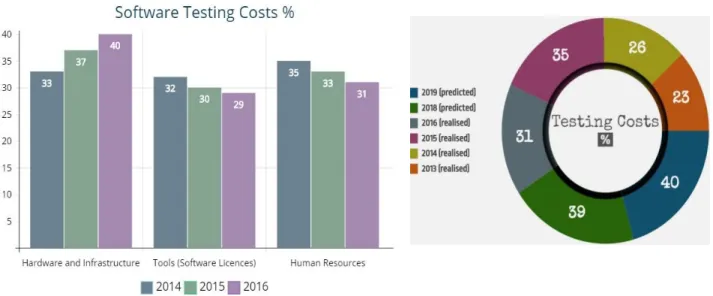
The majority of the tools and resources of software development and maintenance are linked to software testing (Taipale, Kasurinen, Karhu & Smolander 2011:120; Misirli, Bener & Turhan 2011:532). According to Capgemini Group (2017: 17), software testing costs have increased in the recent years, despite the fact that software testing is a maturing discipline. The distribution of the test budget (see Figure 1.1), shows that hardware and infrastructure costs remain the biggest area in budget allocation. The costs increased from 37% in 2015 to 40% in 2016, due to challenges faced by numerous companies in mastering their test environments.
Figure 1.1: Allocation of the testing budget (Capgemini Group 2017:53)
Spending on human resources dropped from 33% in 2015 to 31% in 2016, despite the need for new skill sets. This was achieved with increased automation, by leveraging offshore resources, use of flexible service contracts and greater adoption of open source tools. The research data also shows an increase of 3% (to 33%) in 2016 for tools and software testing costs. OSS has become better and
3
offers more complete solutions, since it is now being accepted as part of development and testing. Software testing costs are estimated to increase to 39% in 2018 and to 40% in 2019. The year-on-year growth of Quality Assurance and Testing budgets indicates that testing is not as efficient as it should be.
Research has also focused on software defect prediction (Bell, Ostrand & Weyuker 2013:479; Caglayan, Tosun, Bener & Miranskyy 2015:206). Defect prediction is a proactive approach that predicts the fault-proneness of modules and allows software developers to assign limited resources to the defect-prone modules, so that reliable applications can be developed on time and within budget (Zhang & Shang 2011: 138; Wang, Shen & Chen, 2012:13). Software defect prediction is essential with the emergence of rapid release software that is aimed at quick functionality (Li, Zhang, Wu & Zhou 2012:203). Understanding the current and previous benefits and limitations of the applications could be used to predict, if the tool will be effective to detect new types of errors in the next software version. Samples of the current version could also be used to create a model to be applied in predicting the effectiveness of the next version. Daniel and Boshernitsan (2008:364) affirm that test tool effectiveness could also be measured in terms of test coverage, using metrics extracted from the program structure.
This research predicts the future reliability of Equinox, Mylyn, Plug-in Development Environment (PDE), Lucene and Eclipse Java Development Tools (JDT) product releases. The main challenge is to predict and eliminate defects of the software, thereby enabling short release cycles of the applications to be developed. Software defect prediction methods can depend on the source code and defect data of current and previous applications.
1.2 Software defects
Software development teams conduct software testing to ensure that the quality of applications meets the users’ expectations. Software defect prediction is one of the testing activities, hence there has been ongoing research to identify and eliminate software defects. As defined by IEEE - SA Standards Board (2010:1-15), a defect is an error, failure or fault in any application that has been
4
created, which does not meet specifications and needs to be repaired. The common terms used in the software context, as defined in the Classification of Software Anomalies are (IEEE - SA Standards Board 2010:5);
Defect: An imperfection or deficiency in a work product where that work product does not meet its requirements or specifications and needs to be either repaired or replaced.
Error: A human action that produces an incorrect result.
Failure: (A) Termination of the ability of a product to perform a required function or its inability to perform within previously specified limits. (B) An event in which a system or system component does not perform a required function within specified limits.
Steps must be taken to prevent system failure. Quality software must be free of defects and errors when delivered to the customer.
1.3 Software quality management
The aim of software quality management is to create good software and enhance the effectiveness of software testing in order to improve software quality and reliability, thereby providing a product that satisfies the user within budget and scheduled time (Gill 2005:14). In the opinion of Jin and Zeng (2011: 639), quality is an abstract measurement and can reveal the grade of a product or service and its level is related to the satisfaction of customers. Software quality encompasses application features that include business concerns such as application correctness and accuracy, functionality and integrity, legacy policies, time to market and robustness to non-functional factors, which include security, portability, usability, flexibility and maintainability.
Software Quality Assurance (SQA) consists of processes and methods that ensure conformance to explicitly and implicitly defined organisational requirements. These pre-specified standards are vital in the development of high assurance systems. SQA utilises resources and includes tasks such as manual code inspections, metrics and measurement procedures, review meetings, intensive software testing (to improve software quality), reporting and quality control mechanisms. Modules that are likely to contain defects are inspected and fixed, thereby reducing the cost of locating faults at a later
5
stage. Locating and correcting defects is costly and time consuming. Defect prediction models guarantee better efficiency by prioritising quality assurance activities. Since, the distribution of defects is usually skewed, (i.e., the distribution of defects in modules is not uniform), such models can locate the most defective bits of code and enable developers to eliminate the defects without spending too much resources and time in the quality assurance activities.
Defects are caused by errors in logic or coding, which result in failure or unpredicted results; hence they have an unfavourable effect on software quality. Defects may cause the delay of a product release, loss of reputation and increased development costs.
According to Harter, Kemerer and Slaughter (2012:810-827), higher standards of quality control greatly minimise the possibility of serious defects. This is beneficial when the requirements are clear, complete and unambiguous. Incessant verification, validation and testing must be a goal in application development. Defects found in the earlier stages of software development can be corrected with minimal expense.
Problem: (A) Difficulty or uncertainty experienced by one or more persons, resulting from an unsatisfactory encounter with a system in use. (B) A negative situation to overcome.
1.4 Software testing
Software testing is the evaluation of a system or its element(s) with the aim of inspecting whether it fulfils the specified requirements or not. The purpose of software testing is to locate defects and analyse the software quality (Lee 2007:191-216).
Software testing is the most common SQA activity and is an activity that must be conducted throughout the software development life cycle (Lee 2007:195). Software testing techniques are influenced by design models, development process, programming languages and other software development technologies. Therefore, test methods are not applicable to all the software and test requirements. Designed test cases can be re-used to increase efficiency and reduce time for writing test methods. A test case is a set of constraints or variables, which indicate if an application meets
6
the requirements or not. The basic types of testing are the execution and non-execution based testing.
1.4.1 Execution-based testing
The method is also called dynamic testing. Test cases which are prepared beforehand are used in program testing. The application is considered faulty if the output is wrong. The application is tested for its utility, correctness, reliability and performance. The absence of errors in the output does not imply the software is fault free, the software may be running correctly on that particular test data.
1.4.2 Non execution-based testing
This is also called static testing. Software is tested without running test cases. Review methods such as walkthroughs and inspections are used to discuss and evaluate a software. A group of knowledgeable people, other than the author, with a wide range of skills, discuss the software as a group. Walkthroughs have fewer actions and are less formal than inspections. Inspections include planning, measurement and control in managing processes.
Walkthroughs
A walkthrough team may consist of the team responsible for the current development, manager, the next project development team, clients and the SQA representative. The software is checked for later correction. Walkthroughs locate errors in the software specification, design, plan and source code. Code inspections
The reason for conducting code inspections is to locate defects and spot any process improvements, if any.
This process may include metrics that can be used to correct defects for the document under review and aid improvements in coding standards. Attendees may benefit from the cross pollination of ideas during inspection. Preparations before the meeting are important, since they include reading of source documents to ensure readiness and uniformity.
7
1.4.3 Testing in a box
Software testers may have internal or external access to a system. 1.4.3.1 Functional testing
This technique is also known as black box testing. The tester does not have access to internal structures and checks for errors, using the functionality of the system. Test cases are designed to test if the system is according to the customer’s specifications and requirements. Black box testing is usually done for validation.
1.4.3.2 Structural or white box testing
In white box testing, testers have access to the internal structures of a program and are capable of detecting and fixing all logical errors, using designed test cases. Programming proficiency is required to identify all logic paths through the application. Not all paths may be tested mainly if there are several loop statements in the application, therefore, instead of absolute paths, logic paths are considered. White box testing is commonly conducted during the unit testing stage and it is typically applied for verification.
1.4.3.3 Gray box testing
Gray box testing is when the software program or device’s internal workings are partly understood. The testing can be described in two ways;
(i) Gray box testing is the integration of black box and white box testing
(ii) Gray box testing method tests software with partial knowledge of its underlying source code or logic. Testers have more knowledge of the code, but do not focus on exploiting the code.
1.4.4 Performance testing
Software performance testing is conducted to identify performance limitations of the system and make adjustments if necessary. The execution speed of some components is calculated. Some of the types of performance testing are load and stress testing.
8
1.4.5 Other types of testing
(i) Load testing. The handling of numerous simultaneous requests to the system is tested. This is to test if the system can manage a sudden increase in traffic. Volume testing is conducted on web systems to check if there is performance degradation when a system is processing numerous requests. System components (e.g. the central processing unit and graphics card) are expected not to crash during load testing.
(ii) Stress testing. The system is deliberately made to process heavy chores to the point of complete failure to test its stability. A stress test may test the simultaneous management of users and the further test the overload of resources on the system. This may result in possibility of system failure and the system is also tested if it can recover from that failure. The stress testing process must test for potential security loopholes, data corruption issues and slowness at peak user periods.
(iii) Reliability testing. This is the probability of an application functioning and not having any failure over certain duration in a specific environment.
(iv) Compatibility testing. This is tests if the system is compatible with other objects in the environment without any discrepancies. Objects include peripherals, operating systems, database and other system software. The purpose is to test if the system performs in the environment.
(v) Regression testing. Re-testing is conducted to ensure that software modules that were not part
of the modification process have not been affected because of the new changes.
1.4.6 Levels of testing
Software applications are normally designed using top-down or bottom-up hierarchy strategies. The smallest part of program design is a module. Units of source code, methods, procedures, or functions are tested separately.
The functionality and performance of the whole software system greatly rely on the characteristics of each unit. Unit testing locates code level faults in the methods and classes of separate components. Hence, units must be tested first.
9
Integration testing, associated system modules are integrated and tested as a group or subsystem
to ascertain functionality of the system. This test exposes errors that result from component integration. It is crucial to locate and fix faults at each level to minimise testing costs.
System testing is the last test; it is conducted to determine if the application’s operation is per specified requirements. Unit testing emphasises on structural testing, whereas system testing is based on functional testing.
Acceptance testing is when the tester and stakeholders test the system to determine if the system
meets user requirements. User requirements may change during the software development. This test is conducted to check if the system is ready for release.
Critical systems must be incessantly operational. These systems must promptly and automatically recover from failures, should they happen.
1.5 Software fault tolerance
System failure despite faults prevailing in the software, can be prevented using fault tolerance techniques (Kienzle 2003: 45-67). A crash failure arises when the system entirely ceases to function. A fail–silent and fail–stop behaviour is when a unit stops functioning and produces a failure. Omission failures transpire when the system does not respond to a request when it is anticipated to do so.
Timing failures can occur in real–time systems if the system fails to respond within the specified time slice. Both early and late responses are regarded as timing failures; late timing failures are occasionally known as performance failures.
1.5.1 Redundancy
The main supporting concept for fault tolerance is redundancy. In software development, redundancy can be of different types: functional redundancy, data redundancy and temporal redundancy. The purpose of functional redundancy is to tolerate design errors. Unlike hardware fault tolerance, software design and implementation faults cannot be identified by merely duplicating identical
10
software units, since the same fault will exist and manifest itself in all copies. The plan is to bring variance into the software imitations, producing dissimilar versions, variants or alternates. These versions functionally match, (i.e. use the same specification), but internally use dissimilar designs, algorithms and implementation methods. Information or data redundancy comprises the use of added information that permits one to check for integrity of vital data, for instance error-detecting or error-correcting codes. Varied data, namely identical data characterised in dissimilar formats, also fall into this group. Lastly, temporal redundancy includes the use of extra time to bring about fault tolerance. Temporal redundancy is an effective method of permitting transient errors. If the temporary conditions causing the fault are excluded later, simple re-execution of the failed operation will be successful. Overall, most software fault tolerance methods add execution overhead to an application and therefore use additional time in contrast to a fault-tolerant application.
1.5.2 Error processing
Forward error recovery necessitates a more or less accurate damage assessment. The error must be diagnosed so as to repair it in a logical way. This diagnosis for forward error recovery relies on the specific system. Exemptions are provided in programming languages to indicate and recognise the type of a fault. Forward error recovery can be accomplished through exception handling.
Backward error recovery demands that a prior accurate state occurs: such systems occasionally stock a copy of a clear state (sometimes called recovery point, check point, save point or recovery line, based on the recovery method), which can be rolled back in the event of an error.
Backward error recovery is a general method: since it re–installs a preceding accurate system state, it does not rely on the nature of the fault nor on the application’s semantics. Its main disadvantage is that it experiences an overhead, even in fault–free executions, because recovery points have to be established occasionally.
An increasing number of companies are working on software projects. Developers may sometimes work on a common set of files over a period of time. Changes made to these files must be monitored and controlled.
11
1.6 Software product line and versioning
A Software Product Line (SPL) reduces the development costs of software systems that are members of a product family. Identical product features between products are captured. Program developers of SPLs focus on certain product issues, instead of aspects that are common to all products (Botterweck & Pleuss 2014:266).
Software versioning is the development of software with the same name and with some features or functions introduced. Codes are allocated to successive and unique states of computer software. These are determined by the basis of the apparent significance of modifications between versions without any clear criterion. A new software version aids in outlining a threshold, which makes a change from a present state to a new state.
Version control is crucial in the software sector in managing software development and modifications, where developers frequently alter source files to implement technical specifications. New versions must be better than previous ones and not introduce new bugs.
Successive versions of software defect test tools that match the advancement of mobile devices and applications on the market have been developed. The high level of similarity and low degree of dissimilarities among versions of a software product enable us to learn about the product trends and predict files that are likely to contain errors in the product line, from information about modifications, bug fixes and failures in the previous software of the product line. In the current fast-paced business environment, most businesses are reducing the time between successive product releases.
Predicting the effectiveness of the software will enable developers to focus on the fault-prone code and allocate scarce resources to the problem areas, thereby improving test efficiency and reducing development cost and time.
1.7 Testing software product lines
Companies can develop SPLs using reduced resources and produce better quality than they can for single systems. This however requires the reusable objects’ quality to be high. Quality assurance and
12
especially testing, which is still the most common quality assurance activity, is critical to product line efforts.
1.8 Problem statement
Previous research on software defect prediction has been conducted. It has focused on the testing and quality of applications using static and change metrics. Successive versions of the application have been developed. Since the versions of the application are released rapidly, the prediction of defects may assist in locating the defect-prone parts, which the developers may focus on, thereby saving financial resources and saving valuable time.
This research was conducted to develop a novel feature selection method to select relevant attributes for software defect prediction. The Mylyn, Equinox, Apache Lucene, Eclipse PDE and Eclipse JDT software applications were used in the experiments. Process metrics were applied in quantifying the defects. Software test effectiveness compares the number of software defects found to the quantity of test cases that have been executed.
1.9 Research questions
This study was conducted in a sequence of linear stages, each of which had its own research question. The most effective process metrics will be selected e code to predict defects. Experiments involving various feature selection methods and machine learning techniques were conducted. A novel feature selection method was used to choose the best set of attributes for the defect prediction process.
The main goal of the research is:
Feature selection has been used in software defect prediction to identify relevant and non-redundant attributes. It aims to counter balance these two factors. In this study, an optimal feature selection
To develop a novel feature selection method to identify the most relevant attributes for defect prediction
13
criterion will be derived from an information theoretic method. An algorithm that will select suitable attributes will be designed.
The research questions derived from the main goal are as follows:
1.9.1 Primary research question
How can a novel feature selection method that will choose suitable attributes for predicting defects be designed?
The new feature selection method has been tested using various machine learning models and prediction results have been compared with those of other feature selection methods. The primary question is subdivided into secondary questions.
1.9.2 Secondary research questions
RQ1: Which metrics are suitable for predicting defects in the versions of a software product line?
This study predicts software defects in revolving software. A literature review was conducted on software defect prediction for software product lines. Previous studies suggest that process metrics are suitable for predicting post-release defects (Xu, Xuan, Liu & Cui 2016:370-381; Liu, Chen, Liu, Chen, Gu & Chen 2014. This study applies process metrics, feature selection and classification techniques for defect prediction. Bug process metrics for Mylyn, Equinox, Lucene, JDT and PDE applications were obtained.
RQ2: Which information theoretic methods have been used in previous research?
The techniques that are based on the entropy concept include the Information Gain, Mutual Information, Symmetric Uncertainty and the Maximal Information Coefficient (Chapter 4).
RQ3: How is the performance of the information theory-based methods compared to other algorithms?
Previous studies have used feature selection techniques for defect prediction. These include statistical, information theoretic, instance-based and probabilistic methods. The results from the tests
14
indicate that the information-based theories are more accurate. The Maximal Information Coefficient selected significant features that resulted in high performance of the algorithms (Chapters 2, 4 and 5).
RQ4: Are the data mining techniques consistently effective in predicting defects?
In this research, the Naïve Bayes, PART and J48 algorithms are applied in the prediction process. Algorithms are assessed and performance measures evaluated (Chapter 6).
RQ5: How can a data redundancy removal technique be derived from the concept of predominant correlation?
Non-redundant attributes are selected from the list of relevant ones using the predominant correlation (Section 3.3)
RQ6: How can a model that will predict defects in the next versions of the software applications be derived?
An optimal information theoretic feature selection measure that selects relevant attributes and maximises prediction accuracy is derived (Chapter 3).
1.10 Research objectives
The main goal of the research is to develop a novel feature selection method to be used in predicting defects in rapidly evolving software.
The objectives of the study are to:
Identify the process metrics that can be used to quantify the software defects.
Develop a unique feature selection method to select features to be used to predict the effectiveness of the next version of the applications.
Study the performance of statistic and information theory based feature selection algorithms in previous research
Compare the performance of information theoretic feature selection algorithms with other algorithms in previous studies
15
Evaluate if the developed novel Maximal Information Coefficient based algorithm and existing Linear Correlation, Information Gain and ReliefF feature selection algorithms can be used by machine learning algorithms to predict defects in rapidly evolving software in this study.
Conduct internal and external validity tests to check if the machine learning methods are consistently effective in predicting defects
1.11 Research methodology
There are various types of research.1.11.1 Research types
The basic types of research are: Descriptive vs analytical
Descriptive research employs fact finding and surveys. Its goal is to acquire the description of the current situation. The researcher has no control over the variables and can only narrate and explain what transpired. In contrast, in analytical research, the researcher uses facts or information on hand to analyse and to make analytical assessment of the material.
Applied vs fundamental
The goal of applied research is to find a resolution to a high priority issue affecting a community or business organisation, while fundamental research is pertained to generalisations and with the inventions of a theory. Pure or basic research is gathering knowledge for knowledge’s sake. Studies that make generalisations of human behaviour are examples of fundamental research. Research may also be conducted to determine social, political or economic trends affecting society or a business organisation. These are examples of applied research and intend to resolve issues at hand. Basic research focuses on obtaining information to be added to the current organised body of scientific knowledge.
16
Quantitative research focuses on measurement of data and it is suitable to observations that can be illustrated in terms of quantity. Conversely, qualitative research is exploratory and uses non-numerical data. The outcome of qualitative research is descriptive instead of predictive.
Conceptual vs empirical
Conceptual research is focused on some abstract ideas or theories. It is normally employed by theorists to create innovative concepts or to explain current ones and it (conceptual research) is also commonly used in social sciences. Conversely, empirical research depends on experience or experimentation and usually does not take system and theory into consideration. Data is utilised to attain conclusions which can be verified using observations or experiments. It is an experimental type of research and is commonly used by scientists.
The design of novel methods that provide effective problem solutions has been recognised by the research community as a methodology.
1.11.2 Design Science
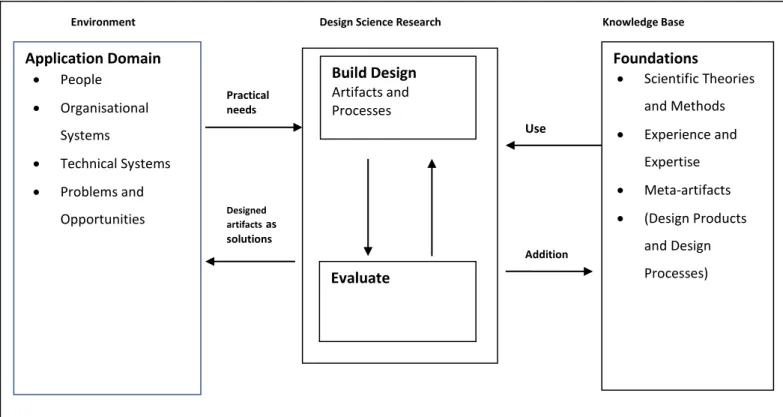
Design science research (DSR) approach aims to create and evaluate artefacts (Adikari, McDonald & Campbell, 2009; Peffers, Tuunanen, Rothenberger & Chatterjee, 2007). An artefact refers to an object that has, or can be transformed into, a material existence as an artificially made object (e.g., model, instantiation) or process (e.g., method, software) (Gregor & Hevner 2013). Concepts that outline a contribution in a Ph.D. thesis, which are also applicable to research articles were defined by Davis (2005). One of the contributions is to consider if the thesis
develops and demonstrates new or improved design of a conceptual or physical artefact. This is often termed “design science.” The contribution may be demonstrated by reasoning, proof of concept, proof of value added, or proof of acceptance and use
An effective DSR should provide clear contributions to the real-world environment from which the research problem or opportunity is drawn (Gregor & Hevner 2013). The DSR generally consists of the following steps:
17 ii. define solution objectives;
iii. design and development; iv. demonstration;
v. evaluation vi. communication
The design and development stage may involve techniques that will lead to the production of an artefact.
1.11.3 Techniques used in software defect prediction
Defect prediction techniques aim at identifying error-prone parts of a module of a software application as early as possible. These techniques vary in the types of data they require. Some of the techniques are discussed below.
1.11.3.1 LOC, Halstead, McCabe complexity metrics
The Lines of Code (LOC) method uses the code from historical software applications to predict defects. The LOC, object oriented metrics or the combination of the metrics are derived from the structure of the code. The standard equation for the LOC is expressed as (Erfanian & Darav 2012: 69-78);
𝐷𝑒𝑓𝑒𝑐𝑡 (𝐷) = 4.86 + 0.018 𝐿𝑖𝑛𝑒𝑠 𝑜𝑓 𝐶𝑜𝑑𝑒(𝐿) (1.1)
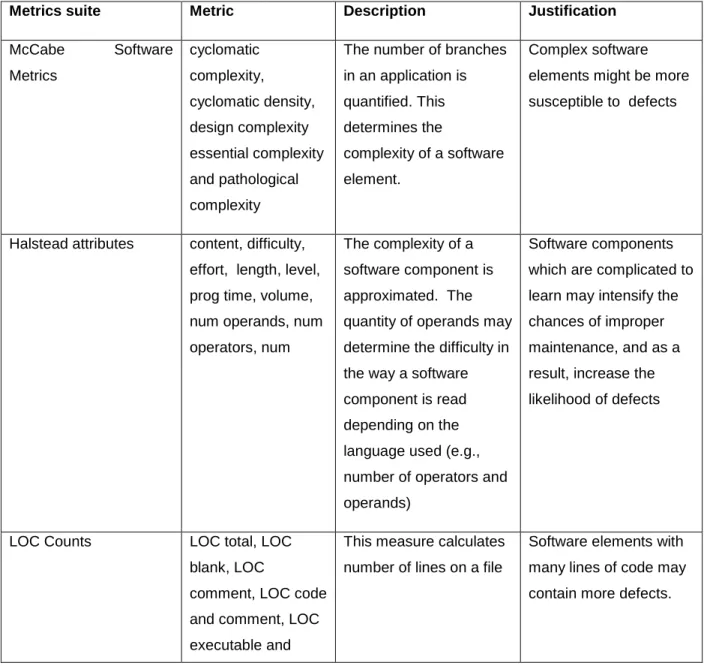
The Halstead metrics and McCabe complexity metrics are common attributes of source code complexity (Ogasawara, Yamada & Kojo 1996: 179-188). McCabe’s metric reflects the software application’s control structure and measures the decision statements in the application’s code. Halstead’s metric evaluates the new addition of operators and operands into an application, which may be caused by the growth of program length. This raises the value of the Halstead’s effort measure.
18 ML Techniques for Defect Prediction
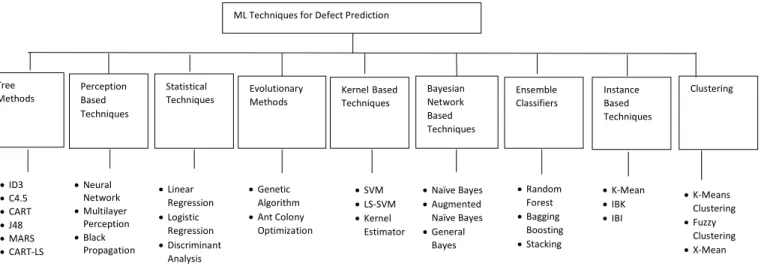
Tree Methods Perception Based Techniques Statistical Techniques Evolutionary Methods Kernel Based Techniques Bayesian Network Based Techniques Instance Based Techniques Clustering Ensemble Classifiers ID3 C4.5 CART J48 MARS CART-LS Neural Network Multilayer Perception Black Propagation Linear Regression Logistic Regression Discriminant Analysis Correlation Analysis Genetic Algorithm Ant Colony Optimization SVM LS-SVM Kernel Estimator Naïve Bayes Augmented Naïve Bayes General Bayes Random Forest Bagging Boosting Stacking K-Mean IBK IBI K-Means Clustering Fuzzy Clustering X-Mean 1.11.3.2 Software reliability growth model
The Reliability Growth Model predicts defects using the data from the current software application. They use statistical models to predict the reliability of the application and are usually applied during the final testing phase. Failure is modelled using a Non-homogeneous Poisson Process. These are the cumulative failures which are likely to arise after the program has run for time (t). The mean value function m (t) is defined as (Ullah 2015:62);
𝑃{𝑁(𝑡) = 𝑛} =𝑚(𝑡)
𝑛
𝑛! 𝑒−𝑚(𝑡) (1.2)
where N (t) represents a counting procedure over time t.
1.11.3.3 Machine learning techniques
Machine learning techniques are a division of artificial intelligence regarding computer programs learning from data (Alshayeb, Eisa & Ahmed 2014:7865-7876), Figure 1.2.
Figure 1.2 Techniques for Defect Prediction (Rathore & Kumar 2016: 5)
Machine learning algorithms include Decision Trees, Bayesian Networks, Probabilistic Classifiers and Evolutionary Based Classifiers.
19 1.11.3.4 Transfer learning/cross project
Cross-project defect prediction models are used if there is inadequate or unavailable historical source data (He, Peters, Menzies & Yang 2013: 45-54). Researchers filter, reduce differences and cluster data from diverse projects. The data is then trained using algorithms for each cluster separately.
1.11.3.5 Capture/recapture analysis
These models rely on expert inspectors to identify and quantify defects in software releases. Duplicates are identified by comparing the newly-located defects to defects in the preceding files. The equation below calculates expected defects as (Zubrow & Clark 2001:1:7);
𝐷𝑒𝑓𝑒𝑐𝑡𝑠 𝐸𝑥𝑝𝑒𝑐𝑡𝑒𝑑 = 𝑛(𝑒𝑥𝑝𝑒𝑟𝑡1) ∗ 𝑛(𝑒𝑥𝑝𝑒𝑟𝑡2)
𝑚(𝑛𝑜 𝑜𝑓 𝑓𝑎𝑢𝑙𝑡𝑠 𝑓𝑜𝑢𝑛𝑑 𝑏𝑦 𝑏𝑜𝑡ℎ 𝑒𝑥𝑝𝑒𝑟𝑡𝑠 (1.3)
1.11.3.6 Topic based
This is a bug prediction approach that is involved on technical issues of a system. Algorithms use these as input for software fault prediction. This is founded on the belief that names of methods, classes, comments or embedded documentation expose the uneasiness they implement (Nguyen, Nguyen & Phuong 2011: 932-935). Examples of functions with issues are Connector.Abort and
faultCode=PARSER_ERROR.
1.11.3.7 Test coverage
Test coverage is used to predict defects using structural testing strategy. It relies on the assumption that a correlation between code coverage and software reliability exists. An adequate number of objects must be tested or covered using test cases. Test cases are used as input in testing software
20
applications. The objects tested may be statements, branches, decisions, functions or loops of the application. The derived metric is called Test Effectiveness Ratio (TER). The condition of test data competence C is a function C:PX S X T → {true, false}. C (p,s,t)=true implies t is suitable for testing program p against specifications as specified by criterion C, else t is unsuitable.
1.11.3.8 Expert opinion
The defects are quantified by various field experts. They provide informed judgement on the least, most, best and worst occurrences of the most likely defects. Experts may use the rule-based approaches to predict defects. These human-based opinions may also be captured and reused in upcoming projects by recognising the effect of expected influential features in the specific context, without creating big data sources (Erturk & Sezer 2015:757:766).
1.11.3.9 Exception handling
Software applications regularly use exception handling to respond to unforeseen exceptions during program execution. Complicated exception handling may be the source of defects. This technique applies complicated exception handling as a defect prediction factor. It requires exception-based software metrics related to exception handling. These include the number of exception handlers
(nHandler), the number of thrown exception types (nThrown) and the number of exception handling
subgraphs a class belongs to (nSubgraph) (Sawadpong & Allen 2016: 55-62).
1.11.4 Data analysis
Features were ranked using the feature selection algorithms. Scores assigned to each feature were compared and the most important features were selected. The algorithms predicted defects using the selected relevant features. Performance evaluation measures were applied to analyse the quality of the prediction models used in the experiments.
21
1.12 Limitations of the study
The study had the following limitations:
Only defects from OSS applications were used in this study.
Only process metrics and machine-learning techniques were utilised for defect prediction.
1.13 Thesis outline
Chapter 1– Introduction
The chapter included the objectives of the study, the common terms used for software anomalies, software defect prediction techniques and software versioning. Discussion of the research questions, research design and data analysis were conducted. The significance of the study is covered.
Chapter 2 – Theoretical background
The chapter focuses on studies that have been conducted on software defect prediction. Machine-learning algorithms that have been designed to improve defect prediction are discussed.
Chapter 3 – Research methodology
Different approaches used for research are discussed. The research instrument for this study has been presented.
Chapter 4 – Information theory
Measures that are based on the information theoretical concept of entropy are discussed. These methods are used in feature weighting, ranking and selection.
22
This chapter discusses feature relevancy and redundancy. Types of feature weighting techniques are covered. Attribute weighting methods are compared. Feature selection processes and methods are analysed.
Chapter 6 –Prediction model evaluation
The analysis of data recorded during software defect testing has been undertaken. The metrics and outputs from the defect models are analysed. The chapter presents the model developed to predict the effectiveness of the software versions. The chapter presents model validation.
Chapter 7 – Conclusion and future work
An outline of the effectiveness of different versions of the software applications is included. The final recommendation for the predicting the effectiveness of mobile devices testing tools is presented. The significance of the study is discussed and suggestions for future research are discussed.
1.14 Chapter summary
Software Quality Management (SQA) in general is the management of activities that ensure the delivery of high quality software. SQA activities include software testing. Software defect prediction is one of the most supporting activities of the testing phase of System Development Life Cycle. The next chapter presents a survey of related work.
23
2.1 Introduction
This chapter discusses the literature review and some of the topics that are fundamental to software defect prediction. Software defect prediction has received substantial attention in the software industry. Software defect data sources, metrics and types of machine learning are explored. Previous research has been conducted to analyse the effect that metrics has on fault proneness. Some of the defect prediction papers that have been published since 2007 have been reviewed. The defect data that has been used in previous research emanates from different sources (Madeyski & Jureczko 2015: 393-422; Muthukumaran, Choudhary & Murthy 2015: 15-20;Bowes, Hall, Harman, Jia, Sarro, Wu 2016:330-341;Fukushima, Kamei, McIntosh, Yamashita & Ubayashi 2014: 172-181), which include open source and industrial projects.
2.2 Data sources
In general, most of the data used in software defect prediction is obtained from the freely available open source repositories, which include the source code management systems and bug tracking systems. Other data is sourced from industrial projects.
2.2.1 Company/Industrial data
Software defect data is sourced from company software development operations. The difference between the development processes of industrial and OSS may affect the defect prediction results (Madeyski & Jureczko 2015: 393-422). In company environments, formal, centralised methods are applied in software development. These processes include formal software verification techniques. Co-located, well-structured teams develop data. Responsibilities may be divided between members of a team. Functional teams are generally used in software development organisations. Developers with similar skills are grouped together. One team in a company may design the interface; another may be focused on database design, while the other team may do implementation and testing.
24
Product teams working on industrial projects are organised, unlike the open source ones. In a study conducted by (Madeyski & Jureczko 2015: 393-422), at least one process metric in all versions of industrial software improved the prediction models, but this was not true for nearly half of the analysed versions of open source projects. This could be due to the organised manner in the development processes of industrial software.
2.2.2 Open source code repository
Task allocations and relationships between users and developers in open source development are less formal. Development processes are more decentralised in open source environments (Madeyski & Jureczko 2015: 393-422). Open source projects are developed as global collaborations of skilled developers. The developers apply different skills than in the industrial projects. The authors who commit software modifications in open source development are active in development, while their counterparts are less active. Therefore, less training, support and technical skills are required to develop OSS.
2.2.3 Bug life cycle participants
According to Ullah & Khan (2011:98-108) there are many contributors in the bug life cycle. They have responsibilities and roles, some of which are as follows:
Bug reporter
This is the participant who reveals the bug and creates a report for it, by entering the bug data in the bug tracking tool. The reporter inputs the bug details that include the title, bug priority, severity, dependencies and the component where the bug is located.
Bug group
This consists of people who regularly receive updates concerning the bug in a bug report. They include the bug reporter, the developer, tester and the quality assurance manager.
Bug owner
The bug owner ensures that information about the bug in the bug tracking system is adequate. The owner manages bugs and guarantees that, for example, high priority bugs in the system are fixed within the shortest possible time.
25
2.2.4 Bug tracking system
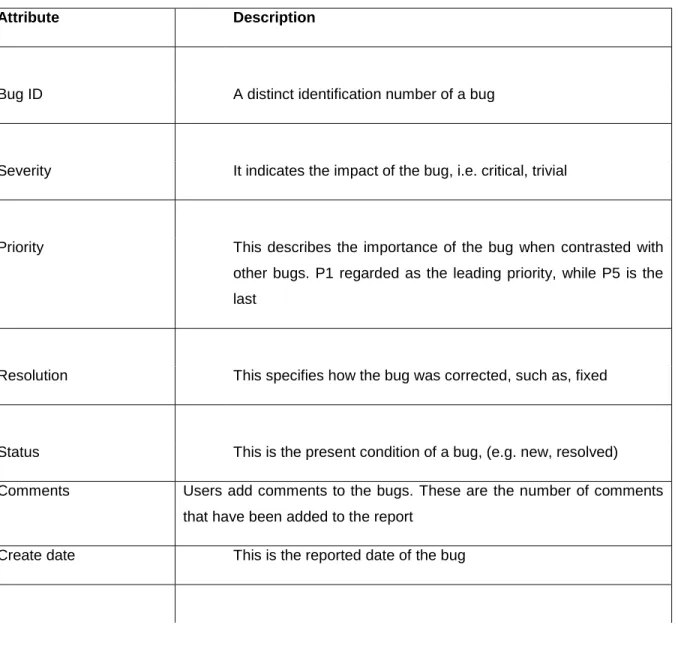
This is a software system that tracks the progress of a bug. A reported bug is analysed, allocated to a developer, fixed and resolved (Babar, Vierimaa &Oivo 2010: 1-407). The bug tracking system records the characteristics of the bugs, such as, defect reported date, the section in which the bug was located, commit date and other properties concerning the bug (Shihab, Ihara, Kamei, Ibrahim, Ohira, Adams, Hassan & Matsumoto 2013: 1005-1042), (see Table 2.1).
Table 2.1 Software bug attributes
Attribute Description
Bug ID A distinct identification number of a bug
Severity It indicates the impact of the bug, i.e. critical, trivial
Priority This describes the importance of the bug when contrasted with
other bugs. P1 regarded as the leading priority, while P5 is the last
Resolution This specifies how the bug was corrected, such as, fixed
Status This is the present condition of a bug, (e.g. new, resolved)
Comments Users add comments to the bugs. These are the number of comments
that have been added to the report
26
Dependencies These are the bugs that depend on other bugs to be fixed for
them to be also fixed
Summary The summary of the problem is written in a single sentence
Date of close This is the date a bug was closed
Keywords These are the keywords that are used to tag and define the bugs
Version This is the version of the software where the bug was located
Platform and OS This defines the environment where the bug was found
The Bugzilla Life Cycle is displayed in Figure 2.1, according to the manner Bugzilla users check and modify the bug status in the database (Sunindyo, Moser, Winkler & Dhungana 2012: 84-102).This life cycle is regarded as the model for developing software projects, particularly for OSS projects. The stages in the cycle demonstrate the procedures followed by OSS developers when modifying bugs. The processes employed when modifying the bug status are regarded as engineering processes and the phases are similar to those in the software development life cycle.
Initially, a bug is presented by users or contributors as an unconfirmed bug. The existence of the bug is then verified and the bug state is changed to ‘new’.
27 UNCONFIRMED CONFIRMED IN PROGRESS RESOLVED VERIFIED
Bus is reported by user. UNCONFIRMED status is assigned
Fix is reported
Fix is incorrect
Developer stops working on bug
Bug is not fixable, i.e. invalid
UNCONFIRMED
Figure 2.1 Bugzilla Life Cycle (Sunindyo, Moser, Winkler & Dhungana 2012: 89)
The new bug is allocated to other contributors or fixed instantly. Bugs that are verified as fixed are closed. Some bugs may be wrongly labelled, ‘RESOLVED’ and may need to be reopened. The Bugzilla bug states are meant to assist the contributors to specify bug status. Contributors may also devise their personal state names.
The defect data used in this research was extracted from Bugzilla and Jira repositories (Ambros, Lanza & Robbes 2010: 31-41). Bug fixes made to the Mylyn, JDT, Lucene, Equinox and PDE open source projects were saved and used to create the defect files. In general, some of the open source
Existence of bug is verified
Developers working on bug
QA confirms bug has been fixed QA not satisfied with
the solution
Bug is reopened. Was never confirmed
UNCONFIRMED
Bug is reported by user. Unconfirmed status is assigned
CONFIRMED
IN PROGRESS
RESOLVED
VERIFIED
Bug is not fixable i.e. invalid
Fix is reported Developer stops
28
systems are used in business to save time and costs. Contributors write modules and correct reported bugs. The contributors’ updates are saved in defect files that are used in software defect prediction.
2.3 Defect prediction approaches
Software quality is an extensively researched area in the software engineering domain (Seliya, Khoshgoftaar & Van Hulse 2010: 26-34). Techniques such as unit testing, code inspections and defect prediction are applied to reduce defects in quality assurance activities (Seliya et al. 2010:26 ;Tan, Peng, Pan & Zhao 2011:244-248 ;Ahmed, Mahmood & Aslam 2014:65-69). Software developers may predict and remove defects in new versions of software (Kastro & Bener 2008: 543-562).
2.3.1 Single version software
One version of software is developed. There is an assumption that the present piece of code determines the existence of future defects. The single version approaches do not depend on the software’s historical data, but examine more its present structure, using different metrics.
2.3.2 Versioning systems
Process metrics are derived from the versioning software. These approaches consider that the newly or regularly modified files are the most possible origin of imminent bugs. Hassan presented the entropy concept to evaluate the code modifications (Hassan 2009:78-88). The FreeBSD, NetBSD, OpenBSD, KDE, KOffice, and PostgreSQL applications were used to assess the entropy metrics. The results proved that the amount of preceding bugs is a better predictor than the number of previous file modifications.
A version control system (VCS) is a repository of files that supports the revision of software and the management of application changes. Revisions are a result of software modifications. VCSs facilitate
29
distributed and collaborated software development. Modifications to software are tracked and references are generated for commits that alter the application (Thongtanunam, Mcintosh, Hassan & Iida 2016: 1039-1050). Sites such as GitHub, SourceForge and Google Code support version control (Yu, Mishra & Mishra 2014:457:466). The services that are provided by the sites include archiving, online code browsing, bug trackers, version downloads and web hosting. Companies that do not have resources to manage their own servers utilise the version control services provided by the web hosting sites. Source Code Control System (SCCS) and Revision Control Systems were created in the 1970s and 1980s respectively. The SCCS and RCS software tools store file versions, while subsequent systems also permitted for remote and mainly centralised repository of the file releases (Cochez, Isomottonen, Tirronen & Itkonen 2013:210).
A multi-sited version control system is a distributed VCS that is administered at different locations to align the development work of numerous people that team up to build a single piece of software. The CVS used to be the most popular open source version control system, but has been surpassed by GitHub and Subversion. Concurrent Versions System (CVS) and Subversion (SVN) are common centralised systems. In distributed version control systems (DVCS), individual users have local copies of the storage, which can be synchronised with other storages. Git and Mercurial use this kind of decentralised system.
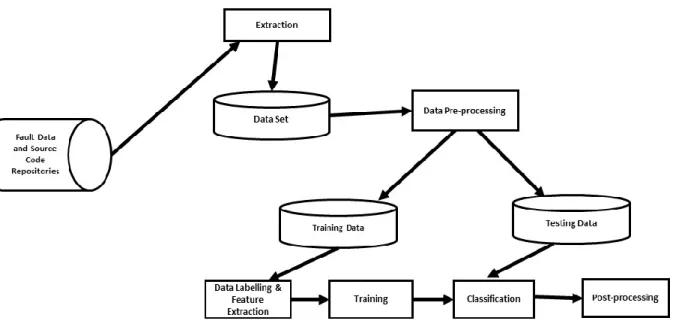
The process metrics used in this study were five open source systems obtained by (Ambros, Lanza & Robbes 2010: 31-41),who created models to depict how the systems changed, since they were created by analysing the versioning system log files. The history of the systems was modelled, using the transactions extracted from the systems’ SCM repositories. The systems were developed using different versioning systems (CVS and SVN) and different bug tracking systems, Bugzilla and Jira. Metrics, also known as software features or attributes, are used to predict defects.
2.4 Software metrics
Software metrics are indicators of defects and therefore essential in the efficient allocation of resources (Madeyski & Jureczko 2015: 393-422).Researchers have used software measures to predict defects and evaluate software. The categories of defect prediction metrics are static and process metrics.