National Louis University
Digital Commons@NLU
Dissertations6-2015
An Evaluation of Teacher Morale in Four
Elementary Schools: The Difference a School
Makes
Jennifer Blackburn National-Louis University
Follow this and additional works at:https://digitalcommons.nl.edu/diss
Part of theEducational Leadership Commons, and theElementary and Middle and Secondary Education Administration Commons
This Dissertation - Public Access is brought to you for free and open access by Digital Commons@NLU. It has been accepted for inclusion in Dissertations by an authorized administrator of Digital Commons@NLU. For more information, please [email protected].
Recommended Citation
Blackburn, Jennifer, "An Evaluation of Teacher Morale in Four Elementary Schools: The Difference a School Makes" (2015).
Dissertations. 118.
AN EVALUATION OF TEACHER MORALE IN FOUR ELEMENTARY SCHOOLS:
THE DIFFERENCE A SCHOOL MAKES
Jennifer Blackburn
Educational Leadership Doctoral Program
Submitted in partial fulfillment
of the requirements of
Doctor of Education
in the Foster G. McGaw Graduate School
National College of Education
National Louis University
2
Copyright by Jennifer D. Blackburn, 2015 All rights reserved
3
NLU Digital Commons Document Origination Statement
This document was created as one part of the three-part dissertation requirement of the National Louis University (NLU) Educational Leadership (EDL) Doctoral Program. The National Louis Educational Leadership EdD is a professional practice degree program (Shulman et al., 2006).
For the dissertation requirement, doctoral candidates are required to plan, research, and implement three major projects, one each year, within their school or district with a focus on professional practice. The three projects are:
Program Evaluation
Change Leadership Plan
Policy Advocacy Document
For the Program Evaluation candidates are required to identify and evaluate a program or practice within their school or district. The “program” can be a current initiative; a grant project; a common practice; or a movement. Focused on utilization, the evaluation can be formative, summative, or developmental (Patton, 2008). The candidate must demonstrate how the evaluation directly relates to student learning.
In the Change Leadership Plan candidates develop a plan that considers organizational possibilities for renewal. The plan for organizational change may be at the building or district level. It must be related to an area in need of improvement, and have a clear target in mind. The candidate must be able to identify noticeable and feasible differences that should exist as a result of the change plan (Wagner et al., 2006).
In the Policy Advocacy Document candidates develop and advocate for a policy at the local, state or national level using reflective practice and research as a means for supporting and promoting reforms in education. Policy advocacy dissertations use critical theory to address moral and ethical issues of policy formation and administrative decision making (i.e., what ought to be). The purpose is to develop reflective, humane and social critics, moral leaders, and competent professionals, guided by a critical practical rational model (Browder, 1995). Works Cited
Browder, L.H. (1995). An alternative to the doctoral dissertation: The policy advocacy concept and the policy document. Journal of School Leadership, 5, 40-69.
Patton, M. Q. (2008). Utilization-focused evaluation (4th ed.). Thousand Oaks, CA: Sage. Shulman, L.S., Golde, C.M., Bueschel, A.C., & Garabedian, K.J. (2006). Reclaiming education’s
doctorates: A critique and a proposal. Educational Researcher, 35(3), 25-32.
Wagner, T., et al. (2006). Change leadership: A practical guide to transforming our schools. San Francisco: Jossey-Bass.
i ABSTRACT
This Program Evaluation Plan (PEP) investigates teacher morale in several schools and explores how it may possibly relate to school grade. There are many factors that influence teacher morale, but I believe that school grade plays a major role; and this dissertation takes a closer look as to how some teachers and administrators feel about their schools and positions. By implementing a questionnaire, and conducting interviews with teachers and administrators, I was able to discover that school grade is weighing in teacher morale.
This study breaks down the findings from the questionnaire that was given and offers some recommendations on how to help improve teacher morale in schools. The literature review in this study reflects the importance of teacher morale and the impact that it has on student achievement. As a result of the examining factors contributing to teacher morale, we can see that it does have an influence on the academic achievement of the school.
ii PREFACE
The purpose of this study was to investigate teacher morale at various schools, to see what issues might surface, and gain some insight on possible ways to boost teacher morale. As an administrator, I know how difficult it is to keep everyone happy. With the demanding deadlines, we have from the district and the state; it is often challenging to ask the teacher to do more, without taking from their plate. When all we do is beat down our teachers with more work, it becomes an impossible task to keep them motivated and willing to work.
This project was near and dear to my heart. I was able to see, first hand, how the morale can be demolished and the impact it has on student achievement. I started my career, as an Assistant Principal, in 2007 at XYZ Elementary school. What was unique about this school was that it opened in 2007 with an experienced principal who was able to bring the majority of his staff from a previous school. Therefore, 75% of the teaching staff was familiar with his leadership style and understood his temperament. The first year of existence, the teachers were excited about starting a new school, and the school earned an A grade. In 2008, the teachers were still happy, everyone working well together, and were ecstatic about earning an A the following year. Therefore, in 2008, the school earned another A. It was in 2009 when things started to change. This is the year that a fifth grade teacher was in a tragic motorcycle accident that almost left her for dead, and she was never able to return to her duties. Those circumstances put a lot of pressure on the remaining fifth grade teachers. They chose not to hire a new teacher and decided to take on the remaining students. In theory, this sounds like the logical answer, however, it caused major stress on the teachers, and they began to resent their decision. During this year, the school earned a grade of B. In 2010, the school dealt with turnover:
iii
a teacher went out on maternity leave, another teacher left due to her daughter having cancer, two teachers retired, another teacher was married and moved, and two other teachers were moved into resource positions. When the new staff came aboard, there was never any staff building or team building activities to help the team members work as a unit. Therefore, the staff did not perform as a unit and that year the school earned a C grade.
As the school grade declined over the years, I witnessed the decline of morale as well. I wanted to see if this was occurring at other schools. My initial goal was to use two high performing schools, two schools that were in the middle, or raised their grades, and then a low performing school. I wanted to see what was happening differently at the higher performing schools than the lower performing. However, when working with volunteers, I had to use the schools that were willing to have me come in and impose on their staff. Although I had many trials with this study, I was able to get some data to investigate teacher morale in our school district.
iv
TABLE OF CONTENTS
ABSTRACT ... i
PREFACE ... ii
SECTION ONE: INTRODUCTION ...1
Purpose ...1
Rationale ...1
Goals ...2
Research Questions ...3
Conclusion ...4
SECTION TWO: REVIEW OF LITERATURE ...5
Introduction ...5
Teacher Morale ...6
School Culture ...7
Administrative Support ...8
Conclusion ...9
SECTION THREE: METHODOLOGY...10
Research Design Overview ...10
Participants ...10
Data Gathering Techniques ...13
Survey ...13
Interviews ...14
Data……… ...15
v
Conclusion ...16
SECTION FOUR: FINDINGS AND INTERPRETATION...17
Findings...15
Setback ...17
Interviews of Teachers ...17
Interviews with the Administration ...23
Interpretation from Interviews Questions ...28
Interpretation of the Teacher Survey ...29
SECTION FIVE: RECOMMENDATIONS ...37
Judgment ...37
Recommendations ...40
Conclusion ...41
REFERENCES ...42
APPENDIX A – The Purdue Teacher Opinionaire ...45
APPENDIX B – Teacher Interview Protocol ...49
APPENDIX C – Administrator Interview Protocol ...50
APPENDIX D – Teacher Survey Informed Consent Form ...51
APPENDIX E – Teacher and Administrator Interview Informed Consent Form ...52
APPENDIX F – Informed Consent Document for Principals to Conduct Research at the School Site ...53
vi TABLES
Table 1 School Accountability Report for 2007-2008 ...11
Table 2 School Accountability Report for 2008-2009 ...11
Table 3 School Accountability Report for 2009-2010 ...11
Table 4 School Accountability Report for 2010-2011 ...12
Table 5 School Accountability Report for 2011-2012 ...12
Table 6 School Absences, in Days, for the 2011 and 2012 School Year ...21
Table 7 Survey Results for Success Elementary...33
Table 8 Survey Results for Charity Elementary ...34
Table 9 Survey Results for Lucky Elementary ...35
vii FIGURES
Figure 1 Teacher Job Satisfaction ...7
Figure 2 Principal Tenure in Years at Current School ...22
Figure 3 Reasons for Returning to their Current School ...23
1
SECTION ONE: INTRODUCTION Purpose
The purpose of this study was to assess teacher morale in selected schools in one school district and investigate the possibility of a relationship between teacher morale, school grade, and student achievement. Miller notes in his article that teacher morale
Can have a positive effect on pupil attitudes and learning. Raising teacher morale level is not only making teaching more pleasant for teachers, but also learning more pleasant for the students. This creates an environment that is more conducive to learning (Miller, 1981, p. 485).
My impression was that higher performing schools were going to have higher teacher morale, and conversely, that lower performing schools would have lower teacher morale. My interest in this study derives from a deep curiosity I have in this topic, as a result of observations I have garnered from my 11 years as a teacher and my experiences as an assistant principal at a Title I school in Florida. If my investigation does indicate a relationship, I will certainly share my findings with my district leaders for their awareness.
Rationale
Bill Maxwell confirmed in his article, One more insult to teachers, that, “Morale is as low as it has ever been” (p. 1). I have spoken with many educators throughout my
career, and noticed complaints regarding morale, specifically in relation to its possible impact on student achievement, and I feel that this is an important area that is worthy of investigating. I am a firm believer that if you respect your teachers and show them how much you appreciate their work, they will work even harder for you. I feel that this study
2
is important to all stakeholders involved, as well as the district and community at large. If I do find there is a relationship between teacher morale and student achievement, this will be one piece to the puzzle. Teacher morale is essentially important and potentially
enhanced through the practices of strong and caring leaders. Once the morale is in the right place, positive morale is highly likely to influence student achievement increases, allowing the school to excel to higher student performance gains and school grades. The higher school performance is beneficial to the students, and can ultimately increase the value of the community.
Goals
For this investigation, I studied five elementary schools: one school that has been low performing for the past two years, two schools that have been high performing for the past two years, and one school that has maintained their grade, and one school that has improved their grade. My plan was to use five years’ worth of school and student
achievement data and interview the staff members that have been at that particular school for five years or more. Because I was looking at five years’ worth of data, I felt that I needed staff that had been there for all five years. I felt that my results would be more accurate with staff that has been there for all five years, instead of new teachers coming in, not knowing the history of the school. I asked them to partake in the Purdue Teacher Opinionaire (Bentley & Rempel, 1967). My goal was to find out from the staff how they felt about their position at the school. Robert Coughlan (Coughlan, 1970, p. 221) defines morale as a “feeling of well-being”. Of interest to me were the schools that went up in
school grade and Annual Yearly Progress (AYP) and maintained their grade status. I wanted to find out from the administration at these successful schools in our county what
3
strategies they used to support good teacher morale. Although the indicator of AYP will soon be phased out, due to Annual Measurable Objectives (AMO), I included this historical data in this report as further evidence of the declining student achievement at our school, and to support the rationale for this inquiry. As stated in a journal article from the US Journal of Instructional Psychology, “literature supports the premise that teachers’ moral directly affects students achievement” (Hunter-Boykin, 1996, p.2).
Research Questions
The primary question for this study was, what is the current status of teacher moral as reported by a sample of teachers from one school district, and is there a relationship between school grade and teacher morale? Secondary research questions that will be included are:
- What do teachers who have high morale report as some of the reasons why they feel like they have high morale?
- What do teachers who have low morale report as some of the reasons why they feel like they have low morale?
- For teachers who have high morale, what are some of the practices of the school administration they report as contributing to their high morale? - For teachers who have low morale, what are some of the practices of the
school administration they report as contributing to their low morale? - What are some of the aspects of the school climate that teachers who have
high morale report as contributing to their high morale?
- What are some of the aspects of the school climate that teachers who have low morale report as contributing to their low morale?
4
- What are some suggestions on school climate and administrative practices that teachers feel could improve teacher morale?
Conclusion
In school year, 2010, I began to feel the morale of our school diminishing more and more. I began to read articles on teacher morale and ways in which I, as a leader, could help increase teachers’ feelings of self-worth. One of the articles I read was the one that I cited, “Staff Morale, School Climate, and Education Productivity”, by William
Miller (1981). I felt confident that this was a relevant problem in schools, and with the information I obtained, I planned to present my findings to the superintendent. Not only did I plan to present the data that assesses current teacher morale and possibly correlates teacher morale and School Grade, AYP, and student achievement, it was also my hope that the data I gathered will suggest strategies that will help schools that are struggling with low teacher morale.
5
SECTION TWO: REVIEW OF LITERATURE Introduction
I have been an educator for 10 years and have had the opportunity to experience three different school settings with three different leadership styles. During my time at the first two schools, the administration was new and therefore the staff was learning the style of the new leadership. For the past five years, however, I have been in
administration. Our first year of opening our school (2007) was exciting, and the morale of the school was up and positive. That year our school earned an A but we did not make Adequate Yearly Progress (AYP), we were at 92% of AYP. In 2008, we earned an A and made AYP (100%). Something happened at the end of 2008, the morale began to drop and as you will see, so did our school grade and AYP. In 2009 we dropped to a B with 77% annual yearly progress; and, in 2010 we dropped to a C with another 77% in AYP. It is now 2012 and I feel that morale is at its lowest. According to the literature, it
appears that teacher morale may be correlated to School Grade and student achievement. There are some articles and dissertations that are relevant to my study on teacher morale and student achievement which seems to reflect in the school’s grade. As William C. Miller states, “there is evidence that the social climate of the school and the staff can have a positive effect on pupil attitudes and learning” (Miller, 1981, p.483). As
President Barak Obama in his Race to the Top initiative, emphasized that his focus was on our teachers, principals, and school leaders. In order to accomplish this goal we must “have a great teacher in every classroom and a great principal in every school (U.S.
Department of Education, 2010, pp.1-2). His vision goes on to describe aspects of teacher morale.
6
Teacher Morale
Merriam-Webster dictionary defines morale as the following:
Principles, teachings, or conduct,the mental and emotional condition (as of enthusiasm, confidence, or loyalty) of an individual or group with regard to the
function or tasks at hand, a sense of common purpose with respect to a group, or the level of individual psychological well-being based on such factors as a sense of purpose and confidence in the future (Merriam-Webster Dictionary, 2012). When teachers feel that they are appreciated, when they feel that they have a voice, and when they feel that they are supported, the morale is often high. This is supported by Maehr, Midgley, and Urdan (1993), who report that “People are more personally invested
in their work with an organization when (1) they have a voice in what happens to them; and (2) their work has meaning and significance in contributing to a higher purpose” (as reported in Lumsden, 2001, p.3). Also from Lumsden’s article, she states, “Where morale was high, schools showed an increase in student achievement” (Lumsden, 2001, p.2). Additionally, “When a healthy school environment exists and teacher morale is high, ‘teachers feel good about each other, at the same time, feel a sense of
accomplishment from their jobs” (Hoy and Miskel, 1987; Lumsden, 1998, p.1). The increased stresses places on teachers and the obstacles to self-sufficiency and creativity in the profession, may combine, to make teaching a strenuous task. Kim Black, the
president for the Pinellas Classroom Teachers Association, stated to the Tampa Bay Times that, “teachers have no voice...” (Maxwell, 2012, p.2). According to Black, this
was contributing to the teachers having ill feelings when it came to scheduling, curriculum, professional development, and planning time. Teachers felt that they no
7
longer had a sense of professional worth. The decisions that were being made left the teachers with a feeling of being, “disregarded and unimportant.” (Maxwell, 2012, p.2.)
According to the MetLife Survey that was conducted in 2012, teacher satisfaction has declined to its lowest point and stress among teachers has amplified since 1985. In 1985, 36% of teachers felt they were under great stress, which number has increased to 51%. As represented in Table 1 teacher job satisfaction continues to decline according to the 2011 MetLife Survey of the American Teacher; satisfaction has dropped 23 percentage points since 2008. The percentage of teachers who report job satisfaction has declined through the years to its lowest point in 25 years, having dropped 5 percentage points from 2011 to 2012 alone, from 44% to 39% very satisfied.
Figure 1. Teacher job satisfaction through the years by percentage who are very satisfied. Source: The Met Life Survey of New Teachers: Challenges of School Leadership, page 45.
School Culture
School culture is usually defined as traditions and beliefs that schools partake in each year. School culture can adversely affect morale and student achievement. From the Center for Improving School Culture, Gary Phillips describes school climate as, “beliefs, attitudes, and behaviors that characterize a school in terms of how people treat
8
rituals and traditions reflecting collaboration and collegiality” (Deal & Peterson, 1993,
p.1). Wagner (2000) intellectualizes school culture as common experiences, a sense of community, and an atmosphere of family. He also states that communication is
encouraged and that it should be open and truthful. In addition, from the Center for Improving School Culture, they conducted research in over 8200 schools. They found an overwhelming correlation between school culture and student achievement. They go on to say that there is no “fix all” for schools; however, they have identified three items
(Wagner, 2002, p. 1) to strengthen school culture:
Professional collaboration, which is characterized as the degree to which people work together, share information, and instructional strategies, and are encouraged to have constructive discussions and debates. Affiliation and Collegiality, which is a sense of belonging, emotional support, and inclusion as a valued member of the organization. Efficacy tends to focus on how stakeholders view themselves. Other components that have an influence over schools are: (a) an engaging and optimistic learning environment focused on student achievement; (b) a
sympathetic, compassionate, and supportive principal that ensured student learning as top priority (Keefe, Kelley, & Miller, 1985, p.71).
Administrative Support
I believe that the administration has a great deal of impact on the teacher morale. The administrators are the leaders; they can either make a positive difference, or bring others down. Rapport with the principal refers to the connection between the teacher and the principal, including leadership practices that affect morale and the level of
9
(Randolph-Robinson, 2007). Principals are expected to encourage collaboration, enrich interpersonal skills, and establish a tone of excellence for high expectations and academic achievement and performance for all. Miller (1981) states, “administrative behavior is a highly important factor in facilitating good staff morale” (p. 483). He also goes on to say that the power of the leader’s behavior is the key in creating good staff morale. Lumsden
(2001) tells us that, “a principal’s ability to create a positive school climate and culture can affect teacher morale” (p. 1). I feel that administration is a key component to this
study. In an article written by Roosevelt Washington, Jr. and Hoyt F. Watson titled “Positive Teacher Morale-The Principal’s Responsibility”, they state that the principal is
significant in cultivating and sustaining affirmative teacher morale (1976, p. 4). In that same article, they stress that, “teachers whose basic needs are satisfied tend to constantly
strive for fulfillment of higher goals, and their efforts and attitudes ultimately will overflow to the student body, resulting in more productive students” (p. 4). Their last
emphasis is that the leader must show bravery, self-control, passion, and a readiness to share (p. 5).
Conclusion
In the 10 years in which I have been employed in education, I have seen
leadership styles that work and some that were not as effective. In my research, there are factors that play a role in school grade and student achievement. These include teacher morale, school culture, and administrative support. Again, it is my anticipation that the information that I collect will help schools that are struggling with teacher morale.
10
SECTION THREE: METHODOLOGY Research Design Overview
All of my readings suggest that teacher morale is related to student achievement. I collected my own data to investigate the relationship and possible effects of teacher morale and student achievement in a school district. I did this by conducting interviews with teachers and administrators. I gave the teachers and administrators a survey on staff morale, I felt that these two methods would give me the information that I am seeking.
Participants
The key participants in this study were teachers and the administrators. Due to the fact that I was looking at five years’ worth of data, I needed schools with
administrators who had been consistent at that school for five years, and teachers who had been at the school for five years and who had worked for the same administrators. Here are the following schools (with pseudonyms) that participated in this study:
Charity Elementary is one of the middle performing schools, averaging a school letter grade of B for the past five years. Lucky Elementary is the lowest performing school with an average of C for the past five years. Success Elementary is the other middle performing school with a B average for the past five years, leaving Victory Elementary as the top performing school, earning a school grade of an A for the past five years. Charity and Success Elementary actually have the exact same average of a 3.4, which is equivalent to a B.
11 Table 1
School Accountability Report for 2007-2008 School Grade Charity Elementary B Lucky Elementary C Success Elementary A Victory Elementary A Table 2
School Accountability Report for 2008-2009
School Grade Charity Elementary A Lucky Elementary C Success Elementary A Victory Elementary A Table 3
School Accountability Report for 2009-2010
School Grade Charity Elementary B
Lucky Elementary C Success Elementary A Victory Elementary A
12 Table 4
School Accountability Report for 2010-2011
School Grade Charity Elementary A Lucky Elementary C Success Elementary B Victory Elementary A Table 5
School Accountability Report for 2011-2012
School Grade Charity Elementary B
Lucky Elementary D Success Elementary C Victory Elementary A
For the purposes of this project, there was no need to survey or interview students. However, I used 5 schools, interviewing 2 administrators at each school; surveying as many teachers as would participate, up to 285 teachers total; and interviewing up to 10 teachers per school, equaling up to 50 teacher interviews.
13
Data Gathering Techniques Survey
Using a quantitative methodology, I used a survey to obtain information from my participants. I conducted a survey with the participants that agreed to participate in this study. I chose this method for the following reasons: 1. Surveys are unbiased and therefore, preferred for a quantitative study (Wysong, 2000). 2. Surveys allow for more general findings (Hartford, 2000). 3. Surveys provide quantitative data. 4. I must be able to complete this project in a time efficient fashion, therefore, data collecting and
analyzing must be quick. Surveys seem to be a logical solution. The survey will be the Purdue Teacher Opinionaire (Bentley & Rempel, 1967) Please see Appendix A for a copy of the questionnaire.
With the use of this form of inquiry, my goal was to see how teachers feel about their job and about their relationship with their administrators. A common tool to measure factors that affect teacher morale is the Purdue Teacher Opinionaire (PTO), which was prepared by Ralph R. Bentley and Averno M. Rempel (1968). The PTO is designed to breakdown down teacher morale into 10 specific dimensions. The instrument is comprised of 100 questions that can be divided up into 10 different measurements. The dimensions included teacher relationship with principal, gratification with teaching, relationship among teachers, teacher salary, teacher burden, curriculum concerns, teacher rank, community support, school facilities and services, and community pressures
(Houchard, 2005). I planned to meet with all participants, after school, and explain the questionnaire to them. The participants who volunteered to participate will fill the survey out and return to me before they leave.
14 Interviews
To keep my data collection strategy valid, I felt that I needed to be fair and only interview those teachers that have been teaching at the school for five or more years. For a copy of the Teacher Interview Protocol, please see Appendix B. Additionally, I felt that looking back five years would reveal any trends in the data. For the interviews, I meet with the volunteer participants (individually) during their block time. I interviewed up to 10 administrators, before or after school. The interviews took no longer than 30 minutes and I recorded the interview with a tape recorder and transcribed the tapes so that I could easily locate relevant samples of the qualitative data (quotes from the participants) in order to illuminate and illustrate themes that emerge from that data.
The administrators’ interview questions assisted in gathering data on some of the
demographics of the school setting (Appendix C). I used semi-structured questions that provided a chance to discuss the teacher’s perceptions concerning their job and the
leadership in the school. Face to face interviews have the discrete benefit of allowing the investigator to create a relationship with the participants and provide more in-depth and nuanced understandings of the teachers’ perceptions (Leedy & Ormond, 2001). Patton
also states in his book, Utilization-Focused Evaluation, that an interview is to collect data and the purpose is not to alter the participants thoughts (2008, p.169). The job of the interviewer is to stay as neutral as possible.
15 Data
I used the Florida Department of Education website to find the School
Accountability Reports. It is from this website that I determined which schools would be used. I needed one school that was high performing, two low performing, one that has maintained, and one that has improved.
Data Analysis Techniques
I tabulated and analyzed the survey data using appropriate descriptive statistical functions. I analyzed the qualitative interview data by identifying meaningful themes, assigning descriptive labels or codes, and sorting and grouping emergent themes and patterns within and across the interview data (Creswell, 2002; Dana, 2009). If my findings are relevant to my district, I will certainly share the data and recommendations with the appropriate people. I am hoping that through with speaking with the teachers and administrators that I may come away with some strategies on how to keep morale up in a school.
Ethical Considerations
When selecting the volunteers for the interview, I tried to choose someone from each ethnic group and kept a representative ratio of females and males from each school, if possible. The participants were given a consent form for the teacher survey (Appendix D) and the teacher and administrator interview (Appendix E) that informs them of their anonymity and the confidentiality of their data. I also obtained informed consent form from the principal at each school in order to conduct the study (Appendix F). I did not include the name of the participants or the name of the school in which they work for. Administrators were not informed as to who participated in the questionnaire or interview
16
process. Any information obtained from the participants remained stringently
confidential. Confidentiality for the participants was my main concern for this project. I did not use any of the participant’s information outside of this project. After I extracted the interview data from the interview tapes, and the study was concluded, I erased the interview tapes. I also used a pseudonym when taping the interview, and selectively transcribed the relevant data quotes myself. All participation in this study was voluntary; all data I collected was anonymous and kept confidential.
Conclusion
As emphasized previously, I purposed that this study would assess teacher morale and investigate any possible relationship between school grade, achievement data, and teacher morale. In the high performing schools, there may be a positive relationship between school grade and higher teacher morale. I had also hope to be able to collect strategies and practices these administrators have used with their staff that may promote good staff morale and that can be shared with other schools in the district.
17
SECTION FOUR – FINDINGS AND INTERPRETATION Findings
Setback
During my original study, I was to use 5 schools, 2 high performing, 2 low performing, and one that increased their letter grade. However, I had a few minor
setbacks along the way. Due to the fact that this was a voluntary study, I was only able to use the schools that were willing to participate. Therefore, I had four A schools and one school that went from a C to a B. Additionally, I had another obstacle. I was asked to move from my position as assistant principal at one school to another school, in the hopes of helping the school with its situation. The school that I was moved to was a school that was participating in my study. Consequently, I dropped that school, which was the school that moved from a C to a B, which left me with four high performing schools. I then dropped one high performing school and picked up a lower performing school; leaving me with three A schools, and one C school.
I met with all four of the schools to explain my research and to seek volunteers. I gave out a total of 131 teacher surveys of which 65 were returned to me, for a response rate of 50%. I was only able to interview one administrator from each school, for a total of 4 interviews.
Interviews of Teachers
I was able to get all five interviews from 2 schools, four from another school, and only two from one school. At the conclusion of my interviews, it was obvious to see that there was at least one negative teacher from each school.
18
In response to Teacher Interview Question number one, which asked “Do you feel
that your current administrator empowers you and involves you with decisions about policies and procedures and if so, how?” Sixty-three percent of the participants felt that
they were empowered by their administration. It was said by one participant that if there were any reason as to why they were not allowed to try something, they were always given an explanation or suggestions on how to make it work better. Three participants (who are all from the lower performing school) felt that they were not supported, that the leadership makes all the decisions, suggestions fall on deaf ears, and one participant felt that it was not even an option to offer suggestions for policies and procedures that come from the district office and there is no changing their minds. This data demonstrates that the teachers at the low performing school do not feel supported or involved. The teachers at Lucky Elementary feel as if they are not being heard and their opinions and ideas are not important. Therefore, the teachers do not have the buy in it takes to be successful.
The second question asked the participants if they felt their administration had an open door policy. Out of all the participants all but one agreed that their administrators had an open door policy. Ninety-two percent also said that their administrators give them their schedule so that they know when they are available. The one who did not agree explained, “The door may be open, but the ears are deaf.” This participant was from the
lowering performing school. In my opinion, as an administrator and based on my experiences and observations as an educator and administrator, if you are going to have an open door policy, this means that your eyes and ears need to be open as well. When a teacher comes in with a suggestion or a concern, the administrator should take the
19
by the teacher will not work, we should take the time to explain why so that the teacher does not feel that they wasted their time or that the information was ignored. After time, when teachers are not being heard, they tend to ask themselves, why bother? A writer for Forbes magazine, Lisa Quast, stated that there were four reasons for exhibiting an open door policy; to show employees that you are accessible, to have an open line of
communication, it’s a faster way to get accurate information, and provides for a closer
working relationship (Quast, p. 1-2). The participant from Lucky Elementary has experienced this and does not go to the administration any more for suggestions or concerns.
The third question asked if the participants felt that their opinions and suggestions were accepted. Fifty-seven percent felt that they were heard and that makes them feel as if they have somewhat of a voice. One participant (from Charity Elementary) clarified by saying, “they listen, but they have a lot to balance and weigh with so many policies; their hands are simply tied sometimes.” Moreover, from Lucky Elementary, the participant simply stated, “They don’t listen.” In my opinion, we as administrators need to keep our
staff informed. There are many times when the administration is asked to follow through on a policy that we don’t necessarily agree with; however, we must show our staff that
we agree with the policy and that we are going to implement the policy with fidelity. If we talk about how bad the policy is, the staff will do the same, and will not follow through on the task due to the lack of expectations. In a post that I read by Harvey
Duetschendorf, he explains that we should be open and consistent in our communication. He goes on to say that when we keep people informed, it lifts their spirits; if we keep people in the dark, then they begin to make up their own version of the truth (p. 1). From
20
the data we can see that at the low performing school there is no communication with their staff. For if there were, the participant would have answered like the middle performing school and know that sometimes administrators do not have a choice in what is implemented at their organization.
In the fourth question, the participants were asked if they felt that they are supported with instruction and discipline. Fifteen out of the sixteen teachers that answered this question felt that they are supported with instruction. The one volunteer that answered no was a Science resource teacher who was new to her position that year. As for discipline, all the participants agreed that they were supported when issues arose. The lower performing school even has a dean on campus, as well as, a Student Resource Officer (SRO). What I found interesting with this data was that the lower performing school was the only school that has a dean and a Student Resource Officer (SRO). In my judgment, the lower performing school is challenged with more discipline issues than the higher performing schools.
The additional question, Question number five, asked how many days the
participants were absent during this current school year and last year. The number of days absent plays into the overall assessment of teacher morale as a corollary to job
satisfaction and more directly to an argument of possible effect on student achievement and school grade to be discussed further as the data is analyzed.
21 Table 6
Absences, in Days, for the 2011 and 2012 School Year
School 2011 2012
Charity Elementary 12 14
Lucky Elementary 41 35
Success Elementary 20 16
Victory Elementary 10 8
By looking at Table 6 above, the data clearly defines that the lower performing school has an attendance issue. The teachers at Lucky Elementary were absent twice as much as the teachers at the higher performing schools. This raises more questions for me: are the teachers not happy, are they tired of the discipline issues, or are they legitimately ill or have been constrained by other issues to take time away from the classroom? Regardless of what the reasons for a teacher’s absence may be, it could be argued that teacher
attendance has an effect on school grade as well. If the teacher is not there to teach, the students are less likely to have the required continuity of instruction to learn at their highest capacity.
Question number six asked the participants if they felt they had opportunities for professional development (PD) at their school. Eighty-two percent of the volunteers felt that they were provided with numerous opportunities for PD and that their professional library was equipped with many useful resources. A participant from the lower
performing school expounded that, “no, it’s more about meetings and there is not any learning taking place.” Teachers must be on top of their game and equipped with the
22
latest and best strategies to motivate their students. Teachers must feel that the professional development is meaningful and has a purpose in order for them to
implement the new knowledge in their classrooms. It is obvious that the PD given at the lower performing school is not effective, and therefore may not be implemented with fidelity.
Question number seven asked how many years they had been assigned to their current school. The reason the question was asked in this manner is because sometimes a teacher becomes displaced due to student enrollment. Therefore, sometimes a situation arises where a teacher is placed at a school and was not required to go through the interview process. In this situation however, the teachers who participated were teachers who interviewed for their position, they were not displaced teachers. As you can see from the Figure 2, the percent of teachers who have been at their current school for less than 5 years was 25%. Of the four principals, 38% have been at their current school more than five years, but less than 10 years; and 38% have also been at their current school for more than 10 years. When the data is broken down by school, the numbers were consistent across the board; there was not a significant difference.
Figure 2. Principal tenure in years at current school. 37% 38% 25% < 5yrs. >5<10yrs. > 10yrs.
23
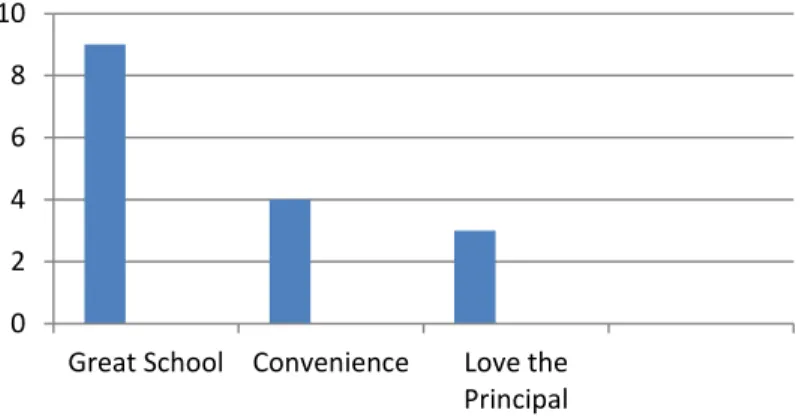
Question eight asked the volunteers to explain their reasoning for returning to their current school each year. This was not a multiple-choice question and therefore, I looked for common themes among the teacher responses. I was able to pull three
common themes from the responses that were as follows: great school, convenience, and teachers love their principal.
Figure 3. Reasons for returning to their current school
The four participants who felt that is was convenience that brought them back to the school each year were from the lower performing school. This might seem to indicate that even if a teacher feels unhappy at their school overall, they will return to the school for convenience. Some of the teachers who think their school is great and love their principal drive over 30 miles (one way) to get to work each day.
Interviews with the Administration
Due to busy schedules and unforeseen circumstances, I was only able to interview the principal at each school. This resulted in a total of 4 principal interviews. The
resulting data sheds light on the issues under consideration.
Question number one asked the administrators if they felt they empowered their staff and involved them in the decision making process. Four out four administrators felt that they try to include them as much as they can. One administrator even said, “I always
0 2 4 6 8 10
Great School Convenience Love the Principal
24
try to remember that the teachers are the ones that make a difference,” this principal over
sees a high performing school. The principal from the low performing school stated, “We try to include them as much as we can. Sometimes are hands are tied, but they are aware of that.” The answer received by the principal at Lucky Elementary, the lower performing school, was quite interesting to me. If you recall, the teachers’ answer to this
was that everything falls on deaf ears. This tells me that the principal feels that she is expressing herself well, while the staff interprets it differently. What I think is happening is that the leadership team at Lucky Elementary make the decisions, then take them to the staff, and ask them what they think. However, when the staff offers suggestions or states concerns, the team states that their hands are tied.
Question number two was asking the administrators if they felt they had an open door policy. All four principals felt that their doors were open and that staff could come in anytime they needed. The principal from the high performing school shared,
“Certainly, the only way to know and help your staff is to listen to them.” A pattern that
I am seeing is that the teachers at the higher performing schools do feel that they are being heard. It is clear that at the higher performing school the principal has taken an interest in their staff, by accepting them into their office and listening to them.
Question number three asked if the principals felt they honored the opinions and suggestions from their staff. Seventy-five percent of the administrators felt they did listen to their staff. The administrator from the low performing school stated that her staff new that she couldn’t make everyone happy. If you recall from the teacher
25
fell on deaf ears.” Therefore, in my opinion, the lower performing principal doesn’t
honor opinions and suggestions from her staff.
The administrators were asked, in question number four, if they felt they
supported their teachers with instruction and discipline. Three out of the four principals agreed that they support their staff, instructionally. One principal, from the high
performing school, stated that they supported their staff 110%. As for discipline, the principal from the high performing school stated they are fortunate and they don’t have
issues. Another principal, from a middle performing school, felt that they did a fair job with their support with discipline. The final two principals (one from a middle
performing school and the other from the low performing school), follow the Code of Conduct that is provided by the district and the principal from the low performing school even went as far as stating, “I am not sure how much more we can do.” Again, I see
discipline being an issue in the lower performing school.
Question number five asked the principals if they felt their teachers had
attendance issues. All four administrators felt that their attendance was good, with the few exceptions of the health issues. This is concerning to me that the principal at the lower performing school feels that her teachers attendance is not an issue. When compared to other schools, her teachers were absent from school twice as much. This tells me that attendance at her school is not a high priority and not monitored on a regular basis.
Question number six asked if the administrators offered opportunities for
professional development (PD) at their schools. All principals agreed that they offer lots of opportunities for learning and growing. They use such items as Personal Learning
26
Communities, and the district provided a database with many teaching videos called PD360, and the principals even bring facilitators to the school for PD. The principal at the high performing school stated that, “I need my teachers at the school, so I bring the training to them”. The principal at the high performing school seems to have his
priorities in line. He realizes the importance of professional development; however, he knows that his students need their teacher as well.
Question number seven asked the principals how many years they have served their current school. The findings are depicted in Figure 4. The principal from Victory has been there 25 years and it’s a high performing school. The principal from Success
has been there 8 years and there school middle performing, as well as, Charity where the principal has lead for thirteen years. The lower performing school, Lucky elementary, the principal has been there for six years. It is obvious to see that the principal with the least amount of experience is leading a low performing school.
Figure 4. The number of years the principals have served their schools. 25 8 13 6 0 5 10 15 20 25 30
Victory Success Charity Lucky
Ye ar s Prin cipa ls h av e se rv ed th eir Sch o o ls
27
Question number eight asked the principals what they felt they could do to improve their school. The three principals from the high and middle performing schools said to, “Continue to bring them (meaning the teachers) authentic professional
development, continue to appreciate the teachers and show them that they are cared for, and hold them accountable while showing them that they are appreciated.” The principal from the low performing school simple stated, “Hold the teachers accountable.” It is
clear to see that the lower performing principal has low expectations for their teachers. The principal is willing to hold the teachers accountable, but it appears they have no intentions on making the teachers feel appreciated for what they do.
Question nine asked the principals if they enjoyed their job. Three out of the four principals (all from the high and middle performing schools) said that they love their jobs, but they do not like the lack of accountability from the parents. The principal from the low performing school commented, “I enjoy the kids and really like it when teachers
get it; when they are here for the students and not for the pay check.” Again, the
principal from the low performing school is exhibiting low expectations. She claims that she enjoys the students, what about the teachers? Maybe if the principal showed more interest in her teachers, told them what they did right, appreciated them more, and held them accountable; they might be there for more than just a paycheck.
Question number ten asked the principals to describe their strengths. Their answers varied from getting the teachers what they need, to being a good listener, and the principal from the high performing school smiled and said, “I have a way with words that always gets me what I want.” The principal from the low performing school stated that
28
to analyze this answer: the principal from the lower performing school feels that their background is their strength. One could take that to mean that she came from nothing and now has a respectable job. Alternatively, due to her being at the lower performing school, maybe her background is holding her back. She exhibited a negative attitude and has low expectations for her school and staff.
Question number eleven asked the administrators to describe their weakness. The principal from the high performing school stated that they were demanding. One
principal, from a middle performing school, tends to expect people to be more like themselves; meaning they should be responsible, take their job seriously, and expect that all students can and will learn. They have to step back, often, and realize that not all people have the same goals. Another principal, from a middle performing school, admits that they have a follow through issue and the principal from the low performing school admits, “I have a temper and the fact that I am demanding. I want it my way. I like
things done a certain way.” It is clear to see that the principal from the low performing school wants things done her way or no way, making it clear that her teachers do not have a voice and are not heard. The principal from the high performing school is demanding, however, his teachers are aware that they have a voice and that they will be heard.
Interpretation from Interview Questions
According to the teachers interviewed, there does not seem to be any
discrepancies between the high performing schools and the lower performing school, as far as the principals being accessible in the eyes of the employees. However, there are discrepancies on whether or not the teachers feel they are being heard. The teachers from the lower performing schools do not feel supported or appreciated by their administrator.
29
As for discipline, most teachers feel that they are competent enough to take care of the misbehaving on their own and for instructional support, most feel that they are well equipped. If not, they are not afraid to ask.
As for the interviews with the administration, these five interviews are strikingly similar. I did notice that the principal of the lower performing school has less years of experience, is very demanding, has a temper, and does not show any appreciation towards what the teachers do well. The three principals from the high performing schools were very open and positive. The principal from the low performing school was negative and rolled their eyes to many of the questions that were asked.
Interpretation of the Teacher Survey
I distributed 147 surveys to teachers at 4 schools; 67 teachers filled out the questionnaire, for a response rate of 46%. I received 27 surveys from Charity
Elementary, 10 from Lucky Elementary, 21 from Success Elementary, and nine from Victory Elementary. According to Bentley and Rempel (1967) morale is
multidimensional. Through their development of the teacher opinnionaire instrument, they identified and validated 10 sub-scales for teacher morale using a representative sample of 3,023 teachers in Indiana and Oregon:
1. Teacher rapport with principal, deals with how the teacher feels about their principal, their professional ability, their ability to communicate, and their interest in teachers and their work.
2. Satisfaction with teaching, relates to the teachers relationship with their students.
30
4. Teacher Salary, how the teacher feels about their salary and the salary policies. 5. Teacher load, deals with record keeping, parent conferences, collaborative
planning, and keeping up professionally.
6. Curriculum Issues focuses on the teachers’ proficiency in the curriculum and
the ability to meet the needs of all students.
7. Teacher Status, teachers feeling wanted and secure in their job.
8. Community Support of Education, simply the support that teachers receive from their community.
9. School Facilities and Services, refers to the campus being clean and teachers receiving the adequate supplies that they need.
10. Community Pressures, to be a respected citizen in the community. As a result of their factor analysis, Bentley and Rempel developed a stanine scale that reliably indicates low, medium, or high scores on the 10 teacher morale sub-scales. In order to determine each schools’ rating on each of the 10 sub-scales, I averaged all the
responses from the teachers at each school to determine if they fell in the low, medium or high range on the stanine scale for each of the 10 sub-scales.
There are nine stanine scores ranging from 1-9. One being very low, two being low, three being below average, four being little below average, five being average, six, being little above average, seven being above average, eight being high, and nine being very high. The data shows that all school averages, according to their stanine score of four for morale were little below average, except for Lucky Elementary with a stanine score of a two, which is low. The first teacher morale sub-scale, Teacher rapport with principal, was little below average at every school except for Victory, which is a high
31
performing school, where it was below average.” This is interesting because I would
think that at the higher performing school the teachers would feel that they had more of a relationship with their principal. However, the data is showing that the middle and lower performing schools feel they have a better rapport with their principal.
The second teacher morale sub-scale, “Satisfaction with Teaching,” was below average at Success and Charity Elementary, low at Lucky, and little below average at Victory. Teaching at any school is difficult with the amount of demands that a teacher is faced with. However, at Lucky Elementary, the teacher satisfaction is low, meaning they are not happy with their job and feel a lack of connection with their students.
For the third teacher morale sub-scale, Rapport among teachers, Lucky was below average, Success was little below average, Charity was average, and Victory was above average. The significance here is the difference between the low and high performing schools. The low performing school teachers have a below average rapport with one another, while the high performing school teachers have an above average rapport with one another; confirming that the teachers at the higher performing schools respect one another and have the ability to collaborate with one another.
Regarding the fourth teacher morale sub-scale, Teacher Salary was below
average in all schools but little below average at Success Elementary. Regardless of what school a teachers works at, they do not make any more money for working in a higher performing school or a lower performing school. Teacher salary is an issue at any level. Teachers are under paid for the amount of work they are responsible for and the shaping of a student’s future. Teachers teach the doctors and the lawyers, but are nearly at the
32
The fifth teacher morale sub-scale, Teacher load was below average in all schools, but was low at Charity Elementary. Teachers at all schools have a high demand on documentation. Lesson plans and grade books become legal documents and must be accurate at all times. Teachers have the responsibility of meeting with parents to discuss grades, progress, and/or any concerns that they may have. Teachers are encouraged to document the conversation in case the parent is not satisfied with the teacher’s response
and takes matters to the administration.
The sixth teacher morale sub-scale, Curriculum Issues, an example of this would include an understanding of the standards and students, and being able to meet the needs of their students. At Lucky Elementary and Success Elementary, the scores were little below average, and average at Charity and Victory Elementary. Therefore, the teachers at both the low performing and high performing schools feel that they could do a better job with learning the standards to better serve their students.
The seventh teacher morale sub-scale, Teacher Status, which is described as the respect that colleagues give; was little below average in all schools except for Lucky Elementary which was below average. It is not surprising to find that the teachers in the lower performing school do not respect one another.
The eighth teacher morale sub-scale, Community Support of Education Status, which is simply the communities support; was below average at Success and Lucky, average at Victory, and little above average at Charity. This data shows us that parental involvement at the low performing school is below average, however, it is also below average at a middle performing school and they are still being successful.
33
The ninth teacher morale sub-scale, Facilities and Services, were average at Charity Elementary and little above average at the remaining schools. This simply shows that the schools do a good job with keeping their facilities cleaned and free from harm. It also proves that the schools are efficient in getting the teachers the supplies that they need.
In addition, the tenth item on the teacher morale sub-scale, Community Pressures, which is the ability to be an upstanding citizen: Success and Charity were below average and average at Lucky and Victory. I find it intriguing that the teachers at the low
performing school and the teachers at the high performing school both feel they are ethical and trust-worthy people.
Table 7
Survey Results for Success Elementary
Factors Stanine Description of Score 1. Teacher rapport with principal.
4 Little Below Average
2. Satisfaction with teaching. 3 Below Average
3. Rapport among teachers. 4 Little Below Average
4. Teacher salary. 4 Little Below Average
5. Teacher load. 3 Below Average
6. Curriculum issues. 4 Little Below Average
7. Teacher status. 4 Little Below Average
8. Community support of education. 3 Below Average
9. School facilities and services. 6 Little Above Average
10. Community pressures. 3 Below Average
34 Table 8
Survey results for Charity Elementary
Factors Stanine Description of Score
1. Teacher rapport with principal.
4 Little Below Average
2. Satisfaction with teaching.
3 Below Average
3. Rapport among teachers.
5 Average 4. Teacher salary. 3 Below Average 5. Teacher load. 2 Low 6. Curriculum issues. 5 Average 7. Teacher status.
4 Little Below Average
8. Community support of education.
6 Little Above Average
9. School facilities and services.
5 Average
10. Community pressures.
3 Below Average
35 Table 9
Survey results for Lucky Elementary
Factors Stanine Description of Score
1. Teacher rapport with principal.
4 Little Below Average
2. Satisfaction with teaching.
2 Low
3. Rapport among teachers.
3 Below Average 4. Teacher salary. 3 Below Average 5. Teacher load. 3 Below Average 6. Curriculum issues.
4 Little Below Average
7. Teacher status.
3 Below Average
8. Community support of education.
3 Below Average
9. School facilities and services.
6 Little Above Average
10. Community pressures.
5 Average
36 Table 10
Survey results for Victory Elementary
Factors Stanine Description of Score
1. Teacher rapport with principal.
3 Below Average
2. Satisfaction with teaching.
4 Little Below Average
3. Rapport among teachers.
7 Above Average 4. Teacher salary. 3 Below Average 5. Teacher load. 3 Below Average 6. Curriculum issues. 5 Average 7. Teacher status.
4 Little Below Average
8. Community support of education.
5 Average
9. School facilities and services.
6 Little Above Average
10. Community pressures.
5 Average
School Average 4 Little Below Average
It was interesting to find that the C school had 3 Low scores in the areas of satisfaction with teaching, teacher load, and community pressure, whereas only 1 A school had a Low score in teacher load, and the other two A schools did not have any Low scores. I also found it heart breaking that all school averages were low; however, the C school was significantly lower. Then again, this does seem to support my initial idea, that school grade has a relationship with teacher morale.
37
SECTION FIVE: RECOMMENDATIONS
I feel that there are many factors contributing to the variables and outcomes of this study that I did not take into adequate consideration. For instance, I think some additional factors causing stress to teachers at this present time are: pay for performance, the new evaluation system, transitioning to Common Core, and the seeming increase in student behavior issues/disabilities. I think that this study has potential for other studies, such as investigating these issues. For example, why is teacher morale low?
As I read articles from major business companies like Google, we cannot give our employees free haircuts, gym memberships, childcare, or shuttle service to and from work. However, we can inspire, challenge, and give our employees a voice. According to Marissa Brassfield, a writer for the the PayScale Career News, she explains that the secret to Google’s success is depositing the same quantity of effort and time into keeping
personnel happy as it does into its inventive products (p.1). We as administrators need to do the same. Our teachers are the farmers plowing our fields. We need to listen to our teachers for they know our crops, we need to give them regular and consistent feedback in a timely manner, and we need to praise them for their accomplishments.
Judgment
The goal of this study was to evaluate the current status of teacher morale at selected elementary schools in one Florida school district. I was curious to find out if there might be a connection between school grade and teacher morale. The primary question for this study was, what is the current status of teacher morale as reported by a sample of teachers from one school district, and is there any indication of a possible relationship between school grade and teacher morale? In reviewing the interviews with
38
the teachers and the administrators, it is apparent that those serving the lower performing school are negative and unhappy. The administrator at the low performing school does nothing to motivate the staff, in fact, they admit that they are demanding and display their temper frequently. This principal even goes so far to say that they appreciate teachers who are there not just for a paycheck.
Turning to the secondary research questions, here is what I glean from that data. The first secondary research question asked. What do teachers who have high morale report as some of the reasons why they feel like they have high morale? In looking at the data that has been provided teachers with high morale have a sense of voice. They feel that their administration hear them and supports them in the suggestions that they offer. They also feel that all their needs are met at the school. They receive the support they need from the school and also receive any professional development they need at the school as well.
What do teachers who have low morale report as some of the reasons why they feel like they have low morale? What I can see in the data is that they are not being supported by their administration. The teachers at the low performing schools feel as if they have no voice, that their suggestions and concerns fall upon deaf ears.
For teachers who have high morale, what are some of the practices of the school administration they report as contributing to their high morale? My interpretation I draw form the data is that at the high performing schools, morale is high because the
administration cares and they listen to their staff. The teachers feel as if they are wanted and appreciated for the job that they do every day.
39
For teachers who have low morale, what are some of the practices of the school administration of which are reported as contributing to their low morale? From the data, it appears that at the schools with low morale, teachers feel as if they are not appreciated. They feel that they are never told what they are doing well, they are always being told the negative. They feel that there is no purpose to their professional development; they feel as if the meetings are just for compliance.
What are some of the aspects of the school climate that teachers who have high morale report as contributing to their high morale? From my analysis of the data, it appears that teachers at the high performing schools work well with one another. The teachers are able to collaboratively plan with one another, sharing the best practices that have worked well in their room, and learning from one another.
What are some of the aspects of the school climate that teachers who have low morale report as contributing to their low morale? The data leads me to conclude that teachers at low performing schools do not work well with one another. Teachers are forced to plan with one another, which consists of one teacher writing the reading plans, one teacher writing the math plans, etc. and then emailing them to one another. Teachers are not able or willing to collaborate with one another.
Are any of the school climate and administrative practices suggestions attributed by teachers as potential contributions to improving teacher morale? Suggestions that I gathered through the data include trying to uphold accountability while showing the staff that you care and that they are appreciated. Listen to the staff and implement their suggestions, if the recommendation is not appropriate, then administration need to communicate the reason(s) why.