Decentralized Access Control with Anonymous
Authentication of Data Stored in Clouds
Sushmita Ruj
‡, Milos Stojmenovic
†, Amiya Nayak
∗‡
CSE, Indian Institute of Technology, IIT, Indore, India, – [email protected]
†Singidunum University, Belgrade, Serbia – [email protected]
∗
SEECS, University of Ottawa, Canada – [email protected]
Abstract—We propose a new decentralized access control scheme for secure data storage in clouds, that supports anonymous authenti-cation. In the proposed scheme, the cloud verifies the authenticity of the ser without knowing the user’s identity before storing data. Our scheme also has the added feature of access control in which only valid users are able to decrypt the stored information. The scheme prevents replay attacks and supports creation, modification, and reading data stored in the cloud. We also address user revocation. Moreover, our authentication and access control scheme is decen-tralized and robust, unlike other access control schemes designed for clouds which are centralized. The communication, computation, and storage overheads are comparable to centralized approaches.
Keywords: Access control, Authentication, Attribute-based signatures, Attribute-based encryption, Cloud storage.
I. INTRODUCTION
Research in cloud computing is receiving a lot of attention from both academic and industrial worlds. In cloud computing, users can outsource their computation and storage to servers (also called clouds) using Internet. This frees users from the hassles of maintaining resources on-site. Clouds can provide several types of services like applications (e.g., Google Apps, Microsoft online), infrastructures (e.g., Amazon’s EC2, Eucalyptus, Nimbus), and platforms to help developers write applications (e.g., Amazon’s S3, Windows Azure).
Much of the data stored in clouds is highly sensitive, for example, medical records and social networks. Security and privacy are thus very important issues in cloud computing. In one hand, the user should authenticate itself before initiating any transaction, and on the other hand, it must be ensured that the cloud does not tamper with the data that is outsourced. User privacy is also required so that the cloud or other users do not know the identity of the user. The cloud can hold the user accountable for the data it outsources, and likewise, the cloud is itself accountable for the services it provides. The validity of the user who stores the data is also verified. Apart from the technical solutions to ensure security and privacy, there is also a need for law enforcement.
Recently, Wang et al. [2] addressed secure and dependable cloud storage. Cloud servers prone to Byzantine failure, where a storage server can fail in arbitrary ways [2]. The cloud is also prone to data modification and server colluding attacks. In server colluding attack, the adversary can compromise storage servers, so that it can modify data files as long as they are internally consistent. To provide secure data storage, the data needs to be
encrypted. However, the data is often modified and this dynamic property needs to be taken into account while designing efficient secure storage techniques.
Efficient search on encrypted data is also an important concern in clouds. The clouds should not know the query but should be able to return the records that satisfy the query. This is achieved by means of searchable encryption [3], [4]. The keywords are sent to the cloud encrypted, and the cloud returns the result without knowing the actual keyword for the search. The problem here is that the data records should have keywords associated with them to enable the search. The correct records are returned only when searched with the exact keywords.
Security and privacy protection in clouds are being explored by many researchers. Wanget al.[2] addressed storage security using Reed-Solomon erasure-correcting codes. Authentication of users using public key cryptographic techniques has been studied in [5]. Many homomorphic encryption techniques have been suggested [6], [7] to ensure that the cloud is not able to read the data while performing computations on them. Using homomorphic encryption, the cloud receives ciphertext of the data and performs computations on the ciphertext and returns the encoded value of the result. The user is able to decode the result, but the cloud does not know what data it has operated on. In such circumstances, it must be possible for the user to verify that the cloud returns correct results.
Accountability of clouds is a very challenging task and involves technical issues and law enforcement. Neither clouds nor users should deny any operations performed or requested. It is impor-tant to have log of the transactions performed; however, it is an important concern to decide how much information to keep in the log. Accountability has been addressed in TrustCloud [8]. Secure provenance has been studied in [9].
Considering the following situation: A Law student, Alice, wants to send a series of reports about some malpractices by authorities of University X to all the professors of University X, Research chairs of universities in the country, and students belonging to Law department in all universities in the province. She wants to remain anonymous while publishing all evidence of malpractice. She stores the information in the cloud. Access control is important in such case, so that only authorized users can access the data. It is also important to verify that the information comes from a reliable source. The problems of access control, authentication, and privacy protection should be solved
simultaneously. We address this problem in its entirety in this paper.
Access control in clouds is gaining attention because it is important that only authorized users have access to valid service. A huge amount of information is being stored in the cloud, and much of this is sensitive information. Care should be taken to ensure access control of this sensitive information which can often be related to health, important documents (as in Google Docs or Dropbox) or even personal information (as in social networking). There are broadly three types of access control: User Based Access Control(UBAC),Role Based Access Control(RBAC), and Attribute Based Access Control (ABAC). In UBAC, the access control list (ACL) contains the list of users who are authorized to access data. This is not feasible in clouds where there are many users. In RBAC (introduced by [10]), users are classified based on their individual roles. Data can be accessed by users who have matching roles. The roles are defined by the system. For example, only faculty members and senior secretaries might have access to data but not the junior secretaries. ABAC is more extended in scope, in which users are given attributes, and the data has attached access policy. Only users with valid set of attributes, satisfying the access policy, can access the data. For instance, in the above example certain records might be accessible by faculty members with more than 10 years of research experience or by senior secretaries with more than 8 years experience. The pros and cons of RBAC and ABAC are discussed in [11]. There has been some work on ABAC in clouds (for example, [12], [13], [14], [15], [16]). All these work use a cryptographic primitive known as Attribute Based Encryption (ABE). The The eXtensible Access Control Markup Language (XACML) [17] has been proposed for ABAC in clouds [18].
An area where access control is widely being used is health care. Clouds are being used to store sensitive information about patients to enable access to medical professionals, hospital staff, researchers, and policy makers. It is important to control the access of data so that only authorized users can access the data. Using ABE, the records are encrypted under some access policy and stored in the cloud. Users are given sets of attributes and corresponding keys. Only when the users have matching set of attributes, can they decrypt the information stored in the cloud. Access control in health care has been studied in [12], [13].
Access control is also gaining importance in online social net-working where users (members) store their personal information, pictures, videos and share them with selected groups of users or communities they belong to. Access control in online social networking has been studied in [19]. Such data are being stored in clouds. It is very important that only the authorized users are given access to those information. A similar situation arises when data is stored in clouds, for example in Dropbox, and shared with certain groups of people.
It is just not enough to store the contents securely in the cloud but it might also be necessary to ensure anonymity of the user. For example, a user would like to store some sensitive information but does not want to be recognized. The user might want to post a comment on an article, but does not want his/her identity to
be disclosed. However, the user should be able to prove to the other users that he/she is a valid user who stored the information without revealing the identity. There are cryptographic protocols like ring signatures [20], mesh signatures [21], group signatures [22], which can be used in these situations. Ring signature is not a feasible option for clouds where there are a large number of users. Group signatures assume the pre-existence of a group which might not be possible in clouds. Mesh signatures do not ensure if the message is from a single user or many users colluding together. For these reasons, a new protocol known as Attribute Based Signature (ABS) has been applied. ABS was proposed by Majiet al.[23]. In ABS, users have a claim predicate associated with a message. The claim predicate helps to identify the user as an authorized one, without revealing its identity. Other users or the cloud can verify the user and the validity of the message stored. ABS can be combined with ABE to achieve authenticated access control without disclosing the identity of the user to the cloud.
Existing work [38], [18], [12], [13], [14], [15], [16] on access control in cloud are centralized in nature. Except [38] and [18], all other schemes use attribute based encryption (ABE). The scheme in [38] uses a symmetric key approach and does not support authentication. The schemes [12], [13], [16] do not support authentication as well. Earlier work by Zhaoet al. [15] provides privacy preserving authenticated access control in cloud. How-ever, the authors take a centralized approach where a single key distribution center (KDC) distributes secret keys and attributes to all users. Unfortunately, a single KDC is not only a single point of failure but difficult to maintain because of the large number of users that are supported in a cloud environment. We, therefore, emphasize that clouds should take a decentralized approach while distributing secret keys and attributes to users. It is also quite natural for clouds to have many KDCs in different locations in the world. Although Yang et al. [34] proposed a decentralized approach, their technique does not authenticate users, who want to remain anonymous while accessing the cloud. In an earlier work, Rujet al.[16] proposed a distributed access control mechanism in clouds. However, the scheme did not provide user authentication. The other drawback was that a user can create and store afile and other users can only read thefile. Write access was not permitted to users other than the creator. In the preliminary version of this paper [1], we extend our previous work with added features which enables to authenticate the validity of the message without revealing the identity of the user who has stored information in the cloud. In this version we also address user revocation, that was not addressed in [1]. We use attribute based signature scheme [24] to achieve authenticity and privacy. Unlike [24], our scheme is resistant to replay attacks, in which a user can replace fresh data with stale data from a previous write, even if it no longer has valid claim policy. This is an important property because a user, revoked of its attributes, might no longer be able to write to the cloud. We therefore add this extra feature in our scheme and modify [24] appropriately. Our scheme also allows writing multiple times which was not permitted in our earlier work [16].
A. Our Contributions
The main contributions of this paper are the following: 1) Distributed access control of data stored in cloud so that
only authorized users with valid attributes can access them. 2) Authentication of users who store and modify their data on
the cloud.
3) The identity of the user is protected from the cloud during authentication.
4) The architecture is decentralized, meaning that there can be several KDCs for key management.
5) The access control and authentication are both collusion resistant, meaning that no two users can collude and access data or authenticate themselves, if they are individually not authorized.
6) Revoked users cannot access data after they have been revoked.
7) The proposed scheme is resilient to replay attacks. A writer whose attributes and keys have been revoked cannot write back stale information.
8) The protocol supports multiple read and write on the data stored in the cloud.
9) The costs are comparable to the existing centralized ap-proaches, and the expensive operations are mostly done by the cloud.
B. Organization
The paper is organized as follows. Related work is presented in Section II. The mathematical background and assumptions are detailed in Section III. We present our privacy preserving access control scheme in Section IV followed by a real life example in Section V. The security is analyzed in Section VI. Computation complexity is discussed in Section VII, and comparison with other work is presented in Section VIII. We conclude in Section IX.
II. RELATED WORK
ABE was proposed by Sahai and Waters [26]. In ABE, a user has a set of attributes in addition to its unique ID. There are two classes of ABEs. In Key-policy ABE or KP-ABE (Goyal et al. [27]), the sender has an access policy to encrypt data. A writer whose attributes and keys have been revoked cannot write back stale information. The receiver receives attributes and secret keys from the attribute authority and is able to decrypt information if it has matching attributes. In Ciphertext-policy, CP-ABE ([28], [29]), the receiver has the access policy in the form of a tree, with attributes as leaves and monotonic access structure with AND, OR and other threshold gates.
All the approaches take a centralized approach and allow only one KDC, which is a single point of failure. Chase [30] proposed a multi-authority ABE, in which there are several KDC authorities (coordinated by a trusted authority) which distribute attributes and secret keys to users. Multi-authority ABE protocol was studied in [31], [32], which required no trusted authority which requires every user to have attributes from at all the KDCs. Recently, Lewko and Waters [35] proposed a fully decentralized ABE where users could have zero or more attributes from each authority and
did not require a trusted server. In all these cases, decryption at user’s end is computation intensive. So, this technique might be inefficient when users access using their mobile devices. To get over this problem, Green et al. [33] proposed to outsource the decryption task to a proxy server, so that the user can compute with minimum resources (for example, hand held devices). How-ever, the presence of one proxy and one key distribution center makes it less robust than decentralized approaches. Both these approaches had no way to authenticate users, anonymously. Yang et al. [34] presented a modification of [33], authenticate users, who want to remain anonymous while accessing the cloud.
To ensure anonymous user authentication Attribute Based Sig-natures were introduced by Maji et al. [23]. This was also a centralized approach. A recent scheme by the same authors [24] takes a decentralized approach and provides authentication with-out disclosing the identity of the users. However, as mentioned earlier in the previous section it is prone to replay attack.
III. BACKGROUND
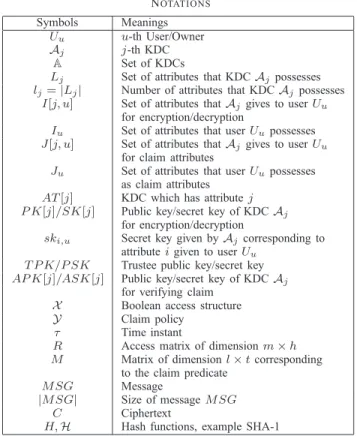
In this section, we present our cloud storage model, adversary model and the assumptions we have made in the paper. Table I presents the notations used throughout the paper. We also describe mathematical background used in our proposed solution.
TABLE I NOTATIONS Symbols Meanings Uu u-th User/Owner Aj j-th KDC A Set of KDCs
Lj Set of attributes that KDCAjpossesses
lj=|Lj| Number of attributes that KDCAjpossesses
I[j, u] Set of attributes thatAjgives to userUu for encryption/decryption
Iu Set of attributes that userUupossesses
J[j, u] Set of attributes thatAjgives to userUu
for claim attributes
Ju Set of attributes that userUupossesses
as claim attributes AT[j] KDC which has attributej P K[j]/SK[j] Public key/secret key of KDCAj
for encryption/decryption
ski,u Secret key given byAjcorresponding to
attributeigiven to userUu T P K/P SK Trustee public key/secret key AP K[j]/ASK[j] Public key/secret key of KDCAj
for verifying claim X Boolean access structure
Y Claim policy
τ Time instant
R Access matrix of dimensionm×h M Matrix of dimensionl×tcorresponding
to the claim predicate
MSG Message
|MSG| Size of messageMSG
C Ciphertext
H,H Hash functions, example SHA-1
A. Assumptions
We make the following assumptions in our work.
1) The cloud is honest-but-curious, which means that the cloud administrators can be interested in viewing user’s
content, but cannot modify it. This is a valid assumption that has been made in [12], [13]. Honest-but-curious model of adversaries do not tamper with data so that they can keep the system functioning normally and remain undetected. 2) Users can have either read or write or both accesses to a
file stored in the cloud.
3) All communications between users/clouds are secured by Secure Shell Protocol, SSH.
B. Formats of access policies
Access policies can be in any of the following formats: 1) Boolean functions of attributes, 2) Linear Secret Sharing Scheme (LSSS) matrix, or 3) Monotone span programs. Any access struc-ture can be converted into a Boolean function [35]. An example of a Boolean function is((a1∧a2∧a3)∨(a4∧a5))∧(a6∨a7)),
wherea1, a2, . . . , a7are attributes.
LetY:{0,1}n→ {0,1}be a monotone Boolean function [24]. A monotone span program forY over afieldFis anl×tmatrix M with entries inF, along with a labeling functiona: [l]→[n] that associates each row ofM with an input variable ofY, such that, for every(x1, x2. . . , xn)∈ {0,1}n,the following condition
is satisfied:
Y(x1, x2, . . . , xn) = 1⇔ ∃v∈F1×l:vM = [1,0,0, . . . ,0]
and(∀i:xa(i)= 0⇒vi= 0)
In other words,Y(x1, x2, . . . , xn) = 1if and only if the rows of
M indexed by{i|xa(i)= 1}span the vector[1,0,0, . . . ,0]. Span
programs can be constructed from Boolean functions in a similar way as shown later in Section V.
C. Mathematical background
We will use bilinear pairings on elliptic curves. Let G be a cyclic group of prime orderqgenerated byg. LetGT be a group
of orderq. We can define the map e:G×G→GT. The map
satisfies the following properties:
1) e(aP, bQ) = e(P, Q)ab for all P, Q ∈ G and a, b ∈ Zq,
Zq ={0,1,2, . . . , q−1}.
2) Non-degenerate:e(g, g)= 1.
Bilinear pairing on elliptic curves groups are used. We do not discuss the pairing functions which mainly use Weil and Tate pairings [36] and computed using Miller’s algorithm. The choice of curve is an important consideration because it determines the complexity of pairing operations.
D. Attribute based encryption
Attribute based encryption with multiple authorities as pro-posed by Lewko and Waters [35] proceeds as follows [16]:
1) System Initialization: Select a primeq, generatorg ofG0, groupsG0 andGT of orderq, a mape:G0×G0→ GT, and a hash function H : {0,1}∗ → G0 which maps the identities
of users to G0. The hash function used here is SHA-1. Each
KDCAj ∈ A has a set of attributesLj. The attributes disjoint
(LiLj = φ fori =j). Each KDC also chooses two random
exponentsαi, yi∈Zq. The secret key of KDCAj is
SK[j] ={αi, yi, i∈Lj}. (1)
The public key of KDCAj is published:
P K[j] ={e(g, g)αi, gyi, i∈L
j}. (2)
2) Key generation and distribution by KDCs: UserUureceives
a set of attributesI[j, u]from KDCAj, and corresponding secret
keyski,u for eachi∈I[j, u]
ski,u=gαiH(u)yi, (3)
whereαi, yi∈SK[j]. Note that all keys are delivered to the user
securely using the user’s public key, such that only that user can decrypt it using its secret key.
3) Encryption by sender: The encryption function is ABE.Encrypt(M SG,X). Sender decides about the access tree
X. LSSS matrixR can be derived as described in III-B. Sender encrypts messageM SG as follows:
1) Choose a random seed s ∈ Zq and a random vector
v∈Zhq, with sas itsfirst entry;his the number of leaves in the access tree (equal to the number of rows in the corresponding matrixR).
2) Calculateλx=Rx·v, whereRx is a row ofR.
3) Choose a random vectorw∈Zhq with 0 as thefirst entry. 4) Calculateωx=Rx·w.
5) For each rowRx ofR, choose a randomρx∈Zq. 6) The following parameters are calculated:
C0=M SGe(g, g)s
C1,x=e(g, g)λxe(g, g)απ(x)ρx,∀x
C2,x=gρx∀x
C3,x=gyπ(x)ρxgωx∀x,
(4) where π(x) is mapping from Rx to the attributei that is
located at the corresponding leaf of the access tree. 7) The ciphertextCis sent by the sender (it also includes the
access tree via Rmatrix):
C=R, π, C0,{C1,x, C2,x, C3,x,∀x}. (5)
4) Decryption by receiver: The decryption function is ABE.Decrypt(C,{ski,u}), whereC is given by equation (13).
Receiver Uu takes as input ciphertext C, secret keys {ski,u},
groupG0, and outputs messagemsg. It obtains the access matrix
R and mappingπfromC. It then executes the following steps: 1) Uucalculates the set of attributes{π(x) :x∈X}Iuthat
are common to itself and the access matrix.X is the set of rows of R.
2) For each of these attributes, it checks if there is a subset X of rows of R, such that the vector (1,0. . . ,0) is their linear combination. If not, decryption is impossible. If yes, it calculates constantscx∈Zq, such that x∈XcxRx=
(1,0, . . . ,0).
3) Decryption proceeds as follows:
a) For eachx∈X,dec(x) = C1,xe(H(u),C3,x)
e(skπ(x),u,C2,x) b) Uu computesM SG=C0/Πx∈Xdec(x).
E. Attribute based signature scheme
1) System Initialization: Select a primeq, and groupsG1and
G2, which are of orderq. We define the mappingeˆ:G1×G1→
G2. Let g1, g2 be generators ofG1 andhj be generators ofG2,
forj∈[tmax], for arbitrarytmax. LetHbe a hash function. Let
A0 =ha00, where a0 ∈Z∗q is chosen at random.(T Sig, T V er)
mean T Sig is the private key with which a message is signed andT V eris the public key used for verification. The secret key for the trustee isT SK= (a0, T Sig)and public key isT P K=
(G1, G2,H, g1, A0, h0, h1, . . . , htmax, g2, T V er).
2) User registration: For a user with identity Uu the KDC
draws at randomKbase ∈ G. Let K0 = K1/a0
base. The following
tokenγ is output
γ= (u, Kbase, K0, ρ), (6)
whereρis signature onu||Kbaseusing the signing keyT Sig.
3) KDC setup: Choose a, b ∈ Z∗q randomly and compute: Aij = haj, Bij = hjb, for Ai ∈ A, j ∈ [tmax]. The private
key of i-th KDC is ASK[i] = (a, b)and public keyAP K[i] =
(Aij, Bij|j∈[tmax]).
4) Attribute generation: The token verification algorithm ver-ifies the signature contained inγ using the signature verification key T V er in T P K. This algorithm extracts Kbase from γ
using (a, b) from ASK[i] and computes Kx = Kbase1/(a+bx), x ∈ J[i, u]. The key Kx can be checked for consistency using algorithmABS.KeyCheck(T P K, AP K[i], γ, Kx), which
checks eˆ(Kx, AijBijx) = ˆe(Kbase, hj), for all x ∈ J[i, u] and
j∈[tmax].
5) Sign: The algorithm ABS.Sign(T P K,{AP K[i] : i ∈ AT[u]}, γ,{Kx:x∈Ju}, M SG,Y), has input the public key of
the trustee, the secret key of the signer, the message to be signed and the policy claim Y. The policy claim is first converted into the span program M ∈Zlq×t, with rows labeled with attributes. Mx denotes row x of M. Let π denote the mapping from
rows to the attributes. So, π(x) is the mapping from Mx to attributex. A vectorvis computed which satisfies the assignment
{x:x∈J[i, u]}. Compute μ=H(M SG||Y). Choose r0 ∈Z∗q andri∈Zq, i∈Ju, and compute:
Y =Kr0 base,Si = (Kivi)r0.(g2g1μ)ri(∀i∈Ju) (7) W =Kr0 0 ,Pj= Πi∈AT[u](AijBπ (i) ij )Mijri(∀j∈[t]) (8)
The signature is calculated as
σ= (Y, W, S1, S2, . . . , St, P1, P2, . . . , Pt). (9) 6) Verify: AlgorithmABS.V erif y(T P K,
σ= (Y, W, S1, S2, . . . , St, P1, P2, . . . , Pt), M SG,Y),
convertsY to the corresponding monotone program M ∈ Zlq×t, with rows labeled with attributes. Compute μ = H(M SG||Y). If Y = 1, ABS.V erif y = 0 meaning false. Otherwise, the following constraints are checked.
ˆ e(W, A0)= ˆ? e(Y, h0) (10) Πi∈leˆ(Si, AijBπ (i) ij )Mij)=? ˆ e(Y, h1)ˆe(g2g1μ, P1), j= 1 ˆ e(g2g1μ, Pj), j >1, (11) wherei=AT[i].
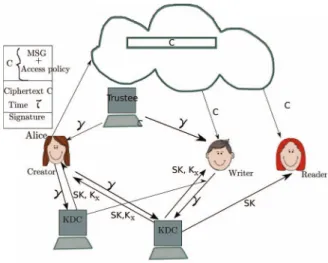
Fig. 1. Our secure cloud storage model
IV. PROPOSED PRIVACY PRESERVING AUTHENTICATED ACCESS CONTROL SCHEME
In this section we propose our privacy preserving authenticated access control scheme. According to our scheme a user can create afile and store it securely in the cloud. This scheme consists of use of the two protocols ABE and ABS, as discussed in Section III-D and III-E respectively. We will first discuss our scheme in details and then provide a concrete example to demonstrate how it works. We refer to the Fig. 1. There are three users, a creator, a reader and writer. Creator Alice receives a token γ from the trustee, who is assumed to be honest. A trustee can be someone like the federal government who manages social insurance numbers etc. On presenting her id (like health/social insurance number), the trustee gives her a token γ. There are multiple KDCs (here 2), which can be scattered. For example, these can be servers in different parts of the world. A creator on presenting the token to one or more KDCs receives keys for encryption/decryption and signing. In the Fig. 1,SKs are secret keys given for decryption,Kxare keys for signing. The message
M SGis encrypted under the access policyX. The access policy decides who can access the data stored in the cloud. The creator decides on a claim policyY, to prove her authenticity and signs the message under this claim. The ciphertextC with signature is c, and is sent to the cloud. The cloud verifies the signature and stores the ciphertextC. When a reader wants to read, the cloud sends C. If the user has attributes matching with access policy, it can decrypt and get back original message.
Write proceeds in the same way asfile creation. By designating the verification process to the cloud, it relieves the individual users from time consuming verifications. When a reader wants to read some data stored in the cloud, it tries to decrypt it using the secret keys it receives from the KDCs. If it has enough attributes matching with the access policy, then it decrypts the information stored in the cloud.
A. Data storage in clouds
A userUu first registers itself with one or more trustees. For simplicity we assume there is one trustee. The trustee gives it a tokenγ= (u, Kbase, K0, ρ), whereρis the signature onu||Kbase
signed with the trustees private keyT Sig (By Equation 6). The KDCs are given keysP K[i], SK[i]for encryption/decryption and ASK[i], AP K[i] for signing/verifying. The user on presenting this token obtains attributes and secret keys from one or more KDCs. A key for an attributexbelonging to KDCAiis calculated
as Kx = Kbase1/(a+bx), where (a, b) ∈ ASK[i]. The user also
receives secret keysskx,ufor encrypting messages. The user then
creates an access policyX which is a monotone Boolean function. The message is then encrypted under the access policy as
C=ABE.Encrypt(M SG,X) (12) The user also constructs a claim policy Y to enable the cloud to authenticate the user. The creator does not send the message M SGas is, but uses the time stampτ and createsH(C)||τ. This is done to prevent replay attacks. If the time stamp is not sent, then the user can write previous stale message back to the cloud with a valid signature, even when its claim policy and attributes have been revoked. The original work by Majiet al.[24] suffers from replay attacks. In their scheme, a writer can send its message and correct signature even when it no longer has access rights. In our scheme a writer whose rights have been revoked cannot create a new signature with new time stamp and thus cannot write back stale information. It then signs the message and calculates the message signature as
σ=ABS.Sign(Public key of trustee, Public key of KDCs, token, signing key, message, access claim)
The following information is then sent in the cloud.
c= (C, τ, σ,Y). (13) The cloud on receiving the information verifies the access claim using the algorithmABS.verif y. The creator checks the value of V =ABS.V erif y(T P K, σ, c,Y). IfV = 0, then authentication has failed and the message is discarded. Else, the message(C, τ) is stored in the cloud.
B. Reading from the cloud
When a user requests data from the cloud, the cloud sends the ciphertextC using SSH protocol. Decryption proceeds using algorithmABE.Decrypt(C,{ski,u})and the messageM SGis
calculated as given in Section III-D4. C. Writing to the cloud
To write to an already existing file, the user must send its message with the claim policy as done duringfile creation. The cloud verifies the claim policy, and only if the user is authentic, is allowed to write on thefile.
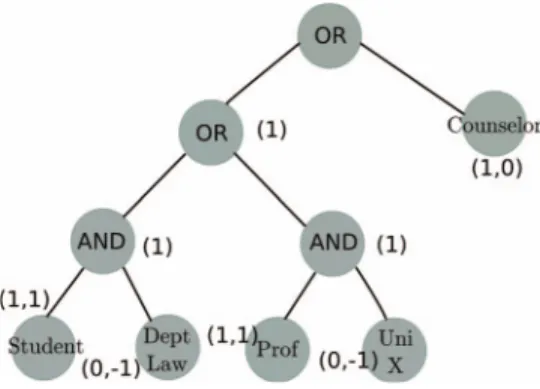
Fig. 2. Example of claim policy
D. User revocation
We have just discussed how to prevent replay attacks. We will now discuss how to handle user revocation. It should be ensured that users must not have the ability to access data, even if they possess matching set of attributes. For this reason, the owners should change the stored data and send updated information to other users. The set of attributes Iu possessed by the revoked
userUu is noted and all users change their stored data that have
attributesi∈Iu. In [13], revocation involved changing the public
and secret keys of the minimal set of attributes which are required to decrypt the data. We do not consider this approach because here different data are encrypted by the same set of attributes, so such a minimal set of attributes is different for different users. Therefore, this does not apply to our model. Once the attributes Iu are identified, all data that possess the attributes are collected.
For each such data record, the following steps are then carried out:
1) A new value ofs,snew∈Zq is selected.
2) Thefirst entry of vectorvnew is changed to newsnew.
3) λx=Rxvnew is calculated, for each rowxcorresponding
to leaf attributes inIu. 4) C1,x is recalculated forx.
5) New value ofC1,x is securely transmitted to the cloud. 6) New C0 = M e(g, g)snew is calculated and stored in the
cloud
7) New value of C1,x is not stored with the data, but is
transmitted to users, who wish to decrypt the data. We note here that the new value of C1,x is not stored in the
cloud but transmitted to the non-revoked users who have attribute corresponding tox. This prevents a revoked user to decrypt the new value ofC0 and get back the message.
V. REAL LIFE EXAMPLE
We now revisit the problem we stated in the introduction. We will use a relaxed setting. Suppose Alice is a Law student and wants to send a series of reports about malpractices by authorities of UniversityX to all the professors of UniversityX, Research chairs of universities X, Y, Z and students belonging to Law department in university X. She wants to remain anonymous, while publishing all evidence. All information is stored in the cloud. It is important that users should not be able to know her
identity, but must trust that the information is from a valid source. For this reason she also sends a claim message which states that she “Is a law student” or “Is a student counselor” or “Professor at university X”. The tree corresponding to the claim policy is shown in Figure 2.
The leaves of the tree consists of attributes and the intermediary nodes consists of Boolean operators. In this example the attributes are “Student”, “Prof”, “Dept Law”, “Uni X”, “Counselor”. The above claim policy can be written as a Boolean function of attributes as
((Student AND Dept Law) OR (Prof AND Uni X)) OR (Student Counselor).
Boolean functions can also be represented by access tree, with attributes at the leaves and AN D(∧) and OR(∨) as the intermediate nodes and root. Boolean functions can be converted to LSSS matrix as below: Let v[x] be parents vector. If node x=AN D, then the left child is (v[x]|1), and the right child is
(0, . . . ,1). Ifx=OR, then both children also have unchanged vectorv[x]. Finally, pad with 0s in front, such that all vectors are of equal length. The proof of validity of the algorithm is given in [25]. We do not present it here due to lack of space.
Using this algorithm, the span program for this policy is
M = ⎛ ⎜ ⎜ ⎜ ⎜ ⎝ 1 1 0 −1 1 1 0 −1 1 0 ⎞ ⎟ ⎟ ⎟ ⎟ ⎠.
An assignmentv= (v1, v2, v3, v4, v5)satisfies this span program
ifvM = (1,0).
The cloud should verify that Alice indeed satisfies this claim. Since she is a Law student, v = (1,1,0,0,0) and is a valid assignment. As a valid user she can then store all the encrypted records under the set of access policy that she has decided. The access policy in case of Alice is
((Prof AND Uni. X) OR
(Research Chair AND ((Uni X OR Uni Y) OR Uni Z)) OR ((Student AND Dept Law)AND Uni X)
Later when a valid user, say Bob wants to modify any of these reports he also attaches a set of claims which the cloud verifies. For example, Bob is a research chair and might send a claim “Research chair” or “Department head” which is then verified by the cloud. It then sends the encrypted data to the Bob. Since Bob is a valid user and has matching attributes, he can decrypt and get back the information.
If Bob wants to read the contents without modifying them, then there is no need to attach a claim. He will be able to decrypt only if he is a Professor in University X or a Research chair in one of the universitiesX, Y, Z or a student belonging to Department of Law in universityX.
Here it is to be noted that the attributes can belong to several KDCs. For example the Professors belonging to universityXhave credentials given by the universityX, and a Ph. D. degree from
a University P, the student counselor might be a psychologist au-thorized by the Canadian Psychological Association and assigned an employee number by a university, the research chairs can be jointly appointed by the universitiesX,Y,Zand the government. The students can have credentials from the university and also a department.
Initially Alice goes to a trustee for example the Canadian health service and presents her a health insurance number or federal agency presents her a social insurance number. Either or both of these trustees can give her token(s) γ = (u, Kbase, K0, ρ).
With the token she approaches the KDCs in the university X and departmentDand obtains the secret keys for decryption and for keysKx andKy for signing the assess policy. She can also
access the public keysAP K[i]of other KDCs. The entire process is carried on in the following way:
A. Data Storage in clouds
Let the data be denoted byM SG,X is the access policy-((Prof AND Uni. X) OR
(Research Chair AND ((Uni X OR Uni Y) OR Uni Z)) OR ((Student AND Dept Law)AND Uni X)
Alice encrypts the data and obtains the ciphertext C=Enc(M SG,X).
Alice also decides on a claim policy Y which is shown in Figure 2. From the matrix,v = (1,1,0,0,0) can be calculated. The values of Y, W, S1, S2, S3, S4, S5, P1, P2 can be calculated.
μ=H(M SG||Y). The current time stamp τ is attached to the ciphertext to prevent replay attacks. The signatureσis calculated asABS.Sign. The ciphertext
c= (C, τ, σ,Y)
is then send to the cloud. The cloud verifies the signature using the function ABS.V erif y as given in Equation (11). If Alice has valid credentials then the ciphertext(C, τ) is stored, else it is discarded.
B. Reading from the cloud and modifying data
Suppose Bob wants to access the records stored by Alice. Bob then decrypts the message M SG using his secret keys using function ABE.Decrypt. Writing proceeds like file creation. It is to be noted that the timeτ is added to the data so that even if Bob’s credentials are revoked, he cannot write stale data in the cloud.
VI. SECURITY OF THE PROTOCOL
In this section we will prove the security of the protocol. We will show that our scheme authenticates a user who wants to write to the cloud. A user can only write provided the cloud is able to validate its access claim. An invalid user cannot receive attributes from a KDC, if it does not have the credentials from the trustee. If a user’s credentials are revoked, then it cannot replace data with previous stale data, thus preventing replay attacks.
Theorem 1: Our access control scheme is secure (no outsider or cloud can decrypt ciphertexts), collusion resistant and allows access only to authorized users.
Proof: We first show that no unauthorized user can access data from the cloud. We willfirst prove the validity of our scheme. A user can decrypt data if and only if it has a matching set of attributes. This follows from the fact that access structure S (and hence matrixR) is constructed if and only if there exists a set of rowsX in R, and linear linear constants cx ∈Zq, such
thatx∈XcxRx= (1,0, . . . ,0). A proof of this appear in [25,
Chapter 4]. We note that dec(x) =C1,xe(H(u),C3,x) e(skπ(x),u,C2,x) =e(g, g) λxe(H(u), g)ωx (14) Thus, Πx∈Xdec(x) = Πx∈X(e(g, g)λxe(H(u), g)ωx)cx =e(g, g)s (15) Equation (15) above holds because λx = Rx ·v and ωx =
Rx·w, where v ·(1,0, . . . ,0) = r and ω ·(1,0, . . . ,0) = 0.
C0/Πx∈Xdec(x) =C0/e(g, g)s=M.
For an invalid user, there does not exists attributes correspond-ing to rows x, such that x∈XcxRx = (1,0, . . . ,0). Thus
e(g, g)s cannot be calculated.
We next show that two or more users cannot collude and gain access to data that they are not individually supposed to access. Suppose that there exist attributesπ(x)from the colluders, such thatx∈XcxRx = (1,0, . . . ,0). However,e(H(u), g)ωx needs
to be calculated according to Eq. (15). Since different users have different values of e(H(u), g), even if they combine their attributes, they cannot decrypt the message.
We next observe that the cloud cannot decode stored data. This is because it does not posses the secret keys ski,u (by Eq.(3)). Even if it colludes with other users, it cannot decrypt data which the users cannot themselves decrypt, because of the above reason (same as collusion of users). The KDCs are located in different servers and are not owned by the cloud. For this reason, even if some (but not all) KDCs are compromised, the cloud cannot decode data.
Theorem 2: Our authentication scheme is correct, collusion secure, resistant to replay attacks, and protects privacy of the user.
Proof: We first note that only valid users registered with the trustee(s) receive attributes and keys from the KDCs. A user’s token is γ = (u, Kbase, K0, ρ), where ρ is signature on
u||Kbase with T Sig belonging to the trustee. An invalid user
with a different user-id cannot create the same signature because it does not knowT Sig.
We next show that only a valid user with valid access claim is only able to store the message in the cloud. This follows from the functions ABS.Signand ABS.V erif y given in Section III-E. A user who wants to create afile and tries to make a false access claim, cannot do so, because it will not have attribute keys Kx
from the related KDCs. At the same time since the message is
encrypted, a user without valid access policy cannot decrypt and change the information.
Two users cannot collude and create an access policy consisting of attributes shared between them. Suppose, there are two users A and B who have attributes xA and xB respectively. They
have the following informationKbaseA, KxA andKbaseB, KxB, respectively. A new value of KxB = K
1/(a+bx)
baseA cannot be calculated by B, because it does not know the values of(a, b). Thus the authentication is collusion secure.
Our scheme is resistant to replay attacks. If a writer’s access claims are revoked, it cannot replace a data with stale information from previous writes. This is because it has to attach a new time stampτ and sign the messageH(C)||τ again. Since it does not have attributes, it cannot have a valid signature.
The mathematical proofs of security of our scheme follows from the security proofs of [35], [23] and has been omitted for the lack of space.
VII. COMPUTATIONCOMPLEXITY
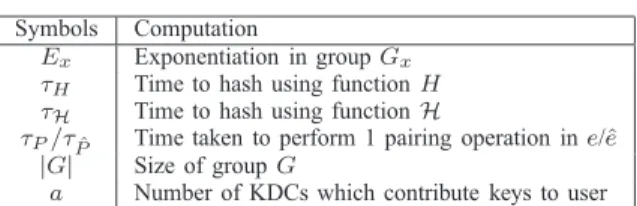
In this section we present the computation complexity of the privacy preserving access control protocol. We will calculate the computations required by users (creator, reader, writer) and that by the cloud. Table II presents notations used for different operations.
TABLE II NOTATIONS
Symbols Computation
Ex Exponentiation in groupGx
τH Time to hash using functionH
τH Time to hash using functionH
τP/τPˆ Time taken to perform 1 pairing operation ine/eˆ |G| Size of groupG
a Number of KDCs which contribute keys to user
The creator needs to encrypt the message and sign it. Creator needs to calculate one pairing e(g, g). Encryption takes 2 ex-ponentiations to calculate each ofC1,x. So this requires 2mET
time, wheremis the number of attributes. User needs to calculate 3 exponentiation to calculate C2,x andC3,x. So time taken for
encryption is (3m+ 1)E0+ 2mET +τP. To sign the message,
Y, W, Sis and Pjs have to be calculated as well as H(C). So,
time taken to sign is(2l+ 2)E1+ 2tE2+τH.
The cloud needs to verify the signature. This requires checking for equation (11). Time taken to verify is (l+ 2t)τPˆ+l(E1+
E2) +τH. To read, a user needs only to decrypt the cipher-text. This requires 2m pairings to calculate e(H(u), C3,x) and
e(skπ(x),u, C2,x) and O(mh) to find the vector c. Decryption
takes2mτP+τH+O(mh). Writing is similar to creating a record.
The size of ciphertext with signature is2m|G0|+m|GT|+m2+
|M SG|+ (l+t+ 2)|G1|.
When revocation is required, C0 needs to be recalculated.
e(g, g)is previously calculated. So, only one scalar multiplication is needed. If the user revoked is Uu, then for each x, C1,x has
to be recomputed. e(g, g)is already computed. Thus, only two scalar multiplication needs to be done, for eachx. So a total of
TABLE III
COMPARISON OF OUR SCHEME WITH EXISTING ACCESS CONTROL SCHEMES
Schemes Fine-grained Centralized/ Write/read Type of Privacy preserving User access control Decentralized access access control authentication revocation? [38] Yes Centralized 1-W-M-R Symmetric key cryptography No authentication No [12] Yes Centralized 1-W-M-R ABE No authentication No [13] Yes Centralized 1-W-M-R ABE No authentication No [16] Yes Decentralized 1-W-M-R ABE No authentication Yes [33] Yes Centralized 1-W-M-R ABE No authentication No [34] Yes Decentralized 1-W-M-R ABE Not privacy preserving Yes [15] Yes Centralized M-W-M-R ABE Authentication No Ours Yes Decentralized M-W-M-R ABE Authentication Yes
TABLE IV
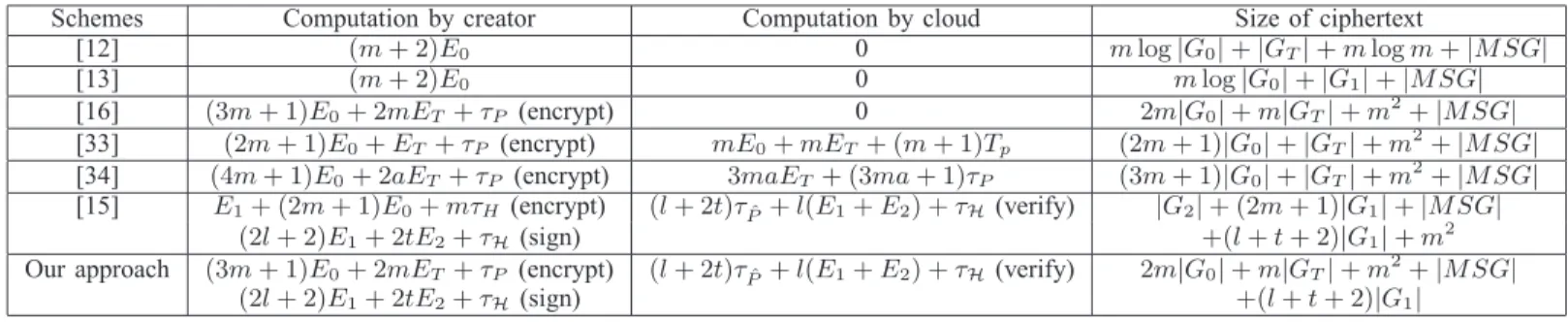
COMPARISON OF COMPUTATION AND SIZE OF CIPHERTEXT WHILE CREATING A FILE
Schemes Computation by creator Computation by cloud Size of ciphertext
[12] (m+ 2)E0 0 mlog|G0|+|GT|+mlogm+|MSG|
[13] (m+ 2)E0 0 mlog|G0|+|G1|+|MSG|
[16] (3m+ 1)E0+ 2mET+τP (encrypt) 0 2m|G0|+m|GT|+m2+|MSG|
[33] (2m+ 1)E0+ET+τP (encrypt) mE0+mET+ (m+ 1)Tp (2m+ 1)|G0|+|GT|+m2+|MSG|
[34] (4m+ 1)E0+ 2aET+τP (encrypt) 3maET+ (3ma+ 1)τP (3m+ 1)|G0|+|GT|+m2+|MSG|
[15] E1+ (2m+ 1)E0+mτH (encrypt) (l+ 2t)τPˆ+l(E1+E2) +τH(verify) |G2|+ (2m+ 1)|G1|+|MSG|
(2l+ 2)E1+ 2tE2+τH (sign) +(l+t+ 2)|G1|+m2
Our approach (3m+ 1)E0+ 2mET+τP (encrypt) (l+ 2t)τPˆ+l(E1+E2) +τH(verify) 2m|G0|+m|GT|+m2+|MSG|
(2l+ 2)E1+ 2tE2+τH (sign) +(l+t+ 2)|G1|
TABLE V
COMPARISON OF COMPUTATION DURING READ AND WRITE BY USER AND CLOUD
Schemes Computation by user while write Computation by user while read Computation by cloud while write
[12] No write access mτP No write access
[13] No write access mτP No write access
[16] No write access 2mτP+τH+O(mh) No write access
[33] No write access E0+τH+O(mh) No write access
[34] No write access E0+τH+O(mh) No write access
[15] E1+ (2m+ 1)E0+mτH (encrypt) (2m+ 1)τP (decrypt) (l+ 2t)τPˆ+l(E1+E2) +τH (verify) (2l+ 2)E1+ 2tE2+τH (sign)
Our approach (3m+ 1)E0+ 2mET+τP (encrypt) 2mτP+τH+O(mh)(decrypt) (l+ 2t)τPˆ+l(E1+E2) +τH (verify) (2l+ 2)E1+ 2tE2+τH (sign)
2m+ 1scalar multiplications are done by the cloud, where m is the number of attributes belonging to all revoked users. Users need not compute any scalar multiplication or pairing operations. Additional communication overhead isO((m+ 1)|GT|).
The curves chosen are either MNT curves (proposed by Miyaji, Nakabayashi and Takano) or supersingular curves. Considering the requirements, elliptic curve group of size 159, with an embedding degree 6 (typedcurves of Pairing based Cryptography - PBC [36]) can be used. Pairing takes 14 ms on Intel Pentium D, 3.0GHz CPU [16]. Such operations are very suitable for a cloud computing environment. A new library for attribute based encryption is also available at [37].
PBC library (Pairing Based Cryptography) [36] is a C library which is built above GNU GMP (GNU Math Precision) library and contains functions to implement elliptic curves and pairing operations. Each element ofGneeds 512 bits at an 80-bit security level and 1536 bits when 128-bit of security are chosen [39].
Each cryptographic operation was implemented using the PBC library ver. 0.4.18 on a 3.0 GHZ processor PC. The public key parameters were selected to provide 80-bit security level. According to [39], implementation uses 160-bit elliptic curve group on the supersingular curve y2 = x3+x over a 512-bit
finite field. The computational cost for a pairing operation is 2.9 ms and that of exponentiation onG(andG0) andGT (andG2)
are 1 ms and 0.2 ms respectively.
We will compare our computation costs with existing schemes like [13], [12], [15] in next Section VIII.
VIII. COMPARISON WITH OTHER ACCESS CONTROL SCHEMES IN CLOUD
We compare our scheme with other access control schemes (in Table III) and show that our scheme supports many features that the other schemes did not support. 1-W-M-R means that only one user can write while many users can read.
M-W-M-R means that many users can write and read. We see that most schemes do not support many writes which is supported by our scheme. Our scheme is robust and decentralized, most of the others are centralized. Our scheme also supports privacy preserving authentication, which is not supported by others. Most of the schemes do not support user revocation, which our scheme does. In Tables IV and V we compare the computation and communication costs incurred by the users and clouds and show that our distributed approach has comparable costs to centralized approaches. The most expensive operations involving pairings and is done by the cloud. If we compare the computation load of user during read we see that our scheme has comparable costs. Our scheme also compares well with the other authenticated scheme of [15].
IX. CONCLUSION
We have presented a decentralized access control technique with anonymous authentication, which provides user revocation and prevents replay attacks. The cloud does not know the identity of the user who stores information, but only verifies the user’s credentials. Key distribution is done in a decentralized way. One limitation is that the cloud knows the access policy for each record stored in the cloud. In future, we would like to hide the attributes and access policy of a user.
ACKNOWLEDGEMENT
This work is partially supported by NSERC Grant CRDPJ386874-09 and the grant: “Digital signal processing, and the synthesis of an information security system”, TR32054, Serbian Ministry of Science and Education.
REFERENCES
[1] S. Ruj, M. Stojmenovic and A. Nayak, “Privacy Preserving Access Control with Authentication for Securing Data in Clouds”,IEEE/ACM International Symposium on Cluster, Cloud and Grid Computing, pp. 556–563, 2012. [2] C. Wang, Q. Wang, K. Ren, N. Cao and W. Lou, “Toward Secure and
Dependable Storage Services in Cloud Computing”, IEEE T. Services Computing, vol. 5, no. 2, pp. 220–232, 2012.
[3] J. Li, Q. Wang, C. Wang, N. Cao, K. Ren, and W. Lou, “Fuzzy keyword search over encrypted data in cloud computing,” inIEEE INFOCOM. , pp. 441–445, 2010.
[4] S. Kamara and K. Lauter, “Cryptographic cloud storage,” in Financial Cryptography Workshops, ser. Lecture Notes in Computer Science, vol. 6054. Springer, pp. 136–149, 2010.
[5] H. Li, Y. Dai, L. Tian, and H. Yang, “Identity-based authentication for cloud computing,” inCloudCom, ser. Lecture Notes in Computer Science, vol. 5931. Springer, pp. 157–166, 2009.
[6] C. Gentry, “A fully homomorphic encryption scheme,” Ph.D. dissertation, Stanford University, 2009, http://www.crypto.stanford.edu/craig.
[7] A.-R. Sadeghi, T. Schneider, and M. Winandy, “Token-based cloud com-puting,” in TRUST, ser. Lecture Notes in Computer Science, vol. 6101. Springer, pp. 417–429, 2010.
[8] R. K. L. Ko, P. Jagadpramana, M. Mowbray, S. Pearson, M. Kirchberg, Q. Liang, and B. S. Lee, “Trustcloud: A framework for accountability and trust in cloud computing,” HP Technical Report HPL-2011-38. Available at http://www.hpl.hp.com/techreports/2011/HPL-2011-38.html.
[9] R. Lu, X. Lin, X. Liang, and X. Shen, “Secure Provenance: The Essential of Bread and Butter of Data Forensics in Cloud Computing,” inACM ASIACCS, pp. 282–292, 2010.
[10] D. F. Ferraiolo and D. R. Kuhn, “Role-based access controls,” in 15th National Computer Security Conference, 1992.
[11] D. R. Kuhn, E. J. Coyne, and T. R. Weil, “Adding attributes to role-based access control,”IEEE Computer, vol. 43, no. 6, pp. 79–81, 2010.
[12] M. Li, S. Yu, K. Ren, and W. Lou, “Securing personal health records in cloud computing: Patient-centric and fine-grained data access control in multi-owner settings,” inSecureComm, pp. 89–106, 2010.
[13] S. Yu, C. Wang, K. Ren, and W. Lou, “Attribute based data sharing with attribute revocation,” inACM ASIACCS, pp. 261–270, 2010.
[14] G. Wang, Q. Liu, and J. Wu, “Hierarchical attribute-based encryption for
fine-grained access control in cloud storage services,” inACM CCS, , pp. 735–737, 2010.
[15] F. Zhao, T. Nishide, and K. Sakurai, “Realizing fine-grained andflexible access control to outsourced data with attribute-based cryptosystems,” in
ISPEC, ser. Lecture Notes in Computer Science, vol. 6672. Springer, pp. 83–97, 2011.
[16] S. Ruj, A. Nayak, and I. Stojmenovic, “DACC: Distributed access control in clouds,” inIEEE TrustCom, 2011.
[17] http://docs.oasis-open.org/xacml/3.0/xacml-3.0-core-spec-cs-01-en.pdf. [18] http://securesoftwaredev.com/2012/08/20/xacml-in-the-cloud.
[19] S. Jahid, P. Mittal, and N. Borisov, “EASiER: Encryption-based access control in social networks with efficient revocation,” in ACM ASIACCS, 2011.
[20] R. L. Rivest, A. Shamir, and Y. Tauman, “How to leak a secret,” in
ASIACRYPT, ser. Lecture Notes in Computer Science, vol. 2248. Springer, pp. 552–565, 2001.
[21] X. Boyen, “Mesh signatures,” in EUROCRYPT, ser. Lecture Notes in Computer Science, vol. 4515. Springer, pp. 210–227, 2007.
[22] D. Chaum and E. van Heyst, “Group signatures,” inEUROCRYPT, pp. 257– 265, 1991.
[23] H. K. Maji, M. Prabhakaran, and M. Rosulek, “Attribute-based signatures: Achieving attribute-privacy and collusion-resistance,” IACR Cryptology ePrint Archive, 2008.
[24] ——, “Attribute-based signatures,” inCT-RSA, ser. Lecture Notes in Com-puter Science, vol. 6558. Springer, pp. 376–392, 2011.
[25] A. Beimel, “Secure Schemes for Secret Sharing and Key Distribution,” Ph D Thesis. Technion, Haifa, 1996.
[26] A. Sahai and B. Waters, “Fuzzy identity-based encryption,” inEUROCRYPT, ser. Lecture Notes in Computer Science, vol. 3494. Springer, pp. 457–473, 2005.
[27] V. Goyal, O. Pandey, A. Sahai, and B. Waters, “Attribute-based encryption forfine-grained access control of encrypted data,” inACM Conference on Computer and Communications Security, pp. 89–98, 2006.
[28] J. Bethencourt, A. Sahai, and B. Waters, “Ciphertext-policy attribute-based encryption,” inIEEE Symposium on Security and Privacy. , pp. 321–334, 2007.
[29] X. Liang, Z. Cao, H. Lin and D. Xing, “Provably Secure and Efficient Bounded Ciphertext Policy Attribute Based Encryption,” inACM ASIACCS, pp 343–352, 2009.
[30] M. Chase, “Multi-authority attribute based encryption,” inTCC, ser. Lecture Notes in Computer Science, vol. 4392. Springer, pp. 515–534, 2007. [31] H. Lin, Z. Cao, X. Liang and J. Shao, “Secure Threshold Multi-authority
Attribute Based Encryption without a Central Authority,” inINDOCRYPT, ser. Lecture Notes in Computer Science, vol. 5365, Springer, pp. 426–436, 2008.
[32] M. Chase and S. S. M. Chow, “Improving privacy and security in multi-authority attribute-based encryption,” inACM Conference on Computer and Communications Security, pp. 121–130, 2009.
[33] Matthew Green, Susan Hohenberger and Brent Waters, “Outsourcing the Decryption of ABE Ciphertexts,” in USENIX Security Symposium, 2011. [34] Kan Yang, Xiaohua Jia and Kui Ren, “ DAC-MACS: Effective Data Access
Control for Multi-Authority Cloud Storage Systems”, IACR Cryptology ePrint Archive, 419, 2012.
[35] A. B. Lewko and B. Waters, “Decentralizing attribute-based encryption,” in
EUROCRYPT, ser. Lecture Notes in Computer Science, vol. 6632. Springer, pp. 568–588, 2011.
[36] “http://crypto.stanford.edu/pbc/.”
[37] “libfenc: The functional encryption library. http://code.google.com/p/libfenc/.”
[38] W. Wang, Z. Li, R. Owens, and B. Bhargava, “Secure and efficient access to outsourced data,” inACM Cloud Computing Security Workshop (CCSW), 2009.
[39] J. Hur and D. Kun Noh, “Attribute-Based Access Control with Efficient Revocation in Data Outsourcing Systems”, IEEE Trans. Parallel Distrib. Syst., vol. 22, no. 7, pp. 1214–1221, 2011.
Sushmita Rujreceived her B.E. degree in Computer Science from Bengal Engineering and Science University, Shibpur, India in 2004, and Masters and Ph D in Computer Science from Indian Statistical Institute, India in 2006 and 2010, respectively. Between 2009 and 2010, she was a Erasmus Mundus Post Doctoral Fellow at Lund University, Sweden and between 2010 and 2012, she was a Post Doctoral Fellow at University of Ottawa, Canada. She is currently an Assistant Professor at Indian Institute of Technology, Indore, India. Her research interests are in security in mobile ad hoc networks, vehicular networks, cloud security, security in smart grids, combinatorics and cryptography. She is on the Editorial Board of Ad Hoc and Sensor Wireless Networks.
Milos Stojmenovicreceived the Bachelor of Computer Science degree at the School of Information Technology and Engineering, University of Ottawa, in 2003. He obtained his Masters degree in computer science at Carleton University in Ottawa, Canada in 2005, and completed his PhD in the samefield at the University of Ottawa, Canada in 2008. Currently he is an Assistant Professor at the Singidunum University, Serbia. He was a visiting researcher at Japans National Institute of Advanced Industrial Science and Technology in 2009. He published over thirty articles in thefields of computer vision, image processing, and wireless networks. His work implements machine learning techniques such as AdaBoost and SVM classification which in turn use Higher order Auto-correlation features (HLAC) to perform Image segmentation and classification.
Amiya Nayak received his B.Math. degree in Computer Science and Combinatorics & Optimization from University of Waterloo in 1981, and Ph.D. in Systems and Computer En-gineering from Carleton University in 1991. He has over 17 years of industrial experience in software engineering, avionics and navigation systems, simulation and system level performance analysis. He is in the Editorial Board of several journals, in-cluding IEEE Transactions on Parallel & Distributed Systems, International Journal of Parallel, Emergent and Distributed Sys-tems, International Journal of Computers and Applications, and EURASIP Journal of Wireless Communications and Networking. Currently, he is a Full Professor at the School of Electrical Engineering and Computer Science at the University of Ottawa. His research interests are in the area of fault tolerance, distributed systems/algorithms, and mobile ad hoc networks with over 150 publications in refereed journals and conference proceedings.