Supplier selection for smart supply chain: An adaptive
fuzzy-neuro approach
Kamar Zekhnini*, Anass Cherrafi, Imane Bouhaddou, Youssef Benghabrit
LM2I Laboratory, ENSAM, Moulay Ismail University, 50500 Meknes, Morocco
[email protected],
[email protected],
[email protected],
[email protected]
Jose Arturo Garza-Reyes
Centre for Supply Chain Improvement, University of Derby, Derby, UK
[email protected]
Abstract
In recent years, companies have experienced international changes that have occurred as a result of technological advances, market globalization, or natural disasters. So, organizations are trying to improve their performance in order to be more competitive. In other words, organizations’ competitiveness highly depends on their suppliers. At present, companies need to consider and include so-called ‘resilience’, ‘sustainability’, and ‘smartness’ in the supplier’s selection to retain a competitive advantage. In this context, the purpose of this paper is to present an intelligent decision-making model for selecting the appropriate suppliers. For doing so, a set of criteria evaluation was determined to respond to the novel era circumstances. The suggested work is helpful for academics as well as professionals as it emphasizes the importance of resilient-sustainable supplier selection in the digital era.
Keywords
Supplier Selection, Digital Supply Chain, Resilience, Sustainability, Adaptive Fuzzy Neuro Approach.
1.
Introduction
Organizations work in environments of significant uncertainties. This includes unexpected exchange rates, supply fluctuations, volatile economies, political instability, unpredictable demand, and natural disasters (Cavalcante et al., 2019; Hosseini et al., 2019; Zekhnini et al. 2020). Epidemic outbreaks are a particular example of supply chain threats that are distinctively characterized by a long-term existence of disruption, propagation of disruption (i.e. ripple effect), and high uncertainty (Ivanov, 2020a). Coronavirus (COVID-19) outbreak is an unusual and out-of-ordinary situation that clearly proves a need for enhanced supply chain resilience study and practice (Ivanov and Dolgui, 2020). For this reason, in recent years, there has been an increasing interest in the selection of robust suppliers (Cavalcante et al., 2019).
The supplier is a key player in the supply chain management. So, the selection of the appropriate suppliers is one of the key factors in increasing the organizations’ competitiveness (Yang and Chen, 2006). In other words, supplier selection is highlighted as a critical and sophisticated decision-making problem in the management of the supply chain (Chattopadhyay et al., 2016; Yang and Chen, 2006). Because, a suitable supplier will have a significant and enduring effect on the profitability of the entire supply chain (Cheng et al., 2020). In addition, reliable suppliers allow supply chains to reduce inventory costs and improve product quality (Yang and Chen, 2006). For this reason, extensive attention has been paid to the issue of supplier selection in the previous studies (Chattopadhyay et al., 2016; Hasan et al., 2020; Yang and Chen, 2006).
Over the years, many researchers have focused on suppliers selection by contributing to the development of the different methods used in this field (Ho et al., 2015). To date, little attention has been given to the suppliers’
selection for the smart supply chain in a crisis situation. The aim of this study is therefore to fill the literature gap by introducing new criteria in the selection process in the era of digitalization. Moreover, this study proposes an architecture system based on the adaptive fuzzy-neuro approach to suppliers selection.
Therefore, it is wide important to study the new criteria related to the digital supply chain implementation and crisis incidents. These criteria include ‘resilience’, ‘sustainability’ and ‘smartness”. In this context, (Rajesh and Ravi, 2015) used a grey approach to study the resilient supplier selection. While (Hosseini et al., 2019) discusses resilient supplier selection and optimal order allocation under disruption risks. On the other hand, (Hasan et al., 2020; Kellner and Utz, 2019; Moheb-Alizadeh and Handfield, 2019) address the sustainability in supplier selection and order allocation. In addition, (Tirkolaee et al., 2020) studied sustainable-reliable supplier selection. Hence, to the best of our knowledge, in the suppliers’ selection issue, there are no academic studies investigating the adaptive fuzzy-neuro approach in the supplier selection for smart supply chain in crisis situations.
This article is organized as follows: in the following section, we present the literature review. Section 3 illustrates the supplier performance criteria related to digital supply chain in crisis situations. And finally, section 4 presents the proposed decision-making model.
2.
Literature Review
The recent emergence and deployment of advanced smart technology (e.g. Internet-of-Things (IoT), Blockchain, Cyber-Physical System (CPS), Big Data Analytics (BDA), Virtual and Augmented Reality (VR & AR) and Artificial Intelligence (AI) techniques), allows all parts of the supply chain to be perceivable, intelligible, transparent, and optimized and thus promote the transformation of the conventional supply chain into a smart supply chain (Chen et al., 2020). Digital supply chain challenges the option of suppliers through dynamic order allocations and offers new possibilities using digital data to enhance procurement decisions (Cavalcante et al., 2019).
The word "supplier" corresponds to all parties directly and indirectly engaged by the manufacturer (Wątróbski, 2019). Supplier selection is an important and intensively researched issue because it has a major impact on purchasing management in the supply chain (Guo et al., 2009). Suppliers play a vital role in the management of the supply chain. It focuses on the suppliers’ selection evaluation and ensures a productive relationship between the various segments of the supply chain (Wątróbski, 2019). Therefore, careful selection of the right supplier for the right mission is essential to performance improvement (Ganesh Pillai and Bindroo, 2020; Stević et al., 2020).
The topic of partner selection in the supply chain is always a frequent one. Previous studies analyzed and studied the suppliers’ selection in the digital supply chain. (Hasan et al., 2020) develop a Decision Support System to incorporate and process an imprecise heterogeneous data in a unified framework to rank a set of resilient suppliers in the logistic 4.0 environment. (Ghadimi et al., 2019) proposed a Multi-Agent Systems (MASs) approach to address sustainable supplier evaluation and selection process in order to provide a proper communication channel, structured information exchange, and visibility among suppliers and manufacturers. In addition, (Chen et al., 2020) present a novel framework to identify smart-sustainable supply chain management practices as supplier selection criteria for a smart supply chain. It proposes a hybrid rough-fuzzy DEMATEL-TOPSIS approach to sustainable supplier selection for a smart supply chain. Moreover, (Cavalcante et al., 2019) develop a hybrid technique, combining simulation and machine learning and examine its applications to data-driven decision making support in resilient supplier selection.
In addition, the supplier selection topic was analyzed with several methods such as MCDM techniques, MP models, and AI approaches (Luan et al., 2019). The AI approaches include ANN methods. In other words, the neural network (NN) was used as a method for the supplier’s selection in different contexts. For instance, (Kuo et al., 2010) used (NN) combined with MADA methods for green suppliers selection. Moreover, (Azadnia et al., 2012) study sustainable Supplier Selection Based on Self-organizing Map NN and Multi-Criteria Decision Making approaches.
3.
Suppliers Performance Data
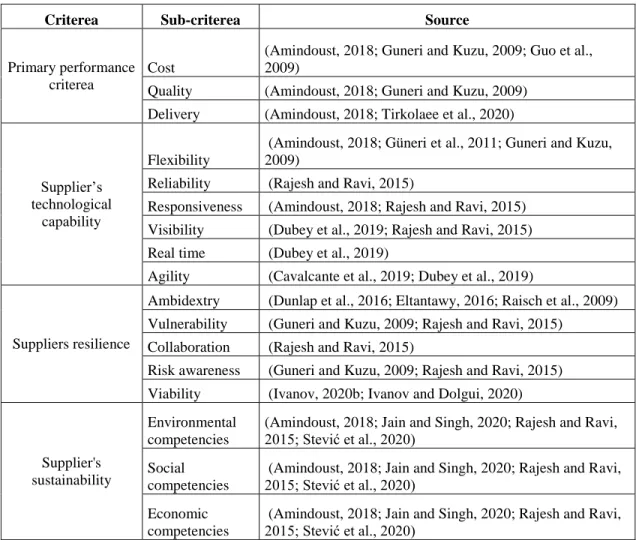
In this section, we present the performance criteria required to select the optimal supplier. In fact, these criteria were chosen considering the three dimensions ‘sustainability’, ‘resilience’, and ‘smartness’ or ‘industry 4.0 technological capabilities’. This choice is made in order to select suppliers that will be able to respond to crisis situations and also who are aware of the importance and advantages of digitalization.
3.1.
Primary Performance Criteria
Through this study, cost, quality, and on-time delivery are considered to be primary performance criteria for suppliers selection in a digital supply chain. In fact, suppliers must deliver on time the required amount of high-quality materials and raw materials (Stević et al., 2020). In other words, suppliers should have the ability to meet quality specifications consistently in term of variety, production quality, quality system, and continuous improvement (Taherdoost and Brard, 2019). In addition, suppliers have also to be able to meet specified delivery schedules such as lead-time, on-time, transportation, etc (Taherdoost and Brard, 2019).
3.2.
Supplier’s Technological Capability
Many organizations in various industries need to upgrade their products using technological advances and migrate towards a higher degree of digitalization. As a result, many have been forced into partnerships with uncertainty with suppliers outside their conventional supplier base or with companies on a technically unstable project (Pazirandeh Arvidsson and Melander, 2020). The concept of Industry 4.0 is that the smart factory provides all the necessary information on its production and supply requirements. Digital technologies promote adaptive decision-making by delivering real-time data to all parts of the supply chain (Dubey et al., 2019). Moreover, they will improve agility, automatic interoperability, performance, or cost savings (Alcácer and Cruz-Machado, 2019).
Profitability, resource efficiency, and responsiveness have been high-level targets in the manufacturing industry for decades. New market dynamics, therefore, require a higher degree of flexibility and agility in industrial production (Isaksson et al., 2018). In other words, the keys performance in the digital era are flexibility, reliability, having high responsiveness, high visibility, and real-time execution (Butner, 2010). Thus, those criteria should be considered while selecting suppliers.
3.3.
Suppliers Resilience
As a result of globalization, supply chains are more threatened with natural, human-made, or technological threats such as floods, earthquakes, fires, transport accidents, labor strikes, terrorist attacks, and so on. Such catastrophic events create problems in the supply chain, which are harmful to organizations (Amindoust, 2018). Hence, it is important to provide a sustainability approach to the supply chain in order to protect the customer from shortages and disruptions. As the supplier involves the performance of the supply Chain, resilience in the selection decision must be considered in order to reduce the risk of business (Amindoust, 2018). Because, resilient supplier selection is a key strategic decision in the context of the supply chain disruption management (Hosseini et al., 2019). More recent literature identifies ambidextrous companies capable of utilizing existing competencies and pursuing new possibilities at the same time (Raisch et al., 2009). Ambidexterity is likely to be greatly linked to more fundamental success measures, including resistance to organizational crisis and corporate reputation. Thus, superior performance is expected from the ambidextrous organization (Raisch et al., 2009). Moreover, suppliers would be the least vulnerable to disruptions. They should also be more aware of possible risks and well-established to face them (Rajesh and Ravi, 2015). Besides, acting collaboratively with suppliers eliminates the risks associated with forecasting and inventory management (Cousins et al., 2005).
3.4.
Supplier's Sustainability
Current disruptions trigger supply chain sustainability. Therefore, it is necessary required to create an effective and resilient supply chain that would be capable to face any disruption and to provide the same sustainability in disruptions event (Amindoust, 2018). The sustainability concept has been considered as a comprehensive concept in the selection of suppliers. Hence, in order to achieve sustainable supply chain management, it is important to evaluate and select sustainable suppliers.
Sustainability has three dimensions that can be categorized as environmental, economic, and social. Social factors are focused on human rights, education, training, etc (Tavassoli et al., 2020). Environmental considerations include compliance with environmental regulations and reducing the use of water and resources. In fact, considering all dimensions of sustainability requires decision-makers to pursue a wide range of economic, social, and environmental performance assessment criteria in a single planning horizon (Jain and Singh, 2020).
Table 1: Suppliers selection criteria
Criterea Sub-criterea Source
Primary performance criterea
Cost
(Amindoust, 2018; Guneri and Kuzu, 2009; Guo et al., 2009)
Quality (Amindoust, 2018; Guneri and Kuzu, 2009) Delivery (Amindoust, 2018; Tirkolaee et al., 2020)
Supplier’s technological
capability
Flexibility
(Amindoust, 2018; Güneri et al., 2011; Guneri and Kuzu, 2009)
Reliability (Rajesh and Ravi, 2015)
Responsiveness (Amindoust, 2018; Rajesh and Ravi, 2015) Visibility (Dubey et al., 2019; Rajesh and Ravi, 2015) Real time (Dubey et al., 2019)
Agility (Cavalcante et al., 2019; Dubey et al., 2019)
Suppliers resilience
Ambidextry (Dunlap et al., 2016; Eltantawy, 2016; Raisch et al., 2009) Vulnerability (Guneri and Kuzu, 2009; Rajesh and Ravi, 2015)
Collaboration (Rajesh and Ravi, 2015)
Risk awareness (Guneri and Kuzu, 2009; Rajesh and Ravi, 2015) Viability (Ivanov, 2020b; Ivanov and Dolgui, 2020)
Supplier's sustainability
Environmental competencies
(Amindoust, 2018; Jain and Singh, 2020; Rajesh and Ravi, 2015; Stević et al., 2020)
Social competencies
(Amindoust, 2018; Jain and Singh, 2020; Rajesh and Ravi, 2015; Stević et al., 2020)
Economic competencies
(Amindoust, 2018; Jain and Singh, 2020; Rajesh and Ravi, 2015; Stević et al., 2020)
4.
Suppliers Decision Making
The proposed decision making architecture for supplier selection is explained in detail in this section. First, we present the adaptive fuzzy neuro network used to select the appropriate supplier using the criteria performance determined in the section before. Then we preset the proposed architecture for the supplier decision.
4.1.
Adaptive Fuzzy Neuro Network
Artificial neural networks are computer models designed to imitate the function of human pattern recognition. They have exhibited excellent problem-solving behavior in many areas such as supplier selection (Kuo et al., 2010). Neural networks is an advanced data modeling method capable of capturing and describing complex input/output relationships (Golmohammadi et al., 2009). In other words, neural networks are capable of discriminating important patterns in input information and responding with a suitable output (Jia Ju Wu et al., 2008). In recent years, the fuzzy-neuro network, incorporating the reasoning power of fuzzy theory and the linking structure of neural networks, has already become a new research hotspot due to its special advantage.
One
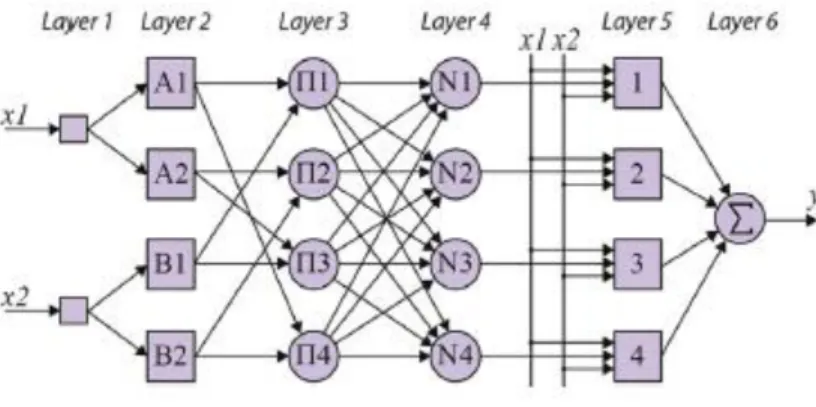
of the most widely used techniques is called the Adaptive Neuro fuzzy System that adopts artificial neural network to tune the the fuzzifier and defuzzifier parameters of the fuzzy system (Rikalovic et al., 2018).Figure 1 : Fuzzy neuro network architecture
The adaptive fuzzy-neuro network consists of six layers, as shown in Figure 1 (Rikalovic et al., 2018).
Layer 1 (Input layer): is the liable layer for taking the imported data. It takes a standard set of criteria (see Table 1) as data.
Layer 2 (Fuzzification layer): This layer is responsible for fuzzifiying the inputs based on a set of membership functions.
Layer 3 (Rule layer): This layer consists of a set of if–then rules expressed in the Takagi–Sugeno model. These rules will be defined by experts.
Layer 4 (Normalized firing strengths layer): This layer is responsible of evaluating every rule.
Layer 5 (Defuzzification layer): This layer consists of removing fuzziness by applying several methods. So, the weighted average defuzzification approach will be applied to this layer.
Layer 6 (Output layer): This final layer computes the final output. In other words, the outputs of the approach are rounded to the nearest integers to reflect the suppliers' ranking score.
4.2.
The Suppliers Decision Making Architecture
The proposed decision-making architecture is based on the adaptive fuzzy neuro network standard. (Figure 2) represents the supplier’s intelligent decision-making architecture including four phases namely the evaluation of supplier performance data (presented in part 3) and fuzzy rules, the adaptive fuzzy neuro network process (described in part 4.1), the classification phase and the final decision phase.
Figure 2 presents the proposed decision-making architecture. In fact, the architecture of the proposed decision-making model is based on the fuzzy neuro network. The used data will be collected by reporting or information systems. This provides a range of details about suppliers: quantitative and qualitative information. In order to choose the correct supplier, the first step to be taken is to produce a number of options and assess the evaluation criteria value for each supplier. Therefore, many relevant experts will be asked to evaluate the set of supplier candidates. Then, the adaptive fuzzy-neuro approach receives a set of supplier criteria (presented in Table 1) and the ranking score for each supplier will be determined. After that, a classification technique will be used, in order to represent the class of suppliers in ascending order. Finally, the highest-ranking supplier is selected based on the classification results obtained by the adaptive fuzzy-neuro approach.
Supplier evaluation and selection constitutes a central issue in supply chain management (SCM). We defined seventeen evaluation criteria considering the three dimensions ‘sustainability’, ‘resilience’, and ‘smartness’ in order to be able to respond to crisis situations. The proposed decision making architecture for supplier selection was conceptualized to choose the optimal supplier for a digital supply chain. It provides classified suppliers. This model can be adaptable for many types of changes that can happen in the value chain. In other words, the adaptive fuzzy-neuro-based system will still work with the same criteria structure when a new supplier comes into consideration or the organization wants to discontinue its partnership with an existing supplier. Moreover, the proposed system is able to be tuned if experts decide to incorporate a new criterion. Likewise, if any variables need to be modified or more rules need to be implemented, the intelligent proposed system can be easily adjusted. Our model can help to reduce the time required for decision making (investment decision for example).
This study contributes to the proposition of a new proposed decision-making architecture for the smart selection of suppliers. In other words, a new criterion evaluation of sustainable, resilient, and smart supplier selection in the context of smart supply chain and crisis situation has been originally explored in this study. The proposed model can provide a valuable support for managers to select appropriate sustainable, resilient, and smart suppliers in line with the development requirements of the smart supply chain. This system can help managers faster to target appropriate suppliers in the preliminary stage of crisis situations.
Conclusion
The adaptive fuzzy-neuro method is more appropriate than other machine learning techniques, such as the fuzzy interference system, based on a sufficient number of training samples. In fact, the adaptive fuzzy-neuro is characterized by the self-adjustment of fuzzy interference rules. This adaptive fuzzy-neuro-based approach model was proposed to choose the optimal supplier in the digital supply chain in crisis situations.
Our study discusses many major points. Firstly, it highlights the necessity of considering ‘resilience’, ‘sustainability’, and ‘smartness’ in supplier selection. Secondly, it proposed a decision-making model based on the adaptive fuzzy-neuro system. This model can be pursued in further work as a roadmap.
As a practical contribution, this study proposes an architecture of decision method for supplier selection that will help improve the selection process and choose the appropriate supplier. The purpose of the innovative human–machine system is to manage classifications under uncertainty. The presented model can be scaled to suit different new criteria.
This study also presents some limitations. Our decision-making model remains to be discussed and reinforced in future studies. Besides, due to the various new risks that could arise in the supply chain 4.0, it is desirable to review the criteria proposed as input of the model so far and consider introducing additional criteria. Also, in the future, measures need to be further developed. Therefore, we will apply the proposed model in an industrial real-case implementation such as an automotive digital supply chain.
References
Alcácer, V., Cruz-Machado, V., 2019. Scanning the Industry 4.0: A Literature Review on Technologies for Manufacturing Systems. Engineering Science and Technology, an International Journal. https://doi.org/10.1016/j.jestch.2019.01.006
Amindoust, A., 2018. A resilient-sustainable based supplier selection model using a hybrid intelligent method. Computers & Industrial Engineering 126, 122–135. https://doi.org/10.1016/j.cie.2018.09.031
Azadnia, A.H., Saman, M.Z.M., Wong, K.Y., Ghadimi, P., Zakuan, N., 2012. Sustainable Supplier Selection based on Self-organizing Map Neural Network and Multi Criteria Decision Making Approaches. Procedia - Social and Behavioral Sciences 65, 879–884. https://doi.org/10.1016/j.sbspro.2012.11.214
Butner, K., 2010. The smarter supply chain of the future. Strategy and Leadership 38, 22–31. https://doi.org/10.1108/10878571011009859
Cavalcante, I.M., Frazzon, E.M., Forcellini, F.A., Ivanov, D., 2019. A supervised machine learning approach to data-driven simulation of resilient supplier selection in digital manufacturing. International Journal of Information Management 49, 86–97. https://doi.org/10.1016/j.ijinfomgt.2019.03.004
Chattopadhyay, M., Sengupta, S., Sahay, B.S., 2016. Visual hierarchical clustering of supply chain using growing hierarchical self-organising map algorithm. International Journal of Production Research 54, 2552–2571. https://doi.org/10.1080/00207543.2015.1101175
Chen, Z., Ming, X., Zhou, T., Chang, Y., 2020. Sustainable supplier selection for smart supply chain considering internal and external uncertainty: An integrated rough-fuzzy approach. Applied Soft Computing 87, 106004. https://doi.org/10.1016/j.asoc.2019.106004
Cheng, Y., Peng, J., Gu, X., Zhang, X., Liu, W., Zhou, Z., Yang, Y., Huang, Z., 2020. An intelligent supplier evaluation model based on data-driven support vector regression in global supply chain. Computers & Industrial Engineering 139, 105834. https://doi.org/10.1016/j.cie.2019.04.047
Cousins, P.D., Lawson, B.R., Squire, B.C., Brown, S., 2005. The effect of supplier manufacturing capabilities on buyer responsiveness: the role of collaboration as a moderator.
Dubey, R., Gunasekaran, A., Childe, S.J., Fosso Wamba, S., Roubaud, D., Foropon, C., 2019. Empirical investigation of data analytics capability and organizational flexibility as complements to supply chain resilience. International Journal of Production Research 1–19.
Dunlap, D., Parente, R., Geleilate, J.-M., Marion, T.J., 2016. Organizing for Innovation Ambidexterity in Emerging Markets: Taking Advantage of Supplier Involvement and Foreignness. Journal of Leadership & Organizational Studies 23, 175–190. https://doi.org/10.1177/1548051816636621
Eltantawy, R.A., 2016. The role of supply management resilience in attaining ambidexterity: a dynamic capabilities approach. Jnl of Bus & Indus Marketing 31, 123–134. https://doi.org/10.1108/JBIM-05-2014-0091
Ganesh Pillai, R., Bindroo, V., 2020. Supplier cluster characteristics and innovation outcomes. Journal of Business Research 112, 576–583. https://doi.org/10.1016/j.jbusres.2019.11.023
Ghadimi, P., Wang, C., Lim, M.K., Heavey, C., 2019. Intelligent sustainable supplier selection using multi-agent technology: Theory and application for Industry 4.0 supply chains. Computers & Industrial Engineering 127, 588–600. https://doi.org/10.1016/j.cie.2018.10.050
Golmohammadi, D., Creese, R.C., Valian, H., Kolassa, J., 2009. Supplier Selection Based on a Neural Network Model Using Genetic Algorithm. IEEE Trans. Neural Netw. 20, 1504–1519. https://doi.org/10.1109/TNN.2009.2027321
Güneri, A.F., Ertay, T., Yücel, A., 2011. An approach based on ANFIS input selection and modeling for supplier selection problem. Expert Systems with Applications 38, 14907–14917. https://doi.org/10.1016/j.eswa.2011.05.056
Guneri, A.F., Kuzu, A., 2009. Supplier selection by using a fuzzy approach in just-in-time: A case study. International Journal of Computer Integrated Manufacturing 22, 774–783. https://doi.org/10.1080/09511920902741075
Guo, X., Yuan, Z., Tian, B., 2009. Supplier selection based on hierarchical potential support vector machine. Expert Systems with Applications 36, 6978–6985. https://doi.org/10.1016/j.eswa.2008.08.074
Hasan, M.M., Jiang, D., Ullah, A.M.M.S., Noor-E-Alam, Md., 2020. Resilient supplier selection in logistics 4.0 with heterogeneous information. Expert Systems with Applications 139, 112799. https://doi.org/10.1016/j.eswa.2019.07.016
Ho, W., Zheng, T., Yildiz, H., Talluri, S., 2015. Supply chain risk management: a literature review. International Journal of Production Research 53, 5031–5069. https://doi.org/10.1080/00207543.2015.1030467
Hosseini, S., Morshedlou, N., Ivanov, D., Sarder, M.D., Barker, K., Khaled, A.A., 2019. Resilient supplier selection and optimal order allocation under disruption risks. International Journal of Production Economics 213, 124– 137. https://doi.org/10.1016/j.ijpe.2019.03.018
Isaksson, A.J., Harjunkoski, I., Sand, G., 2018. The impact of digitalization on the future of control and operations. Computers and Chemical Engineering 114, 122–129. https://doi.org/10.1016/j.compchemeng.2017.10.037 Ivanov, D., 2020a. Predicting the impacts of epidemic outbreaks on global supply chains: A simulation-based
analysis on the coronavirus outbreak (COVID-19/SARS-CoV-2) case. Transportation Research Part E: Logistics and Transportation Review 136, 101922. https://doi.org/10.1016/j.tre.2020.101922
Ivanov, D., 2020b. Viable supply chain model: integrating agility, resilience and sustainability perspectives— lessons from and thinking beyond the COVID-19 pandemic. Ann Oper Res. https://doi.org/10.1007/s10479-020-03640-6
Ivanov, D., Dolgui, A., 2020. Viability of intertwined supply networks: extending the supply chain resilience angles towards survivability. A position paper motivated by COVID-19 outbreak. International Journal of Production Research 58, 2904–2915. https://doi.org/10.1080/00207543.2020.1750727
Jain, N., Singh, A.R., 2020. Sustainable supplier selection under must-be criteria through Fuzzy inference system. Journal of Cleaner Production 248, 119275. https://doi.org/10.1016/j.jclepro.2019.119275
Jia Ju Wu, Gang Liu, Chuan Yu Xi, 2008. The Study on Agile Supply Chain-based Supplier Selection and Evaluation, in: 2008 International Symposium on Information Science and Engineering. Presented at the 2008 International Symposium on Information Science and Engineering (ISISE), IEEE, Shanghai, pp. 280–284. https://doi.org/10.1109/ISISE.2008.25
Kellner, F., Utz, S., 2019. Sustainability in supplier selection and order allocation: Combining integer variables with Markowitz portfolio theory. Journal of Cleaner Production 214, 462–474. https://doi.org/10.1016/j.jclepro.2018.12.315
Kuo, R.J., Wang, Y.C., Tien, F.C., 2010. Integration of artificial neural network and MADA methods for green supplier selection. Journal of Cleaner Production 18, 1161–1170. https://doi.org/10.1016/j.jclepro.2010.03.020 Luan, J., Yao, Z., Zhao, F., Song, X., 2019. A novel method to solve supplier selection problem: Hybrid algorithm
of genetic algorithm and ant colony optimization. Mathematics and Computers in Simulation 156, 294–309. https://doi.org/10.1016/j.matcom.2018.08.011
Moheb-Alizadeh, H., Handfield, R., 2019. Sustainable supplier selection and order allocation: A novel multi-objective programming model with a hybrid solution approach. Computers & Industrial Engineering 129, 192– 209. https://doi.org/10.1016/j.cie.2019.01.011
(Pazirandeh) Arvidsson, A., Melander, L., 2020. The multiple levels of trust when selecting suppliers – Insights from an automobile manufacturer. Industrial Marketing Management 87, 138–149. https://doi.org/10.1016/j.indmarman.2020.02.011
Raisch, S., Birkinshaw, J., Probst, G., Tushman, M.L., 2009. Organizational Ambidexterity: Balancing Exploitation and Exploration for Sustained Performance. Organization Science 20, 685–695. https://doi.org/10.1287/orsc.1090.0428
Rajesh, R., Ravi, V., 2015. Supplier selection in resilient supply chains: a grey relational analysis approach. Journal of Cleaner Production 86, 343–359. https://doi.org/10.1016/j.jclepro.2014.08.054
Rikalovic, A., Cosic, I., Labati, R.D., Piuri, V., 2018. Intelligent Decision Support System for Industrial Site Classification: A GIS-Based Hierarchical Neuro-Fuzzy Approach. IEEE Systems Journal 12, 2970–2981. https://doi.org/10.1109/JSYST.2017.2697043
Stević, Ž., Pamučar, D., Puška, A., Chatterjee, P., 2020. Sustainable supplier selection in healthcare industries using a new MCDM method: Measurement of alternatives and ranking according to COmpromise solution (MARCOS). Computers & Industrial Engineering 140, 106231. https://doi.org/10.1016/j.cie.2019.106231 Taherdoost, H., Brard, A., 2019. Analyzing the Process of Supplier Selection Criteria and Methods. Procedia
Manufacturing 32, 1024–1034. https://doi.org/10.1016/j.promfg.2019.02.317
Tavassoli, M., Saen, R.F., Zanjirani, D.M., 2020. Assessing sustainability of suppliers: A novel stochastic-fuzzy DEA model. Sustainable Production and Consumption 21, 78–91. https://doi.org/10.1016/j.spc.2019.11.001 Tirkolaee, E.B., Mardani, A., Dashtian, Z., Soltani, M., Weber, G.-W., 2020. A novel hybrid method using fuzzy
decision making and multi-objective programming for sustainable-reliable supplier selection in two-echelon supply chain design. Journal of Cleaner Production 250, 119517. https://doi.org/10.1016/j.jclepro.2019.119517 Wątróbski, J., 2019. Ontology Supporting Green Supplier Selection Process. Procedia Computer Science 159,
1602–1613. https://doi.org/10.1016/j.procs.2019.09.331
Yang, C., Chen, B., 2006. Supplier selection using combined analytical hierarchy process and grey relational analysis. Jnl of Manu Tech Mnagmnt 17, 926–941. https://doi.org/10.1108/17410380610688241
Zekhnini, K., Cherrafi, A., Bouhaddou, I., Benghabrit, Y., n.d. Analytic Hierarchy Process (AHP) for supply chain 4.0 risks management .
Biographies
Kamar zekhnini is an E-logistic engineer from ENSIAS, Mohamed 5 University, Rabat, Morocco and a research scholar at LM2I Laboratory, ENSAM, Moulay Ismail University, Meknes, Morocco. Doing PhD in the area of
supply chain management 4.0. The research interests include supply chain management 4.0, industry 4.0, risk management in the 4.0 era, sustainability management, management systems, and supplier selection.
Anass Cherrafi is an Assistant Professor at the Department of Industrial Engineering, ENSAM-Meknes, Moulay Ismail University UMI, Morocco. Holding a Ph.D. in Industrial Engineering, he has seven years of industry and teaching experience. He has published a number of articles in leading international journals and conference proceedings, and has been a Guest Editor for special issues of various international journals. His research interests include Industry 4.0, green manufacturing, Lean Six Sigma, integrated management systems and supply chain management.
Imane Bouhaddou is a professor at the Department of Industrial and Production Engineering, ENSAM, Moulay Ismail University, Meknes, Morocco. Her research interests include industry 4.0, supply chain management 4.0, supply chain complexity, product life cycle management, and risk management.
Youssef Benghabritis a full professor and director of the Center for Doctoral Studies: Research and Innovation for Science Engineer and responsible for scientific research at ENSAM, Moulay Ismail University, Meknes, Morocco. His research interest is statistical modeling and chronic series.
Jose Arturo Garza-Reyes is Head of the Centre for Supply Chain Management and reader in Operations Management and Business Excellence at the Derby Business School, the University of Derby, UK. He has published a number of articles in leading international journals and conferences, and two books in the areas of quality management systems and manufacturing performance measurement systems. He is Co-Founder and Editor of the Int. J. of Supply Chain and Operations Resilience (Inderscience), and has participated as Guest Editor for special issues in various international journals. His research interests include general aspects of operations and manufacturing management, operations and quality improvement and supply chain improvement.