HIGH PERFORMANCE COMMUNICATION
FRAMEWORK FOR MOBILE SINKS
WIRELESS SENSOR NETWORKS
Shih-Hao Chang
A thesis submitted in partial fulfilment of the requirements of
Liverpool John Moores University for the degree of
Doctor of Philosophy
School of Computing and Mathematical Sciences
Liverpool John Moores University
This thesis is dedicated to my
Father Chao Long Chang (1938-2007)
&
ACKNOWLEDGEMENTS
I would like to express my deep felt gratitude to Prof. Madjid Merabti for his patience and guidance and Dr. Hala Mokhtar for her precious help and support during this research. I would also take this opportunity to thank my late father, my mother, my school and college teachers for their guidance and support to enable me to reach this stage in my life. I am also very grateful to my wife Ching-Shan Huang, and my daughter Chih-Ling Chang for their continuous love and support throughout a difficult and trying period in our lives. I would also like to extend my thanks to my sisters Mei-Ling Chang, Mei-Chou Chang and niece Mei-Ling Chen for their support to my family while I was away from Taiwan. I also want to acknowledge my office friends Dr. Paul Fergus and Dr. Omar Abuelma'atti for their encouragement, deliberations and support throughout my PhD studies. I want to thank Dr. John Haggerty and Dr. David Llewellyn-Jones and Mr Rodney Donohoe for those long discussions which helped to overcome difficult periods during my studies. I also want to acknowledge the cooperation of Faycal Bouhafs, Huma Javed, Arshad Muhammad, Gurleen Arora, Robert Hegarty and Kashif Kifayat. Additionally I would like to thank the academic, administrative and technical staff of the School of Computing and Mathematical Sciences. I am particularly grateful to all the people mentioned above in particular and to all those that I have not mentioned that have helped me by their sincere and continuous support throughout the course of my Ph.D.
I want to dedicate this thesis to my late father Chao-Long Chang and mother Nan-Tzu Wen who has been a source of inspiration, selfless love and devotion throughout my life.
ABSTRACT
A wireless sensor networks typically consist of thousand of nodes and each node has limited power, processing and bandwidth resources. Harvesting advances in the past decade in microelectronics, sensing, wireless communications and networking, sensor networks technology is expected to have a significant impact on our lives in the twenty-first century. Proposed applications of sensor networks include environmental monitoring, natural disaster prediction and relief, homeland security, healthcare, manufacturing, transportation, and home appliances and entertainment. However, Communication is one of the major challenges in wireless sensor networks as it is the main source for energy depletion. Improved network lifetime is a fundamental challenge of wireless sensor networks.
Many researchers have proposed using mobile sinks as one possible solution to improve the lifetime of wireless sensor networks. The reason is that the typical many-to-one communication traffic pattern in wireless sensor networks imposes a heavy forwarding load on the nodes close to the sinks. However, it also introduces many research challenges such as the high communication overhead for updating the dynamic routing paths to connect to mobile sinks and packet loss problems while transmitted messages to mobile sinks. Therefore, our goal is to design a robust and efficient routing framework for both non-geographic aware and geographic aware mobile sinks wireless sensor networks.
In order to achieve this goal in non-geographic based mobile sinks wireless sensor networks, we proposed a spider-net zone routing protocol to improve network efficiency and lifetime. Our proposed routing protocol utilise spider web topology inspired by the way spiders hunt prey in their web to provide reliable and high performance data delivery to mobile sinks. For routing in geographic aware based mobile sinks wireless sensor networks, we proposed a fault-tolerant magnetic coordinate routing algorithm to allow these network sensors to take advantage of geographic knowledge to build a routing protocol. Our proposed routing algorithm incorporates a coordinated routing algorithm for grid based network topology to improve network performance. Our third contribution is a component level fault diagnosis scheme for wireless sensor networks. The advantage of this scheme, causal
model fault diagnosis, is that it can "deeply understand" and express the relationship among failure behaviours and node system components through causal relations.
The above contributions constitute a novel routing framework to address the routing challenges in mobile sinks wireless sensor networks, Our framework considers both geographic and non-geographic aware based sensor networks to achieve energy efficient, high performance and network reliability. We have analyzed the proposed protocols and schemes and evaluated their performances using analytical study and simulations. The evaluation was based on the most important metries in wireless sensor networks, such as: power consumption and average delay. The evaluation shows that our solution is more energy efficient, improves the network performance, and provides data reliability in mobile sinks wireless sensor networks.
TABLE OF CONTENTS
ACKNOWLEDGEMENTS ...•••..•...•...•...•.•...•.••.•...•...••...•.•.• iii ABSTRACT ... iv TABLE OF CONTENTS ... vi LIST OF FIGURES ... ix LIST OF T ABLES ... xi 1 INTRODUCTION ... 11.1 Wireless Sensor Nodes Hardware ... 4
1.2 Salient Features of Wireless Sensor Networks ... 7
1.3 Problem Definition ... 8
1.4 Scenarios ... 9
1.5 Research Objectives ... 10
1.6 Novel Research Contributions ... 11
1.7 Thesis Structure ... 13
2 MOBILE SINKS WIRELESS SENSOR NETWORKS BACKGROUND ... 15
2.1 Wireless Sensor Networks Applications ... 19
2.2 General Requirements for Wireless Sensor Networks ... 21
2.3 Mobile Sinks Wireless Sensor Networks ... 23
2.3.1 Hierarchical Architecture and Operation Mode ... 24
2.3.2 Sink Mobility Models ... 25
2.4 2.4.1 2.4.2 2.5 2.5.1 2.5.2 2.5.3 2.6 2.6.1 2.6.2 Wireless Communication Networks ... 28
Wireless Communications ... 29
Communication in Wireless Ad hoc Networks ... 30
Routing Protocols in Wireless Ad hoc Networks ... 31
Proactive Routing ... 31
Reactive (On-demand) Routing ... 32
Hybrid Routing ... 34
Routing Protocols in Wireless Sensor Networks ... 36
Data-Centric Routing Protocols ... 37
Hierarchical Clustering Routing Protocols ... 40
2.6.3 Geographical Routing Protocols ... 43
2.7 Routing Protocols for Mobile Sinks Wireless Sensor Networks ... 49
2.7.1 Geographic Based Routing Protocols for Mobile Sinks Wireless Sensor Networks ... 50
2.7.2 Non-Geographic Based Routing Protocols for Mobile Sinks Wireless Sensor
Networks ... 53
2.8 Fault Tolerance in Wireless Sensor Networks ... 55
2.9 Summary ... 59
3 HIGH PERFORMANCE COMMUNICATION FRAMEWORK FOR MOBILE SINKS WIRELESS SENSOR NETWORKS ... 61
3.1 Motivation and Design Challenges ... 64
3.l.l Routing in Non-Geographic Aware Mobile Sinks Wireless Sensor Networks ... 66
3.1.2 Routing in Geographic Aware Mobile Sinks Wireless Sensor Networks ... . ... 67
3.1.3 Component Level Fault Tolerance Mechanisms in Wireless Sensor Networks ... 69
3.2 Mobile Sinks Routing Mechanisms for Communication ... 70
3.2.1 Scalable Routing Topology for Non-Geographic Based Mobile Sinks Wireless Sensor Networks ... 71
3.2.2 A Fault-Tolerant Coordinate Routing Protocol for Geographic Based Mobile Sinks Wireless Sensor Networks ... 72
3.2.3 A Causal Model Based Fault-Diagnosis Algorithm in Wireless Sensor Networks ... 73
3.3 Simulation Environment ... 74
3.4 Summary ... 76
4 SPIDER-NET ZONE ROUTING PROTOCOL FOR MOBILE SINKS WIRELESS SENSOR NETWORKS ... 78
4.1 Problems and Limitations ... 79
4.2 Spider-Net Zone Routing Protocol. ... 81
4.2.1 Concepts and Assumptions ... 81
4.2.2 Spider-Net Zone Topology Mechanism ... 82
4.2.3 Minimum Response Time Node Selection (MRTNS) ... 85
4.2.4 Spider-Net Data Dissemination Mechanism ... 86
4.3 Discussion ... 90
4.4 Evaluation ... 90
4.4.1 Average Energy Consumption ... 91
4.4.2 Average Delay ... 92
4.4.3 Average Packet Success Ratio ... 93
5 FAULT TOLERANCE MAGNETIC COORDINATE ROUTING FOR MOBILE
SINKS WIRELESS SENSOR NETWORKS ... 96
5.1 Background ... 98
5.2 Fault Tolerance Magnetic Coordinate ... 100
5.2.1 5.2.2 5.2.3 5.2.4 5.3 5.4 5.4.1 5.4.2 5.4.3 5.4.4 Assumptions: ... 100
Virtual Grid Zone Construction ... 10 1 Magnetic Coordinate Data Dissemination ... 103
Consensus-based Fault Tolerance Algorithm ... 107
Discussion ... III Evaluation ... 112
Average Energy Consumption ... 112
Ends-to-End Delay ... 113
Average Success Ratio ... 114
Fault-Tolerance Evaluation ... 115
5.5 Summary ... 116
6 A CAUSAL MODEL METHOD FOR FAULT DIAGNOSIS IN MOBILE SINKS WIRELESS SENSOR NETWORKS ... 117
6.1 6.2 6.2.1 6.2.2 6.2.3 6.4 6.4.1 Background ... 119
A Generic Fault Tolerance Architecture ... 121
Reputation Checker ... 123
Ontological Manager ... 124
Action Planner ... 127
Evaluation ... 129
Fault Injection ... 129
6.4.2 Average Success Ratio ... 131
6.3 Summery ... 134
7 CONCLUSION AND FUTURE WORK ... 135
7.1 Thesis Summary ... 135
7.2 Research Contributions ... 138
7.3 Comparison to Existing Work ... 139
7.4 Future Work ... 142
7.5 Concluding Remarks ... 143
LIST
OF
FIGURES
Figure 1.1 : The Sensor Node Hardware Architecture ... 4
Figure 1.2 : A Scenario View of Mobile Sink Wireless Sensor Networks ... 10
Figure 2.1 : Wireless Sensor Networks Applications Diagram ... 15
Figure 2.2 : Tsunami Propagation Cause and Phenomenon ... 20
Figure 2.3: Three-Tiered Mobile Sinks Wireless Sensor Networks with Cluster Structure ... 25
Figure 2.4 : A Sketch Map of Mobile Sinks Mobility Model ... 27
Figure 2.5 : Basic Wireless Communication Model.. ... 30
Figure 2.6 : DSDV Routing Protocol Diagram ... 32
Figure 2.7 (a) (b) (c): AODV Routing Protocol Diagram ... 34
Figure 2.8: SPIN Routing Protocol Diagram ... 37
Figure 2.9 (a) (b) (c): Direct Diffusion Routing Protocol Diagram ... 38
Figure 2.10: Chaining in PEGASIS Routing Protocol ... : ... 42
Figure 2.11 : Hierarchical Clustering in TEEN & APTEEN ... 43
Figure 2.12 : State Transitions Diagram in GAF Routing Protocol ... 44
Figure 2.13: Recursive Geographic Forwarding in GEAR Routing ProtocoL ... 46
Figure 2.14 : A Diagram of Data Forwarding in ODDD Data Announcement ... 58
Figure 2.15 : An Example of a Causal Analysis of Fault Events ... 58
Figure 3.1 : Proposed Routing Framework ... 76
Figure 3.2 : GTSNetS Simulation Environment.. ... 76
Figure 4.1 : Spider-Net Radial-Ring Network Topology ... 81
Figure 4.2 : Minimum Response Time Node Selection Mechanism ... 85
Figure 4.3 : Spider-Net Zone Topology Construction ... 83
Figure 4.4 : Intra-Spider-Net Zone Routing Diagram ... 84
Figure 4.5 : Inter-Spider-Net Zone Routing Diagram ... 88
Figure 4.6 : Spider-Net Zone Routing Average Energy Consumption ... 92
Figure 4.7 : Spider-Net Zone Routing Average Delay ... 93
Figure 4.8: Spider-Net Zone Routing Average Packet Success Ratio ... 94
Figure 5.1 : Virtual Grid Zone Construction Diagram ... 102
Figure 5.2 : Magnetic Coordinate Data Dissemination Scheme ... 105
Figure 5.3: Reverse Data Path Diagram ... 106
Figure 5.4 (a) (b): Challenge Message & Response Message Routing Diagram ... 108
Figure 5.5 : Consensus-Based Fault Tolerance Algorithm Diagram ... 111
Figure 5.6: Fault Tolerance Magnetic Coordinate Average Energy Consumption Diagram 113 Figure 5.7: Fault Tolerance Magnetic Coordinate Average End-to-End Delay Diagram .... 114
Figure 5.8 : Fault Tolerance Magnetic Coordinate Average Success Ratio Diagram ... 114
Figure 5.9: Fault Tolerance Comparison with 5 Faulty Grid Nodes ... 115
Figure 5.10 : Fault Tolerance Comparison with 10 Faulty Grid Nodes ... 115
Figure 5.11 : Fault Tolerance Comparison with 15 Faulty Grid Nodes ... 116
Figure 5.12: Fault Tolerance Comparison with 20 Faulty Grid Nodes ... 116
Figure 6.1 : The Sensor Node Hardware Architecture ... 122
Figure 6.2: Illustration of Fault Taxonomy Tree ... 125
Figure 6.3 : Illustration of Casual Model Method (CMM) Fault Diagnosis ... 128
Figure 6.4 : Pseudo Code for CMM Fault Tolerance Mechanism ... 130
Figure 6.5 (a) - Average Success Ratio without CMM ... 131
Figure 6.5 (b): Average Success Ratio with CMM Average Ends-to-End Delay ... 131
Figure 6.6 (a): End-to-End Delay without CMM ... 132
Figure 6.6 (b): End-to-End Delay with CMM Average Energy Dissipation ... 132
Figure 6.7: Energy Dissipated Comparison ... 133
LIST OF TABLES
Table 2.1: Routing Table at Node A ... 32 Table 2.2: Classification of Routing Protocols in Wireless Sensor Networks ... .47 Table 2.3: Geographic Based and Non-Geographic Based Routing Protocols Comparison in Mobile Sinks Wireless Sensor Networks ... 54
CHAPTER
1
1
INTRODUCTION
In many situations, users might be interested in gathering information about specific physical phenomena and want to continuously retrieve information about the monitoring object while in motion. Therefore, a new kind of wireless network has appeared in the last few years; Wireless Sensor Networks (WSN). WSN technology is highly anticipated as one of the most promising technologies in the next decade due to its potential applications such as home appliances, intelligent security, medical telemetry, disaster relief, environment monitoring and military surveillance. These applications are resulting from advances in micro-electro-mechanical systems (MEMS), signal processing, wireless communications and networking which led to the development of smart sensors. These smart sensors are expected to be remotely deployed in large numbers and to operate autonomously in unattended environments providing a vision of "Ambient Intelligence" [M.Abdur'09].
In an ambient intelligence environment, devices can cooperate together to support people in carrying out their everyday life activities, in easy, natural ways using information and intelligence that is hidden in the network connecting these devices. In these circumstances, a critical wireless technology needs to coordinate a large number of wireless sensing devices. All sources of information have to collaborate in providing as precise a picture of the real world as is required and transfer information to the place where it is needed. Like many WSN application scenarios, such a network will normally consist of hundreds or thousands of such unattended sensing nodes that communicate through wireless channels for information sharing and cooperative processing.
These unattended wireless sensor nodes are expected to have significant impact on the efficiency of many military and civil applications such as combat field surveillance, security and disaster management. Networking sensor nodes can assist in
gathering geographical and meteorological variables such as position, temperature and humidity. For example, in combat field surveillance, the use of networked sensors can limit the need for personnel involvement in dangerous reconnaissance missions. These sensor nodes in military applications can be used to detect moving targets, chemical gases, or the presence of micro-agents. In disaster management situations such as earthquakes, sensor networks can be used to selectively map the affected regions directing emergency response units to survivors.
As the sensor nodes are small in size, each is only capable of a limited amount of processing. Energy consumption in a sensor node is a dominant consideration due to small and finite sources of energy. In order to make optimal use of this energy, communications should be minimized as much as possible. Many solutions, both hardware and software related, have been proposed to optimize energy usage. Moreover, sensor nodes are deployed in regions which have no infrastructure and have no human intervention which require nodes to be responsible for self-connectivity and self-reconfiguration in case of changes. In addition, in many cases, multiple sensor nodes are required to overcome environmental obstacles like obstructions, line of sight constraints and etc ... In most cases, the environment to be monitored does not have an existing infrastructure for either energy or communication. It therefore becomes imperative for sensor nodes to survive on small, finite sources of energy and communicate through a wireless communication channel.
Sensor nodes differ from nodes in an ad hoc network in the communication pattern: while ad hoc network nodes may contact any other node in the network, sensors nodes send data only to the data collection node, i.e. the "sink". Sink nodes can be static or mobile and are responsible for collecting the data from all sensor nodes. This should be achieved in a fair way. The range of the sensors' radio signal is in general quite short, thus multi-hop communication is needed between source sensor nodes and sinks. As a result, the volume of traffic in the network is focused in the neighbourhood of the sinks. Subsequently, those sensor nodes in the neighbourhood of static sinks have their energy resources depleted. This also means that the lifetime of the network depends on these critical nodes. To overcome this limitation, "Mobile Sinks" can be used in different scenarios. Examples of mobile sinks are PDAs,
laptops carried by users to gather sensor readings, or process and aggregate sensed data from the local environment.
Different from a typical WSN, mobile sinks wireless sensor networks (MSWSN) consist of a large number of sensors with several mobile monitoring terminals, called mobile sinks. This promising solution would enhance performance, extend network lifetime and facilitate congestion avoidance by routing data to a nearby mobile sink. However, it also introduces many problems and research challenges such as the high communication overhead for updating the dynamic routing paths to connect to a mobile sink, and require a reliable data transport scheme because of sink mobility. Several applications can use MSWSN. For example, a fire fighter collects wind direction information, temperature, and weather conditions from a WSN deployed in the scene of a forest fire. The fire fighter collects the sensed information by using a PDA to monitor the current situation to reduce the damage of the wildfires and also maintain data communication. The sensor nodes around the fire fighters can relay temperature related measurement values to track current forest fire situations. Some solutions have been proposed, for example [J.Youn'04] [R.R.Kalva'05] [Khanna'07] [Stefano'08] [Yanzhong'09], for routing data in such scenarios.
Another major issue for WSN is fault tolerance. Since sensor nodes are typically operated with limited energy and deployed in a harsh environment that suffers numerous attackers such as a malicious node attack, fault tolerance becomes vitally important for wireless sensor networks. It can gracefully respond to unexpected failure and properly enable the system to operate continually. However, the drawbacks of existing fault tolerance mechanisms are that they are very complex and consume too much energy and code compiling resources. Therefore, how to implement low cost and highly reliable fault tolerance mechanisms is one of the key issues in WSN.
This thesis addresses the communication and routing mechanisms required to provide high performance and fault-tolerance for MSWSN applications. In this chapter, we first describe the potential applications for WSN and the problems of designing a high performance routing mechanism. We then present the objectives and contributions of this research.
1.1 Wireless Sensor Node
s
Hardware
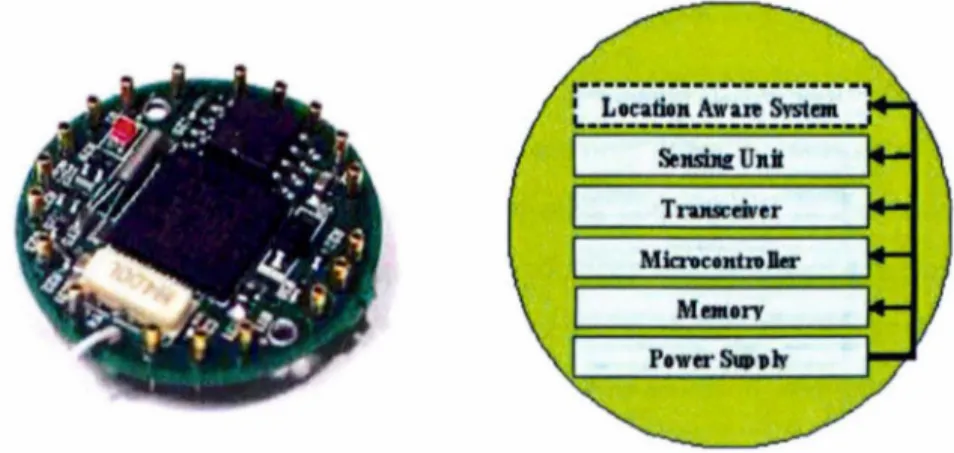
Recently, micro-electro-mechanical systems (M MS) technology has made many promise to revolutionize nearly every product category (e.g. automotive electronics, medical equipment, smart pOl1able electronic, computer peripheral , and wireles devices, etc.). This technol gy enable WS for many monitoring, surveillance and control application . Vitally, thi technology reduce. the cost, ize and power consumption of sensor nodes to an acceptable quality. A Fig.l-I b low show, a sen or node generally compri e integrated hardware (microcontroller, sen ing unit, memory, power supply and transceiver), and al 0 includes oftware (power management, y tem management, and configuration mechanisms). Moreover, because of their mall size, low co t, and low power con umption, communication between units can be u ed to bui Id up a network or 'me h' of sensors. There are a number of research projects that focu on hardware compon nt of wireles. sen. or nodes which specialize in hrinking the ize, energy consumption, and co t , ba ed on the use of off-the-sh If component . However, in thi thesi , we focu on the networking aspect of WSN. For the ake of completeness, the discussion begin by pre enting a proce sor specifically designed for sensor networks.
~.---~-, L_!-_'!!!'-.!_~!!!!.~~_-,
Sea-Vall T l'UllCeirer
Figure 1.2 : The en or Node Hardwar Architecture
en ing Unit: A en ing unit i the int rface that mea ures the phy ical data of the area to b monitored. Thi sen ing unit' ta k i to ample phy ical ignal and convel1 analogue ignal t digital one . The continual analogue ignal en ed i digitized by an Analogue-t -Digital onvel1er (AD ) and ent to controller for further proce ing. Characteri tic and requirements of sen or node hould b mall
size, consume extremely low energy, perfonn in high volumetric densities, and operate in unattended environments. Each sensor node has a certain area of coverage for which it can reliably and accurately report the phenomena that it is observing. Moreover, sensors are classified into two categories; passive and active. Passive sensors sense the data without interacting with the environment and only sample the analogue signal. Active sensors are actively probing the environment, for example, a sonar or radar sensor which generates shock waves to detect target objects.
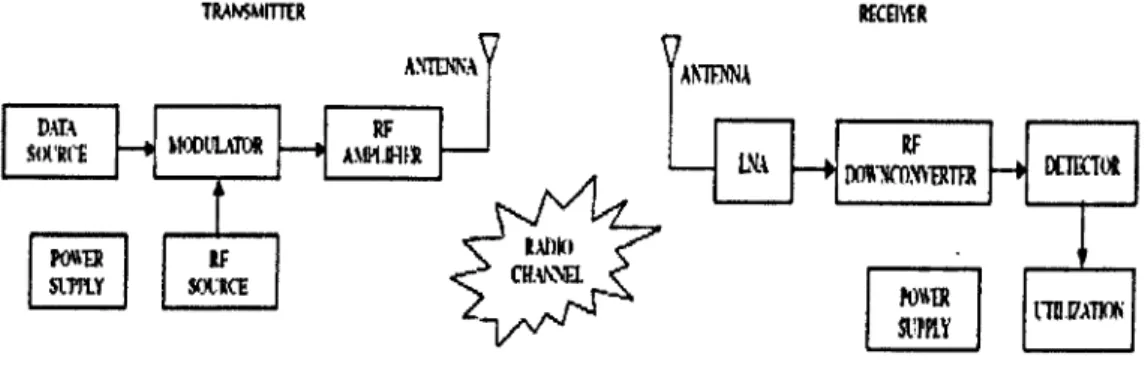
Transceiver: Each wireless sensor node includes a wireless communication module to interact with other nodes. The functionality of a transceiver is provided by combining both transmitter and receiver into a single device. This transceiver has various choices of wireless transmission media such as Radio Frequency (RF), Optical communication (Laser) and Infrared. RF based communication is the most relevant that fits to most of the WSN applications due to its free use, huge frequency spectrum allocation and global availability. Compared to other devices in the sensor node, the radio module consumes the largest amount of power in the node system. If the radio module has a low-power listen mode or intennittent sleep mode and short message transmit times, it will allow the sensor node's lifetime to be extended. So power trade-offs and antenna selection is important for radio perfonnance optimization and must be considered when choosing a transceiver.
Microcontroller: A microcontroller controls the operation of the entire sensor node. The main task of the microcontroller is to take readings from its transceiver, perfonn data processing and control the functionality of other components in the sensor node. Because of their flexibility to connect to other devices and are often programmable, they can coordinate with other devices to monitor incoming signals, perfonn data processing and decide whether to send out a message or switch to sleep mode.
Memory: There are two different types of memory in WSN; Random-Access Memory (RAM) and Read-Only Memory (ROM). The RAM is to store data and interim results. RAM memory used for allowing fast access to results in computations and Non Volatile Random-Access Memory (NVRAM) to store results during power down. RAM also saves space in embedded applications. Different from RAM, ROM provides storage to hold both the program and the data. ROM can contain programs and fixed configuration data. Current research prefers an "All in One" approach based on NVRAM with high speed read time and fast write time.
Power Supply: The power supply is one of the most important components because it provides the energy for sensing, communication and data processing. Energy expenditure is less for sensing and data processing but more for data communication. From a power consumption point of view, processing is a much cheaper operation than transmitting [L. Doherty'OI]. The energy cost of transmitting 1 Kb a distance of 100 m is approximately the same as that for the execution of 3 million instructions by a 100 million instructions per second/watt processor. Batteries are the main source of power supply for sensor nodes. There are two types of battery; chargeable and non-rechargeable. Current sensors are able to extend their lifetime by energy saving or renewing their energy from acoustic energy, thermal energy, vibration energy or solar energy.
Location Aware System: This location aware system is an important optional component which provides geographical location information for sensor network applications. This requires network functionalities designed with an emphasis on spatial/location aspects. A key feature that makes WSN different from traditional networks is they can be viewed as a bridge to the physical world. In location aware WSN or named geographic based WSN, each sensor node is able to obtain its location information through an equipped GPS processor [Patwari'02] or some localization techniques [C. Wang'05]. There are a variety of localization systems and techniques for WSN that will be introduced, such as sensor nodes equipped with a GPS signal receiver (with tradeoffs in cost, complexity and energy consumption) or that acquire their geographical locations without GPS. However, by leverage with cost, complexity and energy consumption, sensor nodes are able to detect and monitor the actual physical phenomena at geographical locations which are very useful in object tracking applications in WSN.
Each of these components has to operate whilst balancing the trade-off between low energy consumption on the one hand and the need to fulfill their tasks on the other. For example, both the communication device and the controller should be turned off as long as possible. To wake up again, the controller could, for example, use a preprogrammed timer to be activated. Alternatively, the sensors could be programmed to raise an interrupt if a given event occurs - say, a temperature value exceeds a given threshold or the communication device detects an incoming
transmission. Such preprocessing can be highly customized to the specific sensor yet remain simple enough to run continuously, resulting in improved energy efficiency.
1.2 Salient Features of Wireless Sensor Networks
In the previous section we discussed the hardware of sensor networks. In this section, we study some of the salient features of wireless sensor networks.
Sensor Limitation - In many sensor networks, sensor nodes have restricted power (probably a few hundred mAh), limited computing capability, small memory (probably a few hundred Kbytes of RAM), low data transmission rates (up to 20 Kbps) and limited communication range (10-50 meters) [Hill'OO]. These limitations have a direct impact on the functioning of the network as a whole and different protocols have to be designed to take into account these limitations. To compensate for this resource limitation, energy-efficient operation is a key technique.
Densely Deployed - Different from traditional network applications, a large number of nodes are deployed. The number of nodes can be from a few hundred to hundreds of thousands depending on the application. From a network viewpoint, a network consisting of a large number of sensor nodes will require nodes to act as relay nodes to avoid using long-distance antenna which has high power consumption. Hence, multi-hop communications will be a particular feature of WSN to improve the energy efficiency of communication.
Data Centric Addressing - In traditional networks, data communication between two specific devices is enabled as each device has the others network address. When users want to query data from a network, typically, they need to know where the data is. The aim of a sensor network is to collect events occurring in the sensor field and produce a different networking viewpoint from traditional networks. This introduces a new networking dimension from a node-centric to a data-centric network. Moreover, sensor nodes are densely deployed which leads to similar sensed and replicated data from neighbouring nodes. In this case, the data-centric approach is closely related to query concepts known from databases; it may also combine well with collaboration, in-network processing, and aggregation. Especially in resource-limited wireless
sensor networks, sensor nodes in a data-centric network will need to co-operate and the sensed data will require aggregation.
1.3 Problem Definition
Unlike traditional networks, where the focus is on maximizing channel throughput or minimizing node deployment, the major consideration in a wireless sensor network is to extend system lifetime, improve network performance and enhance system robustness. Because of the low cost tiny devices used the operation of the network is highly energy sensitive. The system lifetime of the network largely depends on the energy of the sensor nodes nearest the sink(s) that relay all messages on the last hop. Therefore, to overcome this limitation, the mobile sink(s) could move away from depleted areas. However, mobility raises several routing issues. Thus, new protocols are required to provide efficient routing between the source nodes and the mobile sink.
First, energy efficiency is a dominant consideration. As mentioned before, this is because sensor nodes only have a small and finite source of energy. Many solutions, both hardware and software related, have been proposed to optimize energy usage. Since network topology will change more frequently in MSWSN, previously used routing protocols for traditional WSN will not be adaptable. Consequently, a new routing mechanism is required to reduce the communication costs in deciding the routing technique to be used.
Second, in many WSN applications, it is desirable that users do not experience a substantial amount of delay after they request sensor data. However, in many wireless sensor network applications, a large number of nodes are deployed within a certain geographical area. The main challenge is how to provide a high performance data dissemination mechanism in large scale sensor networks, in order to maintain network and network conditions. Hence, routing in large scale sensor networks needs to be scalable with high network performance routing mechanism to achieve user I application requirements.
Third, during the routing process, the sink can be stationary or mobile. This property of the sink will affect the routing protocol, since all nodes in the network
cannot be continuously aware of the current position of the sink and the routing mechanism needs to find the mobile sink. Moreover, the routing topology created by a routing protocol may greatly vary in time to cause extra overhead in the network layer. Hence, the new routing protocol should provide a light-weight and robust routing mechanism to support the efficiency-robustness tradeoff for routing in mobile sink wireless sensor networks.
Finally, since these sensor nodes are typically operated with limited energy, computing, communication capabilities, and randomly deployed in harsh environment, they are likely to suffer numerous attacks. These limitations and attacks render WSN more prone to failure than in conventional wireless networks. Therefore, a reliable and energy efficient error-handling mechanism is required to ensure the robustness of the sensor network, which can avoid failures and break the hierarchical connectivity assumption.
1.4 Scenarios
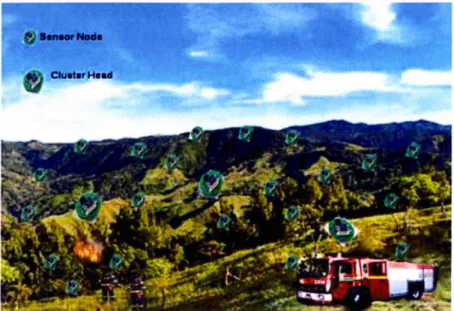
To motivate our research, we consider a target scenario which is the fire rescue services facing a forest fire. Typically, sensor nodes are deployed randomly (e.g., via aerial deployment), and are expected to self-organize to form a multi-hop network. These sensor nodes will cooperate with a fire fighting team to group as an early alarm and fire rescue system. Normally, a fire fight team may consist of a set of firefighters, a few fire engines and at least one incident commander vehicle. During the process of forest fire rescue, the incident commander vehicle is in charge of the whole operation, including sensor data collecting and monitoring the fire. A mobile sink, in this scenario, can be any data collection terminal device carried by firefighters, fire engines or an incident commander vehicle to gather sensor readings from the monitoring region. Fig. 1-2 presents a view offorest fire field scenario.
In this scenario, the fire fighting team is more concerned with physical phenomena associated with geographicallocation(s)/region rather than raw readings of some specific sensor nodes. For instance, the incident commander is more likely to request information such as "tell me the current temperature in zone 36" instead of "tell me the current temperature readings at sensor nodes 2, 3, 11, and 16". Based on
the geographical location information, the incident commander can better arrange and control the fighting team. For example, he can find firefighters with some specialty functions and send them to where they are needed. Due to the importance of geographical location information, sensor nodes equipped with a GPS signal receiver are able to support some systems such a Geographic Information System (GIS) to provide a clear view of the fire situation.
au.t.rH ....
Figure 1.2 : A cenario View of Mobile Sink Wireless Sensor Networks
1.5
Re
earch
Objective
s
The goal of thi re earch is to design a robust and energy efficient routing protocol that satisfies MSWSN requirements. This routing prot col must be able to extend the system lifetime of MSWSN and provide reliable and high perfonnance data delivery to the user. Thi goal will be achieved via the following detailed objectives:
>-
Energy Efficiency: In many WSN cenarios, sensor nodes' power will have to rely on a limited upply of energy ( uch as batteries) and to replace these energy sources in the sen or network field is usually not practical. Radio communication consume the most energy on the sensor node; therefore, how to design energy efficient routing mechanism for M WSN become one of the principle is ues in MSWS .~ Network Performance - As the number of sensor nodes increases, network latency and packet collision become significant factors which defeat the purpose of data transmission. However, mobile sinks wireless sensor networks applications are typically time-sensitive, so it is important to design a new routing algorithm which is able to reduce communication overhead and provide high performance in MSWSN.
~ Fault Tolerance: Due to the low-cost and low-power, sensor nodes are normally deployed in remote hostile territory and are susceptible to attacks from many sources. Fault tolerance becomes vitally important for wireless sensor networks because it is able to respond to unexpected failures enabling the system to continue to operate. However, the drawbacks of current fault tolerance mechanisms are that they will consume large computing resources if high complexities of fault tolerance mechanisms are implemented. Therefore, how to implement low cost and high reliability fault tolerance mechanisms needs to be resolved.
1.6 Novel Research Contributions
In this thesis, we present a new communication framework for wireless sensor networks based on mobile sinks. We propose a novel communication solution that consists of new routing algorithms and mechanisms in order to address the emphasized challenges and achieve our research objectives. Our contributions can be summarized as follows:
• A Routing Topology for Non-Geographic Aware Mobile Sinks Wireless Sensor Networks:
We put forward a new routing topology for sensor networks that provides a concentrated data dissemination algorithm in MSWSN [Chang'07-a, Chang'07-b]. It is inspired by a spider building a web topology that can provide high performance, energy efficiency and reliability to routing in MSWSN. Our algorithm provides a spider-net zone routing topology to improve network efficiency. Instead of changing the whole routing path when the mobile sink moves, this routing mechanism builds a spider-net routing
topology based upon the location of the reference node. Moreover, as sensor networks are prone to node failure by hardware, software or an environmental issue, this mechanism therefore also has connection link redundancy incorporated to increase reliability. The main idea of this connection link redundancy is to ensure that node failure will not impact on data dissemination processes, thus guaranteeing that mobile sinks gather data from proper cluster heads only.
• A Fault Tolerance Coordinate Routing Algorithm for Geographic Aware Based Mobile Sinks Wireless Sensor Networks:
We present a fault-tolerant coordinate routing algorithm based on geographic aware in MSWSN [Chang'07-c, Chang'07-d]. The proposed scheme uses the concept of hierarchical sensor networks where nodes have more energy resources and are able to acquire their geographical location. Thus they are more capable of data aggregation and for long-range communication. The network nodes take advantage of geographic knowledge to build a routing protocol. This routing algorithm incorporates a coordinate routing algorithm on grid based network topology to improve network performance. Moreover, since sensor networks are prone to failure because of node malfunction, and network environmental issues, the proposed solution also provides a simple network connection fault tolerance mechanism to increase reliability. The main idea of this fault tolerance mechanism is to ensure mobile sinks gather "correct" data from proper cluster heads only.
• A Causal Model Based Fault-Diagnosis Algorithm in Wireless Sensor Networks:
We consider the component-level failure from the sensor nodes in WSN [Chang'09]. Due to their small size, low cost and high density sensor nodes are normally deployed in harsh and unremitting environments. It is therefore not uncommon for the sensor nodes to malfunction. These sensor nodes may suffer from system, resource, and/or communication faults which result in sensor node abnormal behaviour. Therefore, it is desirable that nodes can have a fault tolerance capability. The advantage of the Causal Model Method is that it can "deeply understand" and express the relationship among failure
behaviours and node system components through causal relations. The proposed method uses a reputation checker, ontology manager and action planner schemes to provide an efficient fault tolerance algorithm in WSN.
1.7 Thesis Structure
The thesis is structured as follows:
Chapter 1 introduces the problem of communication in WSN. It outlines the salient features of wireless sensor networks and the requirements based on their inherent limitations. We highlight the resource constraints of WSN and the need of new energy efficient and application specific routing protocols for mobile sinks wireless sensor networks. Then, we describe the four major issues in routing for mobile sinks wireless sensor networks. Finally, we outline the aims and the contributions of our work and the structure of the thesis.
Chapter 2 surveys the existing routing and communication protocols for wireless networks in general and wireless sensor networks in particular. This chapter presents a background on WSN with mobile sinks, data dissemination mechanisms and fault tolerance algorithms. In this chapter, we also describe the mobile ad hoc network routing algorithms we used as a basis for our work.
Chapter 3 presents the proposed communication mechanism and our framework for designing a fault-tolerant routing algorithm. It presents an overview of the proposed communication mechanisms and describes the role of each component. We will demonstrate how we integrate these components to reach the goals of our project and provide a roadmap for the subsequent chapters.
Chapter 4 presents the details of our novel network routing topology for non-geographic aware MSWSN to improve network efficiency. This chapter describes the design of this protocol and demonstrates its advantages through simulation.
Chapter 5 presents our fault tolerance coordinate routing scheme for geographic aware MSWSN. We compare the conditions that affect the power nodes (cluster heads) failures in WSN without a fault tolerant mechanism through simulations compared to the effectiveness of our scheme. In this chapter, we also show how our guarantee scheme performs in order that mobile sinks gather "correct" data only from proper cluster heads.
In chapter 6, we describe a generic fault diagnosis algorithm which considers the component-level failure from the sensor nodes in wireless sensor networks. This chapter expresses the relations among the failure behaviour and node system components through causal relations.
Chapter 7, we summarize our work. We conclude the findings and the problems that we have encountered before, discussing the major issues and future work in the area of MSWSN.
CHAPT
E
R
2
2
MOBILE SINKS WIRELESS SENSOR NETWORKS
BACKGROUND
A wireless ensor network (WSN) consists of a number of microcontroll er-integrated smart devices called sensors. Each sensor has sensing, processing, transmission and power propertie . Sensors deployed in an application field are automatically controlled to form a virtual organization. The sensing unit measure ambient conditions and tran forms them into an electrical signal. Each sensor node is capable of only a limited amount of processing. Transmission units forward the data to its neighbour u ing multi-hop wireless network technologies. Combining the outputs retrieved from the individual sensor node, the user can precisely and reliably m nitor the studied environment from a remote site.
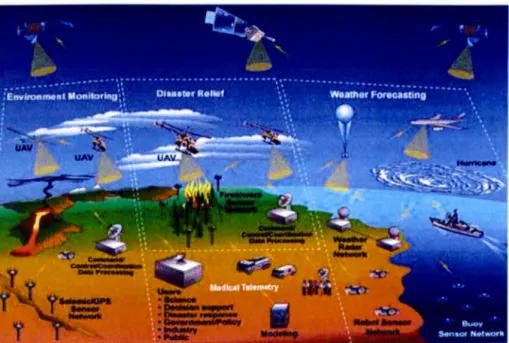
There are many exciting applications based on WSN functionality, such as military, environmental, health, home and commercial applications [Akyildiz'02] [Stojmenovic'05]. Figure 2.1 shows four typical applications of WSN (environment monitoring, disaster relief, weather forecasting and medical telemetry), and each can be monitored. These specific applications of WSN are different from other wireless networks such as WLAN or ad hoc networks and introduce a number of unique technical challenges as listed below:
• Large Numbers: In many WSN applications, large numbers of densely distributed nodes are deployed. Potentially, large amounts of sensing information will be relayed to their neighbouring nodes until each sink node reaches its capacity beyond which network congestion and packet collisions will occur. Therefore, an efficient routing protocol and MAC mechanism is required to reduce communication overheads.
• Limited Resources: Energy issue is the most important concern in WSN. Since sensors are usually small in size and battery powered, their computational and energy capacities are very limited. However, in many WSN applications, sensors are required to run for long periods of time with little human maintenance. It is necessary therefore to find a method whereby the sensors can conserve power.
• Ad Hoc Deployment in Harsh Environment: In many cases, sensors are deployed in monitoring areas without pre-deployed network infrastructure. As an example, sensors deployed in a military hostile environment to collect information from an enemy. A typical deployment approach would be dropping these sensors from an aircraft. Hence, in such a situation, sensors are required to have a self-organizing and fault tolerant capability. • Unattended Nature: The unattended nature of WSN makes them attractive
to surveillance applications. WSN used in such applications are highly vulnerable to node failure and have no tamper-resistant capability.
Therefore, the network management and routing topology must be flexible and robust.
• Frequent Topological Changes: Frequent topology changes can occur due to physical environmental changes, battery outage andlor time-varying channel conditions. Therefore, the routing protocol must be adaptable to take frequent topology changes into consideration.
Considerable research has been carried out on some important aspects of WSN, such as energy efficiency, routing protocols, dynamic topology, and network applications. The proposed solutions aim at optimizing energy usage, minimizing essential routing paths, co-ordinating sensor nodes, and maximizing system lifetime. The major consideration in WSN is to improve network performance as well as network lifetime. In traditional WSN, the nodes near the sink clearly forward a significantly greater volume of packets than nodes further away from the sink. Equally transmission delay will be increased resulting in a decrease in network performance. Furthermore, sensor nodes closer to the sink will drain their energy resources first because these sensor nodes are required to transmit their own packets and to forward packets on behalf of other sensors. This reduces availability within the WSN.
Instead, a better approach is to let the dispatch mobile sink collect data. Mobile Sinks Wireless Sensor Networks (MSWSN) consists of a large number of sensors with several mobile monitoring terminals called mobile sinks. A simple example of a mobile sink is a Personal Digital Assistant (PDA) or a mobile phone carried by a user to gather sensor readings, and to process and aggregate sensed data from the target environment. This promising solution has the potential to enhance performance, extend network lifetime and reduce energy consumption and latency by routing data to a nearby mobile sink. However, routing in MSWSN also introduces many new problems and research challenges because of its inherent characteristics from other wireless networks like personal area network or mobile ad hoc networks. It may cause new routing problems such as high communication overheads needed for updating the dynamic routing paths connected to mobile sinks together with unreliable data transmission that results from node failure.
In this chapter, we investigate the research efforts found in the literature on routing protocols and fault tolerance mechanisms for wireless networks in general and on MSWSN in particular. In the following sections, we will first introduce the network architecture and sink mobility models for MSWSN. Then we will discuss the routing protocols in ad hoc networks and WSN in recent years. The objective is to provide deeper understanding of the current routing protocols in WSN and MSWSN and identify some open research issues that can be further pursued.
In section 2.1, we survey wireless sensor networks routing applications developed by the research community. In section 2.2, we describe the general requirements for an efficient routing protocol and fault tolerance mechanism required to develop a general framework for wireless sensor networks. In section 2.3 the role of mobile sinks in wireless sensor networks, the hierarchical network architecture and sink mobility models are considered. The technique is explained and shows how it can prolong system life and achieve better network performance. In section 2.4, wireless communication is surveyed and the specific characteristics and properties in developed communication protocols in wireless networks are outlined. An explanation as to why these protocols are not suitable for wireless sensor networks is given.
Section 2.5, describes the three main categories of routing protocols for wireless ad hoc networks found in the literature; specifically, proactive, reactive and hybrid routing. Section 2.6, describes the three main categories of routing protocols for wireless sensor networks found in the literature, these being data-centric, hierarchical clustering and geographical based routing. In section 2.7, we discuss the routing protocols for mobile sinks in wireless sensor networks; expose the main requirements related to this field, and the existing solutions found in the literature. Section 2.8 exposes the fault tolerance problem and mechanisms of wireless sensor networks and explains the different types of failure which may occur in the sensor node. Finally, the subject is summarized in Section 2.9.
2.1 Wireless Sensor Networks Applications
Wireless sensor networks have attracted much attention in the research community over the last ten years, driven by a wealth of theoretical and practical challenges and an increasing number of practical applications in the civil sector. "One deployment, multiple applications" is an emerging trend in the development of WSN due to the high cost of deploying hundreds and thousands of sensor nodes over a wide geographical area and the application-specific nature of sensor networks [Min Chen'07]. Such a trend requires sensor nodes to have various capabilities to handle multiple applications such as habitat monitoring, environment observation, military purposes, and smart home or office applications [Cerpa'OI][Wang'03].
In order to enable remote monitoring of an environment, the sensor nodes must send their sensory readings to a remote base station or a mobile sink, through which the user can access the collected data. These sensor nodes can form a single-hop or multi-hop wireless network to perform users demand from remote sites. In a single-hop WSN, a sensor node can communicate with any other sensor node inside its communication range or directly to its sink. In multi-hop WSN, communication between sources to destination nodes may involve a sequence of hops through a connection chain to reach the sink. Moreover, a combination of these two types of communication is also possible. By combining the data retrieved from the individual sensor nodes, the users can precisely and reliably monitor the studied environment from the remote site. In this section scenarios of WSN applications and classification of WSN applications based on their basic characteristics and data delivery features are considered.
Environment Monitoring: One of the most frequently mentioned application types for WSN is environment monitoring. A typical scenario is the surveillance of the monticule around the mouth of a volcano. An understanding of its volcano eruption processes is important for the geognosy. Closely related to environmental control is the use of WSN to gain an understanding of the plant growth process, animal behaviour and habitat monitoring. The main advantages of WSN here are the long-term, unattended, continual operation of sensors close to the objects that have to be observed. Since sensors can be made small enough to be unobtrusive, they have no
effect on the observed animals or plants. A large number of reserved sensors are required to prolong the lifetime of the network lLi, Ying hu'08J.
Disaster Relief Applications - WSN can be u ed to assist and control disaster areas when they occur. Sensor nodes can take temperature readings and normally can determine their own location relative to each other by the use of GPS. These sen ors can be quickly deployed from an aircraft in an area where a forest fire rages. These sensor nodes can collectively produce a map of the area showing relative temperatures. This information will be very useful for firefighters to determine the scope of the forest fire area and show access points for rescue action. Similar scenarios are possible for the monitor and control of huge violent waves, Tsunami. For example, a tsunami can propagate long distances (hundreds or thousands of sea miles) before it strikes a disaster shoreline from the earthquake source as shown in Figure 2.2. These sensors attached to buoys (an underwater buoys ensor network) around the coastline can detect the tidal variation pattern to decide if it is a normal or unusual tide [Li, Yingshu'08].
Figure 2.2 : Tsunami Propagation au e and Phenomenon
Medical Telemetric: Partially related to di a ter relief applications is the medical t lemetric ervice. The u e of W N in medical telemetri application i a potentially very u eful, but al 0 ethjcally controver ial, application. When sensors are directly attached to injured patient information about the condition of an injury can be gained in greater detail compared to basic human medical ob ervation. Patient monitoring by the e en or with as ociated alarm sy terns can free up medical taff from long term
surveillance. This technique in association with doctor tracking systems within hospitals can be literally life saving [Li, Yingshu'08].
Wealth Applications: Increasingly more and more electronic appliances are used in the home. Significant commercial opportunities exist for home and garden automation. Given the great market potential a breakthrough in this sector will surely mark a big milestone in sensor network research. An example application in this category is described in [Mani'OI] Mani et al. shows a "Smart Kindergarten" that builds a sensor-based wireless network for early childhood education. It is envisaged that this interaction-based instruction method will soon take the place of traditional stimulus-responses based methods [Li, Yingshu'08].
To summarize, sensor networks is a highly application-specific field, the requirement and constraints, such as bandwidth and power consumption, are the main concerns of sensor networks applications. As a result, the design issues with respect to the features of sensor networks concern sensor network limitation, system scalability, network reliability, efficient routing design, and fault tolerance mechanisms.
2.2 General Requirements for Wireless Sensor Networks
Wireless sensor networks are expected to be easily deployable even in remote and dangerous environments. It is important therefore that the sensor nodes are able to communicate with each other even in the absence of an established network infrastructure. Battery is the main power source in sensor nodes; the situation has not yet reached the stage where sensors can operate for long periods without recharging. However, in many cases, it is not feasible to recharge or replace the battery power of these sensors. Therefore, all the aspects of the node, from the sensor hardware and communication protocols, must be designed to be extremely energy-efficient and provide a defined network lifetime. In addition, sensor networks need to maintain sufficient coverage and quality of network connectivity to capture timely changing targets. This section explores the problems to support new architectures and protocols in WSN. Listed below are the required mechanisms for WSN including energy efficiency, nodes self-organization, dynamic topology and fault tolerance.
Energy Efficiency: In many WSN scenarios, sensor nodes' power will have to rely on a limited supply of energy (such as batteries) and replacing these energy sources in the sensor networks field is usually not practical. Therefore, how to provide energy efficient operation becomes one of the principle challenging techniques for WSN. Energy efficiency is a key requisite to support long system life in WSN.
Network Performance: As the number of sensor nodes increases, network latency and packet collision become significant factors in reduced data transmission throughput. Indeed, wireless sensor network applications are typically time-sensitive, so it is important to receive the data in a timely manner. Therefore the question of how to reduce the amount of data to be transmitted for provision of good network performance would be an essential factor requiring resolution in multi-hop wireless sensor networks.
Connectivity and Coverage: Sensor nodes in WSN are deployed in regions which have no infrastructure at all. Consequently, the user does not have complete control over the placement of each node. Sometimes, nodes could experience temporary or permanent failure due to changing environmental conditions such as heat and humidity, and this may impact the network connectivity. Hence it is necessary to dimension the number of nodes in the network and their communication range, and also design routing protocols so that sensing coverage of the entire region of interest is assured.
Dynamic Topology: In many sensor network applications, sensor nodes can either be deployed randomly over the area of interest or can have a range of mobility. Due to movement of sensor nodes, running out of energy or crashes in the network, the topology of sensor networks changes very frequently. Therefore, when the network topology has been changed, the update of the routing information has to be taken into account when designing communication protocols.
Fault Tolerance - Due to their low-cost and low-power tiny sensor nodes are normally deployed in remote hostile territory where they may suffer numerous attacks. Fault tolerance becomes vitally important for wireless sensor networks where they must be able to respond to failure and ensure that the system continues to operate. The drawbacks of the current fault tolerance mechanisms are that they consume large
computing resources if high complex fault tolerance mechanisms are implemented. The implementation of low cost and high reliability fault tolerance mechanisms is a major challenge in WSN.
WSN differs from traditional networks in that the requirement demands new networking concepts like energy efficiency and network performance trade-offs to satisfy application necessities. Due to these low cost and low power tiny sensor nodes being deployed in remote hostile territory, designers have to keep "energy" in mind when they design new network architectures in WSN. When node energy gets depleted, the accuracy of the sensory data will be reduced. To extend the life of the network, better energy consumption is needed. Moreover, since sensor nodes are prone to failures resulting in lost communication links, WSN require a robust data dissemination approach and fault tolerance mechanism. This must guarantee the network connectivity and data delivery of the gathered sensory data to the user. It is important to propose a robust and energy efficient data dissemination approach and fault tolerance mechanism that ensures a reliable delivery of the collected information to the user at minimum costs.
2.3 Mobile Sinks Wireless Sensor Networks
Traditional wireless sensor networks consist of many small sensor nodes with limited energy resources and one or more sinks to which the sensors send their measurements. Sensor nodes are usually fixed and perform the relay of data towards the sink. Intermediate sensor nodes in WSN are required to relay information packets between the source nodes and the sink(s) by multi-hop communication. Consequently, the volume of traffic in the network is focused in the neighbourhood of the static sinks. This is mainly because nodes around the static sink transmit their own packets and they also forward packets on behalf of other sensors that are located farther away. Subsequently, nodes in the neighbourhood of the static sinks are the first whose energy resource gets depleted and result in the problem of holes in the WSN. This uneven energy consumption will also reduce network life.
There are two solutions to the above problems. On the one hand, if some sensor nodes withdraw from the network due to energy exhaustion which causes the network connectivity and sensing coverage losses, there must be other supplementary sensor nodes to be deployed. On the other hand, the sensor nodes should be capable of finding and reaching the sink node in possibly different positions, whether or not there are multiple sinks which are able to change their location. The first approach is frequently relating to the network design algorithm. In order to provide energy efficiency and prolong network life the focus should be on the second one; to utilize mobile sinks which have the capability to change their position.
Mobile sinks in wireless sensor networks (MSWSN) have many advantages compared to stationary sinks because they naturally avoid energy dissipation in the neighbourhood nodes of the static sinks. Additionally, mobile sinks can provide timely and efficient ways to visit some areas of the network which will result in the loss of data, while infrequently visiting some regions will result in long delivery delays. Despite these advances, the influence of the velocity of mobile sinks on network performance and reliability has not been fully investigated. A number of researchers have proposed different architectures and solutions using mobility devices traversing the sensor network environment [Lindsey'02] [Yao'02] [Rahul'03] [Somasundara'06] [BretHull'06] [K.Xing'07] [Yanzhong'09]. In this section, the architecture of mobile sink wireless sensor networks is reviewed with scenarios and various routing protocols for mobile sinks in wireless sensor network.
2.3.1 Hierarchical Architecture and Operation Mode
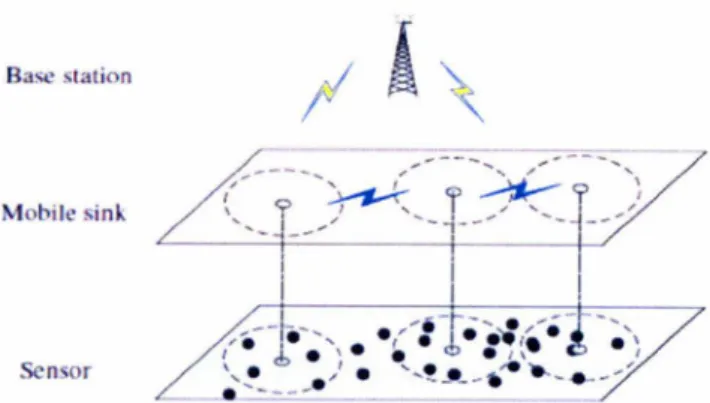
As mentioned in [Chen'06], it has been recognized that a multi-tiered network structure will enhance the network scalability for large scale deployment, as well as of benefit to routing and energy efficiency. As illustrated in Figure 2.3, a mobile and multi radio enabled hierarchical architecture has been designed for mobile sinks wireless sensor networks, which consists of three tiers:
Base station Mobile .ink Sensor ,
---( ----
~
~
--
l
-
*
" I ----, ,,"'i- -... • / .... - - .... ,'
.
.
,..
,
. .
..
,
.
.
' I . ' . • / \ J \ .. ~ ./ . ' ... !,--.. " ... -... /.
-
--
-
-Figure 2.3 : Three- Tiered Mobile Sinks Wireless Sensor Networks with Cluster
Structure
• Sensor Tier: sensor tier denoting various types of static sensor devices that are capable of collecting information and resources.
• Mobile Sink Tier: mobile sink tier composed of mobile phones, laptops, and
other mobile/roaming devices. The mobile sinks will act as relays for
information gatheri ng.
• Base station Tier: base station tier referring to the final information fusion
point, from which the task manager can retrieve data of interest.
2.3.2 Sink Mobility Models
The main idea of a mobile sink is that the sink has significant and easily replenished energy reserves and can move inside the area of the sensor network. In
ll.
Chatzigiannakis'06J, they introduce different sink mobility model for effective data collection. They propose purely random walk, random walk with limited multi-hop
data propagation, predictable random walk and deterministic walking models.
A. Random Walk
The implest of all po sible mobility patterns is the random walk, where the mobile ink can move arbitrarily in any direction at varying speeds. Tn this model,
data i collected in a pa ive manner. Periodically a beacon message is transmitted from the sink. Each sensor node that receives a beacon attempts to acquire the medium and transmit its data to the ink. However, this will lead to many collision ,
thus an appropriate MAC layer protocol with an efficient back-off function is essential for the proper deployment of this protocol. Clearly, this approach minimizes energy consumption since only a single transmission per sensed event is performed; however time efficiency may drop due to the long duration required to visit sensors. B. Random Walk with limited multi-hop data propagation
Another form of random walk is performed by using a set of predefined areas and random transitions between the areas according to their connectivity. In this model, the mobile sink will periodically broadcast a beacon message, which carries a hop counter HC, a time to live counter TIL. Each sensor node maintains a hop distance from the sink and a timestamp to indicate the last time hop distance was updated and the network address of a parent sensor node. This approach assumes and uses more knowledge of the network; it can accelerate to visit network nodes, reduce the distance travelled by the sink (when compare to random walk) and leads to improved time efficiency. On the other hand, it is also more expensive in terms of communication and computational cost on the sensor nodes.
C. Predictable Random Walk
The idea of using a logical graph can be extended in a way that certain areas of the network are favoured (i.e. more frequently visited) by the sink in order to improve the data collection process or to overcome problems that arise from the network topology. This approach uses knowledge collected by the sink in order to speed up the coverage of new areas or increase data delivery in areas with many nodes. Overall, when compared to the random walk approach faster network coverage is expected to be achieved, together with higher delivery rates and lower latency but with an increase in computational overheads at the sink and communication costs at the favoured sensor nodes.
D. Deterministic Walking
This approach uses a simple form of controlled mobility where the mobile entity moves on a predefined trajectory. The sink moves in a predetermined way from one edge of the network area to the other and returns along the same path. Since the