IJEDR1602321
International Journal of Engineering Development and Research (www.ijedr.org)1835
An Efficient Way To Use Heterogeneous Wireless
Sensor Nodes Using Hybrid Unequal Routing
Protocol Using Mobile Sink
1Ketki Singla,2Deepinderjeet Kaur Dhaliwal 1Research Scholar,2Assistant Professor 1Department of Computer Science & Engineering, 1Desh Bhagat University,Mandi Gobindgarh, India
________________________________________________________________________________________________________ Abstract - Remote Sensor Network (WSN) is a system which comprises of various sensor hubs, where every sensor hub has in-fabricate stockpiling and preparing however its battery is not rechargeable. Fundamental capacity of sensor hubs is to sense the earth, send the detected information to the base station (BS), BS then further sends the information to the client through web by means of door. There are a few issues in WSN yet the primary issue is to monitor the vitality of the hubs and to expand the lifetime of the system. Along these lines, the vitality proficient bunching is embraced now days to save the vitality and to beat the hotspot issue. In grouping, sensor hubs are splitted into various bunches of equivalent and unequal sizes. The paper examinations the different works done in this field with respect to proficient grouping approaches in WSN. Likewise idea of portable sink is being talked about and all papers are dissected for their benefits and negative marks.
IndexTerms - Remote Sensor Network, WSN, Base Station, Mobile Sink, Clustering .
________________________________________________________________________________________________________
I.INTRODUCTION
Clustering is one of the most popular unsupervised learning techniques (i.e. used for connecting the causative gap between input and output observation). Clustering is “the process of organizing objects into groups whose members are similar in some ways”. Basically, clustering is to find the internal set of unlabeled information. In clustering, we organize the information in the form of packets or we can say into clusters. There are various clustering techniques such as Test case prioritization techniques schedule test cases in order to increase their effectiveness according to some criterion. Test case prioritization concerns with the identification of the perfect test cases. The purpose of this technique is to meet some performance goals like rate of fault detection, increase the effectiveness etc. Rate of fault detection is used to evaluate how rapidly faults are detected within process of testing.
In most wireless sensor network (WSN) applications nowadays the entire network must have the ability to operate unattended in harsh environments in which pure human access and monitoring cannot be easily scheduled or efficiently managed or it’s even not feasible at all. Based on this critical expectation, in many significant WSN applications the sensor nodes are often deployed randomly in the area of interest by relatively uncontrolled means (i.e., dropped by a helicopter) and they form a network in an ad hoc manner. Moreover, considering the entire area that has to be covered, the short duration of the battery energy of the sensors and the possibility of having damaged nodes during deployment, large populations of sensors are expected; it’s a natural possibility that hundreds or even thousands of sensor nodes will be involved. In addition, sensors in such environments are energy constrained and their batteries usually cannot be recharged. Therefore, it’s obvious that specialized energy-aware routing and data gathering protocols offering high scalability should be applied in order that network lifetime is preserved acceptably high i n such environments. Naturally, grouping sensor nodes into clusters has been widely adopted by the research community to satisfy the above scalability objective and generally achieve high energy efficiency and prolong network lifetime in large-scale WSN environments. The corresponding hierarchical routing and data gathering protocols imply cluster-based organization of the sensor nodes in order that data fusion and aggregation are possible, thus leading to significant energy savings. In the hierarchical network structure each cluster has a leader, which is also called the cluster head (CH) and usually performs the special tasks referred above (fusion and aggregation), and several common sensor nodes (SN) as members. The cluster formation process eventually leads to a two-level hierarchy where the CH nodes form the higher level and the cluster-member nodes form the lower level. The sensor nodes periodically transmit their data to the corresponding CH nodes. The CH nodes aggregate the data (thus decreasing the total number of relayed packets) and transmit them to the base station (BS) either directly or through the intermediate communication with other CH nodes. However, because the CH nodes send all the time data to higher distances than the common (member) nodes, they naturally spend energy at higher rates. A common solution in order balance the energy consumption among all the network nodes is to periodically re-elect new CHs (thus rotating the CH role among all the nodes over time) in each cluster.
© 2016 IJEDR | Volume 4, Issue 2 | ISSN: 2321-9939
IJEDR1602321
International Journal of Engineering Development and Research (www.ijedr.org)1836
II.LITERATURE REVIEWLingyun Yuan, Xingchao Wang, JianhouGan et al. [1] proposed a data gathering algorithm based on mobile agent and emergent event-driven in cluster- based wireless sensor networks. In order to improve energy efficiency and decrease network delay in wireless sensor network applied to emergent event monitoring, a new data gathering algorithm based on mobile agent and event-driven is presented for cluster-based wireless sensor network. R.Rajeshwari1, Mr. B. Prakashet al. [2] presented an Energy Efficient Cluster Based Approach in Wireless Sensor Networks Using Mobile Sink. Sensor networks are collection of sensor nodes which co-operatively send sensed data to base station. The proposed scheme is supposed to be an efficient data compression technology is capable of shrinking the volume of the transmitted data or forwarded towards mobile sink. Babar Nazir , Halabi Hasbullahet al. [3] presented Mobile Sink based Routing Protocol (MSRP) for Prolonging Network Lifetime in Clustered Wireless Sensor Network. The simulation results demonstrated that mobile sink strategy outperforms both static sink and multiple sink strategies in terms of energy per packet and throughput. Lanny Sitanayah, Cormac J. Sreenan,Kenneth N. Brown et al. [4]proposed Poster Emergency Response MAC Protocol (ER-MAC) for Wireless Sensor Networks. ER-MAC, a hybrid MAC protocol for emergency response wireless sensor networks.ER-MAC is designed as a hybrid of the TDMA and CSMA approaches. Guoliang Xing, Member, IEEE, Tian Wang, Student Member, IEEE, ZhihuiXie, and WeijiaJia et al. [5] Rendezvous Planning in Wireless Sensor Networks with Mobile Elements has been proposed .In this paper, the rendezvous-based approach for utilizing MEs to collect sensor data under temporal constraints is discussed. The simulations show that this approach significantly reduces network energy consumption and scale well with network density, ME speed, and the number of different deadlines. Chaurasiya, Sandip K., JaydeepSen, ShrirupaChaterjee, and Sipra D. Bit et al. [6] An energy-balanced
lifetime enhancing clustering for WSN (EBLEC) has been suggested In this paper a clustering scheme in WSN is proposed where
cluster heads are selected based on relative contribution of the nodes towards keeping the network alive for an extended period of time by balancing energy consumption. Zhao, Huan, SongtaoGuo, Xiaojian Wang, and Fei Wang et al [7] Energy-efficient Topology Control Algorithm for Maximizing Network Lifetime in Wireless Sensor Networks with Mobile Sink has been presented. Krishnan, A. Muthu, and P. Ganesh Kumar [8] An Effective Clustering Approach with Data Aggregation Using Multiple Mobile Sinks for Heterogeneous WSN has been presented in this paper. In the proposed algorithm, data gathering based on the clustering architecture with TDMA time slot helps to achieve an efficient data gathering approach. Jose, Deepa V., and G. Sadashivappa et al. [9] proposed a novel scheme for energy enhancement in wireless sensor networks. In this paper a prologue to the two popular bio inspired optimization techniques ABC and PSO are given. The newly proposed strategy with sink mobility is compared with the ABC algorithm and the simulation results prove the efficacy of the proposed one in terms of average packet delay and the life time. Malathi, R.K. Gnanamurthy, et al. [10] proposed a hybrid unequal clustering algorithm to increase the network lifetime, reduce the clustering overhead and to avoid the hot spot problem. In this proposed algorithm hybrid is a combination of static and dynamic algorithm. Simulation results shows that proposed algorithm increases network lifetime and conserves more energy compared to other algorithms.
III.PROBLEM FORMULATION
The problem with LEACH protocol is that it has been designed in such a way that each node gets equal chance of being selected as a cluster head. The reason for the same is that each node should be live for equal times so that there is minimum packet data loss. But this protocol is designed for homogeneous networks and fails in cases of heterogeneous networks where the nodes are distributed with unequal energies in the beginning. In case of heterogeneous networks the stability period is decreased and the instability period is increased. Another major problem addressed in this paper is how to prolong the survival time of the network. A concept of Mobile Sinks (MSs) needs to be developed that can better achieve the result of balancing the nodes’ energy consumption. But determination of the path of the mobile sink is not an easy task and an algorithmic approach need to be taken for this cause.
IV.PROPOSED METHODOLOGY
The paper attempts to solve the problem of data gathering in wireless sensor networks. The solution proposed in this paper includes the development of a novel density based K-means Clustering algorithm for dynamic unequal clustering in every iteration while a concept of mobile sink has been introduced. The path of the mobile sink will be found out for best performance of the system. The mobility of the mobile sink plays an important role in the overall performance of the system. The proposed hybrid algorithm will find the optimal path for the current round of data gathering so that the mobile sink is in the place where the probability of data collection is the most. This will increase the network lifetime of the overall system and will also prevent the hotspot problem and reduce packet delivery ratio. The radio model of energy transmission will be utilized in the paper.
Density- based K means Clustering algorithm plays essential role in finding non-linear shapes structure based on the density. A set of points in space, those points which are closely packed to each other, may group together and those points whose nearest neighbors are so far away, marking as outlier. At data mining conference, this algorithm was awarded the test of time award in 2014. Density reachability and density connectivity are two basic concept used in this algorithm.
V.RESULTS
IJEDR1602321
International Journal of Engineering Development and Research (www.ijedr.org)1837
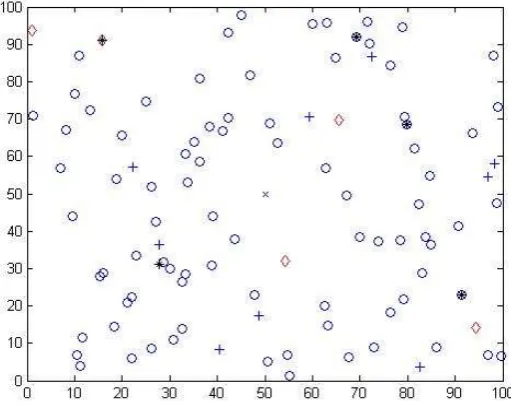
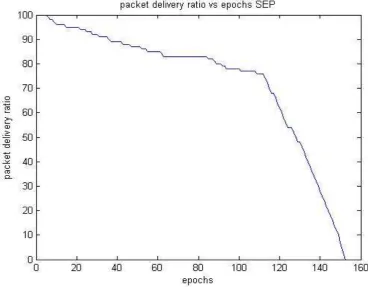
Fig.1 Node DistributionFigure 2 represents the various nodes distributed in the 100x100 area. The simulation runs for 200 epochs. The normal nodes are shown by ‘o’ while ‘+’ represents advanced nodes and ‘∆’ represents super advanced nodes. The ‘*’ represents that the particular node has become cluster head at least once. As the epochs increases the number of nodes becoming cluster head increases. As shown in Figure 4, the packet delivery ratio in percentage is close to 85% for most of the stability period. This ensures a smooth operation and reliable network operation. When compared to packet delivery ratio of simple SEP as shown in Figure 5, it is found that there is a significant improvement in terms of stability period as the packet delivery ratio starts diminishing in our proposed method quite late and sharply when compared to normal SEP.
© 2016 IJEDR | Volume 4, Issue 2 | ISSN: 2321-9939
IJEDR1602321
International Journal of Engineering Development and Research (www.ijedr.org)1838
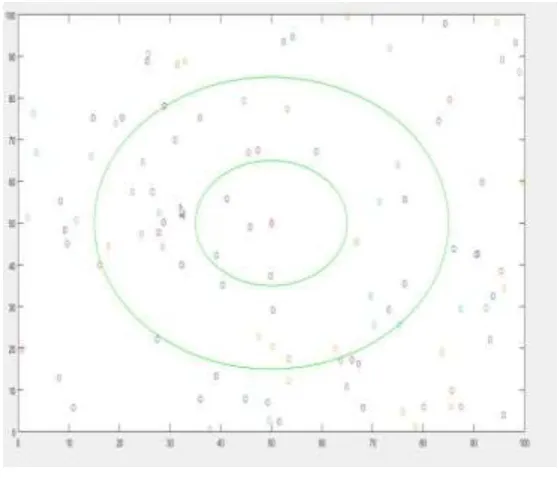
Fig.3: Node distribution with clusteringIJEDR1602321
International Journal of Engineering Development and Research (www.ijedr.org)1839
Fig 5: Packet Delivery Ratio without Sink Elongation ProtocolVI. CONCLUSION
The results show that the proposed algorithm performs better in terms of PDR ratio and prolonged stability period. The stability period is very important as once the nodes start dying in large numbers, the chances of packet data loss starts increasing. The network has been simulated for only 100 nodes which can be further extended to larger number of nodes or even sparse networks. References
[1] Yuan, Lingyun, Xingchao Wang, JianhouGan, and Yanfang Zhao. "A data gathering algorithm based on mobile agent and emergent event-driven in cluster-based WSN." Journal of Networks 5, no. 10 (2010): 1160-1168.
[2] Rajeshwari, R., and Mr B. Prakash ME. "Towards Energy Efficient Cluster Based Approach In Wireless Sensor Networks Using Mobile Sink."
[3] Nazir, Babar, and HalabiHasbullah. "Mobile sink based routing protocol (MSRP) for prolonging network lifetime in clustered wireless sensor network." In Computer Applications and Industrial Electronics (ICCAIE), 2010 International Conference on, pp. 624-629. IEEE, 2010.
[4] Sitanayah, Lanny, Cormac J. Sreenan, and Kenneth N. Brown. "ER-MAC: A hybrid MAC protocol for emergency response
wireless sensor networks." InSensor Technologies and Applications (SENSORCOMM), 2010 Fourth International Conference on,
pp. 244-249. IEEE, 2010.
[5] Xing, Guoliang, Tian Wang, ZhihuiXie, and WeijiaJia. "Rendezvous planning in wireless sensor networks with mobile elements." Mobile Computing, IEEE Transactions on 7, no. 12 (2008): 1430-1443.
[6] Chaurasiya, Sandip K., JaydeepSen, ShrirupaChaterjee, and Sipra D. Bit. "An energy-balanced lifetime enhancing clustering for WSN (EBLEC)."InAdvanced Communication Technology (ICACT), 2012 14th International Conference on, pp. 189-194. IEEE, 2012.
[7] Zhao, Huan, SongtaoGuo, Xiaojian Wang, and Fei Wang. "Energy-efficient Topology Control Algorithm for Maximizing Network Lifetime in Wireless Sensor Networks with Mobile Sink." Applied Soft Computing (2015).
[8] Krishnan, A. Muthu, and P. Ganesh Kumar. "An Effective Clustering Approach with Data Aggregation Using Multiple Mobile Sinks for Heterogeneous WSN." Wireless Personal Communications (2015): 1-12.