1
Aerospace Engineering Masters of Science Program Assessment Plan
Fall 2015
The College of Engineering at California State Polytechnic University, Pomona (Cal Poly Pomona or CPP) offers an MS in Engineering with emphasis in Aerospace Engineering (MSE-AE) degree program at the Lancaster University Center. The Program which started in the Fall quarter 2007 has received WASC approval. Courses are taught in person, some by Cal Poly Pomona Engineering faculty and some by adjunct engineers/scientist from the local aerospace community in Antelope Valley.
Meaning of MS Degree in the Engineering Fields
The MS degree in Aerospace Engineering provides the student with the advanced knowledge
necessary to elucidate the theories to their fields of specialization while grounding them in their
practices. The MS degree enables the graduate to articulate the significant challenges confronting
the field of aerospace engineering utilizing a solid foundation of advanced courses. Through a
careful selection of challenging projects, graduate students propose creative approaches to
solving selected contemporary engineering problems. These project experiences
distinguish the
CPP MS Aerospace Engineering graduate
by providing them with the design and execution
background to tackle complex problems using innovative approaches, that can be
applicable in industry and research.
Expectations for entering students
Admission requirements for the program are:
B.S. in Aerospace, Mechanical engineering from an ABET accredited institution received
within the last 5 years.
GPA in upper-division undergraduate courses in Math, Science and Engineering needs be
~3.0 or higher.
If B.S. received from non-ABET institution or prior to 5 years ago or lower GPA than ~3.0,
but higher than ~2.85, then GRE test score (quantitative + verbal) of at least 301 is required.
Also visit Cal Poly Pomona Admissions Office at CPP website: www.cpp.edu
2
MSAE Program Educational Objectives
The educational objectives of the off-campus MSE with emphasis in Aerospace Engineering,
which helps
preparing the student for their future career
, are:
I.
To provide students with a comprehensive education at the Master’s level that includes
in-depth instruction in aerodynamics, structures, propulsion systems, flight mechanics and
astronautics;
II.
To provide students with opportunities to master research methods and to learn the
methodologies for conducting independent studies;
III.
To prepare students for advancement in their aerospace engineering careers by exposing
them to efficient approaches to analyzing and solving open-ended problems, and design
issues while fostering teamwork, communication skills, and individual professionalism.
The learning experience
includes comprehensive education at the
Master’s level courses
,
team
projects and activities
in the Design classes, and oral presentation and written report for the
Master’s project
. The Department’s effectiveness in meeting these Educational Objectives are
evaluated by indirect tools such as the Masters Employer Surveys and Masters Alumni Surveys.
Undergraduate and Graduate programs are distinctly different.
Our department has both an
undergraduate and a graduate program. They are distinctly different. Our undergraduate
program has expectations which are given in a separate document.
Quality:
These program objectives will be accomplished through the achievement of learning outcomes,
which are given below:
Program Learning Outcomes
After completing the proposed MSE program, the graduate will be able to:
1.
Develop an understanding of advanced mathematical and numerical methods to
effectively address real world engineering problems;
2.
Analyze and design complex aerospace structural elements;
3.
Perform graduate-level aerodynamic analysis;
4.
Analyze sophisticated air-breathing propulsion systems;
5.
Perform in-depth analysis of flight dynamics of aircraft and spacecraft and design
advanced flight control systems;
6.
Develop an ability to work efficiently in teams charged with the design of complex
systems such as spacecraft from a conceptual design perspective;
7.
Demonstrate excellent oral, written and graphic communications skills.
These program outcomes are a modified version of the outcomes for the undergraduate
aerospace program (which were developed in 2004 in preparation for the last professional
accreditation review by ABET) adapted to suit the curriculum of the MSE program.
3
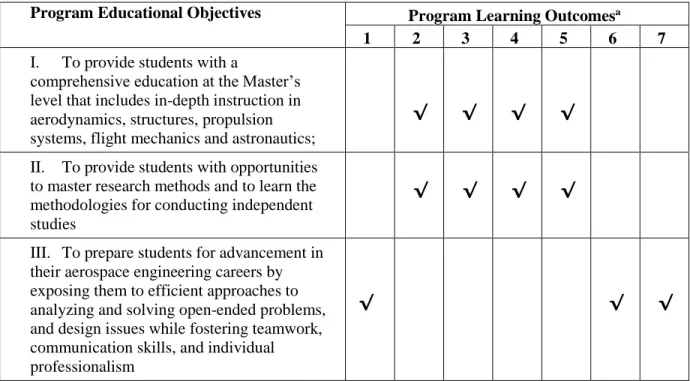
Table 1 shows the relationship of student outcomes to the program educational objectives.
Table 1: Relationship of student program educational objectives
Program Educational Objectives Program Learning Outcomesa
1 2 3 4 5 6 7
I. To provide students with a
comprehensive education at the Master’s level that includes in-depth instruction in aerodynamics, structures, propulsion systems, flight mechanics and astronautics;
√ √ √ √
II. To provide students with opportunities to master research methods and to learn the methodologies for conducting independent studies
√ √ √ √
III. To prepare students for advancement in their aerospace engineering careers by exposing them to efficient approaches to analyzing and solving open-ended problems, and design issues while fostering teamwork, communication skills, and individual professionalism
√ √ √
Program Outcomes are reviewed on a two-year cycle. The outcomes for the undergraduate
program were modified recently based on the judgment of the Aerospace faculty, with advice
from employers and alumni provided through the Aerospace Industry Action Council. The
Council typically consists of representatives from the local aerospace industry. In addition,
several of the representatives are alumni of the Department. Therefore, this is an ideal group to
provide timely input from alumni and employers.
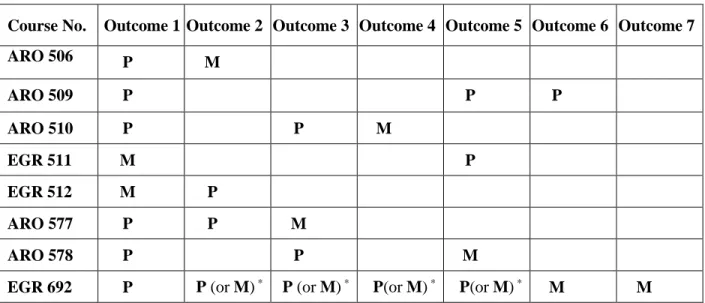
Table 2 shows the relationship of student outcomes to the program educational objectives, and
the level of proficiency at the “Practice” or “Masters” level.
aProgram Learning Outcomes
After completing the proposed MSE program, the graduate will be able to:
1. Develop an understanding of advanced mathematical and numerical methods to effectively address real world engineering problems;
2. Analyze and design complex aerospace structural elements; 3. Perform graduate-level aerodynamic analysis;
4. Analyze sophisticated air-breathing propulsion systems;
5. Perform in-depth analysis of flight dynamics of aircraft and spacecraft and design advanced flight control systems;
6. Develop an ability to work efficiently in teams charged with the design of complex systems such as spacecraft from a conceptual design perspective;
4
Table 2: Relationship of Program Learning Outcomes to Required Courses Course No. Outcome 1 Outcome 2 Outcome 3 Outcome 4 Outcome 5 Outcome 6 Outcome 7
ARO 506 P M ARO 509 P P P ARO 510 P P M EGR 511 M P EGR 512 M P ARO 577 P P M ARO 578 P P M
EGR 692 P P (or M) * P (or M) * P(or M) * P(or M) * M M
P
= Practice level,
M
= Master level
The department
accommodates the entering students’ abilities
by allowing them to tailor their
Master’s projects to the topics related to their current job position.
Integrity:
Our program is accredited by the WASC. The program uses appropriate processes for assessing
and evaluating the extent to which the
student outcomes
are being attained.
Our department utilizes direct assessment instruments of the Master’s Student Outcomes
including the faculty’s evaluation of the student Master’s research project final report and oral
presentation. Indirect measurements include the Master’s Alumni survey. These evaluations are
used to
verify that the students are achieving the outcomes at the expected level
,
update or
add curriculum
,
introduce new teaching methodologies
(such as planning for distance
learning from the Lancaster site to the Cal Poly Pomona campus, and addition of new masters
courses to be taught at the Pomona campus),
identify needs for increasing department faculty
,
and
identify needed improvements in laboratory equipment
. The oral presentation and the
report for the Master’s project is used to
verify that sequence of student learning experiences
achieved its purpose.
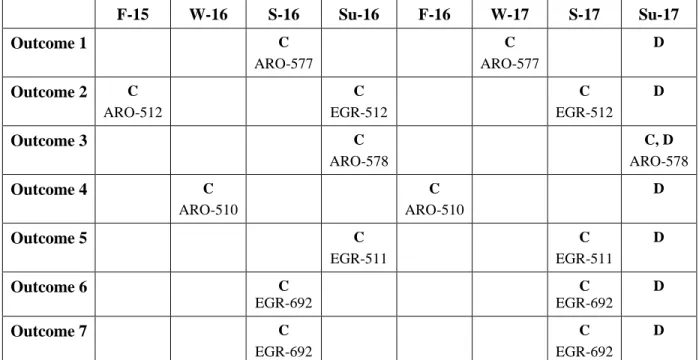
Our tentative assessment plan is shown in Table 3.
5
Collection of Assessment Data and Analysis
Direct Data:
The following measurements will be used to assess each learning outcomes:
Evaluation of student Master’s Project report or Master’s Thesis as well as the final
student oral presentation.
Faculty assessment of student oral presentations, written reports, and the final
examinations of the courses.
Indirect Data
Three-year assessment of program objectives by Alumni Surveys. Alumni Surveys are
analyzed for potential improvements for faculty review.
External evidence of the value of the program
is evaluated by the feedback from the
Aerospace Industry Action Council members.
Discussion of Assessment Results
Graduate committee reviews assessment results and discuss how to improve teaching and
learning as well as inform planning and decision making. The results can highlight successes
such as these:
Evidence that students are meeting or exceeding learning expectations,
Better alignment of the curriculum with desired outcomes,
Creation of useful rubrics,
Development of explicit standards and corresponding samples of student work.
Table 3: Proposed Assessment Plan
F-15 W-16 S-16 Su-16 F-16 W-17 S-17 Su-17 Outcome 1 C ARO-577 C ARO-577 D Outcome 2 C ARO-512 C EGR-512 C EGR-512 D Outcome 3 C ARO-578 C, D ARO-578 Outcome 4 C ARO-510 C ARO-510 D Outcome 5 C EGR-511 C EGR-511 D Outcome 6 C EGR-692 C EGR-692 D Outcome 7 C EGR-692 C EGR-692 D