Distance Education at the MBA Level: e.MBA@PACE
Andrew Varanelli, Jr., D.Ed., Dan Baugher, Ph.D., and James Hall, Ph.D.
Abstract
This paper addresses some of the issues associated with developing distance education at the MBA level. Several approaches are considered. The Internet-based asynchronous MBA program developed at the Lubin school of Busi-ness of Pace University is described in detail. This program, called .eMBA@PACE, uses a problem-based, collabora-tive learning approach to distance education in its curriculum design. The program is team-taught and students proceed through the 24-month program as a cohort. The program uses eight projects that are solved by virtual teams of students and one project that is accomplished by individual students. Teams vary throughout the program. There are nine residencies in the program including an eight-day, orientation residency in which an initial project is solved and eight weekend residencies that follow each of the remaining projects. During the residencies, students present their project solutions to industry experts and the faculty; students are assessed on their understanding of the MBA learning objectives associated with each project. They are also introduced to the business project that is to be solved and presented at the next residency and taught managerial skills through a variety of workshops. The distance-based learning environment for the program is supported by Blackboard’s Courseinfo courseware.
Introduction
The market for Internet-based asynchronous MBA programs is expanding rapidly. Barriers to entry that once existed in the educational marketplace are break-ing down as the technology for Internet-based pro-grams decreases in cost and allows schools and universities to introduce MBA programs outside their regional markets. This new approach to program de-livery is exciting to many regionally-based schools of business because it allows the possibility of expan-sion into markets that would not ordinarily be avail-able to them. A school using asynchronous techniques can now enter a new marketplace without large capi-tal expenditures, such as those required to build fa-cilities or to acquire a regional faculty and staff. At the same time, the ease of entry afforded by this ap-proach can also be a threat to regional schools and possibly to nationally known schools as well.
In this paper, we begin by describing the distance education environment facing business schools and several distance-based MBA programs that are “up and running.” These programs differ enough to sug-gest possible alternative strategies for entry into this market. We then go on to describe our experience in developing an Internet-Based MBA program at Pace University. Our program is non-traditional in the sense that it focuses on problem-based, collaborative learning and the development of managerial skills rather than achievement in discipline-based courses. We hope our experience and approach will stimulate
more discussion on how to re-engineer existing MBA programs in light of the Internet’s impact on educa-tion and the competitive marketplace.
Distance Education and Business
Schools
Michael Hitt predicted in a recent edition of the Acad-emy of Management Review (Hitt, 1998) that there will be an increasing emphasis on distance education as a result of the new asynchronous technology and its ability to provide a global delivery system. The Na-tional Center for EducaNa-tional Statistics reports that 44 percent of two- and four-year higher education institutions offered a total of 52,230 distance educa-tion courses in 1997-98 compared with 33 percent of institutions offering a total of 25,730 such courses in 1994-95 (Mathie, 2000). It appears that distance edu-cation in one form or another is beginning to make significant inroads into the educational process and the thinking of professionals in the field.
Yet, few schools of business have taken a very en-trepreneurial stance in this area. For example, none appears to have goals of dominating business educa-tion globally through the use of distance learning (Hamilton, 1997). Of course, this may change as the marketplace responds to distance education and busi-ness schools begin to deal with the decline in fund-ing, particularly in the public sector. Faced with less funding, some action-oriented business schools are
already beginning to seek lower cost delivery systems for providing high quality education to a broader stu-dent market (Porter, 1997). These schools often ask the question: “How can we do it more cheaply, but with quality, and reach more students?” Distance edu-cation may be one mechanism for achieving this goal and answering this question.
As schools of business begin to use distance learn-ing to expand their markets, they will pose a threat to schools that employ only traditional educational de-livery systems. Threatened schools may respond to inroads made by more aggressive schools by offering more courses via the Internet, especially as the cost of the distance education infrastructure decreases. Un-fortunately, offering courses via the Internet as a re-sponse to a competitor may not be sufficient. It is likely that a more cohesive plan involving changes in fac-ulty allocation, facfac-ulty reward systems, student selec-tion procedures, and curriculum will be necessary for long-lasting success. Still, there is a silver lining to the cloud of distance learning in the competitive market-place. Few schools of business have, as yet, put together cohesive plans for delivering quality products via dis-tance education. Opportunities exist for schools ca-pable of presenting a quality product quickly to this market. Thus, asynchronous distance learning pro-grams can be a source of threats and opportunities.
Some Alternative Approaches for
MBA Programs
MBA programs are often one of the distance educa-tion products offered by business schools. While pro-gram details can vary, several strategic approaches are emerging. These strategies generally reflect the Por-ter model of cost leadership, differentiation (mainly via brand image), and focus (Porter, 1980; Varanelli and Baugher, 1999). Beyond these broad strategic cat-egorizations, there are also some significant differ-ences in how distance-based MBA programs are delivered and taught— including differences in resi-dency periods, the degree to which programs are dis-cipline-based versus problem-based, and the degree to which specific courses are offered via the Internet as a part of the program.
To provide a broad sense of competitor reactions to the challenge of distance education in this market-place, four asynchronous MBA programs are consid-ered in this section: Duke University, Ohio University, Fordham University, and Bienville College. Table 1 summarizes the key components of these programs. Each program serves as a case study on how an MBA might be developed using this new technology.
Duke University
Duke University’s MBA for Global Executives dem-onstrates opportunities for creative implementation of distance learning programs in this rapidly devel-oping industry. Duke is interesting because it is a Tier 1 business school attempting to enhance its reputa-tion and expand its global reach by offering an ex-pensive, highly selective and rigorous distance learning program. The 19-month cohort program relies on individual study and group projects to complete com-plex, discipline-based assignments geared to 15 “courses” in such disciplines as management, econom-ics, finance, and marketing. There are five residencies in four different parts of the world: North America, Europe, Asia, and South America. The residencies last about two weeks and include a minimum of six daily hours of classroom time. The distance learning por-tion of each term lasts about 10 weeks and includes virtual teams dispersed around the world that work together to solve assignments related to course mate-rial covered during the residencies. Students are mem-bers of two different teams during the program. The teams are supervised by the faculty via the Internet. There is no major.
Students are expected to have a minimum of 10 years’ professional experience. However, student se-lection at Duke lies less with traditional admission criteria and more on the willingness of corporate sponsors to invest $95,000 in tuition. All students are expected to secure company sponsorship before they apply. Except for travel to and from the residencies, this tuition covers all costs including the residencies and a personal computer. The program admitted 85 students for the cycle that began in 2000. While about half of the students enrolled in the Duke program live and work within the United States, the program was designed to significantly enlarge Duke’s geographic scope while enhancing its global reputation and im-proving its relationships with world-wide corpora-tions. In general, it appears that Duke’s overall strategy is that of differentiation with a broad global focus. It is seeking a high quality student from any location in the world. Duke University’s business school is AACSB accredited.
Ohio University
Ohio University offers an Internet-based MBA that is built around an educational model, that uses prob-lem-based learning as a vehicle for presenting the busi-ness concepts. In its use of projects, Ohio University avoids specific, discipline-based projects and does not
offer majors. Rather, the same project is often used to educate students about a broad range of disciplines at the same time. In concept, Ohio University’s pro-gram is similar to most Executive MBAs, which are broad-based programs of study emphasizing business concepts for working individuals. The basic program is structured around nine major learning projects. Two years are required to complete the program and stu-dents progress through the program as a cohort. In addition to the nine learning projects, there are three one-week residencies: one at the beginning, one in the middle, and one at the end of the program, as well as three extended weekend residencies during each of the two years. All residencies take place at Ohio Uni-versity.
Ohio University’s student audience for this pro-gram is similar to students who might choose an Ex-ecutive MBA program but who would like to minimize their on-site activities. The program re-quires prospective students to have from two to four years of increasing responsibility in a management position. Sponsorship by the student’s employer is expected. This logic is similar to that of Executive MBA programs where the goal is to develop skills that students can use immediately in their current jobs. While students can enroll from around the world, the market is much less global in nature than that of Duke. All residencies take place in Athens, Ohio. Ohio Uni-versity is using a focused differentiation strategy in that they are emphasizing their brand image as an AACSB accredited business school and pursuing a relatively narrow market segment (i.e., Managers Seeking an Executive MBA). The tuition is $35,000. Except for travel to and from the residencies, this tu-ition covers all costs including the cost of the resi-dences and a laptop computer.
Fordham University
Fordham University offers a Transnational MBA through the Internet. In this program, Fordham uses residencies and Internet-based education in a tradi-tional Executive MBA format but with a transnatradi-tional emphasis. The program is discipline-based, but no major is offered. It takes place over 27 months and has 27 monthly residency periods in which classes convene in an executive conference center north of Manhattan from Friday to Sunday. Learning between residency periods is accomplished over the Internet. The program involves a prescribed course of study that includes 22 courses. Some courses are offered over
the Internet, but for the most part, the program relies on individual study and group projects, which are supervised and completed over the Internet and dur-ing the residency periods. Monthly residencies can involve on-site “residentials” at a domestic or over-seas location of particular business interest. Students travel through the program as a cohort.
The audience for Fordham’s Transnational MBA is similar to a standard Executive MBA program. The program is designed to capture a student audience that is not likely to enroll in their regular MBA pro-gram due to time constraints. While students may enroll from abroad, the focus is clearly on students from the United States — unlike the Duke program, which has a much heavier emphasis on worldwide enrollment. Given their solid reputation and empha-sis on U.S. managers and executives with an interest in moving to global assignments, Fordham is using a focused differentiation strategy. The tuition is $80,000 plus the cost of travel to and from the residencies, which may involve worldwide travel. Fordham University’s business school is AACSB accredited.
Bienville College
Bienville College is a distance learning institution lo-cated in Louisiana. The school offers a distance learn-ing-based MBA which has no majors and uses a standard 42-credit, discipline-based set of MBA courses that is expected to take 14 months to com-plete. There are no residency periods. All course work is completed under a mentor’s supervision through Internet technology. No virtual teams are used. The Louisiana State Board of Education and Board of Re-gents license Bienville College.
Bienville’s MBA program is open to any student with an undergraduate degree from an accredited in-stitution who has a minimum of three years’ business experience. The degree need not be in business. The total cost of the program is $5,450. Bienville College is pursuing a cost leadership strategy in that it is seek-ing a large number of students and it is in no way emphasizing the uniqueness of its product. Its pric-ing reflects this strategy, as do its marketpric-ing efforts and advertising, which are geared almost completely to Internet users. Its offer of a program without a resi-dency requirement also allows the potential for higher numbers of students in the worldwide market af-forded by the Internet. Bienville College is not AACSB accredited.
Table 1
Summary of Components for Four Internet-Based MBA Programs
Pace’s Distance-Based MBA
Program: e.MBA@PACE
Pace University’s Lubin School of Business entered the distance education market in May 2000. The school’s distance-based MBA program is e.MBA@PACE (Pace University, 1999). It combines the convenience of online Internet learning with face-to-face residency weekends every 10-12 weeks. It leads to an MBA in Management in Pace’s AACSB-accredited business program (AACSB, 1991) and is priced at $50,000. This price includes the cost of the residencies in New York City, but not the cost of travel to and from the resi-dencies. Students advance through the 24-month pro-gram as a learning cohort.
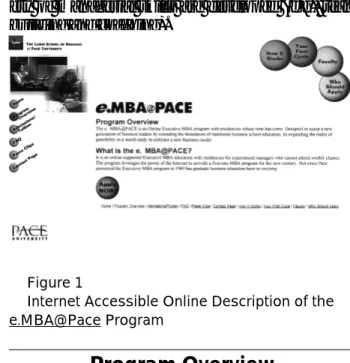
Figure 1 shows the on-line program overview page where potential students can access important pro-gram information. The propro-gram is different in some significant ways from the four programs discussed earlier while similar in other ways. Of the four pro-grams described, Pace’s program most resembles that of Ohio University. Like that program, there are no discipline-based courses (e.g., accounting, marketing), students travel in a cohort and work on projects to achieve learning objectives, and students are compa-rable to those who might choose an Executive MBA program. Unlike that program, the Pace program emphasizes more collaborative learning, links each
residency to a specific project, and assures that a vari-ety of managerial skills are developed (e.g., team building and coaching).
Figure 1
Internet Accessible Online Description of the e.MBA@Pace Program
Program Overview
Thee.MBA@PACE program requires completion of nine large-scale projects and a series of individual learning modules, rather than traditional discipline-based courses. The projects focus on complex, con-temporary business issues that require cross-disciplinary approaches for solution. Working in virtual teams, students confront a variety of issues while completing the eight projects assigned for team solution. Working independently, each student com-pletes a ninth project that answers a business ques-tion facing his or her employer.
Throughout the e.MBA@PACE program, students communicate with each other and with faculty using powerful personal computer software designed to support and facilitate collaboration on the Internet. The courseware used at Pace University is Blackboard’s Courseinfo, V3.0 (Blackboard, 1997). Through this software platform, students can work asynchronously in teams toward project completion while becoming proficient, collaborative problem solvers. Faculty con-tinually track the progress of teams and intervene to provide information, ask questions, or make sugges-tions. Throughout the program, faculty and students interact frequently.
During an initial weeklong orientation residency, students learn to use the courseware efficiently. In addition, they develop interpersonal and group dy-namics skills for collaborating effectively as a virtual team using the Internet-based courseware. The ori-entation residency also helps students learn to find information for projects from many sources, includ-ing the Internet and Pace’s extensive library holdinclud-ings, many of which can be accessed electronically. During
the initial residency, students work in teams to com-plete a short orientation project, which helps them understand the requirements of the problem-based, collaborative learning process.
Face-to-face classroom interaction also occurs dur-ing eight weekend residencies conducted at the completion of each project. During these residencies, solutions to the projects are presented to program faculty and practitioner experts. At this time, students are assessed on how well they have mastered the learn-ing objectives associated with each project. Workshops for developing managerial skills are also included in the residencies. A significant portion of each residency is geared to helping student teams organize and de-velop work plans for the next project. Since teams change from project to project, much as work teams in the real world change, organizing efforts can be a key ingredient for future success.
Students and Faculty
Students in the e.MBA@PACE program have a mini-mum of five years of business experience. They come from diverse backgrounds and act as a cohort for the full 24-month program. In the current class, students have experience as engineers, bankers, medical doc-tors, marketing managers, investment bankers and more. They generally have a broad view of business rather than a narrow specialty. The students are geo-graphically diverse—drawn from the New York met-ropolitan area and other parts of the country.
The program faculty is comprised of senior, full-time business school faculty. Six faculty members comprise the educational team for a single class. The faculty team is committed to the class from program start to finish. The team is drawn from the disciplines of accounting, finance, management science, market-ing, organizational behavior and strategy. If there is a need for specialized faculty in an area such as tax and law, a faculty member can be attached to the team on a temporary basis. Faculty members can take on dif-ferent roles including acting as a project director for a specific project, as a team facilitator, or as a disci-pline-learning specialist. The assignment of faculty duties is a function of project needs.
All faculty are trained to work in the new distance-based, educational environment. It is expected that faculty will rotate in and out of the program over time with a core group of faculty remaining to educate fu-ture faculty. It is also expected that fufu-ture faculty will make use of the learning projects developed by the initial group of faculty though it is also clear that these projects may evolve over time.
Emphasis on Problem-Based,
Collaborative Learning
One unique aspect of the Pace program is its empha-sis on problem-based, collaborative learning. All as-pects of the program, including the residencies, are geared to this approach. This contrasts to the tradi-tional MBA curricula, which is generally comprised of a series of courses in various business disciplines: accounting, economics, finance, law, management, marketing and tax. In this problem-based curriculum, students work in teams with a faculty advisor toward the solution of realistic, large-scale business problems that cross disciplinary lines. While this approach may be different, it has distinguished precedents in edu-cational theory; effective counterparts in other pro-fessional fields, especially medicine; and at least face validity in its evocation of the experience of profes-sional practice in business.
Problem-based learning exemplifies a constructivist approach to curriculum as championed by John Dewey and Edward M. Thorndike in the early 20th century. Constructivism was a reaction to the
ob-jectivist approach that was then, and still is, the philo-sophical basis of most instructional design in the United States. Objectivism leads instructional design-ers to prescribe plans (theory and other content) that learners may, at some future point, apply to real situ-ations. In contrast, constructivism suggests that in-struction should focus less on planning for the future and more on developing the learner’s ability to con-struct (and reconcon-struct) plans and actions in response to the demands of a given situation (Duffy and Jonassen, 1991, p. 9.) In the constructivist approach, theory, facts, and other information are generally learned as needed to satisfy the demands of a specific situation. They are not “pre-learned” far in advance of some possible future need.
Problem-based learning and its constructivist ap-proach to education emerged as an educational frame-work in medical institutions in the 1960s in Canada, the Netherlands, and Australia, as one answer to criti-cisms of the inapplicability of memorization during the ‘information explosion,’ the fragmentation of the medical curriculum, and the lack of prepared gradu-ates” (Major, 1999, p. 7). In the U.S., “problem-based learning has become popular in the health care pro-fessions because of the interest in shaping a new kind of practitioner for the future” (Bruhn, 1997). Follow-ing this approach at the Southern Illinois School of Medicine, H.S. Barrows (1985) was able to increase the application and retention of knowledge in the treatment of patients. Schön (1983, 1987) contends
that such an approach is also well suited to the busi-ness profession and should result in professionals who become self-directed and continuous learners.
Majors (1999) provides an excellent insight into the process of problem-based learning in his descrip-tion of the approach used by Samford University in Birmingham, Alabama for restructuring of its under-graduate programs:
Problem-based learning (PBL) is an approach to learning in which problems serve as a stimu-lus for students to gain course concepts and con-tent as well as metacognitive skills. Generally PBL problems are ill structured, based on real situations, and have more than one ‘right’ an-swer. In the PBL environment, students confront a problem before they receive all of the informa-tion necessary to solve it. Students work in teams to define the nature of the problem, to identify what additional resources they need, and to find viable solutions. Faculty members act as facili-tators by asking questions and monitoring group processes as students actively pursue viable so-lutions. Faculty members also guide students to resources. Students must generally reapply the new knowledge to the original problem and communicate the results of their findings. Among the anticipated outcomes of PBL are enhanced critical thinking and problem-solving skills, research skills, communication skills, and content knowledge. (p. 7)
The e.MBA@PACE uses many of the same ap-proaches used at Samford University. However, it takes problem-based learning at least one step farther by using it as the basis for an entire program offered through a combination of brief residencies, online collaboration and teamwork, and not just within in-dividual courses.
How effective is problem-based learning for busi-ness education as compared with more traditional approaches? Convincing hard data is not yet available. Stinson and Milter (1996) assert that business students find the problem-based approach motivating and that problem-based learning transfers more readily to practice than learning from more objectivist ap-proaches. Albanese and Mitchell (1993), in an exten-sive review of the literature on the use of problem-based learning in medical education, found that students and faculty judge problem-based learn-ing to be effective. More research is needed on the effectiveness and efficiency of this approach for pre-paring business professionals. In the Pace program, the faculty team’s experience has shown that this
“just-in-time” learning model leads to an immediate appli-cation of business concepts and tools to realistic prob-lem solving and an increased possibility for transfer of learning to the work setting.
Project Descriptions
Each of the nine projects in the e.MBA@PACE pro-gram is the equivalent of six credits of work in the regular MBA program and designed to achieve a se-ries of MBA learning objectives that are comparable to those of the regular MBA program. Table 2 de-scribes the projects. Students are assessed on their achievement of each project’s learning objectives dur-ing the residency period that immediately follows the project’s completion. However, it should be empha-sized that the program involves more than these nine projects. Faculty members also develop learning mod-ules geared to topics in the projects. Managerial skills that are behavioral in nature are also developed dur-ing the residency periods.
Table 2
Project Descriptions for the e.MBA@PACE Program
Residencies
The concept of virtual teams for problem solution and residencies for the presentation of project results and learning assessment is designed to provide e.MBA stu-dents with maximum flexibility in planning an edu-cation that fits their demanding schedules. As noted earlier, the program requires nine residencies over a 24-month period. In total, 32 days of residency are required. The orientation residency at the start of the program is eight days. The remaining residencies oc-cupy eight weekends over the 24-month period. Resi-dency dates are established at the start of the program so that students have a long planning horizon for fit-ting the residencies to their schedules.
Orientation Residency
The orientation residency has these characteristics: Eight days - Saturday to Saturday.
Students learn the collaborative courseware. Student teams solve an orientation project. Teams present the project solution to industry ex-perts.
New teams are formed and they are introduced to the first distance-based project.
Teams, with faculty guidance, organize to solve the first project.
Teams present their solution work plan to faculty advisors.
Faculty conducts debriefing session.
Project Residencies
A residency separates each pair of projects. The char-acteristics of these residencies are:
Two and 1/2 days—Friday morning to Sunday af-ternoon.
Teams present project reports to industry experts and faculty.
Individual assessment on project learning objec-tives.
New team assignments. Introduction of new project.
Teams organize for projects and begin work. Students select an individual project at the end of the Project 8 residency.
For the last project (project nine), students are couraged to select a project from their own work en-vironment. Each student presents the results of his or her work on this individual project during the last residency. This individual report completes the MBA requirements.
Conclusions and Implementation
Lessons
The first e.MBA@PACE program started with 14 students. None has dropped out. A class of 17 stu-dents began the second cycle of the program in spring, 2001. The faculty has learned many lessons in design-ing and implementdesign-ing this innovative program. Some of these lessons include the following:
Problem-centered learning is an instructional tech-nique that is particularly well suited to distance-based, graduate programs.
The use of an experienced, outside consultant can be important at the outset for facilitating development of this type of program due to its unusual educational format and its dependency on a new technology. In this regard, we found that our consultant made im-portant contributions especially with regard to the speed of program development.
The combination of distance-based learning and residencies builds cohesion between students and the faculty that may be harder to develop in courses and programs that are taught completely at a distance.
The selection of a reliable and effective collabora-tive software environment is essential to the success of the distance learning aspects of the program. The Internet-based software must be almost transparent to the learning community.
Faculty teams work. The problem-centered instruc-tional technique used in this program is interdisci-plinary by its nature. Faculty teams are an excellent match to this type of learning environment. As is the case with any team, it can take time for faculty to learn to work together, especially when it comes to agree-ing on specific learnagree-ing objectives and gradagree-ing and evaluating students.
Distance education requires different faculty skills. Distance education can involve much more commu-nication between a faculty member and students. Problem-based learning coupled with a need to know, just-in-time approach to the provision of important information can lead to intense bursts of informa-tion requests from students. Faculty must be prepared for this dynamic, spontaneous process.
A critical factor in program design is the balance between individual and virtual team workload for stu-dents in each team. Stustu-dents learning at a distance can become easily disillusioned if the nature of the work and the goal of the work are not understood. The student workload must be appropriate to the per-ceived learning task.
References
AACSB - The International Association for Management Edu-cation (1991). Business Accreditation Standards, St. Louis, Mo. Albanese, M. A. and Mitchell, S. (1993). “Problem-based Learn-ing: A Review of Literature on its Outcomes and Implementa-tion Issues.” Academic Medicine, 68(1), 52-81.
Barrows, H. S. (1985). How to Design a Problem-Based Curricu-lum for the Preclinical Years. New York: Springer Publishing Company.
Blackboard, Inc. (1997). Courseinfo, V 3.0, Washington, DC, Blackboard, Inc.
Bruhn, John G. (1997) “Outcomes of Problem-based Learning in Health Care Professional Education: A Critique.” Family and Community Health, 20, 1, 66-74.
Duffy, Thomas M. and Jonassen, David H. (1991) “Constructivism: New Implications for Instructional Technol-ogy?” Educational Technology, 31, 5, 7-11.
Hamilton, J. O’C. (1997). “Stanford: Eggheads and Entrepre-neurs.” Business Week, June 23, 72-84.
Hitt, Michael A. (1998). “Twenty-First-Century Organizations: Business Firms, Business Schools, and the Academy.” Academy of Management Review, 23, 218-224.
Major, Claire H. (1999) “Connecting What We Know and What We Do Through Problem-Based Learning.” AAHE Bulletin, 51, 7, 7-9.
Mathie, Virginia Andreoli (2000). “From Blackboard to Multi-media Classroom.” Monitor on Psychology, 31(4), 57.
Pace University (1999). MACROBUTTON HtmlResAnchor e.MBA@PACE web site, MACROBUTTON HtmlResAnchor http://www.pace.edu/e.mba, New York, NY.
Porter, L. W. (1997). “A decade of change in the business school: From complacency to tomorrow. “ Selections, Winter, 1-8. Porter, M.. (1980). Competitive Strategy: Techniques for
Analyz-ing Industries and Competitors. New York: The Free Press. Schön, Donald A. (1983) The Reflective Practitioner: How
Profes-sionals Think in Action. New York: Basic Books.
Schön, Donald A. (1987) Educating the Reflective Practitioner. San Francisco: Jossey-Bass Publishers, Inc.
Stinson, J. E. and Milter, R. G. (1996) “Problem-Based Learning in Business Education: Curriculum Design and Implementa-tion Issues.” In New Directions in Teaching and Learning in Higher Education.. San Francisco: Jossey-Bass Publishers, Inc. Varanelli, A. and Baugher, D (1999). “An Overview of Several
Internet-Based MBA Programs.” Proceedings of the 7th Annual Meeting of the ASBBS, Las Vegas, NV.
Web-based Education Commission (December 2000). The Power of the Internet for Learning: Moving from Promise to Practice. Washington, DC: U.S. Government Printing Office.__
About the Authors
Andrew Varanelli, Jr. is Professor of Management and Management Science and Director of Technology and
Information Systems for Pace University’s Lubin School of Business. Dr. Varanelli served as design leader for the e.MBA@PACE program and is currently teaching in the program. He earned his D.Ed. in Man-agement from Rutgers University and has consulted on information systems, strategic management, and the use of technology in education for a broad range of organizations, including AT&T and the New York City Board of Education. He has authored a number of texts in the field of management as well as instruc-tional-support software.
Dan Baugher is Professor of Management and Chair of the Department of Management and Man-agement Science in Pace University’s Lubin School of Business. Dr. Baugher has served as a keynote speaker on the use of Internet-based courseware systems and has authored videos, instructional-support software, and computer-based simulations on such topics as leadership and quantitative methods. He earned his Ph.D. in Psychology from Rutgers University and has consulted on work standards, human factors, and pro-gram evaluation for various organizations including Yale University and Nippon Telephone and Telegraph. James Hall is Professor of Management in Pace University’s Lubin School of Business. Dr. Hall served on the design team for the e.MBA@PACE program and teaches organizational behavior in the both the MBA and e.MBA@PACE programs. He has a strong interest in the teaching and learning of managerial skills and has published a number of articles in this field. Dr. Hall has consulted in corporate training and in the use of technology, including interactive television, for deliv-ering training and education for a variety of organiza-tions including IBM. He earned his Ph.D. in Adult Education at the University of Chicago.
Contact the Authors
Andrew Varanelli, Jr., D. Ed.
Department of Management and Management Sci-ence
Pace University One Pace Plaza
New York, N.Y. 10038-1598 Tel: 212 - 346-1215
Dan Baugher, Ph.D.
Department of Management and Management Sci-ence
Pace University One Pace Plaza
New York, N.Y. 10038-1598 Tel: 212 - 346-1880
E-mail: [email protected]
James Hall, Ph.D.
Department of Management and Management Sci-ence
Pace University One Pace Plaza
New York, N.Y. 10038-1598 Tel: 212 - 346-1804