University of Windsor University of Windsor
Scholarship at UWindsor
Scholarship at UWindsor
Electronic Theses and Dissertations Theses, Dissertations, and Major Papers
10-5-2017
Low Complexity Energy-Efficient Collaborative Spectrum Sensing
Low Complexity Energy-Efficient Collaborative Spectrum Sensing
for Cognitive Radio Networks
for Cognitive Radio Networks
Abeer Fuad Alqawasmeh University of Windsor
Follow this and additional works at: https://scholar.uwindsor.ca/etd
Recommended Citation Recommended Citation
Alqawasmeh, Abeer Fuad, "Low Complexity Energy-Efficient Collaborative Spectrum Sensing for Cognitive Radio Networks" (2017). Electronic Theses and Dissertations. 7232.
https://scholar.uwindsor.ca/etd/7232
This online database contains the full-text of PhD dissertations and Masters’ theses of University of Windsor students from 1954 forward. These documents are made available for personal study and research purposes only, in accordance with the Canadian Copyright Act and the Creative Commons license—CC BY-NC-ND (Attribution, Non-Commercial, No Derivative Works). Under this license, works must always be attributed to the copyright holder (original author), cannot be used for any commercial purposes, and may not be altered. Any other use would require the permission of the copyright holder. Students may inquire about withdrawing their dissertation and/or thesis from this database. For additional inquiries, please contact the repository administrator via email
Low Complexity Energy-Efficient Collaborative
Spectrum Sensing for Cognitive Radio Networks
By
Abeer Alqawasmeh
A Thesis
Submitted to the Faculty of Graduate Studies
through the Department of Electrical and Computer Engineering in Partial Fulfillment of the Requirements for
the Degree of Master of Applied Science at the University of Windsor
Windsor, Ontario, Canada
2017
c
Low Complexity Energy-Efficient Collaborative Spectrum Sensing for Cognitive Radio
Networks
by
Abeer Alqawasmeh
APPROVED BY:
A. Asfour
Department of Civil and Environmental Engineering
M. Abdelkhalek
Department of Electrical and Computer Engineering
K. Tepe, Co-advisor
Department of Electrical and Computer Engineering
E. Abdel-Raheem, Advisor
Department of Electrical and Computer Engineering
DECLARATION OF ORIGINALITY
I hereby certify that I am the sole author of this thesis and that no part of this thesis has
been published or submitted for publication.
I certify that, to the best of my knowledge, my thesis does not infringe upon anyones
copyright nor violate any proprietary rights and that any ideas, techniques, quotations, or
any other material from the work of other people included in my thesis, published or
oth-erwise, are fully acknowledged in accordance with the standard referencing practices.
Fur-thermore, to the extent that I have included copyrighted material that surpasses the bounds
of fair dealing within the meaning of the Canada Copyright Act, I certify that I have
ob-tained a written permission from the copyright owner(s) to include such material(s) in my
thesis and have included copies of such copyright clearances to my appendix.
I declare that this is a true copy of my thesis, including any final revisions, as approved
by my thesis committee and the Graduate Studies office, and that this thesis has not been
ABSTRACT
Clustering approach is considered a management technology that arranged the distributed
cog-nitive radio users into logical groups to improve the sensing performance of the network. A lot of
works in this area showed that cluster-based spectrum sensing (CBSS) technique efficiently tackled
the trade-off between performance and overhead issue. By employing the tree structure of the
clus-ter, a multilevel hierarchical cluster-based spectrum sensing (MH-CBSS) algorithm was proposed
to compromise between the gained performance and incurred overhead. However, the MH-CBSS
iterative algorithm incurs high computational requirements. In this thesis, an energy-efficient low
computational hierarchical cluster-based algorithm is proposed which reduces the incurred
compu-tational burden. This is achieved by predetermining the number of cognitive radios (CRs) in the
cluster, which provides an advantage of reducing the number of iterations of the MH-CBSS
algo-rithm. Furthermore, for a comprehensive study, the modified algorithm is investigated over both
Rayleigh and Nakagami fading channels. Simulation results show that the detection performance of
the modified algorithm outperforms the MH-CBSS algorithm over Rayleigh and Nakagami fading
channels. In addition, a conventional energy detection algorithm is a fixed threshold based
algo-rithm. Therefore, the threshold should be selected properly since it significantly affects the sensing
performance of energy detector. For this reason, an energy-efficient hierarchical cluster-based
co-operative spectrum sensing algorithm with an adaptive threshold is proposed which enables the CR
dynamically adapts its threshold to achieve the minimum total cluster error. Besides, the optimal
threshold level for minimizing the overall cluster detection error rate is numerically determined.
The detection performance of the proposed algorithm is presented and evaluated through simulation
ACKNOWLEDGEMENTS
I would like to express my gratitude to all those who helped me during my MASc
study. The first person I would like to express my sincere gratitude to him my supervisor
Dr. Esam Abdel-Raheem for his continuous support throughout my study and research. I
also appreciate his patience, encouragement, and vast knowledge that helped me
consider-ably during my research and writing of this thesis. I would like to acknowledge my Co.
Supervisor Dr. Kemal Tepe for his kindness and help. I would like also to thank Dr. Faroq
Awin for his motivation, valuable comments, discussions and also his continuous support
during my research. I would like to show appreciation to the rest of my thesis committee:
Dr. Abdul-Fattah Asfour and Dr. Maher Abdelkhalek for their insightful comments, notes,
and discussion during my first seminar. Finally, I would like to thank my parents for their
support, love, and encouragement. Also, many thanks to my beloved husband for
believ-ing in me and bebeliev-ing by my side throughout my study; I couldnt have done it without your
DEDICATION
TABLE OF CONTENTS
DECLARATION OF ORIGINALITY III
ABSTRACT IV
ACKNOWLEDGEMENTS V
DEDICATION VI
LIST OF FIGURES IX
LIST OF ABBREVIATIONS XI
LIST OF SYMBOLS XIII
1 Introduction 1
1.1 Motivation and Research Objectives . . . 3
1.2 Research Contributions and Significances . . . 4
1.3 Outline of the Thesis . . . 5
2 An Overview of Spectrum Sensing in Cognitive Radio Networks 6 2.1 Introduction . . . 6
2.2 Local Spectrum Sensing . . . 7
2.2.1 Energy Detector . . . 8
2.2.2 Matched Filter . . . 9
2.2.3 Cyclostationarity Feature Detection . . . 9
2.2.4 Maximum-Minimum Eigenvalue (MME) Detector . . . 10
2.3 Models of Cooperative Spectrum Sensing . . . 10
2.3.1 Centralized Cooperative Spectrum Sensing . . . 11
2.3.2 Decentralized Cooperative Spectrum Sensing . . . 13
2.3.3 Relay Assisted Cooperative Spectrum Sensing . . . 14
2.4 Gain and Overhead Trade-off in CSS . . . 15
2.4.1 Channel Impairments . . . 16
2.4.2 Models of Fading Channels . . . 17
2.4.2.1 Rayleigh Fading Channel . . . 17
2.4.2.2 Rician Fading Channel . . . 17
2.4.2.3 Nakagami Fading Channel . . . 18
2.5 Cluster-Based Cooperative Spectrum Sensing . . . 20
2.5.1 Strategies of Cluster-Based Spectrum Sensing Technique . . . 21
2.5.1.1 Performance Gain-Oriented Strategy . . . 21
2.5.1.2 Overhead Reduction Oriented Strategy . . . 23
2.5.1.3 Combined Metric Based Strategy . . . 24
3 Low Computational Hierarchical Cluster-Based CSS for CRNs 25
3.1 Introduction . . . 25
3.2 System Model for MH-CBSS Algorithm . . . 27
3.3 Modified MH-CBSS Algorithm . . . 30
3.4 Simulation Results . . . 32
3.5 Conclusions . . . 36
4 Hierarchical CBSS Based on Adaptive Threshold for Energy Detection 37 4.1 Introduction . . . 37
4.2 Threshold Setting . . . 39
4.3 System Model for MH-CBSS Algorithm . . . 41
4.4 The Proposed Algorithms . . . 42
4.4.1 The Proposed Iterative Algorithm for Threshold Optimization . . . 45
4.4.2 The Proposed Algorithm for Hierarchical CBSS with an Adaptive Threshold . . . 47
4.5 Simulation Results . . . 50
4.6 Conclusions . . . 52
5 Thesis Conclusions and Recommendations 54 5.1 Conclusions . . . 54
5.2 Recommendations . . . 55
References 57
LIST OF FIGURES
2.1 Diagram of energy detector. . . 9
2.2 Models of cooperative spectrum sensing: (a) centralized, (b) distributed,
and (c) relay-assisted. . . 11
2.3 Cooperative Spectrum Sensing detection under highly faded and shadowed
environment. . . 15
2.4 Cluster-based spectrum sensing technique (CBSS) structure . . . 21
3.1 System model of the MH-CBSS algorithm. . . 26
3.2 Global probability of detection for the modified algorithm compared to
conventional and MH-CBSS algorithms over Rayleigh fading channel. . . . 32
3.3 Global probability of detection for the modified algorithm, conventional
algorithm and MH-CBSS algorithm over the Nakagami-m fading channel . 33
3.4 Global probability of detection for the modified algorithm over Nakagami
fading channel with different values form. . . 34
3.5 Complementary receiver operating characteristics for the three algorithms
over Rayleigh fading channel. . . 35
3.6 A comparison in global probability of detection between the conventional,
the MH-CBSS algorithms and the modified algorithm at different values of
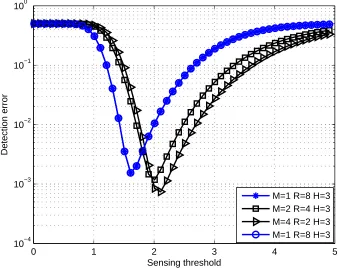
4.1 Error detection rate vs. sensing threshold for a cluster with 24 CRs atγ = 1
dB andα= 60%. . . 44
4.2 A comparison in total error rate between 2 and 3 levels hierarchy with 24
CRs atγ = 1dB andα= 60%. . . 45
4.3 Complementary receiver operating characteristic of the proposed iterative
algorithm (4.1), forN = 24, γ = 1dB andα= 70%. . . 46
4.4 Error detection rate vs. sensing threshold at three different SNR values. . . 48
4.5 Overall probability of detection vs. sensing threshold of three different SNR. 49
4.6 Overall probability of detection of the proposed algorithm compared to a
fixed threshold atα= 60%. . . 50
4.7 Error detection rate vs. SNR of the proposed algorithm compared to a fixed
threshold,atα= 60%. . . 51
4.8 A comparison in a global probability of detection for adaptive threshold
LIST OF ABBREVIATIONS
AWGN Additive white gausain noise AF The amplify and forward protocol.
AP access point.
CBSS Cluster-based spectrum sensing.
CCSS Centralized cooperative spectrum sensing. CDR Constant detection rate.
CFAR Constant false alarm rate.
CH Cluster head.
CMs Cluster members. CR Cognitive radio.
CROC Complementary receiver operating characteristic. CSCG Circularly symmetric complex gausain.
CSS Cooperative spectrum sensing. DF The decode and forward protocol. EGC Equal gain combining.
FC Fusion center.
FR Fusion rule.
GH Group head.
GSC Generalized selection combining. HTP Hidden terminal problem.
HF High-frequency.
IEDs Improved energy detectors. LOS Line of sight.
LSS Local spectrum sensing. MCMG Multi-cluster multi-group. MDS Minimal dominating set.
MME Maximum Minimum Eigenvalue. OSA Opportunistic spectrum access. pdf probability density function.
PU Primary user.
ROC Receiver operating characteristic. RSP Received signal power.
SC Selection combining. SCM Sample covariance matrix. SDR Software Defined Radios.
SINR Signal to interference plus noise ratio. SGH Subgroup head.
LIST OF SYMBOLS
α A predefined percentage of the saved energy.
B The required number of reporting CRs.
β Global probability of false alarm constraint.
d.e Ceiling function.
∆E The percentage of saved total energy consumption.
ξ Control channel gain.
fs Sampling frequency.
Γ(m) The Gamma function.
Γ(a, b) The incomplete Gamma function. ¯
γ Average SNR.
γi SNR for the ith CR.
γmax,j Maximum SNR in the jth subgroup.
H Number of CRs in one subgroup.
h Channel gain between transmitter and CR receiver.
H0 Hypothesis of channel being idle. H1 Hypothesis of channel being busy. Hj Number of CRs in the jth subgroup.
I0 0thorder modified Bessel function of the first kind.
k1 andk2 Fusion rule parameters. K A predefined integer.
¯
K Rice factor.
L Number of sensing sample.
λ Sensing threshold.
λopt The optimal sensing threshold.
M Number of groups in one cluster.
m Nakagami parameter.
Ms Number of sensing samples in 1ms.
Pd Probability of detection for a single CR.
PdSG Probability of detection for a subgroup.
Pf Probability of false alarm for a single CR.
ˆ
Pd Predefined probability of detection.
ˆ
Pf Predefined probability of false alarm.
Pmd Probability of missed detection for a single CR.
P(H0) Probability of PU being absent. P(H1) Probability of PU being present.
P(T(y)> λ|H0) Conditional probability density function ofT(y)> λgivenH0. P(T(y)> λ|H1) Conditional probability density function ofT(y)> λgivenH1. ψ The percentage of reporting CRs in the cluster to the total
num-ber CRs in the cluster.
ϕe Overall error detection rate.
Q(·) Q-function.
Qd Global probability of detection for CRN.
Qf Global probability of false alarm for CRN.
Qm Global probability of missed detection for CRN.
qdG Probability of detection for a group.
qf G Probability of false alarm for a group.
R Number of subgroups in one group.
Rb Bit rate.
σw2 Noise power.
T(y) The test statistic of the energy detector.
ϕe Overall error detection rate.
w(n) The received noise.
x(n) The PU transmitted signal.
CHAPTER 1
Introduction
The emergence of new applications coupled with the demand for higher data rates
are growing because of the wide diversity of wireless devices and technologies. Radio
frequency spectrum is getting extensively more congested. On top of that, given the
limi-tations of the natural frequency spectrum, it becomes apparent that the existing static
fre-quency allocation policy result in spectrum scarcity (i.e., spectrum underutilization).
Spec-trum utilization can be improved substantially by making it possible for an unlicensed user
to exploit the unoccupied spectrum band (i.e., spectrum holes ) of the primary user
dynam-ically at a certain time and a specific geographic region.
A promising technique to deal with the problem of spectrum underutilization is
cogni-tive radio (CR) technology. An essential function of the CR is to be aware of the primary
user (PU) signals characteristics and, be able to learn and adapt its transmission
parame-ters based on its own observations from the surrounding environment along with the CR
users needs. Cognitive radio (CR) is a revolutionary technology proposed to perform
dy-namic spectrum access (DSA) techniques, which enables the unlicensed user to access the
1. INTRODUCTION
Spectrum sensing is considered the most significant element to establish CR networks
through which the CR identify the existence of the PU signal to improve spectrum
utiliza-tion [2, 4]. When a particular frequency band is detected as unused by the licensed user
at a specific time and selected geographical position, the secondary users (SUs) can utilize
the spectrum (i.e., a spectrum opportunity can be found). Accordingly, spectrum sensing
can be executed across the domains of time, frequency, and space [1]. The detection
per-formance of CR user often critically deteriorates due to destructive radio circumstances
such as deep multipath fading and heavy shadowing. As result, CR user may not be able
to identify the existence of a primary transmitter (i.e., hidden terminal problem) [13].
Con-sequently, individual spectrum sensing cannot guarantee the desired reliability. To ensure
accurate sensing results, cooperative detection approaches are implemented to alleviate this
problem. Cooperative detection refers to spectrum sensing methods that allow many
cog-nitive radios to share their local sensing information for more accurate primary transmitter
detection. Cooperative spectrum sensing (CSS) procedure enhances the accuracy and
re-liability of cooperation gain (i.e., detection performance improvement) and mitigates the
impact of harsh radio environment conditions. However, this improvement may also incur
numerous collaboration costs (i.e., additional energy consumption, time, and complexity),
which limit or even compromise the achievable cooperative gain. Thus, striking a
bal-ance between enhancing the collaboration gain and reducing the incurred overhead is an
essential objective in CSS.
Therefore, the principle of clustering was imposed to CSS to enhance the performance
while alleviating the overhead issue. Many works in this field revealed that cluster-based
perfor-1. INTRODUCTION
mance and overhead issue. However, the design of energy efficient CBSS system is still
considered a significant design issue in cognitive radio networks (CRNs).
1.1
Motivation and Research Objectives
Recently, the trend of research concentrates on designing an energy efficient CBSS system
to strike a stability between the performance and cost (i.e., overhead). An iterative
algo-rithm was introduced in [34] to develop multi-level hierarchical cluster based spectrum
sensing (MH-CBSS) algorithm to balance between the achieved performance and incurred
overhead. This performed by employing double fusion stages to reduce control overhead
for a cluster with a significant number of devices. However, the MH-CBSS iterative
al-gorithm incurs high computational burden. Moreover, most energy detection alal-gorithms
assume fixed detection threshold to differentiate between the PU signal and the noise. The
performance of the energy detector depends considerably on the setting of the threshold.
Therefore, it is crucial to set a proper threshold for the energy detector to gain a reliable
and robust sensing ability.
The research work takes into consideration the following objectives.
1. Designing an energy efficient low computational hierarchical cluster-based CSS
sys-tem over Rayleigh and Nakagami fading channels.
2. Designing an energy efficient hierarchical cluster-based CSS system with an adaptive
1. INTRODUCTION
1.2
Research Contributions and Significances
The two main contributions of this thesis are provided as follows:
1. Energy-efficient low computational hierarchical cluster-based cooperative spectrum
sensing for CRNs.
In previous research an iterative algorithm was developed in [34] to construct a
multi-level hierarchical cluster based spectrum sensing MH-CBSS algorithm that
compro-mise between the gained performances and incurred overhead. The MH-CBSS
al-gorithm outperforms both the Conventional CBSS and MCMG alal-gorithm in terms
of probability of detection, throughput and reporting overhead. However, the
MH-CBSS iterative algorithm incurs high computational requirements. In this thesis, we
propose a modified version of the MH-CBSS algorithm that reduces the incurred
computational burden. Moreover, we compare both versions over both Rayleigh and
Nakagami fading channels. Simulation results show that the detection performance
of the modified algorithm outperforms the MH-CBSS algorithm over Rayleigh and
Nakagami fading channels.
2. Energy-efficient adaptive threshold based on hierarchical CBSS for energy detection.
The second contribution developed the proposed MH-CBSS algorithm by
consider-ing the adaptive threshold instead of the conventional fixed threshold. A low
compu-tational energy-efficient hierarchical cluster-based spectrum sensing with an adaptive
1. INTRODUCTION
threshold to achieve the minimum total cluster error. Moreover, the optimal threshold
level for minimizing the overall cluster error rate is numerically determined. The
de-tection performance of the proposed algorithm has been investigated and compared
with the conventional fixed threshold over Rayleigh fading channels. The
simula-tion results have shown that the proposed algorithm can provide higher primary user
protection by improving the detection performance.
1.3
Outline of the Thesis
The thesis is organized as follows: Chapter 2 provides an overview and background of
spectrum sensing in cognitive radio networks used in this thesis including local spectrum
sensing, cooperative spectrum sensing (CSS), the gain and overhead trade-off in CSS, and
cluster-based CSS. An energy-efficient low computational hierarchical cluster-based
spec-trum sensing algorithm is introduced in Chapter 3which reduces the complexity of the
MH-CBSS algorithm. The work in Chapter 4 considers the adaptive threshold instead
of the conventional fixed threshold which enables the CR dynamically adapts its energy
threshold to achieve the minimal total cluster error. Moreover, the optimal threshold level
for minimizing the overall cluster detection error rate is numerically determined.
CHAPTER 2
An Overview of Spectrum Sensing in
Cognitive Radio Networks
2.1
Introduction
Recently, the growth of wireless technologies and services has contributed to the
insuffi-cient utilization of available wireless resources and has increased the demands for extra
bandwidths and higher data rates. This is exacerbated by the unexpected evolution of
mul-timedia technologies and excessive development of its applications and subscribers which
has led to the recent spectrum scarcity problem. Moreover, it becomes noticeable that the
fixed spectrum assignment policies that are enforced by regulatory bodies and the
gov-ernment agencies are unable to satisfy the requirements of increasing number of higher
data rate devices [1]. Consequently, innovative approaches that can offer new methods of
exploiting the available spectrum are required.
A promising approach to tackle the problem of spectrum underutilization is cognitive
2. AN OVERVIEW OF SPECTRUM SENSING IN COGNITIVE RADIO NETWORKS
and be aware of the PU signals characteristics. It is intended to take advantage of the
underutilized licensed spectrum by dynamically exploiting the local vacant spectrum bands
of the primary users (i.e., licensed users) during their inactive periods by secondary users
(i.e., unlicensed users). Cognitive radio (CR) is a revolutionary technology proposed to
perform dynamic spectrum access (DSA) techniques, which enables unauthorized user to
access licensed user band with flexibility and minimum interference [2, 3].
2.2
Local Spectrum Sensing
Spectrum sensing is considered the most important functional element to establish CR
net-works through which the CR identify the existence of the PU signal to improve spectrum
utilization [2, 4]. Detecting the presence of the PU is mainly based on spectrum sensing
hypotheses, which are defined as:
Testing hypotheses=
H0 (idle channel) y(n) = w(n)
H1 (occupied channel) y(n) = h(n)×x(n) +w(n)
(2.1)
whereH0andH1 , are the hypotheses for absence and presence of the PU, respectively.
y(n)is a signal received by the CR,x(n)is the PU transmitted signal,w(n)is the received
noise, andh(n)is the channel gain between the CR and PU.n = 1,2..., Ms, whereMsis
the number of sensing samples [5].
2. AN OVERVIEW OF SPECTRUM SENSING IN COGNITIVE RADIO NETWORKS
as energy detectors [5], cyclostationary detectors [7], matched filter [1], and
eigenvalue-based detectors. However, while each method has its advantages, there are disadvantages.
2.2.1
Energy Detector
Energy detector is the most widely used technique in spectrum sensing due to its simple
hardware implementation, low computational, and execution requirements as it requires no
prior knowledge of PU signal’s characteristics. In the energy detection method, CR users
detect the existence/absence of a primary user through the energy of a received PU signal.
First, the energy detector filters out the desired signal from the unwanted frequency band.
Then, the received signal samples from the filter are squared and summed. Eventually, the
accumulated energy of theMsobservation samples is compared with a predefined threshold
to decide whether a primary user is present or not. The energy detector block diagram is
given in Fig. 2.1, and the test statistic of the energy detectorT(y)is determined as follows
[5]:
T(y) =
Ms X
n=1
|y(n)|2 (2.2)
There are three main drawbacks to the energy detector scheme : (1) its setting of detection
threshold, which should be selected carefully since it significantly affects the sensing
per-formance of energy detection; (2) its poor perper-formance at low signal-to-noise ratio (SNR)
values; and (3) its inability to determine the presence of the signal in another wards it
2. AN OVERVIEW OF SPECTRUM SENSING IN COGNITIVE RADIO NETWORKS
Figure 2.1: Diagram of energy detector.
2.2.2
Matched Filter
Its distinctive feature is the low execution time, but it demands full knowledge about the PU
signal properties. Furthermore, perfect synchronization between the primary transmitter
and cognitive radio user is needed. However, the main impairment of this method is the
fact that its hardware implementation is complicated and it requires high computational
complexity [1, 8].
2.2.3
Cyclostationarity Feature Detection
If partial knowledge about the primary user PU signal existed, feature detection might be
employed. It usually exploits the periodicity in the received PU signal, which is frequently
caused by the sine waves, pulse sequences or cyclic prefixes during modulation. Moreover,
the statistical parameter of the primary user modulated signal, such as mean and
autocor-relation, may also vary periodically, therefore, such statistical periodicity can be applied
to identify the occupation of PUs signal. Unlike the energy detector, the feature detector
is more effective with respect to noise uncertainty. In addition, it can distinguish between
the noise and the PU signal which requires more computational complexity and hardware
2. AN OVERVIEW OF SPECTRUM SENSING IN COGNITIVE RADIO NETWORKS
2.2.4
Maximum-Minimum Eigenvalue (MME) Detector
MME detector is considered a blind spectrum sensing technique where the PU signal
char-acteristics (i.e., expected received SNR, the typical values of the occupied bandwidth, and
on top of that, the noise energy inside the band of interest ) are concealed for the CR
user. The distribution of the eigenvalues of the covariance matrix of the received signal
has recently provided an attractive research topic. MME detection begins by estimating the
sample covariance matrix (SCM) of the received signal. Then, the ratio of the maximum
eigenvalue to the minimum eigenvalue can be utilized to detect the presence/absence of
the PU signal. High probability of detection can be accomplished using MME detector,
particularly at low SNR. However, this will be at the price of higher hardware complexity
[9, 10].
A crucial factor in the success of cognitive transmission is the reliability of the obtained
results from the spectrum sensing process. However, the detection performance of
cogni-tive radio CR often harshly deteriorates due to adverse radio conditions (i.e., multipath
fading and shadowing) [11]. Consequently, individual spectrum sensing cannot guarantee
the desired reliability. To ensure accurate sensing results, CSS was proposed as an effective
approach to mitigate the consequence of radio environment conditions and to improve the
detection performance of the CRs.
2.3
Models of Cooperative Spectrum Sensing
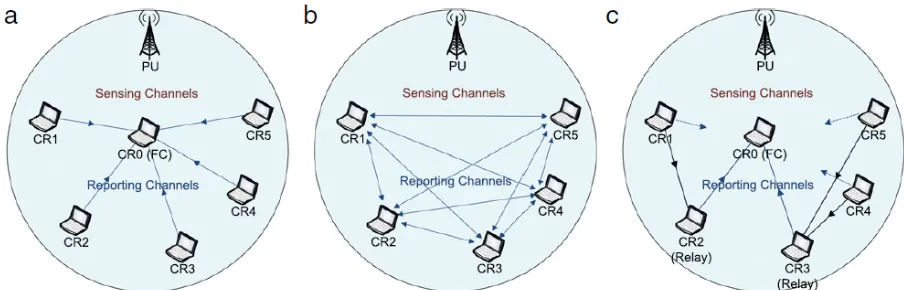
To improve the performance of spectrum sensing especially when CR users experience
2. AN OVERVIEW OF SPECTRUM SENSING IN COGNITIVE RADIO NETWORKS
Figure 2.2: Models of cooperative spectrum sensing: (a) centralized, (b) distributed, and (c) relay-assisted.
their information. As a result, the participation greatly improves the probability of detection
and the throughput while reducing the required sensing time [13]. There are three popular
models for CSS networks that are classified based on how the collaborative SUs share the
sensing information in the network: centralized CSS, decentralized CSS, and relay assisted
CSS, as shown in Fig. 2.2, [2].
2.3.1
Centralized Cooperative Spectrum Sensing
In centralized cooperative spectrum sensing (CCSS), a central unit (i.e., Fusion Center,
Base station) accumulates the sensing information from cognitive radio devices. First,
every single cooperating CR performs local sensing autonomously to measure the signal of
PU user. CR makes its decision about the existence of PU signal based on its local sensing
information. Second, each CR reports its decision to the fusion center (FC) via reporting
channel. The decision can be done in either one-bit form (i.e., hard-based scheme) or as
large quantized number of bits form (i.e., soft-based scheme). Third, the central unit fuses
2. AN OVERVIEW OF SPECTRUM SENSING IN COGNITIVE RADIO NETWORKS
back, which is made according to a predefined rule, called fusion rule (FR) [2, 13].
In the case of a hard decision fusion scheme, the most well-known FR is theK
-out-of-N rule, where CRs report their local decisions as one bit (i.e., ui = 0,1). ifui = 1, then
the CR decides that the spectrum is used. Otherwise, the spectrum is recognized as unused
by theith CR. In this rule,N is the total number of reported local decisions, andK is a
predefined integer between1andN. The concept of this rule is to compare the number of
CRs whose local decisions have been received as1toK. If it is larger than or equal toK,
then the spectrum is defined as used. Otherwise, the spectrum is determined to be unused.
The following equation describes the function ofK-out-of-N rule.
Final decision=
used If PN
i=1ui ≥K
unused If PN
i=1ui < K
(2.3)
OR andAN Drule are considered special cases of the generalK-out-of-N rule when
K is 1 orN respectively [12, 14].
While in the case of a soft decision fusion scheme, CR users forward the entire
sens-ing decision to the central unit as energy. Equal gain combination (EGC), maximal ratio
combination (MRC), and square law combination (SLC) are the most widely adopted soft
combining procedures. Though the soft scheme improves the reliability of centralized CSS
decision, it may increase the overhead (i.e., bandwidth and power consumption) during
reporting to central unit [15].
Many approaches were aimed at enhancing the detection performance such as the
2. AN OVERVIEW OF SPECTRUM SENSING IN COGNITIVE RADIO NETWORKS
data by the involved CRs in CSS. As a result, a trade-off between the detection performance
and the incurred overhead (i.e., energy consumptions, time costs and bandwidth
occupa-tion) should be analyzed carefully before designing the centralized CSS model. Therefore,
many researchers have studied the trade-off between performance and overhead. Some
researchers focused on optimizing different parameters ofK-out-of-N rule targeting
dif-ferent objectives. For example, the researchers in [16] optimize theN(i.e., the total number
of CRs) following two different scenarios: an energy-efficient setup and a throughput
op-timization setup. Moreover, a novel report scheme was introduced in [17], and it reduces
the power consumption considerably by decreasing the number of reporting CRs without
affecting the detection accuracy. A double thresholds fusion scheme was proposed in [18]
to reduce the transmitted information and the incurred overhead while keeping the required
detection performance.
2.3.2
Decentralized Cooperative Spectrum Sensing
This model implies the establishment of the CRs network without need for a central unit. In
this model, each CR takes part to make the cooperative decision. At first, each CR senses
the spectrum autonomously and regularly. Then every CR builds up a communication
link with other CRs and shares the information about the present or absence of PU. Next,
each cognitive radio makes its final decision based on the gathered information from other
CRs and its local decision. Finally, if a definitive agreement about the PU existence is not
achieved, the procedure is repeated until a final agreement is accomplished [19]. Compared
2. AN OVERVIEW OF SPECTRUM SENSING IN COGNITIVE RADIO NETWORKS
a backbone infrastructure and because it can reduce costs [1].
2.3.3
Relay Assisted Cooperative Spectrum Sensing
The cooperative relay is regarded as a key technology to develop spectrum diversity in the
cognitive radio network and combat the influence of fading and shadowing in wireless
com-munication networks. The underlying mechanism is to exploit the space diversity available
among cooperating CRs. Some CR users do not require the entire accessible spectrum due
to the low traffic demands (i.e., strong reporting channel and weak sensing channel). Those
CR users can serve as relays or helpers that assist in forwarding the sensing results from
the CR users who observe strong PU signal and low reporting channel [2, 20].
In this model, two relaying schemes are used most often: the amplify and forward (AF)
protocol, and the decode and forward (DF) protocol. In AF scheme, CR simply
ampli-fies and retransmits the noisy version of the received primary user signal to another CR
in the network [21]-[23]. The relay based CSS was considered in [22] over Rayleigh
fad-ing channels. The relay CRs used an amplify-and-forward relayfad-ing strategy to deliver the
information from primary user to cognitive center. Both single relay and multiple relays
procedures are utilized. Moreover, two phenomena were evaluated: the impact of relays
location between the primary user and cognitive receiver, and the effect of path loss by
measuring the probability of false alarm and probability of detection. In [23], the authors
analyzed the performance of the amplify-and-forward (AF) relay-based cooperative
spec-trum sensing system with generalized selection combining (GSC) over a Rayleigh fading
2. AN OVERVIEW OF SPECTRUM SENSING IN COGNITIVE RADIO NETWORKS
Figure 2.3: Cooperative Spectrum Sensing detection under highly faded and shadowed environment.
probability. The results were compared with the conventional diversity-combining schemes
such as maximal-ratio-combining (MRC) and selection-combining (SC) schemes. It was
shown that the GSC receivers achieve a more balanced compromise between the receiver
performance and the implementation complexity compared to the MRC receivers.
2.4
Gain and Overhead Trade-off in CSS
Cooperative spectrum sensing CSS has been proposed to improve spectrum sensing
capa-bilities over wireless channels. This procedure enhances the accuracy and reliability of
2. AN OVERVIEW OF SPECTRUM SENSING IN COGNITIVE RADIO NETWORKS
oration costs (i.e., additional energy consumption, time, and complexity), which limit or
even compromise the achievable cooperative gain. Therefore, striking a balance between
enhancing the cooperation gain and reducing the incurred overhead is a crucial purpose in
CSS. For the sake of achieving a compromise between the gain and the cost, many factors
should be taken into account. One of these important factors is channel impairments.
2.4.1
Channel Impairments
In broadcast communication networks, as the radio waves travel from the transmitter to
the receiver, the signal power could severely weaken due to harsh radio conditions, such
as heavy shadowing and deep multipath fading. As a result, detection performance (i.e.,
cooperation gain) becomes progressively worse. At this point, the cooperative gain can be
achieved by employing the concept of cooperative spectrum sensing to combat such effect.
The constructive and destructive combination of reflected, scattered and diffracted
sig-nal components of the PU sigsig-nal creates a multipath fading effect. This impact results in
multiple replicas of the transmitted signal that experience different attenuation and
vari-ations (i.e., envelope and phase fluctuvari-ations) at the receiver side. In addition, the fading
caused by obstacles (i.e., natural or human-made features) in the radio bath affects the
wave propagation between the PU transmitter and CRs. This is referred to as shadowing.
2. AN OVERVIEW OF SPECTRUM SENSING IN COGNITIVE RADIO NETWORKS
2.4.2
Models of Fading Channels
The nature of the radio propagation environment can influence how effectively different
models describe the statistical behavior of the multipath fading envelope.
2.4.2.1 Rayleigh Fading Channel
In the Rayleigh fading scheme the magnitude of a signal that has transmitted through a
com-munications channel will fluctuate randomly according to a Rayleigh distribution. Also,
Rayleigh fading is considered the most applicable model when there is no direct line of
sight (LOS) path (i.e., radio waves travel in a direct path from the transmitter to the
re-ceiver).
The probability density function (pdf) of the signal-to-noise ratio (SNR), γ, over a
Rayleigh fading channel is given by
f(γ) = 1 ¯
γ e
−γ¯γ
, γ ≥0 (2.4)
whereγ¯is the average SNR [25].
2.4.2.2 Rician Fading Channel
It is usually utilized to model scattering environment consisting of one strong direct LOS
component and several random contributions with less amplitude. In this situation, the
fading channel of the received signal is characterized by a Rician distribution. Its pdf is
2. AN OVERVIEW OF SPECTRUM SENSING IN COGNITIVE RADIO NETWORKS
f(γ) = ¯
K+ 1 ¯
γ e
−K¯−( ¯K+1)γ¯ γ
I0
s
¯
K( ¯K + 1)γ
¯
γ
, γ ≥0 (2.5)
whereK¯ is the Rice factor andI0 is the0thorder modified Bessel function of the first
kind [26].
2.4.2.3 Nakagami Fading Channel
The Nakagami-m distribution was introduced by Nakagami in the early 1940s to describe
the rapid fading in long-distance high-frequency (HF) channels. It provides greater
flexi-bility and accuracy in matching some empirical data than the Rayleigh and Rician
distri-butions. The Nakagami-m distribution describes the magnitude of the received envelope
which follows the gamma distribution [28]. Hence, the pdf of Nakagami-mchannel is:
f(γ) = 1
Γ(m)
m
¯
γ m
γm−1e(−m¯γ)γ, γ ≥0 (2.6)
wheremis the Nakagami parameter andΓ(m)is the Gamma function.
The Nakagami-m distribution can represent different models of fading environments.
It is a general case that includes the one-sided Gaussian distribution (m = 1/2)and the
Rayleigh distribution (m = 1) as special cases. Furthermore, when m > 1 a close
ap-proximation can be used to obtain a Rician distribution. When the limit of (m → ∞), the Nakagami-m fading channel converges to a non-fading additive white gausain noise
(AWGN) channel [26].
The performance of energy detector was presented in [29] for an unknown transmitted
2. AN OVERVIEW OF SPECTRUM SENSING IN COGNITIVE RADIO NETWORKS
for the probability of detection and the probability of false alarm over Rayleigh and
Nak-agami fading channels were proposed. The work also investigated the impact of diversity
on Rayleigh channels. The results revealed an improvement in detection capability,
espe-cially for relatively low power applications when soft decision fusion rules, such square
law combining (SLC), and square law selection (SLS) were employed.
The authors of [26] examined the performance of cooperative spectrum sensing CSS
over different multipath fading channels such as Rayleigh, Nakagami, and Rician fading
channels. Closed-form expressions of the average detection probability are employed to
provide a comprehensive study of cooperative energy detection in various fading channels.
It has been found that the cooperative among cognitive radios guarantees the enhancement
of the detection performance by employing different data fusion rules. A comparison
be-tween the performances in these channels was presented and showed that spectrum sensing
performance is lower in the presence of Rayleigh, Ricean, and Nakagami fading when
com-pared to an AWGN channel. Further, because of the LoS path, the sensing performance of
a Ricean channel is better than the other fading channels.
The influence of shadowing on the performance of the CSS system was viewed in [27].
In the study, an analytical framework was provided for the analysis and design of
coopera-tive spectrum sensing methods over correlated log-normal shadowing by using the
energy-based detector in each collaborative user. Approximation methods were proposed, and
their accuracy was analyzed to compute the detection probability over correlated
LogNor-mal shadowing. Consequently, the proposed framework provided reliable estimates that
2. AN OVERVIEW OF SPECTRUM SENSING IN COGNITIVE RADIO NETWORKS
2.5
Cluster-Based Cooperative Spectrum Sensing
Clustering technique is considered a management technology that arranged the scattered
cognitive radio users into logical groups to enhance the sensing performance of the
net-work. In the conventional CSS systems, the reporting process of a vast number of
partic-ipating CRs incurs high cooperation cost (i.e., energy consumption, control and
transmis-sion overhead). In addition, when the CRs are assigned in different radio circumstances the
global decision by the base station BS may not include all the participating CRs which in
turn will be reflected on the sensing performance [30, 31]. Hence, the main objectives of
the cluster- based spectrum sensing technique (CBSS) is to improve sensing performance
and address the overhead matters.
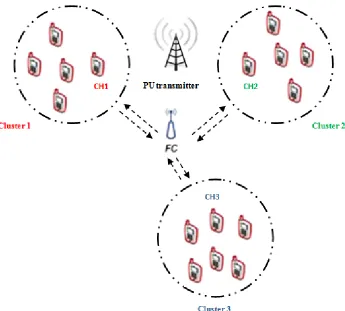
In CBSS technique (Fig. 2.4), CRs are separated into small groups (i.e., clusters)
ac-cording to their geographical area and spectral circumstance. Each cluster has a cluster
head (CH) and cluster members (CMs). Spectrum sensing is executed in a hierarchical
framework. The collaboration process has two levels: the low level is carried out within
the cluster, and the high level is performed between CHs. The CH is usually chosen as a CR
with the greatest reporting channel gain in the cluster. The CMs (i.e., the lowest
coopera-tion level) in a cluster detect the existence of the PU, and then forward their local sensing
outcomes to the CH. The CH combines its observation with the aggregated observations to
extract an accurate decision on the existence of the PU [30].
Lately, the research trend focuses on designing an energy efficient CBSS system in
2. AN OVERVIEW OF SPECTRUM SENSING IN COGNITIVE RADIO NETWORKS
Figure 2.4: Cluster-based spectrum sensing technique (CBSS) structure
2.5.1
Strategies of Cluster-Based Spectrum Sensing Technique
Multiple approaches and algorithms have been recommended to form the clusters for CBSS
scheme. The CBSS system can be classified into three main categories based on their
objective: performance gain oriented models, overhead reduction oriented models, and
combined metrics based models [30, 31].
2.5.1.1 Performance Gain-Oriented Strategy
The optimal number of clusters is achieved in [32] by balancing the trade-off between the
2. AN OVERVIEW OF SPECTRUM SENSING IN COGNITIVE RADIO NETWORKS
cluster head election and cluster formation. Moreover, a closed form expression for a
probability of detection based on polling rule was also derived. A clusters
multi-groups (MCMG) based CSS algorithm was introduced in [33] to improve the detection
performance. By separating a cluster into various groups, the optimal number of groups is
obtained by usingK-out-of-N fusion rule which minimizes the error rate of a cluster.
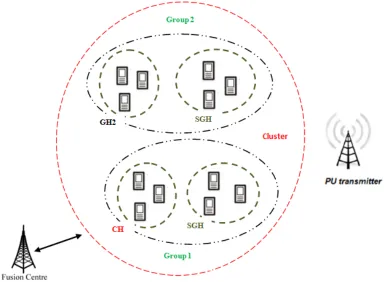
An iterative algorithm was developed in [34] to construct suboptimal number of groups
and subgroups in a multi-level hierarchical cluster based spectrum sensing (MH-CBSS)
algorithm. This was done by employing double fusion stages to reduce the control overhead
for a cluster with a great number of CRs. The idea of the algorithm is to split the CRs in
one cluster into groups. Each group is then divided into subgroups. Each group has a
group head (GH), and each subgroup has a subgroup head (SGH). The subgroup head
polls the received PU signal with maximum strengths of its subgroup members and makes
a subgroup decision, which is then forwarded to the GH of its group. The aggregated
observations from subgroups will be combined by GHs using K-out-of-N rule first, and
then the CH collects decisions from GHs and fuses them to the FC to extract clusters
decision about PU presence also usingK-out-of-N rule. A novel dynamic clustering based
cooperative spectrum sensing (CSS) scheme with improved energy detectors (lEDs) was
considered. In [35] a novel expression for dynamic clustering was proposed under the
Rayleigh fading channels. Only the CRs with the best quality links and distinct access point
(AP) were selected to make a cluster. In addition, the performance of clustered networks
2. AN OVERVIEW OF SPECTRUM SENSING IN COGNITIVE RADIO NETWORKS
2.5.1.2 Overhead Reduction Oriented Strategy
Many paradigms for the development of CBSS were adopted to overcome the incurred
sensing overhead. Clustering technique was developed in [36] to save energy consumption
during the reporting and exchanging information stages. Also, frequency reuse distance
was considered to reduce the transmission delay especially when the cluster CRs number
is significant.
The minimal dominating set (MDS) clustering algorithm was proposed in [37] to achieve
the minimal number of clusters that maintain the network connectivity. The recommended
approach was pointed toward reducing the bandwidth required for reporting the results to
the fusion center (FC) by decreasing the number of reporting CRs. Furthermore, sensing
efficiency, sensing accuracy and throughput were also investigated by employing
differ-ent parameters of the clustering system such as cluster size, a number of clusters, and a
reporting channels error. It was revealed that throughput of cluster-based cooperative
sens-ing system ussens-ing MDS algorithm outperforms the conventional cooperative senssens-ing system
particularly when the reporting channels are subjected to a high probability of error. In
addition to previous works, a new censoring method [18] was applied in the clusters to
decrease the number of the transmission bits and saving the bandwidth. Two thresholds
were given to measure the reliability of the CR information. Only the users with reliable
information were allowed to give their local binary results, and the others will not make any
decision. It was shown that the new method reduced the sensing bit number considerably
2. AN OVERVIEW OF SPECTRUM SENSING IN COGNITIVE RADIO NETWORKS
2.5.1.3 Combined Metric Based Strategy
Considering the trade-off between improvement of sensing performance and the reduction
of incurred sensing overhead to reach a compromise is a significant goal of this type of
CBSS schemes. The work in [38] aimed at a trade-off between the number of clusters
and the detection performance in the cluster based cooperative spectrum sensing scheme.
By characterizing the trade-off as an optimization problem, the optimal number of clusters
was obtained. Base on the optimal cluster number the CR users are separated into different
clusters according to the received signal power (RSP) from the CH. CR users choose the
closest CH to join it according to the RSP. Moreover, the approximation of the optimal
number of clusters was also derived, and simulation results proved the superiority of the
suggested approach.
2.6
Conclusions
This chapter introduced a brief introduction to spectrum sensing in cognitive radio
net-works. Different methods have been presented to perform local spectrum sensing.
More-over, we present some fundamental models and fusion rules that can be adopted in
coopera-tive sensing systems. A trade-off between the detection performance and incurred overhead
has been discussed. Different models that are describing the multipath fading channels are
briefly explained. Eventually, some information about the models of cluster-based
CHAPTER 3
Low Computational Hierarchical
Cluster-Based CSS for CRNs
3.1
Introduction
Cooperative spectrum sensing (CSS) was proposed as an effective solution to minimize the
impact of radio environment conditions and to enhance the detection performance of the
collaborating cognitive radios [1]. On the other hand, the gained improvement attained by
the CSS technique causes cooperative cost called overhead (i.e., bandwidth requirements,
extra sensing time, delay, and energy consumption. Therefore, the principle of clustering
was imposed to CSS to improve the performance while reducing the overhead [2].
In conventional cluster-based cooperative sensing (CBSS) scheme [40], all cooperating
CRs are arranged according to their geographic locations into groups called clusters. Each
cluster has a cluster head (CH) and cluster members (CMs). The CMs in a cluster detect
3. LOW COMPUTATIONAL HIERARCHICAL CLUSTER-BASED CSS FOR CRNS
Figure 3.1: System model of the MH-CBSS algorithm.
combines its observation with the aggregated observations to extract an accurate decision
on the existence of the PU. Lately, the trend of research focuses on designing an energy
efficient CBSS system in order to strike a balance between the performance and overhead.
An iterative algorithm with low complexity was proposed in [41] to extract the optimal
number of CRs in a cluster that maximizes the probability of detection while satisfying the
probability of false alarm constraint.
Multi-clusters multi-groups (MCMG) based CSS algorithm was introduced in [33], to
improve the detection performance. An iterative algorithm was developed in [34] to
con-struct multi-level hierarchical cluster based spectrum sensing (MH-CBSS) algorithm to
compromise between the gained performances and incurred overhead. The MH-CBSS
prob-3. LOW COMPUTATIONAL HIERARCHICAL CLUSTER-BASED CSS FOR CRNS
ability of detection, throughput and reporting overhead. However, the MH-CBSS iterative
algorithm incurs high computational requirements as shown in Fig. 3.1.
In this chapter, a modified version of the MH-CBSS algorithm that reduces the
in-curred computational burden is proposed. Moreover, we compare both versions over both
Rayleigh and Nakagami fading channels. Simulation results show that the detection
per-formance of the modified algorithm outperforms the MH-CBSS algorithm over Rayleigh
and Nakagami fading channels.
This chapter is organized as follows: The MH-CBSS algorithm system model is
de-scribed in Section 3.2. The modified version of the MH-CBSS algorithm is presented in
Section 3.3. Simulation outcomes are presented and discussed in Section 3.4. while the
conclusion is provided in Section 3.5.
3.2
System Model for MH-CBSS Algorithm
Assume a cluster withN CRs is separated intoM groups. Each group is also divided into
Sub- groups, each with H CRs. In subgroup level, H of CRs are considered to be very
close to each other, therefore, they almost experience the same radio environment
condi-tions such as SNR and fading. In group level, each group hasRof SGHs; one SGH between
other SGHs in the group is selected to be a GH. In cluster level, each cluster hasM GHs;
one of the GHs is chosen to be a CH. The probability of detection, Pd, and probability of
false alarm,Pf, for any CR are provided in [42] as
pd=Q (
λ
σ2 −γi−1) s
L
2γ + 1
!
3. LOW COMPUTATIONAL HIERARCHICAL CLUSTER-BASED CSS FOR CRNS
pf =Q
( λ
σ2
w
−1)√L
(3.2)
whereγiis the signal-to-noise ratio (SNR) at the i-th sensor,λis sensing threshold,σ2w
is noise variance,Lis the number of samples andQ(·)isQ-function.
According to MH-CBSS algorithm [34], the cluster is divided into M groups, each
group hasRsubgroups, and each subgroup hasH CRs. Moreover, in practice, the sensing
channels between the CRs and the PU may experience multi-path fading. For thejth
sub-group, withHjCRs, the probability density function of Rayleigh fading is provided in [29]
as
f(γmax,j) =
Hj
γ e −γmax,j
γ
1−e−γmax,jγ Hj−1
(3.3)
whereγmax,j is the largest received SNR in thejthsubgroup.
For the jth subgroup, the SGH polls a subgroups observation and then reports it to the
GH The probability of detection of the SGHPdSG, is calculated as:
PdSG =
Z ∞
0
Pd(γmax,j)f(γmax,j)dγmax,j (3.4)
wherePdSGis numerically calculated using adaptive Gauss-Kronrod Quadrature technique
[43].
For thenth group withR subgroups, considering a perfect channel, the probability of
3. LOW COMPUTATIONAL HIERARCHICAL CLUSTER-BASED CSS FOR CRNS
qdG = R
X
r=k1
R
r
PdSGr (1−PdSG)R−r (3.5)
qf G = R
X
r=k1
R
r
Pfr(1−Pf)R−r (3.6)
wherek1 =dR2efor majority rule, anddxeis ceiling function.
The global probability of detection (Qd) and global probability of false alarm (Qf) for
a cluster withM groups are formulated as:
Qd= M
X
m=k2
M m
βdm(1−βd)M−m (3.7)
Qf = M
X
m=k2
M m
βfm(1−βf)M−m (3.8)
wherek2 =dM2 e,βf = (1−qf G) ¯Pe+qf G(1−P¯e),βd = (1−qdG) ¯Pe+qdG(1−P¯e), and
¯
Peis the probability of reporting error [34].
The criterion of designing MH-CBSS algorithm is provided in [6] as
max
M,R,k1,k2
Qd
subject to R ≥1, M ≥1
k1 ≥1, k2 ≥1 Qf ≤β.
3. LOW COMPUTATIONAL HIERARCHICAL CLUSTER-BASED CSS FOR CRNS
groups,M is the number of groups,k1 is the fusion rule parameters at the group level and
k2 is the fusion rule parameters at the cluster level.
The required number of reporting CRs,B, in the cluster has been computed in [44] as
B =M R−1 = N −H
H (3.10)
3.3
Modified MH-CBSS Algorithm
Letψ represents the percentage of reporting CRs in the cluster to the total number CRs in
the cluster, which is computed as:
ψ = B
N =
N−H
N H (3.11)
In this section, in order to reduce the number of required iterations (i.e., computational
runs) to computeM, R,andH (i.e., number of hierarchical levels), we initially specify the
requiredψ. Therefore,
H =
N
1 +N ψ
(3.12)
The requiredψ will be initially predefined. Then, the number of CRs in the subgroups
will be determined using (3.12), which provides an advantage of reducing the number of
the iterations of MH-CBSS algorithm by around 30%, since only two parameters (i.e.,
R and M) will be determined using the proposed algorithm instead of determining three
3. LOW COMPUTATIONAL HIERARCHICAL CLUSTER-BASED CSS FOR CRNS
proposed modified iterative algorithm is as follows:
Algorithm 3.1. Proposed Low Computational MH-CBSS algorithm
1: SpecifyΨ,and computeH.
2: Specifyβ,Pˆf ,letλ =σw2 (√1L Q
−1( ˆP
f) + 1)
3: Find Factorization ofN an determine its divisors{1, a1, a2,· · · , an}
4: LetM1 ={1, a1, a2,· · ·, an}
5: p=1
For i=1:n
M =M1(i) R = M(Ni)×H
IfR=f ix(R),computePdSG, PdG, Qd, Pf SG, Pf G andQf. IfQf ≤β
M2(p,:) = [QdM R H]
p=p+ 1
ELSE END If END If END
6: [i1, i2] =max(M2(:,1)) 7: M =M2(i2,2), R =M2(i2,3)
As an extended study of the characteristics of the MH-CBSS algorithm, we consider the
case of Nakagami fading channel. Therefore, for thenth subgroup, the fading probability
density function (pdf) of the largest received SNR amongHnCRs is given as [29].
f(γmax,n) =
Hnmmγm−1
¯
γmΓHn m Γ Hn−1
m, m(γmax,n ¯
γ )
e−m(γmax,nγ¯ ) (3.13)
whereΓ(m)is the Gamma function which is defined asΓ(m) = R0∞xm−1e−xdx, while
Γ(a, b)is the incomplete Gamma function which is defined as Γ(a, b) = R0bxa−1e−xdx.
The Nakagami-m distribution can represent different models of fading environments. It
3. LOW COMPUTATIONAL HIERARCHICAL CLUSTER-BASED CSS FOR CRNS
Nakagami-m fading channel converges to a non-fading AWGN channel [26].
3.4
Simulation Results
In this section, the simulation results of the proposed algorithm are presented. The
simu-lation results of the modified algorithm are compared with the conventional CBSS using
majority rule in [40], and the MH-CBSS algorithm in [34]. Simulation settings are assumed
as, N = 24 CRs, sampling frequencyfs = 6MHz, bit rate Rb = 250 kbps, time frame
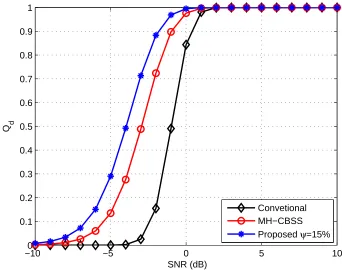
T = 10ms,Pf = 0.1, andβ = 0.01, while the reporting channel gainξ = 1dB.
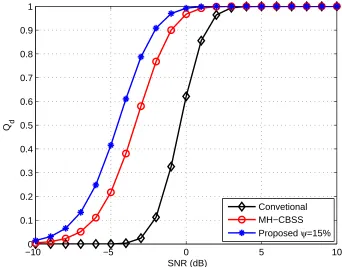
−100 −5 0 5 10
0.1 0.2 0.3 0.4 0.5 0.6 0.7 0.8 0.9 1
SNR (dB)
Q d
Convetional MH−CBSS Proposed ψ=15%
Figure 3.2: Global probability of detection for the modified algorithm compared to con-ventional and MH-CBSS algorithms over Rayleigh fading channel.
The proposed iterative algorithm is examined to assess its performance under different
3. LOW COMPUTATIONAL HIERARCHICAL CLUSTER-BASED CSS FOR CRNS
ψ = 0.15, and using (3.12), the number of CRs in the subgroups,H, is 6. The best values
forM andRobtained by the modified algorithm are 2 and 2, respectively.
It is shown in Fig. 3.2 that the proposed algorithm outperforms both the MH-CBSS and
the conventional algorithms in terms of the global probability of detection over Rayleigh
fading channel, especially, in low SNR scenarios, while it has almost the same total
proba-bility of detection of both algorithms in higher SNR (i.e.,γ >2dB).
It can be observed from Fig. 3.3 that the modified algorithm outperforms both
conven-tional and MH-CBSS algorithms over Nakagami-m fading channel atm= 3.
−100 −5 0 5 10
0.1 0.2 0.3 0.4 0.5 0.6 0.7 0.8 0.9 1
SNR (dB)
Q d
Convetional MH−CBSS Proposed ψ=15%
Figure 3.3: Global probability of detection for the modified algorithm, conventional algo-rithm and MH-CBSS algoalgo-rithm over the Nakagami-m fading channel .
For a comprehensive study, we investigate the performance of the modified algorithm
3. LOW COMPUTATIONAL HIERARCHICAL CLUSTER-BASED CSS FOR CRNS
Fig.3.4.
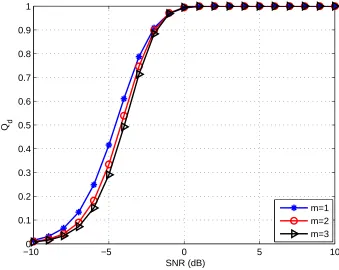
It is noticeable from Fig. 3.4, that the detection performance of the modified algorithm
slightly decreased as Nakagami parameter,m, increased. For the particular case atm = 1
the sensing performance of modified MH-CBSS algorithm will be exactly the same as the
performance over Rayleigh fading channel.
−100 −5 0 5 10
0.1 0.2 0.3 0.4 0.5 0.6 0.7 0.8 0.9 1
SNR (dB)
Q d
m=1 m=2 m=3
Figure 3.4: Global probability of detection for the modified algorithm over Nakagami fad-ing channel with different values form.
Figure 3.5 shows the complementary receiver operating characteristics (CROC) for the
three available algorithms at SNR of 1 dB (i.e., γ = 1 dB) and reporting channel gain
ξ = 1dB. The figure shows that the modified algorithm has better detection performance
3. LOW COMPUTATIONAL HIERARCHICAL CLUSTER-BASED CSS FOR CRNS
10−5 10−4 10−3 10−2 10−1 100
10−6 10−5 10−4 10−3 10−2 10−1 100 Qf Qm Convetional MH−CBSS Proposed ψ=15%
Figure 3.5: Complementary receiver operating characteristics for the three algorithms over Rayleigh fading channel.
−100 −5 0 5 10
0.1 0.2 0.3 0.4 0.5 0.6 0.7 0.8 0.9 1 SNR (dB) Q d Convetional MH−CBSS Proposed ψ=15% Proposed ψ=50%
3. LOW COMPUTATIONAL HIERARCHICAL CLUSTER-BASED CSS FOR CRNS
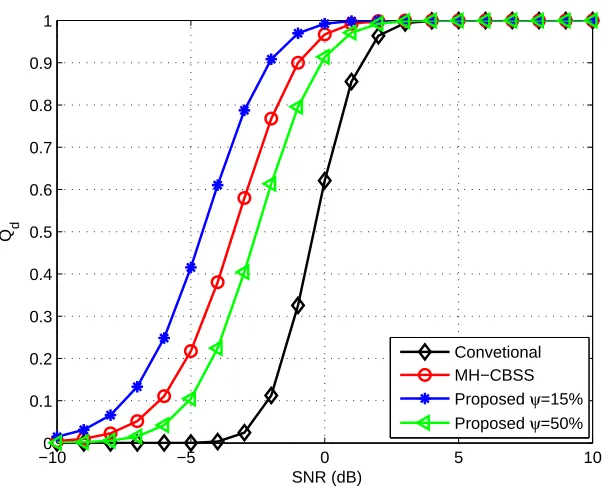
The impact of selecting the predefined percentage of reporting CRs,ψ, on the detection
performance of the modified algorithm is investigated and illustrated in Fig. 3.6. It is
shown in the figure that increasing the value of ψ degrades the detection performance of
the modified algorithm.
3.5
Conclusions
A modified MH-CBSS algorithm has been proposed to reduce the computational
com-plexity of the MH-CBSS algorithm. Moreover, the detection performance of the modified
algorithm has been investigated and compared with the conventional and the MH-CBSS
algorithms over the Nakagami and Rayleigh fading channels. The simulation results have
shown that the modified algorithm provides higher primary user protection while
CHAPTER 4
Hierarchical CBSS Based on Adaptive
Threshold for Energy Detection
4.1
Introduction
A conventional energy detection algorithm is a fixed threshold based algorithm. Setting
a detection threshold is of crucial importance in the performance of an energy detector.
Therefore, it is essential to set a proper detection threshold value for the energy detector to
achieve a reliable and robust sensing capability.
Unlike the conventional fixed threshold based detection algorithm, some current works
investigate the adaptive sensing threshold. In [46], an adaptive threshold was determined
according to the signal to interference plus noise ratio (SINR) for energy detection based
spectrum sensing for individual CR user. The detection threshold was dynamically adjusted
as a linear increasing function of the CRs SINR. The main goal is to maximize the CRs
in-4. HIERARCHICAL CBSS BASED ON ADAPTIVE THRESHOLD FOR ENERGY DETECTION
terference to the PU within a target level. Moreover, the policy function was obtained using
very simple real-time linear calculation which maps the instantaneous SINR to a proper
en-ergy threshold. Simulation results revealed that the proposed method achieves a higher SU
throughput compared to the fixed threshold based energy detector, while maintaining great
stability in the probability of detection and probability of false alarm. In addition, the
pro-posed algorithm in [47] was considered the detection error rate as a criterion to assess the
performance of spectrum sensing algorithm. An optimal adaptive threshold level was
de-termined to minimize the spectrum sensing error for given spectrum sensing constraint for
a single CR. However, the individual CR user may not give accurate sensing results due to
shadowing, multipath fading and hidden terminal problems of the wireless communication
channel. Therefore, in [48] to deal with these problems, the proposed adaptive threshold
approach had been analyzed under the cooperative spectrum sensing (CSS). Simulation
re-sults showed that the probability of detection clearly improved when more than one CR
involved in the spectrum sensing. However, all previously mentioned algorithms did not
consider a compromise between detection performance and incurred energy consumption
for CSS system.
In this chapter, a low computational energy-efficient hierarchical cluster-based CSS
with an adaptive threshold is proposed. The proposed algorithm enables the CR to
dy-namically adapt its detection threshold to meet the minimal overall cluster detection error.
Moreover, the optimal threshold level for minimizing the overall cluster detection error
rate is determined. The detection performance of the proposed algorithm is presented and
evaluated through simulation results.
4. HIERARCHICAL CBSS BASED ON ADAPTIVE THRESHOLD FOR ENERGY DETECTION
The system model is presented in Section 4.3. The proposed algorithm for the adaptive
threshold is introduced in 4.4. Simulation results are presented and discussed in Section
4.5 while the conclusion is provided in Section 4.6.
4.2
Threshold Setting
Before explaining the concept of adaptive threshold, the methods of fixed threshold will
be discussed in this Section. Consider, the test statistic of the energy detector T(y) is
determined as follows.
T(y) =
Ms X
n=1
|y(n)|2
(4.1)
wherey(n)is the signal received by the CR andMsis the observation samples [5].
The performance metric of spectrum sensing can be determined by the detection
prob-abilityPdand the false alarm probabilityPf.
Pd(λ, γ) =P(T(y)> λ|H1) =Q ( λ σ2
w
−γ−1)
s L
2γ+ 1
!
(4.2)
Pf(λ) = P(T(y)> λ|H0) = Q
( λ
σ2
w
−1)√L
(4.3)
whereγ is the signal-to-noise ratio (SNR) at the CR, λis the sensing threshold, σ2
w is the
noise variance, L is the number of samples, Q(·) isQ-function and, H0 and H1, are the
4. HIERARCHICAL CBSS BASED ON ADAPTIVE THRESHOLD FOR ENERGY DETECTION
tion techniques. Therefore, it should be selected carefully; since it significantly affects the
sensing performance of energy detector. The threshold can be set as either fixed or dynamic
(i.e., adaptive threshold); two methods can be used to set a fixed threshold: (1) constant
false alarm rate (CFAR) and(2)constant detection rate (CDR).
(1)The thresholdλP f can be set for CFAR as
λP f =σw2 (
1
√
L Q
−1
( ˆPf) + 1) (4.4)
(2)The thresholdλP d can be set for CDR as
λP d =σw2 (
r
2γ+ 1
L Q
−1( ˆP
d) +γ+ 1) (4.5)
wherePˆdandPˆf are the targeted detection probability and targeted false alarm probability,
respectively.
If the cognitive radio user is expected to guarantee PU’s safely utilize of the spectrum,
the probability of detection should be set to satisfy a predefined probability of detection
called targeted probability of detection (Pˆd) and the probability of false alarm should be
minimized as much as possible. This condition is referred to as CDR method. From the
other perspective, if the CR user aims to ensure the spectrum efficiency of the SUs, the
probability of false alarm should be set to satisfy a predefined targeted probability of false
alarm (Pˆf), and the detection probability should be maximized as much as possible. This
condition is referred to as CFAR method [39]. Therefore, a compromise between the two