An Adaptive Method of Content Extraction
with the Application of Image Segmentation
Using Dynamic Threshold
Vishakha Mehra, Vinesh Jain, Jyoti Gajrani
M.Tech Scholar, Govt. Engineering College Ajmer, Rajasthan, India Assistant Professor Govt. Engineering College, Ajmer, Rajasthan, India Assistant Professor , Govt. Engineering College, Ajmer, Rajasthan, India
ABSTRACT: - Photo segmentation is a essential photograph processing approach this is used to research what is within the photo. Image segmentation is used to split an image into numerous "significant" components. The paper essentially offers with texture segmentation whilst facts pixel become given blended and type errors decreased so it could be one of the issues to deal with similarly. It is going to be primarily based totally on segmentation of content primarily based mostly on the edge and we will display it in code how outcomes adjustments as regular with alternate in threshold values. Every of the pixels in a round is commensurable with the account to a few suitable or computed assets, calm with color, acuteness or texture Graph reduce algorithms are successfully applied to an extensive range of issues in imaginative and prescient and photographs. Here we used this dynamic threshold technique to remedy the photograph segmentation trouble. And we were given success consequences in partitioning an in the photograph. In this paper, we use the normalized reduce method to do the segmentation of a photo. In this technique; we use a computational technique based on the threshold value changes dynamically and eigenvectors to get an optimized segmented picture. We have carried out this method to segment the static pictures.
KEYWORDS: Texture, Pattern recognition, Features, Image segmentation, Threshold I. INTRODUCTION
Probe Image segmentation is to segment the photo into a couple of or more components. It's far useful anywhere whenever we need to research what is interior an Image. For example, if we want to find if there may be a chair or dog interior an indoor photo, we need image segmentation method to split the objects within the picture and analyze each item personally to check what it is…As we already recognize that because of image segmentation we will perceive the diseases in scientific imaging[3] and additionally in many applications like face detection, iris detection, fingerprint reputation and also in brake mild detection technique also we used this image segmentation method.
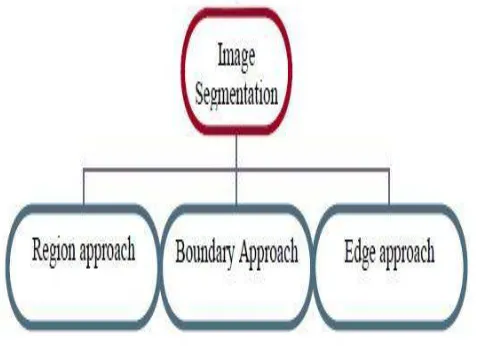
In Probe Image segmentation each approach has its personal advantages and also dangers, so it's tough to tell which one is higher in all of the strategies. There are numerous previous works about the image segmentation, extraordinary survey sources will be observed from these surveys, we will separate the photograph segmentation techniques into 3 unique classes.
In image, segmentation photo is divided into some regions and in that area, every pixel is comparable with appreciate to a few of the feature such as the color, intensity, or texture. Adjoining regions[2] are extensively distinctive with respect to the equal feature(s).
Fig 1: Image Segmentation approach
There are many no of photograph segmentation strategies which are evolved to segment the photograph in a higher manner.
Image segmentation algorithms are developed based totally on two primary homes of depth values: • Discontinuity based
• Similarity-based
In discontinuity primarily based segmentation there are three sorts of discontinuity.
Point: An isolated point may be considered as a line whose length and width are same to 1 pixel. Isolated factors in a photo are the one's factors which have abruptly specific gray values than the ones of its surrounding pixels. A mask is utilized for point detection and entails highlighting the gray value distinction.
Factor: Line may be embedded internal a single uniformly homogeneous vicinity. Within the lines, we are able to section the image on the basis of traces inside the picture.
Aspect: Pixels[7] at which the intensity of photograph adjustments are referred to as aspect pixels. Edges are set of related area pixels. An area basically demarcates between highly exclusive areas.
SIMILARITY BASED SEGMENTATION
In similarity based method segmentation is accomplished based totally on the grouping of pixels primarily based on some capabilities.
Thresholding:
This is the best technique in all of the segmentation techniques. The technique is based totally on a threshold price to turn a gray scale picture into the binary picture.
Histogram based method:
II. LITERATURE SURVEY
Clustering method:
The k-method algorithm is an iterative method this is used to partition the photograph into k -clusters. Clustering primarily based picture segmentation is the process of assigning a label to each pixel in a photograph such that pixels with the identical label share positive visual traits. In cluster orientated segmentation partition the picture pixels into clusters. It makes use of the multi-dimensional information to do that. Cluster-orientated approach is a better approach than histogram-orientated one in segmenting a photograph, where each pixel has several attributes and is represented by a vector.
Basic Edge Detection (gradient)
The picture inclination is to discover edge quality and course at area (x,y) of picture, and characterizes as the vector
grad( )
xy
f
g
x
f
f
g
f
y
The magnitude (length) of vector
f
, denoted as M(x,y)mag(
f
)
g
x
g
yThe direction of the gradient vector is given by the angle
The heading of an edge at a discretionary point (x,y) is orthogonal to the bearing.
We are managing advanced quantities,so a computerized estimate of the fractional subsidiaries over an area about a point is required.
1
( , )
tan
yx
g
x y
g
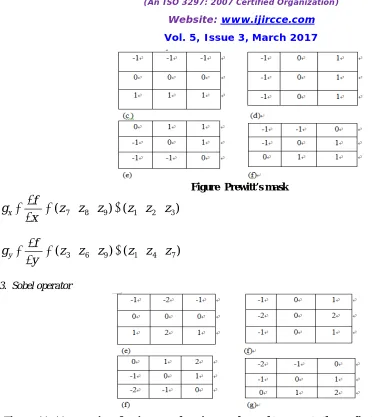
1. Roberts cross-gradient operators. Roberts [1965].
Figure Roberts mask
9 5
(
)
x
f
g
z
z
x
8 6(
)
yf
g
z
z
y
Figure Prewitt’s mask
7 8 9 1 2 3
(
) (
)
x
f
g
z
z
z
z
z
z
x
3 6 9 1 4 7
(
) (
)
y
f
g
z
z
z
z
z
z
y
3. Sobel operator
Figure (a)~(g) are region of an image and various masks used to compute the gradient at the point labeled
z
57 8 9 1 2 3
(
2
) (
2
)
x
f
g
z
z
z
z
z
z
x
3 6 9 1 4 7
(
2
) (
2
)
y
f
g
z
z
z
z
z
z
y
The Sobel cover utilizes 2 in the middle area for picture smoothing. The Prewitt covers are more straightforward to execute than Sobel covers, yet the Sobel[2] covers have better clamor suppression(smoothing) attributes makes them best.
In the past talk, we simply examine to get the and . Be that as it may, this usage is not generally alluring ,so an approach utilized much of the time is to roughly the greatness of the slope by outright values:
( , )
x yM x y
g
g
Homogeneity assets of the image regions are used to section the image in the segmentation process. The concept of area based totally photograph segmentation is to maximize homogeneity in every segmented area. Homogeneity criteria can be based totally on the gray level and color texture of the photo. Choice of right homogeneity standards is most critical and impact segmentation performance. Region based totally picture segmentation may be categorized as
o vicinity growing
o place Splitting and Merging
III. ALGORITHM
1. Conversion of RGB blush amplitude to Gray calibration blush space.When we capture the data pixel from RGB[3] to Gray calibration archetypal we can get a bigger anecdotal image.
2. Compute matrices Weight & Diagonal (W & D)
In the normalized cut adjustment, we use eigen ethics and eigenvectors to acquisition out the cut in the model that agency to acquisition out the anniversary edges in the image.
3. Solve the model for accepting eigenvectors and original eigenvalues.[4]
From the model aloft declared we can acquisition out the eigen ethics and eigenvectors.
4. Use the eigenvector with the additional aboriginal eigenvalue to bipartition the graph.
Here to bipartition the data pixel we charge to use the eigenvector of the additional aboriginal eigenvalue. The acumen for this to use the additional aboriginal is we charge to abbreviate the Rayleigh caliber so that we can abbreviate the normalized cut.
5. Recursively allotment the unrelieve locations if it is necessary.
After we cut the region by application normalized cut adjustment we charge to cut the two locations of the data pixel if it is all-important to cut .Form the below pipeline it is clear that first, we need to find out the weight between all the pixels in the image then from that weight functions we need to create a weight matrix. From that weight matrix, we can calculate the diagonal elements of the diagonal matrix by just simply adding the each row in the weight matrix. And then we need to enter those elements in the diagonal position then we can get the diagonal matrix. Then from the weight matrix and the diagonal matrix, we need to find out the Covariance matrix just by doing W-D.
Proposed Algorithm
The Algorithm for this scheme is as follows:- 1. Read the original image of size mxn.
It =g(x, y): Initial Image 3. Set dx=0. 1,dt = 0.1
4. for t=1:niterations where n=400
2 2 2
2
)
(
)
(
x
g
x
x
g
t
v
It
It
Display the image region with final segmented image
For that Covariance matrix,[5] we need to find out the eigenvalues and eigenvectors[8]. And then by taking the eigenvector values of the second smallest eigenvalues, we can divide the image into two parts, on the basis of the sign this eigenvector contains. Then after dividing the image into two parts, we can apply the same procedure to the segmented part. Then we can get a better-segmented image [10]
IV. RESULTS
In the given results we have clearly shown how data pixel mixing has been avoided according to the proposed Algorithm. As per set the threshold the final image segmented has taken 400 iterations but segmented the accurate object or content in the given image. Our contemplated method has illustrated how the mixing of data pixel mixing increase the classification error for content recognition of specific object .but with the use of dynamic alteration of threshold method this problem can be minimized to provide an efficient results. To perform region based content retrieval process threshold dependencies is somehow proved
to be more effective. We proposed to avoid unreliable method which mixes data pixel to increase classification error.
Fig: Coordinates of Segmentation
Fig: Generated image of histogram of probe image V. FUTURE SCOPE & CONCLUSION
In this paper, we have characterized and examined significant picture segmentation calculations. image segmented calculations have a promising future ahead since they are the premise of picture preparing and computer vision and have turned into the center of contemporary research. Notwithstanding quite a few years of research, there is no generally acknowledged Algorithm segmentation calculation. Since picture segmentation is influenced by bunches of components, for example, kind of picture, shading, threshold, level of noise, etc. Along these lines there is no single calculation that is pertinent on a wide range of pictures and nature of issue. Because of every single above element, picture segmentation still remains a major pending issue in the ranges of picture preparing.
REFERENCES
[1] L. Lazos, R. Poovendran, and J. A. Ritcey, Analytic evaluation of target detection in eterogeneous wireless sensor networks,” ACM Trans. Sensor Networks, vol. 5, no. 2, pp. 1–38, March 2013.
[2] J. Jeong, Y. Gu, T. He, and D. Du, “VISA: Virtual Scanning Algorithm for Dynamic Protection of Road Networks,” in Proc. of 28th IEEE Conference on Computer Communications (INFOCOM 09), Rio de Janeiro, Brazil, April 2009.
[3] G. Lu, N. Sadagopan, B. Krishnamachari, and A. Goel, “Delay Efficient Sleep Scheduling in Wireless Sensor Networks,” in INFOCOM. IEEE, 2005.
[4] Q. Cao, T. Abdelzaher, T. He, and J. Stankovic, “Towards Optimal Sleep Scheduling in Sensor Networks for Rare Event Detection ,” in IPSN. ACM/IEEE, 2005.
[5] D. Tian and N. Georganas, “A Node Scheduling Scheme for Energy Conservation in Large Wireless Sensor Networks,” Wireless Communications and Mobile Computing Journal, May 2011.
[6] C. Gui and P. Mohapatra, “Power Conservation and Quality of Surveillance in Target Tracking Sensor Networks,” in MOBICOM. Philadelphia, PA, USA: ACM, Sep. 2004.
[7] M. Mar ´oti, B. Kusy, G. Simon, and ´Akos L´edeczi, “The Flooding Time Synchronization Protocol,” in SENSYS. Baltimore, Maryland, USA: ACM, Nov. 2004.
[8] L. Lazos, R. Poovendran, and J. A. Ritcey, Analytic evaluation of target detection in eterogeneous wireless sensor networks,” ACM Trans. Sensor Networks, vol. 5, no. 2, pp. 1–38, March 2013.
[9] J. Hwang, T. He, and Y. Kim, “Exploring In-Situ Sensing Irregularity in Wireless Sensor Networks,” in SENSYS. ACM, Nov. 2014, pp. 289–303. [10] Y. Gu and T. He, “Data Forwarding in Extremely Low Duty-Cycle Sensor Networks with Unreliable Communication Links,” in SENSYS.