QR Code Implementation in Car Parking
Locator
Prof. Pallavi Tekade 1, Rutuja Mhaskar2, Priya Surywanshi2, Aishwarya Shirgurkar2, Aniket Panmalkar2, Rohit Patil2
Professor, Dept. of Information Technology, JSPM’s Rajarshi Shahu College of Engineering, Pune, India1
B. E Student, Dept. of Information Technology, JSPM’s Rajarshi Shahu College of Engineering, Pune, India2
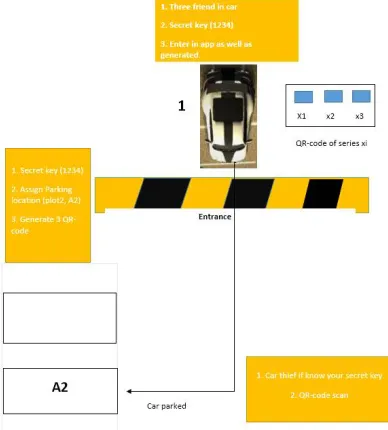
ABSTRACT : Our daily lives in City have become faster with Wider roadways and Faster Vehicles. Things that come along is maintenance, traffic and parking. With rise in number of vehicles parking is getting a bigger pain point for every driver. Due to rush hour, peak work time and tasks running mind, People park anywhere and vaguely. Be it in Malls, Cinemas, Nearby Shops people tend to forget their parked vehicle. We propose an idea which can help solve the problem of parking allotment and searching the allocated parking area of the vehicle. In this system, Admin can be any parking vendor; who maintains the Parking space. The Driver has the android app, where a secret number is generated and this secret number will be given to admin to generate QR Code. Considering there are more than one person on/in vehicle, the number of QR Code will be generated. Admin will now give the parking allotment for that vehicle on its registration. Although the Mall parking areas do have Alphanumeric postings to remember the parking location, this project focuses on all types of parking. Once the vehicle is parked, the time comes when we depart to home from work, you need to find vehicle. Now simply scan QR Code at the entrance of the Parking with Secret code entered into that system, that will show the location where your car is parked. The concept of Shared QR Code, allows only authentic user to find the car.
KEYWORDS : QR-code ,Parking allotment ,authenticated users ,User login.
I. INTRODUCTION
In busy run of urban life, parking is a huge pain point. More over the location of an individual's parked vehicle sometimes is a great pain since there are multiple things going in Human brain. Hence we stand to solve problem using Technology that is by using Shared QR code mechanism for user with shared secret key. With every technology, there comes some disadvantages, that is what if some one tries our secret code with different QR code! Well, again that is taken care of.We propose to develop QR code based car parking locator system. This is android application with web portal application services by using HTTP protocol over internet. In this user has to use android application where a secret number is generated and this secret number will be given to admin to generate QR Code. Considering there are more than one person on/in vehicle, the number of QR Code will be generated. Sensors will check the empty parking slots and will now give the parking allotment for that vehicle on its registration. Admin uses web portal over internet. Whenever user want to find his car from this system it simply scan QR code at the entrance of the Parking with Secret code entered into that system that will show the location where the car is parked. From this application user get help to park his car with security and easily find park location of park car.
II. MOTIVATION
vehicle. Everyone wants to park his\her vehicle safely and under security. From this application user saves his time for parking and avoid problem of traffic and parking of car anywhere on road and unauthorized access through it save and from this you easily get parked your car with under security and you know your car location from this android application.
III. LITERATURE SURVEY
Car parking is today’s common issue and Drivers cannot find parking as easily as they would like. Cars are parked are jamming the streets for long periods. Parking in official premises and No parking zones Cost adversely, than on street spaces. New parking spaces are built in the city, but no one parks there because it is either unknown or too expensive and far away. Anger and rage: People fight, yell and scream over parking spaces .Wasted time: People circle the block roads by looking for parking &cruising for parking. Angry drivers, increases traffic congestion and air pollution, and wastes gasoline and time. Unauthorized person or Car thief accesses cars from parking so parking arises many issues so for observing all this issue we develop QR code based parking car locator system. From this system we try to solve all issues of parking from car thief, unauthorized personnel through and nearby all parking place idea given by QR code and returns with location of parked car.
IV. PROPOSED ARCHITECTURE
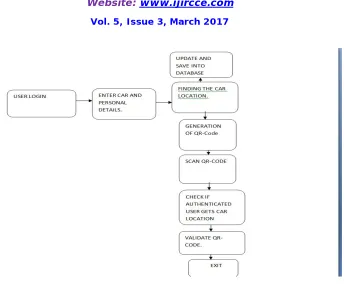
In Proposed system we are developing QR-code based car parking locator system in this admin manages application by web portal using web services over internet. In this Android Application, user all has to do is Login – Secret code generates – Shares to admin & Car parking is allotted with QR Code. To elaborate, User Login on application by providing info as Car number, person name, secret key. Show QR Code- Generated QR Code is shown on user's mobile app. Location – User requests to admin then admin gives location of parking and for QR Code checking ,has info – (Person Checking-In)Checker Enter person name. Scan QR Code – Checker scan user app QR code send to server and retrieve info on mobile. Validate Bike – Checker checks all information given from server then validate with Name if information no valid then show message else exit from parking.
Fig (a) : FlowChart.
Fig (a) represents the Flow in which the given system works while figure (a) shows the architecture of the proposed sytem.
V. MATHEMATICAL MODEL
A. System Specification:
S= {S, s, X, Y, T, fmain, DD, NDD, ffriend, memory shared, CPUcount}
S (system):- Is our proposed system which includes following tuple.
s (initial state at time T ) :-GUI of QR code Based Parking. The GUI provides space to enter a query/input
for user.
X (input to system) :- Input Query. The user has to first enter the query. The query may be ambiguous or
not. The query also represents what user wants to search.
Y (output of system) :- List of URLs with Snippets. User has to enter a query into QR code Based Parking
then QR code Based Parking generates a result which contains relevant and irrelevant URL’s and their snippets.
T (No. of steps to be performed) :- 6. These are the total number of steps required to process a query and
generates results.
fmain(main algorithm) :- It contains Process P. Process P contains Input ,Output and subordinates functions.
It shows how the query will be processed into different modules and how the results are generated.
DD (deterministic data):- It contains Database data. Here we have considered users information alongside
vehicle info to be stored in database. Database is created and maintained by Web Portal itself.
NDD (non-deterministic data):- No. of input queries. In our system, user can enter numbers of queries so
that we cannot judge how many queries user enters into single session. Hence, Number of Input queries are our NDD.
ffriend :- WC And IE. In our system, WC and IE are the friend functions of the main functions. Since we will
be using both the functions, both are included in ffriend function. WC is Web Crawler which is bot and IE is
Memory shared: - Database. Database will store information like list of receivers, registration details and numbers of receivers. Since it is the only memory shared in our system, we have included it in the memory shared.
CPUcount: - 2. In our system, we require 1 CPU for server and minimum 1 CPU for client. Hence, CPUcount is
2.
B. Subordinate functions:
Identify the processes as P.
S= {I, O, P....}
P= {AA,PM}
Where,
AA Android App
PM is Parking Manager
P is processes.
AA= {U, MAX, CP}
Where,
U=User Details
MAX = {1, 2, 3, … n}
CP is user information and vehicle details which will be send to parking manager by the sensor
PM= {CP, PA, Info}
Where,
CP is input
PA will look after search for free parking slots and will allocate a free slot for vehicle.
VI. ALGORITHM
Step 1: Accept user details and vehicle info.
Step 2: Parking Allotment.
2.1: Get parking slots information.
2.2: Will check for the free slots.
2.3: Allocate free slot to the vehicle.
2.4: show allotted slot to user
Step 3: QR code
Step 3.1: user will add his information on App
Step 3.2:Android App will generate a QR code for users info with vehicle information and parking details.
Step 4: Parking Exit
Step 4.1:User will have to show QR code to checker
Step 4.2: checker will scan QR code with his android app
Step 4.3: information from checkers app will be sent to system by the sensor credentials.
Step 5: if user details match user will be able to leave otherwise not
Step 6: Stop.
VII. SIMULATION RESULTS
STEP (1)-Login phase :
Fig : User Login Phase
In this phase user have to make his/her entry for parking the vehicle .User have to register his name and Car number .And to secure the location of the parked vehicle user need to create his own password through which he will get registered into the system .This information will later be accessed by admin.
STEP (2)-Admin Panel :
Fig :Admin Phase.
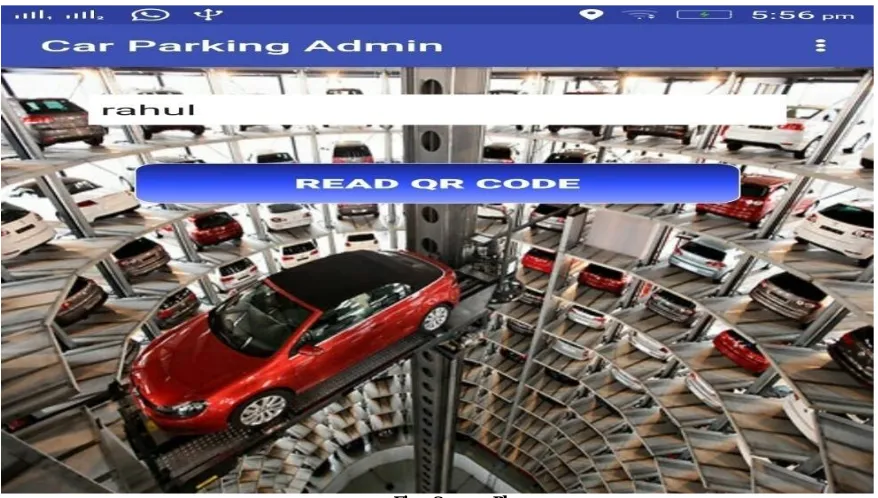
Admin Panel will consist of any authorized person who will act as an observer , automatic allocation of services can be done . Admin can handle the data .Vehicle number can be given to the server to check the location of the given vehicle . STEP (3)-Scanner :
Fig : Scanner Phase.
STEP(4)-Sensor:
Sensors are used to detect the movement of vehicle whether it has entered or exited from the respective parking slot.The microcontroller in the sensor is programmed in such a way that it will detect the vehicle and send the data to the computer ie.to the admin panel where the empty parking slots will be filled by the user.
VIII. IMPLEMENTATION AND DISCUSSION
We believe that proposed system is promising and unique for two reasons:
(1).It makes parking easy .User can see the vacant parking slots and book after making the registration. After scanning the Qr-Code user can see where the vehicle was parked ,that will make the search easy.
(2).It provides the authentication of the user so that the vehicle safety can take place in friendly way. No any unauthorized user can make the access.
IX. CONCLUSION
System is proposed on QR-code based car parking locator which helps making ease in parking and the ensured safety of parking by avoiding technological breach by making use of Shared QR Code & Secret key for verification of genuine owner.
REFERENCES
[1] A. Rai, K. K. Chintalapudi, V. N. Padmanabhan, and R. Sen, “Zee: zero- effort crowdsourcing for indoor localization,” in Proceedings of the 18th annual international conference on Mobile computing and networking. ACM, 2012, pp. 293–304.
[4] P. Krishnan, A. Krishnakumar, W.-H. Ju, C. Mallows, and S. Gamt, “A system for lease: Location estimation assisted by stationary emitters for indoor rf wireless networks,” in INFOCOM 2004. Twenty-third AnnualJoint Conference of the IEEE Computer and Communications Societies, vol. 2. IEEE, 2004, pp. 1001–1011.
[5]Distributed Secret Sharing Approach With Cheater Prevention Based on QR Code Pei-Yu Lin, Member, IEEE
[6] J. C. Chuang, Y. C. Hu, and H. J. Ko, “A novel secret sharingtechnique using QR code,” Int. J. Image Process., vol. 4, pp. 468–475, 2010. [7] H. C. Huang, F. C. Chang, and W. C. Fang, “Reversible data hiding with histogram-based difference expansion for QR code applications,” IEEE Trans. Consum. Electron., vol. 57, no. 2, pp.779–787, May 2011.
[8] S. Dey, K. Mondal, J. Nath, and A. Nath, “Advanced steganography algorithm using randomized intermediate QR host embedded with any encrypted secret message: ASA_QR algorithm,” Int. J. Mod. Educ. Comput. Sci., vol. 6, pp. 59–67,2012.
[9] C. H. Chung, W. Y. Chen, and C. M. Tu, “Image hidden technique using QR-Barcode,” in Proc. 5th Int. Conf. Intell. Inf. Hiding Multimedia Signal Process., 2009, pp. 522–525.