Volume-7 Issue-1
International Journal of Intellectual Advancements
and Research in Engineering Computations
Design and implementation of automated car parking system using RFID
P. Gopalakrishnan
1, Rinse K.M
21
Assistant Professor/ECE,
2PG scholar
Department of ECE, Shree Venkateshwara Hi-Tech Engineering College, Gobi, Tamilnadu,
India.
ABSTRACT
In this project a solutions has been provided to the problems encountered during parking a vehicle at commercial parking lots. This problems has been resolved using Parking Reservation System. The Parking Reservation System is an access control and automated Reservation system that provides ID based parking slot provision system. This system is designed for Multiple Dwelling Units (MDU), offices, schools, colleges, Malls, Cinema theaters, Airports, railway station and many more where there is a requirement of a systematic parking reservation of vehicles. The unique identification of the Vehicle entering using RFID tags permits tracking of vehicles entering and exiting the parking premises. It helps the system to know whether the vehicle or its owner is registered so as to prioritize allocation of parking spaces to incoming customers.
Keywords:
RFID tag, RFID reader, GSM, Micro-controller, IR sensorsINTRODUCTION
In country like India which has a tremendous growing population, parking management is the real concern. Increase in spending power of Indians also makes it unable for the people to park their cars on roads. So Parking Reservation is required so that user’s time is not wasted in search of parking space. Parking Reservation is done by sending SMS to the GSM module present at the base station. As soon as the GSM module receives the SMS, it revert back with parking slot allotment information via SMS. All of this is handle by a dynamically developed PC software. ID based authentication of user is done. RFID tags are attached to every registered vehicles, as soon as the vehicle enters the parking lot entrance, the reader sense the tag and the user as well as vehicle gets authenticated. Only after the identification the user can enter the parking premises. Use of RFID permits us to keep track of vehicle entering and exiting the gate. A lot of time is wasted in
searching vacant slot for parking and many a times it creates jams. Conditions become worse when there are multiple parking lanes and each lane with multiple parking slots. Use of parking management system would reduce the human efforts and time with additional comfort. In the proposed system, the display unit displays a visual representation of the parking and it shows the empty and occupied slots which help the user to decide where to park their car. The system would not only save time but the software and hardware would also manage the Check-in and check-outs of the cars under the control of RFID readers/ tags with additional features of automatic billing, Entry exit data logging. The users go through a onetime registration process where there are asked to fill in their personal details and an account is created for them, this account has information about them and also has money in it which they can recharge at kiosks present in the vicinity. In this system, the users are guided to the vacant slot for parking
using Video Displays at the entrance of the parking floor, these displays show a visual representation of the parking lot with empty and occupied slots which are green and red respectively. The user is provided with a tag which he receives on registration, this tag is linked with his prepaid account and includes his personal information, and this tag uses Radio Frequency identification (RFID) technology and is placed on the top of the user’s windshield. The parking charges are automatically deducted from the user’s account based on the time spent inside the parking area. [1-3]
OBJECTIVE
Now days in many public places such as malls, multiplex systems, hospitals, offices, market areas there is a crucial problem of car parking. The car-parking area has many lanes/slots for car car-parking. So to park a car one has to look for all the lanes. Moreover, this involves a lot of manual labor and investment. So, there is a need to develop an automated parking system that indicates directly the availability of vacant parking slots in any lane right at the entrance. It involves a system including infrared transmitter- receiver pair in each lane and a display outside the car parking gate. So the person desirous to park his vehicle is well informed about the status of availability of parking slot. Conventional parking systems do not have any intelligent monitoring system and the parking lots are monitored by security guards. A lot of time is wasted in searching vacant slot for parking and many a times it creates jams. Conditions become worse when there are multiple parking lanes and each lane with multiple parking slots. Use of parking management system would reduce the human efforts and time with additional comfort. In the proposed system, the display unit displays a visual representation of the parking and it shows the empty and occupied slots which help the user to decide where to park their car. The system would not only save time but the software and hardware would also manage the Checkin and check-outs of the cars under the control of RFID readers/ tags with additional features of automatic
RELATED WORKS
V.W. S. Tang, Y. Zheng, and J. Cao, Wireless sensor networks (WSNs) have attracted increasing attentions from both academic and industrial communities. It can be deployed in various kinds of environments to monitor and collect information. In this paper, we describe a WSN-based intelligent car parking system.
In the system, low-cost wireless sensors are deployed into a car park field, with each parking lot equipped with one sensor node, which detects and monitors the occupation of the parking lot. The status of the parking field detected by sensor nodes is reported periodically to a database via the deployed wireless sensor network and its gateway. The database can be accessed by the upper layer management system to perform various management functions, such as finding vacant parking lots, auto-toll, security management, and statistic report. We have implemented a prototype of the system using crossbow motes. The system evaluation demonstrates the effectiveness of our design and implementation of the car parking system. M. Wada K.S. Yoon,H. Hashimoto, This paper is the first to apply a multilevel driver assistance system in the development of a system to aid in the parking process. The development of this system is described within the iCAN (intelligent car navigation systems) project framework. [4-6]
C. W. Cheng, S. J. Chang, and T. H. Li, This paper is devoted to the design and implementation of a complete intelligent mechatronic system-a mobile robot possessing autonomous parallel parking capability. In this paper, the configuration of the overall system is firstly introduced. The intelligent parallel-parking control method is addressed in the second topic, where a feasible reference path is provided for the fuzzy logic controller to maneuver the steering angle of the robot. The simulation results illustrate the effectiveness of the developed control algorithm. The authors not only investigate intelligent parallel parking control methods but also real-time maneuvering of the developed sensor-based mobile robot. The real-time control of the parallel parking system demonstrates the feasibility of the fuzzy control scheme.
PROPOSED SYSTEM
In this modern world, with the rapid growth of population vehicle traffic has become a part of our day to day life. Moreover, unauthorized vehicle has also increased. Thus our proposed system aims to ensure proper management of vehicles in the public places such as educational institute, office etc. In order to prevent unauthorized vehicle
parking and traffic. The features include detection of permitted and non-permitted vehicles on the main gate, detection of unauthorized vehicle parking in the restricted zone thus sending SMS to the authority to take action and taking fine from the vehicle user. Parking charge is also taken from the parked vehicles inside the parking lot before they leave. The main motivation behind the project was to maintain security of the parking area and reduce system loss in parking lot. The project aims to make an automated parking system which helps to restrict unauthorized vehicle parking in the restricted area and generates fine if a vehicle is parked violating the rules by sending an SMS to the registered owner of the vehicle.
A third arduino mega is used for the LCD display, the IR sensors in the parking lot and the LEDs to be lit corresponding to the IR sensors in the specific parkings. The IR sensors are connected to the pins A0, A1, A2 and A3 and their output LEDs are connected to 9, 8, 7 and 6 respectively. The LCD display shows the number of vehicles currently present in the parking area. After the vehicle is checked in, the time of entry is stored. When the vehicle is about to check out from the parking zone, its bill is generated and then the vehicle is allowed to exit. The system is made in some parts where some work is done in an individual part.
HARDWARE SPECIFICATION
RFID tags and Reader
RFID Tags
RFID reader i.e. radio frequency identification uses RFID tags to get authenticated by them. There are two types of tags present i.e. active tag and passive tag
Active tags
It is self-charged tag having battery on its board which transmits ID signals
RFID Reader (Model EM-18)
inside the reader which acts as the operating system of reader which has a unique identification number. More than one antenna are present inside the chip to generate power and communicate, which enables the RFID tag to exchange data with reader. Reader use Radio frequency waves non-line-of-sight technology. RFID receives the analog signals from tag and convert the analog signal into digital form of information.
GSM
Global system for mobile communication Model Sim 300, this is selected because
communication can be done serially. In this Sim300 two ports are present which provides serial communication. These serial ports can be used to easily develop any applications. SIM300 provide RF antenna interface with two alternatives: antenna connector and antenna pad. In this implementation there will be connection of the GSM module to the PC and the PC app will control and send SMS to any mobile through this device. SIM300 can be integrated with a wide range of applications.
Micro-controller (ATMEGA8 Sensor Unit)
TheATMEGA 8 has 4 different ports, each one having 8 Input/output lines providing a total of 32 I/O lines. Those ports can be used to output DATA and orders do other devices, or to read the state of a sensor, or a switch. Most of the ports of the 89S52 have 'dual function' meaning that they can be used for two different functions Passive tags: It is not self-charged which makes it more cheaper and available.
IR sensors
IR sensors work on the basis of intensity of the light. The changes in the intensity of light are identified by the detectors. IR are used because in this LED produces light at the same wavelength which is required in this project. When there is any object present at the sensors the detectors detects that the intensity of the IR light is no longer there so it identified that there is some vehicle standing at the place and helps to indicate about the presence of an obstacle.
SIMULATION AND RESULT PERFORMANCE EVALUATION
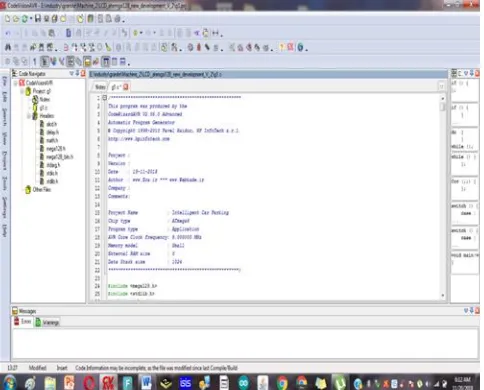
CodeVisionAVR is the only Integrated Development Environment on the market that features an Automatic Program Generator (CodeWizardAVR) for the AVR8, AVR8X and
XMEGA chips shown in figure 4.1,4.2 4.3. CodeVisionAVR V3, besides it’s own IDE, can now also be used as an Extension fully integrated in Atmel Studio 7.
Figure4.2 Screenshot 2 Car Parking Home Screen
Figure. Screenshot 3 Compilation screen
Implementation on ir sensor and gsm with
arudino microcontroller
IR sensor will sense the parking system at regular interval of time and sends to the microcontroller as parking slots are filled or empty and displayed in LCD screen. Through GSM user
FIGURE The system is ready to book a parking slot.
After the system ready user can send a SMS to GSM to check the parking space is available or not. If available user can BOOK the slots with their unique
RFID TAG number through the smart phones. If its not available user can check alternate parking area.
Figure considering 4 slot in parking space.
Initially all 4 slots are empty user can book their slots .After Booking the slots user will arrives the parking within the time or else the parking reservation will be expired. As the screenshots shows, now parking system for vehicle with authorization is achieved. The entire vehicle with the proper authorization tag will be allowed to enter the parking area.
CONCLUSIONS
This paper introduces Parking Reservation System using sensors nodes, GSM and RFID technology. Due to this System, tracking and handling of vehicle has become flexible. Vehicle
REFERENCES
[1]. Lee and M. Gerla,(2010) “A Survey of urban vehicular sensing platforms, “Computer Networks, 54(4), 527-544.
[2]. Kim, M. H., Lee, Y. T. and Son, J, “Age Related Physical and Emotional Characteristics to Safety Warning Sounds: Design guidelines for intelligent vehicles,” IEEE Transactions on Systems, Man, and Cybernetics, Part C: Applications and Reviews, 99, 2010
[3]. Nachimuthu, S. Pooranachandran, B. SharomenaAarthi “Design and implementation of a vehicle to vehicle communication system using Li-Fi technology “international research journal of Engineering and technology (IRJET): 3(5), 2016.
[4]. Shih-Nan Lu, Hsien-Wei Tseng, Yang-Han lee, Yih-Guang Jan and Wei-Chen Lee, “Intelligent safety warning and alert system for car driving” Tamkang journal of Science and Engineering, 13(4), 2016, 395-404.
[5]. Suresh B. Mer, “Smart Vehicle-to-Vehicle Communication with 5G Technology” International journal on recent and innovation trends in computing and communication, 3(5), 2014
[6]. Swati B, Dr. Preeti R. Bajaj, Dr Latesh G Malik. ”Prediction of Vehicle Collision Probability at intersection using V2V Communication” International journal of scientific & Engineering Research, 6, 2015.
[7]. Thomas Kiber, StefenPoferl. Gotthard Bock, Hans-peter Huber and EberhardZeeb, “Optical data Buses for Automotive Applications,” journal of light wave technology. 2004.
[8]. Umair Ali Khan , Dr Sahibzada Ali Mehmud, MusatfaBasit, “Inter-Vehicle Collision Avoidance Using Zigbee Sensor networks “international journal of scientific & Engineering Research, 4(4), 2013