Educational Mining: A Comparative Study of
Classification Algorithms Using WEKA
Driyani Rajeshinigo 1, J. Patricia Annie Jebamalar 2
Research Scholar, Dept. of Computer Science, St.Xavier's College, Tirunelveli, Tamilnadu, India
Assistant Professor, Dept. of Computer Science, St.Xavier's College, Tirunelveli, Tamilnadu, India
ABSTRACTː Data mining is used to analyse large volumes of data. Classification is one of the techniques in data mining which will be used to predict the target attribute accurately from the knowledge it gained from the training data. Predicting student’s performance becomes more challenging due to the large volume of data stored in the educational database. There are various classifiers such as Decision trees, Naive Bayes classifier, random forest, Multilayer Perceptron and Support vector machine can be used to predict the student’s performance. This paper provides the comparative analysis of those algorithms on student’s data set and suggests the best classifier for educational mining.
KEYWORDS: Classification Algorithms, Educational Data Mining (EDM), C4.5, Random Forest, Naive Bayes, Multi
Layer Perceptron and SVM
I. INTRODUCTION
Educational mining is the current trend which uses data mining. There is huge amount of data stored in educational database about students but being unused. Educational institutions normally execute some queries on database to fetch past records about a student. But the data stored in educational database can predict a student’s performance if used correctly. This can help the student to improve himself in future and can help the staffs to give some additional care for the students who were not performing well enough. Choosing the attributes from the data set for classification lays vital role to predict the target attribute accurately.
Data mining is used to analyse large amounts of data effectively to discover some useful information. Classification is one of the techniques of data mining which will be used to predict the target attribute accurately from the knowledge it gained from the training data.
The WEKA software is used as it contains the implementation of the classification algorithms. It is the free software tool and is widely used for research in the data mining field. Several types of classification algorithms are selected and the student dataset was applied with these algorithms. The classifiers used in this paper consist of common decision tree algorithm C4.5 (J48), Random Forest, Bayesian classifiers (Naive Bayes), Multilayer Perceptron and SVM classifiers. These classifiers will be analysed on student’s data set and the results are compared and the best algorithm for predicting student’s academic performance will be suggested.
II. RELATED WORK
that prediction rates are not uniform among the classification algorithms and also show classification algorithms works differently depends on the selection of attributes [4]. Sumit Garg and Arvind K. Sharma analysed various classification algorithms on educational data set and explained thorough details of the implemented algorithms and suggested some good algorithms to work on students’ data set to predict their future performance [8].
Sagar Nikam has done the comparative study of classification algorithms. Analysis of classification algorithm says each algorithm has its own merits and demerits and the techniques have to be selected based on the situation [5]. Bhardwaj and Pal conducted the study on the student performance and found that the factors like students’ grade in senior secondary exam, living location, medium of teaching, mother’s qualification, students other habit, family annual income and student’s family status were highly correlated with the student academic performance [14]. Abdul Hamid and Amin analysed and compared students’ enrolment approval using classification algorithms and found C4.5 gives high accuracy and lowest absolute errors [6]. Trilok Chand Sharma and Manoj Jain discussed about the classification algorithms and explained how to run those classifiers for the selected dataset and found decision tree gives better performance and high accuracy [7].
Surjeet Kumar Yadav and Saurabh Pal have explained Decision tree algorithms on students’ data set and found C4.5 can learn effective predictive models from the student data and gives the better accuracy of classification [12].Sonali Agarwal and Pandey applied classification algorithms on educational data and found SVM classifier LIBSVM with Radial Basis Kernel has been taken as a best choice for data classification [10]. Surjeet Kumar and Brijesh Bharadwaj have done comparative analysis on the decision tree classification algorithms and found CART algorithm is classifying the First, Second, Third class and Fail students with high accuracy [11].
Pandey and Pal conducted study on the student performance based by selecting 600 students from different colleges. By means of Bayes Classification on category, language and background qualification, it was found that whether new comer students will performer or not [13]. Z. J. Kovacic presented a case study on educational data mining to identify up to what extent the enrolment data can be used to predict student’s success. The algorithms CHAID and CART were applied on student enrolment data of information system to get two decision trees classifying successful and unsuccessful students. The accuracy obtained with CHAID and CART was 59.4 and 60.5 respectively [15]. V.Ramesh has done an analysis on classification algorithms for redicting student’s performance and found Multi Layer Perceptron predicted the performance better than the others and also found that parents’ designation plays a vital role for predicting their grades [9].
III. METHODOLOGY
3.1. Classification Algorithmsː
Classification is one of the Data Mining techniques that are mainly used to analyse a given dataset. It is used to extract models that accurately define important data classes within the given dataset.
Classification is a twostep process.
Step 1ː The model is created by applying classification algorithm on training data set
Step 2ː The extracted model is tested against a predefined test dataset to measure the model trained performance and accuracy.
So classification is the process to assign class label from dataset whose class label is unknown.
3.1.1. Decision Treeː
Figure 1ː Decision Tree A.C4.5ː
This algorithm is a successor to ID3 developed by Quinlan Ross .C4.5 handles both categorical and continuous attributes to build a decision tree. In order to handle continuous attributes, C4.5 splits the attribute values into two partitions based on the selected threshold such that all the values above the threshold as one child and the remaining as another child. It also handles missing attribute values. C4.5 uses Gain Ratio as an attribute selection measure to build a decision tree. It removes the biasness of information gain when there are many outcome values of an attribute.
At first, calculate the gain ratio of each attribute. The root node will be the attribute whose gain ratio is maximum. C4.5 uses pessimistic pruning to remove unnecessary branches in the decision tree to improve the accuracy of classification.
B. Random Forestː
Random forest is a collection of decision trees built up with some element of random choice. Random forest works by generating a number of trees to analyse the data then it combine all the output from tree and then through the process of vote (look for the classes who have the majority) to obtain the final result.
Random forest has high robustness for large data but it consumes much cost than other techniques
3.1.2. Naive Bayesː
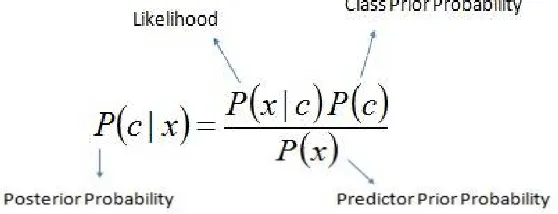
The Naive Bayes Classifier technique is based on Bayesian theorem and is particularly used when the dimensionality of the inputs is high. The Bayesian Classifier is capable of calculating the most possible output based on the input. It is also possible to add new raw data at runtime and have a better probabilistic classifier. A naive Bayes classifier considers that the presence (or absence) of a particular feature (attribute) of a class is unrelated to the presence (or absence) of any other feature when the class variable is given.
• P(c|x) is the posterior probability of class (target) given predictor (attribute) of class.
• P(c) is called the prior probability of class.
• P(x|c) is the likelihood which is the probability of predictor of given class.
• P(x) is the prior probability of predictor of class. Class (c) is independent of the values of other predictors.
3.1.3. Multi Layer Perceptron ː
A Multi Layer Perceptron (MLP) is a feed forward artificial neural network model that maps sets of input data onto a set of appropriate outputs. As its name suggests, it consists of multiple layers of nodes in a directed graph, with each layer fully connected to the next one. The architecture of this class of networks, besides having the input and the output layers, also have one or more intermediary layers called the hidden layers. The hidden layer does intermediate computation before directing the input to output layer.
Figure 3ː Multi Layer Perceptron
3.1.4. Support Vector Machineː
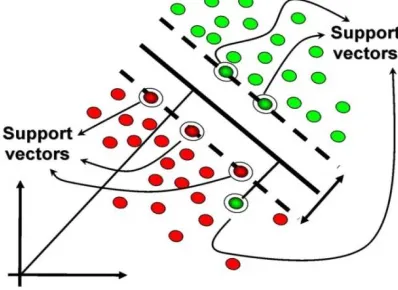
Support Vector Machines are based on the concept of decision planes that define decision boundaries. Support Vector Machine (SVM) is primarily a classier method that performs classification tasks by constructing hyper planes in a multidimensional space that separates cases of different class labels. New examples are then mapped into that same space and predicted to belong to a category based on which side of the gap they fall. An SVM model is a representation of the examples as points in space, mapped so that the examples of the separate categories are divided by a clear gap that is as wide as possible. SVM supports both regression and classification tasks and can handlemultiple continuous and categorical variables. Support vector machine operator consists of kernel types including dot, radial, polynomial, neural, anova etc.
3.2. Applying Classification algorithms in WEKA toolː
3.2.1. WEKA Toolː
The Waikato Environment for Knowledge Analysis (WEKA) where learning algorithms were available in various languages, for use on different platforms, and operated on a variety of data formats. WEKA would not only provide a toolbox of learning algorithms, but also a framework inside which researchers could implement new algorithms without having to be concerned with supporting infrastructure for data manipulation and scheme evaluation. Nowadays, WEKA is recognized as a landmark system in data mining and machine learning. Giving users free access to the source code has enabled a thriving community to develop and facilitated the creation of many projects that incorporate or extend WEKA. In this paper WEKA tool is used to analyse the classification algorithms and predicts the students’ performance.
3.2.2. Data Selection and Transformation ː
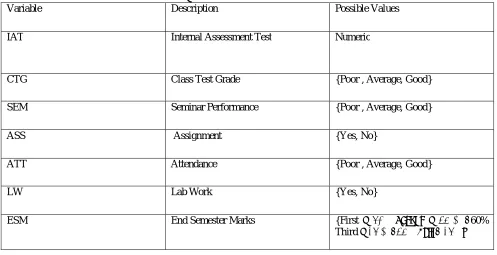
In this step only those fields were selected which were required for data mining. A few derived variables were selected from the database. All the predictor and response variables which were derived from the database are given in Table 1 for reference.
Table 1ː Students Variables
Variable Description Possible Values
IAT Internal Assessment Test Numeric
CTG Class Test Grade {Poor , Average, Good}
SEM Seminar Performance {Poor , Average, Good}
ASS
Assignment {Yes, No}
ATT Attendance {Poor , Average, Good}
LW Lab Work {Yes, No}
ESM End Semester Marks {First ≥ 60% Second ≥ 45 & <60%
Third ≥ 36 & <45% Fail < 36%}
IV. SIMULATIONRESULTS
The data set with the attributes mentioned in Table 1 is supplied to the WEKA tool and all the mentioned classification algorithms in this paper are executed on the data set to predict the semester results.
4.1. Classifier accuracyː
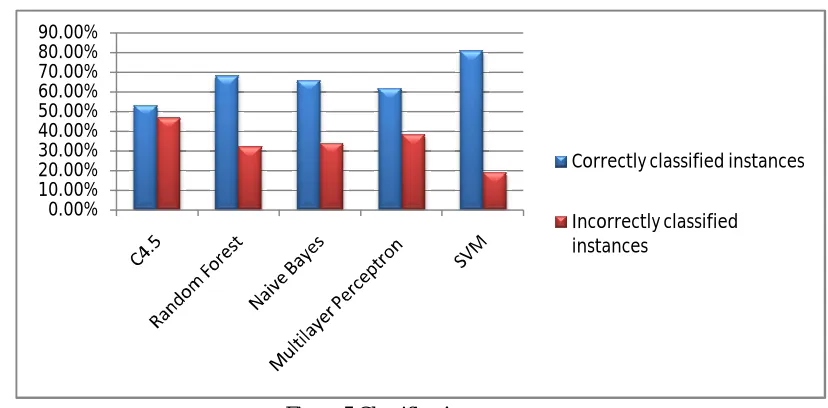
window on the dataset. The results obtained after execution were compared. The below mentioned Table 2 shows the percentage of correctly classified instances and incorrectly classified instances by the classifiers.
TABLE 2ː CLASSIFIER ACCURACY Algorithm Correctly classified
instances
Incorrectly classified instances
C4.5 53.1915 % 46.8085 %
Random Forest 68.0851 % 31.9149 %
Naive Bayes 65.9574 % 34.0426 %
Multilayer Perceptron
61.7021 % 38.2979 %
LibSVM 80.8511% 19.1489%
The below Figure 5 column chart shows the graphical representation of Table 2.
Figure 5.Classifier Accuracy
V. CONCLUSIONANDFUTUREWORK
In this Paper, classification algorithms C4.5, Random Forest, Naive Bayes, Multi Layer Perceptron and SVM classifiers are analysed on the students’ data set. WEKA tool is used to apply the classification algorithms on the selected data set for predicting the student’s semester results. The results were compared and found SVM classifier predicts the results with high accuracy of 81% and C4.5 found to be giving lower accuracy among the algorithms compared. C4.5 algorithm provided lower accuracy because of the use of continuous data as the attribute values. As a future work, these algorithms can be applied on other data sets and techniques need to be found to handle the continuous data in C4.5 to improve the classifier accuracy.
0.00% 10.00% 20.00% 30.00% 40.00% 50.00% 60.00% 70.00% 80.00% 90.00%
Correctly classified instances
REFERENCES
[1] R. Sumitha and Vinothkumar, “Prediction of Students Outcome Using Data Mining Techniques”, International Journal of Scientific Engineering and Applied Science, Volume-2, Issue-6, June 2016
[2] Amirah mohamed Shahiri, Wahidah Husain, “A Review on Predicting Student's Performance Using Data Mining Techniques”, ELSEVIER, Volume 72 ,Pages 414-422, 2015.
[3] Pooja Thakar, Anil Mehta, “Performance Analysis and Prediction in Educational Data Mining: A Research Travelogue”, International Journal of Computer Applications, Volume 110 – No. 15, January 2015.
[4] C.Anuradha and T. Velmurugan, “A Comparative Analysis on the Evaluation of Classification Algorithms in the Prediction of Students Performance”, Indian Journal of Science and Technology, Vol 8(15), 2015.
[5] Sagar Nikam, “A Comparative Study of Classification Techniques in Data Mining Algorithms”, Oriental journal of computer science & technology, Vol. 8, Pgs. 13-19, 2015.
[6] Abdul Hamid and Amin, “A Comparative Analysis of Classification Algorithms for Students College Enrollment Approval Using Data Mining”, Workshop on Interaction Design in Educational Environments,ISBN: 978-1-4503-3034-3,2014
[7] Trilok Chand Sharma and Manoj Jain, “WEKA Approach for Comparative Study of Classification Algorithm”, International Journal of Advanced Research in Computer and Communication Engineering,Vol. 2, Issue 4, April 2013.
[8] Sumit Garg and Arvind K. Sharma “Comparative Analysis of Data Mining Techniques on Educational Dataset”, International Journal of Computer Applications (0975 – 8887) , Volume 74– No.5, July 2013.
[9] V.Ramesh, “Predicting Student Performance: A Statistical and Data Mining Approach”, International Journal of Computer Applications, Volume 63– No.8, February 2013.
[10] Sonali Agarwal and Pandey, “Data Mining in Education: Data Classification and Decision Tree Approach”, International Journal of e-Education, e-Business, e-Management and e-Learning, Vol. 2, No. 2, April 2012.
[11] Surjeet Kumar and Brijesh Bharadwaj, “Data Mining Applications: A comparative Study for Predicting Student’s performance”, international journal of innovative technology & creative engineering, Vol.1 no.12, December 2012
[12] Surjeet Kumar Yadav and Saurabh Pal, “Data Mining: A Prediction for Performance Improvement of Engineering Students using Classification”, World of Computer Science and Information Technology Journal (WCSIT), Vol. 2, No. 2, 2012.
[13] U . K. Pandey, and S. Pal, “Data Mining: A prediction of performer or underperformer using classification”, International Journal of Computer Science and Information Technology, Vol. 2- No.2, 2011.
[14] B.K. Bharadwaj and S. Pal. “Data Mining: A prediction for performance improvement using classification”, International Journal of Computer Science and Information Security, Vol. 9, No. 4, April 2011.
[15] Z. J. Kovacic, “Early prediction of student success: Mining student enrollment data”, Proceedings of Informing Science & IT Education Conference, 2010
BIOGRAPHY
Driyani Rajeshinigois a Research Scholar in the Computer science Department, St.Xavier's College, Tirunelveli. She received Master of Computer Science (M.Sc) degree in 2007 from St.Joseph's College, Trichy. Her research interests are from Data Mining.