Fused Index Code Based Multibiometric
Pattern Retrieval Security System
PrajaktaS.Jadhav1, S. V. Patil2
Student, Dept. of E&TC, J. T. Mahajan College of Engg, Faizpur. NMU University, Maharashtra, India1
Associate Professor, Dept. of E&TC, J. T. Mahajan College of Engg, Faizpur, NMU University, Maharashtra, India2
ABSTRACT: Biometric authentication has been receiving extensive attention over the past decade with increasing demands in automated personal identification. Biometrics is to identify individuals using physiological or behavioral characteristics, such as fingerprint, face, iris, retina, palm-print, etc. Among all the biometric techniques, fingerprint and face recognition [1] is the most popular methods and is successfully used in many applications.Biometric identification system have huge underlying biometric database. In this large identification system, the goal is to determine the identity of a subject from a large set of users already enrolled in biometric database. Though the state-of-art biometric identification algorithm work well for small database in terms of accuracy and response time but fail to scale well for large databases.Classification and indexing can be used to filter the search space during identification process. Classification is procedure where data points are placed into different groups called classes, based on therequantitive information and already classified data points.In identification, the class of query biometric is first identified and then it is compared to each biometric present in the class. In indexing, feature extraction techniques are used and assigned the index value to them using different indexing techniques. The given query is only compared to templates which have comparable index.In this paper we propose an indexing technique for multimodal database which is capable of reducing the response time of biometric identification systems by reducing the search space during identification.
KEYWORDS: Biometrics, indexing, feature extraction, multimodal.
I. INTRODUCTION
Multi-Biometrics is an authentication technology which uses different biometric technologies such as fingerprints, facial features in the identification and verification process. The limitations of unimodal biometric systems can be overcomed by increasing recognition accuracy, improving database capacity, enhancing security, reducing false acceptance rate.The number of multibiometric systems deployed on a national scale is increasing and the sizes of the underlying databases are growing. These databases are used extensively, thereby requiring efficient ways for searching and retrieving relevant identities.The most compelling reason to combine different modalities is to improve the recognition rate. This can be done when biometric features of different biometrics are statistically independent.The International Committee for Information Technology Standards (INCITS) Technical Committee M1, Biometrics, and researchers have described methods for performing multi-biometric fusion [3]. In general, the use of the terms multimodal or multi-biometric indicates the presence and use of more than one biometric aspect (modality, sensor, instance and/or algorithm) in some form of combined use for making a specific biometric verification/identification decision [3].
In this work we are using modular PCA technique for feature extraction of face images using this method we locate vital feature points of face including eyeballs, corners of eyes, nostrils and mouth corners. Then we use LBP method by which these extracted features represented by binary pattern that describe the surroundings of pixels in the region. Then generated index code of different modalities are fused to generate final index code for each entity in database.
II. RELATED WORK
the fingerprints into three major classes. Later, Henry, 1900 refined Galton’s classification by increasing the number of the classes. All the classification schemes currently used by police agencies are variants of the so-called Henry’s classification scheme.Most fingerprint matching systems are based on four types of fingerprint representation schemes , grayscale image Bazen et al., 2000, phase image Thebaud, 1999, skeleton image Feng, 2006, Hara & Toyama, 2007, and minutiae Ratha et al., 2000, Bazen&Gerez, 2003. Due to its distinctiveness, compactness, and compatibility with features used by human fingerprint experts, minutiae-based representation has become the most widely adopted fingerprint representation scheme [7]. A large number of approaches to fingerprint matching can be found in literature.They can be classified into: a) correlation-based approaches, b) minutiae-based approaches, and c) ridge feature-based approaches.The technique proposed by Maeda et al [10] is the only published indexing approach that is modality independent, but is prohibitive for use on large database and has not been designed for multimodal databases.The first published fingerprint classification method, the Henry classification system [5], was based on the spatial configuration of singular points present in fingerprint patterns.Germainet. Al. [5] proposed an indexing scheme for fingerprint based on minutiae triplet feature that uses “Fast look-up Algorithm for string homology (FLASH)” technique to generate index and match.Bhanuet. al [7] proposed a model- based indexing approach which retrieves reduced search space using novel features of minutiae triangles such as angles, handedness, type, direction and maximum length of side.Chao et. al [6] used a novel feature called local axis symmetry (LAS) to index fingerprint.Arun Ross et. al [6] extends the indexing framework based on minutiae triplets proposed by Germain et. al, Bhanu et. al and Bebis et. al by augmenting ridge curve parameters.
III. PROPOSED SYSTEM
The proposed method is used for generating index code for multimodal biometric databases. In this scheme, indexing mechanism is executed separately for each modality and the results of each modality are combined into a final list of potential candidates. A modality-specific index code is generated by matching an input image against these reference images, there are a set of match scores called as index code of that image. During identification, the index code of the input image is compared to the index codes of the enrolled identities in order to find a set of matches from database. General approach for indexing multimodal database is shown in fig 1. By using fusion scheme results in longer index codes. Using longer index codes results in larger variances among them.
A] Feature Extraction
Face feature extraction
Modular PCA
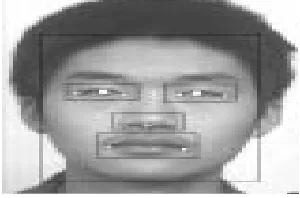
In this type of method, the face images are split up into smaller parts as a sub- images and the PCA approach is applied for each and every sub-images. However, the MPCA technique does not simply apply PCA in each independent face region; since it keeps the relation between the regions and the global information of the face. MPCA establishes multiple Eigen spaces around facial components to form “Eigen features” in place of building a holistic Eigen space for the entire images.
Fig 2 Feature points on face
Linear Binary Pattern
Local Binary Patterns With LBP it is possible to describe the texture and shape of a digital image. This is done by dividing an image into several small regions from which the features are extracted
Fig 3 A preprocessed image divided into 64 regions
These features consist of binary patterns that describe the surroundings of pixels in the regions. The obtained features from the regions are concatenated into a single feature histogram, which forms a representation of the image. Images can then be compared by measuring the similarity (distance) between their histograms.
B] Index Codes for Multimodal Database
Fig 4
C] Levels of Fusion
Fig 5
Fusion in multibiometric systems can be performed utilizing information available in any ofthe modules (data capture module to decision module). Fusion can take place at theselevels: i) sensor level ii) feature level iii) score level iv) rank level and v) decision level. Insensor level fusion raw data captured by the sensor(s) are combined. In feature level fusionfeatures originating from each individual biometric process are combined to form a singlefeature set or vector. In score level fusion, match scores provided by different matchersindicating degree of similarity (differences) between the input and enrolled templates, areconsolidated to reach the final decision. In rank level fusion each biometric sub-systemassigns a rank to each enrolled identity and the ranks from the subsystems are combined toobtain a new rank for each identity. In decision level fusion the final Boolean result fromevery biometric subsystem are combined to obtain final recognition decision.
D] Evaluation of Indexing Performance
The performance of indexing algorithms is commonly evaluated using the hit rate and penetration rate. The hit rate is the percentage of probes for which the corresponding gallery image with the correct identity is retrieved by the indexing mechanism [6]
Where Li is the number of identities in the candidate list of the ith input image and M is the number of identities in the database and N = M.
E] Similarity Measures for Index Codes
Although most data collection protocols impose strict constraints on the data acquisition process, noise in the input images can significantly impact the match scores and, consequently, the index codes. The association between two index codes can be measured by their correlation. Index codes belonging to the same identity are expected to have a strong positive correlation. Index codes belonging to different identities are expected to be uncorrelated. We used the Pearson product-moment correlation coefficient
Index codes can also be viewed as points in a Euclidean space, and the similarity between them can be measured by their spatial proximity. Two examples of such measures are the Euclidean Distance
and the cosine similarity
where “ .” is the dot product.
.
IV. RESULT
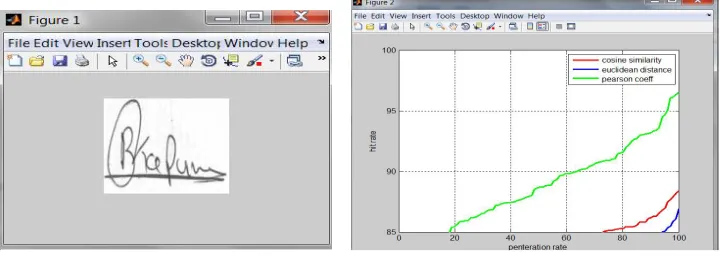
In this approach we have tried to recognize face, fingerprints and signature of users by storing the samples in database.The effect of the distance measure by evaluating the overlap between the distribution of genuine and imposter distances index codes. The equal error rate (EER) calculated for these distributions are shown in table1.
Table 1 EER calculation
Pearson’s coefficient COS similarity Euclidean distance
Face database 0.018 0.074 0.087
Fingerprint database 0.047 0.048 0.082
Signature database 0.035 0.116 0.130
Fig 6 Indexing performance of three distance measures on Face database.
Fig 7 Indexing performance of three distance measures on Fingerprint database.
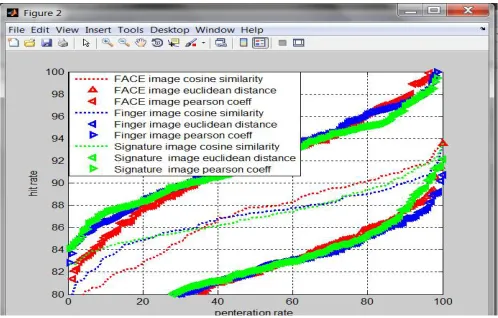
Indexing performance of three distance measures on three biometrics is collectively represented by fig. 9 .
Fig 9 Indexing performance of three distance measures on three biometric databases.
In implementation we use total database size 600 images 200 each of face, fingerprint and signature. For face, finger print and signature database there are ten different images of each of 20 distinct peoples so total images = 200images. Penetration rate of face modality is slightly higher than signature and fingerprint modality. Even signature modality has 99 % hit rate. In all three co-relation methods Pearson co-relation coefficient method achieved low EER rate than Euclidean and cosine coefficient methods
Table 2 Performance of different face reference images
EER N = 50 N = 100 N = 150 N = 200
Pearson’s coefficient 0.0092 0.0097 0.0071 0.0050
Cosine similarity 0.078 0.078 0.073 0.059
Euclidean distance 0.0851 0.0892 0.0852 0.0942
V. APPLICATIONS
The applications of biometrics can be divided into the following three main groups.
• Commercial applications such as computer network login, electronic data security, e-commerce, Internet access, ATM, credit card, physical access control, cellular phone, PDA, medical records management, and distance learning. • Government applications such as national ID card, correctional facility, driver’s license, social security, welfare disbursement, border control, and passport control.
• Forensic applications such as corpse identification, criminal investigation, terrorist identification, parenthood determination, and missing children.
Traditionally, commercial applications have used knowledge- based systems (e.g., PINs and passwords), government applications have used token-based systems (e.g., ID cards and badges), and forensic applications have relied on human experts to match biometric features. Biometric systems are being increasingly deployed in large-scale civilian applications.
VI. CONCLUSION AND FUTURE WORK
scheme is universal and is applicable to any type of multibiometric system, such as those using multiple classification algorithms, multiple biometric traits, or different samples of the same biometric trait.
To speed-up the retrieval process and reduce the storage requirements, a discretization function can be applied to the index codes [9] and an appropriate similarity function used to facilitate the retrieval of identities. Binary index codes can be utilized to perform indexing; this can result in rapid identification even for small databases
E-book:
A Coding Scheme for Indexing MultiBiometric Databases Arun Ross http://www.csee.wvu.edu/ross [email protected]
Handbook of Multibiometrics By Arun A. Ross, KarthikNandakumar and Anil K. Jain Pattern Classification by Dr. C. N. Ravi Kumar
Thesis:
Jai Kumar singh, May-2009 “Clustering and Indexing techniques suitable for Biometric database”, IIT Kanpur
REFERENCES
[1] Anil K. Jain, Arun Ross Member, IEEE, and SalilPrabhakar, Member, “An Introduction to Biometric Recognition” IEEE transactions on circuits and systems for video technology, vol. 14, no. 1, January 2004.
[2] A. Mhatre, S. Palla, S. Chikkerur, and V. Govindaraju, “Efficient search and retrieval in biometric databases,” Biometric Technol.Human Identification II, vol. 5779, no. 1, pp. 265–273, 2005.
[3] Ashish Mishra, Multimodal Biometrics it is: Need for Future Systems, International Journal of Computer Applications (0975 – 8887), Volume 3 – No.4, June 2010.
[4] Arun Ross “An introduction to multibiometrics”, West Virginia University, Morgantown, WV 26506 USA [email protected], http://www.csee.wvu.edu/˜ross, September 2007.
[5] A. Gyaourova and A. Ross, “A coding scheme for indexing multimodal biometric databases,” in Proc.IEEE Computer Society Workshop on Biometrics at the Computer Vision and Pattern Recognition(CVPR) Conf., Miami, FL, Jun. 2009.
[6] AglikaGyaourova, Arun Ross “Index codes for Multi-biometric pattern retrieval”, IEEE transactions oninformation forensics and security,Vol.7,No.2,April 2012.
[7] BirBhanu, Fellow, IEEE, and Xuejun Tan, Student Member, Fingerprint Indexing Based on Novel Features of Minutiae Triplets IEEE transactions on pattern analysis and machine intelligence, vol. 25, no. 5, may 2003.
[8] B. Takács, “Comparing face images using the modified Hausdorff distance, Pattern Recognition”., vol. 31, no. 12, pp. 1873–1881, 1998. [9] K.-H. Lin, K.-M. Lam, X. Xie, and W.-C. Siu, “An efficient human face indexing scheme using eigenfaces,” in Proc. Int. Conf. Neural Networks And Signal Processing, Dec. 2003, vol. 2, pp. 920–923.
[10]Lin Hong and Anil Jain, Fellow, “Integrating Faces and Fingerprints for Personal Identification” IEEE transactions on pattern analysis and machine intelligence, vol. 20, no. 12, December 1998.
[11] LihongZheng and Xiangjian , “Classification Techniques in Pattern Recognition” Faculty of IT, University of Technology, Sydney PO Box 123, Broadway NSW 2007, Sydney, Australia.
[12] Lan;shi-QiangGao;HuiTang;Xiao-Yuan Jing,” Multi-Modal Biometrics Pixel Level Fusion and KPCARBF Feature Classification for Single Sample Recognition Problem “,Image and signalprocessing,2009,CISP’09.
[13] R. S. Germain, A. Califano, and S. Colville. Fingerprint matching using transformation parameter clustering. IEEE Computational Science & Engineering, 4(4):42–49, 1997.
[14] Jai kumarsingh” A clustering and indexing technique suitable for biometric databases”, IIT Kanpur, 2009
[15]A. Torralba, R. Fergus, and Y. Weiss, “Small codes and large image databases for recognition,” in Proc.Conf. Computer Vision and Pattern Recognition, 2008, pp. 1–8.
[16] http://www.biometric solutions.com/applications/index.php [17] http://www.creativeworld9.com/2011/03/abstract-on-biometrics.html
![Fig 4 C] Levels of Fusion](https://thumb-us.123doks.com/thumbv2/123dok_us/1437541.1176150/4.595.120.444.181.541/fig-c-levels-of-fusion.webp)