BlueTech: A Bluetooth-based Advertisement
System for Mall
Onkar Ghate1, Gurunath Chavan2, Krutika Dongare 3, Snehal Mangale4
B. E Students,Department of Computer Engineering, Rajendra Mane College of Engineering and Technology, Ambav,
Mumbai University, India1, 2, 3
Assistant Professor, Department of Computer Engineering, Rajendra Mane College of Engineering and Technology,
Ambav, Mumbai University, India4
ABSTRACT: The idea to make something helpful for shopping has led us to mall app. Since, android is the most rising and trending technologies these days, the application is developed in Android. Bluetooth based advertisement system uses Java and bluetooth wireless technology making it a very portable system. Advertising on mobile devices is one of these new needs and has demonstrated to have a large potential due to the very personal and intimate nature of the devices. A person entering inside the mall can browse this shop data using bluetooth enabled devices. After registering in the application, user can use the different facilities given by the application like product item, offers, discount etc. For Example, entertainment plazas like movie theatres can use this technique to provide information on forthcoming movies as well as current running ones. This system provides a feasible solution for permission-based mobile advertising.
KEYWORDS: BlueTech, bluetooth, floor, permission
I. INTRODUCTION
Android
is the emerging technology in today’s world. Designed to simplify the interaction of human beings with thecommunication devices, Android has achieved many other successes so far. Android applications have become a trend these days. Our lives have become much dependable and enjoyable because of some well-known applications with their functional tactics. In a short amount of time, mobile phones have become multimedia devices and evolved into personal assistants. They are not only used for making phone calls, but also for data services, surfing the Internet and for various multimedia applications. New mobile application domains adapt new paradigms that specifically target the mobile business environment. Allowing clients to receive controlled advertisements and shopping information in their mobile devices without even making any interaction with the system it grants them a strong grade of integration with their surroundings. This kind of system is called a pervasive system, also known as ever-present computing. Users can profit from insidious computing environments in many ways: context attentive applications may actively react, leading to, for example, information being displayed based on the user’s present location.
II. LITERATURE SURVEY
computing device with Bluetooth connection sometimes the term wireless marketing is used to refer the mobile advertising. [1]
This system has to Ubiquitous computing strongly depends on leveraging appropriate contextual information to users, according to their preferences and the environment in which they reside. It combines the productivity of Java with the universal connectivity provided by Bluetooth wireless technology. This paper has focused on building a context-aware system by using UbiqMuseum as a proof of concept that integrates a combination of Bluetooth, WLAN and Ethernet LAN technologies. Impact can be evaluated based on throughput with varying packet size, coding types and device separation distance sending both images and text. Numerical results show that Bluetooth offers a relatively steady throughput up to 10m while the inquiry delay does not increase significantly with distance. [2]
Scatternet formation must be addressed before any ad hoc network protocol can be run over bluetooth. This is due to the occurrence hop nature and piconet unit of Bluetooth. The network formation locates within Bluetooth Network Encapsulation Protocol (BNEP) layer and is underneath the routing protocol. The main task of network formation is to ascertain and preserve bluetooth network topology with better performance and in a fast and economic way. The routing protocol is mainly to find the best routes among the existing network topology. The network formation communicates with routing protocol and management entity using Routing Trigger mechanism. [3]
III.OBJECTIVES
Mobile advertisement is a growing area of development. It is focusing on delivering advertisements to our clients' mobile devices.
a. This system will notify floor wise offers and shop details by using nearest bluetooth access point. b. It will reduce manual efforts and improves the efficiency in shopping process.
Problem definition
To develop a user friendly android app for exploring advertises of shopping mall in coordination with bluetooth sensor devices to aware consumers about the latest offers of mall.
IV.METHODOLOGIES Bluetooth Broadcasting
They provide an efficient data transmission method in Bluetooth broadcasting. The method of Bluetooth broadcasting includes the steps of:
a. At a master, generating a broadcast packet to include assign information and header information and transmitting the broadcast packet.
b. At the master, generating a broadcast packet by including notification information and transmitting the broadcast packet.
c. At the slave, in receipt of the broadcast packet, obtaining the handing over information, header information or notification information included in the broadcast packet and determining Whether or not the slave transmits data.
Bluetooth Pairing
The process of Bluetooth pairing is summarized below:
a. Bluetooth device looks for other Bluetooth devices in range: To be found by other Bluetooth devices, the first device, Device 1 must be set to discoverable mode - this will allow other Bluetooth devices in the vicinity to detect its presence and attempt to establish a connection.
c. Prompt for Passkey: Often the default passkey is set to”0000”, but it is advisable to use something else as hackers will assume most people will not change this. However many more sophisticated devices - Smartphone’s and computers - both users must agree on a code which must obviously is the same for both.
1. Device 1 sends passkey: The initiating device, Device 1 sends the passkey that has been entered to Device 2. 2. Device 2 sends passkey: The passkeys are compared and if they are both the same, a trusted pair is formed,
Bluetooth coupling is established.
3. Communication is established: Once the Bluetooth pairing has occurred, information can be exchanged between the computing devices. Once the Bluetooth coupling has been established it is remembered by the devices, which can then connect to each without user intrusion.
Cryptographic secret handshakes
Cryptographic secret handshakes are related to the broader area of Automatic Trust Negotiation (ATN). Secret handshakes enable two parties to establish that they are affiliated with a certain group, and to disclose their respective roles in the group. They assure that this information is disclosed only when the handshake completes, and no information is consisted by either party when the handshake fails. As such, it is useful when none of the parties are willing to be the first to disclose its affiliation. In this sense, the scheme offers properties similar to a physical secret handshake between two people. However, there is one caveat. One party learns about the achievement of the handshake before the other, and if it chooses to end the communication without responding to the other party’s challenge, the other party is left unsure as to the success of the secret handshake.
Security:
The secret handshake has to be secure against the following attacks:
a. Group member impersonation- an adversary who is unaffiliated with the group performs a successful handshake with a group member.
b. Group member detection - an adversary who intercepts a broadcast from a group member identifies the group it is associated with.
c.
Tracking - an adversary is able to tell that two different handshake attempts were made by the same party. Resiliency to this attack is called unlink ability.V. PROPOSED SYSTEM
A. Outline:
The system has two main components, which are android based administrative panel and user panel.
Administrative Panel
a. Managing general data and floor wise item details. b. Design and manage the database of system.
User Panel
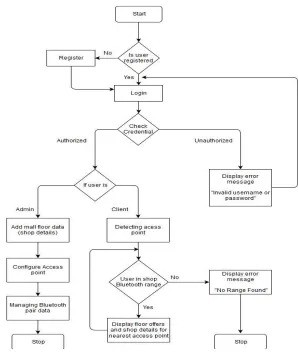
B. Flowchart Diagram and Working
Fig. 1: Flowchart for proposed system
As shown in figure 1, the system has two main components, which are android based administrative panel and application. Administrative panel contain Bluetooth devices configuration details and shop details. This panel can be also managing their general data and floor wise shop details based on Bluetooth. A person entering inside the mall can browse this shop data using Bluetooth enabled devices. After registering in the application, person can use the different facilities given by the application like product item, offers, discount etc.
Different modules in the application are as follows:
a. Administrative panel: In this panel, administrators manage all the data about system and perform operation like modify, update, delete on all the information related to mobile devices and advertisements. All features are accessible by the admin panel to allow easy editing.
VI.ASSUMPTIONS
a. The Users should have Android device with this application.
b. There should be a person in the deployment environment who can handle the Administrative Panel.
VII. RESULTS
The system has two main components, which are android based server side and client side application. Server side application contains bluetooth devices configuration details and shop details. This application can be also managing their general data and floor wise shop details based on bluetooth. A person entering inside the mall can browse this shop data using bluetooth enabled devices. After registering in the application, person can use the different facilities given by the application like product item, offers, discount etc.
Fig. 2: Client Side Homepage Fig. 3: Get Shop list Page Fig. 4: Server Side Homepage
VIII. CONCLUSION
This system is designed to constantly deliver advertisements and information of shopping malls to the customers using nearest bluetooth access point. This will going to reduce manual efforts and improves the efficiency in shopping process.
IX.ACKNOWLEDGMENT
supported us with scientific supervision, advice and support, they were always cooperative and keen, this inspired us in our work
REFERENCES
1. Jose-Maria Sanchez, Juan-Carlos Cano, “Blue Mall: A Bluetooth-based Advertisement System for Commercial Areas”, Carlos T. Calafate and Pietro Manzoni Technical University of Valencia, SPAIN.
2. Juan-Carlos Cano. UbiqMuseum: “A Bluetooth and java based context-aware system for ubiquitous computing”. Wireless Personal Communications, 38:187(202(16), July 2006.
3. Bin Zhen, Jonghun Park and Yongsuk Kim,i-Networking Lab “Scatternet Formation of Bluetooth Ad Hoc Networks” Samsung Advanced Institute of Technology, YongIn city, 440-600, Korea.
4. D. Balfanz, G. Durfee, N. Shankar, D. Smetters, J. Staddon, and Hao-Chi Wong“ Secret handshakes from pairing-based key agreements”. 2003 Symposium on Security and Privacy, 2003.
5. Dr Jennifer Bray and Brian Senese “Bluetooth Applications Developer’s Guide”.
6. Kaan Dogan, Guray Gurel, A. Kerim Kamci “Bluetooth Broadcasting Performance: Reliability and Throughput”.
7. https://www.bluetooth.com
8. http://www.radioelectronics.com/info/wireless/bluetooth/networks-networking-connections-pairing.php
BIOGRAPHY
Onkar Ghate, pursuing Bachelors in Computer Engineering (BE) from RMCET College, Mumbai University. My areas of interest are android programming, java programming, Asp.net(c#), graphics designing and networking.
Gurunath Chavan, pursuing Bachelors in Computer Engineering (BE) from RMCET College, Mumbai University. My areas of interest are java programming, php programming and networking.
Krutika Dongare, pursuing Bachelors in Computer Engineering (BE) from RMCET College, Mumbai University. My areas of interest are android programming and software project management.