Performance Analysis of Cloud based Web Services for Virtual
Learning Environment Systems Integration
Dr. Saife Eldin Fattoh OsmanP 1,
P
Mohammed Eltahir Abdelhag P 2,
P
Dr. Saad MamounP 3
P
1
P
Emirates College for Science & Technology, Sudan32T, [email protected]32T
P
2
P
Information Technology Department, National Ribat University, Sudan, [email protected] 3 College of Applied Sciences, Ibri, Sultanate of Oman, [email protected]
ABSTRACT
Interest in SOA and Web services is quickly increased from their start of use. Web Service is applications integration technology that allows applications in heterogeneous environments to communicate with each other, it can be implemented in different protocols, but the most commonly used protocols are SOAP and REST. These protocols are differing in their performance and other QoS. Since Performance is an important quality aspect of Web services because of their distributed nature. A detailed analysis and comparison of performance must be done before adopting any web service based systems. The goal for this study is to conduct a comparative analysis of the most commonly used web services integration protocols in Moodle VLE which hosted in cloud environment, and integrated with mobile app to determine which protocol should be applied in such that cases. Performance analyses result can be used to make appropriate choice for developing and optimizing mechanism to web services environment. The performance metrics response time and throughput are analyzed while accessing a quiz web services from the cloud by using Apache JMeter as a performance analysis tool.
Key words: SOA, integration protocols, SOAP, REST, Performance Analysis, and Moodle.
1. INTRODUCTION
Service Oriented Architecture (SOA) and web services are important technologies that can help and solve the communication and integration problems of different environments platforms and architectures [1]. SOA is architecture for designing distributed system and web services is a mechanism to implement it. SOA enables exiting virtual learning environment (VLE) systems including legacy systems and applications to integrate without any need for adding any custom code or updating these systems to newer versions [1]. Cloud Computing provides a flexible and scalable platform through processing external services, also provides the ability to connect with customers, partners, and suppliers. However, without SOA, organizations will face difficulties in using
Cloud Computing because of the fact that the applications do not have a solid architectural foundation [2].
Both SOA and cloud are concerning about delivering of services to systems with better flexibility, integration, interoperability and cost effectiveness to achieve a satisfied level of that, the virtual learning systems can be prepared with functions to service students , teachers and other learners [3].
The cloud brings a good means for distributing services in SOA architecture paradigm. SOA is related to cloud computing when we are dealing with clouds, we are dealing with services, and when we are dealing with services we should we dealing with SOA. This study will be implemented based on architecture which presented in [3] see figure 1.
SOA has a performance problem due to the loosely coupled and heterogeneous nature of the approach. To practically and widely apply SOA in developing applications, performance problem has to be overcome [4]. Performance is an important non-functional requirement of any web based system and is necessary to the acceptance of the system. The performance of a web service will show how fast a service request can be completed. So it’s wise to evaluate the performance of the web services protocols within a process before making it available for online usage.
Although there are many choices of web services integration protocols to choose from, developers should choose the protocol that fit the best to their system. The performance of web services is depending on the underlying integration protocol. So what is an integration protocol will be very likely to have best performance in a real environment, the selection of appropriate protocol for implementation is purely based on performance offered by the particular protocol. Both SOAP and REST allows different systems, written in multiple languages, to communicate and consume web services. In order to have the trust of service users, it is necessary that the application must conform to the performance requirements as it is the most important factor for evaluating a system estimated number of potential users that the system can efficiently handle.
Our proposed system is Moodle-based e-Learning which
is hosted in cloud (hostinger), its functions are developed as web services, and we will use Quiz web service as an example to integrate with Moodle mobile App depending in web services technology, and allowing students to taking their quizzes through their mobile devices. Moodle Mobile is the official mobile app for Moodle which is an HTML5 app that uses common web technologies. And it’s basically a Web Services client that uses REST or SOAP as protocol to get and send information to Moodle cloud system. Integration between m-learning applications and VLE is not an easy task, because VLE do not usually include interoperability standards to communicate with external applications they are usually designed as monolithic or layered systems [5]. Web Services Testing is considered A as the most important factor that will decide the success of the Web Services technology. The loosely coupled nature of web services and non-existence of a User interface present a challenge to the developers [6] [7].
This paper mainly focuses on web services performance analysis of Moodle VLE in the cloud, while accessing Quiz services using smart phone based on SOAP and REST integrations protocols. Metrics chosen for the experiment are response time and throughput, using Jmeter as a web services performance testing tool.
Figure 1: the proposed VLS Architecture [3].
2. RELATED WORK AND OUR CONTRIBUTIONS
Performance measurements and analysis is important to web services due to its loose coupled and distributed nature. Unfortunately few articles have focused on cloud based web services performance analysis.
A similar study was presented in [8]. The authors empirically compared two versions of an electronic book inventory system implemented using Active Server Pages (ASP) and Web services. The workload generator used in this study was S-client [9]. The results showed that the ASP implementation has higher throughput and lower response time than the Web services implementation. Analytical performance modeling techniques have been used to identify performance problems in Web applications in [10]. A simulation technique for analyzing performance of composite Web services was proposed in [11], in this paper the authors considered a scenario of an online book store and used the simulation tool JSIM to build the simulation model of this scenario, the service time, communication latency, and waiting time for each Web service in the scenario were measured by load testing. The results from the simulation model were found to be close to the results obtained from the actual service execution. In [12] the authors investigated web reliability and web performance on different types of Internet connections, authors compared several web service implementations with Java-RMI and CORBA in terms of performance. Li et al. [13] present a Cloud Prophet that can accurately predict the response time of an on-premise web application if migrated to a cloud virtual environment. Kai et al. [14] studied the impact on system performance when introducing Web Service interfaces to an originally tightly coupled application. They used two implementation variants of Sun’s Java Pet Store application, one based strictly on the J2EE platform and the other as Web Services. Performance is compared in terms of the achieved overall throughput, response times and latency. Machado and Ferraz [15] presented guideline for two mostly used java base web services frameworks. They give recommendation on the use of SOAP features to guarantee interoperability between the frameworks. Their paper provides details of the principal performance overheads of web services.
In our study we present a measurement study of most commonly used web services performance integration protocols for Moodle based e-learning (ECe-L) hosted in cloud, for that purpose we use Quiz web services developed in PHP to conduct our experiments. Our goal is not to test standalone web services but to examine how SOAP-based web services and REST-based web services hosted in cloud will perform when integrating with smartphone devices. For generating the workload for our experiments we used Jmeter as a tool for performance testing and collecting data for analyzing. Unlike the previous studies [10] [14] which test the overall response time and throughput of web services based system, we conducting the performance for the architectural level that hosted on cloud. The result obtained from this study contributes towards quantifying the load introduced by SOAP and REST web services hosted in cloud and
integrating with mobile platform.
3. SERVICE ORIENTED ARCHITECTURE AND WEB SERVICES
Service Oriented Architecture (SOA) is defined as “an application architecture with which all functions are defined as independent services with well-defined invokable interfaces which can be called in defined sequence to form business process” [16]. Web service is a software system designed to support interoperable machine-to-machine interaction over a network. Distributed components are interfaced via non-object-specific protocols. SOA can be implemented through web services. Web service is a software application identified by a URI whose interface is described and discovered by using XML. Then the service interface is encapsulated by Web Services Definition Languages (WSDL). After that, it is published in the Universal Discovery Description Integration (UDDI) which is known as Broker or Registry. Next, the service can be transferred through message passing over HTTP [17]. It is based on the interaction of three roles [18] as shown in Figure 2.
Figure 2: SOA architecture [6]
3.1 SOA Integration Protocols
SOAP: Simple Object Access Protocol (SOAP) [19] is a protocol specification for exchanging structured information in the implementation of Web Services. It uses XML for the message format. It is independent of the transport protocol (could be HTTP, FTP, TCP, UDP). SOAP provides a mechanism for services to describe themselves to clients (WSDL), and to advertise their existence (UDDI). SOAP also provides reliable messaging (WS-Reliable Messaging) that is successful retry logic built in and provides end to end reliability through soap intermediaries.
REST: Representational State Transfer (REST) [19] is an architecture style for designing networked applications, that Involves clients and servers sending request and responses respectively. Request and response are built around the transfer of representations of resources. REST
recognizes everything a resource (e.g. User, Lottery, etc.) and each resource implements a standard uniform interface (typically HTTP interface), resources have name and addresses (URIs), each resource has one or more representation (like JSON or XML) and resource representations move across the network usually over HTTP.
4. MOODLE
Moodle [22] stands for Modular Object-Oriented Dynamic Learning Environment. It's one of many virtual learning environments (VLEs) used to deploy courses online. Moodle [24] is an open source platform for the production and distribution of e-learning material. It's used by colleges and training departments because it can be adapted to many purposes. The most recent versions of Moodle support most mobile devices, including Android, iPhone and iPad. In terms of browser compatibility. By using web services Moodle can easily integrate with mobile devices via any integration protocols such as SOAP or REST.
4.1
Hosting Moodle in cloud
Cloud computing [20] is a type of computing that relies on sharing computing resources rather than having local servers or personal devices to handle applications. Cloud hosting services [21] provide hosting for websites on virtual servers which pull their computing resource from extensive underlying networks of physical web servers. Cloud hosting has quickly become one of the fastest growing services for businesses. Using a cloud provider that gives universities the ability to adjust their educations resources immediately can help them improve students’ retention and learning quality. So universities replace a purchase of expensive computers and their maintenance by computer cloud services.
The normal way of setting up Moodle is to install it on a Windows or a Linux server in a data center, and manage it as part of an IT system. The setting up requires large investments in hardware and software. If Moodle is hosted in the Cloud, no big investments are needed. So our experiments model will migrate locally hosted Moodle to the cloud (hostinger) environment. The operation of Moodle will developed as web services and hosted on cloud. The download and upload processes are necessary because this is the method to ensure that customized Moodle works on cloud. However, the uploaded package can be installed only on one virtual server on the cloud [23]. Mobile learning learners can visit learning resources inside the Moodle stored in the cloud. Easily Moodle can run in the cloud and data can be stored in the cloud. All they need to do is access the learning materials with their mobile devices via the Internet.
5. FORMS OF CLOUD-BASED SOFTWARE TESTING
There are four different forms of cloud-based software testing. Each of them has different focuses and objectives. A. Testing a SaaS in a cloud – It assures the quality of a SaaS in a cloud based on its functional and non-functional service requirements.
B. Testing of a cloud – It validates the quality of a cloud from an external view based on the provided cloud specified capabilities and service features. Cloud and SaaS vendors as well as end users are interested in carrying on this type of testing.
C. Testing inside a cloud - It checks the quality of a cloud from an internal view based on the internal infrastructures of a cloud and specified cloud capabilities. Only cloud vendors can perform this type of testing since they have accesses to internal infrastructures.
D. Testing over clouds – It tests cloud-based service applications over clouds, including private, public, and hybrid clouds based on system level application service requirements and specifications. This usually is performed by the cloud-based application system providers [30].
6. PERFORMANCE MEASUREMENTS METHODOLOGY
The important performance analysis of Web services is the process of measuring the services’ ability to serve contents to their requestors in an acceptable time. In other words, Web service performance analysis is the process of monitoring and projecting service workload and specifying the most effective computing environment to meet future demands given a small number of parameters [25]. There are multiple ways to measure the performance of a system. The most commonly used performance metrics are response time and throughput [26]. To a Web service, the general scenario for generating response times involved the client sending some data to the server at an instance of time A measured in milliseconds. The server received the request, processed it, and sent the response to the client. The client received the response completely at some time B in milliseconds. The response time was measured as the difference between times A and B. The throughput is generally considered as a measure of the service’s productivity, that is, the number of requests served successfully during the measurement period. Throughput indicates the number of transactions per second an application can handle, the amount of transactions produced over time during a test.
Through this work we compared the performance analysis of Web services for Moodle base virtual learning using the two major Web service building technologies SOAP and REST. Both technologies work on HTTP as a layer of transport. The client in this model is a mobile device
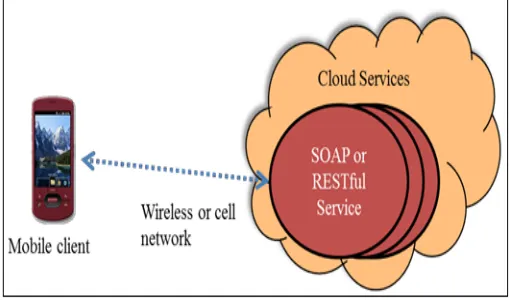
(smartphone), and the server is Apache which runs and hosted in Hostinger [29] which is free cloud hosting provider. Which support PHP and MySQL without any restrictions with the following specifications, disk space 2000 MB, data transfer 100 GB, script auto installer 50 Scripts. Server network speed 10 mbps, server RAM 8 GB, server processor Xeon E3-1230, operating system Centos. The clients will increase from one to five and the payload will also vary to evaluate the comparison. The clients will also be tested on 3G and Wi-Fi networks. The interaction between the client application and Quiz web service was used as the basis for analyzing the performance of SOAP and REST. a Quiz web services is used based on a quiz table in MySQL database which containing the following attributes: quiz_id, course_id, format, load_attempt, user_id, summary_view, category_id. The Quiz web services provide many functions such as: getQuiz returns a quiz with all questions from the database, get_questions_by_quiz returns all questions for the given quiz with all details, get_questions_by_course returns all questions for the given course, with all details and submitAnswer. On the basis of these functions, we calculate the response time and throughput, using Jmeter.
Figure 3: Consuming WS from Mobile Client
7. EXPERIMENTAL RESULTS 7.1 Response time for getQuiz function
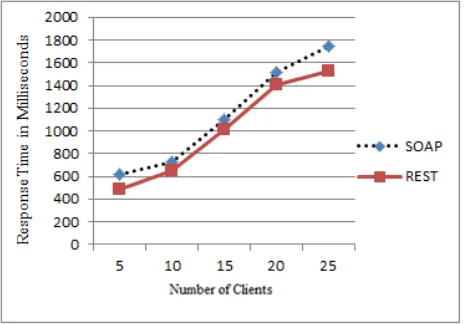
The getQuiz function provides a client to request for information about a quiz by using format and quiz_id attributes. The service gets the particular quiz details from the database and sends the response to the client. Multithreading was used to depict multiple clients requesting the service at the same time. Figure 4 shows the response time for getQuiz function. It can be seen from the graph that for the getQuiz function, REST had better response time than SOAP as the number of simultaneous clients increased.
Figure 4: Response time for getQuiz function SOAP vs REST
7.2 Response time for submitAnswer function
The submitAnswer function is used to store the answers that have been done by student to the database. Figure 5 depicts SOAP vs. REST comparative chart for the clients. From the graphs, it can be observed that for the submitAnswer function, REST had better response times than SOAP as the number of simultaneous clients increased. Similar to getQuiz function, REST had better response time.
Figure 5: Response time for submitAnswer function SOAP vs. REST
7.3 Throughput in Clients per Second
Throughput, expressed as clients per second, was calculated by dividing the number of clients by the response time in seconds. The values for response times were taken from the results for the getQuiz function with multiple clients, as discussed above. Figure 6 represents the number of simultaneous clients on the x-axis and throughput in clients per second on the y-axis. REST performance was comparatively better than that of SOAP from the above graphs and got better as the number of service requests increased.
Figure 6: Throughput Clients per Second SOAP vs. REST
8. DISCUSSION
The results of the experiments indicate that REST has better response times and throughput than SOAP. Response times can be affected by server processing capabilities and network bandwidth [27]. Throughput can be affected by a number of parameters, including network capability, transmission channel, network congestion (number of shared applications), distance between computers, payload size, and processing technique to handle a payload [28].
In our experimental setup, both Moodle based web services were tested using the same set of payload sizes, client and server machine configurations, number of clients, and number of service requests. All services used HTTP as the main protocol for exchanging messages and files. To ensure that services have same processing capabilities, both SOAP-based and REST-based services were hosted in the same cloud based server. the main difference between REST and SOAP integrations protocols is that, for SOAP messages, the actual payload is included inside the envelope element, whereas, for REST entire message is the payload. So, SOAP service would have to perform additional processing to get the payload information. Similarly, when sending a response message, SOAP service would have to perform additional processing to construct a SOAP formatted message. The SOAP client machines also would have to perform extra processing to create and to read the message. This extra processing time incurred towards retrieving information from the message and embedding response into the message, may explain higher response times for SOAP service. REST on average performed better than SOAP for throughput experiments. Throughput experiments were conducted using getQuiz function. Taking results of the experiments and practical indications into consideration, we recommend selecting REST based interaction styles. The RESTful approach would be suitable when the bandwidth needs to be limited and
unstable.
9. CONCLUSIONS
Web services are widely used over internet. Web Service performance is became an important factor. Efforts are going on to reduce the performance limitations of Web services. One of these efforts is to choose best integration protocol from the performance perspective. This paper conducted a comparative analysis of REST and SOAP Moodle based web services hosted on cloud, using Quiz web services through response time and throughput metrics. The results showed that REST operates more quickly than SOAP with less response time and better throughput.
There can be various factors which affects the response time such as server processing capabilities, network bandwidth, payloads, distance between client and server and number of clients accessing the Web service. Therefore, Restful web service provides high performance and perfectly good solution for Moodle based web services. Thus as a part of future work, comparison can be made by increasing the number of clients and testing them using different payloads and more functions, and trying to extend our experiments to cover other platforms.
REFERENCES
[1] Mohammed ELtahir Abdelhag, Dr.Saife Eldin Fatoh. “SOA for Effective Data Integration of Virtual Learning Environment Systems" International Journal of Advanced Research in Computer Science and Software Engineering. Volume 4, Issue 6, June 2014. ISSN: 2277 128X www.ijarcsse.com.
[2] The Importance of SOA to Cloud Computing, http://www.servicetechmag.com/I87/1214-3
[3] Mohammed ELtahir Abdelhag, Saife Eldin Fatoh Osman “SOA for Dynamically Integrated Virtual Learning Environment Systems based on Cloud Services” International Journal of Computer Applications Technology and Research Volume 4– Issue 2, 115 - 118, 2015, ISSN: 2319–8656. www.ijcat.com.
[4] Jin Sun Her ; Si Won Choi ; Sang Hun Oh ; Soo Dong Kim “A Framework for Measuring Performance in Service-Oriented Architecture” Next Generation Web Services Practices, 2007. NWeSP 2007. Third International Conference on 29-31 Oct. 2007.
[5] María José Casany, Marc Alier, Enric Mayol, Jordi, Extending Moodle Services to Mobile Devices: The Moodbile Project, The Sixth International Conference on Mobile Ubiquitous Computing, Systems, Services and
Technologies, 2012. [6]http://aws.iwi.unileipzig.de/em/fileadmin/user_upload/
doc/Issues/Volume_13/Issue_01/V13I2_Performance_An
alysis_and_Simulation_of_Composite_Web_Services.pdf [7] http://docplayer.net/7493623-Introduction-to-testing-webservices.html, Retrieved 10 February. 2016
[8] M. Tian, T. Voigt, T. Naumowicz, H. Ritter, and J.Schiller, “Performance Impact of Web Services on In- ternet Servers”, International Conference on Parallel and Distributed Computing and Systems, Marina Del Rey, USA, Nov. 2003.
[9] G. Banga and P. Druschel, “Measuring the Capacity of a Web Server under Realistic Loads”, World Wide Web, May 1999, pp. 69–89.
[10] C. Catley, D. Petriu and M. Frize, “Software Per- formance Engineering of a Web Service-based Clin- ical Decision Support Infrastructure”, 4th Interna- tional Workshop on Software and Performance, Red- wood Shores, California, 2004, pp. 130–138
[11] S. Chandrasekaran, J. Miller, G. Silver, B. Arpinar, and A. Sheth, “Performance Analysis and Simulation of Composite Web Services”, International Journal of Electronic Commerce & Business Media, Vol.13, No.2, 2003, pp. 18–30.
[12] Ren, M. and K. Lyytinen (2008) "Building Enterprise Architecture Agility and Sustenance with SOA," Communications of the Association for Information Systems 22(1), pp. 75-86.
[13] Li, A., Zong, X., Kandula, S., Yang, X., Zhang, M.: Cloud Prophet: towards application performance prediction in cloud. SIGCOMM Comput. Commun. Rev. 41(4), 426–427 (Aug 2011).
[14] Kai S. Juse,S.Kounev and and A.Buchmann.Petstore-WS:Measuring the performance implications Of Web Services,29th International Conference of the Performance Evaluation of Enterprise Computing Systems,2003.
[15] Ana C.C. Machado and Carlos A.G.Ferraz.Guidelines for performance evaluation of web services ,WebMedia‟05,pocos de caldas,MG,Brazil ,2005.
[16] Z., Qinghua, D., Bo, T., Feng and C., 2008 Wei, A servicoriented approach to integration of e-learning Information and Resource Management Systems. Proccedings of 12th International Conference on Computer Supported Cooperative Work in Design (CSCWD), Xi'an, China.
[17] A., Brown, S., Johnston and K., Kelly, Using service-oriented architecture and component-based development to build web service applications. Rational Software Corporation. (2002).
[18] web services : http://www.webopedia.com/TERM/W/Web_Services.html
, retrieved on march 2015.
[19 ] REST and SOAP – Web services analogy: http://blog.manishchhabra.com/2013/04/rest-and-soap-web-services-analogy/ ( retrieved on august 2015). [20]cloud computing,
http://www.webopedia.com/TERM/C/cloud_computing.ht ml, Retrieved 12 March. 2016
[21] what is cloud hosting, http://www.interoute.com/what-cloud-hosting, Retrieved 15 March. 2016
[22] http://www.whoishostingthis.com/compare/moodle/, Retrieved 1 March. 2016
[23] MORGANO, E. M., SCHMIDT, R.: Increasing Moodle Resources Through Cloud Computing. In: Proceeding of Iberian Conference on Information Systems & Technologies 2012, pp. 104–107, 2012.
[24] What Is Moodle & What Is it Used for:
http://www.moodlerooms.com/community-initiatives/what-is-moodle (retrieved on March, 2015). [25] K. Kant, Y. Won, 1999 “Server capacity planning for Web traffic workload”,In IEEE Transactions on Knowledge and Data Engineering,vol. 11,no.5, pp. 59-75. [26] E. Lazowska, J. Zahorjan, S. Graham, K. Sevcik, 1984 Quantitative system performance: computer system analysis using queueing network models, Prentice Hall, USA,pp.203-300.
[27] Cherkasova, L., Fu, Y., Tang, W., & Vahdat, A. (2003). Measuring and characterizing end- to-end Internet service performance. ACM Transactions on Internet Technology (TOIT),3(4), 347-391. doi:10.1145/945846.945849.
[28] Zhu, G., Davis, L. M., Chan, T., & Perreau, S. 2011. Trade-offs in energy consumption and throughput for a simple two-relay network. Paper presented at the Communications Theory Workshop (AusCTW), 2011 Australian, Melbourne, Australian.
[29] web hosting, http://www.hostinger.ae/web-hosting, Retrieved 19 March. 2016.
[30 Maurya Bhumika, Chandraprabha andRashmi Patil, 2013. Review Of Cloud Testing, Types, Challenges And Future Scope. International Journal of Advance Research In Science And Engineering, May, 2: 7-11.
![Figure 1: the proposed VLS Architecture [3].](https://thumb-us.123doks.com/thumbv2/123dok_us/7852536.1302187/2.612.63.298.372.651/figure-the-proposed-vls-architecture.webp)
![Figure 2: SOA architecture [6]](https://thumb-us.123doks.com/thumbv2/123dok_us/7852536.1302187/3.612.57.278.345.496/figure-soa-architecture.webp)