A New Interference Aware Routing Metric for
Efficient Load Balancing In 802.11s Networks
A. Ram Raoa
Prof &HOD, CSE Dept, LIET
V. Anj i Redd y
Asst.prof,LIE T
Y. Raj ani Kan th
Student, M.Tech, T LIE
Abstract-A new kind of wireless multi-hop network architecture called Wireless Mesh Network (WMN) has recently attracted much attention. WMNs have recently gained a lot of popularity due to their rapid deployment, instant communication capabilities and support for many types of application. For these applications, network congestion and interference is the main reasons for lower throughput and longer delay. Most of the present routing protocols for WMN’s are not designed to adapt congestion, interference and optimal link quality. In this paper, we propose congestion and interference aware multipath routing protocol called EAOMDV-iLB for multiradio multiple interface wireless mesh networks (WMN). The protocol calculates multiple paths using proposed airtime congestion and interference aware (ACIA) metric and performs load balancing by computing queue utilization of multiple interfaces of a nodein terms of reduced interflow and intra-flow interference. Moreover, the effective load balancing technique maintains data transmission on optimal path by diverting traffic all the way through congested area. The simulation results using ns2 reveal that our proposed load balancing scheme performs better than AOMDV in terms of throughput, end-to end delay with high traffic density.
Keywords—Wireless Mesh Network; multiple interfaces and multiple channels; airtime link cost metric; round trip time; congestion; load balancing; Received signal strength indicator.
I. INTRODUCTION
As various wireless networks evolve into the next generation to provide better services, a key technology, wireless mesh network (WMN), has emerged recently. In WMNs, nodes are comprised of mesh routers and mesh clients. A WMN is dynamically organized and self-configured, with the nodes in the network automatically establishing and maintaining mesh connectivity among themselves. WMN is a promising wireless technology for numerous applications e.g., broadband home networking, community and neighborhood networks, enterprise networking, building automation, etc. [1]. This feature brings many advantages to WMNs such as low up-front cost, easy network maintenance, robustness, bandwidth fairness, easy deployment and reliable service coverage [2]. WMNs will greatly help the users to be always-on-line anywhere anytime. Moreover, the gateway/bridge functionalities in mesh routers enable the integration of WMNs with various existing wireless networks such as cellular, wireless sensor, wireless-fidelity Worldwide interoperability for Microwave Access (WiMAX), WiMedia networks [3].
Fig. 1. Infrastructure Wireless Mesh Network [1]
Based on the functionality of the nodes, WMNs can be classified into three categories: Infrastructure backbone, client backbone and hybrid. Mesh routers are used to form a multi-hop and multi-path wireless backbone capable of communicating with gateways and clients. Mesh clients can form self organized ad hoc networks which can access services by relaying requests to wireless backbone network. The hybrid mesh network architecture is a combination of infrastructure and client meshing and is expected to be the best choice in the next generation WMNs. Some of the technical challenges in WMNs are load balancing, optimal routing, fairness, network auto configuration and mobility management [4].
Various routing metrics such as ETX, ETT, WCETT and MIC have been proposed but they cannot
guarantee the quality and efficiency of the path.
channel around some gateways, or a few gateways can get overloaded while others are underutilized [7]. This may lead to undesirable effects such as longer delay, lower packet delivery fraction and higher routing overhead. Therefore load balancing becomes a challenging task in WMN. Efficient load balancing mechanism with less interference can help to improve network performance by avoiding routing traffic all the way through congested area. Some suitable routing protocols need to be designed for WMNs to achieve load balancing in a manner that they can adapt characteristics of WMNs.
This paper proposes load balancing at mesh routers and also introduces a congestion and interference aware load balancing algorithm to divide the traffic among mesh routers. The main contributions of this paper are: (1) We propose congestion and interference aware airtime link cost metric that provides load balancing at mesh router and (2) We introduce efficient load balancing scheme that maintains nodes transmission on optimal path and compute queue utilization of multiple interfaces to avoid heavily loaded nodes. The rest of this paper is organized as follows: Section II depicts related work. Section III provides description of proposed approach. Section IV describes simulation tool and parameters. Section V presents the analysis and discussion of the simulation results. Finally, in Section VI we summarize our conclusion and discuss future work
II. RELATED WORK
A new approach on load balancing for multi radio WMN is needed as the research is still in the early stage. In this section, the research work related to congestion control and interference aware routing metrics in mobile adhoc networks and wireless mesh network is presented. In [2] the author suggests gateway cluster based load balancing approach for multicast communication to achieve quality of service. The author use intermediate node’s routing load as the primary route selection metric. This helps the protocol to discover a route with less network congestion and bottlenecks.
Load balancing in WMNs can be achieved through path based load balancing, gateway based load balancing or mesh router based load balancing. In Gateway based load balancing scheme the traffic is distributed among gateways by assessments carried out by the gateways, In Path-based load balancing, and the traffic is distributed across multiple paths towards the gateways. Similarly, router based load balancing can improve the network performance by distributing the traffic over the entire network to avoid congested links. Transmission failure and congestion aware load balancing scheme is proposed [3] which ensures path selection on basis of backoff stages and residual capacity. Author suggested a novel routing metric (MF) which captures interference and provides load balancing.
A congestion aware load balancing strategy along with routing metric weighted cumulative expected transmission time-load balancing (WCETT-LB) to solve
the problem of network congestion and interference is proposed in [4]. Queue Utilization is computed periodically at each node. If it is greater than threshold, WCETT-LB is recomputed and multicast to its entire neighbor node till source node. When the difference between current path metric cost and alternate path is greater than threshold, switching is made otherwise load is balanced at mesh router. This scheme improve throughput and reduce end to end delay.
Distributed load balancing protocol is proposed in [5] where gateways coordinate to reroute flows from congested gateway to underutilized gateway. Initially sink nodes associate with nearest gateway. If congestion occurs or domain is overloaded, the traffic of border sink is transferred to the domain which is closer to it. This scheme will harm less to the other flows in the domain and improve performance of network. In [6] author has suggested cluster based load balancing scheme with load aware routing metric. The mesh network is divided into multiple overlapping clusters. When the cluster head estimates a high traffic load, the path with lowest link cost is selected as the optimal route. Therefore the proposed scheme will yield a path having high throughput and less congestion.
All the above works are based on single radio networks. But, few works are reported in the literature on load balancing using multipath routing for multi radio WMN. The effective method to avoid congestion and losses in the networks is by multipath routing which distributes traffic among different paths and thereby improve the efficiency of the network. Ad hoc On-demand Multipath Distance Vector (AOMDV) which computes multiple loop free and link-disjoint paths is proposed in [8]. The primary design goal of this protocol is to provide efficient fault tolerance, fast recovery from route failures in dynamic networks. Multipath routing protocol [9] is used to improve the reliability and load balancing. In this paper, the combined metric for interference avoidance protocol is designed with exclusive expected transmission time (EETT), interference load aware (ILA) and interference aware metric (IAWARE). The source node chooses path with minimum metric cost as primary path to the next hop. If there is failure notification in primary path, the alternate path is chosen that has second minimum value of metric cost.
routers so later if request for same file arrives then it is served by routers and the load on gateway reduces.
In [12] Adaptive multipath routing for load balancing is proposed which selects optimal path based on minimum energy utilization and maximum residual battery power of node. This mechanism improves load distribution and enhances network performance of adhoc network. Congestion aware route discovery is proposed for Mobile Adhoc network (MANET) in [13] where optimal routing path is selected based minimum queue size of the node. Congestion aware multipath routing protocol with multiple interfaces is introduced [14] to improve quality of service. This scheme computes maximum three paths based on Round Trip Time (RTT) and routing path is selected based on less queue utilization of link.
A novel load aware Airtime link cost routing metric [16] is proposed to maximize load balancing in WMN. Airtime link cost defines the amount of channel resources consumed by transmitting frame over particular link. Traffic load is measured by the nodes' average queue length and number of neighbor nodes which share same channel. [17] In this work the congestion control is achieved by implementing the Congestion and Energy Aware Routing Protocol (CAERP). In order to achieve the congestion free communication with minimized energy utilization the data rate of the individual nodes are changed according to the queue state and signal strength identifier. If the value of the Received Signal Strength Indicator (RSSI) is low, it is assumed that the distance between the sources to sink is high and vice versa.
III. PROPOSED WORK
In this section, we have proposed Airtime Congestion and Interference Aware (ACIA) routing metric with efficient load balancing scheme that maintains nodes transmission on optimal path and improve the efficiency of wireless mesh network. The three components of our metric airtime link cost, round trip time and interference ratio provides link quality, congestion aware and interference aware features respectively. We also have computed queue utilization of multiple interfaces on each node to avoid highly loaded nodes. We detail the proposed metric and load balancing scheme as follows.
A. Calculation of Airtime Congestion & Interference Aware (ACIA) Metric
In order to provide congestion and interference aware routing metric for multi radio WMNs, our proposed metric is based on Airtime Link Cost metric and Received Signal Strength Indicator (RSSI). Instead of well known link quality metrics such as ETT (Expected Transmission Time), we utilize airtime link cost because it can support multiple radio environments. The airtime link cost metric defines the amount of channel resources consumed by transmitting the frame over a particular link. The Airtime Link Cost metric captures link quality by monitoring medium usage and improve the throughput of the network.
The airtime link cost for each link is calculated as following.
(1)
Where Oca, Op and Bt are constants whose values are listed
in Table I and the input parameters r and ef are the data rate
in Mbps and the frame error rate for the test frame size Bt
respectively. The rate r represents the data rate at which the node would transmit a frame of standard size Bt based on current conditions and its estimation is dependent on local implementation of rate adaptation. The frame error rate ef is
the probability when a frame of standard size Bt is
transmitted at the current transmission bit rate r, the frame is corrupted due to transmission error [15].
Table i. Representative Constants Of Airtime Metric
802.11a 802.11b/g Description
Oca 75s 335s Channel access
overhead
Op 110s 364s Protocol overhead
Bt 8192 bits 8224 bits Bits in test frame
The load balancing feature in airtime link cost which we define as Received Signal Strength Indicator (RSSI) is measured by unicast probes between neighboring nodes. To calculate RSSI, a node sends a probe packet carrying a timestamps to each of its neighbors every probe interval. Each neighbor immediately responds to the probe with a probe acknowledgement, echoing the timestamp. If either node or neighbor node is overloaded, the probe or probe acknowledgement will experience queuing delay and resulting high RTT. In the proposed approach, we integrate congestion aware component which we called RTT into airtime link cost metric. The second part of RSSI is used to calculate the SNR and SNIR which reveals the channel interference ratio. This combine metrics provides least congested and best quality paths with less interference. For path p, the proposed Airtime Congestion and Interference Aware link metric cost is calculated as following.
1 ∑∈ 1 ∑∈
∑∈ (2)
Where, Ca1 is the existing airtime link cost measured at a
node in a particular link l, Cb1 is channel interference
B. Computation of Queue Utilization
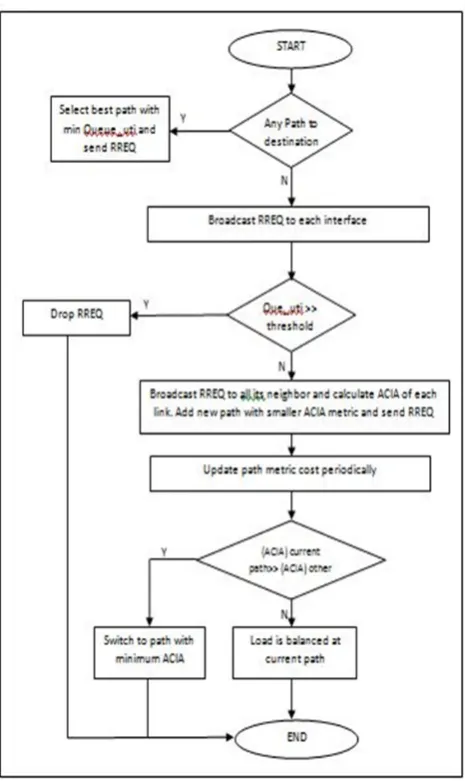
The proposed load balancing is carried out in route request procedure which ensures that path selected to destination is less congested. When a source node wants to communicate with a destination node and has no available routing information about the destination, it will initiate a route request procedure to find a route by broadcasting a Route Request (RREQ) message. But, not every immediate node that receives the message, will respond to the RREQ. Before broadcasting the RREQ again, the intermediate node itself first makes a decision if it is qualified. This decision is based on the queue utilization of that node and received signal strength. If nodes average interface queue utilization and signal strength is under the defined threshold value, the node is qualified and able to broadcast RREQ. If the nodes queue utilization and RSS value is over the threshold value, it is not qualified and will drop the RREQ. By doing so, the overloaded nodes are excluded from the newly created paths. The queue utilization of a node is calculated using nodes own current queue utilization and neighbors queue utilization. Noise ratio is calculated at both ends of a link. To perform load balancing efficiently, every intermediate node calculates Queue Utilization of multiple interface by following equation [14].
_ ∑ _
Where, Interface_quei is the average queue utilization of
interface i of neighbor and n is the number of the neighbors’ interfaces. Based on some threshold, the node can take a decision to switch to the less congested route.
C. Effective load balancing scheme
If the load of the nodes on the path increases seriously, the transmission efficiency of the original optimal path will decrease. For this reason, we need a scheme to measure the metric cost of the paths periodically so that the nodes transmissions can be maintained on the optimal path. The source node periodically updates the metric cost of all possible paths, and compares the current metric cost with other path metric cost. As long as the current path is still with the minimum metric cost from other possible paths, our scheme regards the current path load balanced. On the other hand, once the other path has the minimum cost in the next periodically update, the flow will change the current path to the other path on next periodically update. We use this scheme to maintain nodes’ transmission on the optimal path and improve overall performance of the mesh network [10].
The AOMDV computes multiple paths depending upon ACIA value. In this approach, we choose optimal path with minimum metric (ACIA) cost and less queue utilization that makes congestion aware routing. This is traffic size based, in which the load is balanced by distributing traffic evenly across all network resources. We also use scheme to maintain nodes transmission on optimal path by calculating metric cost periodically and improve the performance of the network.
Fig. 2. Flow chart for proposed load balancing scheme with ACIA metric
IV. SIMULATION MODEL
This section describes the simulation tool and parameters chosen to simulate the routing protocol. The performance metrics used to compare the performance of routing protocols are also described.
A. Simulation environment
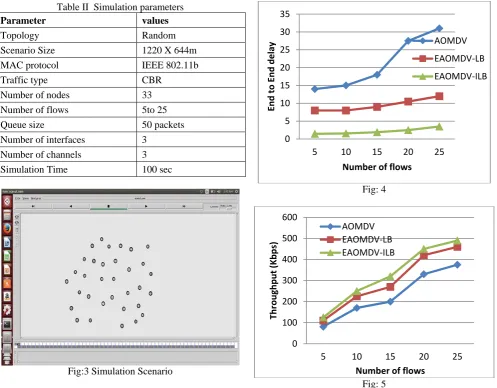
We conduct extensive simulation in NS-2 [17] to evaluate our proposed load balancing scheme using 802.11b network. We use CMU tool to design wireless network topology with random traffic flows. We also set up random traffic connections of CBR between nodes using traffic scenario generator script cbrgen.tcl. The CBR flows are varied from 5 to 25 using cbrgen.tcl script [18]. The queue type used is DropTail and the maximum queue size is set as 50 packets.
Table II Simulation parameters
Parameter values
Topology Random
Scenario Size 1220 X 644m
MAC protocol IEEE 802.11b
Traffic type CBR
Number of nodes 33
Number of flows 5to 25
Queue size 50 packets
Number of interfaces 3
Number of channels 3
Simulation Time 100 sec
Fig:3 Simulation Scenario
B. Performance Metrics
The performance of these two routing protocol is compared using the following performance metrics.
Throughput---- It is the number of packets received by the destination per second. The maximum throughput is the maximum rate of successful packet delivery in a time interval.
End to end Delay---- It is the time needed for a data packet to be delivered from the source to the destination node. The maximum end to end delay is the maximum time a packet travel from source to destination.
V. RESULTS AND DISCUSSION
This section presents the results and discussion of our proposed effective load balancing scheme with airtime congestion and interference aware (ACIA) metric for infrastructure wireless mesh network. In this scenario, we have kept all nodes static. We vary the data flows in network from 5 to 25 flows. The graphs for this scenario are shown in Fig. 4 and Fig. 5.
Fig: 4
Fig: 5
As shown in figure 4, end to end delay of EAOMDV-iLB is better than existing AOMDV and EAOMDV-LB. As traffic flow increases, AOMDV will experience higher delay due to congestion. Therefore data packet takes more time to arrive the destination. EAOMDV-iLB captures link quality by monitoring queue utilization, frame error rate and channel utilization. It minimizes congestion among channels and routers by computing multiple paths with less interference based on proposed airtime congestion and interference aware (ACIA) metric so that singe device is not overwhelmed. As all network resources are utilized optimally, data packets take less time to reach destination. Hence end to end delay of EAOMDV-iLB is lower. Moreover the load balancing scheme maintains the data transmission on optimal path by switching traffic all the way through congested area. We have achieved end to end delay of EAOMDV-LB, 55% lower than AOMDV with high traffic density.
Proposed load balancing scheme (EAOMDV-iLB) performs better with regard to throughput when more data is transmitted through network as shown in figure 5. As there is more traffic in the network, optimal path of AOMDV will experience congestion and there will be high packet loss hence AOMDV has lower throughput. EAOMDV-LB captures congestion by calculating RTT and
0 5 10 15 20 25 30 35
5 10 15 20 25
En
d
to
En
d
delay
Number of flows
AOMDV
EAOMDV‐LB
EAOMDV‐ILB
0 100 200 300 400 500 600
5 10 15 20 25
Throughpu
t
(Kbps)
Number of flows AOMDV
airtime metric so that there will be less chance of congestion but suffers with interference. But, EAOMDV-iLB captures congestion by calculating RTT and airtime metric so that there will be less chance of congestion and interference. It also performs load balancing by computing queue utilization of multiple interfaces of node. Hence there will be less congestion, less packet loss, resulting in high throughput. We can clearly say that EAOMDV-iLB achieves 40% better throughput than AOMDV.
VI. CONCLUSION AND FUTURE WORK
Multi-radio wireless mesh networks have a great potential for a wide range of applications. But, the routing protocols need to find a least congested multiple paths using better routing metric and perform load balancing by utilizing all network resources optimally. In this paper, we proposed EAOMDV-iLB routing protocol which calculates multiple paths using ACIA metric and perform load balancing using queue utilization information of multiple interfaces of a node. The proposed technique maintains nodes’ transmission on optimal path and improves the efficiency of network. The performance evaluation of AOMDV, EAOMDV-LB and EAOMDV-iLB routing protocols is carried out using a NS-2 for static scenarios. The simulation results indicate that proposed protocol exhibits a better performance in highly loaded situations with regard to throughput and end-to-end delay.
As a future work, we plan to compare and analyzed proposed routing metric with other routing metrics.
REFERENCES
[1] I.F.Akyildiz and X.Wang, “A survey on wireless mesh networks”, IEEE Communications M a g a z i n e , vol. 43, no. 9, Sept. 2005, pp.23-30.
[2] L.Zhao,A.Y Al-Dubai and G.Min, “A QoS Aware Multicast Algorithm for Wireless Mesh Networks”, IEEE Conference on Parallel and distributed processing, 2009, pp.1-8
[3] I.Ullah, K.Sattar, Z.U.Qamar, W. Sami, and Ali, “Transmissions Failures and Load-Balanced Routing Metric for Wireless Mesh Networks”, IEEE Conference on HONET, 2011, pp.159-163 [4] L.Ma and M.K.Denko,“A Routing Metric for Load-Balancing in
Wireless Mesh Networks”, International Conference on Advanced information Networking and Applications Workshops, 2007, pp.409-414.
[5] J.J.Galvez, P.M.Ruiz and Antonia F.G.Skarmeta, A Distributed Algorithm for Gateway Load Balancing in Wireless Mesh Networks”, IEEE Conference on Wireless Days, 2008, pp.1-5. [6] A.S.Panicker and Seetha S, “An Efficient Implementation of load
balanced routing scheme for wireless Mesh Networks Using ETT-LB Metric”, International Journal of Engg Science and Research Technology, March 2013, pp.503-507.
[7] E.Ancillotti, R. Bruno and M. Conti, “TALB: A Traffic-Aware Load Balancer for Throughput Improvement in Wireless Mesh Networks”, IEEE International Conference on Mobile Ad-Hoc and Sensor Systems, 2011, pp.75-81
[8] M.K. Marina, S.R.Das, “On-demand multi path distance vector routing in ad hoc networks”, Proceedings of the Ninth International Conference on Network Protocols, IEEE Computer Society, Washington, DC, USA, 2001.
[9] K.Valarmathi and N. Malmurugan, “Multipath Routing protocol for improving Reliability in IEEE 802.16 Wireless Mesh Networks”, IEEE Conference on Int.Science and computing, 2011,pp.116-121. [10] G.Liao, C.Chen, S.Hsu and H.Chao, “Adaptive situation aware load
balance scheme for Mobile Wireless Mesh Networks”, IEEE Conference on Computer Communication, 2011, pp.391-396.2015 International Conférence on Communication, Information & Computing Technology (ICCICT), Jan. 16-17, Mumbai, India 978-1-4799-5522-0/15/$31.00©2015 IEEE
[11] T.Sangwongthong and P.Siripongwutikorn, “Proxy caching in Wireless Mesh Network”, IEEE Conference on Telecommunication and Information Technology (ECTI-CON), 2012, pp.1-4.
[12] O.S.Bawa and S.Banerjee, “Congestion based Route Discovery AOMDV Protocol”, International Journal of computer Trends and Technology, 2013, pp.54-58.
[13] S.Soundararajan and P.Siripongwutikorn, “Adaptive Multipath Routing for Load Balancing in Mobile Adhoc Networks”, International Journal of Computer Science 8 {5}, 2012, pp.648-655. [14] D.G.Narayan, R.Nivedita, S.Kiran and M.Uma, “Congestion
Adaptive Multipath Routing Protocol for Multi Radio Wireless Mesh Networks”, International Conference on Radar, Communication and Computing new York, John Wiley & Sons., 2012, pp.72-76. [15] J.Y.Choi and Y.B.Ko, Multipath routing with load aware metric for
Tactial Adhoc Network”, International Conference on Information and communication technology and convergence, November 2010, pp. 370-375.
[16] Kruti.N.Kapadia, Dayanand.D.Ambawade,Congestion Aware Load Balancing for Multiradio Wireless Mesh Network,International Conférence on Communication, Information & Computing Technology (ICCICT), Jan. 16-17, Mumbai, India.
[17] Arappali Nedumaran and V. Jeyalakshmi “CAERP: A Congestion and Energy Aware Routing Protocol for Mobile Ad Hoc Network”, Indian Journal of Science and Technology, Vol 8(35), DOI: 10.17485/ijst/2015/v8i35/70014, December 2015
[18] The Network Simulator–NS2. Available via web-site http://www.isi.edu/nsnam/ns/2007.
![Fig. 1. Infrastructure Wireless Mesh Network [1]](https://thumb-us.123doks.com/thumbv2/123dok_us/7875754.1306552/1.595.316.538.200.396/fig-infrastructure-wireless-mesh-network.webp)