R E S E A R C H
Open Access
Multiple statuses of through-wall human
being detection based on compressed
UWB radar data
Wei Wang
*, Dan Wang and Yu Jiang
Abstract
Ultra-wideband (UWB) radar is one of the most favorable methods for through-wall human detection due to its strong penetration ability in many common non-metallic obstructions. The paper proposed the residual subspace projection method for multiple statuses of through-wall human being detection behind. And the compressed sensing method was presented to collect incomplete UWB radar data because of its large dimension. The experiments with brick wall and seven statuses were implemented, and the results showed that the proposed algorithm could detect the human being under the multiple statuses in compressed data and uncompressed data. But classification algorithm should be used to distinguish the status.
Keywords:Ultra-Wideband radar, Compressed sensing, Residual subspace projection, Through-wall human being detection, Multiple statuses
1 Introduction
Through-wall human being detection is of consider-able interest to police, rescue, security, surveillance,
antiterrorism, and so on. But wall attenuation
becomes a prominent limitation in the ensuing power
budget and objection detection. Ultra-wideband
(UWB) radar operates in the baseband approximately up to 3.5 GHz. It has the ability to penetrate many common non-metallic obstructions (such as walls), and also can detect, locate, and track the target hid-den behind the obstructions. The ultra-wideband radar for detection targets through walls has become to a promising technique to prevent crimes and terror as its high range resolution, strong penetrating power, and good resolving ability. At present, UWB radar technology has been accumulated wealthy research achievements in various fields including target detec-tion, medical monitoring, ranging positioning, and human being detection through wall. The focus of this paper is using PulsON 410 UWB radar for mul-tiple status of through-wall human being detection.
Many researchers have focused on through-wall ra-dars imaging (TWRI) for human being detection. In [1], an efficient method of TOA estimation using UWB through-wall radar is proposed to detect and track moving target behind wall based on TWRI algo-rithm. In [2], a multi-channel through-wall radar imaging based on image fusion for combining the single-channel images to obtain a high signal-to-clutter ratio image was proposed for through-wall human being detection. In [3], a signal processing strategy was proposed to track multiple extended tar-gets in a scene by means of a wide-band monostatic through-wall radar. And this method used the prepro-cessing of raw data, model-based radar image forma-tion for objecforma-tion detecforma-tion and tracking. In [4], the authors presented a technique for classifying station-ary targets based on the high-range resolution profile extracted from 3-D TWRIs and the targets classified which using a naïve Bayesian classifier supported by principal component analysis. In [5], a novel near-field through-wall imaging algorithm with ability in the presence of wall ambiguities was proposed, and the capability of the new algorithm to detect the tar-gets was verified by finite-difference time-domain method. In [6], an extension iterative target detector * Correspondence:[email protected]
Tianjin Key laboratory of Wireless Mobile Communications and Power Transmission, College of Electronic and Communication Engineering, Tianjin Normal University, Tianjin, China
and another detector based on Bayes’ test were pro-posed with joint detection and fusion of a set of mul-tipolarization radar images. In [7], a compressive sensing-based through-the-wall imaging algorithm was presented, and the algorithm performance was ana-lyzed with respect to the total number of measure-ments for different sparsity levels and for varying SNR levels.
Although these methods could detect human being effectively, two or more UWB radars were needed and the algorithms were complex. Some methods were also proposed which only used the one UWB radar data directly for through-wall human being detection. In [8] and [9], the authors proposed some signal processing methods such as discrete Fourier transform, short Fou-rier transform for periodic respiratory motion of human target detection based on PulsOn 220 UWB radar data. In [10], a time domain, moving target detection process-ing formulation for detectprocess-ing human motion behind walls was presented with consisting of exponential aver-aging background subtraction, ordered statistics con-stant false alarm rate detection and binary accumulation. In [11], the authors presented methods based on fast Fourier transform and S transform to detect and identify the human’s life characteristic which was concentrated in the processing and identifying of the life signal under strong clutter. In [12], an improved UWB respiratory signal model is built up based on an even power of cosine function which is used to reveal the harmonic structure of respiratory signal. In [13], the authors used the compressed UWB data and acquired the singular values of the compressed data based on singular value decomposition algorithm.
Although many methods have been presented for through-wall human being detection based on UWB radars, there are few research on multiple status of human being detection. In this paper, we will propose an algorithm based on anomaly detection method with residual subspace projection theory for some status of human being detection through brick wall. In the mean time, according to the data needed for human being detection far less than the actual sampling amount of UWB radar data, we also pro-posed the detection algorithm with compressed data. The paper is organized as follows. In Section 1, we
introduced the research status of through-wall
human being detection with UWB radar. In Section 2, we introduced the principle of spectrum theory and
the proposed algorithm for multiple status of
through-wall human being detection. In Section 3, the experimental system configuration was intro-duced and the experimental results was showed and analyzed. In Section 4, it was the conclusion and discussion of this paper.
2 Multiple status of through-wall human being detection algorithm
2.1 Residual subspace projection and multiple status of through-wall human being detection
Let the multiple echo signals of UWB radar could be represented by a matrix X= [x1,x2,…xL]∈RN×L. Where
xi∈RN× 1(i= 1, 2,⋯L) is one echo signal of UWB radar
andLis the number of UWB radar echoes.
For notational simplicity, we get the mean value Xi of
each echo firstly and remove the mean value then.
Xi¼ XN
j¼1
xij ð1Þ
Furthermore, we normalized each echo signal and acquire the centralized matrix Xc. IfXc is available, the residual subspace projection performs the eigenvalue decomposition of the sample covariance matrix as [14]:
ΣX¼ð1=LÞXCXTC¼UΛUT ð2Þ
From which the K principal eigenvectors U corre-sponding to the largest K eigenvalues can be found. Thus, we get the residual subspace matrix:
P¼I−UUT ð4Þ
The projection value of any echo vector onto residual subspace could be given as follows:
z¼Px¼I−UUTx ð5Þ
And we can get the squared prediction errorTspeas:
Tspe¼k kz 22¼ I−UUT
x
2
2 ð6Þ
In residual subspace analysis, the Tspe follows a non-central chi-square distribution under the null hypothesis. Hence, rejection of the null hypothesis could be based on whether norm of the error vector exceeds a certain threshold corresponding to a desired false alarm rate.
The through-wall detection of human being is based on the fact that the human body is always in a state of motion even if it sleeps or is trapped because of breath-ing. These tiny human motions would also cause changes of electromagnetic wave which is emitted by UWB radar and return through walls from human body target. According to this theory, theTspewill be different when the status of human being is different, so we can achieve the multiple status of through-wall human being detection based on the varying trend ofTspe.
2.2 Multiple status of through-wall human being detection with compressed UWB radar data
equivalent to sub-sampling the temporal UWB radar echo stream. Inspired by the compressive sensing (CS) theory, we proposed a compressed detection algorithm based on UWB radar data.
Random Gaussian measurement matrix is used to compress the xi from Nto M and its relation with the
compressed data can be given by
yi¼Φxi ð7Þ
where yi∈RM× 1 and Φ∈RM×N is a random Gaussian
matrix. And with a probability of at least 1−δ, the
changes in the eigenvalues could be bound by [14].
λi−ζi
j j≤4pffiffiffi2λ1
ffiffiffiffiffiffiffiffiffiffiffiffiffiffiffiffiffiffiffiffiffiffiffiffiffi K
Mþ ffiffiffiffiffiffiffiffiffiffi
2 ln1
δ
M s v u u t 0 B @
1 C
A ð8Þ
whereλi andζiare the eigenvalues of the complete data
X and compressed dataY. The Eq. (8) is a direct
conse-quence of the concentration property of Gaussian
en-sembles. From the Eq. (8), it can be showed that as the
principal subspace spanned by X is nearly kept in the
compressed dataYwith a high probability.
According to the detection algorithm in Eq. (6), it can be seen that the detection of human being is entirely based on the total power of the residuals rather on the actual residual subspace itself. It can be obviously shown that when the measurement matrixΦis normalized, the total power of residuals is unchanged. In other words, the total power of residual subspace in the compressed UWB radar data can also be used for through-wall human being detection.
3 Experiments and results
3.1 UWB radar and experimental system
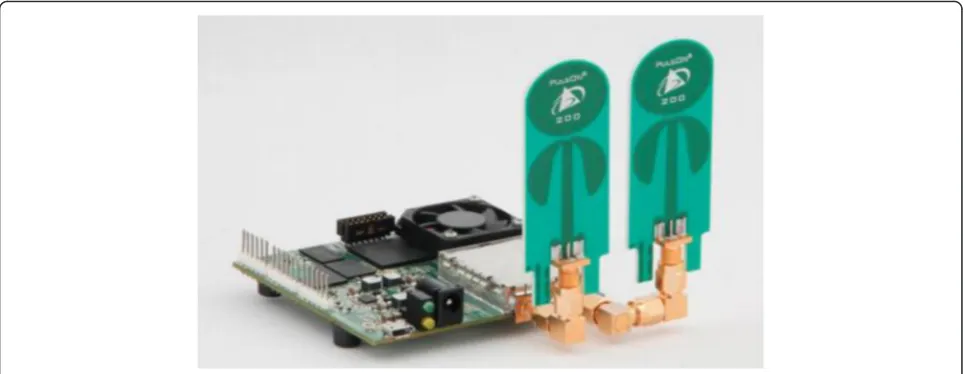
This paper uses P410 UWB radar which is worked in monostatic mode and waveform pulses are transmitted and received from a single Omni-direction antenna. The radar is showed in Fig. 1. The two antenna ports on the P410 are utilized for the transmitting and receiving an-tennas. A cable is utilized to connect the radio to the PC and radar can be controlled by the application software. The P410 UWB radar has center frequency of 4.3 GHz, a pulse sampling points set for 1000 of the P410 MRM, and its sampling interval is 61.024 ps. The P410 MRM transmit pulse repetition rate is 10.1 MHZ. The parame-ters of P410 radar in the experiments are as follows in Table 1. In this section, we will introduce a few signifi-cant parameters:
(1)Pulse integration index (PII): Integration is the number of the pulses that radar enhances the single-to-noise ratio. It is the total number of UWB pulses per waveform scan sample. Each Fig. 1Time domain UWB P410 in monostatic mode
Table 1PulsON 410 specifications
PulsON 410 specifications
Parameter UWB PulsON 410
Center freq 4.3 GHZ
PII 13
Scan time 38,928 us
Start scan 4999 ps
Stop scan 75,311 ps
(Step size) sampling interval 61.024 ps
Transmit pulse repetition rate 10.1 MHZ
time the integration is doubled, the SNR of received single will enhance by 3 dB. Time domain stipulated that the minimum integration the user can set is 64:1 which the PII is 6. Thus, a PII setting of 6 will enhance the SNR by 18 dB. The maximum PII of 15 which it will provide an SNR of 45 dB.
(2)Step size (ps): Step size is the length between the two data points which is increase with 32 bin, in picosecond (1 bin = 1.907 ps). Each data point is a difference of 61.024 ps.
(3)Scan time: Each scan requires a certain amount of time to complete. This time is a function of the integration rate and the size of the scan window (different between the scan start and scan stop times). The time required is determined by the following equations:
The number of quanta¼ðstop scan psð Þ‐start scan psð ÞÞ=5859ps
Scantime usð Þ ¼ðnumber of quanta in scan windowÞ
0:792us
ð Þ 2ðPulseIntegrationIndexÞ
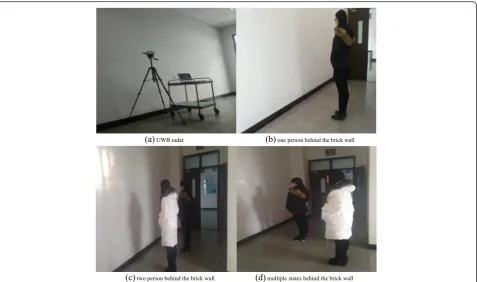
We set up an experimental system which is shown in Fig. 2. The material of the wall is brick with the thick-ness of 23.5 cm. The P410 UWB radar is placed at a dis-tance of 20 cm from the brick wall. The disdis-tance
between the P410 and the ground is the half of the brick wall (about 140 cm). The main beam of the transmitting and receiving antenna is oriented perpendicularly to the surface of the brick wall to avoid the multiple influence of reflection from the ground. The computer is Win7 with 64 operating systems. There are two kinds of exper-iments for through-wall human being detection in this experiment environment. The first kind is one person
(a) UWB radar (b) one person behind the brick wall
(c) two person behind the brick wall (d) multiple states behind the brick wall
Fig. 2The experimental figures.aUWB radar.bOne person behind the brick wall.cTwo person behind the brick wall.dMultiple states behind the brick wall
0 5 10 15 20 25 30 35 40 45 50 0
0.5 1 1.5
multiple statuses
Ts
p
e
No person status Normal breathing status
Breathing rapidly status Swinging arms status
2m away status
Fig. 3The Tspe for one person under multiple statuses
with four statuses and no person behind the brick wall. And the statuses included the position of one person standing away from the wall 1 m with normal breathing, breathing rapidly, swinging their arms with periodic motion, and standing 2 m away from the brick wall. The second experiment is two people with three statuses be-hind the brick wall. And the statuses included two per-sons standing side by side, two perper-sons standing forward and backward, and two persons standing forward and backward with 45°. The parameters of P410 radar in the experiments are as follows:
3.2 Results and analysis
In the experiments, we collect five hundreds echoes of P410 radar for no person status and other seven statuses with 1000 samples for each echo. Firstly, the residual sub-space matrixPcould be achieved by the echo signal matrix
under no person status. For the human being detection, we select the signals from the 200th echo to the 300th echo and obtain one test echo signal from the average of every ten echoes. The experimental results are showed below.
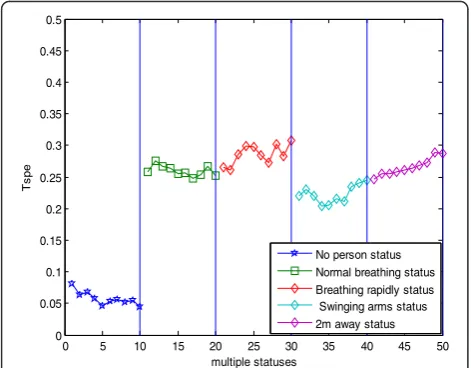
The Tspe of different statuses with one person are shown in Fig. 3. It can be seen that the Tspe under no person status is less than under person status. And the Tspe under norm breathing is less than under breathing rapidly. But the Tspe under breathing rapidly is close to the Tspe under swinging arms and we could not distin-guish the two statuses only based on the value of Tspe. Meanwhile, it can be seen that the Tspe will be larger when the person stands farer away from the wall.
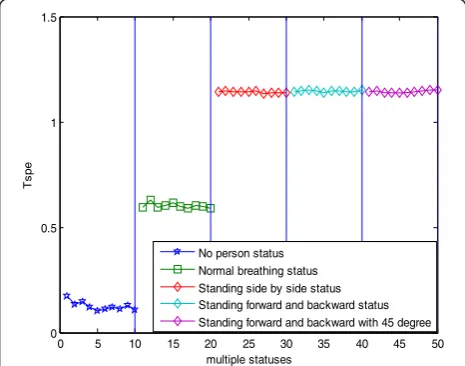
The Tspe of different statuses with two persons are shown in Fig. 4. It can be obviously shown that the values of Tspe are similar, and it also can be thought that the Tspe is not sensitive to the direction of human beings.
The first echo to the 100th echo The 101st echo to 200th echo The 201st echo to 300th echo The 301st echo to 400th echo The 401st echo to 500th echo
Fig. 5The trend of Tspe under one person norm breathing status
0 5 10 15 20 25 30 35 40 45 50 Swinging arms status 2m away status
Fig. 6The Tspe for one person under multiple statuses (M= 600)
0 5 10 15 20 25 30 35 40 45 50 Standing side by side status Standing forward and backward status Standing forward and backward with 45 degree
Fig. 7The Tspe for two persons under multiple statuses (M= 600) 0 5 10 15 20 25 30 35 40 45 50
Standing side by side status Standing forward and backward status
Standing forward and backward with 45 degree
We calculated the Tspe for all five hundreds echoes under one person norm breathing status based on the some calculation method described above. The results are shown in Fig. 5. We can see that the Tspe is small for the first two hundreds echoes, and it increases for the last one hundred echoes. It may indicate that the receiving echoes of different UWB pulse can produce the superposition effect. So, we should select the mid-dle echoes for human being detection based on the values of Tspe.
We also calculate the Tspe with the compressed UWB echo data based on the compressed sensing theory. We chose the M= 600 and M= 300, and the results are shown in Figs. 6, 7, 8, and 9. It can be seen that the through-wall human being can be detected with Tspe for both one person multiple statuses and two person sta-tuses. But for one person multiple statuses, the value of
Tspe are smaller and the trends of Tspe are varied com-pared with uncompressed data.
4 Conclusions
We have presented a framework for through-wall human being detection under multiple statuses with P410 UWB radar based on residual subspace projection theory. The work addressed the compressed sensing theory for deal-ing with incomplete UWB radar echoes. The experi-ments were tested under seven statuses for brick wall in complete data and compressed data. The results exploited the fact that the proposed algorithm could de-tect the human being through brick wall, but classifica-tion method should be studied for class the statuses further.
Acknowledgements
This paper is supported by Natural Science Foundation of China (61271411), Natural Youth Science Foundation of China (61501326). It also supported by Tianjin Research Program of Application Foundation and Advanced Technology (15JCZDJC31500), Tianjin Science Foundation (16JCYBJC16500).
Competing interests
The authors declare that they have no competing interests.
Received: 21 March 2016 Accepted: 26 August 2016
References
1. S Wu, G Fang,Detection and Tracking of Moving Target Behind Wall using UWB Through-Wall Radar(Proceedings of IEEE on Intelligent System Design and Engineering Application (ISDEA), Changsha, 2010), pp. 605–608 2. Y Jia, L Kong, X Yang, K Wang,Multi-Channel Through-Wall-Radar
Imaging Based on Image Fusion(IEEE Radar Conference, Kansas City, 2011), pp. 103–105
3. G Gennarelli, G Vivone, P Braca, Multiple Extended Target Tracking for Through-Wall Radars. IEEE Trans. Geosci. Remote Sens.53(12), 6482–6494 (2015) 4. GE Smith, BG Mobasseri, Robust Through-the-Wall Radar Image
Classification Using a Target-Model Alignment Procedure. IEEE Trans. Image Process.21(2), 754–767 (2012)
5. W-J Zhong, C-M Tong, L Xin, Y Geng,A Novel Near Field Imaging Approach for Through-wall Imaging(Cross Strait Quad-Regional Radio Science and Wireless Technology Conference, Harbin, 2011), pp. 164–167 6. C Debes, AM Zoubir, MG Amin, Enhanced Detection Using Target
Polarization Signatrues in Through-the-Wall Radar Imaging. IEEE Trans. Geosci. Remote Sens.50(5), 1968–1979 (2012)
7. M Duman, AC Gurbuz,Analysis of Compressive Sensing Based Through the Wall Imaging(IEEE Radar Conference, Atlanta, 2012), pp. 0641–0646 8. S Singh, Q Liang, D Chen, L Sheng, Sense Through Wall Human Detection
Using UWB Radar. EURASIP J. Wireless Commun. Netw.2011(1), 1–11 (2011) 9. A Kumar, Q Liang, Z Li, B Zhang, X Wu,Experimental Study of Through-wall
Human Being Detection Using Ultra-wideband(UWB) Radar(IEEE Globecom Workshops, Anaheim, 2012), pp. 1455–1459
10. G Zhu, J Hu, Z Yuan, X Huang,Automatic Human Target Detection of Ultra-Wideband Through-Wall Radar(2013 IEEE Radar Conference, Ottawa, 2013), pp. 1–4
11. J Li, Z Zeng, J Sun, F Liu, Through-Wall Detection of Human Being’s Movement by UWB Radar. IEEE Geosci. Remote Sens. Lett.9(6), 1079–1083 (2012) 12. X Li, D Qiao, Y Li, H Dai,A Novel Through-Wall Respiration Detection Algorithm
Using UWB Radar(International Conference of the IEEE Engineering in Medicine and Biology Society(EMBS), Osaka, 2013), pp. 1013–1016
13. W Wang, X Zhou, B Zhang, J Mu, Anomaly Detection in Big Data from UWB Radars. Secur. Commun. Netw. Secur. Commun. Netw.8(14), 2469–2475 (2015) 14. D-S Pham, S Venkatesh, M Lazarescu, S Budhaditya, Anomaly Detection in
Large-Scale Data Stream Networks. Data Min. Knowl. Discov.28(1), 145–189 (2014)
Standing side by side status Standing forward and backward status
Standing forward and backward with 45 degree
Fig. 9The Tspe for two persons under multiple statuses (M= 300) 0 5 10 15 20 25 30 35 40 45 50 Swinging arms status
2m away status
Fig. 8The Tspe for one person under multiple statuses (M= 300)