Volume 2008, Article ID 437801,13pages doi:10.1155/2008/437801
Research Article
Power Backoff Reduction Techniques for Generalized
Multicarrier Waveforms
F. Danilo-Lemoine,1D. Falconer,1C.-T. Lam,1M. Sabbaghian,1and K. Wesołowski2
1Department of Systems and Computer Engineering, Carleton University, Ottawa, Canada K1S 5B6 2Institute of Electronics and Telecommunications, Pozna´n University of Technology, 60965 Pozna´n, Poland
Correspondence should be addressed to D. Falconer,[email protected]
Received 3 April 2007; Revised 31 July 2007; Accepted 18 October 2007
Recommended by Hikmet Sari
Amplification of generalized multicarrier (GMC) signals by high-power amplifiers (HPAs) before transmission can result in
un-desirable out-of-band spectral components, necessitating power backoff, and low HPA efficiency. We evaluate variations of several
peak-to-average power ratio (PAPR) reduction and HPA linearization techniques which were previously proposed for OFDM signals. Our main emphasis is on their applicability to the more general class of GMC signals, including serial modulation and
DFT-precoded OFDM. Required power backoffis shown to depend on the type of signal transmitted, the specific HPA
nonlin-earity characteristic, and the spectrum mask which is imposed to limit adjacent channel interference. PAPR reduction and HPA
linearization techniques are shown to be very effective when combined.
Copyright © 2008 F. Danilo-Lemoine et al. This is an open access article distributed under the Creative Commons Attribution License, which permits unrestricted use, distribution, and reproduction in any medium, provided the original work is properly cited.
1. INTRODUCTION
High-power amplifiers (HPAs) used in radio transmitters have nonlinear characteristics which can cause significant distortion to signals whose instantaneous power fluctuations come too close to the HPAs output saturation power. Even small amounts of nonlinear distortion can cause undesirable spectral regrowth, which can interfere with signals in adja-cent frequency channels. Transmitted spectra must generally be confined within spectral masks which are imposed by reg-ulatory agencies to keep worst-case adjacent channel inter-ference to acceptable limits. Larger amounts of nonlinear dis-tortion also cause nonlinear in-band self-interference, which results in increased received bit error rate. Normally, HPAs are operated with a certain “power backoff” which can be defined as the ratio of maximum saturation output power to lower average output power. The larger the backoffis, the less the nonlinear distortion will be. However, for a given trans-mitted power, a larger power backofflowers HPA efficiency and increases overall power consumption and battery drain. It also means that a more expensive HPA, with a higher max-imum output power rating, is necessary to produce a given average output power. The HPA is generally one of the most significant cost components of user terminals, and the
rela-tionship of HPA cost to maximum power rating is an im-portant technology issue. The cost can rise sharply with the output power rating, and it is affected not only by the HPA device itself but also by thermodynamics, that is, provision of heat sinks, fans, and so forth [1].
Minimizing power backoffis thus desirable, without sac-rificing BER performance or spectral efficiency, especially for cost- and power-sensitive user terminals. Two main ap-proaches are pursued, which can be applied singly or in com-bination: (1) peak-to-average power ratio (PAPR) reduction to reduce the dynamic range of the transmitted signal be-fore it is applied to the HPA and (2) direct HPA predistor-tion to compensate for the HPA distorpredistor-tion. The requirements and methods are strongly dependent on the modulation and multiplexing schemes. For example, multicarrier or parallel modulation and multiplexing schemes, such as orthogonal frequency division multiplexing (OFDM) and multicarrier code division multiple access (MC-CDMA), have inherently higher PAPR value than single-carrier or serial schemes [2].
known as generalized multicarrier (GMC) signals [5–7]. This class includes OFDM and frequency domain-generated single-carrier signals, as well as multicarrier signals with noncontiguous spectral occupancy. Rather than introducing significantly new PAPR reduction techniques, we focus on the spectral regrowth reduction that existing schemes and variations of them can achieve for important classes of GMC signals at the output of a realistic HPA. Previous analyses of spectral regrowth generally rely on power series expansions, with few terms, of HPA input/output characteristic models [8], but more general models, capable of representing a wide range of HPAs, are best accommodated by simulation of out-put power spectra. This is the approach we use in this paper. This focus on spectral regrowth differentiates the paper from most of the previous papers, which tend to focus on PAPR distributions and/or receiver performance degrada-tions due to nonlinear distortion. In practice, at power back-offlevels for which significant spectral regrowth starts to be-come noticeable, bit error rate degradation due to the non-linearity is small—a fact which will be illustrated by results shown inSection 4.
Section 2 reviews OFDM and the more general GMC signal classes.Section 3provides a reference background by comparing transmitted waveform amplitude distributions and HPA output power spectra for OFDM and discrete Fourier transform—(DFT-) precoded GMC signals. Sections 4and5consider clipping and filtering, and selective mapping techniques, respectively. GMC signals with noncontiguous data spectra are considered in Section 6, including signals with frequency-multiplexed pilots and interleaved frequency division multiple access (IFDMA), and block IFDMA signals. Section 7describes an HPA predistortion technique that can be used in combination with PAPR reduction techniques. Fi-nally, Section 8 contains summary and conclusions. Some of the variations of PAPR reduction and predistortion pre-sented here have previously appeared in recent conference papers by the authors in [9–13]. This paper presents these and other results in a unifying context.
2. PAPR REDUCTION FOR OFDM AND OTHER
GENERALIZED MULTICARRIER SIGNALS
A block OFDM signal, transmitting coded data symbols
{Am, m = 0, 1,. . .,M}, is normally generated as the in-verse discrete Fourier transform (DFT) of the data symbol sequence. The resultingOFDM symbol, sampled atN ≥M times per block, is expressed as
s(n)=√1
M M−1
m=0
Amexp
j2πmn
N
, n=0, 1,. . .,N−1.
(1)
To this end, the OFDM symbol is prepended by a cyclic pre-fix (CP), which is a copy of the lastN samples, whereN exceeds the maximum expected channel impulse response length. The CP is discarded at the receiver; its purpose is to prevent interblock interference and to impart a circular convolution structure to the received block, thus facilitating the use of DFT processing (normally implemented with fast
Fourier transform (FFT)). Each such block in a sequence of blocks generated in this way is windowed by a rectangular function whose length isN+Nsamples; this would cause undesirable sinc function spectral sidelobes, decaying only inversely with frequency. For this reason, a smoother time window is normally applied, such as a raised-cosine window, for which the sidelobe decay is proportional to the inverse cube of frequency.
Any samples(n) is a linear combination ofMdata sym-bols, equally weighted in magnitude. Therefore, its maxi-mum possible magnitude is at least M times the average data symbol magnitude. This ratio could be the basis for the peak-to-average power ratio (PAPR) definition, but it is not very useful since for largeM, the peak magnitude is seldom achieved. Other measures reflecting signal magnitude varia-tion are discussed in the next secvaria-tion.
Methods for PAPR reduction of OFDM signals include nonlinear block error correction coding [14, 15], selective mapping (SLM) [16], partial transmit sequences [16, 17], reference signal subtraction [3], and amplitude predistortion [18]. All of the above methods require extra transmitter sig-nal processing complexity1and most of them also require the
transmission of extra overhead. OFDM signals may also be clipped to remove power peaks, followed by filtering to sup-press out-of-band spectral regrowth caused by the nonlin-ear clipping operation. Several stages of clipping and filter-ing are more effective than one since the filtering operation tends to restore some of the signal’s peakedness [19–21]. This approach has the virtue that no extra processing or side in-formation is necessary for reception, but it can cause a slight degradation in bit error rate due to the clipping-caused non-linear distortion on the signal.
A more general form of OFDM signal format, called gen-eralized multicarrier (GMC) [5–7], is formed by performing a matrix transformation on the vectoraofMdata symbols before applying (1):
A=Ma, (2)
whereMis anNbyMmatrix. The transmitted signal vector
scan be expressed as
s=F∗Ma, (3)
whereF∗is theNbyNinverse DFT matrix.
Most linearly modulated signal types such as multicarrier code division multiple access (MC-CDMA) and interleaved frequency division multiple access (IFDMA) can be gener-ated in this way, by the appropriate choice ofM. ChoosingM
as an identity matrix gives OFDM. Inserting rows of zeroes in the identity matrix gives orthogonal frequency division multiple access (OFDMA), in which data-bearing subcarri-ers are selected based on divsubcarri-ersity or traffic considerations.
1Typically, these methods require generation and comparisons, on the
A version of GMC, which is of interest in this paper, is DFT-precoded OFDM,2in which Mcontains a DFT matrix, that
is, expression for the sampled waveform:
s(n)=
This describes samples ofserial modulated(SM) or single-carrier(SC) waveform, in which data symbols are transmit-ted serially, at intervals ofN/M samples by pulse amplitude modulating a pulse waveform g(n). Here,g(n) is a circu-larly shifted, sampled version of a band-limited pulse wave-form with zero excess bandwidth (or zero rolloff); it is time-limited toNsamples. Its envelope decays approximately as n−1. Thus, the magnitude of each samples(n) is mainly
deter-mined by a weighted sum of a small number of adjacent data symbols, and so, as with any SM waveform, its dynamic range will be much less than that of the equivalent OFDM wave-form. The amplitude range ofs(n) can be further reduced, at the expense of increasing the signal bandwidth, by replacing g(n) by a circularly shifted raised cosine or other pulse with excess bandwidth. Another variant of DFT-precoded OFDM, with similar low-PAPR properties, is interleaved frequency division multiple access (IFDMA),3 in whichLrows of
ze-roes are inserted after every row of Fin (4) [22]. The signal spectrum then consists ofMDFT-modulated subcarriers at intervals ofL. The pulseg(n) can then be shown to be that of (6), but withnbeing replaced byLn. Thus, IFDMA pro-duces a serial modulated signal. IFDMA has the advantage over contiguous-spectrum signals of extra frequency diver-sity since its spectrum is spread over a wider band. Another recently proposed variation is block IFDMA (B-IFDMA), in which subcarriers are grouped in small blocks, well sepa-rated from other blocks [23] to enhance frequency diversity. In contrast to IFDMA, B-IFDMA does not result in a pure serial modulation waveform, but it is shown in [23] and in Section 6that it still has good PAPR and power backoff prop-erties.
2This is also called localized SC-FDMA in the context of 3GPP long-term
evolution.
3IFDMA is also called distributed SC-FDMA in the context of 3GPP
long-term evolution.
SERMOD, 25% rolloff OFDMA, 25% rolloff
SERMOD, 0% rolloff OFDMA, 0% rolloff
Figure 1: Distribution of instantaneous power for comparable
OFDMA and serial modulated waveforms with 0% rolloff,
gener-ated in the frequency domain with 5.5% raised-cosinetime-domain
windowing, and with 25% rolloffgenerated in the time domain by
square-root raised-cosinefrequency domainfiltering. The number
of data symbols per block isM=256.
3. PAPR AND SPECTRAL REGROWTH AT HPA OUTPUT
PAPR is a commonly used measure of the range of a sig-nal’s amplitude. It is a reasonably goodqualitativemeasure; signals with low PAPR generally require less power backoff and exhibit less performance sensitivity when amplified by a nonlinear HPA than do signals with high PAPR. However, PAPR is determined by the single largest-amplitude sam-ple in a block ofN samples, and therefore it is not a good
quantitative measure of nonlinearity sensitivity. Somewhat more informative is the complementary cumulative distri-bution (CCDF) function of the signal amplitude measured over many samples.Figure 1illustrates CCDFs of QPSK se-rial modulated and OFDMA signals generated by (a) the zero rollofffrequency domain method of (4)–(6), with a num-ber of used subcarriers M = 256 and 5.5% raised-cosine windowing of the time-domain waveform, and (b) the tra-ditional time-domain method, with 25% excess bandwidth square-root raised-cosine filtering of the time-domain wave-form, again with 256 symbols per block. The lower am-plitude range of the serial modulated (or DFT-precoded OFDM) signal is evident. It is also evident that excess band-width (25% versus 0%) reduces the amplitude range of the serial modulation signal, because of lower g(n) sidelobes, while having little or no effect on the OFDM signal’s ampli-tude range.
0
Figure2: Rapp model of HPA nonlinearity.
with a parameter p = 2, is a good approximation to the amplitude-to-amplitude conversion characteristic of a typ-ical low-cost solid-state power amplifier. The ratio of output to input amplitude in this model with parameter pis given by
where Vsat is the saturated output level of the amplifier.4
With p = 10 or higher, the characteristic approaches that of an ideal linear clipper. Examples of spectral regrowth due to a p = 2 nonlinearity for the OFDM and serial mod-ulated QPSK signals ofFigure 1are shown in Figures 3(a) and3(b). The greater the power backoffis—which can be defined as the ratio of maximum saturation output power to actual average output power—the less the spectral re-growth at the HPA output will be. InFigure 3and most sub-sequent power spectra figures, the average signal powers of signals being compared (and hence their backoffs) are ad-justed so that their resulting output power spectra are very similar, in order that they barely satisfy the same imposed spectral mask.Figure 3(a)shows that for the 0% rolloff fre-quency domain-generated signals, whose CCDFs are shown inFigure 1, serial modulation and OFDM require 7 dB and 9 dB backoffs, respectively, for comparable maximum spec-trum sidelobe levels of about−40 dB. The backofffor serial modulation is further decreased to about 6.3 dB for the time-domain-generated signals with 25% rolloffalthough the sig-nals’ bandwidth has increased by 25% with this rollofffactor. The required power backoffis significantly reduced by up to 2–4 dB for an HPA with Rapp parameter p=10 that ap-proximates an ideal linear clipper, as shown in Figures4(a) and4(b)for the same signals as in the previous figures. This
4In this formula, the amplifier gain is normalized to unity for notational
convenience.
is an indication, which will be reinforced by later examples, that linearization by predistortion of the HPA characteris-tic (as proposed inSection 7) is a very useful complement to PAPR reduction techniques for reducing the required power backoff.
For small values of p the out-of-band radiation has smaller components at higher frequencies and most of the out-of-band power is concentrated in the near in-band spec-trum. On the other hand, for largep, the out-of-band radi-ation components are spread over a wider frequency range. This can be seen if we use the binomial expansion for the de-nominator of the Rapp model. The expansion of the Rapp model would be If we assume that the saturation level is high enough to use only the first formula forVin < Vsatand compare the
out-of-band radiation of amplifiers with two different values
ofp, the corresponding outputs forp=2 andp=10 would
be
The expansion of the output when p = 2 includes smaller powers of the input signal. Thus, forp=2, the out-of-band radiation power is more concentrated at frequencies closer to the in-band spectrum. The second term of the above expan-sion generates the major part of the distortion. Whenp=2, this term is larger than whenp=10. This increases the adja-cent out-of-band radiation of the amplifier with p=2 rela-tive to that withp=10.
−100
Frequency normalized to symbol rate
SERMOD, dB backoff=7
Frequency normalized to symbol rate
SERMOD, dB backoff=6.3 OFDMA, dB backoff=9
(b)
Figure3: Power spectra at output of ap=2 Rapp nonlinearity for QPSK OFDM and serial modulated signals with (a) 0% and (b) 25% excess bandwidths.
Frequency normalized to symbol rate
SERMOD, dB backoff=4.8
Frequency normalized to symbol rate
SERMOD, dB backoff=3 OFDMA, dB backoff=7.3
(b)
Figure4: Power spectra at output of ap=10 Rapp nonlinearity for QPSK OFDM and serial modulated signals with (a) 0% and (b) 25% excess bandwidths.
4. CLIPPING AND FILTERING
It is well known that the dynamic range of the instantaneous power of OFDM signals can be reduced by a variety of tech-niques mentioned above. It is perhaps not so well appreciated that many of these techniques can also be applied to DFT-precoded OFDM or serial modulation. Even clipping and fil-tering (see [19,20] and the references therein) can be applied to serial modulation, as to OFDM, with only moderate effects of nonlinear distortion on the received signal. An example of
the effect of one stage of clipping and filtering, on bit error probability of 16 QAM serial modulation signal in additive white Gaussian noise, for various degrees of power backoff, is shown inFigure 5. The clip level equals the amplifier sat-uration level. The BER performance is seen to be relatively robust to clipping and filtering and the nonlinear amplifier for backoffs down to 5 dB, especially forp=10.
10−4 10−3 10−2 10−1
BER
0 2 4 6 8 10 12 14
Eb/N0(dB)
IBO=10 dB IBO=7 dB IBO=5 dB
IBO=4 dB IBO=3 dB
(a)
10−4 10−3 10−2 10−1
BER
0 2 4 6 8 10 12 14
Eb/N0(dB)
IBO=10 dB IBO=7 dB IBO=5 dB
IBO=4 dB IBO=3 dB
(b)
Figure5: Bit error rate due to additive white Gaussian noise added to 16 QAM serial modulated signals emerging from one stage of clipping
and filtering plus an Rapp model nonlinearity. (a) Rapp parameter p= 2; (b) Rapp parameter p= 10. Clipping level equals amplifier
saturation level. (IBO=power backoffin dB.)
regrowth due to p=2 andp=10 nonlinearities are shown in Figures6(a)and6(b), respectively, for QPSK serial modu-lation and OFDM signals. The backoffs required to achieve the same output spectra as those of Figures 3(a)and 4(a) havenotbeen significantly reduced for p =2 as a result of applying clipping and filtering. For p = 10, backoffs have been reduced by less than 1 dB for both serial modulation and OFDM. The signal-to-nonlinear distortion ratio is be-low 33 dB for each of these cases. Thus, reductions in back-offfrom clipping and filtering are seen to be only significant when combined with an HPA which has been linearized (cor-responding to a high value ofp).
5. MODIFIED SLM ALGORITHM
Selective mapping (SLM) is a recognized method for PAPR reduction in OFDM signals [17]. This method is based on generating Ns different transformed blocks for each given block of data. Then, it transmits the one with the lowest PAPR and some side information to the receiver about the identity of the transform of the block. In the conventional SLM method, to generate independent blocks of data, each block is multiplied symbol by symbol, before the IFFT oper-ation, by one of the pseudorandom but fixed sets of vectors whose elements are complex numbers with unit amplitude and a random phase uniformly distributed between [0, 2π]. In contrast to clipping and filtering, SLM introduces no extra distortion to the signal that is to be amplified by the HPA.
In SLM-OFDM, the transmitter selects the signal with the lowest peak as the best one. In SM, high peaks are gener-ated after filtering, when there are large magnitude points of the constellation near each other in the data sequence.
Con-sequently, the number of large peaks in an SM block is greater than that of OFDM. This makes the distribution of the am-plitude in SM different from OFDM. A modified version of the SLM algorithm for SM is suggested in [10]. The proposed method has two differences from the original SLM. The first one is the method of generating random blocks and the sec-ond one is the selection rule.
In the suggested SLM method, like OFDM, Ns diff er-ent blocks of data are generated in the transmitter, but each one is a permuted version of the original sequence to avoid occurrence of consecutive high peaks. Therefore, the trans-mitter does not need the pseudorandom sequence, and the side information only determines the selected permutation for the receiver. The permuted signal with the smallest mean squared error between the input signal and the output sig-nal of the nonlinear amplifier is chosen for transmission. The metric which is based on the sum of squared errors (SSEs) is
mk=
N−1
n=0
ek(n)2
, 1≤k≤Ns, (11)
where
ek(n)=
Vin,k(n)−.9Vsat, Vin,k(n)≥.9Vsat,
0, otherwise,
(12)
andkis the index of each permutation andNis the number of samples per data block.
−100
Frequency normalized to symbol rate
SERMOD, dB backoff=7
Frequency normalized to symbol rate
SERMOD, dB backoff=4.1 OFDMA, dB backoff=6.7
(b)
Figure6: Output power spectra of QPSK signals with 4 iterations of clipping and filtering passed through an Rapp model nonlinearity with
parameter (a)p=2, (b)p=10.
the envelope distribution and reduces the out-of-band radia-tion. In all of the simulations, the transmitted blocks contain 256 symbols randomly chosen from a 16-QAM constellation. Raised-cosine time-domain windowing is used. The trans-mitter generates Ns = 4 blocks for each data block in the SLM method. Out-of-band radiations of SM and OFDM are depicted in Figures7(a)and7(b). In both figures, we con-sidered power backoffs of 5 and 7 dB for an amplifier with p=10 and backoffof 5 dB forp=2. SLM can significantly decrease the out-of-band components which cause interfer-ence for other subscribers using these frequencies, especially the first sidelobe. We note that, for a given power backoff, SLM is more effective for an amplifier with larger Rapp pa-rameter p which is more linear up to the saturation level. Thus, SLM, like other PAPR-reduction methods, is most ef-fective when used with an HPA that approximates an ideal linear clipper, or whose input-output characteristic is com-pensated by an adaptive predistortion scheme. The work in [11] describes a variation of this PAPR reduction method ap-plied to MC-CDMA and serial CDMA.
6. GMC SIGNALS WITH NONCONTIGUOUS
DATA SPECTRA
For the purpose of channel estimation for frequency do-main equalizer adaptation, pilot training signals are usu-ally multiplexed with data signals in some or all transmit-ted OFDM symbols. If they are time-multiplexed via sepa-rate short training blocks, there is no implication for PAPR or power backoff, as long as the training signals have uni-form amplitude, such as Chu sequences [25]. However, pi-lots frequency-multiplexed with data can affect PAPR prop-erties of the resulting composite signal. A common form of frequency-multiplexed pilots is inserted with afrequency
ex-panding technique(FET). In this technique, rows of zeroes are periodically inserted in theFmatrix in (4) in case of DFT-precoded OFDM, or in the identity matrix inMin case of OFDM. Thus, pilot tones appear at uniformly spaced fre-quencies in the transmitted spectrum, surrounded by data-carrying tones. The pilot tones can be chosen to be DFT components of a Chu sequence, so that the power spectrum and amplitude samples of the pilot waveform are uniform [26,27]. A length-LChu sequence can be obtained by The FET pilot sequence in the frequency domain is the L-point DFT of{cn}. Since the pilot subcarriers are at regular intervals, the added pilot waveform is equivalent to a low-PAPR IFDMA waveform.
For OFDM, there is little or no effect on PAPR proper-ties since pilot tones resemble data tones. However, when FET pilots are applied to DFT-precoded OFDM, the result-ing time-domain sampled data waveform (not includresult-ing the pilot waveform) can be shown to be [26]
whereKis the interpilot spacing, and
−80
Frequency normalized to symbol rate
SERMOD without SLM
Frequency normalized to symbol rate
OFDM without SLM OFDM with SLM
(b)
Figure7: Reduction of spectral sidelobes by SLM for (a) 16 QAMserial modulation; (b) 16 QAMOFDM; (IBO=backoffin dB,p=Rapp
parameterp).
This is no longer a pure serial modulated waveform, and so it can be expected that its amplitude range properties will be worse than those of the SM waveform of (5). Furthermore, the pilot waveform is added to it.
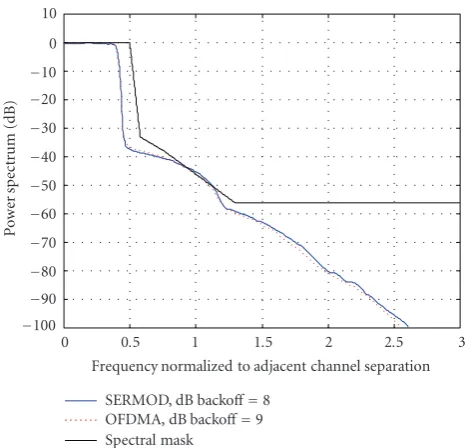
Figure 8shows double-sided QPSK DFT-precoded SM and OFDM spectra at the output of Rappp=2 nonlinearity, along with a spectral mask that has been proposed for WIN-NER wireless systems [28]. The frequency axis in this figure is normalized to the proposed WINNER channel spacing in-stead of the symbol rate. The signals are of the same type as those ofFigure 3(a), but they have FET pilots inserted at ev-ery 4th subcarrier. The OFDM spectrum and backoffto sat-isfy the mask are nearly identical to those ofFigure 3(a), but the serial modulated signal with FET pilots requires about 1 dB higher backoffalthough it is still 1 dB less than that of the OFDM signal. Typical pilot arrangements will place pilots in only a fraction of the transmitted blocks, for example, in 2 blocks out of 12 as in [26]. Thus, only a fraction of transmit-ted SM blocks needs the slight extra backoffassociated with FET pilots. For those blocks, the pilot level can be boosted slightly and the data power can be decreased, the only effect being a fraction of dB loss in average data signal SNR [27]. InFigure 8, the pilot power has been boosted by 1 dB for the SM signal, and the resulting SNR loss to data, if 1/6 of trans-mitted blocks has pilots, is 0.2 dB.
Figure 9shows spectral regrowth plots for IFDMA and B-IFDMA signals mentioned inSection 2, and further detailed in [23]. In both plots, the number of used subcarriers is 128, and the nominal bandwidth is 40 MHz. The spacing between adjacent blocks of occupied subcarriers is 8 subcarriers for IFDMA and 32 subcarriers for B-IFDMA. Even though the B-IFDMA waveform is not a pure SM waveform, its backoff is less than that of the OFDMA signal, and it is only slightly larger than that of IFDMA.
−100 Frequency normalized to adjacent channel separation
SERMOD, dB backoff=8 OFDMA, dB backoff=9 Spectral mask
Figure8: Power spectra for p = 2 Rapp model nonlinearity for QPSK serial modulated and OFDM signals, with FET pilot tone at every 4th subcarrier. Also shown is a spectral mask proposed for WINNER systems.
−80 128 chunks of width 1 (IFDMA);
spacing=8 subcarriers
Frequency (MHz) 32 chunks of width 4;
spacing=32 subcarriers
Frequency (MHz)
DFT-precoded OFDMA, dB backoff=7.1 OFDMA, dB backoff=9
Spectral mask
(b)
Figure9: HPA output power spectra for OFDMA and DFT-precoded OFDMA. (a) IFDMA with 128 subcarriers, block width=1, and
8-subcarrier spacing between subcarriers; (b) B-IFDMA with 128 subcarriers, block width=4, and 32-subcarrier spacing between blocks.
Both are with 40 MHz nominal bandwidth. HPA has Rapp model nonlinearity with parameterp=2.
−80
Frequency normalized to symbol rate
SERMOD,Ns=1
Figure10: Power spectra of QPSK DFT-precoded and OFDM
sig-nals withM=416 data symbols/block and 104 FET pilots formed
from one of theNscyclically shifted Chu sequences chosen to
min-imize PAPR. Rapp parameterp=10; backoff=7 dB.
is necessary. The work in [9] extends this concept to DFT-precoded OFDM signals, using orthogonal cyclically shifted Chu pilot sequences instead of Walsh-Hadamard sequences, and using either a PAPR selection rule as in [29] or the SSE selection rule of [10].Figure 10shows power spectra from the output of ap=10 Rapp nonlinearity, using this cyclically
shifted Chu pilot sequence selection technique, with power backoffof 7 dB, for both DFT-precoded OFDM and OFDM signals. The parameter Ns is the number of Chu pilot se-quences from which the PAPR-minimizing selection is made. Results for the SSE rule are similar [9].Ns=1 corresponds to conventional FET pilots with no PAPR reduction applied. Ev-ery 4th subcarrier is a pilot. Choosing fromNs=32 possible pilot sequences is seen to reduce sidelobe regrowth slightly for the serial modulation case, even showing improvement over the case of no pilots. The improvement over the case of no pilots is more significant for OFDM. However, for the case where 1/4 of the occupied subcarriers is pilots, the side-lobe reduction obtained by choosing amongNs = 32 pilot sequences is more significant for DFT-precoded signals than for OFDM signals. Again, however, the improvement is only significant for the linear clipper (p=10) HPA model; there is little improvement forp=2 [9].
In [13], this idea is carried further, by combining it with the SLM procedure; each possible pilot sequence based on the selected codeword of a maximum length code is com-bined with a different SLM mask sequence. The mask/pilot combination giving the least PAPR is chosen at the transmit-ter.
7. HPA PREDISTORTION METHODS
techniques have been applied) with a nonlinear circuit hav-ing a characteristic that is reciprocal to the HPA characteris-tic. A lookup table (LUT) can be applied to store the value of a variable complex gain which depends on the current value of the input signal magnitude. The size of the LUT is deter-mined by the quantization accuracy of the input signal mag-nitude. The adaptation algorithm modifies the contents of each memory cell which has to be selected by the input sig-nal. OFDM waveforms have an approximately Gaussian dis-tribution, and hence some of the memory cells are very rarely addressed and their contents are rarely modified. This results in a slow convergence of the HPA predistortion process. The speed of convergence of the adaptation algorithm can be in-creased [30].
Instead of applying a predistorter based on a variable gain retrieved from the LUT, HPA reciprocal characteristics can be adaptively synthesized using a small number of nonlinear el-ements. In [31], the results of neural networks applied to the HPA compensation have been reported proving their good performance for predistorters both with and without mem-ory. It has been also proved in [32] that a predistorter based on memory polynomials (another example of the nonlinear “elements”) results in much more effective HPA nonlinearity compensation than that which operates on the current signal only.
Another predistortion algorithm based on the principle of piecewise linear approximation of the HPA inverse char-acteristics is evaluated in [12,33]. Recall that in case of solid-state amplifiers, the AM/PM conversion is negligible, there-fore only the AM/AM HPA characteristics have to be com-pensated.
As in the LUT-based predistorter, the baseband signal in form of the in-phase and quadrature components is con-verted into polar form. Only the signal magnitude is a subject of processing by the predistorter. First, the piecewise charac-teristic which compensates for the inverse HPA characcharac-teristic has to be selected. In order to do this, the range of the input signal magnitudes is divided into smallerMssubranges. In this way, thex-coordinates of the break points of the piece-wise linear function are chosen. The adaptation algorithm finds the best y-coordinates of these points such that for a given signal block the mean square error of the following form is minimized:
wherenkis the number of samples contained in thekth range of the predistorter signal,x(ki)is theith sample of predistorter input signal belonging to thekth subrange,yk(i)is theith sam-ple of the predistorter output signal belonging to thekth sub-range, (xk,yk) are the coordinates of thekth knee-points of the predistorter characteristics, andA(·) is the HPA AM/AM characteristic.
We note that the total number of signal samples on which predistorter optimization is based is equal to
n=
Figure11: Piecewise linear AM/AM characteristics of the predis-torter.
and it is, for example, the number of samples representing a single OFDM symbol or a single block of a GMC signal.
Figure 11 presents the approximation of the AM/AM characteristic of the predistorter. At the givenx-coordinates of the knee-points, their y-coordinates are adjusted to min-imize the mean square error on the output of the HPA. The error is given by the expression
e(ki)=A
y(ki)
−x(ki). (18)
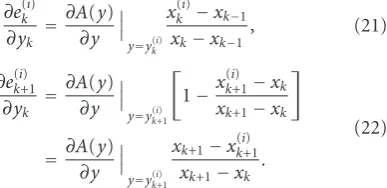
Let us recall that due to the applied piecewise linear ap-proximation, they-coordinates of the characteristics belong-ing to the neighborbelong-ingkth and (k+ 1)th subranges are de-scribed by the formulas
yk(i)= tively, the gradient of the cost functionCis calculated:
∂C
Calculation of the partial derivatives in the above formula leads to the following results:
∂e(ki)
Using the following approximation of derivatives:
in (22), applying (20), and performing some mathematical simplifications, we obtain the expression describing the pre-distorter adaptation algorithm for thejth OFDM symbol:
yk,j+1=yk,j−αk
1 yk,j−yk−1,j
nk
i=1
e(ki)
x(ki)−xk−1
− 1
yk+1,j−yk,j nk
i=1
e(ki+1)
xk(i+1) −xk
,
k=1,. . .,Ms, (24)
whereαkis the adaptation step of the algorithm.
Note that the basic part of the iterative adaptation algo-rithm is the set ofMs correlators which correlate the HPA output error with the difference of the input signal and the x-coordinate of the left edge of the range into which the input signal sample falls.
Note that a similar idea of linear approximation of the signal samples falling between discrete points of the predis-torter characteristics was already presented in [34]. Karam and Sari applied it in the LUT predistorter to the in-phase and quadrature serially modulated signal components in or-der to save the LUT memory size, or equivalently to reduce the number of LUT address bits. Our approach differs not only in the aim of linear approximation but also in the pos-sibility of selection of the predistorter characteristic’s knee-points in any locations on the signal magnitude axis which best fit the predistortion goal. We show that the number of knee-points can in practice be very low. We also show the predistorter adaptation algorithm which is integrated with the proposed predistorter structure that has not been dis-cussed in [34].
Let us note that the proposed predistorter based on piece-wise approximation of the HPA inverse characteristics and the adaptation algorithm associated with it (represented by (19) and (24)) can be easily implemented digitally. Such a predistorter will produce its output signal at the frequency resulting from the sampling frequency applied in PAPR re-duction process.
In order to evaluate the quality of the proposed predis-torter algorithm, simulations were performed. Their results for the OFDM signals are shown inFigure 12. The OFDM signal was the sum of 1664 16-QAM modulated subcarri-ers. The predistorter characteristics consisted ofMs=9 lin-ear segments. They-coordinates of the knee-points were up-dated once per each OFDM symbol. As we see, 300 OFDM symbols are sufficient to achieve a good convergence of the predistorter.
Similar results of HPA nonlinearity compensation were achieved when a single-carrier modulation was investigated. As previously, the Rapp model withp=2 was used to simu-late the influence of a nonlinear HPA. We simusimu-lated serial 16-QAM transmission with spectral shaping by a square-root raised-cosine filter with the rollofffactor being equal to 0.2. Four samples per modulation period were generated. Small sidelobes of the power density spectrum of the gener-ated QAM signals are seen inFigure 13. They result from the shaping filter design exclusively and would be lower if
higher-−60
−50
−40
−30
−20
−10 0
PSD
(dB)
−3000 −2000 −1000 0 1000 2000 3000 Frequency [number of subcarriers]
0 iteration 100 iterations
200 iterations 300 iterations
Figure12: Power spectral density (PSD) on the output of the lin-earized HPA after operation of the proposed adaptation algorithm for OFDM signals with 1664 16-QAM modulated subcarriers.
order FIR shaping filter was applied. Despite the nonconstant envelope of a QAM signal with the shaped baseband pulse, its dynamic range is much lower than that of the OFDM signal. Thus, a lower value of IBO can be applied in the HPA. We report our simulations for IBO=5 dB, although other IBO values were also tested.Figure 13presents the power density spectrum at the output of the HPA after 0, 50, 100, and 150 it-erations of the predistorter adaptation algorithm. The piece-wise linear characteristic was adjusted after transmission of each block of 1024 16-QAM symbols. It was found that for IBO =5 dB, the step sizeαk = 1 resulted in the fast con-vergence of the adaptation algorithm. It was also observed that when IBO was lower, the step size had to be decreased as well. As we observe inFigure 13, only 50 iterations of the adaptation algorithm are sufficient to suppress the nonlinear distortion below 40 dB. After 100 iterations, the performance of the HPA with the predistorter is already very good.
8. SUMMARY AND CONCLUSIONS
In general, transmitted signal power spectra must be con-fined within spectral masks which are designed to pre-vent excessive out-of-band interference to adjacent channel users. Some power backoffis necessary to keep spectral re-growth due to nonlinear HPAs within the mask limit. We have extended some popular peak power reduction schemes to the class of generalized multicarrier signals, including ones with noncontiguous spectra and with added frequency-multiplexed pilots, showing resulting power backoff reduc-tions. Generally, power backoff requirements must be as-sessed with respect to specific power amplifier models.
We can summarize by listing the following conclusions. (1) Most spectral masks for licensed interference-limited
−60
−50
−40
−30
−20
−10 0 10
PSD
(dB)
0 0.2 0.4 0.6 0.8 1 1.2 1.4 1.6 1.8 2
Frequency normalized to symbol rate
1 2 3
4 5
Figure13: (1) PSD on the output of the linear amplifier and (2) the nonlinear amplifier before predistorter adaptation (3) after 50 iter-ations, (4) 100 iteriter-ations, and (5) 150 iterations of the predistorter adaptation algorithm for single-carrier 16-QAM modulated signal
blocks with the square-root raised-cosine shaping filter (rolloff
fac-tor equal to 0.2).
HPA nonlinearity are negligible. This means that spec-tral regrowth is a more important criterion than BER when assessing nonlinear HPA effects.
(2) Required power backofffor a specific HPA nonlinear-ity model and spectrum mask is a better quantitative
criterion than peak-to-average power ratio or its dis-tribution.
(3) DFT-precoded OFDM has lower PAPR and lower backoffrequirements than OFDM or OFDMA. It is equivalent to serial or single-carrier modulation if the transmitted subcarriers are contiguous or equally spaced. DFT precoding can in fact be considered as an effective PAPR reduction technique for OFDM. (4) Several other PAPR reduction schemes, that have
been previously found to be effective for OFDM, are also effective for DFT-precoded OFDM, in particular, SLM, pilot-selection schemes, and, perhaps surpris-ingly, clipping and filtering. However, when used for reducing required power backoff, these schemes are most effective when combined with adaptive HPA pre-distortion which effectively makes the HPA nonlinear characteristic close to that of an ideal linear clipper. (5) A novel piecewise linear HPA predistortion technique,
with a few well-chosen knee-points, was described and found effective in reducing the out-of-band spectrum.
ACKNOWLEDGMENTS
This work has been performed in the framework of the IST Project, IST-4-027756 WINNER, which is funded by the Eu-ropean Union. This work was partly funded by the WINNER Project and the Natural Sciences and Engineering Research
Council (NSERC) of Canada. The authors would like to ac-knowledge the contributions of their colleagues in WINNER, although the views expressed are those of the authors and do not necessarily represent the project.
REFERENCES
[1] P. Struhsaker and K. Griffin, “Analysis of PHY Waveform Peak
to Mean Ratio and Impact on RF Amplification,” contribution to IEEE 802.16.3c-01/46, March 2001.
[2] B. Come, S. Donnay, L. Van der Perre, et al., “Impact of front-end non-idealities on bit error rate performance of
WLAN-OFDM transceivers,” inProceedings of IEEE Radio and
Wire-less Conference (RAWCON ’00), pp. 91–94, Denver, Colo, USA, September 2000.
[3] M. Lampe and H. Rohling, “Reducing out-of-band emissions
due to nonlinearities in OFDM systems,” in Proceedings of
IEEE Vehicular Technology Conference (VTC ’99), vol. 3, pp. 2255–2259, Houston, Tex, USA, July 1999.
[4] S. H. Han and J. H. Lee, “An overview of peak-to-average power ratio reduction techniques for multicarrier
transmis-sion,”IEEE Wireless Communications, vol. 12, no. 2, pp. 56–65,
2005.
[5] Z. Wang and G. B. Giannakis, “Wireless multicarrier
commu-nications,”IEEE Signal Processing Magazine, vol. 17, no. 3, pp.
29–48, 2000.
[6] D. Falconer and S. Kaiser, Eds, “Broadband Frequency Domain-Based air Interfaces for Future-Generation Wire-less Systems,” WWRF WG4 White paper, September 2005, http://wg4.ww-rf.org/WWRF WG4 FD air interface WP.doc.
[7] R. TafazolliEds,Technologies for the Wireless Future, John Wiley
& Sons, New York, NY, USA, 2006.
[8] C. Liu, H. Xiao, Q. Wu, and F. Li, “System design of RF power
amplifiers for wireless communication systems,”IEEE
Trans-actions Consumer Electronics, vol. 48, no. 1, pp. 72–80, 2002. [9] C.-T. Lam, D. Falconer, and F. Danilo-Lemoine, “PAPR
reduc-tion using frequency domain multiplexed pilot sequences,” in
Proceedings of IEEE Wireless Communications and Networking Conference (WCNC ’02), pp. 1428–1432, Hong Kong, March 2007.
[10] M. Sabbaghian and D. Falconer, “ Reducing required power
back-offof nonlinear amplifiers in serial modulation using
SLM method,” inProceedings of the 62nd IEEE Vehicular
Tech-nology Conference (VTC ’05), vol. 3, pp. 1882–1886, Dallas, Tex, USA, September 2005.
[11] M. Sabbaghian and D. Falconer, “Peak to average power
ra-tio properties of MC-CDMA and SM-CDMA,” inProceedings
of the 63rd IEEE Vehicular Technology Conference (VTC ’06), vol. 4, pp. 2013–2017, Melbourne, Australia, May 2006. [12] K. Wesołowski, “A novel fast HPA predistorter for high
PAPR signals,” inProceedings of IEEE International
Sympo-sium on Personal, Indoor and Mobile Radio Communications (PIMRC ’05), vol. 2, pp. 863–867, Berlin, Germany, Septem-ber 2005.
[13] K. Wesołowski, “On the PAPR minimization using selected
mapping algorithm in pilot-assisted OFDM systems,” in
Pro-ceedings of European Wireless, Paris, France, April 2007. [14] A. E. Jones, T. A. Wilkinson, and S. K. Barton, “Block coding
scheme for reduction of peak to mean envelope power ratio of
multicarrier transmission schemes,”Electronics Letters, vol. 30,
no. 25, pp. 2098–2099, 1994.
OFDM,” inProceedings of the 46th IEEE Vehicular Technology Conference (VTC ’96), vol. 2, pp. 904–908, Atlanta, Ga, USA, May 1996.
[16] L. J. Jr. Cimini and N. R. Sollenberger, “Peak to average power reduction of an OFDM signal using partial transmit
se-quences,”IEEE Communications Letters, vol. 4, no. 3, pp. 86–
88, 2000.
[17] S. H. Muller and J. B. Huber, “A novel peak power reduction
scheme for OFDM,” inProceedings of the 8th IEEE
Interna-tional Symposium on Personal, Indoor and Mobile Radio Com-munications (PIMRC ’97), vol. 3, pp. 1090–1094, Helsinki, Finland, September 1997.
[18] S. Sezginer and H. Sari, “OFDM peak power reduction with
simple amplitude predistortion,”IEEE Communications
Let-ters, vol. 10, no. 2, pp. 65–67, 2006.
[19] J. Armstrong, “Peak-to-average power reduction for OFDM by
repeated clipping andfrequency domain filtering,”Electronics
Letters, vol. 38, no. 5, pp. 246–247, 2002.
[20] R. Dinis and A. Gusm˜ao, “A class of nonlinear
signal-processing schemes for bandwidth-efficient OFDM
transmis-sion with low envelope fluctuation,” IEEE Transactions on
Communications, vol. 52, no. 11, pp. 2009–2018, 2004.
[21] H. Ochiai, “Power efficiency comparison of OFDM and
single-carrier signals,” inProceedings of the 56th IEEE Vehicular
Tech-nology Conference (VTC ’02), vol. 2, pp. 899–903, Vancouver, Canada, September 2002.
[22] R. Dinis, D. Falconer, C.-T. Lam, and M. Sabbaghian, “A mul-tiple access scheme for the uplink of broadband wireless
sys-tems,” inProceedings of IEEE Global Telecommunications
Con-ference (GLOBECOM ’04), vol. 6, pp. 3808–3812, Dallas, Tex, USA, December 2004.
[23] T. Svensson, T. Frank, D. Falconer, M. Sternad, E. Costa, and A.
Klein, “B-IFDMA—a power-efficient multiple access scheme
for non-frequency-adaptive transmission,” inProceedings of
the16th IST Summit Conference, pp. 1–5, Budapest, Hungary, July 2007.
[24] C. Rapp, “Effects of HPA nonlinearity on a 4DPSK/OFDM
sig-nal for a digital sound broadcasting system,” inProceedings of
the 2nd European Conference on Satellite Communications, pp. 179–184, Liege, Belgium, October 1991.
[25] D. C. Chu, “Polyphase codes with good periodic correlation
properties,”IEEE Transactions on Information Theory, vol. 18,
no. 4, pp. 531–532, 1972.
[26] C.-T. Lam, D. Falconer, F. Danilo-Lemoine, and R. Dinis, “Channel estimation for SC-FDE systems using frequency
do-main multiplexed pilots,” inProceedings of the 64th IEEE
Vehic-ular Technology Conference (VTC ’06), pp. 1438–1442, Mon-treal, Canada, September 2006.
[27] C.-T. Lam, G. Auer, F. Danilo-Lemoine, and D. Falconer, “De-sign of time and frequency domain pilots for generalized
mul-ticarrier systems,” inProceedings of IEEE International
Confer-ence on Communications (ICC ’07), pp. 4076–4081, Glasgow, Scotland, June 2007.
[28] IST-2003-507581 WINNER, “Duplex Arrangements for Fu-ture Broadband Radio Interface,” October 2004.
[29] M. Garca, O. Edfors, and J. Paez-Borrallo, “Peak power re-duction for OFDM systems with orthogonal pilot sequences,”
IEEE Transactions on Wireless Communications, vol. 5, no. 1, pp. 47–51, 2006.
[30] K. Wesołowski and J. Pochmara, “Efficient algorithm for
ad-justment of adaptive predistorter in OFDM transmitter,” in
Proceedings of the 53rd IEEE Vehicular Technology Conference (VTC ’01), vol. 5, pp. 2491–2496, Boston, Mass, USA, Septem-ber 2000.
[31] J. Pochmara, “Improving compensation of nonlinear distor-tions in OFDM system using recurrent neural network with
conjugate gradient algorithm,” inProceedings of the 15th IEEE
International Symposium on Personal, Indoor and Mobile Radio Communications (PIMRC ’04), vol. 1, pp. 180–185, Barcelona, Spain, September 2004.
[32] L. Ding, G. T. Zhou, D. R. Morgan, Z. Ma, J. S. Kenney, J. Kim, and Ch. Giardina, “A robust digital baseband predistorter
con-structed using memory polynomials,”IEEE Transactions on
Communications, vol. 52, no. 1, pp. 159–165, 2004.
[33] IST-2003-507581 WINNER, “D2.3 Assessment of Radio-Link Technologies,” February 2005.
[34] G. Karam and H. Sari, “Generalized data predistortion using
intersymbol interpolation,”Philips Journal of Research, vol. 46,