Volume 2010, Article ID 254837,9pages doi:10.1155/2010/254837
Research Article
Optimized Punctured ZCZ Sequence-Pair Set: Design, Analysis,
and Application to Radar System
Lei Xu and Qilian Liang (EURASIP Member)
Department of Electrical Engineering, University of Texas at Arlington, Arlington, TX 76010, USA
Correspondence should be addressed to Lei Xu,[email protected]
Received 23 November 2009; Accepted 26 April 2010
Academic Editor: Xiuzhen (Susan) Cheng
Copyright © 2010 L. Xu and Q. Liang. This is an open access article distributed under the Creative Commons Attribution License, which permits unrestricted use, distribution, and reproduction in any medium, provided the original work is properly cited.
Based on the zero correlation zone (ZCZ) concept, we present the definitions and properties of a set of new ternary codes, ZCZ sequence-Pair Set (ZCZPS), and propose a method to use the optimized punctured sequence-pair along with Hadamard matrix to construct an optimized punctured ZCZ sequence-pair set (OPZCZPS) which has ideal autocorrelation and cross-correlation properties in the zero correlation zone. Considering the moving target radar system, the correlation properties of the codes will not be severely affected when Doppler shift is not large. We apply the proposed codes as pulse compression codes to radar system and the simulation results show that optimized punctured ZCZ sequence-pairs outperform other conventional pulse compression codes, such as the well-known polyphase code—P4 code.
1. Introduction
Pulse compression is known as a technique to raise the signal to maximum sidelobe (signal-to-sidelobe) ratio to improve the target detection and range resolution abilities of the radar system. This technique allows a radar to simultaneously achieve the energy of a long pulse and the resolution of a short pulse without the high peak power which is required by a high energy short duration pulse [1]. One of the waveform designs suitable for pulse compression is phase-coded wave-form design. The phase-coded wavewave-form design is that a long pulse of durationTis divided intoNsubpulses each of width
Ts. Each subpulse has a particular phase, which is selected in accordance with a given code sequence. The pulse com-pression ratio equals the number of subpulsesN =T/Ts ≈
BT, where the bandwidth isB ≈ 1/Ts. In general, a phase-coded waveform with longer code word, in other words, higher pulse compression ratio, can have lower sidelobe of autocorrelation, relative to the mainlobe peak, so its main peak can be better distinguished. The relative lower sidelobe of autocorrelation is very important since range sidelobes are so harmful that they can mask main peaks caused by small targets situated near large targets. In addition, the cross-correlation property of the pulse compression codes should be considered in order to reduce the interference among
radars when we choose a set of pulse compression codes to work in a Radar Sensor Network (RSN).
sidelobes for the radar system. By suffering a smallS/N loss, the authors in [9] present several binary pulse compression codes to greatly reduce sidelobes. In the previous paper [10], pulse compression using a digital-analog hybrid technique is studied to achieve very low range sidelobes for potential application to spaceborne rain radar. In the paper [11], time-domain weighting of the transmitted pulse is used and is able to achieve a range sidelobe level of−55 dB or better in flight tests. These sidelobe suppression methods, however, degrade the receiving resolution because of wider mainlobe.
On the other hand, for periodic sequences, the lowest periodic ACF that could be achieved for binary sequences, as in the case ofm-sequences [12,13] or Legendre sequences, is |Ri(τ /=0) = 1|. GMW [14] has the same periodic ACF properties, but posses larger linear complexity. Con-sidering the nonbinary case, it is possible to find perfect sequences, such as two valued Golomb sequences, Ipatov ternary sequences, Frank sequences, Chu sequences, and modulatable sequences. However, it should be noted that for both binary and non-binary cases, it is impossible for the sequences to have perfect ACF and CCF simultaneously although ideal CCFs could be achieved alone. One can synthesize a set of non-binary sequences with impulsive ACF and the lower bound of CCF:Ri j =
√
N,∀τ,i /=j[15,16], which is governed by Welch bound and Sidelnikov bound.
So far in the previous work, range sidelobes could hardly reach as low as zero. In addition, it has also been well proven that it is impossible to design a set of codes with ideal impul-sive autocorrelation function and ideal zero cross-correlation functions, since the corresponding parameters have to be limited by certain bounds, such as Welch bound [15], Sidelnikov bound [16], Sarwate bound [17], and Levenshtein bound [18]. To overcome these difficulties, the new concepts, generalized orthogonality (GO), also called Zero Correlation Zone (ZCZ) is introduced. Based on ZCZ [19–21] concept, we propose a set of ternary codes, ZCZ sequence-pair set, which can reach zero autocorrelation sidelobe zero mutual cross-correlation peaks during Zero Correlation Zone. We also present and analyze a method to construct such ternary codes and subsequently apply them to a radar detection system. The method is that optimized punctured sequence-pair joins together with Hadamard matrix to construct optimized punctured ZCZ sequence-pairs set. An example is presented, investigated, and studied in the radar targets detection simulation system for the performance evaluation of the proposed ternary codes. Because of the outstanding property performance and well target detection performance in simulation system, the newly proposed codes can be useful candidates for pulse compression application in radar system.
The rest of the paper is organized as follows.Section 2
introduces the definitions and properties of ZCZPS. In
Section 3, the optimized punctured ZCZPS is introduced, and a method using optimized punctured sequence-pair and Hadamard matrix to construct such codes is given and proved. In Section 4, the properties and ambiguity function of optimized punctured ZCZPS are simulated and analyzed. The performance of optimized punctured ZCZPS is investigated in radar targets detection system by comparing
with P4 code in Section 5. In Section 6, conclusions are drawn on optimized punctured ZCZPS.
2. Definitions and Properties of
ZCZ Sequence-Pair Set
Zero Correlation Zone (ZCZ) is a new concept provided by Fan et al. [21,22] in which the autocorrelation sidelobes and cross-correlation values are zero while the time delay is kept within ZCZ instead of the whole period of time domain. There has been considerable interest in constructing [23–
27] new classes of ZCZ sequences in ZCZ and studying their properties [28].
Here, we introduce sequence-pair into the ZCZ concept to construct ZCZ sequence-pair set. We consider ZCZPS (X,Y),Xis a set ofK sequences of lengthN andYis a set ofKsequences of the same lengthN:
x(p)∈X p=0, 1, 2,. . .,K−1,
y(q)∈Y q=0, 1, 2,. . .,K−1. (1)
The autocorrelation function (ACF) (here we use auto-correlation to stand for the cross-auto-correlation between two different sequences of a sequence-pair to distinguish the cross-correlation between two different sequence-pairs) of sequence-pair (x(p),y(p)) is defined by
The cross-correlation function of two sequence-pairs (x(p),y(p)) and (x(q),y(q)),p /=qis defined by For pulse compression sequences, some properties are of particular concern in the optimization for any design in engineering field. They are the peak sidelobe level, the energy of autocorrelation sidelobes, and the energy of their mutual cross-correlation [4]. Therefore, the peak sidelobe level which represents a source of mutual inter-ference and obscures weaker targets can be presented as maxK|Rx(p)y(p)(τ)| = 0, τ is among the zero correlation zone for ZCZPS. Another optimization criterion for the set of sequence-pairs is the energy of autocorrelation sidelobes joined together with the energy of cross-correlation. By minimizing the energy, it can be distributed evenly, and the peak autocorrelation sidelobe and the cross-correlation level can be minimized as well [4]. Here, the energy of ZCZPS can be employed as
cross-correlation values of any two sequence-pairs within Zero Correlation Zone.
Hence, the ZCZPS can be constructed by minimizing the autocorrelation sidelobe of a sequence-pair and cross-correlation value of any two sequence-pairs in ZCZPS.
Definition 1. Assume (X,Y) to be a sequence-pair set ofK
sequence-pairs and each sequence-pair is of N bit length. If all the sequence-pairs in the set satisfy the following equation: sequence-pair set, ZCZPS(N,K,Z0) is an abbreviation.
3. Optimized Punctured ZCZ Sequence-Pair Set
3.1. Definition of Optimized Punctured ZCZ Sequence-Pair Set. Matsufuji and Torii have provided some methods of constructing ZCZ sequences in [29, 30]. In this section, a set of novel ternary codes, namely, the optimized punctured ZCZ sequence-pair set, is constructed by applying the opti-mized punctured sequence-pair [31] to the Zero Correlation Zone. Here, optimized punctured ZCZPS is a specific kind of ZCZPS.where P is the number of punctured bits in sequence u. Suppose vj ∈ (−1, 1) and uj ∈ (−1, 0, 1), u is P -punctured binary sequence, (u,v) is called a punctured binary sequence-pair.
Definition 3 (see [31]). The autocorrelation of punctured sequence-pair (u,v) is defined as
If the punctured sequence-pair has the following auto-correlation property:
the punctured sequence-pair is called an optimized punc-tured sequence-pair [31]. Where,E = N−1
i=0 uivi = N−P, is the energy of punctured sequence-pair.
Definition 4. If (X,Y) in Definition 1 is constructed by optimized punctured sequence-pair and a certain matrix, such as Hadamard matrix or an orthogonal matrix, where
xi(p)∈(−1, 1), i=0, 1, 2,. . .,N−1, be called an optimized punctured ZCZ sequence-pair set. OPZCZPS(N,K,Z0) is an abbreviation.
3.2. Design of Optimized Punctured ZCZ Sequence-Pair Set. Based on an optimized punctured binary sequence-pair of odd length and a Hadamard matrix, an optimized punctured ZCZPS can be constructed on following steps.
Step 1. Considering an optimized punctured binary sequence-pair (u,v) of odd length, the length of each sequence isN1:
u=u0,u1,. . .,uN1−1, ui∈(−1, 1),
v=v0,v1,. . .,vN1−1, vi∈(−1, 0, 1),
i=0, 1, 2,. . .,N1−1, N1is odd.
(11)
Step 2. A Hadamard matrixB(the Hadamard matrix is made up of a set of Walsh sequences) of orderN2is used here.N2,
Step 3. Doing bit-multiplication on the optimized punc-tured binary sequence-pair and each row of the Hadamard matrixB, then sequence-pair set (X,Y) is obtained,
b(p)=b(0p),b
(p)
1 ,. . .,b
(p)
N2−1
, p=0, 1,. . .,N2−1,
x(jp)=ujmodN1b
(p)
jmodN2, 0≤p≤N2−1, 0≤j≤N−1,
X=x(0);x(1);. . .;x(N2−1)
,
y(jp)=vjmodN1b
(p)
jmodN2, 0≤p≤N2−1, 0≤j≤N−1,
Y=y(0);y(1);. . .;y(N2−1)
.
(13)
Here, the optimized punctured binary sequence-pairs are of odd lengths and the lengths of Walsh sequence are 2n, n = 1, 2,. . . . It is easy to see that gcd(N
1,N2) = 1,
common divisor of N1 and N2 is 1, then N = N1 ∗N2.
The sequence-pair set (X,Y) is the optimized punctured ZCZPS and N1 −1 is the Zero Correlation Zone Z0. The
length of each sequence in optimized punctured ZCZPS is
N = N1∗N2 that depends on the product of length of
optimized punctured sequence-pair and the length of Walsh sequence in Hadamard matrix. The number of sequence-pairs in optimized punctured ZCZPS rests on the order of the Hadamard matrix. The sequence x(p) in sequence set X and the corresponding sequence y(p) in sequence set Y
construct a sequence-pair (x(p),y(p)) that can be used as a
pulse compression code.
The correlation property of the sequence-pairs in opti-mized punctured ZCZPS is
Rx(p)y(q)(τ)=Ruv(mmodN1)Rb(p)b(q)(mmodN2)
= ⎧ ⎪ ⎪ ⎪ ⎪ ⎨ ⎪ ⎪ ⎪ ⎪ ⎩
EN2, ifm=0, p=q,
0, if 0<|m| ≤N1−1, p=q,
0, if 0≤ |m| ≤N1−1, p /=q,
(14)
whereN1−1 is the Zero Correlation ZoneZ0andτ=mTs.
Proof. (1) Whenp=q,
τ=0, Ruv(0)=E, Rb(p)b(q)(0)=N2,
Rx(p)y(q)(0)=Ruv(0)Rb(p)b(q)(0)=EN2,
0<|τ| ≤(N1−1)Ts, Ruv(τ)=0,
Rx(p)y(q)(τ)=Ruv(mmodN1)Rb(p)b(q)(mmodN2)=0. (15)
(2) Whenp /=q,
τ =0, Rb(p)b(q)(0)=0,
Rx(p)y(q)(0)=Ruv(0)Rb(p)b(q)(0)=0,
0<|τ| ≤(N1−1)Ts,
Ruv(τ)=0,
Rx(p)y(q)(τ)=Ruv(mmodN1)Rb(p)b(q)(mmodN2)=0. (16)
According toDefinition 1, the OPZCZPS constructed by the above method is a ZCZPS.
4. Properties of Optimized Punctured ZCZ
Sequence-Pair Set
Considering the optimized punctured ZCZPS constructed by the method mentioned in the last section, the autocor-relation and cross-corautocor-relation properties can be simulated and analyzed. For example, the optimized punctured ZCZPS (X,Y) is constructed by 31-length optimized punctured binary sequence-pair (u,v),u=[+ + + +− − −+−+−+ + +
− − − −+− −+− −+ + +−+ +−],v=[+ + + + 000 + 0 + 0 +
+ + 0000 + 00 + 00 + + + 0 + +0] (using “+” and “−” symbols for “1” and “−1”) and Hadamard matrixHof order 4. We follow the three steps presented inSection 3.2to construct the optimized punctured ZCZPS. The number of sequence-pairs here is 4, and the length of each sequence is 31∗4 =
124. The first row of each matrixX = [x(1);x(2);x(3);x(4)]
andY = [y(1);y(2);y(3);y(4)] constitute a certain optimized
punctured ZCZP (x(1),y(1)). Similarly, the second row of each
matrixXandYconstitute another optimized punctured ZCZ sequence-pair (x(2),y(2)), and so on:
x(1)=[+ + + +− − −+−+−+ + +− − − −+− −+−−
+ + +−+ +−+ + + +− − −+−+−+ + +−−
− −+− −+− −+ + +−+ +−+ + + +− − −+
−+−+ + +− − − −+− −+− −+ + +−+ +−
+ + + +− − −+−+−+ + +− − − −+− −+−
−+ + +−+ +−],
y(1)=[+ + + + 000 + 0 + 0 + + + 0000 + 00 + 00 + + + 0
+ +0 + + + +000 + 0 + 0 + + + 0000 + 00 + 00 + +
+ 0 + +0 + + + +000 + 0 + 0 + + + 0000 + 00 + 00
+ + + 0 + +0 + + + +000 + 0 + 0 + + + 0000 + 00
+00 + + + 0 + +0],
x(2)=[+−+− −+− − − − − −+− −+−+ + +− − −
+ +−+ + +− − −+−+ +−+ + + + + +−+ +−
+− − −+ + +− −+− − −+ + +−+− −+−−
− − − −+− −+−+ + +− − −+ +−+ + +−
− −+−+ +−+ + + + + +−+ +−+− − −+
y(2)=[+−+−000−0−0−+−0000 + 00−00 +−+ 0
+−0−+−+000 + 0 + 0 +−+ 0000−00 + 00
−+−0−+0 +−+−000−0−0−+−0000
+ 00−00 +−+ 0 +−0−+−+000 + 0 + 0 +−
+0000−00 + 00−+−0−+0]. (17)
Here, optimized punctured ZCZ sequence-pairs (x(1),y(1))
and (x(2),y(2)) are studied as two examples in the following
parts.
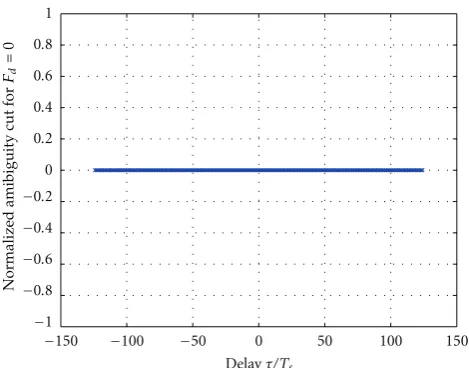
4.1. Autocorrelation and Cross-Correlation Properties. The autocorrelation property and cross-correlation property of 124-length sequence-pairs in the optimized punctured ZCZ sequence-pair set (X,Y) are shown in Figures1and2.
From the Figures 1 and 2, the peak autocorrelation sidelobe of ZCZPS and their cross-correlation value are kept as low as zero while the time delay is kept withinZ0=N1−
1 = 30 (Zero Correlation Zone). And it is always true that the cross-correlation values of optimized punctured ZCZPS and the autocorrelation sidelobe could be kept as low as zero during ZCZ.
We still have to confess that the energy loss of the proposed codes is no less than 1.7 db due to reference mismatch. However, the perfect periodic ACF and CCF achieved simultaneously during the ZCZ zone and the codes’ structure could make up for it. It is known that a suitable criterion for evaluating code of length N is the ratio of the peak signal mainlobe divided by the peak signal sidelobe (PSR) of their autocorrelation function, which can be bounded by [32]
[PSR]dB≤20 log2N=[PSRmax]dB. (18)
The only aperiodic uniform phase codes that can reach the PSRmaxare the Barker codes whose length is equal or less than
13. Considering the periodic sequences, them-sequences or Legendre sequences could achieve the lowest periodic ACF of|Ri(τ /=0) =1|. For non-binary sequences, it is possible to find perfect sequences of ideal ACF. Golomb codes are a kind of two valued (biphase) perfect codes which obtain zero periodic ACF but result in large mismatch power loss. The Ipatov code shows a way of designing code pairs with perfect periodic autocorrelation (the cross-correlation of the code pair) and minimal mismatch loss. In addition, zero periodic autocorrelation function for all nonzero shifts could be obtained by polyphase codes, such as Frank and Zadoff codes. However, for both binary and non-binary periodic sequences, it is not possible for the sequences to have perfect ACF and CCF simultaneously although ideal CCFs could be achieved alone. Comparing with the above codes, the proposed ternary codes could obtain perfect periodic ACF during the ZCZ and the reference sequence is made of (−1, 0, 1) which is much less complicated than other perfect ternary codes such as Ipatvo code. The reference code for Ipatov code is of a three-element alphabet which might not always be integer.
−0150 −100 −50 0 50 100 150
0.1 0.2 0.3 0.4 0.5 0.6 0.7 0.8 0.9 1
Delayτ/Ts
Normalized
amibiguity
cut
for
Fd
=
0
Figure 1: Periodic autocorrelation property of optimized
punc-tured ZCZPS.
Nevertheless, considering multi targets in the system, multiple peaks of the autocorrelation function of the pro-posed codes might affect on the range resolution. The range resolution could be limited asTs < τ < N1Tsorτ > NTs. Here,Tsis one bit duration,N1is the length of an optimized
punctured sequence-pair andNis the length of an optimized punctured ZCZ sequence-pair. In the Figure 1, N1 = 31.
Otherwise, some digital signal processing methods could also be introduced to distinguish the peaks. On the other hand, there may also be the concern that multiple peaks of single transmitting signal reflected from one target may affect determining the main peak of ACF. As a matter of fact, the matched filter here could shift at the period of ZCZ length to track each peak instead of shifting bit by bit after the first peak is acquired. Hence, in this way could it be working more efficiently. Alike the tracking technology in synchronization of CDMA system, checking several peaks instead of only one peak guarantee the precision of PD and avoidance of PFA. In addition, those obtained peaks could be averaged before the detection in order to reduce the effect of random noise in the channel so that the detection performance could be improved.
To sum up, the new code could achieve perfect ACF and CCF in the ZCZ simultaneously according to Figures1and
2, and its PSR can be as large as infinite.
−150 −100 −50 0 50 100 150
Figure2: Periodic cross-correlation property of optimized
punc-tured ZCZPS.
The ambiguity function which is usually used to analyze the radar performance within Doppler shift and time delay is defined in [32]:
A(τ,FD)≡
−∞∞ x(s)ej2πFDsx∗(s−τ)ds≡A(τ,FD), (19)
where τ is the time delay between transmitting signal and matched filter, andFDis the Doppler shift.
In [33], Periodic Ambiguity Function (PAF) is intro-duced by Levanon as an extension of the periodic autocor-relation for Doppler shift. And the single-periodic complex envelope is [34]
whereTis one period of the signal.
We are studying sequence-pairs in this research, so we use different codes for transmitting part and receiving part. The single-period ambiguity function for ZCZPS can be rewritten as of the signal and Tsis one bit duration. At the same time, whenp=q, (21) can be used to analyze the autocorrelation property within Doppler shift, and when q /=p, (21) can be used to analyze the cross-correlation performance within
Doppler shift. Equation (21) is plotted inFigure 3in a three-dimensional surface plot to analyze the radar performance of optimized punctured ZCZPS within Doppler shift. Here, maximal time delay is 1 unit (normalized to length of the code, in units of NTs) and maximal Doppler shift is 5 units for cross-correlation and 3 units for autocorrelation (normalized to the inverse of the length of the code, in units of 1/NTs).
In Figure 3(a), there is relative uniform plateau sug-gesting low and uniform sidelobes. This low and uniform sidelobes minimize target masking effect in Zero Correlation Zone of time domain, whereZ0 = 30,−30τc ≤ τ ≤ 30τc. From Figure 3(b), considering cross-correlation property between any two optimized punctured ZCZ sequence-pairs of the ZCZPS, we can see that the optimized punctured ZCZPS is tolerant of Doppler shift when Doppler shift is not large. When the Doppler shift is zero, or the target is not moving, cross-correlation of our proposed code is zero during ZCZ.
Since synchronizing techniques develop exponentially in the industrial world, time delay between transmitting signal and matched filter can, to some extent, be precisely esti-mated. Therefore, it is necessary to investigate the property of our proposed code when we have the output of the matched filter at the expected timeτ=0. Whenτ =0, the ambiguity function can be expressed as
A
And the Doppler shift performance without time delay is presented in theFigure 4.
Figure 4(a)illustrates that without time delay of matched filter but having the Doppler shift less than 1 unit, the autocorrelation value of optimized punctured ZCZPS falls sharply during one unit, and the trend of the amplitude over the whole frequency domain decreases as well. Figure 4(b)
shows that there are some convex surfaces in the cross-correlation performance. From Figures4(a)and4(b), when Doppler frequencies equal to multiples of the pulse repetition frequency (PRF= 1/PRI = 1/Ts), all the ambiguity values turn to zero except when Doppler frequency is equal to 2 PRF for cross-correlation. That is the same as many widely used pulse compression binary code such as the Barker code. Overall, the ambiguity function performances of optimized punctured ZCZP can be as efficient as conventional pulse compression binary code.
5. Application to Radar System
0
Figure3: Ambiguity function of 124-length ZCZPS: (a)
autocorre-lation, (b) cross-correlation.
length. In the simulation model, 105 times of Monte-Carlo
simulation has been run for each SNR value. The Doppler shift frequency is a random variable that is kept less than 1 unit (normalized to the inverse of the length of the code, in units of 1/NTs), and the expected peak time of the output of the matched filter is atτ=0.
FromFigure 5, the probabilities of miss target detection
PM of the system using 124-length optimized punctured ZCZP are lower than 124-length P4 code especially when the SNR is not high. When SNR is higher than 18 dB, both probabilities of miss targets of the system approach zero. However, the probabilities of miss targets of P4 code fall more quickly than optimized punctured ZCZP.
We plotted the detection probability PD versus false alarm probability PFA of the coherent receiver. We have
simulated the performance at different SNR values. Because of the limited space, we only chose SNR at 12 db and 14 dB.Figure 6shows performance of 124-length optimized punctured ZCZP and performance of the same length P4 code when the SNR is 12 dB and 14 dB. Within the same SNR value either 12 dB or 14 dB, the detection probabilities of optimized punctured ZCZ sequence-pair are much larger
0 0.5 1 1.5 2 2.5 3
Figure 4: Doppler shift of 124-length ZCZPS (τ = 0): (a)
autocorrelation (b) cross-correlation.
than detection probabilities of P4 code, and meanwhilePFA
of the first code are also smaller thanPFAof the latter code.
Stating differently, optimized punctured ZCZ sequence-pair has higher target detection probability while keeping a lower false alarm probability. Furthermore, observing Figure 6, 124-length optimized punctured ZCZ sequence-pair even has much better performance at 12 dB SNR than P4 code of corresponding length at 14 dB SNR.
6. Conclusions
12 13 14 15 16 17 18 19 20 0
0.02 0.04 0.06 0.08 0.1 0.12 0.14 0.16
Punctured P4
SNR (dB)
P
r
obabilit
y
o
f
miss,
Pm
Figure 5: Probability of miss targets detection: 124-length
opti-mized punctured ZCZ sequence-pair versus 124-length P4 code.
−2.6 −2.4 −2.2 −2 −1.8 −1.6 −1.4 −1.2 −1 −0.8 0.7
0.75 0.8 0.85 0.9 0.95 1
14 dB-P4 12 dB-P4
P
r
obabilit
y
o
f
d
et
ecion,
Pd
14 dB-punctured 12 dB-punctured
Probability of false alarm (base 10 logarithm ofPfa)
Figure6: Probability of detection versus probability of false alarm
of the coherent receiver: 124-length optimized punctured ZCZ sequence-pair versus 124-length P4 code.
optimized punctured ZCZPS is the considerably reducedn autocorrelation sidelobe and zero mutual cross-correlation value during ZCZ. According to the radar system simulation results shown in Figures5and6, it is easy to observe that 124-length optimized punctured ZCZPS has better performance than P4 code of the same length when the target is not moving very fast in the system. A general conclusion can be drawn that the optimized punctured ZCZPS consisting of optimized punctured ZCZ sequence-pairs can effectively increase the variety of candidates for pulse compression
codes. Because of the ideal cross-correlation properties of optimized punctured ZCZPS, our future work would focus on the application of the optimized punctured ZCZPS in multiple radar systems.
Acknowledgment
This work was supported in part by the National Science Foundation under Grants CNS-0721515, CNS- 0831902, CCF-0956438, CNS-0964713, and Office of Naval Research (ONR) under Grant 0395 and N00014-07-1-1024.
References
[1] S. Ariyavisitakul, N. Sollenberger, and L. Greenstein, Introduc-tion to Radar System, Tata McGraw-Hill, Delhi, India, 2001. [2] A. M. Boehmer, “Binary pulse compression codes,” IEEE
Transactions on Information Theory, vol. 13, pp. 156–167, 1967.
[3] R. Turyn, “On Barker codes of even length,”Proceedings of the IEEE, vol. 51, no. 9, p. 1256, 1963.
[4] U. Somaini, “Bianry sequences with good autocorrelation and cross correlation properties,”IEEE Transactions on Aerospace and Electronic Systems, vol. 11, no. 6, pp. 1226–1231, 1975. [5] R. L. Frank, “Polyphase codes with good nonperiodic
correla-tion properties,”IEEE Transactions on Information Theory, vol. 9, pp. 43–45, 1963.
[6] B. L. Lewis and F. F. Kretschmer Jr., “A new class of polyphase pulse compression codes and techniques,”IEEE Transactions on Aerospace and Electronic Systems, vol. 17, no. 3, pp. 364– 372, 1981.
[7] B. L. Lewis and F. F. Kretschmer Jr., “Linear frequency modulation derived polyphase pulse compression codes,” IEEE Transactions on Aerospace and Electronic Systems, vol. 18, no. 5, pp. 637–641, 1982.
[8] J. W. Taylor Jr. and H. J. Blinchikoff, “Quadriphase code—a radar pulse compression signal with unique characteristics,” IEEE Transactions on Aerospace and Electronic Systems, vol. 24, no. 2, pp. 156–170, 1988.
[9] R. Sato and M. Shinrhu, “Simple mismatched filter for binary pulse compression code with small PSL and small S/N loss [radar],”IEEE Transactions on Aerospace and Electronic Systems, vol. 39, no. 2, pp. 711–718, 2003.
[10] K. Sato, H. Horie, H. Hanado, and H. Kumagai, “A digital-analog hybrid technique for low range sidelobe pulse compres-sion,”IEEE Transactions on Geoscience and Remote Sensing, vol. 39, no. 7, pp. 1612–1615, 2001.
[11] A. Tanner, S. L. Durden, R. Denning et al., “Pulse compression with very low sidelobes in an airborne rain mapping radar,” IEEE Transactions on Geoscience and Remote Sensing, vol. 32, no. 1, pp. 211–213, 1994.
[12] S. W. Golomb, Shift Register Sequences, Holden-Day, San Francisco, Calif, USA, 1967.
[13] S. W. Golomb, Shift Register Sequences, Aegean Park Press, Laguna Hills, Calif, USA, 1982.
[14] R. A. Scholtz and L. R. Welch, “GMW sequences,” IEEE Transactions on Information Theory, vol. 30, no. 3, pp. 548– 553, 1984.
[16] V. M. Sidelnikov, “On mutual correlation of sequences,”Soviet Mathematics. Doklady, vol. 12, pp. 197–201, 1971.
[17] D. V. Sarwate and M. B. Pursley, “Crosscorrelation properties of pseudorandom and related sequences,”Proceedings of the IEEE, vol. 68, no. 5, pp. 593–620, 1980.
[18] P. G. Boyvalenkov, D. P. Danev, and S. P. Bumova, “Upper bounds on the minimum distance of spherical codes,”IEEE Transactions on Information Theory, vol. 42, no. 5, pp. 1576– 1581, 1996.
[19] P. Z. Fan and M. Darnell,Sequence Design for Communications Applications, Research Studies Press, John Wiley & Sons, London, UK, 1996.
[20] P. Z. Fan and M. Darnell, “On the construction and com-parison of period digital sequences sets,” IEE Proceedings: Communications, vol. 144, no. 6, pp. 111–117, 1997.
[21] P. Z. Fan, N. Suehiro, N. Kuroyanagi, and X. M. Deng, “A class of binary sequences with zero correlation zone,” Electronics Letters, vol. 35, no. 10, pp. 777–779, 1999.
[22] P. Fan and L. Hao, “Generalized orthogonal sequences and their applications in synchronous CDMA systems,” IEICE Transactions on Fundamentals of Electronics, Communications and Computer Sciences, vol. E83-A, no. 11, pp. 2054–2066, 2000.
[23] X. Tang and W. H. Mow, “A new systematic construction of zero correlation zone sequences based on interleaved perfect sequences,”IEEE Transactions on Information Theory, vol. 54, no. 12, pp. 5729–5734, 2008.
[24] Z. Zhou, X. Tang, and G. Gong, “A new class of sequences with zero or low correlation zone based on interleaving technique,” IEEE Transactions on Information Theory, vol. 54, no. 9, pp. 4267–4273, 2008.
[25] Z. C. Zhou and X. H. Tang, “A new class of sequences with zero correlation zone based on interleaved perfect sequences,” inProceedings of the IEEE Information Theory Workshop (ITW ’06), pp. 548–551, Chengdu, China, October 2006.
[26] S. Matsufuji, “Two families of sequence pairs with zero correlation zone,” in Proceedings of the 4th International Conference on Parallel and Distributed Computing, Applications and Technologies (PDCAT ’03), pp. 899–903, August 2003. [27] S. Matsufuji, K. Takatsukasa, Y. Watanabe, N. Kuroyanagi,
and N. Suehiro, “Quasi-orthogonal sequences,” inProceedings of the 3rd IEEE Workshop on Signal Processing Advances in Wireless Communications (SPAWC ’01), pp. 255–258, March 2001.
[28] X. H. Tang, P. Z. Fan, and S. Matsufuji, “Lower bounds on correlation of spreading sequence set with low or zero correlation zone,”Electronics Letters, vol. 36, no. 6, pp. 551– 552, 2000.
[29] S. Matsufuji, N. Kuroyanagi, N. Suehiro, and P. Fan, “Two types of polyphase sequence sets for approximately synchro-nized CDMA systems,”IEICE Transactions on Fundamentals of Electronics, Communications and Computer Sciences, vol. E86-A, no. 1, pp. 229–234, 2003.
[30] H. Torii, M. Nakamura, and N. Suehiro, “A new class of zero-correlation zone sequences,”IEEE Transactions on Information Theory, vol. 50, no. 3, pp. 559–565, 2004.
[31] T. Jiang,Research on quasi-optimized binary signal pair and perfect punctured binary signal pair theory, Ph.D. dissertation, Yanshan University, 2003.
[32] M. A. Richards, Fundamentals of Radar Signal Processing, McGraw-Hill, New York, NY, USA, 2005.
[33] N. Levanon and A. Freedman, “Periodic ambiguity function of CW signals with perfect periodic autocorrelation,” IEEE
Transactions on Aerospace and Electronic Systems, vol. 28, no. 2, pp. 387–395, 1992.