R E S E A R C H
Open Access
Ordered statistics-based list decoding
techniques for linear binary block codes
Saif EA Alnawayseh
1and Pavel Loskot
2*Abstract
The ordered statistics-based list decoding techniques for linear binary block codes of small to medium block length are investigated. The construction of a list of the test error patterns is considered. The original ordered-statistics decoding (OSD) is generalized by assuming segmentation of the most reliable independent positions (MRIPs) of the received bits. The segmentation is shown to overcome several drawbacks of the original OSD. The complexity of the ordered statistics-based decoding is further reduced by assuming a partial ordering of the received bits in order to avoid the complex Gauss elimination. The probability of the test error patterns in the decoding list is derived. The bit error rate performance and the decoding complexity trade-off of the proposed decoding algorithms is studied by computer simulations. Numerical examples show that, in some cases, the proposed decoding schemes are superior to the original OSD in terms of both the bit error rate performance as well as the decoding complexity.
Keywords: Decoding, Fading, Linear code, Performance evaluation
Introduction
A major difficulty in employing forward error correction (FEC) coding is the implementation complexity especially of the decoding at the receiver, and the associated decod-ing latency for long codewords. Corresponddecod-ingly, the FEC coding is often designed to trade-off the bit error rate (BER) with the decoding complexity and latency [1], and even with the energy efficiency [2]. Many universal decod-ing algorithms have been proposed for the decoddecod-ing of linear binary block codes [3]. The decoding algorithms in [4,5] are based on the testing and re-encoding of the information bits as initially considered by Dorsch [6]. In particular, a list of the likely transmitted codewords is gen-erated using the reliabilities of the received bits, and then, the most likely codeword is selected from this list. The list of the likely transmitted codewords can be constructed from a set of the test error patterns. The test error pat-terns can be predefined as in [4,7], and as assumed also in this article, predefined and optimized for the channel statistics as in [8], or defined adaptively for a particular received sequence as suggested in [9]. The complexity of
*Correspondence: [email protected]
2College of Engineering, Swansea University, Singleton Park, Swansea SA2 8PP, UK
Full list of author information is available at the end of the article
the list decoding can be further reduced by the skipping and stopping rules as shown, for example, in [4,7].
Among numerous variants of the list decoding tech-niques, the ordered-statistics decoding (OSD) is well known [4,7]. The structural properties of the FEC code are utilized to reduce the OSD complexity in [10]. The achievable coding gain of the OSD is improved by con-sidering the multiple information sets in [11]. The decod-ing proposed in [12] exploits randomly generated biases to present the decoder with the multiple received soft-decision values. The sort and match decoding of [13] divides the received sequence into two disjoint segments. The list decoding is then performed for each of the two segments independently, and the two generated lists are combined using a sort and match algorithm to decide on the most likely transmitted codeword. The box and match decoding strategy is developed in [5]. An alter-native approach to the soft-decision decoding of linear binary block codes relies on the sphere decoding tech-niques [14,15]. For example, the input sphere decoder (ISD) considered in this article can be considered to be a trivial sphere decoding algorithm. Furthermore, the struc-ture of the channel code can be exploited to design the channel code-specific list decoding [16].
In this article, we investigate the OSD-based decod-ing strategies for linear binary block codes. Our aim is
to obtain low-complexity decoding schemes that pro-vide sufficiently large or valuable coding gains, and more importantly, that are also well suited for implementa-tion in the communicaimplementa-tion systems with limited hardware resources, e.g., at the nodes of wireless sensor networks [17]. We modify the original OSD by considering dis-joint segments of the MRIPs [18]. Such segmentation of the MRIPs creates flexibility that can be exploited to fine-tune a trade-off between the BER performance and the decoding complexity. Thus, the original OSD can be considered to be a special case of the segmentation-based OSD having only one segment corresponding to the MRIPs. Furthermore, since the complexity of obtain-ing a row echelon form of the generator matrix for every received codeword represents a significant part of the overall decoding complexity, we examine a partial OSD (POSD) when only the systematic part of the received codeword is ordered. Finally, the simulation results pre-sented in [18] are extended with the rigorous analysis of the probability of error for the OSD schemes which also includes the analysis how to select the optimum decoding list.
The rest of this article is organized as follows. System model is described in “System model’’ section. Construc-tion of the list of the test error patterns is investigated in “List selection” section. The list decoding algorithms are developed in “List decoding algorithms” section. The per-formance analysis is considered in “Perper-formance analysis” section. Numerical examples to compare the BER per-formance and the decoding complexity of the proposed decoding schemes are presented in “Numerical examples” section. Finally, conclusions are given in “Conclusions” section.
System model
Consider the transmission of codewords of a linear binary block codeC over a Rayleigh fading channel with addi-tive white Gaussian noise (AWGN). The codeC, denoted as (N,K,dmin), has block length N, dimension K, and the minimum Hamming distance between any two code-wordsdmin. Binary codewordsc∈ZN2 whereZ2= {0, 1} are generated from the vector of information bitsu∈ZK2
using the generator matrixG∈ZK2×N, i.e.,c=uG, and all binary operations are considered over a Galois field GF(2). If the codeC is systematic, the generator matrix has the form,G=[I P], whereIis theK×Kidentity matrix, and
P ∈ ZK2×(N−K) is the matrix of parity checks. The code-word cis mapped to a binary phase shift keying (BPSK) sequencex∈ {+1,−1}N before the transmission. Assum-addition. Then, the encoded bitcican be recovered from the symbolxiusing the inverse mapping,ci=M−1(xi)= (1 − xi)/2. For brevity, we also use the notation, x = M(c) and c = M−1(x), to denote the component-wise modulation mapping and de-mapping, respectively.
The codewords of code C are assumed to have equally
probable values of the encoded bits, i.e., the probability, Pr{ci=0} = Pr{ci=1} = 1/2, fori = 1, 2,. . .,N. Con-sequently, all codewords are transmitted with the equal probability, i.e., one has thea prioriprobability, Pr{c} =
2−K for∀c∈C.
The signal at the output of the matched filter (i.e., at the input to the decoder) at the receiver can be written as
yi=hixi+wi
where the frequency non-selective channel fading coeffi-cients hi as well as the AWGN sampleswi are mutually uncorrelated zero-mean circularly symmetric complex Gaussian random variables. The variance ofhiis unity, i.e., E|hi|2 = 1 where E [·] is expectation, and| · |denotes the absolute value. The samples wi have the variance, E|wi|2
=(Rγc)−1, whereR=K/Nis the encoding rate ofC, andγcis the signal-to-noise ratio (SNR) per transmit-ted encoded binary symbol. The covariance, Ehih∗j
= 0 fori =j, where(·)∗denotes the complex conjugate, cor-responds to the case of fast fading channel with the ideal interleaving and deinterleaving. On the other hand, for slowly block-fading channel, the covariance E
hih∗j
= 1 for∀i,j = 1, 2,. . .,N, whereas the fading coefficients are assumed to be uncorrelated between the transmissions of adjacent codewords.
In general, denote asf(·)the probability density func-tion (PDF) of a random variable. The reliabilityri of the received signalyi is given by the ratio of the conditional PDFs ofyi[19], i.e.,
f(yi|xi= +1,hi) f(yi|xi= −1,hi) ∝
Reh∗iyi =ri
since the PDF f(yi|xi,hi), forxi = {+1,−1}, is the con-ditionally Gaussian distribution. Sincexi are real-valued symbols, the reliabilityrican be written as
ri=Re{hi}Re
yi +Im{hi}Im
yi = |hi|2xi+ |hi|wi.
The bit-by-bit binary-quantized (i.e., hard) decisions are then defined as
where sign(·)denotes the sign of a real number.
codeword error. Thus, we can assume that the decod-ing algorithm designed usdecod-ing the probability of codeword error also achieves a good BER performance [19].
The maximum likelihood (ML) decoder minimizing the probability of codeword error provides the decisioncˆML on the most likely transmitted codeword, i.e.,
ˆ tors of the received signalsyi, the channel coefficientshi, the transmitted symbolsxi, and the reliabilitiesriwithin one codeword, respectively, · is the Euclidean norm of a vector,is the component-wise (Hadamard) product of vectors, and the binary operator ‘·’ is used to denote the dot-product of vectors. The codewordsc ∈Cused in (2) to search for the maximum or minimum value of the ML metric are often referred to as the test codewords. In the following section, we investigate the soft-decision decod-ing algorithms with small implementation complexity to replace the computationally demanding ML decoding in (2).
List decoding
We investigate the list-based decoding algorithms. For simplicity, we assume binary block codes that are linear and systematic [20]. We note that whereas the extension of the list-based decoding algorithms to non-systematic codes is straightforward, the list-based decoding of non-linear codes is complicated by the fact that the list of the test codewords is, in general, dependent on the received sequence. More importantly, we define and measure the decoding (time) complexity Oof the list decoding algo-rithms as the size of the list given by the number of the test codewords that are examined in the decoding process. Hence, the ML decoding (2) has the complexity,OML = 2K, which is prohibitive for larger values ofK. Among the practical list-based decoding algorithms with the accept-able decoding complexity, we investigate the OSD-based list decoding algorithms [4] for the soft-decision decoding of linear binary block codes.
The OSD decoding resumes by reordering the received sequence of reliabilitiesri,i=1, 2,. . .,N. Thus, let,
|˜r1| ≥ |˜r2| ≥ · · · |˜rN| (3)
so that the ordering of reliabilities can be described by the permutation,λ, i.e.,
˜
r=(r˜1,. . .,r˜N)=λ[r] .
The permutationλcorresponds to the generator matrix
˜
G = λ[G] having the reordered columns. In order to
obtain the MRIPs for the first K bits in the codeword,
additional swapping of the columns of G˜ may have to
be used which corresponds to the permutationλ, and
the generator matrix G˜=λ then guaranteed it can be manipulated into a row (or a reduced row) echelon form using the Gauss (or the Gauss-Jordan) elimination. To simplify the notation, let˜randG˜
denote the reordered sequence of the reliabilitiesrand the reordered generator matrixG˜ in a row (or a reduced row) echelon form, respectively, after employing the permuta-tionsλandλ, that will be used to decode the received sequencey. Thus, fori ≥j, the reordered sequencer˜has elements, |˜ri| ≥ |˜rj|, for i,j ∈ {1,. . .,K}, as well as for i,j∈ {K+1,. . .,N}.
The complexity of the full ML decoding (2) of the received sequenceycan be reduced by assuming a list of theL test codewords, so thatL 2K. Denote such list of the test codewords of cardinalityL generated by the matrixG˜ as,EL= {e0,e2,. . .,eL−1} ⊂ZN2, and lete0=0 be the all-zero codeword. Then, the list decoding ofyis defined as
ˆ
c=argmaxe∈EL:x=M(cˆ0⊕e)˜r·x (4)
where the systematic part of the codewordcˆ0is given by the hard-decision decoded bits at the MRIPs. The decod-ing step to obtain the decisioncˆ0is referred to as the 0th order OSD reprocessing in [4]. In addition, due to linearity ofC, we have that(c0⊕e)∈C, and thus, the test error pat-ternse∈ELcan be also referred to as the test codewords in the decoding (4). Using property (1), we can rewrite the decoding (4) as system model employing the list decoding (5) is illustrated in Figure 1. Hence, as indicated in Figure 1, the system model can be represented as an equivalent channel with the binary vector inputcand the vector soft-outputr˜0.
List selection
The selection of the test error patternseto be included in the listELas well as the list sizeLcritically affect the prob-ability of incorrect codeword decision in the list decoding. Denote such probability of codeword error as Pe, and let
Figure 1Equivalent system model.The system model and equivalent vector channel with the binary vector inputcand the vector soft-outputr˜0.
where the decisioncˆis obtained by the decoding (5), and the condition,cˆML = cTx, is satisfied provided that the vectorscˆMLandcTxdiffer in at least one component, i.e., ˆ
cML = cTx if and only if all the components of these vectors are equal. Since, for any list EL, the probability, Prcˆ=cTx|ˆcML=cTx = 1, and usually, the
probabil-The bound (6) is useful to analyze the performance of the list decoding (5). The first term on the right-hand side of (6) is the codeword error probability of the ML decoding, and the second term is the conditional code-word error probability of the list decoding. Furthermore, the probability Prcˆ=cTx|ˆcML=cTx is decreasing with the list size. In the limit of the maximum list size when the list decoding becomes the ML decoding, the bound (6)
becomes Pe =Pr
ˆ
cML=cTx . However, in order to con-struct the list of the test error patterns, we consider the following alternative expansion of the probability Pe, i.e.,
Pe = Pr
Using (4) and (5), the probability PIthat the list decoding (5) selects the transmitted codeword provided that such codeword is in the list (more precisely, provided that the error patterncTx⊕ ˆc0is in the list) can be expressed as
The probability (7) decreases with the list size, and, in the limit of the maximum list sizeL = 2K, PI = 1−Pe. On the other hand, the probability PIIthat the transmitted codeword is in the decoding list increases with the list size, and PII=1, forL=2K.
Since the codingCas well as the communication chan-nel are linear, then, without loss of generality, we can assume that the all-zero codeword, cTx = 0, is trans-mitted. Consequently, given the list decoding complexity L, the optimum list EL∗ minimizing the probability Pe is constructed as decision codeword cˆ0 ∈ C represents the error pattern observed at the receiver after the transmission of the codeword cTx = 0. For given list of the test error pat-ternsEin (8), and assuming the system model in “System model” section with asymptotically large SNR, the prob-ability PI = Pr
ˆ
c=0|ˆc0∈E is dominated by the error events corresponding to the error patterns with the small-est Hamming distances. Since the error patterns in the list are also codewords ofC, the smallest Hamming dis-tance between any two error patterns in the list E is at leastdmin. Furthermore, assuming that the search in (8) is
constrained to the listsEhaving the minimum Hamming
distance between any of the two error patterns exactly equal todmin, the probability PIis approximately constant for all these lists E. Consequently, we can consider the sub-optimum list construction
EL=argmaxE:|E|=LPr
ˆ
c0∈E . (9)
The list construction (9) is recursive in its nature, since the list E maximizing (9) consists of the L most prob-able error patterns. However, in order to achieve the small probability of decoding error Pe and approach the probability of decoding error, PrcˆML=cTx , of the ML decoding, the list size L must be large. Hence, we can obtain a practical list construction by assuming theL suf-ficiently probable error patterns rather than assuming the Lmost likely error patterns. We restate Theorems 1 and 2 in [4] to obtain the likely error patterns and to define the practical list decoding algorithms.
Denote as P(i1,i2,. . .,in)thenth-order joint probability of bit errors at the bit positions 1≤i1<i2< . . . <in ≤ N in the received codeword after the orderingλandλ, and before the decoding. Since the test error patterneis a codeword ofC, the probability P(i1,i2,. . .,in), forin≤K, is equal to the probability Pre= ˆc0 assuming thatnbit errors occurred during the transmission corresponding to the positions (after the ordering)i1,i2,. . .,in. We have the following lemma.
Lemma 1. For any bit positionsI1⊆I⊆ {1, 2,. . .,N},
P(I)≤P(I1).
≤ min{P(I1), P(I\I1|I1)} ≤ P(I1)whereI\I1denotes the difference of the two sets.
Using Lemma 1, we can show, for example, that P(i,j)≤
P(i), and P(i,j) ≤ P(j). We can now restate Theorems 1 and 2 in [4] as follows.
Theorem 1.Assume bit positions1 ≤ i < j< k ≤N, and let the corresponding reliabilities be|˜ri| ≥ |˜rj| ≥ |˜rk|. Then, the bit error probabilities
P(i) ≤ P(j)
P(i,j) ≤ P(i,k).
Proof.Without loss of generality, we assume that the symbolsxi= −1,xj= −1, andxk= −1 have been trans-mitted. Then, before the decoding, the received bits would be decided erroneously if the reliabilitiesr˜i > 0,˜rj > 0, andr˜k > 0. Conditioned on the particular transmitted symbolsxi,xj, andxk, letf(·)denote the conditional PDF probability of error for bitsiandj, respectively, is
P(i) =
Using Theorems 1 and 2 in [4], the original OSD assumes the following list of the test error patterns,
EL= {eG: 0≤wH[e]≤I, e∈ZK2} (10)
whereIis the so-called reprocessing order of the OSD, and wH[e] is the Hamming weight of the vectore. Thus, the list (10) uses aK-dimensional sphere of radiusIdefined about the origin0= (0,. . ., 0)inZK2. The decoding complexity
for the list (10) isL = Il=0Klwherelis referred to as the phase of the orderIreprocessing in [4]. Assuming an AWGN channel, the recommended reprocessing order is I= dmin/4 Kwhere·is the ceiling function. Since the OSD algorithm may become too complex for larger values ofIandK, a stopping criterion for searching the listELwas developed in [10].
We can identify the following inefficiencies of the orig-inal OSD algorithm. First, provided that no stopping or skipping rules for searching the list of the test error pat-terns are used, once the MRIPs are found, the ordering of bits within the MRIPs according to their reliabili-ties becomes irrelevant. Second, whereas the BER per-formance of the OSD is modestly improving with the reprocessing orderI, the complexity of the OSD increases rapidly withI[10]. Thus, for givenK, the maximum value ofIis limited by the acceptable OSD complexity to achieve a certain target BER. We can address these inefficiencies of the original OSD by more carefully exploiting the proper-ties of the joint probability of bit errors given by Lemma 1 and Theorem 1. Hence, our aim is to construct a well-defined list of the test error patternswithoutconsidering the stopping and skipping criteria to search this list.
Recall that the test error patterns are uniquely speci-fied by bits within the MRIPs, whereas the bits outside the MRIPs are obtained using the parity check matrix of the code. In order to generate a list of the test error patterns independently of the particular generator matrix (i.e., independently of the particular code) as well as inde-pendently of the particular received sequence, we consider only the bit errors within the MRIPs. Hence, we assume that, for all test error patterns, the bit errors outside the MRIPs affect the value of the metric in (5) equally. More importantly, in order to reduce the list decoding complex-ity while improving the BER performance, we consider partitioning of the MRIPs into disjoint segments. This decoding strategy employing segments of the MRIPs is investigated next.
Segmentation-based OSD
a small number of segmentsQ, it is expected that a good decoding strategy is to decode each segment indepen-dently, and then, the final decision is obtained by selecting the best error (correcting) pattern from these segments decodings. In this article, we refine this strategy forQ = 2 segments as a generalization of the conventional OSD having onlyQ=1 segment.
Assuming that the two segments of the MRIPs are decoded independently, the list of the test error patterns can be written as
L2 are the sublists of the test error patterns corresponding to the list decoding of the first
seg-ment and of the second segseg-ment, respectively, and L =
L1 +L2. Obviously, fewer errors, and thus, fewer error patterns can be assumed for shorter segments, and the segments with larger reliabilities of the received bits. Sim-ilar to the case of the conventional OSD having only one
segment, forQ = 2 segments of the MRIPs considered,
we assume all the test error patterns up to the maximum Hamming weightIq,q=1, 2. Then, the sublists of the test error patterns in (11) are defined as
E(1)
Hence, the overall decoding complexity of the segmentation-based OSD with the sublists in (12) is
L=
Recall that the original OSD, denoted as OSD(I) or OSD(I|K), has one segment of lengthKbits, and that the maximum number of bit errors assumed in this segment is I. The segmentation-based OSD is denoted as OSD(I1,I2) or OSD(I1|K1,I2|K2), and it is parameterized by the seg-ments lengthK1, andK2, and the maximum number of bit errors in these segmentsI1andI2, respectively. The seg-ment sizesK1andK2are chosen empirically to minimize
the BER for a given decoding complexity L and the set
of codes under consideration. In particular, for systematic block codes of block lengthN < 128 and rateR ≥ 1/2, it was found that the best BER performance is achieved if the length of the first segment is
K1≈ 0.35K
so that the second segment length isK2 = K−K1. The maximum number of bit errorsI1andI2in the two seg-ments are then selected empirically to fine-tune the BER performance and the decoding complexity trade-off. For
instance, we can set the parameters of the segmentation-based list decoding to have the BER performance as well as the decoding complexity between those corresponding to the original decoding schemes OSD(I)and OSD(I+1). Finally, we note that it is straightforward to develop the skipping criteria for efficient search of the list of the test error patterns in the OSD-based decoding schemes. For instance, one can consider the Hamming distances for one or more segments of the MRIPs between the received hard decisions (before the decoding) and the temporary deci-sions obtained using the test error patterns from the list. If any or all of the Hamming distances are above given thresholds, the test error pattern can be discarded with-out re-encoding and calculating its Euclidean distance. For
the Q = 2 segments OSD being considered, our
empir-ical results indicate that the thresholds of the number of bit errors in the first and the second segments should be
0.35dminanddmin, respectively.
POSD
The Gauss (or the Gauss-Jordan) elimination employed in the OSD-based decoding algorithms represents a signifi-cant portion of the overall implementation complexity. A new row (or a reduced row) echelon form of the genera-tor matrix must be obtained after every permutationλ
until the MRIPs are found. Hence, we can devise a POSD that completely avoids the Gauss elimination, and thus, it further reduces the decoding complexity of the OSD-based decoding. The main idea of the POSD is to order only the firstK received bits according to their reliabili-ties, so that the generator matrix remains in its systematic form. It is clear that such decoding strategy can only pro-vide the coding gain if more than one segment of the
information bits is considered. Thus, we assumeQ = 2
segments, and denote this decoding as POSD(I1,I2) or POSD(I1|K1,I2|K2). The parametersK1,K2,I1, andI2can be optimized empirically as in the case of OSD(I1,I2) to fine-tune the BER performance versus the implemen-tation complexity; it is recommended to use the same parameters as for the OSD(I1,I2) decoding. Moreover, even though the partial ordering of the firstK out ofN received bits is irrelevant for the OSD decoding using one segment only, we note that the POSD(I)decoding can be referred to as the input-sphere decoding ISD(I).
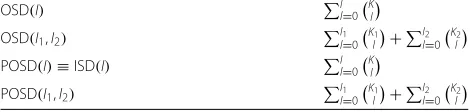
Implementation complexity
Table 1 The implementation complexity of the OSD and
1, 152 FLOPS and 528, 448 BOPS to find the MRIPs and to obtain the corresponding equivalent generator matrix in a row echelon form. All this complexity can be completely avoided by assuming the POSD decoding. The number of the test error patterns isL = 2080 for OSD(2), andL = 1177 for OSD(2, 2)withK1 = 21 andK2 = 43 whereas the coding gain of OSD(2) is only slightly better than the coding gain of OSD(2, 2) (see Figure 2). Hence, the overall complexity of the OSD-based schemes can be sub-stantially reduced by avoiding the Gauss (Gauss-Jordan) elimination.
Performance analysis
Recall that we assume a memoryless communication channel as described in “System model’’ section. We derive the probability Prcˆ0∈EL in (9) that the error patterncˆ0 observed at the receiver after the transmission of the code-wordcTx = 0is an element of the decoding listEL. The derivation relies on the following generalization of Lemma 3 in [4].
Lemma 2.For any ordering of the N received bits, con-sider the I bit positions I ⊆ {1, 2,. . .,N}, and the I1I subsetsI1 ⊆ I of I1bit positions, such that I1 ≤ I ≤ N. Then, the total probability of I1bit errors within the I bits can be calculated as
Table 2 The decoding list sizes for the OSD and the POSD OSD(I) Il=0Kl
where p0is the probability of bit error corresponding to the bit positionsIbefore the decoding.
Proof.The ordering of the chosenIbits in the given set
Iis irrelevant sinceallsubsetsI1ofI1errors within theI bitsIare considered. Consequently, the bit errors in the setIcan be considered to be independent with the equal probability denoted asp0.
Using Lemma 2, we observe that the lists of the test error patterns (10) and (12) are constructed, so that the order-ing of bits within the segments is irrelevant. Then, the bit errors within the segments can be considered to be mutu-ally independent. This observation is formulated as the following corollary of Lemma 2.
Corollary 1.For the OSD(I) and the list of the test error patterns (10), the bit errors in the MRIPs can be considered as conditionally independent. Similarly, for the POSD(I1,I2) and the list of the test error patterns (12), the bit errors in the two segments can be considered to be conditionally independent.
Thus, the bit errors in Corollary 1 are independent con-ditioned on the particular segment considered as shown next.
Let P0be the bit error probability corresponding to the MRIPs in the OSD(I)decoding. Similarly, let P1and P2be the bit error probabilities in the first and the second seg-ments in the OSD(I1,I2) decoding, respectively. Denote the auxiliary variables,v1= |˜rK1|,v2 = |˜rK1+1|, andv3= |˜rK+1|of the ordered statistics (3), and letu ≡ |ri|,i = 1, 2,. . .,K. Hence, always, v1 ≥ v2, and, for simplicity, ignoring the second permutationλ, also,v2 ≥ v3. The probability of bit error P0corresponding to the MRIPs is calculated as
where Eu[·] denotes expectation w.r.t. (with respect to)u, fv3(v)is the PDF of the(K+1)th-ordered statistic in (3), andFu(v)is the cumulative distribution function (CDF) of the absolute value of the received reliability before the ordering. Similarly, the probability of bit error P1for the first segment is calculated as
0 1 2 3 4 5 6 10−6
10−5 10−4 10−3 10−2 10−1 100
SNR[dB]
BER
BPSK ISD(2) ISD(3)
POSD(1|6,3|10) POSD(2|6,3|10) ML
Figure 2BER: BCH(128, 64, 22), AWGN channel.The BER of the(128, 64, 22)BCH code over an AWGN channel.
where fv1(v) and Fv1(v) are the PDF and the CDF of theK1th-ordered statistic in (3), respectively. The values of the probabilities P0, P1, and P2 have to be evaluated numerically. Finally, we can substitute the probabilities P0, P1, and P2forp0in Lemma 2 to calculate the probability Prcˆ0∈EL of the test error patterns in the listEL. Numerical examples
We use computer simulations to compare the BER perfor-mances of the proposed soft-decision decoding schemes. Recall that all block codes considered are linear and sys-tematic.
The BER of the(128, 64, 22)BCH code over an AWGN
channel is shown in Figure 2 assuming OSD(1) and
OSD(2) with K=64, and assuming OSD(2, 2) with
K1=21 andK2=43. The number of the test error pat-terns for the OSD(1), OSD(2), and OSD(2, 2)decodings are 64, 2, 081, and 1, 179, respectively. A truncated union bound of the BER in Figure 2 is used to indicate the ML performance [19, Ch. 10]. We observe that both OSD(2)and OSD(2, 2)have the same BER performance for the BER values larger than 10−3, and OSD(2) out-performs OSD(2, 2) by at most 0.5 dB for small values of the SNR. Our numerical results show that, in gen-eral, the OSD(2, 2) decoding can achieve approximately the same BER as OSD(2)for small to medium SNR val-ues while using about 50% less test error patterns. Thus, a slightly smaller coding gain (less than 0.5 dB) of OSD(2, 2)
in comparison with OSD(2)at larger values of the SNR is well compensated for by the reduced decoding complex-ity. More importantly, OSD(2, 2) can trade-off the BER performance and the decoding complexity between those provided by OSD(1) and OSD(2), especially at larger values of the SNR.
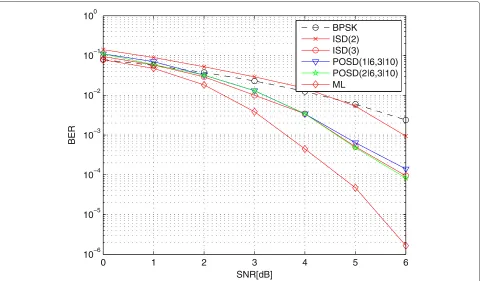
The BER of the (31, 16, 7) BCH code over an AWGN
channel is shown in Figure 3 assuming ISD(2)and ISD(3)
withK =16 having the 137 and 697 test error patterns, respectively, and assuming POSD(1, 3) and POSD(2, 3)
with K1=6 and K2=10 having the 183 and 198 test
error patterns, respectively. We observe that POSD(1, 3)
achieves the same BER as ISD(3)while using much less error patterns which represents the gain of ordering the received information bits into two segments. At the BER of 10−4, POSD(1, 3)outperforms ISD(2)by 1.1 dB using approximately 50% more test error patterns. Thus, the POSD(1, 3)decoding provides 2.3 dB coding gain, and has a small implementation complexity at the expense of 2 dB loss compared to the ML decoding.
Figure 4 shows the BER of the (63, 45, 14) BCH code over an AWGN channel. The number of the test error patterns for the ISD(2), ISD(3), POSD(1, 3), and OSD(2)
0 1 2 3 4 5 6 7 10−6
10−5 10−4 10−3 10−2 10−1 100
SNR[dB]
BER
BPSK ISD(2) ISD(3)
POSD(1|13,3|32) OSD(2)
Figure 3BER: BCH(31, 16, 7), AWGN channel.The BER of the(31, 16, 7)BCH code over an AWGN channel.
0 1 2 3 4 5
10−7 10−6 10−5 10−4 10−3 10−2 10−1 100
SNR[dB]
BER
BPSK OSD(1) OSD(2) OSD(2|21,2|43) soft union bound
the complexity of the Gauss elimination to obtain the row echelon form of the generator matrix for the OSD. For example, the Gauss elimination for the (63, 45, 14) code requires approximately 20, 400 BOPS (cf. Table 1).
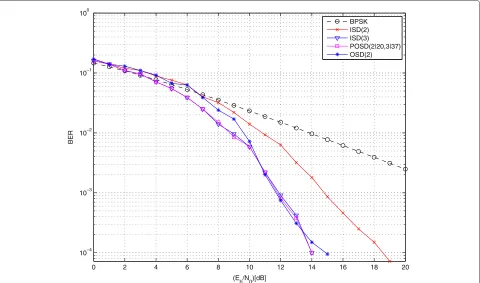
The BER of the(31, 16, 7)BCH code over a fast Rayleigh fading channel is shown in Figure 5. We assume the same decoding schemes as in Figure 3. The POSD(1, 3)
decoding with the 183 test error patterns achieves the coding gain of 17 dB over an uncoded system, the coding gain of 4 dB over ISD(2) with the 137 test error pat-terns, while it has the same BER as OSD(3) with the 697 test error patterns. The BER of the high-rate BCH code(64, 57, 4) over a fast Rayleigh channel is shown in Figure 6. In this case, the number of the test error pat-terns for the ISD(2), ISD(3), POSD(2, 3), and OSD(2)
decoding is 1, 654, 30, 914, 8, 685, and 1, 654, respec-tively. We observe that, for small to medium SNR values, POSD(2, 3)which does not require the Gauss elimination (corresponding to approximately 3, 000 BOPS) outper-forms OSD(2)by 1 dB whereas, for large SNR values, these two decoding schemes achieve approximately the same BER performance.
Conclusions
The low-complexity soft-decision decoding techniques employing the list of the test error patterns for linear binary block codes of small to medium block length were
investigated. The optimum and sub-optimum construc-tion of the list of the test error patterns was developed. Several properties of the joint probability of bit errors after the ordering were derived. The original OSD algo-rithm was generalized by assuming segmentation of the MRIPs. The segmentation of the MRIPs was shown to overcome several drawbacks of the original OSD, and it also enables flexibility to devise new decoding strategies. The decoding complexity of the OSD-based decoding algorithms was further reduced by avoiding the Gauss (or the Gauss-Jordan) elimination using a partial ordering of the received bits in the POSD decoding. The perfor-mance analysis was concerned with the problem of finding the probability of the test error patterns contained in the decoding list. The BER performance and the decod-ing complexity of the proposed decoddecod-ing schemes were compared by extensive computer simulations. Numer-ical examples demonstrated excellent flexibility of the proposed decoding schemes to trade-off the BER per-formance and the decoding complexity. In some cases, both the BER performance as well as the decoding com-plexity of the segmentation-based OSD were found to be improved compared to the original OSD.
Appendix
We derive the probabilities P0, P1, and P2in “Performance analysis” section. Without loss of generality, we assume
0 5 10 15 20
10−4 10−3 10−2 10−1 100
(Eb/N0)[dB]
BER
BPSK ISD(2) ISD(3)
POSD(1|6,3|10) OSD(2)
0 2 4 6 8 10 12 14 16 18 20
Figure 6BER: BCH(64, 57, 4), Rayleigh fading channel.The BER of the(64, 57, 4)BCH coded over a Rayleigh fading channel.
that the all-ones codeword was transmitted, i.e., xi = −1 for∀i. Then, after the ordering, theith received bit, i = 1, 2,. . .,N, is in error, provided that ˜ri > 0. The probability of bit error P0 for bits within the MRIPs is calculated as
where the conditional PDF [21],
fu(u|u≥v3)= reliabilities of the received bits, respectively, and thus,
P0=
Similarly, after the ordering, the probability of bit error P1, for the received bits in the first segment, is calculated as
The probability of bit error P2after the ordering, for the received bits in the second segment, is calculated as
P2=
and the joint PDF of the ordered statisticsv1≥v3is
fv1,v3(v1,v3)=
The authors declare that they have no competing interests.
Author details
1Electrical Engineering Department, Mu’tah University, P.O. BOX (7), Postal
Code 61710, Mu’tah, Jordan.2College of Engineering, Swansea University,
Singleton Park, Swansea SA2 8PP, UK.
References
1. N Chen, Z Yan, Complexity analysis of Reed-Solomon decoding over GF(2m) without using syndromes. EURASIP J. Wirel. Commun. Netw. 2008(Article ID 843634), 1-11 (2008)
2. S Howard, C Schlegel, K Iniewski, Error control coding in low-power wireless sensor networks: when is ECC energy-efficient? EURASIP J. Wirel. Commun. Netw.2006(Article ID 74812), 1-14 (2006)
3. H Yagi,A study on complexity reduction of the reliability-based maximum likelihood decoding algorithm for block codes: (PhD thesis, Waseda University, 2005)
4. M Fossorier, S Lin, Soft-decision decoding of linear block codes based on ordered statistics. IEEE Trans. Inf. Theory.41, 1379–1396 (1995) 5. A Valembois, M Fossorier, Box and match techniques applied to soft
decision decoding. IEEE Trans. Inf. Theory.50, 796–810 (2004) 6. B Dorsch, A decoding algorithm for binary block codes and J-ary output
channels. IEEE Trans. Inf. Theory.20, 391–394 (1974)
7. J D Gazelle, Snyders, Reliability-based code-search algorithms for maximum-likelihood decoding of block codes. IEEE Trans. Inf. Theory.43, 239–249 (1997)
8. A Kabat, F Guilloud, R Pyndiah, New approach to order statistics decoding of long linear block codes. inProceedings of the GLOBECOM 2007. (Washington, DC, USA, 26–30, November 2007, pp. 1467–1471 9. H Yagi, T Matsushima, S Hirasawa, Fast algorithm for generating candidate
codewords in reliability-based maximum likelihood decoding. IEICE Trans. Fund. Electron. Commun. Comput. Sci.E89-A, 2676–2683 (2006) 10. M Fossorier, S Lin, Computationally efficient soft decision decoding of
linear block codes based on ordered statistics. IEEE Trans. Inf. Theory.42, 738–750 (1996)
11. M Fossorier, Reliability-based soft-decision decoding with iterative information set reduction. IEEE Trans. Inf. Theory.48, 3101–3106 (2002) 12. W Jin, M Fossorier, Reliability based soft decision decoding with multiple
biases. IEEE Trans. Inf. Theory.53, 105–119 (2007)
13. A Valembois, M Fossorier, Sort-and-match algorithm for soft-decision decoding. IEEE Trans. Inf. Theory.45, 2333–2338 (1999)
14. M El-Khamy, H Vialko, B Hassibi, R McEliecce, Performance of sphere decoding of block codes. IEEE Trans. Commun.57, 2940–2950 (2009) 15. H Vikalo, B Hassibi, On joint detection and decoding of linear block codes
on Gaussian vector channels. IEEE Trans. Signal Process.54, 3330–3342 (2006)
16. T Hu, M Chang, List decoding of generalized Reed-Solomon codes by using a modified extended key equation algorithm. EURASIP J. Wirel. Commun. Netw.2011(Article ID 212136), 1-6 (2011)
17. J Ser, D Manjarres, P Crespo, S Gil-Lopez, J Garcia-Frias, Iterative fusion of distributed decisions over the Gaussian multiple-access channel using concatenated BCH-LDGM codes. EURASIP J. Wirel. Commun. Netw. 2011(Article ID 825327) (2011)
18. S Alnawayseh, P Loskot, Low-complexity soft-decision decoding techniques for linear binary block codes. inProceedings of the WCSP, 2009. Nanjing, China, 13–15 November 2009, pp. 1–5
19. S Benedetto, E Biglieri,Principles of Digital Transmission with Wireless Applications: (Kluwer Academic, Netherlands, 1999)
20. S Lin, D Costello,Error Control Coding: Fundamentals and Applications: (Prentice-Hall Englewood Cliffs, NJ, 1983)
21. A Papoulis, S Pillai,Probability, Random Variables, and Stochastic Processes. 4th edn (McGraw-Hill, NY, 2002)
doi:10.1186/1687-1499-2012-314
Cite this article as:Alnawayseh and Loskot:Ordered statistics-based list decoding techniques for linear binary block codes. EURASIP Journal on
Wireless Communications and Networking20122012:314.
Submit your manuscript to a
journal and benefi t from:
7Convenient online submission 7Rigorous peer review
7Immediate publication on acceptance 7Open access: articles freely available online 7High visibility within the fi eld
7Retaining the copyright to your article