R E S E A R C H
Open Access
On the Lambert-W function for constrained
resource allocation in cooperative networks
Félix Brah
1*, Abdellatif Zaidi
2, Jérôme Louveaux
1and Luc Vandendorpe
1Abstract
In cooperative networks, a variety of resource allocation problems can be formulated as constrained optimization with system-wide objective, e.g., maximizing the total system throughput, capacity or ergodic capacity, subject to constraints from individual users, e.g., minimum data rate, transmit power limit, and from the system, e.g., power budget, total number of subcarriers, availability of the channel state information (CSI). Most constrained resource allocation schemes for cooperative networks require rigorous optimization processes using numerical methods since closed-form solutions are rarely found. In this article, we show that the Lambert-W function can be efficiently used to obtain closed-form solutions for some constrained resource allocation problems. Simulation results are provided to compare the performance of the proposed schemes with other resource allocation schemes.
Keywords:Resource allocation, Lambert-W function, cooperative networks, QoS
1 Introduction
Cooperative transmissions have attracted much atten-tion over the last few years. It has been demonstrated that the benefits of multi-antenna transmission can be achieved by cooperative transmission without requiring multiple antennas at individual nodes (for example see [1-3]). Cooperation is particularly relevant when the size of mobile devices limits the number of antennas that can be deployed.
Wireless Mesh networks (WMN) and relay networks are among the main networks that use cooperative com-munication. The main distinguished characteristic of mesh and relay networks is possibility of multi-hop communication. In Mesh networks, traffic can be routed through other mobile stations (MSs) and can also take place through direct links. Nodes are composed of mesh routers and mesh clients and thus routing process is controlled not only by base station (BS) but also by mobile station MS [4]. Each node can forward packets on behalf of other nodes that may not be within direct wireless transmission range of their destination. In case of relay networks, the network infrastructure consists of relay stations (RSs) that are mostly installed, owned, and
controlled by service provider. A RS is not connected directly to wire infrastructure and has the minimum functionality necessary to support multi-hop communi-cation. The important aspect is that traffic always leads from or to BS. The realization of the performance improvement promised by cooperation in wireless mesh and relay networks depends heavily on resource alloca-tion (among other things).
Recently, resource allocation for OFDMA WMN with perfect CSI has been an active research topic. In [5], a fair subcarrier and power allocation scheme to maximize the Nash bargaining fairness has been proposed. Instead of solving a centralized global optimization problem, the authors proposed a distributed hierarchical approach where the mesh router allocates groups of subcarriers to the mesh clients, and each mesh client allocates trans-mit power among its subcarriers to each of its outgoing links. In [6], an efficient intra-cluster packet-level resource allocation approach taking into account power allocation, subcarrier assignment, packet scheduling, and QoS support has been studied. The authors employ the utility maximization framework to find the joint power-frequency-time resource allocation that maximizes the sum rate of a WMN while satisfying users minimum rate requirements. The benefits of optimal resource allo-cation in cooperative relay networks with perfect CSI * Correspondence: [email protected]
1
ICTEAM Institute, Université Catholique de Louvain, Place du Levant 2, 1348 Louvain-la-Neuve, Belgium
Full list of author information is available at the end of the article
has also been investigated by several authors (see, e.g., [7,8], and references therein).
However, when the channel variations are fast, the transmitter may not be able to adapt to the instanta-neous channel realization. Hence, CSI-aware resource allocation is not suitable for environments with high mobility. When the channel state can be accurately tracked at the receiver side, the statistical channel model at the transmitter can be based on channel distribution information feedback from the receiver. We refer to knowledge of the channel distribution at the transmitter as CDIT. In [9], CDIT-based constrained resource allo-cation problem for non-cooperative OFDMA-based net-works is studied. The authors derive an optimal power allocation algorithm in closed-form. In [10], a dynamic resource allocation algorithm aiming to maximize the delay-limited capacity of a cooperative communication with statistical channel information is developed. In [11], a power allocation problem for ergodic capacity maximization in relay networks under high SNR regime is solved using numerical methods.
In this article, we present a new result on how the Lambert-W function can be used to efficiently find closed-form solution of constrained resource allocation problems for cooperative networks.
There are two significant benefits from using the Lam-bert-W function in the context of resource allocation for cooperative networks. Most resource allocation schemes for cooperative networks require rigorous optimization processes using numerical methods since closed-form solutions are rarely found. Using the Lambert-W func-tion, resource allocations can not only be expressed in closed-form but they can also quickly be determined without resorting to complex algorithms since a number of popular mathematical softwares, including Maple and Matlab, contain the Lambert-W function as an optimi-zation component.
The Lambert-W function has several uses in physical and engineering applications [12-15]. In [14], the Lam-bert-W function is used for the purpose of diode para-meters determination in diodeI-Ucurve fitting. Recent work in [15] shows that the Lambert-W function also finds utilization in Astronomy to calculate the position of an orbiting body in a central gravity field.
The remainder of this article is organized as follows. In Sect. 2, we provide a concise introduction to the Lambert-W function. In Sect. 3, we show how the Lam-bert-W function is applied to a subcarrier allocation problem in WMNs. The use of the Lambert-W function to a power allocation problem in relay networks with statistical channel information is discussed in Sect. 4. In Sect. 5, we show the performance of the proposed resource allocation methods by simulation. Finally, con-clusions are drawn in Sect. 6.
2 The Lambert-W Function
The Lambert functionW(x) is defined to be the multi-valued inverse of the function f(x) =xex [12]. That is, Lambert W(x) can be any function solution of the trans-cendental equation
W(x)eW(x)=x. (1)
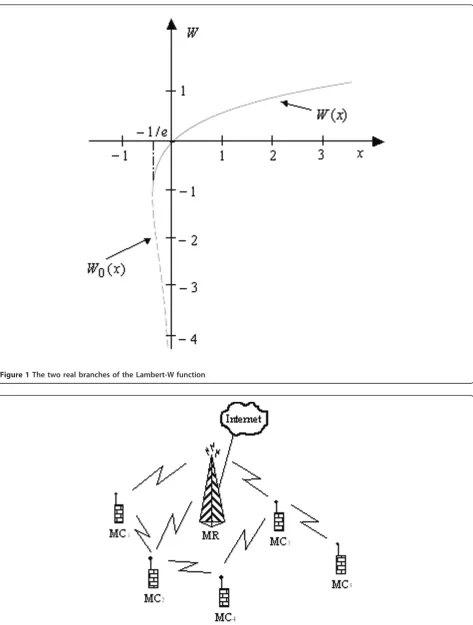
Actually, for some values of x, Equation 1 has more than one root, in which case the different solutions are called branches of W. Since the values of interest in our work are real, we will concentrate on real-value branches ofW. If xis real, then for -1/e≤ x< 0, there are two possible real values ofW(x) (see Figure 1). The branch satisfying W(x)≤ -1 is denoted by W0(x). The branch satisfying W(x)≤-1 is denoted byW(x) and it is referred to as the principal branch of the Lambert-W function.
Thenth derivative of the Lambert-W function is given by [12].
dnW(ex) dxn =
qn(W(ex))
(1 +W(ex))2n−1 forn≥1 , (2)
in which the polynomialsqn, given by
qn(w) = n−1
i=0
n−1
i
(−1)iwi+1, (3)
contain coefficients expressed in terms of second-order Eulerian numbers andq1(w) = w.
In (3), the second-order Eulerian number
n m
cor-responds to the number of permutations of themultiset {1, 1, 2, 2,...,n,n} withmascents which have the prop-erty that for each i, all the numbers appearing between the two occurrences ofiin the permutation are greater thani[16].
The application of the Lambert-W function to obtain a closed-form solution for resource allocation problems in wireless mesh and relay networks constitutes the principal contribution of this article.
3 The Lambert-W function for subcarrier allocation in wireless mesh network 3.1 Problem formulation
Figure 1The two real branches of the Lambert-W function.
There are a total ofNsubcarriers in the system. Each subcarrier has a bandwidthB. The channel gain of sub-carriernon link (k,j), which connects MCkto MCj, is denoted byGnkjand the transmit power of MC kon sub-carriern is denoted by pnk. MC khas a transmit power limit ofp¯kand a minimal rate requirement ofRk. Let nk be the number of subcarriers to allocate to MCk, using only information available at the MR, i.e., the average channel gain of all outgoing links at MCk,G¯k. Based on
¯
Gkand uniform power allocation assumption over all the nk subcarriers(pnk =p¯k
nk,∀k), the MR determines an approximated rate for MCkas
rk(nk) =nkBlog2
n is the thermal noise power, and Γ is the SNR gap related to the required bit-error-rate (BER). The main reason that the MR determines an approxi-mated rate instead of the exact rate is that the MR knows only the average channel gainG¯k, but not the complete channel gainGnkj. In general, exact and com-plete information needed to determine the exact rate is rarely available at the MR. For practical SNR values (SNR > 5 dB), the gap between the exact rate and its approximate (4) is very small and (4) can be viewed as the rate realized at MCk.
There are various constraints associated with resource allocation in OFDMA-based WMNs. At each node k, the sum of the transmit power on the allocated subcarriers is bounded by a maximum power level p¯k. We assume that each subcarrier can only be allocated to one transmission link in a cluster. Different traffic types require different packet transmission rates. For example, voice packets require a constant rate; video traffic has minimum, mean, and maximum rate requirements; while data traffic is usually treated as background traffic whose source rate is dynamic. In our problem formulation, we only take the minimum rate requirement of these three traffic types, if any, into account.
The resources to allocated are defined as a set of subcarriers, and the total transmit power available at each node. We consider a distributed hierarchical resource allocation, where the MR only performs a rough resource allocation with limited information (the average channel gain of all outgoing links at MC or the statistical channel information) and the MCs perform more refined resource allocation with full information that is available locally. In this section, we focus on subcarrier allocation at MR and we assume that each MCk distributes its transmit power limitp¯k equally over all its allocated subcarriers. After
subcarrier allocation, the optimal power allocation is performed at each MC k. The optimal power alloca-tion is not developed in this article. Mathematically, the subcarrier allocation problem at MR can be formu-lated as
3.2 Solution method
We propose a solution method based on the Lagrange dual approach and the Lambert-W function. First, we express the Lagrangian of the primal problem (5) as
L(nk,λk,μ) =
where lk and μare the Lagrangian multipliers asso-ciated with the minimum rate constraint of MC kand the total subcarrier constraint.
By KKT first optimality condition [17], we take the derivative of (6) with respect tonkfor fixed (lk, μ) and set the derivative to zero to obtain
ln optimal value of subcarriers to be allocated to MCkis given by (see Appendix A)
n∗k=
min λk,μ
L(n∗k,λk,μ). (9)
The optimalλ∗k, for fixed μ, are found using KKT con-ditions. To derive L(n∗k,λk,μ)overlk, we make use of the formula of the nth derivative of the Lambert-W function given by (2). Applying (2) for n= 1, we obtain that the optimalλ∗khas to satisfy (see Appendix B)
fm(λ∗k)− Rk
It can be shown thatfmis a strictly increasing function of λ∗k and fm(λ∗k)>0for all λ∗k≥0. Thus, the inverse
Now we turn to find the optimalμ*. Substitutinglkin (8) by the optimal value obtained in (11) and using the constraintKk=1nk=N, we obtain (see Appendix C. for proof).
Thus
μ∗=g−1
m (N). (14)
3.3 Extension to Mesh router with statistical channel information
In some fading environments, there may not be a feed-back link sufficiently fast to convey the full CSI to the MR. The MR may know only the channel distribution information (CDI) and may use the CDI to allocate resource. Following the approach in [9], we can formu-late an ergodic rate maximization problem at the mesh router with only CDI as
max the statistical expectation with respect toa.
Using the solution method proposed in 3.2, the opti-mal subcarrier allocation solution of (15) can be obtained by solving the following equation forn˜k
Eαk
To express the left hand side of (16), we need to find the probability density function (pdf) of the random variable
It can be observed that f˜mis monotonically nonde-creasing and non-negative with respect to ak. Thus, there exists a unique inverse function, ˜f−1
m , of f˜m. Let F˜αk(αk)andT˜αk(αk)denote the cumulative distri-bution function (cdf) and the pdf ofak. We assume that
˜
Fαk(αk)andT˜αk(αk)are known at the MR.
First, using the same derivation as in Appendix A where the right hand side of equation (A.1) is ˜fminstead of 0, we can express the inverse function of f˜mas
Using expression (18) for the root, we derive the cdf
Finally, using (20), the optimal subcarrier assignment
˜
n∗kis obtained by solving the following equation forn˜∗k
∞
For given multipliers lk and μ, Equation 21 can be solved numerically.
The optimal values oflk, (kÎ [1, K]) and μstill need to be found. They correspond to the ones that satisfy the individual rate constraints and the total subcarriers constraint (with equality). If some of the individual rate constraints are exceeded, the corresponding lkis equal to zero. Unlike in the instantaneous allocation where we have derive closed forms forlk andμ, here it is not easy to obtain a close form. We use an iterative search algorithm to find the optimal set oflkand μ.
4 The Lambert-W function for CDIT-based power allocation in relay networks
In this section, we show how the Lambert-W Function can be used for constrained resource allocation in relay networks.
4.1 Problem formulation
Consider the relay network operating in receiver coop-eration mode as illustrated in Figure 3. The transmitter at the source node sends a signalx. Letx1 andy1 denote the transmitted and received signals at the relay node, respectively. We assume that the relay node operates in the full duplex mode, i.e., the relay can receive and transmit simultaneously on the same frequency channel [7]. Thus, the received signals at the relay node and the destination node are given by
y1=h2x+z1
y=h1x+√gh3x1+z,
(22)
wherez1 andzare independent identically distributed (i.i.d) zero mean circularly symmetric complex Gaussian (ZMCSCG) additive noise with unit variance.
The capacity cut set bound of the relay network of Figure 3 operating in a full duplex mode with perfect CSI can be expressed as [11]
Cinst= max
wherer represents the correlation between the trans-mit signals of the transtrans-mitter and the relay, and gi= |hi| 2
.
We assume Rayleigh fading where each channel gain hi, i = 1, 2, 3, is i.i.d. and normalized to have unit var-iance; hence, the corresponding channel power gain is i. i.d. exponential with unit mean. The average channel power gain between the relay and the receiver isg. We assume that gcharacterizes only path-loss attenuation, hence g = 1/da, where d is the distance between the relay node and the receiver node and ais the path-loss power attenuation exponent. As in receiver cooperation mode the relay is assumed to be close to the receiver, the scenario of interest is whendis small.
We consider a fast fading environment, where the recei-ver has CSI to perform coherent detection, but there is no fast feedback link to convey the CSI to the transmitter. Hence, the transmitter only has CDI, but no knowledge of the instantaneous channel realizations. Ergodic capacity is used to characterize the transmission rate of the channel.
We assume the channel has unit bandwidth. We further assume an average network power constraint on the system:
E|x|2+|x1|2
≤P, (24)
where the expectation is taken over repeated channel uses.
The network power constraint model is applicable when the node configuration in the network is not fixed [11]. Note that, when the node configuration is fixed, the individual power constraint model reflects the prac-tical scenarios more than the network model. However, the power allocation problem is, in general, more tract-able under network power constraint.
The total power P is optimally allocated between the transmitter and the relay, i.e.,
E|x|2≤βP, E|x1|2
≤(1−β)P, (25)
wherebÎ[0,1] is parameter to be optimized based on CDI and node geometryg.
It has been shown in [7] that the capacity upper bound in the asynchronous channel model, i.e., the channel model where the nodes do not have complete CSI, can be found by setting the correlation rto zero. Since the CDI channel model falls into this case, the ergodic capacity upper bound can be found by taking the expectation of (23) over the channel distribution and settingr= 0. Making use of the high SNR (P≫ 1) approximation log(1 +xP)≈log(xP), the ergodic capa-city upper bound is then given by
Cerg= max
The problem is to find the optimal power allocation, i. e., the optimal value of b, that gives the capacity upper bound Cerg(b) of (26). Mathematically the power alloca-tion problem can be formulated as
max
Problem (27) has been addressed in [11] and a numer-ical solution has been proposed, but no closed-form expression has been provided. This contrasts with what will be done here.
4.2 Solution method
To find the optimal power allocation in closed-form, we propose an approach that uses the Lambert-W function.
First, we need to evaluate the expected value of the capacity expression over the channel fading distribution. For this end, we make use of the following formula for i.i. d. exponential random variablesX1,X2with unit mean:
E[log(a1X1+a2X2)]
where a1anda2 are positive scalar constants andgis Euler’s constant.
Applying formula (28), the first term and the second term inside the min{.} in expression (26) are given, respectively, by
Expression (29) is an increasing function of b. It is easy to show that expression (30) is a decreasing func-tion ofb(for gof interest, i.e.,g> 1). Thus the optimal valueb* solution of the maximization problem (27) can be found by equating expressions (29) and (30) as
log2P+ log2β∗+ log2e1−γ=log2P
+g(1−β ∗)log
2(g(1−β∗))−β∗log2β∗
g(1−β∗)−β∗ −log2eγ. (31)
Equation 31 is equivalent to
ln (β∗) + 1 = g(1−β
∗) ln (g(1−β∗))−β∗ln (β∗)
g(1−β∗)−β∗ ,(32)
where ln(x) is the natural logarithm ofx.
After some algebraic manipulations (32) can be rewrit-ten equivalently as
−β∗
It can be recognized that Equation 33 is in the form of a transcendental Equation 1. Thus we have
W
The optimal valueb* is deduced from (34) as
β∗= Kg
whereK=−W
−1
e = 1.
It is interesting is to observe that the optimal power allocation is obtained in closed-form and depends only ong, i.e., on the distancedbetween the relay node and the destination node and the path-loss power attenua-tion exponenta.
4.3 Comparison with CSIT-based power allocation
In order to assess the relevance of the CDIT-based approach, it has to be compared to the allocation scheme based on perfect CSIT. Perfect CSIT is unrealis-tic, but for the purpose of comparison, let us assume perfect CSIT. Then the power allocation can be formu-lated to maximize the instantaneous capacity instead of the ergodic capacity. Mathematically, the CSIT-based power allocation can be formulated as
max 0≤ρ,β≤1min
1
2log2(1 +βP(1−ρ 2) (γ
1+γ2)),
1 2log2
1 +βPγ1+
(1−β)g+ 2ρβ(1−β)g
Pγ3
.
(36)
The optimal values of rand b solution of (36) have been found in [11] as
ρ∗= 1
g2+ 2g+ 2, (37)
β∗= g2+ 2g+ 2
g2+ 3g+ 2. (38)
The instantaneous capacity upper bound for high SNR regime is deduced as
Cinst= log2
2#g+ 1$
g+ 2 P
. (39)
Both CDIT-based and CSIT-based optimal power allo-cation expressions (35) and (38) are in closed-form and very fast to compute. Thus, the complexity is almost the same. The main difference between the two allocation schemes is the amount of feedback required to perform power allocation. Recall that, for the CSIT-based scheme, the allocation is performed after each symbol period. Let Ns be the number of symbol periods after which the CDIT-based resource allocation is performed. Then a rough estimation tells us that the feedback needed to perform CDIT-based power allocation is
reduced by 1
Ns
compared to the perfect CSIT scheme.
5 Simulation results
In order to assess the performance of the proposed resource allocation methods, we conduct simulations
and compare the simulation results with other baseline schemes.
5.1 Simulation results for wireless mesh networks
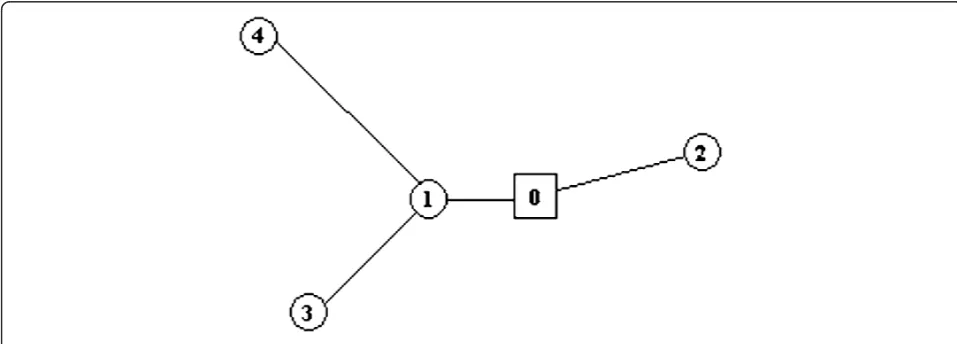
We consider a cluster with four wireless nodes with the scheduling tree topology shown in Figure 4 and 4a total number of subcarriers N = 128 over a 1-MHz band. The relative effective SNR difference between MC 1 (the closest MC to the MR) and MC 2, 3, and 4 are 3, 6, and 10 dB, respectively. The minimum rate requirements are chosen to be the same for all MCs, the maximal power at each MC kis p¯k= 50 mW, the thermal noise power isσ2
n = 10−11W.
We assume a Rayleigh fading. Thus, for the CDI-based allocation, the ak follow a c2 distribution with 2Lk degree of freedom, whereLk is the number of outgoing links at MCk. For MC with a single outgoing link,akis reduced to an exponential distribution.
We name the proposed scheme with optimal alloca-tion at MR and MCs as full optimal resource allocation (FORA). For comparison, we also implement the follow-ing resource allocation schemes:
1.MR-based optimal resource allocation (MORA) where the MR performs the proposed optimal subcarrier assignment, but each MC performs uniform power allocation among its outgoing links.
2.Full uniform resource allocation (FURA) where each MC is assigned the same number of subcarriers and transmit power at each MC is uniformly distrib-uted over the assigned subcarriers and the active links.
We evaluate system performance in terms of sum rate, and satisfaction of minimum rate requirements.
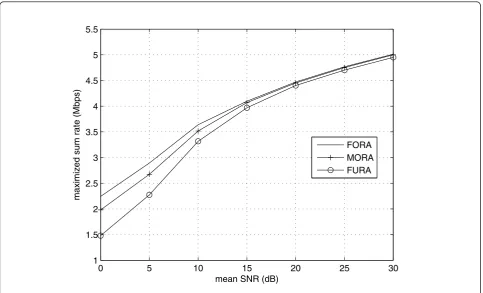
In Figure 5, the performance of the proposed FORA is compared to that of the optimal resource allocation at MR under uniform power allocation at MCs (MORA) and the FURA. The result shows that the proposed optimal resource allocation brings significant gain over uniform resource allocation, especially for low SNRs.
0 5 10 15 20 25 30 1
1.5 2 2.5 3 3.5 4 4.5 5 5.5
mean SNR (dB)
maximized sum rate (Mbps)
FORA MORA FURA
Figure 4Network topology used in the simulations.
1 2 3 4
0 0.5 1 1.5
MC node ID (k)
rate per MC (Mbps)
min. rate req. (R
k)
FORA MORA FURA
5.2 Simulation results for relay networks
In all the simulations, we assume a path-loss power attenuation exponent of 2, and henceg= 1/d2. The dis-tance dbetween the relay node and the receiver node varies from 0.1 to 1.
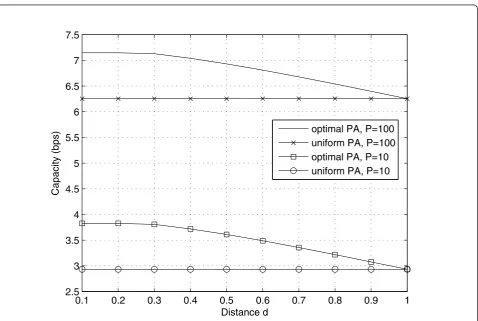
In Figure 7, the ergodic capacity achieved using the proposed power allocation scheme is compared to the one obtained with uniform power allocation (b= 0.5, ∀d Î [0.1, 1]). We consider system average network power constraints of P = 10 and P = 100. It can be observed that the achieved capacity using the proposed
optimal power allocation method outperforms the capa-city obtained with uniform allocation.
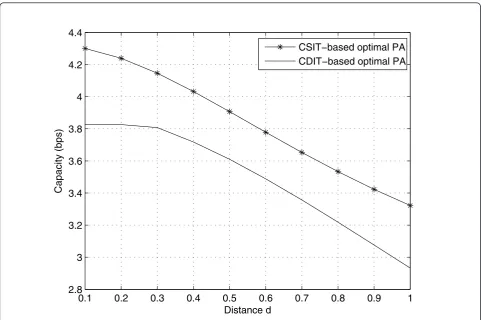
Figure 8 illustrates the achieved capacity using the proposed CDIT-based optimal power allocation (35) in comparison with the capacity of the CSIT-based optimal power allocation (38). The CSIT-based capa-city is averaged over the same number of channel rea-lizations Ns over which the distribution is taken to evaluate the ergodic capacity. The result shows that the gap between the average capacity and the ergodic capacity is small. Thus, even with CDIT only, optimal power allocation improves performance of relay networks.
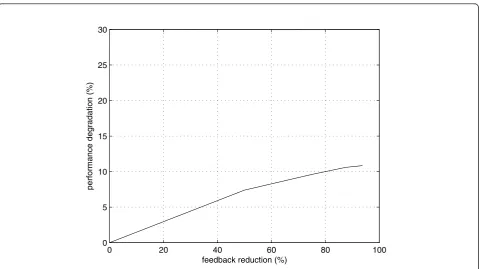
The trade-off between reduced feedback and perfor-mance degradation of the proposed CDIT-based optimal power allocation in comparison with the perfect CSIT-based optimal power allocation is shown in Figure 9. We observe that adapting the transmission strategy to the short-term channel statistics, increases the perfor-mance but also increases the amount of feedback. How-ever, if the transmission is adapted to the long-term channel statistics, the amount of feedback decreases sig-nificantly but with a penalty on the performance. For a CDIT-based allocation with a distribution taken over 16 Figure 6Per mesh client rate forRk= 1 Mbps.
0.1 0.2 0.3 0.4 0.5 0.6 0.7 0.8 0.9 1
2.5 3 3.5 4 4.5 5 5.5 6 6.5 7 7.5
Distance d
Capacity (bps)
optimal PA, P=100 uniform PA, P=100 optimal PA, P=10 uniform PA, P=10
symbol periods, the amount of feedback is reduced by 93.75%, while the performance degradation in terms of capacity is less than 12%.
6 Conclusion
We have addressed constrained resource allocation pro-blems for wireless mesh and relay networks. For mesh networks, we have formulated a distributed subcarrier allocation problem to maximize the sum rate while satisfying minimum rate demand. For relay networks, we have formulated power allocation problem to maxi-mize the ergodic capacity under total power constraint. Both cases of perfect and statistical channel knowledge at the transmitter have been considered. We have shown how the Lambert-W function can be use to effi-ciently find the optimal resource allocation in closed-form. Using the Lambert-W function, resource alloca-tion can quickly be determined since a number of popu-lar mathematical softwares, including Maple and Matlab, contain the Lambert-W function as an optimi-zation component. The Lambert-W function can be combined with the Lagrange dual approach to solve variety of wired and wireless resource allocation
problems without resorting to complex numerical algorithms.
Appendix
Appendix A: Derivation of (8)
Equation 7 can be rewritten as
ln
nk
nk+αk −
nk
nk+αk
+ 1 + B μ
ln 2(1 +λk)
= 0. (A:1)
Equation A.1 can be rewritten equivalently as
− nk
nk+αk
e
− nk nk+αk
=−exp
−1− B μ
ln 2(1 +λk)
(A:2)
Expression (A.2) is in the form of the Lambert-W function W(x), which is the solution toW(x)eW(x)=x. Thus, from (A.2) we can deduce that
W
−exp
−1− B μ
ln 2(1 +λk)
=− nk
nk+αk
(A:3)
which when then solved fornkgives (8).
0.1 0.2 0.3 0.4 0.5 0.6 0.7 0.8 0.9 1
2.8 3 3.2 3.4 3.6 3.8 4 4.2 4.4
Distance d
Capacity (bps)
CSIT−based optimal PA CDIT−based optimal PA
Appendix B: Derivation of (10)
Replacingnk in (6) by its optimal value given by (8), we get the dual function
L(λk,μ)=
Equation B.1 can be rewritten as
L(λk,μ)=μN−
Applying (2) for n= 1 and using the property of the derivative of a composite function, we obtain the deriva-tive ofwkwith respect tolkfor fixedμas
Applying KKT optimality conditions, we set the deri-vative (B.4) to zero to obtain
−Rk
feedback reduction (%)
performance degradation (%)
We see that Equation B.5 can be rewritten in the form of Equation 10.
Appendix C: Proof of Proposition 1
Let
The derivative ofw˜kwith respect toμis given by
dwk(μ)
Using (C.1), we can calculate the derivative of gk,m(μ) with respect toμas
dgk,m(μ) This completes the proof.
Abbreviations
BS: base station; BER: bit-error-rate; CDI: channel distribution information; CSI: channel state information; cdf: cumulative distribution function; FORA: full optimal resource allocation; FURA: full uniform resource allocation; MC: mesh clients; MR: mesh router; MS: mobile station; MORA: MR-based optimal resource allocation; RS: relay station; WMNs: wireless Mesh networks; ZMCSCG: zero mean circularly symmetric complex Gaussian.
Author details 1
ICTEAM Institute, Université Catholique de Louvain, Place du Levant 2, 1348 Louvain-la-Neuve, Belgium2SYSCOM, Université Paris-Est, Marne la Vallée,
France
Competing interests
The authors declare that they have no competing interests.
Received: 4 October 2010 Accepted: 20 June 2011 Published: 20 June 2011
References
1. A Nosratinia, A Hedayat, Cooperative communication in wireless networks. IEEE Commun Mag.42(10):74–80 (2004). doi:10.1109/MCOM.2004.1341264 2. JN Laneman, D Tse, GW Wornell, Cooperative diversity in wireless networks:
efficient protocols and outage behavior. IEEE Trans Inf Theory.
51(9):3062–3080 (2004)
3. G Kramer, M Gastpar, P Gupta, Cooperative strategies and capacity theorems for relay networks. IEEE Trans Inf Theory.51(9):3037–3063 (2005). doi:10.1109/TIT.2005.853304
4. IF Akyildiz, X Wang, W Wang, Wireless mesh networks: a survey. Comput Netw ISDN Syst.47(4):445–487 (2005)
5. KD Lee, VCM Leung, Fair allocation of subcarrier and power in an OFDMA wireless mesh networks. IEEE J Sel Areas Commun.24(11):2051–2060 (2006) 6. HT Cheng, W Zhuang, Novel packet-level resource allocation with effective
QoS provision for Wireless Mesh Networks. IEEE Trans Wireless Commun.
8(2):694–700 (2009)
7. A Host-Madsen, J Zhang, Capacity bounds and power allocation in wireless relay channel. IEEE Trans Inf Theory.51(6):2020–2040 (2005). doi:10.1109/ TIT.2005.847703
8. Y Yao, X Cai, GB Giannakis, On energy efficient and optimum resource allocation of relay transmissions. IEEE Trans Wireless Commun.
4(6):2917–2927 (2005)
9. F Brah, J Louveaux, L Vandendorpe, CDIT-Based constrained resource allocation for mobile WiMAX systems. EURASIP J Wireless Commun Netw
2009, 1–8 (2009). Article ID 425367
10. D Grunduz, E Erkip, Opportunistic cooperation by dynamic resource allocation. IEEE Trans Wireless Commun.6(4):1446–1454 (2007) 11. CTK Ng, AJ Goldsmith, The impact of CSI and power allocation on relay
channel capacity and cooperation strategies. IEEE Trans Wireless Commun.
7(12):5380–5389 (2008)
12. RM Corless.,et al, On the Lambert W function. Adv Comput Math.5, 329–359 (1996). doi:10.1007/BF02124750
13. N Galidakis, On an application of Lambert’s W function to infinite exponentials complex variables. Elliptic Equ.49(11):759–780 (2004) 14. P Hruska, Z Chobola, L Grmela, Diode I-U curve fitting with Lambert W
function. Proceedings of the IEEE International Conference on Microelectronics, Belgrade. 468–471 (2006)
15. P Sengupta, The Lambert-W function and solutions to Kepler’s equation. Clestial Mech Dyn Astron.99(1):13–22 (2007). doi:10.1007/s10569-007-9085-6 16. RL Graham, DE Knuth, O Patashnik,Concrete Mathematics: A Foundation for
Computer Sciences,, 2nd edn. (Addison-Wesley, Reading, 1994)
17. S Boyd, L Vandenberghe,Convex Optimization. (Cambridge University Press, Cambridge, 2004)
doi:10.1186/1687-1499-2011-19
Cite this article as:Brahet al.:On the Lambert-W function for
constrained resource allocation in cooperative networks.EURASIP Journal
on Wireless Communications and Networking20112011:19.
Submit your manuscript to a
journal and benefi t from:
7Convenient online submission
7Rigorous peer review
7Immediate publication on acceptance
7Open access: articles freely available online
7High visibility within the fi eld
7Retaining the copyright to your article