R E S E A R C H
Open Access
Performance evaluation of chaotic
spreading sequences on software-defined
radio
Leonard Novosel
*and Gordan Šišul
Abstract
In this paper, bit error performance evaluation of chaotic sequences is presented. Performance of chaotic sequences is evaluated on multiple access spread spectrum system model for USRP software defined radio. LabVIEW is used to perform numerical simulations and bit error rate analysis. Chaotic sequences of different lengths are generated using one-dimensional, two-dimensional, and three-dimensional maps. It is expected that sequences generated from complex maps will have better multiple access performance. Performance of chaotic sequences is evaluated against orthogonal sequences in multiple access scenario. Using Golay figure of merit and Pearson correlation coefficient, analysis of correlation properties and a comparison is performed on orthogonal and chaotic sequences for correlation properties comparison. The results show that chaotic sequences from two-dimensional maps have lower bit error rate than orthogonal and other chaotic sequences. Comparison of correlation properties shows that sequences with a low figure of merit and low Pearson coefficient have lower bit error rate. Those results can be used to generate chaotic sequences with desired correlation properties.
Keywords: Chaotic sequence, Chaotic map, Spread spectrum, Multiple access, Software-defined radio, LabVIEW, USRP
1 Introduction
Chaotic behavior is present in many systems where it has been labeled as noise or some internal non-linear charac-teristic of the observed system. Chaotic oscillations come from non-linear system elements that cause unwanted behavior. Those chaotic signals have been identified as a component in all man-made and natural complex sys-tems. Research has found that these chaotic oscillations can be reproduced using relatively simple mathematical constructs that led to better understanding of chaotic and non-linear system behavior.
Various applications of non-linear dynamics and chaos have been researched in the past decades [1]. With the discovery of chaotic synchronization by Pecora and Car-rol [2], chaotic signals are used in communication sys-tems. After the development of electronics for generating chaotic signals using Chua’s circuit [3, 4], chaos could be used in digital communications as well. Since these discoveries, various digital communication systems, have
*Correspondence: [email protected]
University of Zagreb, Faculty of electrical engineering and computing, Unska 3, Zagreb, Croatia
been developed with chaotic signals [3, 5–10] with fur-ther advances in different fields of chaotic modulation techniques [11–15].
Chaotic systems display interesting properties that can be used in digital communication systems. One of these properties is sensitivity to system parameter change and changes to initial conditions. Another property is the ran-dom nature of chaotic signals. Both properties can be used to increase the capacity in multiple access systems [16, 17]. Sensitivity to initial conditions and system parameters can be used to generate sequences from dis-crete chaotic maps. These sequences have been known to have random characteristics similar to pseudo-random sequences [16–18]. Chaotic sequences can be used instead of pseudo-random sequences in cryptography, spread-spectrum systems, image, and video coding.
Research in using chaotic sequences in spread spectrum for multiple access has been made before [3, 6–9, 19–21] with some implementations in various hardware architectures [10, 22, 23].
This paper was inspired by previous work on sim-ulated chaotic spread-spectrum system models. In this paper, the focus is on bit error performance comparison of
orthogonal and chaotic sequences on a spread-spectrum communication system based on software-defined radio.
This paper is organized as follows: Section 2 explains spread spectrum modulation with a high overview of spread spectrum receiver. Section 3 explains how chaotic sequences for multiple access can be generated. Section 4 gives the overview of spread spectrum system model built in LabVIEW for software-defined radio. Section 5 discusses results obtained from software-defined radio system. Section 6 concludes this paper.
2 Spread spectrum multiple access principles Spreading sequences are used in direct sequence-spread spectrum (DS-SS) systems for spreading the baseband information signal. Spreading sequence is known only to the valid transmitter–receiver pair where spreading the information signal can be seen as a coding oper-ation. The result of baseband signal spreading enables increased interference mitigation and improved perfor-mance in multipath propagation as well as signal security and low probability of interception [24].
Direct sequence-spread spectrum modulation can be explained through two modulation stages. First, the data sequence is spread using a wideband spreading code. The spreading code is used to spread the baseband data stream into a wideband signal with the low power-spectral den-sity and noise-like properties. Spread signal is modulated on a carrier using a phase-shift keying modulation. Result-ing wideband signal will have bandwidth that is almost equal to spreading code’s bandwidth [25].
If Rb denotes the baseband information rate of data signal in bits/s, and bit duration Tb = 1/Rb, then the information signalb(t)can be expressed as [26]:
b(t)=
Spreading, pseudo-noise signal can be given as [26]:
c(t)=
∞
n=−∞
cnp(t−nTc) (2)
where {cn} = ±1 represents a pseudo-noise symbols series, andp(t)is a rectangular pulse of durationTc.
The spreading sequence has a much larger bandwidth than the information signal Tc << Tb. In spread-spectrum systemsp(t)is also called a chip, andTcis called a chip duration. 1/Tcis approximately equal to spreading signal’s bandwidthWm≈1/Tc[26].
By multiplying the data signal with the spreading sig-nal, each baseband information bit is spread toNcchips whereNcis the number of spreading sequence samples.
The main characteristic of DS-SS signal is that the power-spectral density of the spread signal can be below chan-nel noise spectral density level. The low power-spectral density of spread signal allows for stealthy com-munications and provides protection against interference or jamming [24].
In multiple access system, all users occupy the same fre-quency bandwidth at the same time slot. Multiple access is achieved by multiplying the information signals of dif-ferent users with their respective spreading sequences so different information sources are separated only by their spreading sequences.
Wideband spreading is usually done with pseudo-random or pseudo-noise (PN) sequences that are deter-ministic periodic signals known to the transmitter and receiver. Because pseudo-noise sequences are periodic, there are only a limited number of sequences of given length. Also, there exists a finite number of uncorrelated or orthogonal pseudo-noise sequences that set the limit on the number of users in multiple access schemes.
Most significant limitation in spread-spectrum mul-tiple access systems is the interference introduced by an increasing number of users in the bandwidth-limited channel. Multiple access interference (MAI) reduces over-all system capacity and increases bit error rate (BER) of the individual user. MAI can be reduced using sequences with good cross-correlation properties. Sequences in spread spectrum multiple access should be orthogonal while retaining good autocorrelation properties. Good cross-correlation (orthogonal) properties reduce MAI while good autocorrelation properties are needed for sequence synchronization and despreading [27].
2.1 Spread spectrum receiver
Digital communication system receiver is modeled as an optimal filter for the specific user or sequence. Spread-spectrum receiver can be thought as an optimal filter where the spreading sequence acts as a filter coefficient. Spread spectrum receiver generates a local copy of spread-ing sequence that is used to despread the received signal
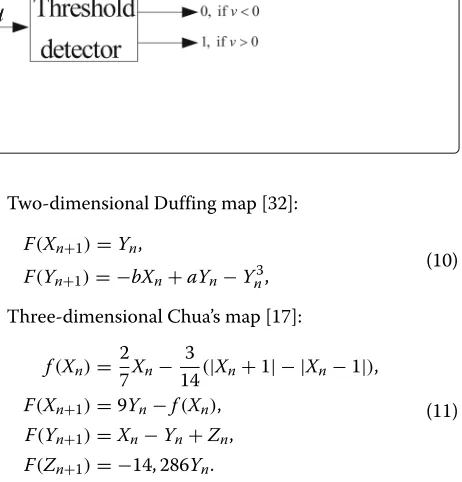
r(t). Received signal is first multiplied by a synchro-nized copy of a spreading sequence. Noise is suppressed and useful signal is amplified after low-pass filtering the despread signal. A high view overview of such spread-spectrum receiver model can be seen in Fig. 1.
Despread signalz(t)can be given as [25]:
z(t)=c(t)r(t)=c2(t)b(t)+c(t)n(t). (3)
Spreading sequence is bipolar and alternates between ±1, so squaring gives:
Fig. 1Direct sequence-spread spectrum receiver
soz(t)can be written as:
z(t)=b(t)+c(t)n(t). (5)
From Eq. 5 it can be seen that noise signal is spread over a large bandwidth, and therefore, its power spectral den-sity is low, much like the information signal in transmitter spreading procedure. After despreading, the information signal can be viewed as narrowband, where noise signal is made broadband. Using a low-pass filter, original infor-mation signalb(t) is recovered and noisen(t)is filtered out. Using a threshold detector, original message can be recovered [25].
3 Generating chaotic sequences for spread spectrum multiple access
Sample based chaotic signals can be generated from chaotic maps that give the mathematical description of a non-linear dynamical system. Although the signals are produced using a discrete non-linear system, they can be viewed as deterministic because their method of genera-tion is known and is repeatable [17].
Chaotic maps are mathematical objects that can be given as [28]:
Xn+1=F(Xn), (6)
where Xn is a state variable and F(Xn) is a mapping function.
There exists a large number of chaotic maps that can be used as chaotic sequence generators that were intensely studied before [17, 29]. Following one-, two-, and three-dimensional maps were chosen to generate chaotic spreading sequences in this paper:
Tent map [30]:
F(Xn+1)=
2μXn if 0≤Xn≤0.5
2μ(1−Xn) if 0.5<Xn≤1. (7)
Quadratic map [29]:
F(Xn+1)=μXn(1−Xn), (8)
Two-dimensional Hénon map [31]:
F(Xn+1)=Yn+1−aXn2, F(Yn+1)=bXn,
(9)
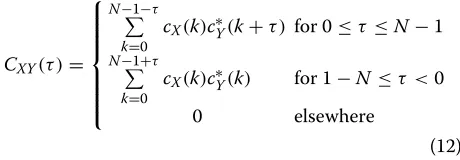
Two-dimensional Duffing map [32]:
F(Xn+1)=Yn,
F(Yn+1)= −bXn+aYn−Yn3,
(10)
Three-dimensional Chua’s map [17]:
f(Xn)= 2 7Xn−
3
14(|Xn+1| − |Xn−1|),
F(Xn+1)=9Yn−f(Xn), F(Yn+1)=Xn−Yn+Zn, F(Zn+1)= −14, 286Yn.
(11)
More detailed descriptions and properties of these chaotic maps can be found in [17, 29].
Changing the system parameter or initial conditions alters the dynamics of the system, therefore, exhibiting chaotic behavior [16]. Minor change to the non-linear system parameters produces different signals that can be used as an alternate spreading sequence in multiple access spread spectrum communication schemes. Sensi-tivity to initial conditions and system parameter makes chaotic maps ideal for generating spreading sequences of the appropriate length.
Chaotic system dependence on system parameters can be seen in Fig. 2 where two chaotic signals are gener-ated using tent map Eq. 7 with bifurcation parameters
0 20 40 60 80 100
Sample
-1 -0.8 -0.6 -0.4 -0.2 0 0.2 0.4 0.6 0.8 1
Amplitude
=1.99 =1.9899999
μ = 1.99 and μ = 1.9899999. If a threshold func-tion is applied to these two signals, the generated binary sequences are different [16]. The bifurcation parameter, or any other parameter in a chaotic system, can be known to transmitter and receiver in multiple access system. Locally generated spreading sequence can be reconstructed from a known chaotic system parameter [16]. Storing only one parameter and not the whole sequence can lead to increased security.
Chaotic sequences in this paper were generated using chaotic maps Eqs. 7, 8, 9, 10, 11. A threshold function is applied to the chaotic signals to obtain chaotic spread-ing sequences. These sequences are then used to spread BPSK-modulated signals in DS-SS system model built in LabVIEW. Discretization of chaotic signals leads to loss of information and randomness, but only binary values are allowed as spreading signals in this system model. Further improvements to this system model are needed so that sequences with more states can be used.
3.1 Measures of correlation properties of spreading sequences
Correlation properties give a numerical description of the quality of generated spreading sequences. In spread spec-trum systems, two correlation functions are observed: the autocorrelation function and the cross-correlation function.
Correlation properties can be evaluated using aperiodic correlation function and statistical tests [33, 34]. If cX andcY are sequences, then aperiodic correlation can be defined as [27]:
The Golay figure of merit factor (FoM) for a sequence of lengthNis given as [27, 33, 34]:
whereCXXis the aperiodic correlation function.
Golay figure of merit measures the energy in autocor-relation function sidelobes. Low energy sidelobes lead to better and faster sequence synchronization. Better syn-chronization gives better performance in systems where sequence synchronization is performed using autocorre-lation function.
Pearson correlation coefficient measures correlation between two sequences and can be given as [34]:
CP = mean values of cX and cY. A strong correlation occurs between two sequences for CP ±1 , and no correla-tion exists forCP≈0. Pearson coefficient is calculated for each pair of sequences. The mean Pearson coefficient is used for specified number of users as a measure of cross-correlation between sequences. Low cross-cross-correlation is essential for better performance in multiple access sys-tems where several users share same time-frequency resource. Sequences with low cross-correlation minimize noise received from other users thus minimizing multiple access interference (MAI).
The performance of different spreading sequences in software-defined radio model will be compared against mean Pearson correlation coefficient and Golay figure of merit factor.
4 Software-defined radio system model in LabVIEW
This paper presents a spread-spectrum multiple access communications system model built and tested in Lab-VIEW for software-defined radio Universal Software Radio Peripheral (USRP) transceiver chain. A receiver and a transmitter programs are built separately for two USRP software-defined radio devices.
The transmitter for a single user consists of a ran-dom number generator that generates data bits. Data bits are first encoded using a convolutional encoder with code rate 1/2 and constraint length 9. The frame is constructed using padding head bits, Barker code of length 13, encoded data bits, and tail padding bits as can be seen in Fig. 3. Padding bits are necessary due to filter delay in LabVIEW filters. Barker code is used for phase synchronization during phase shift key-ing demodulation as well as for frame synchronization after bit recovery. Constructed frame is BPSK-modulated and spread using different codes. The generated sig-nal is upsampled to 1 million samples per second and transmitted through software-defined radio transmitter. Output port of the transmitter and input port of the receiver device are connected using a coaxial cable so
the channel can be considered single path. Although the transmitter and receiver are directly connected using a coaxial cable, there exists some fading and attenuation which is not taken into account. Any channel anoma-lies or other interference from hardware components is not taken into account. The feedforward equalizer is used to minimize the error from channel and hardware imperfections.
The receiver side software-defined radio device receives the raw IQ data. The data is downsampled and low-pass filtered so that most channel and oscillator noise is removed.
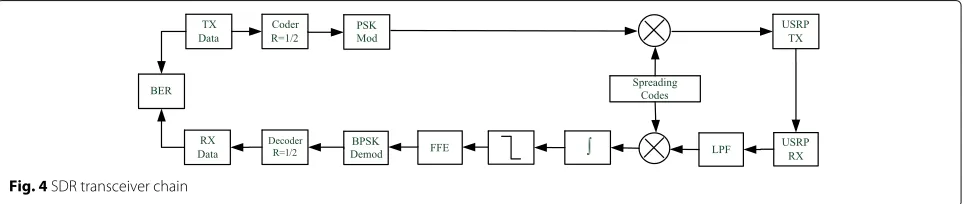
The receiver relies on sequence synchronization to start the despreading and demodulation process where good autocorrelation properties are essential. Longer sequences will have better correlation properties, but increased sequence length leads to more time needed for syn-chronization. When a sequence is synchronized above a set threshold level of 0.05 using a majority vote slid-ing correlator, despreadslid-ing and demodulation is per-formed. After despreading, the signal is equalized using a feedforward equalizer and BPSK demodulated where phase ambiguity in demodulation process is resolved using Barker sequence in the preamble. The data recov-ered after demodulation is grouped into a frame where the start of the recovered frame is synchronized and aligned using Barker sequence in the preamble. Data bits are decoded using convolutional decoder with traceback depth of 15 bits. Received data bits are extracted and compared against sent bits so that bit error rate can be calculated. Complete transceiver chain can be seen in Fig. 4.
The number of users is varied from 1 to 16 users so that performance in multiple access case can be evaluated. The waveforms of all users in the channel are added together and sent through USRP transceiver chain.
5 Results
Performance evaluation is performed after all decoded data bits were received and recovered. The multiple access system was scaled from 1 to 16 users separated only by their spreading sequence.
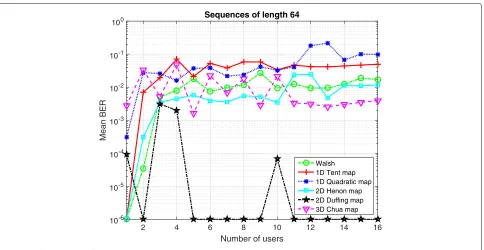
Bit error performance comparison of chaotic and Walsh sequences against can be seen in Figs. 5, 6, and 7.
Chaotic sequences generated from simple one-dimensional map functions can perform equivalently to widely used sequences in spread spectrum systems. Although performance of sequences generated from one-dimensional maps is the same or better than commonly used sequences, the number of chaotic sequences of the appropriate length surpasses the number of orthogonal or maximum length sequences.
Chaotic sequences generated from two-dimensional maps outperform other spreading sequences by a large margin. Those results can be clearly seen in cases with a large number of users where good cross-correlation properties are essential. Two-dimensional maps are more complicated than one-dimensional but require little more resources for sequence generation. The performance gain from using two-dimensional maps justifies some addi-tional resource consumption. It is interesting to notice the different performance between Hénon and Duffing map. Hénon map sequences behave the same as Walsh sequences, where Duffing map sequences show large per-formance gain. These results show the strengths and weaknesses of using chaotic systems where it is essen-tial to choose good iniessen-tial values and to tweak the chaotic system parameters.
Sequences generated from Chua’s three-dimensional map show interesting behavior, although the performance is worse compared to two-dimensional maps. The bit error curve acts like a sawtooth function, which can be explained through varying auto- and cross-correlation functions in a regular manner.
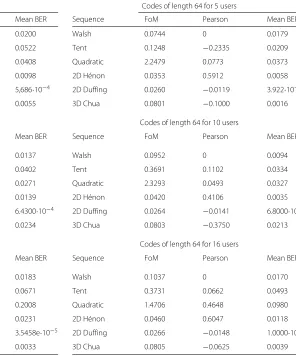
More tests were done on correlation properties of spreading sequences. Results of these tests can be seen in Tables 1, 2, and 3. Golay figure of merit and Pear-son correlation coefficient were used to observe auto-and cross-correlation properties of all sequences. Mean BER and correlation coefficients were computed for all sequence lengths as well as for cases where we have 5, 10, and 16 users.
From correlation testing, it can be seen that low figure of merit factors combined with low mean Pearson coefficient
2 4 6 8 10 12 14 16
Number of users
10-6 10-5 10-4 10-3 10-2 10-1 100
Mean BER
Sequences of length 32
Walsh 1D Tent map 1D Quadratic map 2D Henon map 2D Duffing map 3D Chua map
Fig. 5BER for sequences of length 32
yield the best performance results. Low figure of merit means low sidelobe energy that result in better autocor-relation function with more energy in the main peak. Main peak is used for synchronization and despreading, therefore, it is ideal to have as much energy as possible
in the main peak. Mean Pearson coefficient shows the cross-correlation or linear dependence of all sequences in a set. Codes that are used in spread spectrum systems need to have a large autocorrelation and low cross-correlation value. It can be seen from Tables 1, 2, and
2 4 6 8 10 12 14 16
Number of users
10-6 10-5 10-4 10-3 10-2 10-1 100
Mean BER
Sequences of length 64
Walsh 1D Tent map 1D Quadratic map 2D Henon map 2D Duffing map 3D Chua map
2 4 6 8 10 12 14 16
Number of users
10-6 10-5 10-4 10-3 10-2 10-1 100
Mean BER
Sequences of length 128
Walsh Tent map Quadratic map 2D Henon map 2D Duffing map 3D Chua map
Fig. 7BER for sequences of length 128
Table 1Correlation properties for codes of length 32
Codes of length 32 for 5 users
Sequence FoM Pearson Mean BER
Walsh 0.1572 0 0.0200
Tent 0.3008 −0.1481 0.0522
Quadratic 4.2325 0.0790 0.0408
2D Hénon 0.0765 0.1878 0.0098
2D Duffing 0.0586 −0.0242 5,686·10−4
3D Chua 0.1709 0 0.0055
Codes of length 32 for 10 users
Sequence FoM Pearson Mean BER
Walsh 0.1950 0 0.0137
Tent 0.5026 0.1546 0.0402
Quadratic 3.9574 0.0452 0.0271
2D Hénon 0.0905 0.4431 0.0139
2D Duffing 0.0608 −0.0287 6.4300·10−4
3D Chua 0.1779 −0.1000 0.0234
Codes of length 32 for 16 users
Sequence FoM Pearson Mean BER
Walsh 0.1974 0 0.0183
Tent 0.4538 0.2802 0.0671
Quadratic 2.5046 0.5762 0.2008
2D Hénon 0.0989 0.4092 0.0231
2D Duffing 0.0621 −0.0301 3.5458e·10−5
3D Chua 0.1823 −0.0625 0.0033
Table 2Correlation properties for codes of length 64
Codes of length 64 for 5 users
Sequence FoM Pearson Mean BER
Walsh 0.0744 0 0.0179
Tent 0.1248 −0.2335 0.0209
Quadratic 2.2479 0.0773 0.0373
2D Hénon 0.0353 0.5912 0.0058
2D Duffing 0.0260 −0.0119 3.922·10−4
3D Chua 0.0801 −0.1000 0.0016
Codes of length 64 for 10 users
Sequence FoM Pearson Mean BER
Walsh 0.0952 0 0.0094
Tent 0.3691 0.1102 0.0334
Quadratic 2.3293 0.0493 0.0327
2D Hénon 0.0420 0.4106 0.0035
2D Duffing 0.0264 −0.0141 6.8000·10−5
3D Chua 0.0803 −0.3750 0.0213
Codes of length 64 for 16 users
Sequence FoM Pearson Mean BER
Walsh 0.1037 0 0.0170
Tent 0.3731 0.0662 0.0493
Quadratic 1.4706 0.4648 0.0980
2D Hénon 0.0460 0.6047 0.0118
2D Duffing 0.0266 −0.0148 1.0000·10−6
Table 3Correlation properties for codes of length 128
Codes of length 128 for 5 users
Sequence FoM Pearson Mean BER
Walsh 0.0360 0 0.0029
Tent 0.0552 −0.2335 0.0726
Quadratic 1.9255 0.0279 0.0256
2D Hénon 0.0144 0.5971 0.0040
2D Duffing 0.0123 −0.0059 6.499·10−5
3D Chua 0.0374 0 0.0027
Codes of length 128 for 10 users
Sequence FoM Pearson Mean BER
Walsh 0.0461 0 0.0043
Tent 0.2381 0.0781 0.0557
Quadratic 1.8833 0.0666 0.0829
2D Hénon 0.0162 0.6356 0.0024
2D Duffing 0.0124 −0.0070 1.0000·10−6
3D Chua 0.0374 −0.1000 0.0248
Codes of length 64 for 16 users
Sequence FoM Pearson Mean BER
Walsh 0.0512 0 0.0107
Tent 0.5138 −0.0013 0.4094
Quadratic 1.1836 0.3891 0.0177
2D Hénon 0.0190 0.6555 0.0.0032
2D Duffing 0.0124 −0.0301 1.0000·10−6
3D Chua 0.0374 −0.0625 0.0045
3 that Walsh codes have mean Pearson coefficient of 0 which is not surprising as those codes are orthogonal and should, theoretically, have no cross-correlation or linear dependence. From bit error performance of Duffing map from Figs. 5, 6, and 7 and Duffing map correlation performance in Tables 1, 2, and 3, a conclusion for gen-erating optimal code can be drawn. Optimal code should have figure of merit and Pearson coefficient values equal to 0. Code optimization could be performed to find the minimum of those two values. The bit error performance can be checked in a simulation or using software-defined radio model.
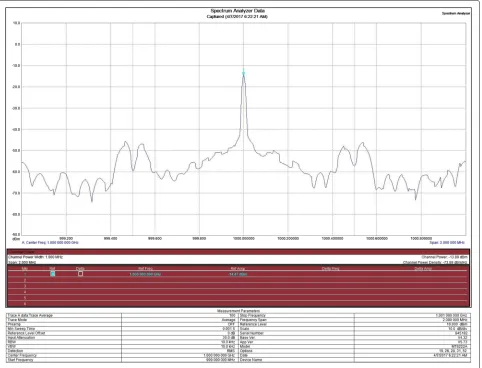
Average channel power was measured using Anritsu MT 8222 spectrum analyzer. Signal power measure-ment was performed by averaging the modulated signal power in 1 MHz bandwidth for all spreading codes and all code lengths for system of 16 users, the example of such measurement can be seen in Fig. 11. Average power was measured using 10 kHz resolution band-width (RBW) with 100 averaging traces. The noise power
was measured as an average noise power in 1 MHz bandwidth without modulated signal. The average noise
power was measured to be −58.64 dBm . To increase
the signal level, transmitter amplifier gain was varied by 1 dB increments. Due to USRP hardware imperfec-tions and limitaimperfec-tions, the average signal level was ampli-fied from 0.8 to 1.1 dB with transmitter amplifier gain increments. Because of the USRP amplifier non-linear gain and measurement inaccuracy, the measured aver-age power interval for BER performance analysis was set to 2 dB.
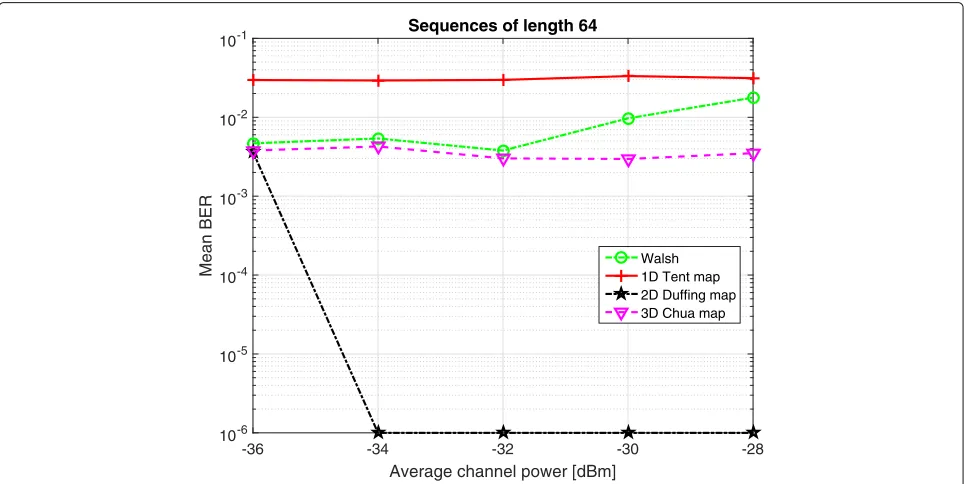
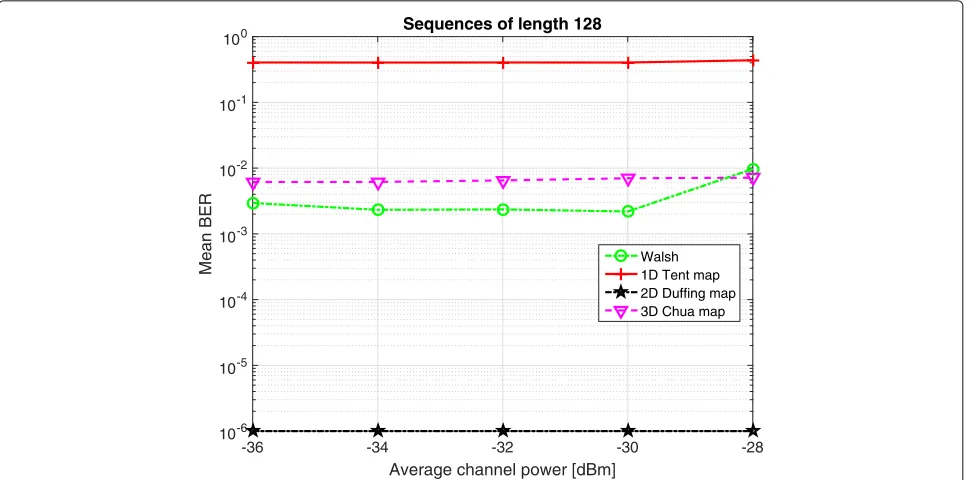
For each signal level value, BER for system of 16 users was evaluated for a choice of one-dimensional, two-dimensional, and three-dimensional maps, as well as for Walsh codes. The results in Figs. 8, 9, and 10 confirm that sequences generated from two-dimensional maps have better performance for all signal level values. Sequences generated from one-dimensional and three-dimensional maps and Walsh sequences are not suitable for usage in software-defined radio spread-spectrum sys-tems with a large number of users regardless of chan-nel power or sequence length. As is expected, longer sequences have better error rate performance. Due to lim-itations USRP amplifier’s and input filters, the results are corrupted by hardware used in this analysis [35]. The spectrum of Duffing sequences of length 128 with mea-surement details form spectrum analyzer can be seen in Fig. 11.
These diverse results in chaotic sequences come from non-linearities in dynamical systems used for spreading sequence generation where more study is needed to gen-erate chaotic sequences with specific properties. There does not yet exist a proven method to generate chaotic sequences with desired correlation properties, rather the sequences are generated, and their properties are com-pared post generation [28].
Results are corrupted by USRP’s as well. USRP rep-resents a real-world communication systems with hard-ware that has it’s faults and limitations. Main problem is the imperfect synchronization of oscillators and data transmission between transmitter and receiver. Data transmission is synchronized using packet energy where some packets are lost due to synchronization and need to be sent multiple times. There exists a certain fre-quency drift between transmitter and receiver oscilla-tors, especially after a long operating time. Frequency drift leads to loss of synchronization and increases in bit error rate.
-36 -34 -32 -30 -28
Average channel power [dBm]
10-6 10-5 10-4 10-3 10-2 10-1
Mean BER
Sequences of length 32
Walsh 1D Tent map 2D Duffing map 3D Chua map
Fig. 8Mean BER against average channel power for sequences of length 32
varying spreading factors. These networks are used for monitoring and control applications as well as for wireless sensor networks and automation. Using chaotic codes, even alongside orthogonal codes, could increase security, reliability as well as network capacity. Many of WPAN’s
operate in unlicensed spectrum where a lot of interference comes from other devices that use spread spectrum with conventional spreading codes. Good signal-to-noise ratio is essential for LoRa operation where chaotic codes could minimize multiple access interference from other devices.
-36 -34 -32 -30 -28
Average channel power [dBm]
10-6 10-5 10-4 10-3 10-2 10-1
Mean BER
Sequences of length 64
Walsh 1D Tent map 2D Duffing map 3D Chua map
-36 -34 -32 -30 -28
Average channel power [dBm]
10-6 10-5 10-4 10-3 10-2 10-1 100
Mean BER
Sequences of length 128
Walsh 1D Tent map 2D Duffing map 3D Chua map
Fig. 10Mean BER against against average channel power for sequences of length 128
Devices for critical monitoring (i.e., in medical or indus-trial environment) could benefit from new types of codes to limit the interference from existing systems. One espe-cially interesting application of chaotic codes for WPAN’s is for networks with varying data rates such as sensor networks. Devices in sensor networks generate varying baseband data rate and codes of varying length are needed to spread the data to the same chip rate. Chaotic codes can be generated in any length where the length of orthog-onal sequences has to be an exponent of 2. Another advantage of chaotic sequences is their large number. Chaotic systems can generate an almost infinite number of sequences if system parameters and starting condi-tions are chosen appropriately. Such a large number of chaotic sequences of varying lengths could be used in large distributed, sensor networks in which the node operates independently. Every node could have its own code from some code table and could be identified by it. While transmitting, nodes would not interfere between themselves.
Using chaotic sequences of varying lengths could increase network capacity and reduce energy consump-tion. The only drawback in using chaotic sequences is in changing existing system structures and modulation tech-niques, but using software-defined radios with most of the processing done in FPGA should enable future systems to accommodate various modulation techniques. Even today low-cost software-defined radio systems, that oper-ate in specific band, can be used as sensor networks. Such
sensor networks would be especially suitable for chaotic modulation techniques.
6 Conclusions
Fig. 11Measurement of average channel power using spectrum analyzer for Duffing sequence
systems. From results of the statistical and correlation properties testing with real-world performance evalua-tion chaotic sequences with desired properties can be generated.
Funding
The research was supported by the Ministry of Science and Education of the Republic of Croatia under grants I-312-01097-VIF2013-12 and
I-312-01097-VIF2015-SISU.
Authors’ contributions
All authors contributed to the work. All authors read and approved the final manuscript.
Competing interests
The authors declare that they have no competing interests.
Publisher’s Note
Springer Nature remains neutral with regard to jurisdictional claims in published maps and institutional affiliations.
Received: 24 November 2016 Accepted: 12 April 2017
References
1. TS Parker, LO Chua, Chaos: A tutorial for engineers. Proc. IEEE.75(8), 982–1008 (1987)
2. LM Pecora, TL Carroll, Synchronization in chaotic systems. Phys. Rev. Lett.
64(8), 821 (1990)
3. P Galajda, D Kocur, Chua’s circuit in spread spectrum communication systems. mH.1, 1 (2002)
4. P Galajda, M Guzan, et al., in2016 26th International Conference Radioelektronika. Implementation of a custom chua’s diode for chaos generating applications (IEEE, Kosice, 2016), pp. 66–70
5. J Zhang, L Zhang, X An, H Luo, KE Yao, Adaptive coupled synchronization among three coupled chaos systems and its application to secure communications. EURASIP J. Wirel. Commun. Netw.1, 1 (2016) 6. N Xuan Quyen, V Van Yem, T Manh Hoang, inAbstract and Applied Analysis,
vol. 2013. A chaos-based secure direct-sequence/spread-spectrum communication system (Hindawi Publishing Corporation, Cairo, 2013) 7. S Mandal, S Banerjee, inNat. Conf. Nonlinear Sys. Dynamics, Indian Institute of
Technology, Kharagpur. A chaos-based spread spectrum communication system, (2003)
8. MB Luca, S Azou, G Burel, A Serbanescu, inCircuits and Systems, 2005. ISCAS 2005. IEEE International Symposium On. A complete receiver solution for a chaotic direct-sequence spread spectrum communication system (IEEE, Kobe, 2005), pp. 3813–3816
10. H Wang, J Hu, inInformation, Communications and Signal Processing, 1997. ICICS., Proceedings of 1997 International Conference On, vol. 1. Coupled-map spatiotemporal chaos synchronization and application in cdma (IEEE, Beijing, 1997), pp. 69–73
11. H Li, H Liu, S Vafi, Bipolar chaotic pulse position modulation
communication system based on cyclic ldpc. EURASIP J. Wirel. Commun. Netw.1, 1–9 (2014)
12. U Parlitz, LO Chua, L Kocarev, K Halle, A Shang, Transmission of digital signals by chaotic synchronization. Int. J. Bifurcation and Chaos.2(04), 973–977 (1992)
13. H Dedieu, MP Kennedy, M Hasler, Chaos shift keying: modulation and demodulation of a chaotic carrier using self-synchronizing chua’s circuits. Circ. Syst. II: Analog Dig. Sig. Process IEEE Trans.40(10), 634–642 (1993) 14. G Kolumban, inProc. 4th Int. Workshop on Nonlinear Dynamics of Electronic
Systems. Differential chaos shift keying: a robust coding for chaotic communication, (1996), pp. 87–92
15. J-M Liu, LS Tsimring. Digital communications using chaos and nonlinear dynamics (Springer Science, New York, 2006)
16. G Heidari-Bateni, CD McGillem, inWireless Communications, 1992. Conference Proceedings., 1992 IEEE International Conference on Selected Topics in. Chaotic sequences for spread spectrum: an alternative to pn-sequences (IEEE, Vancouver, 1992), pp. 437–440
17. N Rahnama, S Talebi, Performance comparison of chaotic spreading sequences generated by two different classes of chaotic systems in a chaos-based direct sequence code division multiple access system. Communications, IET.7(10), 1024–1031 (2013)
18. VA Kumar, A Mitra, SM Prasanna, On the effectivity of different pseudo-noise and orthogonal sequences for speech encryption from correlation properties. Int. J. Inf. Technol.4(2), 455–462 (2007)
19. W Keren, H Shiqi, inCommunication Technology Proceedings, 1998. ICCT’98. 1998 International Conference on, vol. 2. A kind of parallel chaotic ds/cdma communication system (IEEE, Beijing, 1998), p. 5
20. B Jovic, C Unsworth, Performance comparison of multi-user chaos-based ds-cdma synchronisation unit within awgn and rayleigh fading channel. Electron. Lett.43(18), 988–989 (2007)
21. D Munoz-Rodriguez, Chaotic sequences for multiple access. Electron. Lett.34(3), 235–237 (1998)
22. K Kashyap, MP Sarma, KK Sarma, inAdvances in Electronics, Computers and Communications (ICAECC), 2014 International Conference on. Chaotic spread spectrum modulation—a hardware implementation approach (IEEE, Bangalore, 2014), pp. 1–6
23. H Watanabe, Y Narumiya, M Hasegawa, Performance evaluation of chaotic cdma using an implemented system on software defined radio. Nonlinear Theory and Appl. IEICE.4(4), 473–481 (2013)
24. SS Haykin, M Moher, D Koilpillai, Modern wireless communications. Pearson Education (2005)
25. S Haykin,Communication systems, 5th edn. (Wiley Publishing, USA, 2009) 26. JG Proakis,Spread spectrum signals for digital communications. (Wiley
Online Library, 2003). http://dx.doi.org/10.1002/0471219282.eot296. [Online; published 27-August-2012]
27. I Oppermann, BS Vucetic, Complex spreading sequences with a wide range of correlation properties. Communications, IEEE Trans.45(3), 365–375 (1997)
28. V Patidar, KK Sud, NK Pareek, A pseudo random bit generator based on chaotic logistic map and its statistical testing. Informatica (Slovenia).
33(4), 441–452 (2009)
29. RL Devaney, An introduction to chaotic dynamical systems (2003) 30. WFH Al-shameri, MA Mahiub, Some dynamical properties of the family of
tent maps (2013)
31. M Hénon, inThe Theory of Chaotic Attractors. A two-dimensional mapping with a strange attractor (Springer International Publishing, New York, 1976), pp. 94–102
32. B Stoyanov, K Kordov, Novel image encryption scheme based on chebyshev polynomial and duffing map. The Scientific World Journal (2014)
33. MJ Golay, The merit factor of long low autocorrelation binary sequences (corresp.) Inf. Theory, IEEE Transactions on.28(3), 543–549 (1982) 34. M Francois, T Grosges, D Barchiesi, R Erra, A new pseudo-random number
generator based on two chaotic maps. Informatica.24(2), 181–197 (2013) 35. Ettus Research: Test report: SBX without UHD corrections. http://files.
ettus.com/performance_data/sbx/SBX-without-UHD-corrections.pdf. Accessed 30 Mar 2017
Submit your manuscript to a
journal and benefi t from:
7Convenient online submission
7 Rigorous peer review
7Immediate publication on acceptance
7 Open access: articles freely available online
7High visibility within the fi eld
7 Retaining the copyright to your article