A Modified CT Image Boundary Detection
using Global Information and Region Based
Method
Afroz Khan1, Dr. Ramgopal Kashyap2 *, Dr. Rajeev Gupta3
Research Scholar, Department of Computer Science, SISTec Bhopal, M.P., India1 Associate Professor, Department of Computer Science, SISTec Bhopal, M.P., India2,3
ABSTRACT: Image segmentation is a core technique in medical image analysis. By enabling semantic interpretability of raw image data, it allows both medical experts and automatic processing software to diagnose and to plan for the treatment of pathologies with greater accuracy and efficiency. The level set method (LSM) can be a capable technique however rapid process employing correct segments is still complex task. The region based model does inadequately for intensity irregularity images. For this, we have a whole new tendency to propose a better region based level set method of which integrates the altered signed pressure function because of the geodesic active contour models plus the Mumford-Shah model. Therefore as to eliminate the re-initialization method for ancient level set model and removes the computationally costly re-initialization. A compared employing ancient model, our model is more stable against images employing weak edge and also intensity irregularity. The novelty contained by our method is to help you locally compute improved Signed pressure power (SPF) function, which uses neighborhood mean values which allow it to detect boundaries within the homogenous places. Compared with other active design models proposed method derives valuable advantages not having difficulties just using quick process, automation and also correct medical image segments. This method offers undergone several analysis tests to prove its importance in medical image segmentation.
KEYWORDS : Active contour models, Chan Vese model, Geodesic active contours, Intensity irregularity, Level set method, Medical image segmentation, Mumford-shah model, Modified Signed pressure force, Region Based Segmentation
I. INTRODUCTION
able to do improve for pictures with blurred concludes. This region-based type isn't vulnerable to be able to initialization regarding level set function and will recognize theObject’s limitations [8-10].
Region-based models tend to be preferred for picture segmentation because they provide enhancement more than edge based model inside a few aspects, it offers limitations. The regular region-based models which can be proposed in binary images using the assumption that each and every image region is usually homogeneous, do not operate perfectly for pictures with intensity inhomogeneity and it's also sensitive to the particular preliminary contour along with the evolving curve could be trapped into local minima[11-12]. In supplement, the Chan–Vese (CV) method isn't made for fast processing since, in each version, the standard intensities within and beyond contour should end up being computed, which helps in the computation time. The particular traditional region-based models which may be offered inside the unique binary images usually do not perform properly once the purpose photograph offers high intensity inhomogeneous regions in that. The local binary fitting (LBF) model by means of embedding nearby image information and has the ability to segment images along with intensity inhomogeneity which can be much more accurate in contrast to planned procedures. It is good way to introduce the Gaussian kernel function even though it portions well the particular images with depth inhomogeneity. It obtained high computational time complexity [13-15]. Therefore, segmentation process requires a significant time in comparison with old segmentation procedure. Zhang deliberate a method driven by local image fitting (LIF), which provides similar segmentation results and possesses less time complexity in comparison with LBF model [16-20]. Reinitialization of the level set method arranged perform Signed Distance Function (SDF) over the advancement used related to retaining firm advancement as well as ensuring appealing effects. From the practical viewpoint, the re-initialization process is more often than not rather convoluted and pricey [21-22]. We proposed a modified signed distance function to get rid of the need connected with re-initialization and regularization is effective under the substantial intensity inhomogeneity problem and consist better results which have a practical other methods[23-28]. It utilizes each edge and spot information to segment a photo into no overlapping spot and based upon concept to stop the evolving curve in line with the membership degree with the current economic pixel being inside or away from active contour [29-32]. It is applied by new region dependent SPF purpose that utilizes the particular image local information obtained while using the LBF energy model. By introducing this SPF function based upon local image fitting (LIF) This planned approach will segment images along with inhomogeneity and MR images to show the reliability, effectiveness, and robustness from the algorithm [33-34].
II. BACKGROUNDS
2.1. Mumford-Shah segmentation functional
Mumford and Shah proposed this segmentation technique based on a variational platform. Let Ω certainly be a restricted open amount of region R in addition to is initial image data. Segmentation of this kind of image into homogeneous items is completed via the search for a pair of components (u, K), where K is a number of contours, and u is usually a piecewise smooth approximation of .The minimization of an energy functional (u, K) in a way that u varies smoothly in the related components related to Ω/K. The energy functional is determined in 2D because:
(1)
Where µ in addition to are fixed parameters.The very first term with this functional makes certain that u is beneficial approximation of and the second term confirms smoothness along with the third term makes sure that the discontinuities E have minimal length, using the a sole dimensional Hausdorff compute H. A reduced case about the above model is found by reducing the segmented graphic u inside every single connected component Ω. After that this
2 2 10
\ ,
MS
K K
F u K u u dx u dx dH
segmentation issue, referred to for the reason that small partition problem is solved via minimization about the following functional:
(u,K)= ∑ ∫ | −| +ʋ∫ (2)
Again, is a parameter, having some type of scaling role. In such cases, for a fixed K, the energy during Equation (2) is minimized through computation in the variables [29-31].
2.2. Active contours without edges
A new energy functional about homogeneity based segmentation subsequent from the work regarding Mumford and Shah appeared to be proposed by Chan as well as Vese. Let us assume which a photo, is formed by two parts of approximate piecewise typical strengths, of one of a kind values and. Let's represent the boundary between two areas as well as given a primary curve defined within the image, the following “fitting energy” could be minimized to segment the regions:
2 2
1 2 0 1 0 2
( ) ( )
( ) ( )
inside C outside C
F C F C
u c dx
u c dx (3)The specific parameters, match the mean values within the image interior and far away from the curve. The contour that will resembles towards borderline within the object decreases that energy functional:
1 2
1
0 2
0inf 0
C F C F C F C F C
(4)
To be a distinct case from the Mumford-Shah functional, Chan and Vese projected a dynamic contour models resulting from this energy functional with the help of two regularizing terminology to the curve and the inside of curve and minimization on this energy functional simultaneously two curves in addition to find four homogeneous areas well-defined with the joint of each curves.
dxdy H dxdy H y x u c dxdy H dxdy H y x u c ) ( 1 )) ( 1 )( , ( ) ( , ) ( ) ( ) , ( ) ( 0 2 0 1 (5)Where c1 and c2 are two constants which will estimated the graphic strength in exterior and inside zero level collection. The constants c1 and c2 might be far unlike from the original information, when the strengths with sometimes outside(C) or inside(C) won't be homogeneous that is going to be images with depth inhomogeneity. Consequently, the CV model infrequently segments image from the occurrence of inhomogeneity which is frequently happens in real world images [32-34].
III. PROPOSED METHOD
domain Ω. Even as know, area based image segmentation is relied on area perimeter, size, boundary. Here we reflect circular neighborhood they are made by the partition of complete domain of image Ω.
In this paper, circular neighborhood strengths might be classified by computing the cluster center tocalculate the contour map with the image the original contour is defined at the boundary of the image. To move the level set inwards, numerous of us calculate the interior sub region involving zero level necessities using > 0. The particular SDF satisfies the desirable property |∇ | = 1. The action functional ( ) hard drives the zero degree set toward the thing boundaries[38-40]. Keeping preset and minimizing the energy with respect to 1 and 2, it eliminates the need of reinitialization that is computationally very expensive. Regularization using Gaussian kernel provides better smoothing results and no energy leakage as compared to the area smoothing and penalization.
Improved SPF function is a mathematical expression in whose value ranges coming from positive to disapproving for inside and over and above region of interest. Plentiful ways are already developed to an SPF function some includes global strength means and numerous uses local depth means in its creation [33]. In this paper we recommend a entire new SPF function, which practicesuniversal fitted image limited which has a mask term to enforce level organizedgrowth inwards. If mask term is well-defined it modulates the symbols in the pressure forces inside and away from area of interest so that the contour shrinks when away from object and enlarges when in the object. This gives a limitation-free segmentation natural atmosphere, needing minimal consumer intervention. It is obvious that trusting the global mean (inside and outside the contour) as inside C-V model just isn't enough to type strength distributions in the occurrence the images to become segmented have foregrounds seen as a more complex strength distributions. To overwhelmed this issue, we introduce the precise global median or a global mean inside energy term for existence minimized [34]. Assumed some contour c, x the pixel position inside image I(x), the energy term is designated as:
( ) =∫ ( ) ( ) + ∫ ( )2 ( ) (6)
Where,
( ) = | ( )− | + | ( )− | (7)
( ) = | ( )− | (8)
In which the positive constants and define the weight of all term (inside and away from the contour), as well as are scalars approximating the precise median and mean intensity individually, to the image I inside the contour, and is frequently a scalar similar to the mean away from the contour. Subsequent the conventional variational level well-known formulations [43], we substitute the precise contour curve C while using the level set perform ∅ thus receiving.
( ) =∫ ( ) + ∫ 2 ( ) (9)
n a like way to other intensity driven active contour representations, these statistical descriptors , in addition to , are defined.
( ) = ( ( )|∅( )≥0),
( ) = ( ( )|∅( )≥0),
( ) = ( ( )|∅( ) < 0), (10)
When using the level set functionality ∅to imply the contour C from the domain Ω, the energy E can be written being a functional as practices:
( ) =∫ ( ) ( ( )) + ∫ 2 ( )(1− ( ) ) (11)
By keeping , and fixed, we lessen the energy functional E regarding ∅ to get the gradient descent stream as
∅
= (∅) 2 ( )− ( ) (12)
replacement of Edge Stopping Functionality (ESF), aarea based Singed Pressure Force function (SPF) has been shaped [44-46]. This SPF activate controls the realway of evolution. Differingsymbols round the borders on the object in this function generate the curve to competent to enlarge when it's inside the real boundary also to shrinks when it's exterior the real boundary. Where SPF function is
( , ) = 1
∑ (( ( , ) + )
( , ) + )
(13)
u ( ( , )) ( , )
( )
( ( , ) ( )
(14)
Set the figure of clusters c and for each pixel analyse the signed pressure function using Equation (14).Where is the prototype of respectively cluster and and are given in Equation (6). Put spf in Equation (16)and then it turn out to be,
∅
= (∅). Spf I(x, y) 2 ( )− ( ) (15)
The Improved SPF functionality computed while using the local attributes of image that exterior the boundary with the area concerning interest is denoted through positive values of SPF function and the adverse values of SPF function that are inside the border with the area concerning interest. The energy minimization is understood to be
( ) = [ | ( )− | + | ( )− | ] (16)
and
2 ( )=[2 | ( )− | ] (17)
Note that the {2 ( )− ( )]is not reliant on to scale of local intensities due to intensity in homogeneity. Energy minimization about the midpoint of the cluster defined by
[ | ( )− | + | ( )− |
[2 | ( )− | ]
(18)
We minimize the energy preparation to get the region of interest. This is iterative method in which after each iteration energy is minimized.
IV. TESTS AND OUTCOME ANALYSIS
4.1 Comparison with respect to Effectiveness along with Accuracy
In this part, we relate the actual proposed method with numerous segmentation methods. The first one was active contours without edges by T. Chan and L. Vese [47] concerning image segmentation, the second one ended up existence Active contours according to local Gaussian distribution offered by Wang [48], the third one ended up being Active contours driven by local image suitable energy presented by Huihui Song [49], plus the last one was A Level Set Technique for Image Segmentation in the Existence of Intensity Inhomogeneities offered by Chunming Li [50]. Fig. 1 shows the results for medical image in which primary contours are designed, from then on curve evolution steps are offered soon after sufficient progression, we got region of interest and the connection between the method can be revealed from the Fig. 1.
(b)
(c)
(d)
(e)
Fig.1.Visual comparisons among the five segmentation methods. Fig.1(a)The active contours technique without edges (first row),Fig.1(b) The enhanced Chan-Vesetechnique(row),Fig.1(c) The local image fitting energy technique (third row), Fig.1(d) A Level Set Technique of Image Segmentation in the Occurrence of Intensity Inhomogeneities (fourth
row) and fig.1(e) The proposed technique(fifth row) are shown for an image.
4.2. Comparison with respect to Speed in addition to Efficiency
In this portion, we inspect the proposed technique with CV technique, Better CV, Active contours technique by local image suitable energy, Level Set Technique with bias rectification. Each of the CPU time is accessible in Table 1. For excellence and correctness, it can be realized how the proposed method gives considerable well result associated to Chan-Vese, Boosted Chan-Vese, Local image fitting energy technique and Level Set Technique Strength In homogeneitiesso forth the shape and the location of the initial curve. The significance changes with the whole initial contour and you will want to run algorithm so you can choose the superlative result; hence, this technique cannot be used intended for precise and appropriate segmentation, CV model uses location dataand considered as one of the greatest used models intended for segmentation. One of various prominent aspects of the CV model is which it makes well for the images having uncertain without ends. However, being a restriction, your CV model always assumes image having intensity homogeneity, local image fitting method gives suitable result.
Table 1.ComparisionofProposedMetrhodWith Improved CV andIbfMethod
Time Elapsed
450 Iterations (Time in seconds)
Images Improved CV ibf Proposed Method
Image1(human brain)
44.25703 44.99645 8.952092
It is essential to run the specific algorithm more than once in order to select the utmost beneficial result; so, these methods can't be used concerning correct along with suitable segmentation, CV model uses spot data along with considered among the greatest used models about segmentation. Among the prominent characteristics of the CV model is which it does well for the images along with fuzzy or perhaps without perimeters. Though, like a restriction, the specific CV model always assumes the specific image along with strength homogeneity, local impression fitting method gives suitable result yet our method is sooner.
Fig. 2. Shows this segmentation response to medical MRI along with CT image of human body. The response to the offered method is correct along with clear; these resulting curves are closed and present no discontinuities. Fig 2(a) is showing segmentation result using active curves method without edges, Fig. 2(b) segmentation result with the enhanced Chan-Vese technique, Fig. 2(c) using the Active curves method by local image fitting, Fig. 2(d) shows the segmentation result with all the A Level Set Method for Image Segmentation with Strength Inhomogeneities with Application to MRI along with Fig. 2(e) illustrate the segmentation outcome with the proposed technique
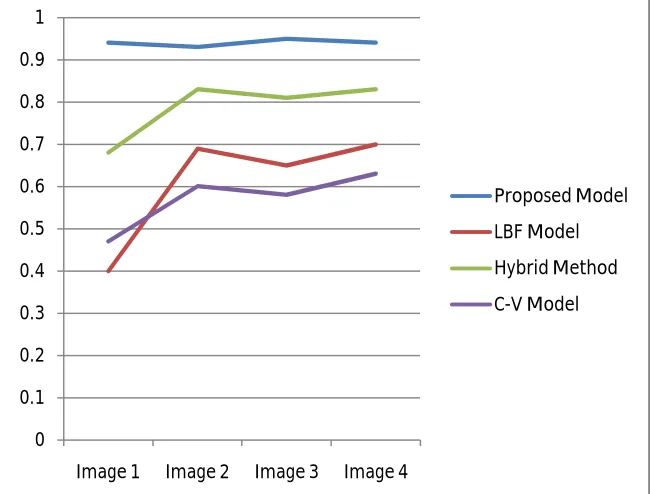
Figure 3 shows the comparison of LBF model, Enhanced C-V model, C-V Model with Proposed Model. In which Our proposed model gives better performance than others.
Fig. 3.Quantitative comparisons among proposed method with the LBF model, Hybrid Method and C-V Model. 0
0.1 0.2 0.3 0.4 0.5 0.6 0.7 0.8 0.9 1
Image 1 Image 2 Image 3 Image 4
Proposed Model
LBF Model
Hybrid Method
V. CONCLUSIONS
In this paper a modified region-based segmentation technique is proposed to detect and segment parts of interest in medical care image methodologies. A market fits to distinct places. The proposed segmentation algorithm partitioned an impact into an arbitrary number of sub regions. It starts by means of dividing the suggestions image into a pair of sub regions and then among the many sub regions can be further divided inside two sub regions before ending condition can be fulfilled. we have presented an electricity based modified variational model in line with the controlling the growing contour while using membership function in the dynamic pixel staying inside or exterior with this evolving contour using a new region focused SPF function developed from the Chan-Vese (CV) energy functional model, which in turn stops contours in fragile or blurred perimeters. A Gaussian kernel is required which regularizes what type set function but also eliminates the will need of computationally costly reinitialization. The experimental results show that your segmentation of the parts of interest in an image is influenced because of the intensity, brightness and contrast in the objects and history. It’s an interactive procedure in which theme of initial contour will never affect the producing contours. Experimental results concerning medical images have verified the good performance of one’s proposed method concerning speed, effectiveness within the presence of high intensity inhomogeneities, accuracy as well as efficiency.
REFERENCES
1. W. Aitfares, E. H. Bouyakhf, F. Regragui, A. Herbulot, and M. Devy.: A robust region-based active contour for object segmentation in heterogeneous case. Pattern Recognit. Image Anal. 24, 1, 24-35 (2014).
2. Umamaheswari, J. and Radhamani, G. :Hybrid Medical Image Segmentation based on Fuzzy Global Minimization by Active Contour Model. International Journal of Computer Applications, 39(13), pp.1-6 (2012).
3. K. Ye and Y. Zhan.:Image segmentation algorithm based on mathematical morphology and active edgeless contour model without edges, Journal of Computer Applications, vol. 29, no. 9, pp. 2398-2401 (2009).
4. Kovacs, A., & Sziranyi, T.: Harris function based active contour external force for image segmentation. Pattern Recognition Letters, 33(9), 1180-1187(2012).
5. Wang, B., Zhang, K., Shi, L., & Zhong, H.:An Edge Detection Algorithm of Moving Object Based on Background Modeling and Active Contour Model. AMR, 765-767, 2393-2398(2013).
6. Balla-Arabe, S., Xinbo Gao, & Bin Wang.: GPU Accelerated Edge-Region Based Level Set Evolution Constrained by 2D Gray-Scale Histogram. IEEE Transactions On Image Processing, 22(7), 2688-2698(2013).
7. Oh, J., Martin, D., & Hu, X.: Partitioned edge-function-scaled region-based active contour (p-ESRAC): Automated liver segmentation in multiphase contrast-enhanced MRI. Med. Phys., 41(4), 041914(2014).
8. N. M. Altarawneh, S. Luo, B. Regan, C. Sun and F. Jia.:Global Threshold and Region-Based Active Contour Model for Accurate Image Segmentation, Signal & Image Processing : An International Journal, vol. 5, no. 3, pp. 01-11( 2014).
9. Lecca, M., Messelodi, S., & Serapioni, R.:A New Region-based Active Contour Model for Object Segmentation. Journal Of Mathematical Imaging And Vision, 53(2), 233-249(2015).
10. D. Wei.:Region-Based Level Set Model for Image Segmentation, AMR, vol. 616-618, pp. 2223-2228( 2012).
11. Zhang, H., Gao, S., & Zhu, Y.: Local and Global Region-Based Curve Evolutions for Image Segmentation. TOCSJ, 8(1), 951-956(2014). 12. Wen, W., He, C., & Li, M.: Transition region-based active contour model for image segmentation. J. Electron. Imaging, 22(1), 013021(2013). 13. Liu, Y., Xi, D., Li, Z., & Shi, C.: Analysis and Application of the Relationship between Cumulonimbus (Cb) Cloud Features and Precipitation
Based on FY-2C Image. Atmosphere, 5(2), 211-229(2014).
14. Hu, H., Gao, Z., Liu, L., Liu, H., Gao, J., & Xu, S.: Automatic Segmentation of the Left Ventricle in Cardiac MRI Using Local Binary Fitting Model and Dynamic Programming Techniques. Plos ONE, 9(12), e114760(2014).
15. Lin, Y., Li, X., Zhang, H., & Luan, Q.: Fast local binary fitting optimization approach for image segmentation. Journal Of Computer Applications, 33(2), 491-494(2013).
16. Fan, L., Ou, W., & Sun, S.: Based on LBF Model of Adaptive Distance Keeping Level Set Evolution on Medical Image Segmentation. AMM, 333-335, 984-987(2013).
17. H. Wang And M. Liu.:Medical Images Segmentation Using Active Contours Driven by Global and Local Image Fitting Energy, Int. J. Image Grap., Vol. 12, No. 02, P. 1250015( 2012).
18. Zhao, J., Qi, Y., & Pan, Z.: Active contour segmentation model of combining global and dual-core local fitting energy. Journal Of Computer Applications, 33(4), 1092-1095(2013).
19. Zhang, J., Ma, X., Chen, Y., Fang, L., & Wang, J.: MR Image Segmentation based on Local Information Entropy Geodesic Active Contour Model. International Journal Of Multimedia And Ubiquitous Engineering, 9(4), 127-136(2014).
21. Wang, X., Shan, J., Niu, Y., Tan, L., & Zhang, S.: Enhanced distance regularization for re-initialization free level set evolution with application to image segmentation. Neurocomputing, 141, 223-235(2014).
22. Yamasaki, S., Nomura, T., Kawamoto, A., Sato, K., Izui, K., & Nishiwaki, S.: A level set based topology optimization method using the discretized signed distance function as the design variables. Struct Multidisc Optim, 41(5), 685-698(2009).
23. H. Liu, Y.Cheng and M. Meng.:A Variational Multiphase Level Set Algorithm For Image Segmentation Based On Active Contour Model, International Journal Of Information Acquisition, Vol. 09, No. 01, P. 1250004(2013).
24. J. Park, S. Park and W. Cho.:Medical Image Segmentation using Level Set Method with A New Hybrid Speed Function Based on Boundary And Region Segmentation, Ieice Transactions On Information And Systems, Vol. 95, No. 8, Pp. 2133-2141( 2012).
25. Zheng, Q.: New local segmentation model for images with intensity inhomogeneity. Optical Engineering, 51(3), 037006(2012).
26. Waoo, N., Kashyap, R., & Jaiswal, A. (2010, April). DNA Nano array analysis using hierarchical quality threshold clustering. In The 2nd IEEE International Conference on Information Management and Engineering (ICIME), 2010 (pp. 81-85). IEEE.
27. Juneja, P., & Kashyap, R. (2016). Energy based Methods for Medical Image Segmentation. International Journal of Computer Applications, 146(6).
28. Kashyap, R., & Gautam, P. (2013). Microarray Image Segmentation using Improved GOGAC Method. Science and Engineering (IJCSE), 2(4), 67-74.
29. Upadhyay, A., & Kashyap, R. (2016). Fast Segmentation Methods for Medical Images. International Journal of Computer Applications, 156(3), 18-23.
30. Kashyap, R., & Gautam, P. (2017). Fast Medical Image Segmentation Using Energy-Based Method. Pattern and Data Analysis in Healthcare Settings, 35-60.
31. Kashyap, R., & Gautam, P. (2015, November). Modified region based segmentation of medical images. In Communication Networks (ICCN), 2015 International Conference on (pp. 209-216). IEEE.
32. Juneja, P., & Kashyap, R. Optimal Approach For CT Image Segmentation Using Improved Energy Based Method. International Journal of Control Theory and Applications, 9(41) 2016, pp. 599-608.
33. Kashyap, R., & Tiwari, V. (2017). Energy-based active contour method for image segmentation. International Journal of Electronic Healthcare, 9(2-3), 210-225.