DOI: 10.15662/ijareeie.2014.0307043
Object Detection and Tracking in Dynamically
Varying Environment
M.M.Sardeshmukh
1, Dr.M.T.Kolte
2, Dr.P.N.Chatur
3Research Scholar , Dept. of E&Tc, Government College of Engineering., Amravati, Maharashtra, India1
Professor and Head, Dept. of E&TC, MIT College of Engineering, Pune, Maharashtra, India2
Associate Professor and Head, Dept. of E&Tc, Government College of Engineering., Amravati, Maharashtra, India3
ABSTRACT:Object detection and tracking is one of the important aspect in many video surveillance applications like human activity recognition, patient monitoring, traffic control etc. This task becomes more difficult and challenging in varying illumination, occlusion , outdoor scenes and cluttered environment. We proposed an algorithm which continuously update the background and improves the object detection. Detected object is tracked in the next frames of video and then finally it is classified. The videos which are used contains mainly three types of object viz. Single person, group of persons and vehicle. This type of classification is useful in surveillance systems at different places such as shopping mall, parking slot etc.
KEYWORDS: Cognitive Object detection, object tracking, dynamically varying environment .
I.INTRODUCTION
Security of human lives and property has always been a major concern for civilization for several centuries. In modern civilization, the threats of theft, accidents, terrorists’ attacks and riots are ever increasing. Due to the high amount of useful information that can be extracted from a video sequence, video surveillance has come up as an effective tool to forestall these security problems. The automated security market is growing at a constant and high rate that is expected to sustain for decades. Video surveillance is one of the fastest growing sectors in the security market due to its wide range of potential applications, such as a intruder detection for shopping mall and important buildings , traffic surveillance in cities and detection of military targets, recognition of violent/dangerous behaviors (eg. in buildings, lifts) etc Visual surveillance in dynamic scenes, especially for humans and vehicles, is currently one of the most active research topics in computer vision The most desirable qualities of a video surveillance system are (a) robust operation in real world scenarios, characterized by sudden or gradual changes in the input statistics and (b) intelligent analysis of video to assist the operators in scene analysis and event classification
1.1 Overview of Automated Visual Surveillance System
DOI: 10.15662/ijareeie.2014.0307043
fixed cameras in overlapping and non-overlapping field of views (FOV). Jianpeng Zhou and Jack Hoang presented a paper in I3DVR international Inc, which is Real time robust human detection and tracking system. Which can be abstracted as, a real time robust human detection and tracking system for video surveillance which can be used in varying environments. This system consists of human detection, human tracking and false object detection. The human detection utilizes the background subtraction to segment the blob and use codebook to classify human being from other objects. The optimal design algorithm of the codebook is proposed. The tracking is performed at two levels: human classification and individual tracking
II.SYSTEM MODEL AND ASSUMPTIONS
The Auto detection and tracking system has two major subsystems 1) Detection of the human / object
2) Tracking the detected object
Going through the literature the detection techniques are broadly classified in to two major categories 1)Temporal Differ 2) Background Subtraction
1.2 Background Modeling
Background is typically static and seldom changes dramatically. Nevertheless, some background subtraction techniques have many problems, especially when used outdoors. For instance, when sunshine is covered by clouds, the change in
illumination is considerable. One of the successful solutions to these problems is to use a multi-color background model per pixel. Stauffer and Grimson introduced a method for modeling each background pixel via a mixture of M Gaussian distributions. However, computational cost of this method is high. Therefore, this paper presents a new method inspired by Gaussian mixture model. First, the stability S(x; y) of each pixel will be determined. The stability of pixel (x; y) increases by one if the difference in pixel value between the current image and previous two images is less than a threshold Tbackground. Then, the background pixel value B(x; y) of location (x; y) will be computed as the mean value of all similar pixels in this period. Next, the background information is updated based on three conditions including (1) pure background, (2) illumination change, and (3) static object. First, a pure background test will be carried out, and then an illumination change test and finally a static object test will be performed.
III. FLOWCHART AND ALGORITHM
Technique Advantage Problem
Temporal difference very adaptive to changes in dynamic environment
does not make assumptions about the scene
only motion at edges is visible for homogeneous objects
Background subtraction performance extracting object
information
DOI: 10.15662/ijareeie.2014.0307043
Algorithm
1. Start
2. Read a video input.
3. Extract the frames from the video. 4. Convert each frame to gray scale.
5. Consider initial 6 frames as learning frames for threshold calculation. 6. Calculate threshold values for background.
7. Consider next 10 frames for object detection.
8. Compare incoming frame pixels with threshold values
9. If more than 40% of the pixels are changed then it is temporary illumination change, consider next frame else Extract the foreground object from the entire frame.
10. Deduce boundary for foreground object.
11. Calculate height, width and height to width ratio of the object. 12. Find centroid, bottom leftmost and bottom rightmost point.
13. Store the difference between bottom rightmost and bottom leftmost points. 14. If height to width ratio is less than 1 then vehicle is detected.
15. If height to width ratio is greater than 1 and the difference between leftmost and rightmost point shows period nature then pedestrian is detected.
16. Display the result. 17. Stop
IV. RESULT AND DISCUSSION
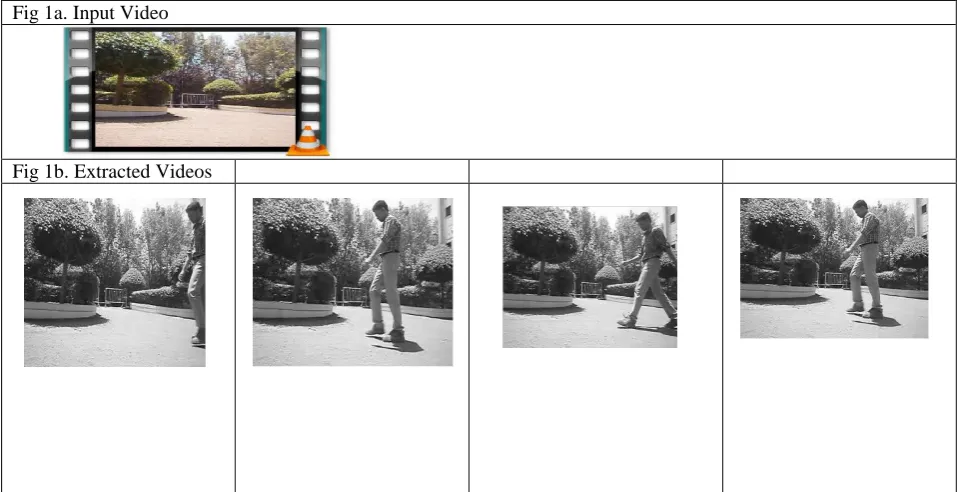
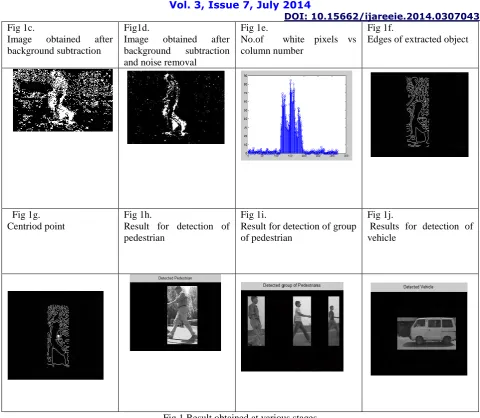
The experimentation is carried out with several videos specially outdoor scenes sample results are shown below for detection of pedestrian group of pedestrian and vehicle. Background subtraction is used to extract the foreground object from the frame. To eliminate the frequent illumination changes background updating technique is used. Using features like height to width ratio object classification is done. The periodic nature of the movement of legs of pedestrian is used to differentiate it from vehicle. The main advantage of the technique is the simplicity in idea and algorithm. It is observed that the algorithm used classifies the pedestrian group of pedestrian and vehicle in a outdoor video.
Fig 1a. Input Video
DOI: 10.15662/ijareeie.2014.0307043
Fig.1 Result obtained at various stages
Fig. 1 b shows the extracted images from video. The background is continuously upgraded and subtracted from the current image which separates the foreground and background effectively. Morphological operations are used to clean the object image. The fig 1 e shos the white count in each column which is used as one of feature in object classification. The edges are found for the detected object which is shown in fig 1 f. Centroid point is obtained for the
Fig 1c.
Image obtained after background subtraction
Fig1d.
Image obtained after background subtraction and noise removal
Fig 1e.
No.of white pixels vs column number
Fig 1f.
Edges of extracted object
Fig 1g. Centriod point
Fig 1h.
Result for detection of pedestrian
Fig 1i.
Result for detection of group of pedestrian
Fig 1j.
DOI: 10.15662/ijareeie.2014.0307043
BIOGRAPHY
M.M.Sardeshmukh, has completed his B.Tech. and M.Tech in Electronics and in E & Tc from Dr .B.A.T. University, Lonere, Presently he is pursuing his Ph.D. from SGB Amravati University, Amravati ,Maharashtra, India .