Disease Identification Using Iterative Partitioned Gray Scale
Matrix with Support Vector Machine Classifier
Dr. Raja Murali Prasad
Professor, Vardhaman College of Engineering, Hyderabad, Telangana, India
ABSTRACT
Horticultural harvests in India are under consistent risk of nuisances influencing their underlying foundations and in addition take off. Plant illnesses cause huge harm and financial misfortunes in yields. In this way, diminishment in plant illnesses by early conclusion brings about generous change in nature of the item. Colossal cotton edit yield is lost each year, because of fast pervasion by nuisances and bugs. Tainted cotton plants can exhibit an assortment of symptoms and making conclusion was to a
great degree troublesome. Basic symptoms are
incorporates anomalous leaf development, shading distortion, hindered development, decays and harmed units. In this paper, we have utilized SVM classifier to recognize the vermin and sort of malady in cotton plant. Picture obtaining gadgets are utilized to get pictures of ranches at normal intervals. These pictures are then subjected to pre-handling utilizing middle separating method. The pre-handled leaf pictures are then sectioned utilizing iterative partitioning means (IP-M) technique. At that point the shading highlights (mean, Skewness),
surface elements, for example, vitality, entropy,
connection, differentiate, edges are removed from ailing leaf picture utilizing gray scale matrix (GSM) in the surface and then contrasted and ordinary cotton leaf picture. The Support Vector Machine (SVM) classifier is utilized to order the vermin and Disease in cotton trim. Keywords: Cotton plants, disease identification, Fuzzy C means, feature extraction, Gray scale matrix, iterative partitioning means, statistical parameters and Support vector machine
I.
INTRODUCTION
Horticulture is a standout amongst the most vital hotspots for human sustenance on Earth. Not just does it gives the much vital sustenance to human presence and utilization additionally assumes a noteworthy fundamental part in the economy of the nation. However, Plant illnesses have transformed into a situation as it can bring about huge decrease in both quality and amount of rural items. These days agriculturists are confronting numerous vital issues
for showing signs of improvement yield reason for fast change in atmosphere and startling level of creepy crawlies, with a specific end goal to improve yield need to lessen the level of bug. A few a great many dollars are spent worldwide for the wellbeing of harvests, horticultural create and great, sound yield [1]. It involves worry to shield crops from Bio-aggressors, for example, bugs and creepy crawlies, which generally prompt to across the board harm and loss of harvests. In a nation, for example, India, roughly 18% of product yield is lost because of irritation assaults each year which is esteemed around 90,000 million rupees [2]. Routinely, manual nuisance monitoring techniques, sticky traps, dark light traps are being used for bug monitoring and discovery in ranches. Manual bug monitoring techniques are tedious and subjective to the accessibility of a human master to recognize the same. Malady is created by pathogen which is any specialist bringing about ailment. In the greater part of the cases bugs or maladies are seen on the leaves or stems of the plant. In this way recognizable proof of plants, leaves, stems and discovering the bug or ailments, rate of the irritation or malady occurrence, symptoms of the nuisance or illness assault, assumes a key part in effective development of harvests. When all is said in done, there are two sorts of factors which can convey passing and annihilation to plants; living (biotic) and non-living (abiotic) operators [3]. Living specialist's including creepy crawlies, microorganisms, parasites and infections. Non-living specialists incorporate extremes of temperature, abundance dampness, poor light, inadequate supplements, and poor soil pH and air toxins. Here the division procedure utilized is IP-M and GLCM is utilized to remove the surface components with SVM classifier.
II.
RELATED WORK
that Leaves with spots must be pre-prepared firstly so as to complete the wise conclusion to trim in view of picture handling and fitting components ought to be removed on the essential of this. A forecast approach in view of bolster vector machines [4] for creating climate based expectation models of plant sicknesses is proposed by Rakesh and Amar. The execution of ordinary various relapse, counterfeit neural system (back spread neural system, summed up relapse neural system) and bolster vector machine (SVM) was looked at. Stereomicroscopic strategy and Image investigation [8] technique is thought about for handiness of picture examination as a proficient and exact technique to gauge natural product qualities like size, shape dispersal related structures by Mix and Pico. Brendon J. Woodford, Nikola K. Kasabov and C. Howard Wearing in paper titled "Organic product Image Advances in Image Processing for Detection of Plant Diseases" proposed wavelet based picture preparing procedure and neural system to build up a technique for on line distinguishing proof of irritation harm in pip natural product in plantations. Three irritations that are pervasive in plantations were chosen as the possibility for this exploration: the leaf-roller, codling moth, and apple leaf twisting midge. A novel approach [7] is proposed for incorporating picture examination method into symptomatic master framework. A CLASE (Central Lab. of Agricultural Expert System) indicative model is utilized to oversee cucumber trim. The master framework discovers the maladies of client perception. With a specific end goal to analyze a turmoil from a leaf picture, four picture preparing stages are utilized: upgrade, division, highlight extraction and grouping .They tried three unique issue, for example, Leaf mineworker, Powdery and Downey and this approach has significantly diminished error inclined exchange amongst framework and client. The morphological components of leaves are broke down for plant grouping and in the early analysis of certain plant ailments. Stereomicroscopic technique and Image examination strategy is analyzed for helpfulness of picture investigation as a proficient and exact strategy to gauge organic product characteristics like size, shape dispersal related structures by Mix and Pico. When all is said in done organic product length got with picture investigation was altogether more prominent than that recorded with a stereomicroscopic. Just organic product length gauges did not contrast between the two strategies. A forecast approach in light of bolster vector machines for creating climate based expectation models of plant sicknesses is
proposed by Rakesh and Amar. The execution of traditional different relapse, counterfeit neural system (back proliferation neural system, summed up relapse neural system) and bolster vector machine (SVM) was analyzed. Santanu &Jaya depicted a product prototype framework in paper for ailment location in light of the tainted pictures of different rice plants. They utilized picture developing, picture division techniques to identify contaminated parts of the plants. Zooming calculation is utilized to concentrate elements of the pictures .Self Organize Map (SOM) neural system is utilized for characterizing unhealthy ascent pictures.
A.
Fuzzy C-means Clustering
The fluffy rationale is an approach to preparing the data by giving the halfway enrolment esteem to every pixel in the picture. The enrolment estimation of the fluffy set is reaches from 0 to 1. Fluffy grouping is essentially a multi esteemed rationale that permits intermediate qualities i. e. , individual from one fluffy set can likewise be individual from other fluffy sets in a similar picture. There is no unexpected move between full participation and non-enrolment. The participation work characterizes the fluffiness of a picture furthermore to characterize the information contained in the picture. These are three fundamental essential components required in portrayed by enrolment work. They are support, Boundary. The center is a completely individual from the fluffy set. The support is non-enrolment estimation of the set and limit is the intermediate or incomplete participation with esteem somewhere around 0 and 1. In fluffy grouping, every point has a level of having a place with bunches, as in fluffy rationale, as opposed to having a place totally with only one bunch. In this way, focuses on the edge of a group might be in the bunch to a lesser degree than focuses in the focal point of bunch. For every point x we have a coefficient giving the level of being in the kth cluster uk(x). For the most part, the entirety of those coefficients for any given x is characterized to be 1:
The degree of belonging is related to the inverse of the distance to the cluster center:
Then the coefficients are normalized and fuzzyfied with a real parameter m > 1 so that their sum is 1. So
For m equal to 2, this is equivalent to normalizing the coefficient linearly to make their sum 1. When m is close to 1, then cluster center closest to the point is given much more weight than the others, and the algorithm is similar to k-means.
The fuzzy c-means algorithm:
Choose a number of clusters Assign randomly to each point coefficients for being in the clusters
Repeat until the algorithm has converged (that is, the coefficients' change between two iterations is no more than , the given sensitivity threshold) Compute the centroids for each cluster, using the
formula above
For each point, compute its coefficients of being in the clusters, using the formula above
The algorithm minimizes intra-group difference also, yet has an indistinguishable issues from k-means, the minimum is a nearby minimum, and the outcomes rely on upon the underlying selection of weights. The desire boost calculation is an all the more measurably formalized strategy which incorporates some of these thoughts: incomplete participation in classes. It has better union properties and is all in all liked to fluffy c-means.
III.
PROPOSED FRAME WORK
A.
Image Pre-Processing and Segmentation
The pre-handling included the systems to set up the pictures for ensuing investigation. The influenced leaf pictures were changed over from RGB shading organization to dim scale pictures. Division alludes to the way toward bunching the pixels with specific properties into notable locales and these areas relate to various confronts, things or characteristic parts of the things. We proposed iterative dividing strategy to section objectivezones. Target locales are those ranges in the picture that spoke to visual symptoms of a parasitic illness.
Fig.1 Proposed disease identification flow chart
B.
Feature Extraction
The symptoms connected with different Phyto-obsessive issues of cotton leaves under scrutiny noticeable on the influenced leaves were extricated from their particular pictures utilizing IP-means. The picture examination was for the most part spotlights on the extraction of shape components and their shading based division. The picture investigation method is done utilizing Gray-level co-event network. The influenced regions fluctuate in shading and surface and are prevailing in arranging infection symptoms. In this way, we have considered both shading and surface elements for acknowledgment and grouping reason. The utilization of shading elements in the discernible light range gave extra picture trademark includes over customary dark scale representation. GLCM is a strategy in which both shading and surface components are considered to land at extraordinary elements which speak to that picture.
1) GLCM
range of an image the processing required to calculate a GLCM is prohibitive. The input image was scaled by the gray matrix. By default to reduce the intensity values from 256 to 8 in Gray scale image Graycomatrix use scaling. Using the num levels and the gray limits parameters of the Graycomatrix function the number of gray levels and the scaling of the intensity values in the GLCM can be controlled. The properties about the spatial distribution of the Gray level in the texture image can be revealed by the Gray level co-occurrence matrix.
2) OVERVIEW OF TEXTURE
We as a whole think about the term Texture, yet to define it is a hard time. One can separate the two distinct Textures by perceiving the likenesses and contrasts. Usually there are three routes for the use of the Textures. In light of the Textures the pictures can be portioned to separate between effectively sectioned districts or to characterize them. We can repeat Textures by creating the depictions. The surface can be dissected in three diverse ways.
They are Spectral, Structural and Statistical:
Statistical:
Ordinarily the textures might be arbitrary yet with the predictable properties. Such Textures can be portrayed by their measurable properties. Snapshot of force assumes a noteworthy part in depicting the Texture in an area. Assume in a locale we develop the histogram of the forces then the snapshots of the 1-D (one dimensional) histogram can be processed.
The mean power which we have talked about is the primary minute.
The difference depicts how comparative the powers are inside the locale then this fluctuation is the second focal minute.
Skew portrays the symmetry of the force dispersion about the mean then this skew is the third focal minute.
The accompanying figure indicates how dark co lattice computes the initial three values in a GLCM. In the yield GLCM, component (1,1) contains the esteem 1 in light of the fact that there is just a single case in the information picture where two on a level plane neighbouring pixels have the qualities 1 and 1, separately. GLCM (1,2) contains the esteem 2 in light of the fact that there are two examples where two on a level plane neighbouring pixels have the qualities 1 and 2. Component (1,3) in the GLCM has the esteem 0 on the grounds that there are no examples of two evenly adjoining pixels with the qualities 1 and 3.
dim co network keeps handling the info picture, filtering the picture for other pixel sets (i, j) and recording the entireties in the relating components of the GLCM.
3) Process used to make the GLCM
Indicating the balances: By default, a solitary GLCM with the spatial relationship, or counterbalance, characterized as two evenly adjoining pixels made by the Gray co grid work. Dark co grid can make a various GLCM'S for a solitary picture in light of the fact that a solitary even balance won't not be touchy to surface with a vertical introduction. To make the numerous GLCM'S a variety of 0ffsets to the Gray co network capacity is determined. These balances characterize pixel connections of fluctuating separation and bearing. For instance, you can characterize a variety of counterbalances that indicate four bearings (level, vertical, and two diagonals) and four separations. For this situation, the info picture is spoken to by 16 GLCM’s. When you ascertain insights from these GLCM’s, you can take the average. These balances can be determined as a p-by-2 exhibit of numbers. Every column in the cluster is a two component vector. What's more, it is spoken to as the [Row_offset, column_offset]. Row_offset indicates the quantity of lines between the pixel of interest and its neighbor. column_offset determines the quantity of sections between the pixel of interest and its neighbour. offsets = [ 0 1; 0 2; 0 3; 0 4;...
-1 1; -2 2; -3 3; -4 4;... -1 0; -2 0; -3 0; -4 0;... -1 -1; -2 -2; -3 -3; -4 -4];
4) Deriving Statistics from a GLCM
In the wake of treating the GLCM' s Gray co props capacity might be utilized to get a few insights from them. These inferred measurements give information about the surface of a picture. By calling the Gray props work you can indicate the insights you need. The accompanying table illustrates the measurements you have been inferred. At that point the table is as per the following:-
5) Texture feature based on GLCM
picture preparing. Surface investigation can be utilized to discover the surface limits, called surface division. Surface examination can be useful when protests in a picture are more described by their surface than by force, and conventional thresholding techniques can't be utilized effectively. Utilizing the surface channel works these measurements can describe the surface of a picture since they give information about the neighborhood inconstancy of the force estimations of pixels in a picture. For instance, in regions with smooth surface, the scope of qualities in the area around a pixel will be a little esteem; in regions of unpleasant surface, the range will be bigger. Also, ascertaining the standard deviation of pixels in an area can demonstrate the level of fluctuation of pixel values in that locale. What's more, the insights can be clarified in the accompanying forbidden segment. GLCM makes a lattice with the headings and the separation between the pixels, and after that concentrates meaningful measurements from the framework as surface elements. GLCM surface components ordinarily appeared in the accompanying. GLCM is composed of the probability value, it is defined as P i, j d, θ which expresses the probability of the couple pixels at θdirection and the d interval. When θ and d are determined P i, j d, θ is shown byPi,j. Distinctly GLCM is a symmetry matrix its level is determined by the image gray level. Elements in the matrix are computed by the equation shown as the following
P i, j d, θ = P i, j d, θ P i, j d, θ 𝑖 𝑗
GLCM expresses the texture feature according the correlation of the couple pixels Gray level at different positions. It quantificationally describes the texture features. But here mainly four things are considered they are energy, contrast, entropy and the inverse difference
Energy
E = p x, y 2 y
x
It is a gray scale image texture measure of the homogeneity changing reflecting the distribution of the image gray-scale uniformity of the image and the texture.
Contrast
Contrast is the main diagonal near the moment of inertia, Which measures the value of the matrix is distributed and images of local changes in the number, reflecting the image clarity and the texture of the shadow depth if the contrast is large then the texture is deeper.
I = x − y 2p x, y
Entropy
Entropy measures image texture randomness, when the space co-occurrence matrix for all values is equal, it achieved the minimum value; on the other hand, if the value of co-occurrence matrix is very uneven, its value is greater. Therefore, the maximum entropy implied by the image gray distribution is random.
S = − p x, y log p x, y
𝑦 𝑥
Inverse difference
It measures local changes in image texture number. Its value in large is illustrated that image texture between the different regions of the lack of change and partial very evenly. Here p(x, y) is the gray level value at the co-ordinate (x, y)
H = 1
1 + x − y 2p x, y y
x
C.
Statistical Analysis
Measurable investigation undertakings are finished to pick the best components that speak to the given picture, along these lines minimizing highlight repetition. We have found that lone 13 highlights contribute as separating components as this is fundamental for better characterization. Extents that are workable to figure by means of the co-event framework are: vitality, entropy, homogeneity, differentiate, Mean, Standard Deviation, RMS, Variance, Smoothness, Kurtosis, Skewness, IDM and connection.
D.
Grouping
choice limits. A choice plane is one that parts among an arrangement of items having diverse class affiliation. Classifier that separate an arrangement of articles into their comparing classes with a line. Incomparable grouping undertakings, notwithstanding, are not that humble, and consistently more troublesome structures are required with a specific end goal to make an ideal separation, i.e., effectively arrange new questions (test cases) on the premise of the cases that are accessible (prepare cases). All the confirmation from past procedures is given to multiclass SVM .The Multiclass SVM were utilized for cotton illness grouping.
This section briefly explains the basic theory of proposed segmentation algorithm. Let A={ai | i=1,…,f} be attributes
of f-dimensional vectors and X={xi | i=1,…,N} be each
data of A. The K-means clustering separates X into k partitions called clusters S={si | i=1,…,k} where M ε X is Mi={mij | j=1,…, n(si)} as members of si, where n(si) is number of members for si. Each cluster has cluster center of C={ci | i=1,…,k}.
Algorithm can be described as follows
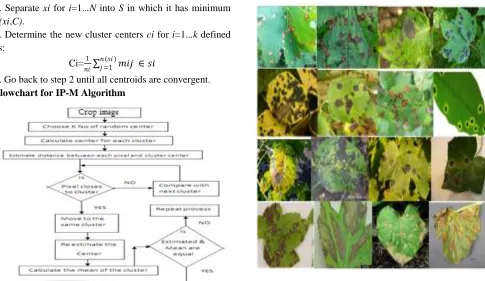
1. Initiate its algorithm by generating random starting points of initial centroids C.
2. Calculate the distance d between X to cluster center C. Euclidean distance is commonly used to express the distance.
3. Separate xi for i=1...N into S in which it has minimum d(xi,C).
4. Determine the new cluster centers ci for i=1...k defined as:
Ci=1
𝑛𝑖 𝑚𝑖𝑗
𝑛(𝑠𝑖 )
𝑗 =1 ∈ 𝑠𝑖
5. Go back to step 2 until all centroids are convergent.
Flowchart for IP-M Algorithm
The centroids can be said converged if their positions do not change in the iteration. It also may stop in the t iteration with a threshold ε if those positions have been updated by the distance below ε:
𝑐𝑡−𝑐𝑡−1 𝑐𝑡
< ε
IV.
SIMULATION
RESULTS
Identified Phyto-pathological problems experiments modules are developed using MATLAB R2014a, which runs in the environment Windows7, 8 and 10. Two species of samples are taken for the experiment, whose digital images are obtained by a camera. FIG shows the species type and numbers of leaves images for these species. Figure3 shows that the database of leaf images tested using the proposed algorithm. Selected cotton leaf for the testing purpose to identify the disease has shown in figure 4. Clustered indexes which have been obtained using proposed IP-M algorithm has given in figure 5 i.e., cluster 1, cluster 2 and cluster 3. Then we need to select the disease affected leaf from the cluster indexes in which index the disease is visible, this message box has shown in figure 6. After selecting the index number it automatically displays the type of disease in the MATLAB command window using SVM classifier.
Fig.4Disease affected leaf from the dataset
Fig.5Cluster indexes after K-means segmentation process
Fig.6Select the cluster index in which the disease is presented
V. CONCLUSION
In this, we portrayed our work worried with the separation amongst solid and sick to cotton crops utilizing a SVM. In this paper, separately, the uses of K-means grouping have been figured for bunching and characterization of infections that effect on plant takes off. Distinguishing the illness is by and large the drive of the proposed strategy. Along these lines, the proposed procedure was tried on 2 ailments which impact on the plants; they are: Leaf spot and Leaf excavator. These elements are imperative for the shading and morphology of the leaf spots and they give basic information about its visual representation. By utilizing division procedure it is simple for us to extricate the elements of infection leaf of the picture. Another approach in view of elements extraction was proposed for cotton leaf acknowledgment in this work. The entire procedure of leaf arrangement can be executed utilizing leaf identification, highlight extraction and order. For concentrate the proposed technique, the formed dataset is utilized. The dataset contains ailing pictures. Pictures were pre-processed and trimmed to a settled standard size. At that point, components are separated from all the leaf pictures in the dataset utilizing IP algorithm. For every picture leaf more incessant IP key focuses are extricated to distinguish an exceptional component. It licenses finding related components for various picture. Eventually, the extricated IP elements are rendered to a SVM classifier for reason for order. There are recognizing contrasts amongst ailing and non-sick leaf in structure, shading, measure and so forth. Along these lines, ID depends on these distinctions. At the end of the day, contrasts amongst sick and non-unhealthy leaves and the key focuses which are separated from leaf are utilized for characterizing. The diverse strategy is performed and the dataset was separated in two sections, 70% for prepare and 30% for testing.
VI. FUTURE WORK
For future review , we can extend this venture to order infection symptoms influenced on organic products , vegetables , business crops and so on., we may work for better application like we build up an Internet of Things ( IOT) based web administration plot where any individual can transfer their picture they will discover there sick and full insight about the illness. What they accomplish for their fields and yields . What is the preferred standpoint and disservice of this sickness and what ought to do to control it.
[1] Maheswari1, “N. B. Classification and Recognition of Herbal Leaf Using SVM Algorithm”, Research Journal of Pharmaceutical, Biological and Chemical Sciences, (2014).
[2] Romer, “L. P.-K, Optimal Wavelengths foran Early Identification of Cercospora Beticola With Support Vector Machines Based on Hyper spectral Reflection Data”, IEEE,(2010)
[3] A. L. David, “Pattern classification using a support vector machine for geneticdisease diagnosis”, IEEE on Electrical and Electronics Engineers, Israel, (2004).
[4] G. K. Kaur, “Classification of Biological Species Based on Leaf Architecture”, International Journal of Engineering Research andDevelopment, (2012) [5] S. A. Kutty, “Classification of watermelon leaf
diseases using neural network analysis”, Business Engineering and Industrial ApplicationsColloquium (BEIAC) on IEEE, (2013)
[6] S. Q. L. Sheng, “Diseases classification using support vector machine (SVM)”, International conference on Neural Information Processing (ICONIP), (2002).
[7] S. S. Nandpuru, “MRI brain cancer classification using Support Vector Machine”, IEEE, (2014) [8] F. Z. R. Ghaffari, “Early Detection of Diseases in
Tomato Crops: An Electronic Nose and Intelligent Systems Approach”, IEEE, (2010)
[9] K. R. Zhou, “Early Detection And Continuous Quantization Of Plant Disease Using Template Matching And Support Vector MachineAlgorithm”, IEEE, (2013)
[10]V. Sannakki, “Diagnosis and classification of grape leaf diseases using neural networks, IEEE, (2013). [11]Q. G. W. Huang, “New Optimized Spectral Indices
For Identifying and Monitoring Winter Wheat Diseases”, IEEE Journal of Selected Topics In Applied Earth observation and remote sensing, (2014).
[12]T. Youwen, “The Recognition of Cucumber Disease Based on Image Processing and Support Vector Machine”, IEEE, (2008).
[13]Y. Tian, “C. Z. SVM-based Multiple Classifier
System for recognition of wheat leaf diseases”, IEEE, (2013)