c
International Journal of Research (IJR)
e-ISSN: 2348-6848, p- ISSN: 2348-795X Volume 2, Issue 12, December 2015Available at http://internationaljournalofresearch.org
Design and Control of Internet of Things Enabled Wireless
Sensor Network
K. Praveen Kumar
1, Ch.Nagaraju
2M.Tech Student, Dept of ECE(VLSI&ES),DJR College Of Engineering & Technology, India1 Assoc Professor, Dept of ECE(VLSI&ES),DJR College Of Engineering & Technology , India2
[email protected] , [email protected]
Abstract
-
In this paper; we have reported an effective implementation of Internet of Things used for monitoring and control of regular domestic conditions by means of low cost sensor network. The interconnecting mechanisms for reliable measurement of parameters by smart sensors and transmission of data via internet are being presented.
This paper presents a low cost and flexible home control and monitoring system using an embedded hardware mote, with IP connectivity for accessing and controlling devices and appliances remotely using mobile application. The proposed system does not require a dedicated server PC with respect to similar systems and offers a novel communication protocol to monitor and control the home environment.
To demonstrate the effectiveness of this system, devices such as room temperature, humidity sensor, current sensor and atmospheric pressure sensor have been integrated with the proposed home control system.
Keywords: Internet of Things; Smart Home; Home Automation; Smartphone; Wireless sensor nodes
1. Introduction
Enormous increase in users of Internet and modifications on the internetworking technologies enable IoTs. Internet of Things (IoT) is about physical items talking to each
other, machine-to-machine communications and person-to-computer communications.
Key technologies that will drive the future IoT will be related to Smart sensor technologies including Nanotechnology, Miniaturization and Wireless Sensor Networks (WSN). Humans usually interact with the environment settings like air pressure, temperature, light etc., if the settings of the environment can be made to respond to human behaviour automatically, then several advantages present there.
The automation of home settings react according to the inhabitant requirements is termed as intelligent home automation system. Ambient intelligence responds to the behaviour of inhabitants in home and provides them with various facilities.
In general, intelligent home automation system consists of clusters of sensors, collecting different types of data, regarding the utility consumption at home.
Systems with computing capabilities analyze the assimilated data to recognize the activities of inhabitants or events. These can automate the domestic utilizations effectively and also can support the inhabitant by reducing the costs and improving the standard of living.
c
International Journal of Research (IJR)
e-ISSN: 2348-6848, p- ISSN: 2348-795X Volume 2, Issue 12, December 2015Available at http://internationaljournalofresearch.org
continuously monitored desired temperature or monitoring amount of energy consumption. Hence, this will contribute to overall cost reduction and energy saving which is one of the main concerns of today.
Related Work
Home automation or Smart Homes can be described as introduction of technology within the home environment to provide security, comfort, convenience and energy efficiency to its occupants. Adding intelligence to home environment can provide increased quality of life for the elderly and disabled people who might otherwise require caregivers or institutional care. Due to higher affordability and advancement in Smart phones and tablets which allows vast connectivity there has been a significant increase in phone automation. With the introduction of the Internet of Things, the implementation and research of home automation are getting more popular. Various wireless technologies that can support some form of data transfer, sensing, monitoring and control such as Wi-Fi, RFID, Bluetooth and cellular networks have been utilized to embed various levels of intelligence in the home.
The studies in have presented Bluetooth based home automation systems using Android mobile applications without the control of internet. The devices are physically connected to a Bluetooth sub-controller which is then accessed and controlled by the Smart phone.
However, due to some limited range of operation system is unable to cope with mobility and can only be controlled within the range. To provide network interoperability and remote access to control devices and appliances at home using home gateways researches also attempted. Introduced a Wi-Fi based home control system using PC based web server which manages the connected home appliances. Several designs have also been presented in where a web server, web page and a database have been developed to
interconnect and manage the devices with the disabled people who might otherwise require caregivers or institutional care. Due to higher affordability and advancement in Smart phones and tablets which allows vast connectivity there has been a significant increase in phone automation.
With the introduction of the Internet of Things, the implementation and research of home automation are getting more popular. Various wireless technologies that can support some form of data transfer, sensing, monitoring and control such as Wi-Fi, RFID, Bluetooth and cellular networks have been utilized to embed various levels of intelligence in the home.
The studies in have presented Bluetooth based home automation systems using Android Smart phones without the Internet controllability. The devices are physically connected to a Bluetooth sub-controller which is then accessed and controlled by the Smart phone using built-in Bluetooth connectivity.
However, due to limited range of operation (maximum up to 100 m) the system is unable to cope with mobility and can only be controlled within the vicinity. Researchers have also attempted to provide network interoperability and remote access to control devices and appliances at home using home gateways. Introduced a Wi-Fi based home control system using PC based web server which manages the connected home devices. Similar designs have also been presented in where a dedicated web server, database and a web page have been developed to interconnect and manage the devices with the Internet.
c
International Journal of Research (IJR)
e-ISSN: 2348-6848, p- ISSN: 2348-795X Volume 2, Issue 12, December 2015Available at http://internationaljournalofresearch.org
pages which also add to the cost. A GSM based communication and control for home appliances has also been presented by where different AT commands are sent
to the Home Mobile for controlling different appliances.
The drawback of this system is that users are not provided with a graphical user interface and users have to remember different AT commands to control the connected devices. Proposed mobile IP based architecture and its potential applications in Smart homes security and automation without any actual deployment and testing.
Proposed System
Features of the Proposed System
In order to address the mentioned issues of flexibility and functionality, designed and implemented a standalone, flexible, novel and low cost home controlling and monitoring system using Restful based Web services as an interoperable application layer. The system consists of a micro Web - server based on Ethernet, hardware interface modules and the Android compatible Smart phone application.
The architecture presented in this work can be customized in different ways in order to accommodate different application scenarios with minimum recoding and design that is each time a device is added to the Web-server, a new thread dedicated to the device is automatically created in the mobile application.
Hence, the aim of the proposed work is not to incorporate expensive components such as high end personal computers. The smart phone app provides a graphical user interface (GUI) for accessing and controlling the devices at home through server real IP.
Description of Proposed Architecture
This section describes the proposed architecture and design of flexible and low cost home monitoring and controlling system. The proposed system architecture is divided into three layers:
Home Environment, Home Gateway and Remote Environment.
Remote Environment represents authorized users who can access the system on their Smart phone app using the Internet via 3G/4G or Wi-Fi network. Home Environment consists of a hardware interface module. The primary function of the Gateway for the proposed architecture is to provide data translation services between the Internets.
The main component of the Gateway is a micro Web -server based on Ethernet. The main task of the server is to monitor, control and manage the hardware components that enables interface modules to successfully execute their assigned task using actuators and to report server. Hardware interface modules are directly interfaced with sensors through wired connection. It has the capabilities to control energy management systems like lightings, power plugs, HVAC (heating, ventilation, and air conditioning) systems. For monitoring Home Environment the system supports sensors such as temperature, humidity, atmospheric pressure and current.
Hardware Architecture
c
International Journal of Research (IJR)
e-ISSN: 2348-6848, p- ISSN: 2348-795X Volume 2, Issue 12, December 2015Available at http://internationaljournalofresearch.org
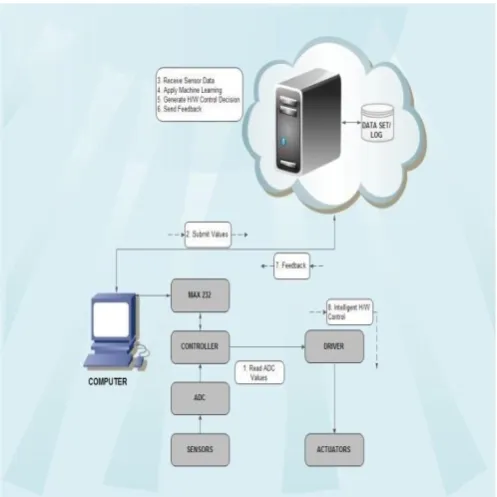
to the hardware motes and also shows the wireless conne the ARM Cortex M3 with the mobile phone.
Figure 1: Overall System structure connecting different sensing units
Figure :2 Schematic Block Diagram
Temperature and Humidity Node
In this paper, we use a sensor device as temperature and humidity node. ARM Cortex
M0 board equip with a TMP102 temperature, Honeywell's HIH 4030 humidity sensor and BMP 085 pressure sensor. The sensors will return temperature, humidity of room and pressure of environment to smart phone.
Figure: 3 TMP 102 Sensors
The TMP102 is, serial output temperature
sensor available in a tiny SOT563 package which is not requiring any external components, the TMP102 is capable of reading temperatures to a resolution 0.0625°C.The TMP102 features two compatibility, SMbus and allows up to four devices can connect to single bus. It also has the feature as SMB alert function. The TMP102 is ideal for temperature measurement in a variety of computer, consumer, communication, industrial, environmental and instrumentation applications. The device can specify for operation over a temperature range of to +125°C.
Figure: 4 HumditySensor
c
International Journal of Research (IJR)
e-ISSN: 2348-6848, p- ISSN: 2348-795X Volume 2, Issue 12, December 2015Available at http://internationaljournalofresearch.org
humidity and delivers it as an analogy output voltage. The output of the sensor can be directly connected to an ADC on a microcontroller and, the data is very easy Voltage applied to the supply pins should be within 4 5.8VDC, and optimally at 5V. The sensor can only consume about 200μA. This product comes as the Fig 4, with the HIH-4030 soldered onto the breakout board.
Discussion and Future Work
With the advancements in technology, it is expected that the availability of internet is everywhere and online at all time. In this paper, a novel architecture for low cost and flexible home control and monitoring system using Android based Smart phone is proposed and implemented. The proposed architecture utilizes Web services as an interoperable application layer for communicating between the remote user and the home devices. With the features of scalability, fault tolerance and effective power consumption of nodes and transceiver IoT have facilitated ubiquity computational ability to internetwork heterogeneous smart devices easily and facilitate availability of data anywhere. The key idea of the proposed method is to provide a low cost solution and flexible connection mechanisms for integrating Internet of things with home monitoring systems. The advantages of the developed system are to have greater control over routing of packets (security and customization) and ability to adapt to other wireless sensor networks.
References
[1] Dargie, W. and Poellabauer, C.,
(2010)’Fundamentals of wireless sensor networks: theory and practice’, John Wiley and Sons, ISBN 978-0-470-99765
[2] Rajeev Piyare,(2013) ‘Internet of Ubiquitous Home Control and Monitoring System using Android based Smart Phone’ International Journal of Internet of Things
[3] Kelly.S.D.T, Suryadevara.N.K and
Mukhopadhyay.S.C, FIEEE, IEEE(2013) ‘Towards the Implementation of IoT for Environmental Condition Monitoring in Homes’
[4] Zach Shelby, Carsten Bormann ‘6LoWPAN: The Wireless Embedded Internet’, A John Wiley and Sons, Ltd, Publication
[5] Suryadevara.N.K, Gaddam.A, Rayudu.R.K,
Mukhopadhyay.S.C, (2012) ‘Wireless Sensors Network Based Safe Home to Care Elderly People: Behaviour Detection’, 20, Elsevier Sensors and
Actuators: A Physical http://dx.doi.org/10.1016/j.sna
03.0Vol 25
[6] Chen .C.H, Gao.C-C, and Chen.J ‘Intelligent Home Energy Conservation System Based On WSN,’ presented at the International Conference on Electrical, Electronics a Engineering, Pattaya
[7] Shahriyar.R, Hoque.E, Sohan.S, Naim.I,
Akbar.M.M, and Khan.M.K(2008), ‘Remote
controlling of home appliances using mobile telephony,’ International Journal of Smart Home, vol. 2, pp. 37-54,.
FirstAuthor :
K.PRAVEEN KUMAR received his B.Tech degree in Electronics & Communication Engineering in the year 2013 and pursuing M.Tech degree in Electronics &Communication Engineering (VLSI&ES) from DJR College of Engineering & Technology
SECOND AUTHER’S: