Available online:
https://edupediapublications.org/journals/index.php/IJR/
P a g e | 1879Cost Analyis of Rc Beam Using Genetic Algorithm
Ankit Gupta & Arpit ChawdaM-Tech scholor, Assistant professor Department of civil engineering, RKDF SOE, Indore
ABSTRACT
In this study we present a use of genetic
algorithm applications and lay a special
emphasis on use of the same as one of the
most important optimization tool. Finally,
some examples illustrate the effectiveness
and efficiency of the genetic algorithm
based optimal design. Optimization
processes act as a vital part in design of
structure; the main aim of optimization is
to find the best manners so that a designer
can figure the maximum gain from existing
resources. Optimum structural design
methods are able to be carried out
corresponding to the design belief
involved. Even today, the majority of the
civil structures were designed based on
allowable stress criteria as per code
requirements. Nonetheless, a specific
factor of safety beside ultimate collapse of
the structure is used by various new
processes. This study proposes a new
genetic algorithm for RC beam design. A
genetic algorithm model was prepared to
execute the optimization of cost for singly
and doubly reinforced concrete beam
which was subjected to different loading
conditions. The initial solution was
acquired by utilizing the limit state design.
Code was written in MATLAB by using
genetic algorithm to obtain the optimal
values.
This optimization problem is then solved
by a genetic algorithm specially tailored to
the problem. In the objective function, the
total cost of the structure is minimized. .
Cost optimization for singly and doubly
reinforced beam is illustrated and plotting
of various cases are shown. the total cost
of beam reduces with the increase in
characteristic compressive strength of
concrete, while fixing the applied load and
the grade of steel, beacuse the Genetic
Algorithm optimizes the final cost by
decreasing the dimension of section in
order to find the optimal cost.
Keywords
Structural optimization, cost saving, genetic algorithm, design optimization
INTRODUCTION
Available online:
https://edupediapublications.org/journals/index.php/IJR/
P a g e | 1880structures were more adaptable, durable, and incur comparatively less maintenance costs. They offer superior resistance for damage caused by fire and water, and have good potential for an extensive service years. Weight of a Reinforced structure comprises a chief component of the overall cost.
Cost of the material is a chief subject in case for construction and design of reinforced concrete structures. Quantity of concrete and steel reinforcement is the primary factors affecting the total cost that is needed. Hence, it is necessary to build lighter reinforced concrete structures, and should be able to fulfil the strength and serviceability requirements. The cost of formwork and labour are important along with the cost of materials. The cost of formwork is generally articulated in the form of cost per unit area, and it is complicated to compute the cost of labour. The combination of cost of labour and the cost of formwork is very widespread in order to get reasonable overall cost of construction. Therefore, for optimal usage of acquirable resources, it is necessary to minimize the overall cost of structure. A structural design engineer needs good understanding, instinct and knowledge for formulating the capability to design robust, practical and economical structures. The
standard design codes hardly give a design that can satisfy all the conditions that are given– Hence, the designer has to carry out an elite number of analysis and design cycles prior to meeting up the best solution. A better initial result decreases the number of analysis and design cycles. A set of initial solutions generated by the GA from the acceptable range for each design variable, as acquired from the intuitive design, was taken as the initial population to be optimized. For cost of structure to be minimum , the optimization process selects a group of design variables that make sure that overall cost is minimum; and is subjected to the satisfy several constraints as per IS:456-2000.
Objective of study
The objective of this study is to optimize the RC beam using genetic algorithm coding that satisfies the limitation and specifications of the IS: 456-2000.
MODEL FORMULATION
Available online:
https://edupediapublications.org/journals/index.php/IJR/
P a g e | 1881are efficient in bearing both tension and compression. Though, concrete beams contain their own limiting moment of resistance that changes with change in specific value of depth, width, grade of concrete and grade steel.
In general, doubly reinforced beams are applied to in situations in which the cross-sectional dimensions of the beam are limited (by architectural or other circumstances) and when singly reinforced sections are not adequate in stipulations of moment-resisting capability. The existence of compression reinforcement decreases the long-term deflections caused by shrinkage. The design based on limit state and the optimization methods were done, which is subjected to satisfaction of a range of geometrical and behavioural and condition as commended by the Bureau of Indian Standards in IS: 456-2000
GENETIC ALGORITHM
Genetic algorithms are search algorithms that have been evolved from the evolution observed in nature, namely the processes of natural selection, genetics and survival of the fittest. Genetic algorithm applies these
natural processes to mathematical string structures and adds \some of the artificial reasoning of search algorithms. It is a type of search paradigm that applies arbitrary selection as a tool to carry out an extremely expansive search and selection method, throughout a range of constraint limited space. Genetic algorithm was advanced as a mathematical tool at the University of Michigan, by John Holland, with the support of his peers and students. The chief goals of their research in the development of GA were:
(a) To abstract the adaptive process of natural systems and rigorously explain the same, and
(b)
To formulate an artificial program or system that imbibes the essential functionalities of natural processesRESULT AND DISCUSSION
Comparison of genetic algorithm model
with the Neural Network model of
previous work For singly reinforced
concrete beam
Available online:
https://edupediapublications.org/journals/index.php/IJR/
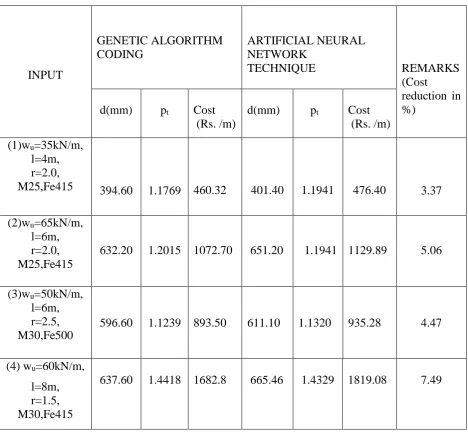
P a g e | 1882Table 1: Comparison of cost for singly reinforced beam by genetic algorithm model with Neural the Network model
INPUT
GENETIC ALGORITHM CODING
ARTIFICIAL NEURAL NETWORK
TECHNIQUE REMARKS
(Cost reduction in %)
d(mm) pt Cost (Rs. /m)
d(mm)
pt
Cost (Rs. /m) (1)wu=35kN/m,
l=4m, r=2.0,
M25,Fe415 394.60 1.1769 460.32 401.40 1.1941 476.40 3.37
(2)wu=65kN/m, l=6m, r=2.0, M25,Fe415
632.20 1.2015 1072.70 651.20 1.1941 1129.89 5.06
(3)wu=50kN/m, l=6m, r=2.5, M30,Fe500
596.60 1.1239 893.50 611.10 1.1320 935.28 4.47
(4) wu=60kN/m, l=8m, r=1.5, M30,Fe415
637.60 1.4418 1682.8 665.46 1.4329 1819.08 7.49
Available online:
https://edupediapublications.org/journals/index.php/IJR/
P a g e | 1883
(a)Problem 1 (b) Problem 2
Available online:
https://edupediapublications.org/journals/index.php/IJR/
P a g e | 1884For doubly reinforced concrete beam:
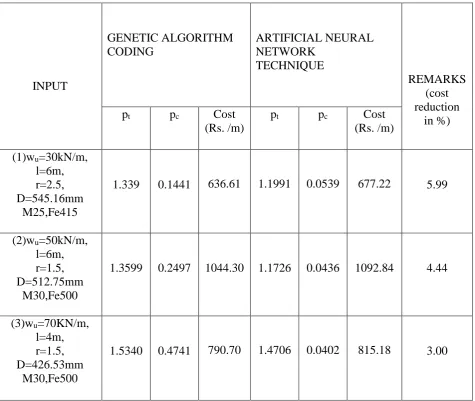
Comparison of cost for doubly reinforced concrete beam with the Neural Network model is shown below in tabular form.
Table 5.6: Comparison of cost for doubly reinforced beam by genetic algorithm model with Neural Network model
INPUT
GENETIC ALGORITHM CODING
ARTIFICIAL NEURAL NETWORK
TECHNIQUE
REMARKS (cost reduction
in %) pt pc Cost
(Rs. /m)
pt pc Cost
(Rs. /m)
(1)wu=30kN/m, l=6m, r=2.5, D=545.16mm
M25,Fe415
1.339 0.1441 636.61 1.1991 0.0539 677.22 5.99
(2)wu=50kN/m, l=6m, r=1.5, D=512.75mm
M30,Fe500
1.3599 0.2497 1044.30 1.1726 0.0436 1092.84 4.44
(3)wu=70KN/m, l=4m, r=1.5, D=426.53mm
M30,Fe500
Available online:
https://edupediapublications.org/journals/index.php/IJR/
P a g e | 1885Graphs have been plotted for the above solved values
(a)Problem 1 (b) Problem 2
(c)Problem 3
Discussion:
The optimal cost of singly and doubly reinforced concrete beams by Genetic Algorithm model was compared with the optimal cost by Neural Network considered from one of the previous works and it was found that the former technique showed a considerable fall in total optimal cost. The
resulting optimal designs shows cost savings of up to 5.1% for singly reinforced concrete beam and 4.48% for doubly reinforced concrete beam when compared with the literature considered for comparison.
Available online:
https://edupediapublications.org/journals/index.php/IJR/
P a g e | 1886A genetic algorithm model was prepared to execute the optimization of cost for singly and doubly reinforced concrete beam which was subjected to different loading conditions. The initial solution was acquired by utilizing the limit state design. Code was written in MATLAB by using genetic algorithm to obtain the optimal values.
Following conclusions were inferred from this study:
1. Reduction in cost was negligible due to change above certain values of mutation rate, number of generations and population size for singly and doubly reinforced concrete beam.
2. The total cost of beam reduces with the increase in characteristic compressive strength of concrete, while fixing the applied load and the grade of steel, beacuse the Genetic Algorithm optimizes the final cost by decreasing the dimension of section in order to find the optimal cost.
3. The total cost increases with the increase in grade of steel, while fixing the applied load and compressive strength of concrete.
4. On comparison with an earlier literature related to cost optimization of reinforced beams, it was concluded that there was cost reduction of 5.1% for
singly reinforced concrete beam and in case of doubly reinforced concrete beams cost reduction of 4.48% was acquired by genetic algorithm model.
REFERENCES
[1] Adamu,A., and Karihaloo,B.L (2006). “Minimum cost design of RC beams using DCOC part I:beams with freely-varying cross sections”. Structural Optimization7,235-251,Springer-Verlag. [2] Alqedra,M., Arafa,M., and Ismail,M. (2011). “Optimum cost of Prestressed concrete beams using genetic algorithms”. Journal of artificial intelligence 4(1):76-88, ISSN /DOI:10.3923/jai.2011.76.88, Asian network for scientific information.
[3] Bassir,D.H., Tang, X.G., and Zhang,W.H. (2008). “Material Optimization with Mixed Variables Based on Genetic Algorithm”. EngOpt - International Conference on Engineering Optimization, Rio de Janeiro, Brazil. [4] Camp,C.V., Pezeshk,S., and Hansso,H. (2003). “Flexural Design Of Reinforced Concrete Frames Using A Genetic Algorithm” 10.1061/ASCE, 0733-9445,129:1(105).
Available online:
https://edupediapublications.org/journals/index.php/IJR/
P a g e | 1887[6] Coello,C.C., Christiansen ,A.D., and Hernandez,F.S. (2000). “A simple genetic algorithm for the design of reinforced concrete beams”.
[7] Falcon,G.S., Garcia,S.G., Piraciaba,M.P., Karam,V., Desir,J.M.