RF Based Lighting System For Industries
Harshitha M N
& Dr. Shankaraiah
1 M.Tech, Department of Electronics & Communication Engineering, Sri Jayachamarajendra College of Engineering(SJCE), JSS S&T University Campus, Mysore, Karnataka, India
2Professor & Head Department of Electronics & Communication Engineering, Sri Jayachamarajendra College of Engineering(SJCE), JSS S&T University Campus, Mysore, Karnataka, India
Abstract—
This paper present an efficient and practical method for Light controlling system in industries and based on IoT.The project aims in controlling the operation of lights using the proprietary RF meter data. The Internet of things (IoT) is the inter-networking of physical devices, vehicles (also referred to as "connected devices" and "smart devices"), buildings, and other items embedded with electronics, software, sensors, actuators, and network connectivity which enable these objects to collect and exchange data.
The IoT-based Light Controlling system in the industry mainly concerns with the interoperability between devices and machines that use different protocols and have different architectures. The IoT-based Lighting system uses the RF meters as the source of data, which is in a peer to peer mesh network. RF/LPR (Low Power Radio) mesh network of meter boards, a key element in building the “Industrial Internet of Things” (IIoT).
Keywords— Internet of things, Radio Frequency
I. INTRODUCTION
Electrical energy is a major input sector for economic development of any country. To deliver a sustained economic growth rate of 8% to 9% through 2031-32 and to meet life time energy needs of all citizens, India needs to increase its primary energy supply by 3 to 4 times and electricity generation capacity about 6 times. As a result energy service demand growth rates will keep on increasing because of accelerated industrialization, urbanization, and an emerging consumer society. The cost of generating electricity will only go up to keep up with the costs of inflation. In such a scenario, it is very clear that consumers will be paying more prices per unit of electricity consumed, in the years to come.
Electricity is one of the most important resources in this century that should be conserved. On several occasions, we get out of rooms, offices, and hall and forget to turn off the lights/fan, thus the electricity is wasted and billing is also increased. Manual operation of light in offices is one of the challenges being faced by members of staff in any organization.
‗Industrial Internet of Things (IIoT)‘ is the emerging practice of connecting intelligent physical entities, such as sensors, devices, machines, assets, and products, to each other, to Internet services, and to applications allowing Industrial
companies to use information from these connected devices to lower costs, optimize processes, and create transformative new applications, services, or business models.
II. LITERATURE SURVEY
Energy is a major input sector for economic development of any country. To deliver a sustained economic growth rate of 8% to 9% through 2031-32 and to meet life time energy needs of all citizens, India needs to increase its primary energy supply by 3 to 4 times and electricity generation capacity about 6 times. As a result energy service demand growth emerging consumer society. The cost of generating electricity will only go up to keep up with the costs of inflation. In such a scenario, it is very clear that consumers will be paying more prices per unit of electricity consumed, in the years to come.
Authors in paper [1], discusses the amount of electricity is consumed due to street lights. This is due to continuous operation of lighting during the night time. In order to reduce the electricity consumption and wastage of energy, the system that has to combine the existing network with intelligence to think itself. This newly developed concept will enable the street lights to adjust automatically based on the real time traffic conditions and change according to naturalistic condition (Full moon). This paper presents the low cost intelligent street light system through sensors for the reduction in electrical energy. This Dynamic Street Lighting System is experimented through IR and PIR sensors and the outputs are obtained through proteus7 simulation software. By introducing this system, the energy crisis in today‘s world can be reduced to some extent.
Authors in paper [3], discusses ―IoT Based Smart Intelligent Lighting System for Smart City ―as a cost effective, practical, eco-friendly and the safest way to save energy. In this system the light status information can be accessed from anytime and anywhere. It clearly tackles the two problems that world is facing today, saving of energy and also disposal of incandescent lamps, very efficiently.
Authors in the paper [4], elaborates the design and construction of automatic street control system circuit. Circuit works properly to turn street lamp ON/OFF. After designing the circuit that controls the light of the street as illustrated in the previous sections. LDR sensor and the photoelectric sensors are the two main conditions in working the circuit. If the two conditions have been satisfied the circuit will do the desired work according to specific program. Each sensor controls the turning ON or OFF the lighting column.
Authors in paper [5], have designed an Automatic Light Control system used in offices and the performance of the work after testing met the design specifications. The design was installed in an office for power management and it is sensitive to darkness for its operation. During the night time when there is darkness, the system automatically turns on the bulbs and simultaneously switches off the bulbs during the daytime with the aid of Light Dependent Resistor.
Authors in paper [6], present a new model which will reduce the power consumption of the street lighting system about 20-35 % compared to conventional design. In this system the authors estimates in saving lot of power without any Wastage, by these advanced technologies the authors can design many more systems which can be done by solar lights and through these solar lights we have a vast usage at the same time we can do automatic systems instead of doing it manually like with LDR‘s. Secondly, using highly advanced IC‘s and with the help of growing technology the project has been successfully implemented.
Authors in paper [7], proposes an intelligent street lighting system with high degree of adaptability and ease of installation is presented in this paper. The system takes advantage of a centralized control strategy and the use of wireless connection elements to achieve increased energy efficiency as well as viable communication links in complex scenarios.
Authors in paper [8], proposes remote-controllable and energy-saving room architecture to reduce power consumption. To realize the proposed room architecture, we proposed and designed the automatic power cut-off outlet and a RF communication.
Authors in paper [9], discusses the design is established for the automation of power house system. They show how to remotely control and monitor power, automatically cut-off power on a single click using micro-controller based switches, wireless hardware module and web user interface during the shortage of power for power management or when bill is not
paid. Web user interface shows complete information and power status of consumer stored in database; the data in a database is collected from remote module. IR module, zigbee module and server module through internet, static state relay for controlling power on/off outlets and sensors used to sense electric current being used by electric outlets.
A. RF Features
Serial interface (RS232) Maximum data rate: 22.5 kbps
Obtained in an electrically quiet outdoor location. Greatly influenced by building construction materials
and contents, other radio systems operating in the vicinity, and noise generated by nearby equipment Provide link-layer packet protocol
Wireless control of power increase energy saving. System helps to reduce power cuts in once particular
area.
Reduce the cost by effective use of energy across the city elaborate advantages.
RF can form a network; hence it is easy to build a wide network for client units.
Admin control helps to strictly follow the energy distribution policies.
Easy to modify
B. RF modem
Figure 1 : RF modem used for Wireless Communication
III. PROBLEMDESCRIPTIONANDMETHOLOGY
The main objective of this project is to use IIoT for the automation of lights, by using an application that controls and monitors operation of lights based on the proprietary RF meter data. In order to reduce the electricity consumption and wastage of energy, the system that has to combine the existing network with intelligence to think it. This project work is focused on design and implementation of an automatic light controlling system for use in offices in order conserve electricity as well as reducing electricity bill. Building an Automation Lighting System in the industries reduces the wastage of energy and CO2 emissions.
In the proposed system we are building a RF meter using a proprietary RF protocol. With the help of 866 MHz Proprietary Mesh Protocol, data collection from RF meters is faster as it uses the concept of AMR (Automated Meter Reading).
The customer segmentation application is mainly developed with the Application Development Framework (ADF). The Oracle Application Development Framework is an end-to-end application framework that builds on Java Platform, Enterprise Edition (Java EE) standards and open-source technologies. Oracle ADF can be used to implement enterprise solutions that search, display, create, modify, and validate data using web, wireless, desktop, or web services interfaces. Because of its declarative nature, Oracle ADF simplifies and accelerates development by allowing users to focus on the logic of application creation rather than coding details. Used in tandem, Oracle JDeveloper and Oracle ADF gives an environment that covers the full development lifecycle from design to deployment, with drag and drop data binding, visual UI design, and team development features built in [3].
IV.SYSTEMMODEL
System design is the process of defining the architecture, modules, interfaces, and data for a system to satisfy specified requirements. Systems design could be seen as the application of systems theory to product development. There is some overlap with the disciplines of systems analysis, systems architecture and systems engineering.
i. Building the RF mesh network
An RF Meter is a small electronic device used to transmit and/or receive radio signals between two devices over radio wirelessly. When RF current is supplied to an antenna, an electromagnetic field is created and that is able to propagate through space for communication. RF modules are widely used in electronic design owing to the difficulty of designing radio circuitry. Figure 2 shows the building of RF mesh network
Figure 2 : Building of RF mesh network
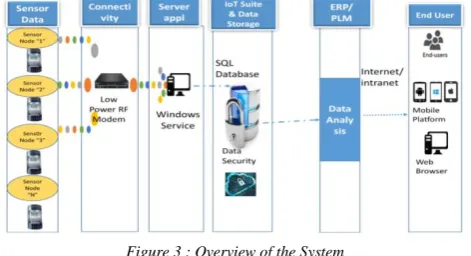
Figure 3 shows the Overview of the System. The sensor data is the RF meter data, RF meters acts as sensor nodes. The Gateway (also known as coordinator) is the RF modem which is a wireless communication that uses 866 MHz / Sub GHz (Ultra high Frequency) to connect to the RF meter boards. Server application is nothing but a Windows based application
Figure 3 : Overview of the System
ii. Serial Port Communication
Figure 4 : Snapshot of Serial port communication using C# application
In computing, a serial port is a serial communication interface through which information transfers in or out one bit at a time (in contrast to a parallel port). Throughout most of the history of personal computers, data was transferred through serial ports to devices such as modems, terminals and various peripherals. Figure 5 shows the code in C# for serial port communication.
Figure 5 : Code for Serial Port communication
iii. Collection of RF Meter Data
Once the serial port connection is established next step is collection of the RF meter data. The RF data can be collected by creating a GUI based application using Windows Forms. In this process we create an XML file with a specified tag names for meter id, meter serial number, network id, type of meter data to be collected etc. This tag names used in the XML file are used while coding, thus they track the data using the ID and store them in a specified database location. The data stored will be in a XSLT format.
Figure 6 : The JDeveloper Workspace
V. DESIGN FLOW OF THE PROJECT
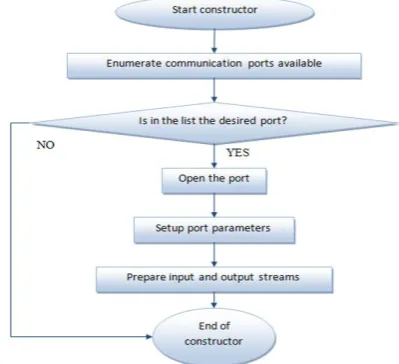
Flow diagram is a collective term for a diagram representing a flow or set of dynamic relationships in a system. The term flow diagram is also used as a synonym for flowchart, and sometimes as a counterpart of the flowchart Figure 6.1 depicts the flowchart for serial port constructor which checks for setting baud rate, parity, stop bits and data bits.
Figure 7 : Serial port Constructor
When the serial constructor in the program begins it initializes port for communication and then checks for the baud rate, data bits, parity if the desired port is available it opens the port and sets the port settings and takes input from the system otherwise it fails and does not connect to the desired port. Apart of this, two more methods are going to be needed, by now, to manage the communication. One to read the data received and another one to write the data that is going to be sent. The method responsible for reading what is in input stream is called ‗SerialReader‘.
VI. TESTING
completely. Once the product done with the design process and ready to use by the user in this stage gives for testing to check the correctness of product. It checks whether it meets the user requirements and product id there according to the user expectation. Testing can be done using various testing methods.
i. DockLight Testing
Initially before initializing the communication between RF meters and PC using C# application, we use DockLight tool to check the correct working of RF meters. This tool mainly uses the COM port for connecting and testing of RF meters. The tool uses AT commands for communication since the interface
is a RF modem. Figure 8 shows the screenshot of DockLight testing.
Figure 8 : Screenshot of DockLight testing
VII. RESULT
The Figure 9, shows the data collection part where there are several types of data that are displayed. We can select the desired data (eg: Instantaneous data) and plot the graph of the data at the current date and time. Based on the scheduled and threshold values set we make an analysis of controlling the operation of lights by switching ON or OFF.
Figure 9 : The data collection part
The below Figure 10, shows the graphs of power vs time based on the collected data. We can plot the graph for each data. It can be settings data, tamper data, full data, etc.
Figure 9 : Visualization graph of power vs time
The below Figure 11, shows the snapshot of application used for controlling and monitoring of lights in the industry. Switching the lights ON or OFF can be done either all at a
time using a single button or it can also be done individually.
Figure 11 : Controlling application used for automation of lights in the industry
Conclusion
We have developed an effective system to remotely monitor the use of power and are able to detect power theft in power system in accurate and cost effective way. This will help in preventing huge loss of power. The system has the ability to inform or send data about the consumer‘s consumption to the admin using wireless radio link and sending control commands from admin to consumer. With the use of RF meter data, Windows forms and UI we are able to control the operations of the lights remotely in a timely manner. Thus we can successfully and effectively address problems related to power theft by the consumers in a completely automated, wireless, cost effective and most importantly reliable way.
Future Scope