Design And Analysis Of Various Cooling Fluids On Engine Block
ABSTRACT:
Cooling system assumes vital parts to control the temperature of auto's motor. One of the vital components in the auto cooling system is cooling liquid. The utilization of wrong cooling liquid can give negatives effect to the auto's motor and abbreviate motor life. A proficient cooling system can keep motor from overheating and helps the vehicle running at its ideal performance.This theory was led to consider the viability of different sorts cooling specialist in the vehicle cooling system which will impact the operation time of the motor square predominantly chamber in the light vehicle cooling systems. Hypothetical counts were done to decide the general warmth exchange coefficient and warmth lost by the barrel by differing the liquids
and material of chamber. Three primary sorts of liquids were utilized as a part of this study, which are 1.Tap water, 2.Distilled water, 3. Refined water with Ethylene glycol. Warm examination is done on the barrel by fluctuating the materials Cast Iron, Aluminum compounds 7475 and 6061.
KEYWORDS: CAD, ANSYS, Ethylene Glycol, Alloys, Effectiveness, etc
INTRODUCTION
Cooling Systems in Vehicles
Despite the fact that gasoline engines have enhanced a considerable measure, they are still not extremely effective at turning synthetic vitality into mechanical force. The majority of the vitality in the fuel (maybe 70%) is changed over into Mohammed Asif
M.Tech (Thermal engineering), P.G. Scholar
Nishitha College of engineering and technology
Rangdal Srikanth
Mtech(AMS), Asst professor
warmth, and it is the occupation of the cooling system to deal with that warmth. [Leong, 2010]In truth, the cooling system on an auto driving down the turnpike scatters enough warmth to warmth two normal estimated houses! The essential occupation of the cooling system is to keep the motor from overheating by exchanging this warmth to the air, yet the cooling system likewise has a few other critical employments [Nice, 2012].The motor in your auto runs best at a genuinely high temperature. At the point when the motor is icy, parts wear out speedier, and the motor is less productive and discharges more contamination. So another essential occupation of the cooling system is to permit the motor to warm up as fast as could be allowed, and after that to keep the motor at a steady temperature [Ofria,2006].
Inside your auto's motor, fuel is always smoldering. A ton of the warmth from this burning goes right out the fumes system, however some of it douses into the motor, warming it up. The motor runs best when its coolant is around 200 degrees Fahrenheit (93 degrees Celsius). At this temperature: • The ignition chamber is sufficiently hot to totally vaporize the fuel, giving better burning and decreasing discharges. • The oil used
to grease up the motor has a lower thickness (it is more slender), so the motor parts move all the more uninhibitedly and the motor squanders less power moving its own segments around. • Metal parts wear less.
TWO TYPES OF COOLING SYSTEMS
There are two sorts of cooling systems found on autos: fluid cooled and air-cooled. Fluid Cooling The cooling system on fluid cooled autos flows a liquid through channels and paths in the motor. As this fluid goes through the hot motor it ingests heat, cooling the motor. After the liquid leaves the motor, it goes through a warmth exchanger, or radiator, which exchanges the warmth from the liquid to the air blowing through the exchanger.
AIR COOLING
warmth to the air. Since most autos are fluid cooled, we will concentrate on that system in this article.
AIR COOLED ENGINES
The reason of an air-cooled motor is entirely basic: Let wind stream over the motor to keep it cool. Be that as it may, since this article should be a tad bit longer than that, we'll touch on a couple of more points of interest (for my editorial manager's purpose, at any rate). Most present day autos use water-cooled motors with radiators, water pumps and hoses that circle a water and coolant blend all through the motor. The warmth from the motor is exchanged to the coolant, and after that the coolant is cooled in the radiator and sent back around once more. Air-cooled motors need none of this. They depend on great out-dated air to chill them off. To be reasonable, all motors are in fact aircooled in light of the fact that even water-cooled motors use air to cool the liquid in the radiator. Yet, we should not part hairs.Air-cooled motors have balances reaching out from the motor to force warm away. Cool air is then constrained over the blades - ordinarily by a fan in autos. For flying machine and
bikes, the vehicle's velocity alone moves enough cool air over the balances to keep the motor cool.Some air-cooled motors may likewise have conduits around the motor to keep air streaming to the most smoking ranges.
moving of the auto sequential construction system nowadays, yet that doesn't as a matter of course mean they're anyplace close dead.If you jump on a bike, off-road vehicle, or even a typical riding cutter then you're most likely encountering an air-cooled motor (albeit a few bikes are fluid cooled). In any case, its flying machine that have had the longest running air-cooled track record in light of the fact that numerous helicopters and little planes have remained air-cooled right from the earliest starting point. Advantages and Limitations of Air-Cooled Engines.
So an air-cooled motor has no requirement for a radiator, a water pump, coolant, hoses or some other related parts a fluid cooled motor has. In any case, is it accurate to say that this is really something worth being thankful for? The short reply: Sometimes.Obviously, and air-cooled motor doesn't have coolant spillage issues and won't ever require things like the water pump or radiator to be supplanted, which can be an extraordinary thing. Regularly, they're lighter than fluid cooled motors, as well, since they have less parts.Air-cooled motors additionally warm up a considerable measure speedier than fluid cooled motors and don't have any danger
of the coolant solidifying, which is useful in case you're working the vehicle in to a great degree icy temperatures. In any case, there are some extensive disadvantages, as well. For one thing, air-cooled motors will probably overheat. No doubt, that is a bummer. They can likewise be more costly to construct and the extensive fans used to cool the motor can take away a great deal of power.This doesn't imply that air-cooled motors are awful or insufficient. Indeed, for cruisers, recreational vehicles and certain air ship the air-cooled motor works to a great degree well. However, on autos, the normal agreement is that the downsides exceed the advantages.
LITERATURE SURVEY
cooling system can keep motor from overheating and helps the vehicle running at its ideal execution. A straightforward model that comprise auto's cooling system parts was outline for this study. Two fundamental kind of liquid were utilized as a part of this study, which are liquid with coolant and liquid without coolant[Pang, 2011]. This study utilized the fan working time and temperature as a determinant to survey the viability of cooling operator. Results demonstrated that treated faucet water is the best fluid without coolant. Then, for the fluid with coolant, we prescribe the blend of 60% long life coolant with 40% refined water. It likewise demonstrates that fluids containing coolant a bit much a compelling cooling operator.
SUMMARY
Cooling System is a standout amongst the most imperative systems in the motor since it is appointed to control and keep the motor working temperature. It expels abundance heat from the motor, to keep the motor working at the most proficient temperature, and to permit the motor to achieve its optimal operation temperature in the briefest time conceivable [Schappell, 2011]. Inappropriate use of cooling fluid can bring about negative impacts on the system and further harm
the motor. Clients are encouraged to be ready and perceive the name and capacity of any coolant before use it. All in all, for the clients that lean toward fluid without coolant, this study proposes the utilization of treated faucet water for the auto cooling system; for the clients that favor fluid with coolant, this study recommends to utilize the blend of 60% long life Coolant with 40% refined water for the auto cooling system. Both of the fluid can be utilized as a part of cooling systems, as it has the same capacities and interests, which give cooling to the system amid motor operation [Salah, 2010].
Likewise, the vehicle cooling system working temperatures are additionally impacted by different elements, for example, the wind current, sort of radiator, radiator top, indoor regulator, fan engine productivity, and the measure of the fan edges (Hammer, 2008). Further studies might be performed to distinguish the fundamental elements which impact the working temperature of the present auto cooling system.
Heat Transfer Calculations :
1 / U A = L / k A + 1 / hA (1)
Where
U = the overall heat transfer coefficient (W/m2K)
A = the contact area for each fluid side (m2)
k = the thermal conductivity of the material(W/mK)
h = the individual convection heat transfercoefficient for each fluid (W/m2K)
L= the wall thickness (m)
The thermal conductivity - k - for sometypical materials (varies with temperature)
Alloy Cast Iron : 53.3 W/mK
Aluminum 6061: 205 - 250 W/mK
Aluminum7475 : 138 W/mK
More about conductive Heat Transfer Thermal Conductivity for Several materials The convection heat exchange
coefficient - h - relies on upon The sort of liquid - gas or fluid
The stream properties, for example, speed Other stream and temperature subordinate properties
Heat transfer coefficient for some common fluids:
Tap Water: 5000W/m2K
Distilled Water: 10 000 W/m2K
Distilled water with Ethylene Glycol: 350 W/m2K
Engine Specifications
Length of the cylinder: 0.072 m
Bore diameter: 0.0685 m
Thickness of cylinder: 0.004 m
Heat Transfer Q = U A (Tg - Tc)
U = Over all heat transfer coefficient
A = Area of cylinder
Tg = Temperature inside cylinder
Area of cylinder = 1.235e-5 m2
Heat Transfer calculations
withAluminium 6061 with different coolants:
• U= 1666.7 W/m2K Q = 5.128 W (with tapwater without coolant)
• U = 2000 W/m2K Q = 6.154 W (with distilledwater without coolant)
• U = 2850 W/m2K Q = 8.770 W (Distilledwater with Ethylene
glycol)
Heat Transfer calculations
withAluminium 7475 with different coolants:
• U= 1385.54 W/m2K Q = 4.26 W (with tapwater without coolant)
• U = 1608.39 W/m2K Q = 4.949 W (withdistilled water without coolant)
• U = 2266.67 W/m2K Q = 6.970 W (Distilledwater with Ethylene glycol)
Heat Transfer calculations with Alloy CastIron with different coolants:
• U= 644.81 W/m2K Q = 1.98W (with tapwater without coolant)
• U = 689.25 W/m2K Q = 2.12 W (withdistilled water without coolant)
• U = 1090.27W/m2K Q = 3.35W (Distilledwater with Ethylene glycol)
METHODOLOGY
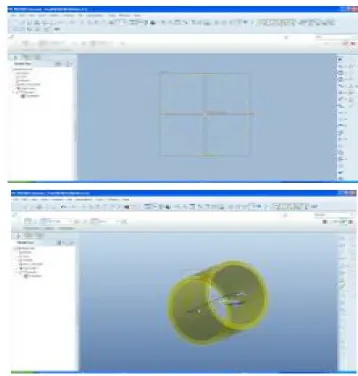
Prologue to CAD& PRO/Engineer Computer-helped plan (CAD), otherwise called PC supported outline and drafting (CADD), is the utilization of PC innovation for the procedure of configuration and configuration documentation. PC Aided Drafting depicts the way toward drafting with a PC. CADD programming, or situations, give the client information devices with the end goal of streamlining outline forms; drafting, documentation, and assembling forms. CADD yield is regularly as electronic documents for print or machining operations.
(development, producing, and so forth.) normally utilizes vector-based (straight) situations while realistic based programming uses raster-based (pixelated) Environments. CADD situations regularly include more than just shapes. As in the manual drafting of specialized and designing drawings, the yield of CAD must pass on data, for example, materials, procedures, measurements, and resistances, as per application-particular traditions. Computer aided design might be utilized to plan bends and figures in two-dimensional (2D) space; or bends, surfaces, and solids in three-dimensional (3D) Objects. Computer aided design is an essential mechanical workmanship widely utilized as a part of numerous applications, including car, shipbuilding, and aviation commercial enterprises, modern and structural configuration, prosthetics, and some more. Computer aided design is likewise generally used to create PC movement for enhancements in motion pictures, promoting and specialized manuals. The present day pervasiveness and force of PCs implies that even scent containers and cleanser gadgets are outlined utilizing strategies incredible by architects of the 1960s. In view of its huge financial significance, CAD has been a noteworthy main
impetus for examination in computational geometry, PC illustrations (both equipment and programming), and discrete differential geometry.
traditional drafting programs. In routine drafting (either manual or PC helped), different perspectives of a section are made trying to depict the geometry.
Every perspective consolidates parts of different components (surfaces, cuts, radii, gaps, distensions) however the elements are not exclusively characterized. In highlight based displaying, every element is exclusively depicted then coordinated into the part. The other critical part of customary drafting is that the part geometry is characterized by the drawing. On the off chance that it is sought to change the size, shape, or area of an element, the physical lines on the drawing must be changed (in each influenced view) then related measurements are upgraded. At the point when utilizing parametric demonstrating, the components are driven by the measurements (parameters). To alter the distance across of a gap, the gap breadth parameter quality is changed. This naturally changes the element wherever it happens - drawing sees, congregations,
and so forth. Another extraordinary characteristic of Pro/ENGINEER is that it is a strong demonstrating program. The outline method is to make a model, view it, collect parts as required, then create any drawings which are required. It ought to be noticed that for some employments of Pro/E, complete drawings are never made.
Figure 1: Sheetmetal Design
THERMAL ANALYSIS OF ENGINEBLOCK
Aluminium Alloy 6061
Tap Water Without Coolant
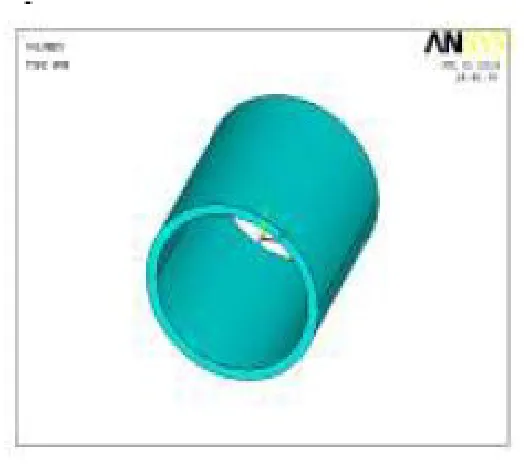
Figure 2: Tap water as coolant
Element Type: solid 20 nodes 90
Material Properties: Thermal Conductivity –0.18W/mm K
Specific Heat – 896 J/kg K
Density - 0.0000027 kg/mm3
Meshed Model
Generate Mesh
Meshing is done by using size controlscommand of lines, the line of specimen is
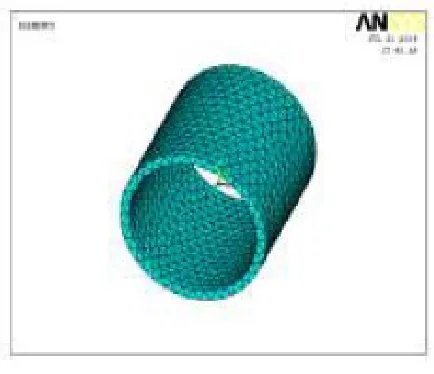
Figure 3: After applying mesh
Apply LoadsLoads – Define Loads – Apply – Thermal –TemperatureTemperature –558K
Loads – define Loads – Apply – Thermal –Convection – on areas
Bulk Temperature – 313K
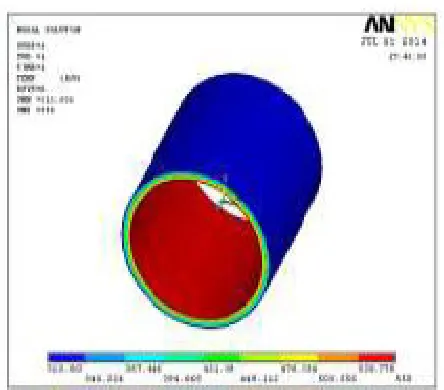
Figure 3: after applying loads
Figure 4: Load Analysis
As indicated by the form plot, at internal surface the most extreme rate of warmth exchange (heat flux) range is 1.251and at external surface the base is 1.092 Like this for various creation diverse investigation was done.
RESULTS:
CONCLUSIONS
In this postulation we have outlined acylinderin the motor ofa auto. The present utilized material for motor piece
viewed as Tap water, Distilled Water and Distilled Water with Coolant Ethylene Glycol.Theoretical counts were done to decide the general warmth exchange coefficient and warmth lost by motor chamber. By watching the qualities, utilizing material Aluminum amalgam 6061 and liquid Distilled Water with Ethylene Glycol has high warmth exchange rate.Thermal investigations were done in Ansysto decide the warmth exchange rate scientifically on the motor chamber. By watching the investigation results, utilizing Aluminum combination 6061 for barrel and liquid Distilled Water without coolant has high warmth exchange rate since warm flux is more.So we can reason that by scientifically and hypothetically Aluminum Alloy 6061 is better for chamber. In any case, cooling liquid Distilled water without coolant is better scientifically and Distilled water with coolant is better hypothetically.
REFERENCES
1. Leong, K.Y., Saidur, R., Kazi, S. N., &Mamun, A. H. (2010).
Performance Investigation Of An Automotive Car Radiator Operated With Nanofluid-Based Coolants (Nanofluid As A Coolant In A Radiator). Applied Thermal
Engineering, Vol 30,Issue 17/18, P2685-2692.
2. Heat and Mass transfer by R.K. Rajput
3. MohdRajuli, M. B. (2006). TeknologiAutomotif
:PengenalanSistem. PetalingJaya : IBS
4. BukuSdn Bhd.
5. Nice, K. (n.d.). How Car Cooling Systems Work. Retrieved 11 July 2012 from
http://auto.howstuffworks.com/cooli ngsystem3. htm
6. Ofria, C. (2006). A Short Course on Cooling Systems. Retrieved 11 July 2012 from
7. http://www.familycar.com/classroo m/Cool ingSystem.htm
8. Pang, S. C., Masjuki, H. H., Hazrat, M. A., &Kalam, M. A. (2011). Integration of 1D
9. and 3D Simulations of Engine Cooling System: After Keyed- Off. IEEE, P46 -50.
11. Peyghambarzadeh, S. M.,
Hashemabadi, S. H., Hoseini, S. M., &SeifiJamnani, M. (2011).
12. Experimental Study Of Heat Transfer Enhancement Using Water/Ethylene Glycol Based Nanofluids As A New Coolant For Car Radiators. International
Communications In Heat & Mass Transfer, Vol. 38, Issue 9,
P1283-1290.
13. Ross, S. (2006). An Antifreeze Antidote? Aftermarket Business, Vol 116, No.7,
14. Advanstar Publication.
15. Salah, M. H., Mitchell, T. H., Wagner, J. R., & Dawson, D. M. (2010). A Smart Multiple-
16. Loop Automotive Cooling System— Model, Control, and Experimental Study. IEEE/Asme Transactions On Mechatronics, Vol. 15, No. 1, 117 – 123.
17. Schappell, K. (2011). The Car Cooling System. Retrieved 11 July 2012 from