3064
Double Path Networks for Sequence to Sequence Learning
1Kaitao Song,2Xu Tan,3Di He,1Jianfeng Lu,2Tao Qin and2Tie-Yan Liu1Nanjing University of Science and Technology 2Microsoft Research
3Key Laboratory of Machine Perception, MOE, School of EECS, Peking University {kt.song, lujf}@njust.edu.cn
{xuta, taoqin, tyliu}@microsoft.com {di he}@pku.edu.cn
Abstract
Encoder-decoder based Sequence to Sequence learning (S2S) has made remarkable progress in recent years. Different network architectures have been used in the encoder/decoder. Among them, Convolutional Neural Networks (CNN) and Self Attention Networks (SAN) are the promi-nent ones. The two architectures achieve similar performances but use very different ways to encode and decode context: CNN use convolutional layers to focus on the local connectivity of the sequence, while SAN uses self-attention layers to focus on global semantics. In this work we propose Double Path Networks for Sequence to Sequence learning (DPN-S2S), which leverage the advantages of both models by using double path information fusion. During the encoding step, we develop a double path architecture to maintain the information coming from different paths with convolutional layers and self-attention layers separately. To effectively use the en-coded context, we develop a cross attention module with gating and use it to automatically pick up the information needed during the decoding step. By deeply integrating the two paths with cross attention, both types of information are combined and well exploited. Experiments show that our proposed method can significantly improve the performance of sequence to sequence learning over state-of-the-art systems.
1 Introduction
Sequence to Sequence learning (S2S) (Cho et al., 2014; Sutskever et al., 2014) is one of the challenging tasks in artificial intelligence, which covers machine translation, document summarization and question answering, etc. It has attracted more and more attention in recent years due to the success of deep learn-ing. Sequence to sequence learning is usually developed based on a general encoder-decoder framework: The encoder reads the source sequence and generates a set of representations. After that, the decoder es-timates the conditional probability of each target token given the source representations and its preceding tokens.
Different network architectures for sequence to sequence modelling have been designed based on this framework. Long Short-Term Memory (LSTM) based model (Cho et al., 2014) is the most popular. In the LSTM based model, the tokens are encoded/decoded using LSTM units, which can effectively summarize the temporal information of the sentences in source/target domains. However, because of its recurrent nature, the LSTM based model is difficult to parallel, so the training efficiency becomes the major challenge. Recently, Convolutional Neural Network (CNN) based (Gehring et al., 2017a) and Self Attention Network (SAN) based (Vaswani et al., 2017) models have been proposed, which achieved significant improvements in accuracy. Both models replace the recurrent structure with networks that are easy to parallelize, leading to training time acceleration.
CNN based and SAN based sequence to sequence models encode and decode information in very different ways. CNN based model treats the sequences similar with images: The convolutional layer is used to summarize information for a local region of the sequence, which corresponds to a subsequence
This work was done when K. Song was an Intern at Microsoft Research
of tokens. Different from CNN based model, SAN based model uses self-attention layer to abstract the context based on semantic meanings: In each layer, for each token, the similarity between the token and all other tokens in the sequence are computed. Then the contexts are weighted combined based on the global semantic similarity. By stacking multiple convolutional layers or self-attention layers, the two models obtain the whole contextual information during the encoding and decoding step.
As we can see, the convolutional layer focuses more on abstracting information according to local connectivity, while self-attention layer focuses more on using global semantics. Both models achieve similar accuracy on several sequence to sequence learning tasks. Then a natural question raises: is there any way to integrate the two methods together to achieve a higher accuracy? This is exactly the purpose of the paper.
In this work, we investigate the possibility to combine the two models into a unique framework and de-velop efficient architecture to leverage both advantages. In particular, we propose Double Path Networks for Sequence to Sequence learning (DPN-S2S), which contain a convolutional path and a self-attention path with attention information fusion between the encoder and the decoder. In the encoding step, we use the convolutional path and self-attention path independently. Thus we can summarize the context of the source sequences from different aspects. In the decoding step, we develop a cross attention module with gating to automatically select appropriate context, and use the context in a similar double path structure. As there is no recurrent structure in convolutional layers and self-attention layers, the model is still easy to parallelize. Since we abstract the hidden representation from different ways, the contexts we obtain are more diverse, making it possible to achieve higher accuracy under the same parameter number.
Experimental results show that our proposed approach can achieve significant improvements than single path based S2S framework. The results are summarized as follows:
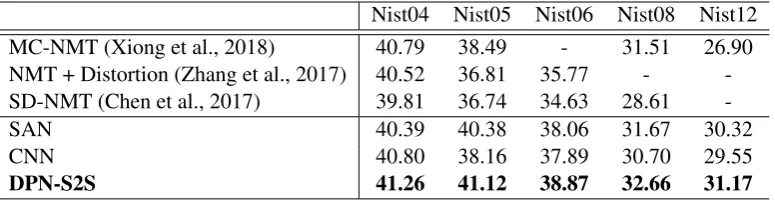
• With a similar number of parameters, our model outperforms CNN based, SAN based model. More specifically, on Nist Chinese-English translation task, we outperform the strong CNN based baseline by 0.46-2.96 BLEU, SAN based baseline by 0.74-0.99 BLEU respectively in different Nist test sets. Furthermore, our model also achieves state-of-art BLEU/ROUGE score on IWSLT14 German-English translation task and German-English Gigaword text summarization task.
• Through ablation studies and analyses we show that both the CNN and SAN path are important in the encoder and the decoder. Removing any part would cause performance drop, which demon-strates the effectiveness of our model.
2 Background
2.1 Encoder-Decoder Framework
Denote x = (x1, x2, ..., xm) andy = (y1, y2, ..., yn) as the sentence pair, in which xi andyt are the
i-th andt-th tokens for sequencesxandy,mandnare the lengths of the sequences. The sequence to sequence model learns to estimate the conditional probabilityP(y|x). Denote the model parameter as θ and denote the training corpus as S. One of the most popularly used objective functions is the log likelihood function:
According to the probability chain rule, we have:
P(y|x;θ) = n
Y
t=1
P(yt|y<t, x;θ), (2)
wherey<t is the sequence of proceeding tokens before positiont. To model the conditional probability,
an encoder-decoder framework is usually employed (Cho et al., 2014; Bahdanau et al., 2015). In the encoding phase,(h1, h2,· · · , hm)is learnt as the representations of the source sequence:
wheref(·)can be implemented as RNN, CNN or SAN. During the decoding phase, the decoder generates the target tokenytat positiontusing the previous generated tokensy<t and the source representations (h1, h2,· · · , hm).
An attention mechanism is usually adopted to choose the places in the source representations to focus on. There are several types of attention used in the literature, such asdot,concatandgeneral(Luong et al., 2015; Bahdanau et al., 2015). In this paper, we mainly adopt thedottype which is formulated as the q-k-v form:
Attention(q, k, v) =sof tmax(qkT)v, (4)
wheresof tmaxfunction computes the attention coefficient which evaluates how well the source repre-sentationskmatches the target queryq. qis usually the hidden state in the current decoder layer andk, vare usually the same as source representationh.
2.2 CNN based Encoder-Decoder
CNN based Encoder-Decoder framework (Gehring et al., 2017b) typically uses one-dimensional convo-lution in each layer to perform nonlinear transformation. Denotehliwith dimensiondas thei-th hidden state in thel-th CNN layer and seth0i =ei, whereeiis the input embedding of the sequence. The hidden
statehliis computed by the convolution operation:
hli=v([hli−−1r/2, ..., hi+r/2l−1 ]Wl+blw) +hli−1, (5)
whereWl∈ Rrd×2dis the convolution filter with kernel sizer,bl
w∈ R2dis the bias anddis the hidden
dimension. The convolution input is the concatenation of r elements in the lower layer with hidden dimensiond. We use Gated Linear Units (GLU) (Dauphin et al., 2017) as the activation functionv, with
2dinput vector anddoutput vector.
2.3 SAN based Encoder-Decoder
SAN system is first proposed by Vaswani et al. (2017). Each single self-attention layer has two sublayers: a multi-head self-attention layer and a feed forward network. Both sublayers are stacked using residual connection (He et al., 2016) and layer normalization (Ba et al., 2016). The multi-head self-attention layer M H(·)is formulated as follows:
M H(q, k, v) =Concatsi=1hi(q, k, v),
hi(q, k, v) =Att(
qWiq
√
ds
, kWik, vWiv). (6)
Each head uses weightsWiq,WikandWivto linearly transform the inputq,k,vand then performsAtt(·)
which is equal to Equation 4.Wiq,WikandWiv ∈ Rd×ds, whered
sis a scale factor, which equal tod/s,
dis the hidden size of q, andsis the number of heads.
For the feed forward network, we use a simple two-layer, fully connected network with ReLU activa-tion funcactiva-tion in the middle layer:
F eedF orward(x) =f2(M ax(0, f1(x))), (7)
wheref1(·)andf2(·)are both feed forward network. The feed forward network applies the non-linear
transformation on each position identically and separately.
3 Double Path Networks
Multi-Head
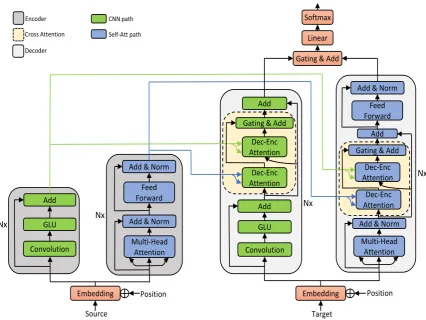
Figure 1: DPN-S2S architecture. The CNN and SAN path are depicted with green and blue module, respectively. The encoder part is colored with dark grey, attention fusion part with light yellow, and decoder part with light grey. The blue and green line show the information flow from encoder to decoder.
3.1 Double Path Encoder
To leverage the advantage of CNN and SAN layer, we design an encoder which includes a CNN and SAN path, introduced in Section 2.2 and 2.3 respectively. We sum up the position embeddingp= (p1, ..., pm)
and word embeddingw= (w1, ..., wm)as the input of encoder, to give the model a sense of the token’s
position in the sentence. For each path, we employ residual connections to stack multiple layers for deeper network. Consequently, we can collect two various context representations from encoder.
3.2 Cross Attention with Gating
Between the encoder and the decoder, we develop a cross attention module with gating fusion, to au-tomatically pick up the information needed to decode target word. As shown in Figure 1, the attention fusion module consists of two submodules: Dec−Enc AttentionandGating&Add. We now give detailed descriptions of the two submodules.
Each path in the decoder take encoder’s double-path outputs as context to make attention. Thus, there are four types of information flows through encoder to decoder. TheDec−Enc Attentionmodule in the decoder takes Eq. (4) to compute attention results, which is denoted as:
ctxcc=Attention(qc, kc, vc), ctxca=Attention(qc, ka, va),
ctxac=Attention(qa, kc, vc), ctxaa =Attention(qa, ka, va). (8)
For example, ctxca ∈ Rd means the attention result with attention query qc from CNN path in the
decoder and attention keykaand valuevafrom SAN path in the encoder.
This fusion gate is shown as theGating & Add module in the right side of Figure 1, formulated as follows:
gc=sigmoid([ctxcc, ctxca]Wc+bc),
ga=sigmoid([ctxaa, ctxac]Wa+ba),
ctxc=ctxcc·(1−gc) +ctxca·gc,
ctxa=ctxaa·(1−ga) +ctxac·ga,
(9)
wheregcandga are scalar attention gates for CNN context and SAN context; [·,·]is an element con-catenate operation; Wc andWa ∈ R2dare the weight matrices; bcandba are the scalar biases of the
attention gates; andctxcandctxa are the fusion context vectors for the current CNN layer and SAN layer. For the gategcandga, both the two attention results are used as inputs to the gating computation.
3.3 Double Path Decoder
The decoder is illustrated in the right side of Figure 1. It is similar to the encoder except for the decoder-to-encoder attention. Each layer in CNN and SAN contains two decoder-decoder-to-encoder attention modules, which is denoted in last subsection. We also need remove the future information in the convolution and self-attention operations in order to be consistent with decoding phase, for target sentence is generated sequentially, without any prior knowledge about next word.
We also apply a gating mechanism to combine the outputs of the two decoder paths and feed the combined result into thesof tmaxlayer to generate next word:
go=sigmoid([zc, za]Wo+bo), zo=zc·(1−go) +za·go,
P(y) =sof tmax(zoWs+bs),
(10)
wherezcandzaare the outputs of CNN and SAN path, respectively.zois the fusion output andWs,bs are linear transform weights and biases beforesof tmax.
4 Experiment Settings
In this section, we introduce the datasets used in experiments, model settings, and training details.
4.1 Datasets
We evaluate our proposed method on two neural machine translation tasks and one abstractive text sum-marization task. The datasets are described as follows:
IWSLT2014 German-English We use the dataset of IWSLT14 German-English machine translation
track (Cettolo et al., 2014) for training and evaluation. We tokenize the data which come from TED and TEDx talks. After preprocessing, the dataset remains 160K training sentences and 7K development sentences1. We concatenate dev2010, tst2010, tst2011 and tst2012 as the test set. We consider a joint source and target byte-pair encoding (BPE) with 10K types (Sennrich et al., 2016).
Nist Chinese-English We use the corpus consisting of 1.25M sentence pairs extracted from LDC cor-pora 2. This dataset contains 27.9M Chinese words and 34.5M English words respectively. We learn a 25K subwords dictionary based on BPE for source and target languages separately. After tokeniza-tion, we get a source vocabulary with 37K words and a target vocabulary with 25K words. We choose Nist-2003 as the development set, and Nist-{2004, 2005, 2006, 2008, 2012}as the test sets.
1
https://github.com/facebookresearch/fairseq-py/blob/master/data/prepare-iwslt14.sh
Text Summarization We use the Gigaword corpus (Graff et al., 2003) and follow the processing as Rush (2015). We obtain 3.8M training samples and 190K validation samples. We evaluate our approach on Gigaword dataset, which is a widely used test set with 2000 article-title pairs. Similar to Gehring (2017a), we use source and target vocabulary both with 30K words. Follow Gehring (2017a), we require the length of generated sequence is at least 14 words.
4.2 Model Settings
IWSLT14 German-English For CNN path, we adopt 4 idential convolutional layers with 256 neurons in both the encoder and the decoder. As one self-attention layer is comprised of 2 sublayers, we set 2 layers for SAN to guarantee the depth consistency of network. The hidden size and the filter size of SAN block are set as 256 and 1024 respectively. The word embedding dimension is 256. And the dropout rate is set as 0.1. In order to demonstrate the efficiency of our method, we compare our method with four following baselines: (i)Deeper CNN Model, a standard CNN based model with 8 layers of 256 neurons.
(ii) Wider CNN Model, a standard CNN based model with 4 layers of 512 neurons. (iii) Wider SAN
Model, a standard SAN based model with 2 layers of 512 neurons. (iv)Deeper SAN Model, a standard
SAN based model with 4 layers of 256 neurons. Besides, we also list some related works for comparison.
Nist Chinese-English We perform a deep model on Nist Chinese-English translation task. This model adopts 12 stacked layers for the CNN path and 6 stacked layers for SAN path in the encoder and decoder respectively. The hidden size of both CNN/SAN layers are both set as 256 and the filter size of SAN layer is 1024. We set 256 neurons for the word embedding. The dropout rate is set as 0.2. For the purpose of comparison, We choose two model settings as baselines: (i)CNN Model, a CNN based model with 12 stacked layers of 512 neurons (ii)SAN Model, a SAN model with 6 stacked layers of 512 neurons and the filter size of layer is 2048. These model settings contain approximately similar number of parameters in contrast to our model. We also list some previous works for comparison.
Text Summarization We follow the same model setting as described in IWSLT14 German-English
translation task. For this task, We adopt the models including RNN MRT (Ayana et al., 2016), WFE (Suzuki and Nagata, 2017) and ConvS2S (Gehring et al., 2017a) as the baselines.
4.3 Training and Evaluation
Params BLEU
AC+LL (Bahdanau et al., 2016) - 28.53
NPMT+LM (Huang et al., 2017) - 29.16
Wider CNN 20.37M 30.63
Wider SAN 27.06M 31.29
Deeper CNN 13.82M 30.70
Deeper SAN 13.54M 31.43
DPN-S2S 11.57M 31.99
Table 1: IWSLT14 German-English translation perfor-mance.
We adopt Nesterov Accelerated Gradient (NAG) (Bengio et al., 2012) as training optimizer. The initial learning rate is set as 0.25 for IWSLT14 German-English and text summarization, and 0.50 for Nist Chinese-English, with a decay schedule that shrinking by 10 when the validation loss stops decreasing. Each training batch contains approximately 4000 source and target tokens. During inference, we set beam size as 5 for IWSLT14 German-English and text summarization, and 10 for Nist Chinese-English. All models are
implemented in PyTorch based on fairseq-py3. We use one Nvidia Titan x Pascal GPU for IWSLT14 German-English and text summarization, and 4 GPUs for Nist Chinese-English.
5 Results
In this section, we report our results on translation and summarization tasks. In addition, we also conduct a series of extensive analyses for a better understanding of our model.
Nist04 Nist05 Nist06 Nist08 Nist12
MC-NMT (Xiong et al., 2018) 40.79 38.49 - 31.51 26.90
NMT + Distortion (Zhang et al., 2017) 40.52 36.81 35.77 -
-SD-NMT (Chen et al., 2017) 39.81 36.74 34.63 28.61
-SAN 40.39 40.38 38.06 31.67 30.32
CNN 40.80 38.16 37.89 30.70 29.55
DPN-S2S 41.26 41.12 38.87 32.66 31.17
Table 2: Performance of different systems on Nist Chinese-English translation task.
5.1 IWSLT2014 German-English
We evaluate the translation accuracy by BLEU4 (Papineni et al., 2002). Table 1 shows the experiment results on German-English translation task. We list the results of the wider network, deeper network and some related works for a comparison. The results can be summarized as follow:
When compared with wider network, DPN-S2S achieves an improvement of 1.36 BLEU and 0.70 BLEU over CNN and SAN model. When compared with deeper network, DPN-S2S achieves an im-provement of 1.29 BLEU and 0.56 BLEU over CNN and SAN model. Generally, we note that DPN-S2S can produce better performance than wider or deeper networks with fewer parameters. In addition, we choose two methods which used an actor-critic algorithm (Bahdanau et al., 2016) and a phrased-based model with an auxiliary language model (Huang et al., 2017) separately. We find our method also out-performs these approaches. All of these comparsions indicate the effectiveness of our method.
5.2 Nist Chinese-English
Table 2 lists the results about our model on each Nist Chinese-English test set, together with several NMT baselines. These baselines are RNNSearchs with some well acknowledged techniques including: 1) Using multi-channel information into encoder (MC-NMT) (Xiong et al., 2018); 2) Incorporating word reorder information into NMT (NMT+Distortion) (Zhang et al., 2017); 3) An attention mechanism with a directed-syntax (SD-NMT) (Chen et al., 2017). We can observe that our method surpasses SAN and CNN baseline by 0.74-0.99 and 0.46-2.96 BLEU score in different test sets. In addition, we also compare our results with some related works, and our model outperforms MC-NMT by 0.47-4.27 BLEU, NMT+Distortion by 0.74- 4.31 BLEU and SD-NMT by 1.44-4.38 BLEU in Nist test sets. These results on Nist Chinese-English dataset prove that our model can also achieve improvement in large dataset.
Gigaword
RG-1 (F) RG-2 (F) RG-L (F)
RNN MRT (Ayana et al., 2016) 36.54 16.59 33.44
WFE (Suzuki and Nagata, 2017) 36.30 17.31 33.88
ConvS2S (Gehring et al., 2017a) 35.88 17.48 33.29
DPN-S2S 36.92 17.91 34.32
Table 3: Accuracy on Gigaword text summarization task in terms of ROUGE-1 1), ROUGE-2 (RG-2), and ROUGE-L (RG-L). F stands for F1-score.
5.3 Text Summarization
We employ three variants of ROUGE (Lin, 2004) as evaluation metrics for text summariza-tion: ROUGE-1 (unigrams), ROUGE-2 (bigrams), and ROUGE-L (longest-common substring).
4https://github.com/moses-smt/mosesdecoder/blob/master/scripts/generic/multi-bleu.
ID
Table 4: Ablation studies of DPN-S2S on IWSLT14 German-English. ∆means the model contains this component.
We compare our model with some previous work including RNN MRT (Ayana et al., 2016) which adopts RNNSearch on this task, WFE (Suzuki and Nagata, 2017) which addresses the problem of repeated sequence generation, and ConvS2S (Gehring et al., 2017a). Table 3 shows the text summarization results on the Gi-gaword dataset. DPN-S2S outperforms all the three models by 0.43-1.04 ROUGE-1, 0.43-1.32 ROUGE-2 and 0.64-1.23 ROUGE-L in terms of F1 score.
5.4 Ablation Study
To understand to what extent each path in the encoder/decoder can affect the model perfor-mance, we conduct some experiments for abla-tion study. For conciseness we just choose one task (IWSLT14 German-English) for this study.
Table 4 shows the experiment settings and results. All the models are of the same dimensions for hid-den states and word embedding. Note that model M9 is our proposed DPN-S2S. We have the following observations.
• Comparing model M4 with M7, M5 with M8, and M6 with M9, we can see that adding the CNN encoder leads to 0.80-1.23 BLEU gain.
• Comparing model M2 with M3, M5 with M6, and M8 with M9, we observe that adding the CNN decoder leads to 0.26-0.56 BLEU gain.
• Comparing model M1 with M7, M2 with M8, and M3 with M9, we find that adding the SAN encoder results in 0.43-0.73 BLEU improvement.
• Similarly comparing model M1 with M3, M4 with M6, and M7 with M9, we see 0.88-1.31 BLEU gain by adding the SAN decoder.
These results suggest that both the CNN path and the SAN path make positive contributions to the overall architecture, and they are needed in both the encoder and decoder.
5.5 Attention Visualization
Table 5: The entropy of the alignments of CNN/SAN decoder to CNN/SAN encoder on IWSLT14 German-English.
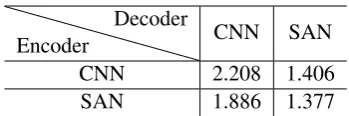
To demonstrate the different characteristics of the CNN and SAN path, we analyze the alignments (attention coefficients) from the four types of decoder-to-encoder atten-tion. The alignments are computed by Sof tmax(qkT)from Eq. (4), and the align-ments from each token in decoder form a dis-tribution. We use the entropy of the distri-bution−P
ixilogxito depict to what extent
the target token focuses on the source tokens.
Small entropy means less uncertainty, i.e., the attention is more concentrated.
(a) CNN to CNN (b) CNN to SAN (c) SAN to CNN (d) SAN to SAN
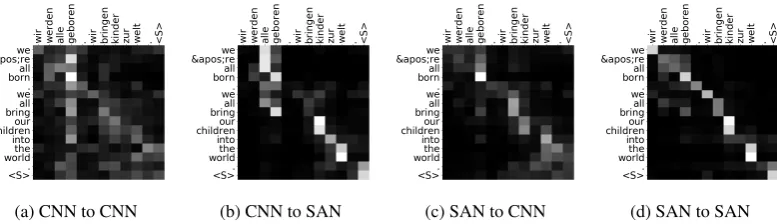
Figure 2: The alignments of CNN/SAN decoder to CNN/SAN encoder from DPN-S2S. The x-axis and y-axis of each plot correspond to the words in the source language and target language. Each pixel shows the alignment scores of the target word to source word.
Translation
Source (De) das ist die linke hlfte, die die logische seite ist und dann die rechte h¨alfte, die die intuitive seite ist.
Target (En) there ’sthe left half, which is the logical side, and thenthe right half, which is the intuitive.
CNN this ishalf the left half, which is the logical side, and thenhalf the rightsthat is the intuitive side.
SAN that’s the left half, which is the logical side , and thenhalf, that ’s the intuitive side.
DPN-S2S that’sthe left half, which is the logical side, and thenthe right half, which is the intuitive side.
Table 6: A German-English translation case to demonstrate DPN-S2S outperforms CNN and SAN in terms of translation accuracy.
of the CNN path in the decoder to extract necessary information for target word generation; in contrast, each hidden state in the SAN path has already included global semantics, and so the decoder only needs to focus on a small number of hidden states of the SAN path in the encoder, resulting in more focused alignments and smaller entropy (the second row of the table).
For an intuitive understanding, we visualize the alignments of a sentence pair in Figure 2. Comparing Figure 2b with 2a, we can see that the attention from the CNN path of the decoder to the SAN path of the encoder is more focused than that to the CNN path of the encoder. The same phenomenon can be found for attention from the SAN path of the decoder to the encoder, by comparing Figure 2d with 2c.
5.6 Case Study
To better understand the advantage of DPN-S2S over single path models, Table 6 shows a case from the German-English test set. We list the generated target sentence by CNN based model, SAN based model and DPN-S2S, respectively. As can be seen, CNN based model generates detailed words such as “half the left half” and “half the rights”, without a global view to correctly organize these local meanings. SAN based model misses the local details about the “the right half” information. Our DPN-S2S well combine the local information from the CNN based path and the global information from the SAN based path, resulting in a better translation.
6 Conclusion
In this paper, we have proposed double path networks for sequence to sequence learning, named DPN-S2S, which uses a cross attention module to leverage the advantages of two different models, and achieves the state-of-art performance in several sequence to sequence tasks.
Acknowledgments
This work was supported by The National Key Research and Development Program of China under Grant 2018YFB1004904.
References
Ayana, Shiqi Shen, Zhiyuan Liu, and Maosong Sun. 2016. Neural headline generation with minimum risk training.
arXiv.
Lei Jimmy Ba, Ryan Kiros, and Geoffrey E. Hinton. 2016. Layer normalization.arXiv.
Dzmitry Bahdanau, Kyunghyun Cho, and Yoshua Bengio. 2015. Neural machine translation by jointly learning to align and translate. ICLR 2015.
Dzmitry Bahdanau, Philemon Brakel, Kelvin Xu, Anirudh Goyal, Ryan Lowe, Joelle Pineau, Aaron C. Courville, and Yoshua Bengio. 2016. An actor-critic algorithm for sequence prediction. arXiv.
Yoshua Bengio, Nicolas Boulanger-Lewandowski, and Razvan Pascanu. 2012. Advances in optimizing recurrent networks. ICASSP.
Mauro Cettolo, Jan Niehues, Sebastian St¨uker, Luisa Bentivogli, and Marcello Federico. 2014. Report on the 11th iwslt evaluation campaign. InProceedings of the 11th IWSLT.
Kehai Chen, Rui Wang, Masao Utiyama, Eiichiro Sumita, and Tiejun Zhao. 2017. Syntax-directed attention for neural machine translation. AAAI.
Kyunghyun Cho, Bart van Merrienboer, C¸ aglar G¨ulc¸ehre, Dzmitry Bahdanau, Fethi Bougares, Holger Schwenk, and Yoshua Bengio. 2014. Learning phrase representations using RNN encoder-decoder for statistical machine translation. InEMNLP 2014, pages 1724–1734.
Yann N. Dauphin, Angela Fan, Michael Auli, and David Grangier. 2017. Language modeling with gated convolu-tional networks. In Doina Precup and Yee Whye Teh, editors,ICML 2017.
Jonas Gehring, Michael Auli, David Grangier, Denis Yarats, and Yann N. Dauphin. 2017a. Convolutional se-quence to sese-quence learning. InICML 2017.
Jonas Gehring, Michael Auli, David Grangier, Denis Yarats, and Yann N. Dauphin. 2017b. Convolutional se-quence to sese-quence learning.ICML 2017.
Graff, David, Kong, Junbo, Chen, Ke, Maeda, and Kazuaki. 2003. English gigaword. InLinguistic Data Consor-tium.
Kaiming He, Xiangyu Zhang, Shaoqing Ren, and Jian Sun. 2016. Deep residual learning for image recognition. InCVPR 2016.
Po-Sen Huang, Chong Wang, Dengyong Zhou, and Li Deng. 2017. Neural phrase-based machine translation.
arXiv.
Chin-Yew Lin. 2004. Rouge: A package for automatic evaluation of summaries. InProc. ACL workshop on Text Summarization Branches Out.
Thang Luong, Hieu Pham, and Christopher D. Manning. 2015. Effective approaches to attention-based neural machine translation. InEMNLP 2015.
Kishore Papineni, Salim Roukos, Todd Ward, and Wei-Jing Zhu. 2002. Bleu: a method for automatic evaluation of machine translation. InACL.
Alexander M. Rush, Sumit Chopra, and Jason Weston. 2015. A neural attention model for abstractive sentence summarization. In Llu´ıs M`arquez, Chris Callison-Burch, Jian Su, Daniele Pighin, and Yuval Marton, editors,
EMNLP 2015.
Rico Sennrich, Barry Haddow, and Alexandra Birch. 2016. Neural machine translation of rare words with subword units. InACL 2016.
Ilya Sutskever, Oriol Vinyals, and Quoc V. Le. 2014. Sequence to sequence learning with neural networks. In
Jun Suzuki and Masaaki Nagata. 2017. Rnn-based encoder-decoder approach with word frequency estimation.
arXiv.
Ashish Vaswani, Noam Shazeer, Niki Parmar, Jakob Uszkoreit, Llion Jones, Aidan N. Gomez, Lukasz Kaiser, and Illia Polosukhin. 2017. Attention is all you need. NIPS.
Hao Xiong, Zhongjun He, Xiaoguang Hu, and Hua Wu. 2018. Multi-channel encoder for neural machine transla-tion. AAAI.