Adapting a Semantic Question Answering System to the Web
Sven Hartrumpf
Intelligent Information and Communication Systems (IICS) University of Hagen (FernUniversit¨at in Hagen)
58084 Hagen, Germany
Abstract
This paper describes how a question an-swering (QA) system developed for small-sized document collections of several mil-lion sentences was modified in order to work with a monolingual subset of the web. The basic QA system relies on com-plete sentence parsing, inferences, and se-mantic representation matching. The ex-tensions and modifications needed for use-ful and quick answers from web docu-ments are discussed. The main extension is a two-level approach that first accesses a web search engine and downloads some of its document hits and then works similar to the basic QA system. Most modifica-tions are restricmodifica-tions like a maximal num-ber of documents and a maximal length of investigated document parts; they en-sure acceptable answer times. The result-ing web QA system is evaluated on the German test collection from QA@CLEF 2004. Several parameter settings and strategies for accessing the web search en-gine are investigated. The main results are: precision-oriented extensions and exper-imentally derived parameter settings are needed to achieve similar performance on the web as on small-sized document col-lections that show higher homogeneity and quality of the contained texts; adapting a semantic QA system to the web is feasible, but answering a question is still expensive in terms of bandwidth and CPU time.
1 Introduction
There are question answering (QA) systems in-tended for small-sized document collections ( tex-tual QA systems) and QA systems aiming at the web (web(-based) QA systems). In this pa-per, a system of the former type (InSicht, see
(Hartrumpf, 2005b)) is transformed into one of the latter type (called InSicht-W3 for short). In Sect. 2, the textual QA system for German is pre-sented. The extensions and modifications required to get it working with the web as a virtual doc-ument collection are described and discussed in Sect. 3. The resulting system is evaluated on a well-known test collection and compared to the basic QA system (Sect. 4). After the conclusion, some directions for further research are indicated.
2 The Basic QA System
The semantic1 QA system that was turned into a web QA system is InSicht. It relies on complete sentence parsing, inferences, and semantic repre-sentation matching and comprises six main steps.
In the document processing step, all docu-ments from a given collection are transformed into a standard XML format (CES, corpus encoding standard, see http://www.cs.vassar.edu/CES/) with word, sentence, and paragraph borders marked up by XML elements w, s, and p, respectively. Then, all preprocessed documents are parsed by WOCADI (Hartrumpf, 2003) yielding a syntactic dependency structure and, more importantly, a se-mantic representation, a sese-mantic network of the MultiNet formalism (Helbig, 2006) for each doc-ument sentence. The parser can produce intersen-tential coreference links for a document.
In the second step (query processing), the user’s question is parsed by WOCADI. Determining the sentence type (here, often a subtype ofquestion) is especially important because it controls some parts of two later steps: query expansion and an-swer generation.
Next comes query expansion: Equivalent and similar semantic networks are derived from the original query network by means of
semantic relations from HaGenLex (Hagen Ger-man Lexicon, (Hartrumpf et al., 2003)) and a lex-ical database (GermaNet), equivalence rules, and inferential rules like entailments for situations (ap-plied in backward chaining). The result is a set of disjunctively connected semantic networks that try to cover many possible kinds of representations of sentences possibly containing an explicit or im-plicit answer to the user’s question.
In the fourth step (semantic network matching), all document sentences matching at least one of the semantic networks from query expansion are collected. A two-level approach is chosen for effi-ciency reasons. First, an index of concepts (disam-biguated words with IDs from the lexicon) is con-sulted with the relevant concepts from the query networks. Second, the retrieved documents are compared sentence network by sentence network to find a match with a query network.
Answer generation is next: Natural language (NL) generation rules are applied to semantic net-works that match a query network in order to gen-erate an NL answer string from the deep seman-tic representations. The sentence type and the se-mantic network control the selection of generation rules. The rules also act as a filter for uninforma-tive or bad answers. The results are tuples of gen-erated answer string, numerical score, supporting document ID, and supporting sentence ID.
To deal with different answer candidates, an answer selection step is required. It realizes a quite simple but successful strategy that combines a preference for more frequent answers and a pref-erence for more elaborate answers. The best an-swers (by default only the single best answer) and the supporting sentences are presented to the user that posed the question.
The first step, document processing, is run off-line in InSicht; it is run onoff-line in InSicht-W3 to avoid unacceptable parsing costs before the sys-tem can be used. The remaining five steps will be left mostly unchanged for InSicht-W3, in parts just differently parameterized.
3 QA System Extensions for the Web
3.1 A Naive Approach to Web-based QA
The simplest approach to turning InSicht into a web QA system would be to collect German web pages and work with the resulting document col-lection as described in Sect. 2. However, a deep semantic analyzer will need several years to parse
all web pages in German (even if excluding the pages from the much larger deep web). The fol-lowing formula provides a rough estimate2 of the CPU years needed:
t = #documents·#sent per document[sent]
parser speed[sent/h]
= 500,000,000·320[sent]
4000[sent/h]
= 40,000,000h ≈ 4,566a
This long time indicates that the naive approach is currently not an option. Therefore a multi-level approach was investigated. In this paper, only a two-level approach is discussed, which has been tried in shallow QA systems.
3.2 A Two-Level Approach to Web-based QA
As in other applications, a web search engine can be used (as a first level) to preselect possibly rel-evant documents for the task at hand (here, an-swering a question posed by a user). In InSicht-W3, the web is accessed when similar and equiva-lent semantic networks have been generated dur-ing query expansion. Clearly, one cannot di-rectly use this semantic representation for retriev-ing document URLs from any service out there on the web—at least till the arrival of a web anno-tated with formal NL semantics. One must trans-form the semantic networks to an adequate level; in many web search engines, this is the level of search terms connected in a Boolean formula us-ingand andor.
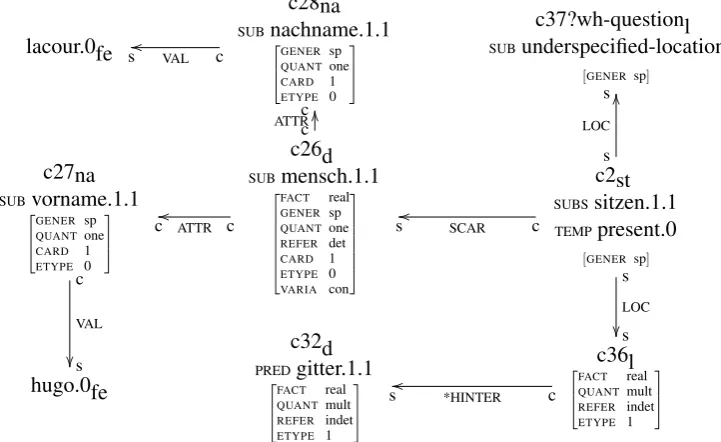
To derive a search engine query from a seman-tic network, alllexical concepts from the seman-tic network are collected. For example, question qa04 068 from QA@CLEF 2004 in example (1) leads to the semantic network depicted in Fig. 1 (and related semantic networks; for a QA@CLEF 2004 question, 4.8 additional semantic networks on average).
(1) Wo Where
sitzt sits
Hugo Hugo
Lacour Lacour
hinter behind
Gittern? bars? ‘Where is Hugo Lacour imprisoned?’
The lexical concepts are roughly speaking those concepts (represented as nodes in graphical form) whose names are not of the formc1,c2, etc. The lexical concepts are named after the lemma of the
2The average number of sentences per document has been
Figure 1: Semantic network for CLEF question qa04 068:Wo sitzt Hugo Lacour hinter Gittern?(‘Where is Hugo Lacour imprisoned?’). Some edges are shown folded below the node name.
lacour.0fe c28na SUBnachname.1.1 GENER sp QUANT one CARD 1 ETYPE 0 VAL c
soo
c37?wh-questionl
SUBunderspecified-location.0
[GENERsp]
c27na SUBvorname.1.1 GENER sp QUANT one CARD 1 ETYPE 0 VAL c s c26d SUBmensch.1.1 FACT real GENER sp QUANTone REFER det CARD 1 ETYPE 0 VARIA con ATTR c
coo
ATTR c cOO
c2st
SUBSsitzen.1.1
TEMPpresent.0
[GENERsp]
LOC s s LOC s sOO
SCAR c
soo
hugo.0fe c32d PREDgitter.1.1 FACT real QUANT mult REFER indet ETYPE 1 c36l FACT real QUANTmult REFER indet ETYPE 1 *HINTER c
soo
corresponding word plus a numerical homograph identifier and a numerical reading identifier.
As current web search engines provide no (or only rough) lemmatization for German, one must go one step further away from the semantic net-work by generating full forms for each word be-longing to a lexical concept. (Others have tried a similar approach; for example, Neumann and Sacaleanu (2005) construct IR queries which can be easily adapted to different IR engines.) In the example, the node sitzen.1.1 (to sit) leads to 26 different full forms (shown below in example (2)). These forms can be used as search terms; as alter-natives, they are connected disjunctively. Thus for each semantic network from query expansion, a conjunction of disjunctions of word forms is con-structed. Word forms can belong to words not occurring in the question because query expan-sion can introduce new concepts (and thereby new words), e.g. by inferential rules. The Boolean formulae for several semantic networks are con-nected disjunctively and the resulting formula is simplified by applying logical equivalences. What one can pass to a web search engine as a prese-lection query for question (1) is shown in prefix notation in example (2):
(2)(or (and
(orGitter Gittern Gitters)
(orLacour Lacours)
(or gesessen gesessene gesessenem gesesse-nen gesessener gesessenes saß saßen saßest saßet saßt sitze sitzen sitzend sitzende sitzen-dem sitzenden sitzender sitzendes sitzest sitzet sitzt s¨aße s¨aßen s¨aßest s¨aßet))
. . .; query derived from second query network )
If a search engine does not offer Boolean operators (or limits Boolean queries to some hundred char-acters), one can transform the Boolean query into DNF and issue for each disjunct a search engine query that requires all its terms (for example, by prepending a plus sign to every term).
There are several problems related to break-ing down a semantic network representation into a Boolean formula over word forms. For example, lexical concepts that do not stem from a surface form in the question should be excluded from the query. An example is the concept nachname.1.1 (‘last name’) which the named entity subparser of WOCADI installs in the semantic network when constructing the semantic representation of a hu-man being whose last name is specified in the text (see Fig. 1).
understand-(plus proximity information3) vs. concepts within (possibly normalized) semantic representations of sentences (or texts). This level mismatch deteri-orates the precision of the first level and thereby the recall of the second level. The latter might be surprising. The precision of the first level (viewed in isolation) is not problematic because the second level achieves the same precision no matter how low the precision of the first level is. But precision doesmatter because the limited number of docu-ments that the first level can return and that the second level can efficiently process might lead to not seeing relevant documents (i.e. lower recall) or at least to seeing them much later (which can im-ply unacceptable answer times). Or to put it differ-ently: Very low precision in the first level can lead to lower recall of the whole multi-level system if there are any retrieval set limits for the first level.
At the end of the first level, the retrieved web documents are simplified by a script that uses the text dump function of thelynxweb browser to ex-tract the textual content. The resulting document representations can be processed by InSicht.
3.3 Deficiencies of Web Search Engines
Web search engines typically restrict the length of queries, e.g. to 1000 bytes, 1500 bytes, or 10 terms. But the rich morphology of languages like German can lead to long and complex preselection queries so that one needs to reduce preselection queries as far as possible (e.g. by dropping rare word forms). An additional strategy is to split the query into several independent subqueries.
The QA system is currently based on match-ing semantic representations with the granularity of a sentence only. Thus one would achieve much better precision if the web search engine allowed a same-sentence operator or at least a proximity operator (often named NEAR) of say 50 words which ignores linguistic units like sentences and paragraphs but suffices for our goals. Although some web search engines once had some kind of proximity operator, currently none of the search engines with large indices and Boolean queries seems to offer this facility.
3.4 Pragmatic Limits for Web-based QA
Pragmatic limits are needed to ensure acceptable answer times when dealing with the vast number
3At least some years ago and hopefully in the future again,
see Sect. 3.3.
of web documents. The following constraining pa-rameters are implemented in InSicht-W3:
number of documentsd(BT-R) 4 The number of documents retrieved from a search engine is limited by InSicht-W3. A separate query is sent to the search engine for each top-level disjunct, which corresponds to one semantic network. For each of theq subqueries, d/q documents are retrieved, at most.
Many search engines employ a maximal number of hits h. (A popular choice is cur-rently 1000.) Due to other filtering con-straints (like snippet testing as defined be-low), the limithcan inhibit the performance of InSicht-W3 even ifhis greater thand.
document format (BT-R) Only documents en-coded as HTML or plain text are covered. Other formats are omitted by adding a format constraint to the preselection query, by inves-tigating the URL, and by interpreting the re-sult of the UNIX programfile.
document language (BPT-R) Only documents that are mainly written in German are treated. A language identification module is available in InSicht-W3, but the selection of document language in the web search engine was precise enough.
document lengthl(T-R) If a document is longer thanlbytes it is shortened to the firstlbytes (current value: 1,000,000 bytes).
document URL (BPT-R) The URL of a docu-ment must belong to certain top-level do-mains (.at, .ch, .de, .info, .net, .org) and must not be on a blacklist. Both conditions aim at higher quality pages. The blacklist is short and should be replaced by one that is collab-oratively maintained on the web.
snippet testing (BPT-R) Many search engines return atext snippet for each search hit that typically contains all word forms from the search engine query. Sometimes the snip-pet does not fulfill the preselection query. A stronger constraint is that a snippet passage
4Trade-offs (and goals) are indicated in parentheses,
without ellipsis (. . . ) must fulfill the preselec-tion query. This realizes an imperfect same-sentenceor similar proximity operator.
word form selection (BT-R) To shorten prese-lection queries for highly inflecting word categories (e.g. German verbs), InSicht-W3 omits full forms that are less likely to be con-tained in answering document sentences (e.g. verb forms that can only be imperative or first and second person). For adjectives, only the forms matching the degree (positive, compar-ative, and superlative in German) used in the question are included. The most restrictive parameter setting is to choose only one word form per content word, e.g. the word form oc-curring in the question.
These constraints can be checked before the sec-ond level starts.
The following parameters are applicable on the second level:
number of parsed sentencess(T-R) For each document, at most s sentences are parsed (current value: 100).
sentence language (PT-R) As many web pages contain passages in several languages, it is sometimes important to discard sentences that seem to be in a different language than the document itself. If the percentage of un-known words in a sentences reaches a thresh-old, the sentence is considered to be written in a foreign language
sentence selection (T) Only a sentence whose set of word forms fulfills the preselection query sent to the web search engine is parsed by WOCADI. This realizes asame-sentence op-erator on the second level. Of course, this operator would be more helpful in the web search engine (see Sect. 3.3).
3.5 Parameter Settings of the QA System
In general, the QA system must be parameterized differently when going from a high quality, low-redundancy, small-sized collection (like archives of some newspapers) to a mixed quality, high-redundancy, large-sized collection (like a consid-erable subset of the web). For example, the varia-tion of concepts (like synonyms, hyponyms, and hyperonyms) is less important on the web than in smaller collections due to its large redundancy
and increased chance to find a formulation whose semantic representation contains exactly the con-cepts from the question. This is helpful because full concept variations lead for some questions to very long preselection queries.
3.6 Language-specific Problems
InSicht-W3 has to deal with several problems in the German language and German web pages, which might be less problematic for English or some other languages. On the one hand, the rich morphology requires to generate word forms for content words derived from query networks; on the other hand, to avoid very long preselection queries the generation must be limited (e.g. with the word form selection parameter).
The morphological phenomenon of separable prefix verbs in German requires special treatment. Certain word forms of such verbs must appear as one orthographic word or two orthographic words (often separated by many intervening words). The choice depends on the word order of the sentence or clause that contains the verb. InSicht-W3’s pre-selection queries contain both variants, e.g. for the word formabsitztthe following formula is gener-ated:(orabsitzt(andab sitzt)).
In German web pages, two orthography sys-tems can be found, the old one and the new one introduced in 1998. As both systems are often mixed in pages (and question sets), the NL pars-ing must be flexible and exploit the links between old spellings, new spellings, and spelling vari-ants. The parser normalizes all words and concept names to the old orthography. For preselection queries, word forms for all orthography systems must be generated.
Not only the orthography system might change in a web page, also the language itself might switch (often without correct markup), e.g. be-tween English and German. Therefore the sen-tence language parameter from Sect. 3.4 was in-troduced. Such effects also occur for other lan-guages.
Table 1: Evaluation results for the German questions from QA@CLEF 2004. InSicht used all 200 questions, InSicht-W3 only 170 questions (see text).
setup answers (%) K1
system document collection non-empty empty
right inexact wrong right wrong
InSicht QA@CLEF document collection 30.5 2.5 0.0 10.0 57.0 0.28 InSicht-W3 web (as virtual document collection) 22.9 2.9 2.4 0.0 71.8 0.18
4 Evaluation of the Web QA System
The resulting web QA system is evaluated on an established set of test questions: QA@CLEF 2004 (Magnini et al., 2005). Some questions in this set have an important implicit temporal context. For example, the correct answer to questions like qa04 090 in example (3) critically depends on the time this present tense question is uttered.
(3) Wer Who
ist is
Pr¨asident president
von of
UNICE? UNICE?
In QA@CLEF, a supported correct answer to this question can be the name of a UNICE presi-dent only from a certain time period because the QA@CLEF document collection consists of newspaper and newswire articles from 1994 and 1995 (and because there are no documents about the history of UNICE). On the web, there are ad-ditional correct answers.5 Questions with implicit time restriction (30 cases) are excluded from the evaluation so that 170 questions remain for eval-uation in InSicht-W3. Alternatives would be to refine these questions by making the temporal re-striction explicit or to extend the gold standard by answers that are to be considered correct if work-ing on the web.
Table 1 contains evaluation results for InSicht-W3: the percentages of right, inexact, and wrong answers (separately for non-empty answers and empty answers) and the K1-measure (see (Her-rera et al., 2005) for a definition). For compar-ison, the results of the textual QA system InSicht on the QA@CLEF document collection are shown in the first row. The percentages for non-empty an-swers differ for right anan-swers and wrong anan-swers. In both aspects, InSicht-W3 is worse than InSicht. The main reason for these changes is that the struc-ture and textual content of documents on the web
5Or just one correct answer, which differs from the one
in QA@CLEF, when one interprets the present tense in the question as referring to today.
are much more diverse than in the QA@CLEF col-lection. For example, InSicht-W3 regarded some sequences of words from unrelated link anchor texts as a sentence, which led to some wrong an-swers especially for definition questions. Also for empty answers, InSicht-W3 performs worse than InSicht. This is in part due to the too opti-mistic assumption during answer assessment that all German questions from QA@CLEF 2004 have a correct answer on the web (therefore the col-umn labelled right empty answers contains 0.0 for InSicht-W3). However, InSicht-W3 found 12 right answers that InSicht missed. So there is a potential for a fruitful system combination.
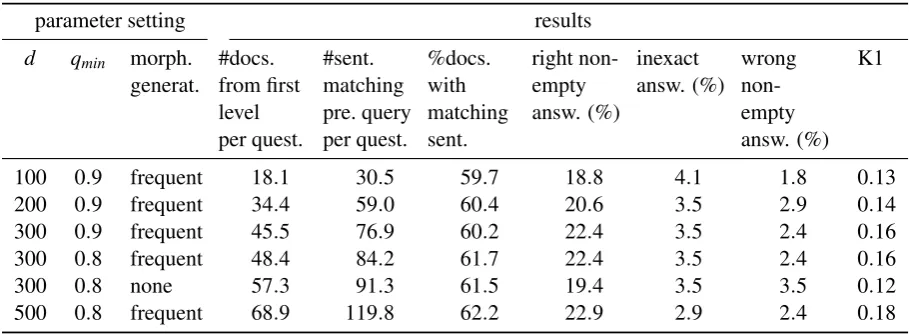
Table 2: Influence of parameters on InSicht-W3 results. Parameter d is the maximal number of doc-uments used from the search engine results (see Sect. 3.4); qmin is the minimal query network quality.
parameter setting results
d qmin morph. generat.
#docs. from first level per quest.
#sent. matching pre. query per quest.
%docs. with matching sent.
right non-empty answ. (%)
inexact answ. (%)
wrong non-empty answ. (%)
K1
100 0.9 frequent 18.1 30.5 59.7 18.8 4.1 1.8 0.13 200 0.9 frequent 34.4 59.0 60.4 20.6 3.5 2.9 0.14 300 0.9 frequent 45.5 76.9 60.2 22.4 3.5 2.4 0.16 300 0.8 frequent 48.4 84.2 61.7 22.4 3.5 2.4 0.16
300 0.8 none 57.3 91.3 61.5 19.4 3.5 3.5 0.12
500 0.8 frequent 68.9 119.8 62.2 22.9 2.9 2.4 0.18
Error analysis and classification is difficult as soon as one steps to the vast web. One could start with a classification of error reasons for wrong empty answers. The error class that can be most easily determined is that the search engine re-turned no results for the preselection query. 40 of the 170 questions (23.5%) belong to this class. This might surprise users that believe that they can find nearly every bit of information on the web. But there are areas where this assumption is wrong: many QA@CLEF questions relate to very specific events of the year 1994 or 1995. Twelve years ago, the web publishing rate was much lower than today; and even if the relevant pieces of in-formation were on the web at that time (or in the following years), they might have been moved to archives or removed in recent years. Other er-ror reasons are very difficult and labor-intensive to separate:
1. Result pages from the first level do not con-tain an answer, but if one requests more docu-ments (e.g. by raising the parameterd) result pages with an answer will be found.
2. Result pages from the first level contain an answer, but one or more components of the textual QA system cause that the answer is not found. Subclasses could be defined by adapting the hierarchy that Hartrumpf (2005a) applied to evaluate InSicht.
On average, the 40th search engine result is the first that contains a right answer (in the best
InSicht-W3 run).6 Although this result is for the system and not for a real user (they differ in their strengths and weaknesses in NL understanding), it indicates that human users of web search engines might find the correct answer quite late if at all. This is a strong argument for more advanced, sec-ond level tools like a semantic QA system: How many users will read through 40 search engine re-sults and (possibly) 40 underlying web pages?
The answer time of InSicht-W3 currently ranges between 15 and 1200 seconds. The doc-ument download time was excluded because it de-pended on too many external factors (caches, in-tranet effects, parallel vs. sequential downloads) to be measured consistently and reliably.
5 Related Work
There are few QA systems for German. The sys-tem described by Neumann and Xu (2003) works on German web pages. Its general approach dif-fers from InSicht because it relies on shallow, but robust methods, while InSicht builds on sentence parsing and semantic representations. In this re-spect, InSicht resembles the (English) textual QA system presented by Harabagiu et al. (2001). In contrast to InSicht, this system applies a theorem prover and a large knowledge base to validate can-didate answers. An interesting combination of web and textual QA is presented by Vicedo et al. (2005): English and Spanish web documents are used to enhance textual QA in Spanish.
6This high number is in part an artifact of the preselection
[image:7.595.71.526.107.274.2]One of the first web QA systems for English was Mulder (Kwok et al., 2001). Mulder parses only the text snippets returned by the search en-gine, while InSicht-W3 parses the underlying web pages because the text snippets often have omis-sions (‘...’) so that full parsing becomes problem-atic or impossible. InSicht-W3’s approach needs more time, especially if the web pages are not in the local cache that InSicht-W3 maintains in order to reduce its bandwidth requirements.
6 Conclusion and Perspectives
In this paper, an existent textual QA system was extended and modified to work successfully on the German web as a virtual document collection. The main results are: precision-oriented exten-sions and experimentally derived parameter set-tings are needed to achieve similar performance on the vast web as on small-sized document col-lections that show higher homogeneity and quality of the contained texts; taking a semantic QA sys-tem to the web is feasible as demonstrated in this paper, but answering a question is still expensive in terms of bandwidth and CPU time.
There are several interesting directions for fu-ture work. The first level of InSicht-W3 can be im-proved by finding a better suited search engine or by building and running a new one in a distributed manner. Ideally, it should support arbitrarily com-plex Boolean queries, parameterized proximity operators like NEAR/N (N ∈ {1,2, . . . ,100}), or even linguistically informed operators like same-sentence andsame-paragraph.
The second level (the textual QA system) can be improved by acquiring more inferential knowl-edge to allow better query expansion. The match-ing approach can be extended from the unit sen-tenceto a larger linguistic unit like paragraph, text, and even text collection. Distributed architectures and algorithms can reduce answer times.
References
Sanda Harabagiu, Dan Moldovan, Marius Pas¸ca, Rada Mihalcea, Mihai Surdeanu, R˘azvan Bunescu, Rox-ana Gˆırju, Vasile Rus, and Paul Mor˘arescu. 2001. The role of lexico-semantic feedback in
open-domain textual question-answering. InProceedings
of the 39th Annual Meeting of the Association for
Computational Linguistics (ACL-2001), pages 274–
281, Toulouse, France.
Sven Hartrumpf, Hermann Helbig, and Rainer Oss-wald. 2003. The semantically based computer
lex-icon HaGenLex – Structure and technological
en-vironment. Traitement automatique des langues,
44(2):81–105.
Sven Hartrumpf. 2003. Hybrid Disambiguation in
Natural Language Analysis. Der Andere Verlag,
Os-nabr¨uck, Germany.
Sven Hartrumpf. 2005a. Question answering using sentence parsing and semantic network matching. In (Peters et al., 2005), pages 512–521.
Sven Hartrumpf. 2005b. University of Hagen
at QA@CLEF 2005: Extending knowledge and
deepening linguistic processing for question
an-swering. In Carol Peters, editor, Results of the
CLEF 2005 Cross-Language System Evaluation Campaign, Working Notes for the CLEF 2005
Work-shop. Centromedia, Wien, Austria.
Hermann Helbig. 2006. Knowledge Representation
and the Semantics of Natural Language. Springer,
Berlin.
Jes´us Herrera, Anselmo Pe˜nas, and Felisa Verdejo. 2005. Question answering pilot task at CLEF 2004. In (Peters et al., 2005), pages 581–590.
Cody Kwok, Oren Etzioni, and Daniel S. Weld. 2001.
Scaling question answering to the web. ACM
Trans-actions on Information Systems, 19(3):242–262.
Bernardo Magnini, Alessandro Vallin, Christelle Ay-ache, Gregor Erbach, Anselmo Pe˜nas, Maarten de Rijke, Paulo Rocha, Kiril Simov, and Richard Sutcliffe. 2005. Overview of the CLEF 2004 mul-tilingual question answering track. In (Peters et al., 2005), pages 371–391.
G¨unter Neumann and Bogdan Sacaleanu. 2005.
Experiments on robust NL question interpretation and multi-layered document annotation for a cross-language question/answering system. In (Peters et al., 2005), pages 411–422.
G¨unter Neumann and Feiyu Xu. 2003. Mining
an-swers in German web pages. InProceedings of the
International Conference on Web Intelligence
(WI-2003), Halifax, Canada.
Carol Peters, Paul Clough, Julio Gonzalo, Gareth J. F. Jones, Michael Kluck, and Bernardo Magnini,
ed-itors. 2005. Multilingual Information Access for
Text, Speech and Images: 5th Workshop of the
Cross-Language Evaluation Forum, CLEF 2004,
volume 3491 ofLNCS. Springer, Berlin.
Jos´e L. Vicedo, Maximiliano Saiz, Rub´en Izquierdo,
and Fernando Llopis. 2005. Does English help
question answering in Spanish? In (Peters et al.,