Lexical Query Paraphrasing for Document Retrieval
Ingrid ZukermanSchool of Computer Science and Software Eng. Monash University
Clayton, VICTORIA 3800 AUSTRALIA
Bhavani Raskutti Telstra Research Laboratories
770 Blackburn Road Clayton, VICTORIA 3168
AUSTRALIA
Abstract
We describe a mechanism for the generation of lexical paraphrases of queries posed to an Inter-net resource. These paraphrases are generated us-ing WordNet and part-of-speech information to pro-pose synonyms for the content words in the queries. Statistical information, obtained from a corpus, is then used to rank the paraphrases. We evaluated our mechanism using 404 queries whose answers reside in the LA Times subset of the TREC-9
cor-pus. There was a 14% improvement in
perfor-mance when paraphrases were used for document retrieval.
1 Introduction
The vocabulary of users of domain-specific retrieval systems often differs from the vocabulary within a particular resource, leading to retrieval failure. In this research, we address this problem by submit-ting multiple paraphrases of a query to a retrieval system, in the hope that one or more of the posited paraphrases will match a relevant document.
We focus on the generation of lexical paraphrases for queries posed to the Internet. These are para-phrases where content words are replaced with syn-onyms. We use WordNet (Miller et al., 1990) and part-of-speech information to propose these syn-onyms, and build candidate paraphrases from com-binations of these synonyms. The resultant para-phrases are then scored using word co-occurrence information obtained from a corpus, and the high-est scoring paraphrases are retained. Our evaluation shows a 14% improvement in retrieval performance as a result of query paraphrasing.
In the next section we describe related research. In Section 3, we discuss the resources used by our mechanism. The paraphrase generation and docu-ment retrieval processes are described in Section 4. Section 5 presents sample paraphrases, followed by our evaluation and concluding remarks.
This research was supported in part by Australian Research Council grant DP0209565.
2 Related Research
The vocabulary mis-match between user queries and indexed documents is often addressed through
query expansion. Two common techniques for
query expansion are blind relevance feedback (Buckley et al., 1995; Mitra et al., 1998) and
word sense disambiguation (WSD) (Mihalcea and
Moldovan, 1999; Lytinen et al., 2000; Sch¨utze and Pedersen, 1995; Lin, 1998). Blind relevance feed-back consists of retrieving a small number of docu-ments using a query given by a user, and then con-structing an expanded query that includes content words that appear frequently in these documents. This expanded query is used to retrieve a new set of documents. WSD often precedes query expansion to avoid retrieving irrelevant information. Mihalcea and Moldovan (1999) and Lytinen et al. (2000) used a machine readable thesaurus, specifically WordNet (Miller et al., 1990), to obtain the sense of a word, while Sch¨utze and Pedersen (1995) and Lin (1998) used automatically constructed thesauri.
The improvements in retrieval performance re-ported in (Mitra et al., 1998) are comparable to those reported here (note that these researchers con-sider precision, while we concon-sider recall). The re-sults obtained by Sch¨utze and Pedersen (1995) and by Lytinen et al. (2000) are encouraging. However, experimental results reported in (Sanderson, 1994; Gonzalo et al., 1998) indicate that the improvement in IR performance due to WSD is restricted to short queries, and that IR performance is very sensitive to disambiguation errors.
and select which paraphrases to retain, and then use the paraphrase scores to influence the document re-trieval process.
3 Resources
Our system uses syntactic, semantic and statistical information for paraphrase generation. Syntactic in-formation for each query was obtained from Brill’s part-of-speech (PoS) tagger (Brill, 1992). Seman-tic information consisting of different types of syn-onyms for the words in each query was obtained from WordNet (Miller et al., 1990).
The corpus used for information retrieval and for the collection of statistical information was the LA Times portion of the NIST Text Research Collec-tion (//trec.nist.gov). This corpus was small enough to satisfy our disk space limitations, and suf-ficiently large to yield statistically significant results (131,896 documents). Full-text indexing was per-formed for the documents in the LA Times collec-tion, using lemmas (rather than words). The lemmas for the words in the LA Times collection were also obtained from WordNet (Miller et al., 1990).
The statistical information was used to assign a score to the paraphrases generated for a query (Sec-tion 4.4). This informa(Sec-tion was stored in a lemma dictionary (202,485 lemmas) and a lemma-pair tionary (37,341,156 lemma-pairs). The lemma dic-tionary associates with each lemma the number of times it appears in the corpus. The lemma-pair dictionary associates with each ordered lemma-pair
-
the number of times
appears before
in a five-word window in the corpus (not counting stop words and closed-class words). The dictionary maintains a different entry for the lemma pair
. Lemma-pairs which appear only once constitute 64% of the pairs, and were omitted from our dictio-nary owing to disk space limitations.
4 Paraphrasing and Retrieval Procedure
The procedure for paraphrasing a query consists of the following steps:
1. Tokenize, tag and lemmatize the query.
2. Generate synonyms for each content lemma in the query (stop words are ignored).
3. Propose paraphrases for the query using differ-ent synonym combinations, compute a score for each paraphrase, and rank the paraphrases ac-cording to their score. The lemmatized query plus the 19 top paraphrases are retained.
Documents are then retrieved for the query and its paraphrases.
4.1 Tagging and lemmatizing the queries
We used the part-of-speech (PoS) of a word to con-strain the number of synonyms generated for it. Brill’s tagger correctly tagged 84% of the queries. In order to determine the effect of tagging er-rors on retrieval performance, we corrected manu-ally the wrong tags, and ran our system with both automatically-obtained and manually-corrected tags (Section 6). After tagging, each query was lemma-tized (using WordNet). This was done since the in-dex used for document retrieval is lemma-based.
4.2 Proposing synonyms for each word
The following types of WordNet synonyms were generated for each content lemma in a query:
synonyms, attributes, pertainyms and
seealsos (Miller et al., 1990).1 For example, according to WordNet, a synonym for “high” is “steep”, anattributeis “height”, and aseealso
is “tall”; a pertainym for “chinese” is “China”. In order to curb the combinatorial explosion, we do not allow multiple-word synonyms for a lemma, and do not generate synonyms for proper nouns or stop words.
4.3 Paraphrasing queries
Query paraphrases are generated by an iterative pro-cess which considers each content lemma in a query in turn, and proposes a synonym from those col-lected from WordNet (Section 4.2). Queries which do not have sufficient context are not paraphrased. These are queries where all the words except one are stop words or closed-class words.
4.4 Computing paraphrase scores
The score of a paraphrase is based on how common are the lemma combinations in it. Ideally, this score
would be represented by Pr , where is
the number of lemmas in the paraphrase. However, in the absence of sufficient information to compute this joint probability, approximations based on con-ditional probabilities are often used, e.g.,
Pr Pr
Pr !" #
Pr
Unfortunately, this approximation yielded poor paraphrases in preliminary trials. We postulate that this is due to two reasons: (1) it takes into account the interaction between a lemma $
and only one other lemma (without considering the rest of the lemmas in the query), and (2) relatively infrequent lemma combinations involving one frequent lemma
1
are penalized (which is correct for conditional prob-abilities). For instance, if
appears 10 times in the corpus and
is a normalizing constant). In contrast, if
appears 200 times in the corpus and
pears 30 times,
is a more frequent lemma combination, and should contribute a higher score to the paraphrase.
To address these problems, we propose using the joint probability of a pair of lemmas instead of their conditional probability. In the above example, this yields
is a normalizing constant). These probabilities re-flect more accurately the goodness of paraphrases containing these lemma-pairs. The resulting ap-proximation of the probability of a paraphrase
com-posed of lemmas
is obtained directly from the lemma-pair frequencies, yielding
is a normalizing constant.2 Since this con-stant is not informative with respect to the rela-tive scores of the paraphrases for a particular query, we drop it from consideration, and use only the frequencies to calculate the score of a paraphrase. Thus, our paraphrase scoring function is
!#"
When calculating the score of a paraphrase us-ing Equation 2, the followus-ing aspects regardus-ing freq
must be specified: (1) the extent to which the order of
and
(as it appears in the paraphrase) should be enforced; and (2) how to handle
pairs in the paraphrase that are absent from the lemma-pair dictionary. To illustrate these aspects, consider the candidate paraphrase “who is the greek deity of the ocean?” (proposed for “who is the greek god of the sea?”). The first aspect determines whether the frequency of only “greek deity” should be used, or whether “deity greek” should also be taken into ac-count. The second aspect determines how to score the paraphrase if “greek ocean” is absent from the lemma-pair dictionary. These aspects are specified as experimental parameters of the system.
2&(' )
# of lemma-pairs*+,*.-0/21435
' )
Relative word order. The extent to which we en-force the order of
when calculating freq
is determined by the weight> orderas follows:
freq
is the frequency of the lemma-pair
allows only the word order in the paraphrase, while
>
order E
counts equally the order in the para-phrase and the reverse order. We experimented with weights of 0, 1 and 0.5 for>
order(Section 6).
Absent lemma-pairs. When a lemma-pair is not in the dictionary, a frequency of 0 is returned. Us-ing this frequency is too strict, because it invali-dates an entire paraphrase on account of one cul-prit which may actually be innocent (recall that 64% of the lemma-pairs in the corpus – approximately 66 million pairs – had a frequency of 1 but were not stored). To address this problem, we assigned a penalty frequency of AbsFreq = 0.1 to a lemma-pair in a paraphrase that does not appear in the dictio-nary. That is, the score of a paraphrase is divided by 10 for each of its lemma-pairs that is absent from the dictionary.
In addition, we defined the experimental parame-ter AbsAdjDiv, which models the impact of adjacent lemma-pairs on paraphrasing and retrieval perfor-mance. This parameter takes the form of a divisor for AbsFreq: it stipulates by how much to divide
Ab-sFreq for a lemma-pair that is adjacent in the
para-phrase but absent from the dictionary. In the above example, AbsAdjDiv=10 would cause an absent “de-ity ocean” to receive a penalty of 0.01 (=0.1/10) compared to an absent “greek ocean”, which would receive a penalty of 0.1. We experimented with four values for AbsAdjDiv: 1, 2, 10 and 20 (Section 6).
4.5 Retrieving documents for each query
Our retrieval process differs from the standard one in that for each queryF , we adjust the scores of the
retrieved documents according to the scores of the paraphrases ofF (obtained from Equation 2). Our
retrieval process consists of the following steps:
1. For each paraphrase
of F (G
# para F ), where CH
is the lemmatized query:
(a) Extract the content lemmas from
:
I IJ
, where K is the number of
content lemmas in paraphrase
.
(b) For each lemma, compute a score for the re-trieved documents using a standard IR mea-sure, e.g., Term Frequency Inverse Document Frequency (TFIDF) (Salton and McGill, 1983). Let tfidfLNM
I
document LNM retrieved for lemma (
K ). When a documentLM is retrieved
by more than one lemma in a paraphrase
, its TFIDF scores are added, yielding the score
J
tfidfLNM 2I
. This score indi-cates how well LNM matches the lemmas in
paraphrase
. In order to take into account the plausibility of
, this score is multiplied by !#"
– the score of
obtained from Equation 2. This yields
"
M
I
, the score of documentLNM for paraphrase
2. For each documentLM , add the scores from each
paraphrase (Equation 4), yielding
An outcome of this method is that lemmas which appear in several paraphrases receive a higher weight. This indirectly identifies the important words in a query, which positively affects retrieval performance (Section 6).
5 Sample Results
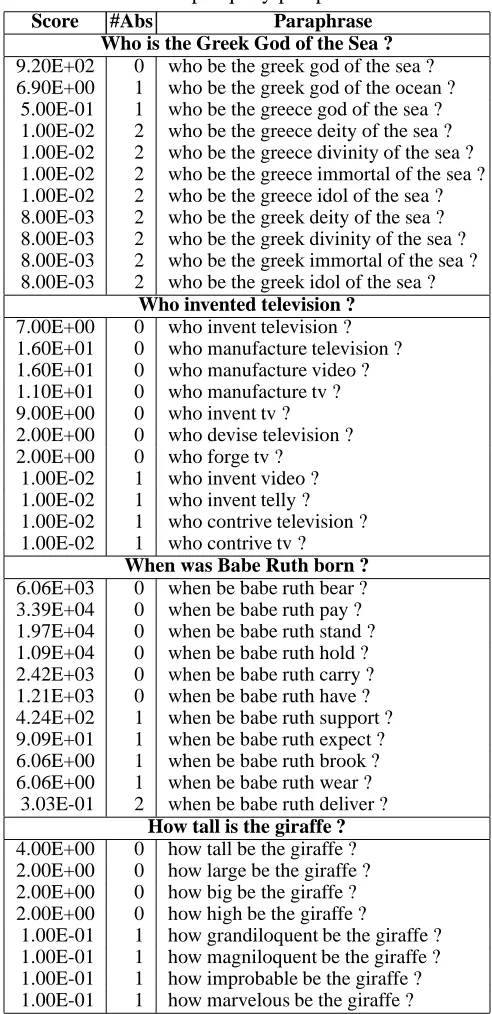
Table 1 shows the top 10 paraphrases generated by our system for three sample queries, and the 7 para-phrases generated for a fourth query (the lemma-tized query is listed first). These paraphrases were obtained with >
order
, AbsAdjDiv = 10, and manually-corrected tagging (Section 4). The third column contains the paraphrase, the first column contains its score, and the second column contains the number of lemma-pairs in the paraphrase which were not found in the dictionary.
These examples illustrate the combined effect of contextual information and WordNet senses. The first query yields mostly felicitous paraphrases, de-spite their low overall score and absent lemma-pairs. This outcome may be attributed to the gen-erally appropriate synonyms returned by WordNet for the lemmas in this query. The second query produces a mixed paraphrasing performance. The problematic paraphrases are generated because our corpus-based information supports WordNet’s inap-propriate suggestions of “manufacture” as a syn-onym for “invent” and “video” as a synsyn-onym for “television”, thus yielding highly-ranked but incor-rect paraphrases. The third query is an extreme example of this behaviour, where WordNet syn-onyms conspire with contextual information to steer
Table 1: Sample query paraphrases
Score #Abs Paraphrase
Who is the Greek God of the Sea ?
9.20E+02 0 who be the greek god of the sea ? 6.90E+00 1 who be the greek god of the ocean ?
5.00E-01 1 who be the greece god of the sea ? 1.00E-02 2 who be the greece deity of the sea ? 1.00E-02 2 who be the greece divinity of the sea ? 1.00E-02 2 who be the greece immortal of the sea ? 1.00E-02 2 who be the greece idol of the sea ? 8.00E-03 2 who be the greek deity of the sea ? 8.00E-03 2 who be the greek divinity of the sea ? 8.00E-03 2 who be the greek immortal of the sea ? 8.00E-03 2 who be the greek idol of the sea ?
Who invented television ?
7.00E+00 0 who invent television ? 1.60E+01 0 who manufacture television ? 1.60E+01 0 who manufacture video ? 1.10E+01 0 who manufacture tv ? 9.00E+00 0 who invent tv ? 2.00E+00 0 who devise television ? 2.00E+00 0 who forge tv ?
1.00E-02 1 who invent video ? 1.00E-02 1 who invent telly ? 1.00E-02 1 who contrive television ? 1.00E-02 1 who contrive tv ?
When was Babe Ruth born ?
6.06E+03 0 when be babe ruth bear ? 3.39E+04 0 when be babe ruth pay ? 1.97E+04 0 when be babe ruth stand ? 1.09E+04 0 when be babe ruth hold ? 2.42E+03 0 when be babe ruth carry ? 1.21E+03 0 when be babe ruth have ? 4.24E+02 1 when be babe ruth support ? 9.09E+01 1 when be babe ruth expect ? 6.06E+00 1 when be babe ruth brook ? 6.06E+00 1 when be babe ruth wear ?
3.03E-01 2 when be babe ruth deliver ?
How tall is the giraffe ?
4.00E+00 0 how tall be the giraffe ? 2.00E+00 0 how large be the giraffe ? 2.00E+00 0 how big be the giraffe ? 2.00E+00 0 how high be the giraffe ?
1.00E-01 1 how grandiloquent be the giraffe ? 1.00E-01 1 how magniloquent be the giraffe ? 1.00E-01 1 how improbable be the giraffe ? 1.00E-01 1 how marvelous be the giraffe ?
the paraphrasing process toward inappropriate syn-onyms of “bear”. The final example illustrates the opposite case, where the corpus information over-comes the effect of WordNet’s less appropriate sug-gestions, which yield low-scoring paraphrases.
6 Evaluation
documents in this collection. Our main evaluation was performed for the TREC-9 question-answering task, since our ultimate goal is to answer ques-tions posed to an Internet resource. From a total of 131,896 documents in the collection, 1211 doc-uments contained the correct answer for 404 of the 693 TREC-9 queries. An additional evaluation was performed for the TREC-6 ad-hoc retrieval task, where 1105 documents were judged relevant to 48 of the 50 TREC-6 keyword-based queries.
Our results show that query paraphrasing im-proves overall retrieval performance. For the ad-hoc task, when 20 retrieved documents were retained for each query, 22 correct documents in total were re-trieved without paraphrasing, while a maximum of 20 paraphrases per query yielded 35 correct docu-ments (only 18 of the 48 queries were paraphrased). For the question answering task, under the same retrieval conditions, recall improved from 294 cor-rect documents without paraphrasing to 337 with a maximum of 20 paraphrases per query. Specifically, the number of queries for which correct documents were retrieved improved from 169 to 182.
In addition, we tested the effect of the following factors on retrieval performance.
WordNet locations – three usages of word
co-locations (none, for scoring only, for scoring and paraphrase generation).
Tagging accuracy – manually-corrected tagging
versus automatic PoS tagging (Brill, 1992), which tagged correctly 84% of the queries.
Out-of-order weight (> order) – how much we
should take into account the word order in a query (strict consideration, ignore word order, intermediate).
Absent adjacent-pair divisor (AbsAdjDiv) – how
much we should penalize lemma-pairs that are adjacent in the query but absent from the corpus (same penalty as non-adjacent absent lemma-pairs, a little higher, a lot higher).
Query length – how the number of words in the
query affects retrieval performance.
For each run, we submitted to the retrieval engine increasing sets of paraphrases as follows: first the lemmatized query alone (Set 0), next the query plus 1 paraphrase (Set 1), then the query plus 2 para-phrases (Set 2), and so on, up to a maximum of 19 paraphrases (Set 19). For each submission, we varied the number of documents returned by the re-trieval engine from 1 to 20 documents.
6.1 WordNet Co-locations
As indicated above, we considered three usages of WordNet with respect to word co-locations: Col,
0 5 10 15 20
290 295 300 305 310 315 320 325 330 335
Number of paraphrases
Total number of correct documents
Correct Documents Vs Number of Paraphrases
Col ColScore NoCol
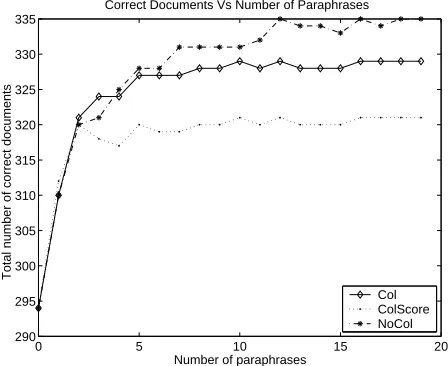
Figure 1: Effect of word co-location and number of paraphrases (20 retrieved documents)
NoCol and ColScore. Under the Col setting, our mechanism checked whether a lemma-pair in the input query corresponds to a WordNet co-location, and if so, generated synonyms for the pair, instead of the individual lemmas. For instance, given the lemma-pair “folic acid”, theColsetting yielded syn-onyms such as “folate” and “vitamin m” for the lemma-pair. During paraphrase scoring, these co-locations were assigned a high frequency score, cor-responding to the 999th percentile of pair frequen-cies in the corpus. In contrast, the NoCol setting did not take into account WordNet co-locations at all. For instance, one of the paraphrases gener-ated by this method for “folic acid” was “folic lsd”. ColScore is a hybrid setting, where WordNet was used for scoring lemma-pairs in the proposed para-phrases, but not for generating them.
Figure 1 depicts the total number of correct doc-uments retrieved (for 20 retrieved docdoc-uments per query), for each of the three co-location settings, as a function of the number of paraphrases in a set (from 0 to 19). The values for the other fac-tors were: >
order=1, AbsAdjDiv=2, and
0 5 10 15 20 0
50 100 150 200 250 300 350
Number of retrieved documents
Total number of correct documents
Correct Documents Vs Number of Retrieved Documents
NoPara Col ColScore NoCol
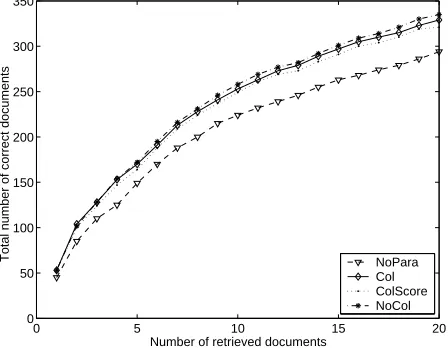
Figure 2: Effect of word co-location and number of retrieved documents (maximum paraphrases)
for the 6 paraphrases was replicated for Sets 7 to 19. Figure 2 depicts the total number of correct doc-uments retrieved (for 19 paraphrases or maximum paraphrases), for each of the three co-location set-tings, as a function of the number of documents re-trieved per query (from 1 to 20). As for Figure 1, paraphrasing improves retrieval performance. In ad-dition, as expected, recall performance improves as more documents are retrieved.
TheColsetting generally yielded fewer and more felicitous paraphrases than those generated without considering co-locations (for the 118 queries where co-locations were identified). Surprisingly however, this effect did not transfer to the retrieval process, as theNoColsetting yielded a marginally better per-formance. This difference in performance may be attributed to whether a lemma or lemma-pair that was important for retrieval was retained in enough paraphrases. This happened in 9 instances of the NoCol setting and 2 instances of the Col setting, yielding a slightly better performance for theNoCol setting overall. For example, the identification of “folic acid” as a co-location led to synonyms such as “vitamin m” and “vitamin bc”, which appeared in most of the paraphrases. As a result, the effect of the lemma-pair “folic acid”, which was actually re-sponsible for retrieving the correct document, was obscured. In contrast, the recognition of “major league” as a co-location (which was paraphrased to “big league” in only 3 of the 19 paraphrases) en-abled the retrieval of the correct document. Since the performance under theColScorecondition was consistently worse than the performance under the other two conditions, we do not consider it in the rest of our evaluation.
6.2 Tagging accuracy
The PoS-tagger incorrectly tagged 64 of the 404 queries in our corpus (usually, one word was mis-tagged in each of these queries). The instances of mis-tagging which had the largest impact on the quality of the generated paraphrases occurred when nouns were mis-tagged as verbs and vice versa (18 cases). In addition, proper nouns were mis-tagged as other PoS and vice versa in 24 cases, and the verb “name” (e.g., “Name the highest mountain”) was mis-tagged as a noun in 17 instances. Surpris-ingly, retrieval performance was affected only in 5 instances both for theColand theNoColsettings: 3 of these instances had a mis-tagged “name”, and 2 had a noun mis-tagged as another PoS.
6.3 Out-of-order weight
We considered three settings for the out-of-order weight, > order (Equation 3): 1, 0 and 0.5. The
first setting ignores word order. For instance, given the query “how many dogs pull a sled in the Idi-tarod?” the frequency of the lemma-pair “dog-pull” is added to that of the pair “pull-dog”. The second setting enforces a strict word order, e.g., only “dog-pull” is considered. The third setting considers out-of-order lemma-pairs, but gives their frequency half the weight of the ordered pairs.
Interestingly, this factor had no effect on retrieval performance. This may be explained by the obser-vation that the lemma order in the queries reflects their order in the corpus. Thus, when an ordered lemma-pair in a query matches a dictionary entry, the additional frequency count contributed by the reverse lemma order is often insufficient to affect significantly the relative score of the paraphrases.
6.4 Penalty for absent adjacent lemma-pairs
We considered four settings for the penalty assigned to lemma-pairs that are adjacent in a paraphrase but absent from the dictionary. These settings are repre-sented by the values 1, 2, 10 and 20 for the divisor
AbsAdjDiv. For instance, a value of 10 means that
the score for an absent adjacent lemma-pair is 1/10 of the score of an absent non-adjacent lemma-pair. That is, the score of a paraphrase is divided by 100 for each absent adjacent lemma-pair.
This factor had only a marginal effect on retrieval performance, with the best performance being ob-tained for AbsAdjDiv = 10.
6.5 Query Length
3 4 5 6 7 8 9 10 11 12 0
10 20 30 40 50 60 70 80
Query length (in words)
Percentage of successful queries
Percentage of successful queries Vs query length
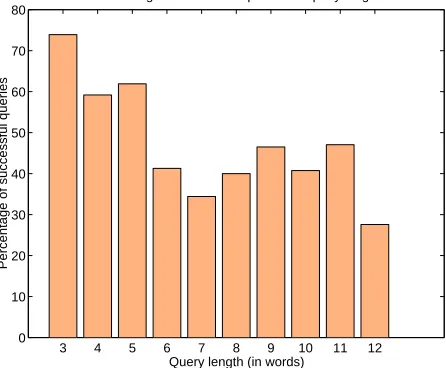
Figure 3: Effect of query length (20 retrieved docu-ments and maximum paraphrases)
query length in words (20 documents were retrieved using 19 or maximum paraphrases). These results were obtained for the settings Col, > order
and AbsAdjDiv=10, with manually-corrected tag-ging. As seen in Figure 3, there is a drop in retrieval performance for queries with more than 5 words. These results generally concur with the observa-tions in (Sanderson, 1994; Gonzalo et al., 1998). Nonetheless, on average we returned a correct doc-ument for 42% of the queries which had 6 to 11 words.
7 Conclusion
We have offered a mechanism for the generation of lexical paraphrases of queries posed to an Internet resource. These paraphrases were generated using WordNet and part-of-speech information to propose synonyms for the content lemmas in the queries. Statistical information obtained from a corpus was used to rank the paraphrases. Our evaluation shows that paraphrasing improves retrieval performance. This is achieved despite mis-tagging and erroneous paraphrasing of co-located words.
References
E. Brill. 1992. A simple rule-based part of speech tagger. In ANLP-92 – Proceedings of the 3rd
Conference on Applied Natural Language Pro-cessing, pages 152–155, Trento, IT.
C. Buckley, G. Salton, J. Allan, and A. Sing-hal. 1995. Automatic query expansion using SMART. In D. Harman, editor, The Third Text
REtrieval Conference (TREC3). NIST Special
Publication.
J. Gonzalo, F. Verdejo, I. Chugur, and J. Cigar-ran. 1998. Indexing with WordNet synsets can improve text retrieval. In Proceedings of the
COLING-ACL’98 Workshop on Usage of Word-Net in Natural Language Processing Systems,
pages 38–44, Montreal, Canada.
S. Harabagiu, D. Moldovan, M. Pasca, R. Mi-halcea, M. Surdeanu, R. Bunescu, R. Girju, V. Rus, and P. Morarescu. 2001. The role of lexico-semantic feedback in open domain tex-tual question-answering. In ACL01 –
Proceed-ings of the 39th Annual Meeting of the Associ-ation for ComputAssoci-ational Linguistics, pages 274–
281, Toulouse, France.
D. Lin. 1998. Automatic retrieval and clustering of similar words. In COLING-ACL’98 –
Proceed-ings of the International Conference on Compu-tational Linguistics and the Annual Meeting of the Association for Computational Linguistics,
pages 768–774, Montreal, Canada.
S. Lytinen, N. Tomuro, and T. Repede. 2000. The use of WordNet sense tagging in FAQfinder. In
Proceedings of the AAAI00 Workshop on AI and Web Search, Austin, Texas.
R. Mihalcea and D. Moldovan. 1999. A method for word sense disambiguation of unrestricted text. In ACL99 – Proceedings of the 37th Annual
Meet-ing of the Association for Computational LMeet-inguis- Linguis-tics, Baltimore, Maryland.
G. Miller, R. Beckwith, C. Fellbaum, D. Gross, and K. Miller. 1990. Introduction to WordNet: An on-line lexical database. Journal of
Lexicogra-phy, 3(4):235–244.
M. Mitra, A. Singhal, and C. Buckley. 1998. Im-proving automatic query expansion. In SIGIR’98
– Proceedings of the 21th ACM International Conference on Research and Development in In-formation Retrieval, pages 206–214, Melbourne,
Australia.
G. Salton and M.J. McGill. 1983. An Introduction
to Modern Information Retrieval. McGraw Hill.
M. Sanderson. 1994. Word sense disambiguation and information retrieval. In SIGIR’94 –
Pro-ceedings of the 17th ACM International Confer-ence on Research and Development in Informa-tion Retrieval, pages 142–151, Dublin, Ireland.
H. Sch¨utze and J.O. Pedersen. 1995. Information retrieval based on word senses. In Proceedings
of the Fourth Annual Symposium on Document Analysis and Information Retrieval, pages 161–