Contextual Recommendation based on Text Mining
Yize Li, Jiazhong Nie, Yi ZhangSchool of Engineering University of California Santa Cruz
{yize,niejiazhong,yiz}@soe.ucsc.edu
Bingqing Wang
School of Computer Science Technology Fudan University
Baoshi Yan, Fuliang Weng
Research and Technology Center Robert Bosch LLC
[email protected] [email protected]
Abstract
The potential benefit of integrating con-textual information for recommendation has received much research attention re-cently, especially with the ever-increasing interest in mobile-based recommendation services. However, context based recom-mendation research is limited due to the lack of standard evaluation data with con-textual information and reliable technol-ogy for extracting such information. As a result, there are no widely accepted clusions on how, when and whether con-text helps. Additionally, a system of-ten suffers from the so called cold start problem due to the lack of data for train-ing the initial context based recommenda-tion model. This paper proposes a novel solution to address these problems with automated information extraction tech-niques. We also compare several ap-proaches for utilizing context based on a new data set collected using the pro-posed solution. The experimental results demonstrate that 1) IE-based techniques can help create a large scale context data with decent quality from online reviews, at least for restaurant recommendations; 2) context helps recommender systems rank items, however, does not help pre-dict user ratings; 3) simply using context to filter items hurts recommendation per-formance, while a new probabilistic latent relational model we proposed helps.
1 Introduction
In the information retrieval community, one ma-jor research focus is developing proactive re-trieval agent that acts in anticipation of informa-tion needs of a user and recommends informainforma-tion to the user without requiring him/her to issue an explicit query. The most popular examples of such kind of proactive retrieval agent are recommender systems. Over the last several years, research in standard recommender systems has been im-proved significantly, largely due to the availability of large scale evaluation data sets such as Netflix. The current research focus goes beyond the stan-dard user-item rating matrix. As researchers start to realize that the quality of recommendations de-pends on time, place and a range of other rele-vant users’ context, how to integrate contextual information for recommendation is becoming an ever increasingly important topic in the research agenda (Adomavicius and Ricci, 2009).
1 I was very excited to try this place andmy wifetook me here on mybirthday. . . We ordered a side of the brussell sprouts and they were the highlight of thenight. 2 A friend of minesuggested we meet up here for anightofdrinks. . . This actually
a restaurant with a bar in it, but when we went it was10pmand . . .
Table 1: Examples of the restaurant reviews
succeed until a user has interacted with it for a long period of time to enable context based rec-ommendation models well trained.
On the other hand, a large amount of re-view documents from web sites such as tri-padvisor.com, yelp.com, cnet.com, amazon.com, are available with certain contextual information, such as time and companion, implicitly in the re-views (see Table 1 for examples). This offers us an opportunity to apply information extraction tech-niques for obtaining contextual information from the review texts. Together with users’ explicit rat-ings on items, this might lead to a large research data set for context based recommendation and consequently address the cold start issue in the recommender systems. This paper describes the methods that extract the contextual information from online reviews and their impact on the rec-ommendation quality at different accuracy levels of the extraction methods.
Another challenge is how to integrate contex-tual information into existing recommendation al-gorithms. Existing approaches can be classified into three major categories: pre-filtering, post-filtering and the modeling based approaches (Oku et al., 2007; Adomavicius and Tuzhilin, 2008). Pre-filtering approaches utilize contextual infor-mation to select data for that context, and then pre-dict ratings using a traditional recommendation method on the selected data (Adomavicius et al., 2005). Post-filtering approaches first predict rat-ings on the whole data using traditional methods, then use the contextual information to adjust re-sults. Both methods separate contextual informa-tion from the rating estimainforma-tion process and leads to unsatisfying findings. For example, Adomavi-cious et al. (2005) found neither standard col-laborative filtering nor contextual reduction-based methods dominate each other in all the cases. In the modeling based approaches, contextual infor-mation is used directly in the rating prediction
process. For example, Oku et al. (2007) propose a context-aware SVM-based predictive model to classify restaurants into “positive” and “negative” classes, and contextual information is included as additional input features for the SVM classifier. However, treating recommendation as classifica-tion is not a common approach, and does not take advantage of the state of art collaborative filtering techniques. In this paper, we propose a new prob-abilistic model to integrate contextual information into the state of art factorization based collabora-tive filtering approach, and compare it with sev-eral baselines.
2 Mining Contextual Information from Textual Opinions
The context includes any information that can be used to characterize the situation of entities. Ex-amples of context are: location, identity and state of people, companions, time, activities of the cur-rent user, the devices being used etc. (Lee et al., 2005). Without loss of generality, we looked into widely available restaurant review data. More specifically, we investigated four types of contex-tual information for a dining event, as they might affect users’ dining decisions, and they have not been studied carefully before. The four types of contextual information are: Companion(whether a dining event involves multiple people), Occa-sion(for what occasions the event is),Time(what time during the day) andLocation (in which city the event happens).
2.1 Text Mining Approaches
We developed a set of algorithms along with exist-ing NLP tools (GATE (Cunnexist-ingham et al., 2002) etc.) for this task. More detailed description of these algorithms is given below.
compiled a list of lexicons for these different types of meal times, and used a string matching method to find the explicit meal times from reviews. Here, the meal time with an expression, such as “6pm”, was extracted using ANNIE’s time named entity recognition module from the GATE toolkit. For example, if a user says, “When we went there, it was 10pm”, we infer that it was for dinner.
Occasion: The ANNIE’s time named en-tity recognition module recognizes certain special days from text. We augmented ANNIE’s lookup function with a list of holidays in the United States from Wikipedia1as well as some other occasions,
such as birthdays and anniversaries.
Location: Ideally, a location context would be a user’s departure location to the selected restau-rant. However, such information rarely exists in the review texts. Therefore, we used the location information from a user’s profile to approximate.
Companion: Extracting a companion’s infor-mation accurately from review data is more diffi-cult. We utilized two methods to address the chal-lenge:
Companion-Baseline: This is a string match-ing based approach. First, we automatically gen-erated a lexicon of different kinds of compan-ion words/phrases by using prepositcompan-ional patterns, such as “with my (our) NN (NNS)”. We extracted the noun or noun phrases from the prepositional phrases as the companion terms, which were then sorted by frequency of occurrence and manually verified. This led to a lexicon of 167 entries. Next, we grouped these entries into 6 main cate-gories of companions: “family”, “friend”, “cou-ple”, “colleague”, “food-buddy” and “pet”. Fi-nally, the review is tagged as one or more of the companion categories if it contains a correspond-ing word/phrase in that lexicon.
Companion-Classifier: In order to achieve bet-ter precision, we sampled and annotated 1000 sentences with companion terms from the corpus and built three classifiers: 1) a MaxEnt classi-fier with bag-of-words features, 2) a rule-based classifier, 3) a hybrid classifier. For the rule-based classifier, we looked into the structural as-pects of the window where companion terms
oc-1http://en.wikipedia.org/wiki/List of holidays by
country#United States of America
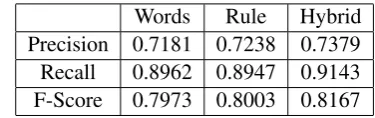
curred, specifically, the adjacent verbs and prepo-sitions associated with those terms. We collected high frequency structures including verbs, verb-proposition combinations, and verb-genitive com-binations from the whole corpus, and then con-structed a list of rules to decide whether a compan-ion context exists based on these structures. For the hybrid classifier, we used the patterns identi-fied by the rule-based classifier as features for the MaxEnt model (Ratnaparkhi, 1998). To train the classifier, we also included features such as POS tags of the verb and of the candidate companion term, the occurrence of a meal term (e.g. “lunch”, “dinner”), the occurrence of pronouns (e.g. “we” or “us”) and the genitive of the companion term. Based on the evaluation results (using 5-fold cross validation) shown in Table 2, the hybrid classifier is the best performing classifier and it is used for the subsequent experiments in the paper.
Words Rule Hybrid
Precision 0.7181 0.7238 0.7379
Recall 0.8962 0.8947 0.9143
F-Score 0.7973 0.8003 0.8167
Table 2: Evaluation results for the bag-of-words-based classifier (Words), the rule-bag-of-words-based classifier (Rule) and the hybrid classifier (Hybrid)
3 Recommendation based on Contextual Information
in-tegrate contextcinto the user’s observed features fi. This makesfia dynamic feature vector, which will change with different context. The goal is to predict ratings for candidate items given useri and contextc, and recommend the top items. We
present two recommendation models for integrat-ing contextual information in this section.
3.1 Boolean Model
The Boolean Model filters out items that do not match the context. The Boolean model itself re-turns an item set instead of a ranked list. We fur-ther rank the items by predicted rating values. We score items by the Boolean model as follows:
s(j) =
(
sm(j) if itemjmatches the context
−∞ otherwise
(1) wheresm(j)is the predicted rating computed us-ing a ratus-ing prediction methodm, such as a Col-laborative Filtering model without using context.
3.2 Probabilistic Latent Relational Model
We propose a novel Probabilistic Latent Rela-tional Model (PLRM) for integrating contextual information. In a context-aware recommender system, a user’s interest for item is influenced by two factors: (1) the user’s long-term preference, which can be learned from users’ rating history; (2) the current context (how the item matches the current context). To capture the two factors si-multaneously, we introduce a new probabilistic model by assuming the rating valueyi,j,cfollows a Gaussian distribution with meanui,j,cand vari-ance1/λ(y):
yi,j,c ∼ N(ui,j,c,1/λ(y)) (2) ui,j,c = uTi Avj+ (Wufi)T(Wvfj) (3)
whereuiandvj are the hidden representations of user iand itemj to be learned from rating data, andWu andWv are feature transformation matri-ces for users and items respectively. In Equation (3), the first termuTi Avj is the estimation based on user’ long term preferences, whereA={a}is a matrix modeling the interaction betweenui and
vj.2 The second term(Wufi)T(Wvfj)is the
esti-2We introduce A matrix so that the model can also
be used to model multiple different types of
relation-mation based on current context and the observed features of users and items, since the contextcis
integrated into user’s observed featuresfi.
{U, V, A, W}are the parameters of the model to be estimated from the training data set D,
where W = {Wu, Wv} = {w} , U =
{u1,u2, ...uN}andV ={v1,v2, ...vM}. We as-sume the prior distribution of the parameters fol-low the Gaussian distributions centered on 0. We use1/λ(u),1/λ(v),1/λ(w)and1/λ(a)to represent the variance of the corresponding Gaussian distri-butions. The effect of the prior distribution is sim-ilar to the ridge regression (norm-2 regularizer) commonly used in machine learning algorithms to control model complexity and avoid overfitting.
The proposed model is motivated by well per-forming recommendation models in the literature. It generalizes several existing models. If we setA to the identity matrix andWu, Wv to zero matri-ces, the model presented in Equation (3) is equiv-alent to the well known norm-2 regularized singu-lar value decomposition, which performs well on the Netflix competition(Salakhutdinov and Mnih, 2007). If we setAto zero matrix andWu to iden-tity matrix, the Model (3) becomes the bilinear model that works well on Yahoo news recommen-dation task (Chu and Park, 2009).
Based on the above model assumption, the joint likelihood of all random variables (U, V, A, W andD) in the system is:
We use a modified EM algorithm for parame-ter estimation to find the posparame-terior distribution of
(U, V) and max a posterior (MAP) of (A, W).
The estimation can be used to make the final
dictions as follows:
E Step:the Variational Bayesian approach is used to estimate the posterior distributions ofU andV. Assuming (A, W) are known, based on Equation 4, we have
Deriving the exact distribution and use it to predict ywill result in intractable integrals. Thus we ap-proximate the posterior with a variational distribu-tionQ(U, V) =QMi=1Q(ui)QNj=1Q(vj).Q(ui) andQ(vj)are restricted to Gaussian distributions so that predictingyusing Bayesian inference with Q(U, V)will be straightforward.Q(U, V)can be
estimated by minimizing the KL-divergence be-tween it andP(U, V|A, W, D). SinceQ(U, V)is factorized into individual Q(ui) and Q(vj), we can first focus on oneQ(ui)(orQ(vj)) at a time by fixing/ignoring other factors. For space consid-erations, we omit the derivation in this paper. The optimalQ(ui)isN(¯ui,Σi), whereu¯i= Σidi,
M Step: Based on the approximate pos-terior estimation Q(U, V) derived in the E
step, the maximum a posteriori estimation of {A, W} can be found by maximizing the expected posterior likelihood {A,ˆ Wˆ} =
argmaxA,WEQ(U,V)(logP(A, W, U, V|D)).
This can be done using the conjugate gradient descent method, and the gradient of A, Wu, Wv can be calculated as follows:
∂Φ
(a) Time (b) Location (c) Occasion
(d) Companion (e) All
Figure 1: Performance on the top-K recommendation task. The plots focus on the top 20% ranking region.
Dataset #Ratings #Users #Items
All 756,031 82,892 12,533
Location 583,051 56,026 12,155
Time 229,321 49,748 10,561
Occasion 22,732 12,689 4,135
Companion 196,000 47,545 10,246
Table 3: Statistics of data
4.2 Experimental Setup
We design the experiments to answer the follow-ing questions: 1) Does includfollow-ing contextual in-formation improve the recommendation perfor-mance? 2) How does the probabilistic latent re-lational modeling approach compare with pre-filtering or post-pre-filtering approaches? 3) How does the extraction quality of the contextual infor-mation affect the recommendation performance?
To answer the first question, we compare the performance of the Probabilistic Latent Relational Model on a standard collaborative filtering setting where only rating information is considered, in-dicated by Nocontext. We also evaluate the per-formance of the Probabilistic Latent Relational Model when integrating contextual information, indicated by Context-X, where X represents the
type of contextual information considered. To answer the second question, we compare the performance of Context-X with the pre-filtering Boolean Model, which first uses the context to se-lect items and then ranks them using scores com-puted by Nocontext. To answer the third question, we compare the recommendation performance for different extraction precision. The performance on the following two recommendation tasks are reported in this paper:
Top-K Recommendation: We rank the items by the predicted rating values and retrieve the top K items. This task simulates the scenario where a real recommender system usually suggests a list of ranked K items to a user. To simulate the sce-nario that we only want to recommend the 5-star items to users, we treat 5-star rating data in testing data as relevant. Ideally, classic IR measures such as Precision and Recall are used to evaluate the recommendation algorithms. However, without complete relevance judgements, standard IR eval-uation is almost infeasible. Thus we use a varia-tion of the evaluavaria-tion method proposed by Koren (Koren, 2008).
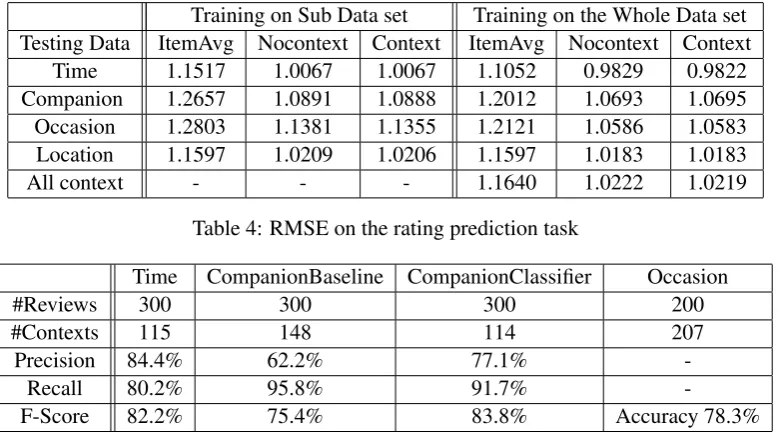
Training on Sub Data set Training on the Whole Data set Testing Data ItemAvg Nocontext Context ItemAvg Nocontext Context
Time 1.1517 1.0067 1.0067 1.1052 0.9829 0.9822
Companion 1.2657 1.0891 1.0888 1.2012 1.0693 1.0695
Occasion 1.2803 1.1381 1.1355 1.2121 1.0586 1.0583
Location 1.1597 1.0209 1.0206 1.1597 1.0183 1.0183
All context - - - 1.1640 1.0222 1.0219
Table 4: RMSE on the rating prediction task
Time CompanionBaseline CompanionClassifier Occasion
#Reviews 300 300 300 200
#Contexts 115 148 114 207
Precision 84.4% 62.2% 77.1%
-Recall 80.2% 95.8% 91.7%
-F-Score 82.2% 75.4% 83.8% Accuracy 78.3%
Table 5: Performance of the context extraction module
ion itemj. The prediction accuracy is measured by Root Mean Square Error (RMSE), which is commonly used in collaborative filtering research. This task simulates the scenario that we need to guess a user’s rating about an item, given that the user has already purchased/selected the item.
For each data set (Time, Companion, Location, Occasion and All), we randomly sample 10% for testing, 80% for training and 10% for validation.
5 Experimental Results
5.1 Performance on Top-K Recommendation
Figure 1(a)-(e) shows the ranking performance on each data set. The x-axis is the rank and the y-axis is the portion of relevant products covered by this level of rank. The results across all data sets are consistent. With contextual information, PLRM Context-X outperforms Nocontext, whereas using context to pre-filter items (Boolean) does not help. It means that contextual information can help if used appropriately, however improperly utilizing context, such as simply using it as a boolean filter, may hurt the recommendation performance. Our proposed PLRM is an effective way to integrate contextual information.
5.2 Performance on Rating Prediction Task
Table 4 summaries the RMSE results of differ-ent approaches on the rating prediction task. The
RMSE of simply using item’s average rating value as the prediction is also reported as a reference since it is a commonly used approach by non per-sonalized recommender systems. For each con-text, we can either train the model only on the sub-set that consists of rating data with related context, or train on a bigger data set by adding the rating data without related context. The results on both settings are reported here. Table 4 shows that uti-lizing context does not affect the prediction accu-racy. We may wonder why the effects of adding context is so different on the rating task compared with the ranking task. One possible explanation is that the selection process of a user is influenced by context, while how the user rates an item after selecting it is less relevant to context. For exam-ple, when a user wants to have a breakfast, he may prefer a cafeteria rather than a formal restaurant. However, how the user rates this cafeteria is more based on user’s experiences in the cafeteria, such as quality of services, food, price, environment, etc.
5.3 How does Text Mining Accuracy Affect Recommendation
perfor-mance on the samples3. The results are shown in
Table 5. Compared with other contexts, the ex-traction of companion context is more challenging and the string matching baseline algorithm pro-duces significantly inferior results. However, by using a MaxEnt classifier with features selection, we can boost the precision of the companion text extraction to a level comparable to other con-texts.
To further investigate the relationship between the quality of the extracted context and the perfor-mance of the recommender system, we compare the recommendation performance of Companion-Baseline and Companion-Classifier in Figure 1(d). It shows that improving the quality of the extraction task leads to a significant improvement on the recommender systems’ top-K ranking task.
6 Conclusions
Reviews widely available online contain a large amount of contextual information. This paper proposes to leverage information extraction tech-niques to help recommender systems to train better context-aware recommendation models by mining reviews. We also introduce a probabilis-tic latent relation model for integrating the cur-rent context and the user’s long term preferences. This model takes the advantages of traditional col-laborative filtering approaches (CF). It also cap-tures the interaction between contextual informa-tion and item characteristics. The experimental results demonstrate that context is an important factor that affects user choices. If properly used, contextual information helps ranking based rec-ommendation systems, probably because context influences users’ purchasing decisions. Besides, more accurate contextual information leads to bet-ter recommendation models. However, contextual information does not help the user rating predic-tion task significantly, probably because context doesn’t matter much given the user has already chosen a restaurant.
As the first step towards using the information
3We sample 300 reviews for “Time” and “Companion”
evaluation. Due to the extremely low probability of occur-rence of Occasion context, we futher sample 200 reviews containing Occasion-related expressions and only evaluate extraction accuracy on these samples
extraction techniques to help contextual recom-mendation, the techniques used in this paper are far from optimal. In the future, we will research more effective text mining techniques for contex-tual extraction(Mazur and Dale, 2008; McCallum et al., 2000; Lafferty et al., 2001) at the same time increasing the amount of annotated review data for better classifier performance through actively learning (Laws and Sch¨utze, 2008). We also plan to work towards a better understanding of con-textual information in recommender systems, and explore other types of contextual information in different types of recommendation tasks besides restaurant recommendations.
7 Acknowledgements
Part of this research is funded by National Sci-ence Foundation IIS-0713111 and the Institute of Education Science. Any opinions, findings, con-clusions or recommendations expressed in this pa-per are the authors’, and do not necessarily reflect those of the sponsors. Bingqing Wang’s work is done during his stay in the Research and Technol-ogy Center, Robert Bosch LLC.
References
Adomavicius, Gediminas and Francesco Ricci. 2009. Recsys’09 workshop 3: workshop on context-aware recommender systems, cars-2009. InProceedings of the 3rd ACM Conference on Recommender Sys-tems, RecSys 2009, pages 423–424.
Adomavicius, Gediminas and Alexander Tuzhilin. 2008. Context-aware recommender systems. In
Proceedings of the 2nd ACM Conference on Rec-ommender Systems, RecSys 2008, pages 335–336. Adomavicius, Gediminas, Ramesh Sankaranarayanan,
Shahana Sen, and Alexander Tuzhilin. 2005. Incorporating contextual information in recom-mender systems using a multidimensional approach.
ACM Transactions on Information Systems (TOIS), 23(1):103–145.
Chu, Wei and Seung-Taek Park. 2009. Personalized recommendation on dynamic content using predic-tive bilinear models. InProceedings of the 18th In-ternational Conference on World Wide Web, WWW 2009, pages 691–700.
robust nlp tools and applications. InProceedings of the 40th Anniversary Meeting of the Association for Computational Linguistics, ACL 2002, pages 168– 175.
Koren, Yehuda. 2008. Factorization meets the neighborhood: a multifaceted collaborative filtering model. InProceedings of the 14th ACM SIGKDD International Conference on Knowledge Discovery and Data Mining, SIGKDD 2008, pages 426–434.
Lafferty, John D., Andrew McCallum, and Fernando C. N. Pereira. 2001. Conditional random fields: Probabilistic models for segmenting and labeling sequence data. In Proceedings of the 18th Inter-national Conference on Machine Learning, ICML 2001, pages 282–289.
Laws, Florian and Hinrich Sch¨utze. 2008. Stopping criteria for active learning of named entity recogni-tion. InProceedings of the 22nd International Con-ference on Computational Linguistics, Coling 2008, pages 465–472, August.
Lee, Hong Joo, Joon Yeon Choi, and Sung Joo Park. 2005. Context-aware recommendations on the mo-bile web. In On the Move to Meaningful Internet Systems 2005: OTM 2005 Workshops, pages 142– 151.
Mazur, Pawel and Robert Dale. 2008. What’s the date? high accuracy interpretation of weekday names. In Proceedings of the 22nd International Conference on Computational Linguistics, Coling 2008, pages 553–560.
McCallum, Andrew, Dayne Freitag, and Fernando C. N. Pereira. 2000. Maximum entropy markov models for information extraction and segmenta-tion. InProceedings of the 17th International Con-ference on Machine Learning, ICML 2000, pages 591–598.
Oku, Kenta, Shinsuke Nakajima, Jun Miyazaki, and Shunsuke Uemura. 2007. Investigation for design-ing of context-aware recommendation system usdesign-ing svm. InProceedings of the International MultiCon-ference of Engineers and Computer Scientists 2007, IMECS 2007, pages 970–975.
Ratnaparkhi, A. 1998. MAXIMUM ENTROPY MOD-ELS FOR NATURAL LANGUAGE AMBIGUITY RESOLUTION. Ph.D. thesis, University of Penn-sylvania.