Universal Dependencies for Turkish
Umut Sulubacak? and Memduh G¨okırmak†Department of Computer Engineering Istanbul Technical University
34469 Istanbul, Turkey
{?sulubacak| †gokirmak}@itu.edu.tr
Francis M. Tyers
HSL-fakultehta
UiT Norgga ´arktalaˇs universitehta N-9018 Tromsø, Norway
C¸a˘grı C¸¨oltekin
Department of Linguistics University of T¨ubingen 72074 T¨ubingen, Germany
Joakim Nivre
Department of Linguistics and Philology Uppsala University
75126 Uppsala, Sweden
G¨uls¸en Eryi˘git
Department of Computer Engineering Istanbul Technical University
34469 Istanbul, Turkey
Abstract
The Universal Dependencies (UD) project was conceived after the substantial recent interest in unifying annotation schemes across languages. With its own annotation principles and abstract inventory for parts of speech, morphosyntactic features and dependency relations, UD aims to facilitate multilingual parser development, cross-lingual learning, and parsing research from a language typology perspective. This paper presents the Turkish IMST-UD Treebank, the first Turkish treebank to be in a UD release. The IMST-UD Treebank was automatically converted from the IMST Treebank, which was also recently released. We describe this conversion pro-cedure in detail, complete with mapping tables. We also present our evaluation of the parsing performances of both versions of the IMST Treebank. Our findings suggest that the UD frame-work is at least as viable for Turkish as the original annotation frameframe-work of the IMST Treebank.
1 Introduction
The Universal Dependencies (UD)1 project is an international collaborative project to make cross-lin-guistically consistent treebanks available for a wide variety of languages. Currently in version 1.3, the UD project covers 40 languages, including two Turkic languages: Kazakh, which was annotated from scratch, and Turkish, the creation of which is described in this paper.
The universal annotation guidelines of UD are based on the Google Universal Part-of-Speech Tagset (Petrov et al., 2012) for parts of speech, the Interset framework (Zeman, 2008) for morphologi-cal features, and Stanford Dependencies (De Marneffe et al., 2006; Tsarfaty, 2013; De Marneffe et al., 2014) for dependency relations. The objective of harmonizing annotation guidelines as far as possible is to make comparison of parsing results and investigating cross-linguistic methods across languages easier. This is achieved by a number of principles, including the primacy of content words, distinguishing core arguments from modifiers and distinguishing clausal constituents from nominals.
The IMST-UD Treebank was first released in UD version 1.3 and became the first Turkish tree-bank to be included in a UD release. The treetree-bank was created by automatic conversion of the IMST This work is licenced under a Creative Commons Attribution 4.0 International License. License details: http:// creativecommons.org/licenses/by/4.0/
1http://universaldependencies.org/
Treebank (Sulubacak et al., 2016), which is itself a reannotation of the METU-Sabancı Turkish bank (Oflazer et al., 2003; Atalay et al., 2003). Although the annotation framework of the IMST Tree-bank was revised, it is still fundamentally similar to that of the METU-Sabancı TreeTree-bank and radically different from the UD framework in both morphology and syntax.
In this paper, we describe the procedures employed in converting the annotation schemes of the IMST Treebank to the corresponding UD-compliant schemes. We also provide comparative statistics on the composition of the IMST Treebank before and after the conversion. Afterwards, we report our initial parsing results on the new IMST-UD Treebank in comparison with the original IMST Treebank. The paper is structured as follows: Section 2 discusses the conversion procedure, Section 3 describes the IMST Treebank and the relevant statistics, Section 4 explains the parsing tests and their analysis, and finally, Section 5 presents the conclusion.
2 Mapping
In this section, we describe the procedure we employed in mapping the original IMST Treebank to a UD-compliant framework. The UD-UD-compliant grammatical representations to which we mapped the original annotation schemes were largely adapted from previous work in the subject (C¸¨oltekin, 2015; C¸¨oltekin, 2016). The original treebank was available in the CoNLL-X data format (Buchholz and Marsi, 2006), where sentences are bounded by empty lines, and every word has a separate row, each containing a tab-delimited array of morphosyntactic data pertaining to the word. In compliance with the UD standard, the converted sentences were output in the CoNLL-U format.2
The sections to follow present explanations and discussions on the procedures of mapping morpho-logical and syntactic data, as well as some idiosyncratic linguistic phenomena. Quick reference tables were also provided where applicable, showing what conditions on thesourceunit are required to assign which properties to thetargetunit.
2.1 Segmentation
The inflectional group (IG) formalism (Oflazer, 1999; Hakkani-T¨ur et al., 2002) was designed to make the highly agglutinative typology of Turkish tractable for language processing. Since then, it has seen usage in many influential works (Oflazer, 2003; Eryi˘git and Oflazer, 2006) and has become the de facto standard in parsing Turkish. According to the formalism, orthographic tokens are divided into mor-phosyntactic words fromderivational boundaries.3 These units are called the inflectional groups (IGs) of the token. The IG formalism establishes these, rather than orthographic tokens, as the syntactic units of the sentence.
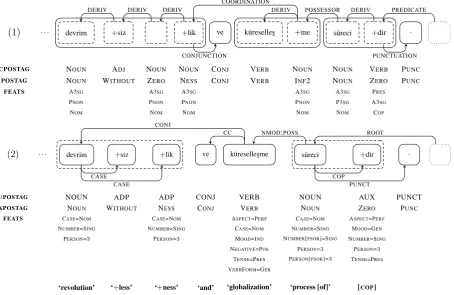
The original IMST treebank also follows its predecessors in using the IG formalism. The rightmost IG governs the word, while every other IG depends on the next one in line with the exclusive relation DERIV. Though a computationally effective representation, IGs are in contradiction with the UD prin-ciples. The representation dictates that the rightmost IG (which is, more often than not, a function word) be the head, whereas the leftmost IG (which is always a content word) is made to be the deepest de-pendent. As this does not comply with the principle of the primacy of content words, IGs have been removed during the conversion to UD. As a substitute, some derivational morphemes were treated as un-bound enclitics, segmented off of their host words, assigned parts of speech such as ADP and AUX, and made to depend on their stems. Other morphemes were merged with their stems and were either fully lexicalized or marked for complex morphology. By a lexicalized derivation we mean tokens for which the grammatical process of derivation is not represented, and the result of the derivation is considered to be the lemma. An example for this is shown withk¨ureselles¸mein Figure 1.
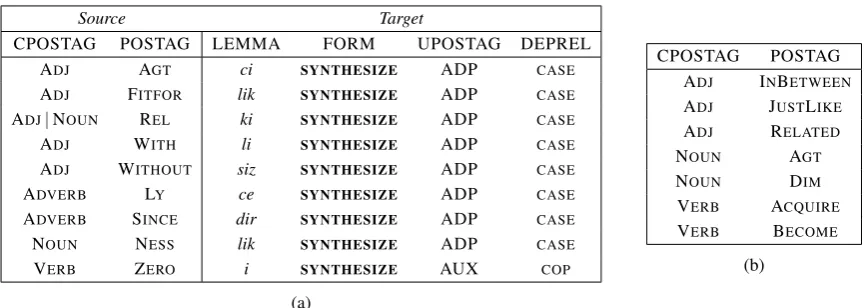
Table 1a outlines the derivations that were segmented off of their stems. The surface forms for each such segment was constructed with the help of a morphological synthesizer, by1)compiling the morpho-logical analysis of the whole token, then2)removing the part that corresponds to the derivation and any
Source Target
CPOSTAG POSTAG LEMMA FORM UPOSTAG DEPREL
ADJ AGT ci SYNTHESIZE ADP CASE ADJ FITFOR lik SYNTHESIZE ADP CASE ADJ|NOUN REL ki SYNTHESIZE ADP CASE ADJ WITH li SYNTHESIZE ADP CASE ADJ WITHOUT siz SYNTHESIZE ADP CASE ADVERB LY ce SYNTHESIZE ADP CASE ADVERB SINCE dir SYNTHESIZE ADP CASE NOUN NESS lik SYNTHESIZE ADP CASE VERB ZERO i SYNTHESIZE AUX COP
(a)
CPOSTAG POSTAG ADJ INBETWEEN ADJ JUSTLIKE ADJ RELATED
NOUN AGT
NOUN DIM
VERB ACQUIRE VERB BECOME
[image:3.595.80.514.60.214.2](b)
Table 1:(a)Segmentation of copulas and other derivations, and(b)lexicalized derivations.
following inflection, and finally3)synthesizing the new form from this partial analysis. The segments were also assigned the lemmas and parts of speech given in the LEMMA and UPOSTAG columns of the table, and made to depend on their stems with the relation specified in the DEPREL column.
The derivations given in Tables 1a, 1b and 3 are made via the addition of various derivational suffixes. Each of these suffixes has several allomorphs according to vowel harmony (e.g. the agent-deriving suffix may have the following 16 forms: –cı, –ci, –cu, –c¨u, –c¸ı, –c¸i, –c¸u, –c¸¨u, –ıcı, –ici, –ucu, –¨uc¨u, –yıcı, –yici, –yucu, –y¨uc¨u), and sometimes there is no overt suffix (as in the third person singular copula, which is a zero morpheme). Moreover, words are often further inflected after derivation, or may be multiply derived, and the analysis of these cascading and overlapping suffixes is an ambiguous and unreliable process. Therefore, instead of derivational morphemes, the minor part-of-speech tags assigned to each word (given in the POSTAG column) were used to identify derivations.
Source Target
CPOSTAG POSTAG UPOSTAG FEATS
ADJ NUM NUM —
ADJ — ADJ —
ADVERB — ADV —
DET — DET —
DUP — X ECHO=RDP
CONJ — CONJ —
INTERJ — INTJ —
NOUN NUM NUM —
NOUN PROP|ABR PROPN —
NOUN — NOUN —
POSTP NEG VERB —
POSTP QUES AUX —
POSTP — ADP —
PRON DEMONS PRON PRONTYPE=DEM
PRON PERS PRON PRONTYPE=PRS PRON QUANT PRON PRONTYPE=IND
PRON REFLEX PRON REFLEX=YES
PRON — PRON —
PUNC — PUNCT —
VERB ZERO AUX —
VERB — VERB —
[image:3.595.274.519.429.736.2]Table 2: Part-of-speech tag mapping. Table 1b lists the derivations that were
not considered sufficiently productive and merged with their stems. Although these derivations have varying degrees of productivity, words derived by them are largely confined to a limited group of fairly common derivations. The fact that these words were more often than not lexicalized in the original treebank served as our justification for the lexical-ization. Thelexicalized token was made to inherit the surface form, lemma, and all morphological and syntactic data from thederivation, as well as its dependents, before replacing both the stem and the
derivation.
Source Target
CPOSTAG POSTAG UPOSTAG FEATS
ADVERB ADAMANTLY VERB VERBFORM=TRANS
ADVERB AFTERDOINGSO VERB VERBFORM=TRANS
ADVERB ASIF VERB VERBFORM=TRANS
ADVERB ASLONGAS VERB VERBFORM=TRANS
ADVERB BYDOINGSO VERB VERBFORM=TRANS
ADVERB SINCEDOINGSO VERB VERBFORM=TRANS
ADVERB WHILE VERB VERBFORM=TRANS
ADVERB WHEN VERB VERBFORM=TRANS
ADVERB WITHOUTBEINGABLETOHAVEDONESO VERB MOOD=ABIL|NEGATIVE=NEG|VERBFORM=TRANS ADVERB WITHOUTHAVINGDONESO VERB NEGATIVE=NEG|VERBFORM=TRANS
ADJ AORPART VERB TENSE=AOR|VERBFORM=PART
ADJ NARRPART VERB ASPECT=PERF|TENSE=PAST|VERBFORM=PART
ADJ PASTPART VERB TENSE=PAST|VERBFORM=PART
ADJ PRESPART VERB TENSE=PRES|VERBFORM=PART
ADJ FUTPART VERB TENSE=FUT|VERBFORM=PART
NOUN INF1 VERB VERBFORM=GER
NOUN INF2 VERB VERBFORM=GER
[image:4.595.78.524.60.337.2]NOUN INF3 VERB VERBFORM=GER
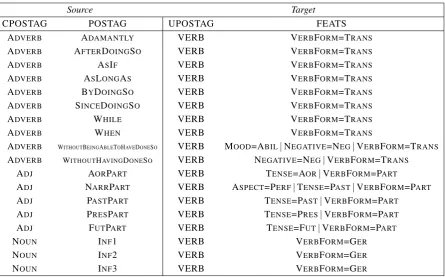
Table 3: Merging of verbal derivations (transgressives, participles and gerunds).
derivation. Themerged tokenwas also assigned a VERBFORM feature as designated by the mapping, along with ASPECT, MOOD, TENSEand NEGATIVEfeatures, before replacing thestemand the
deriva-tion.
In addition to the derivations discussed previously in this section, there were some zero derivations in the original treebank that were immediately derived into other parts of speech without any inflection inbetween, such as when adjectives were derived into zero nouns before copular (verbal) derivations. These intermediate derivations held no morphosyntactic information and were eliminated in conversion.
2.2 Part-of-Speech Tags
The mapping of the UD part-of-speech tags are displayed in Table 2. Most parts of speech were mapped in a straightforward, one-to-one fashion, with a small number of exceptions. In some cases, extra mor-phological features were used for an expressive conversion.
[image:4.595.74.526.63.337.2]2.3 Morphological Features
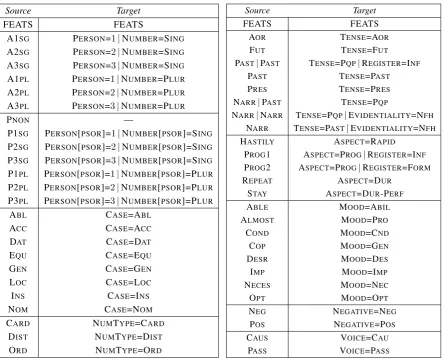
Table 4 shows the mapping of the morphological features. Derivational information was mostly kept in the minor part of speech (POSTAG) field in the original IMST Treebank. These tags were retained in the XPOSTAG field in the CoNLL-U output after the conversion. Using either a directly corresponding UD feature or a combination of other UD features, we were able to represent most of the information kept in these fields.
Source Target
FEATS FEATS
A1SG PERSON=1|NUMBER=SING
A2SG PERSON=2|NUMBER=SING
A3SG PERSON=3|NUMBER=SING
A1PL PERSON=1|NUMBER=PLUR
A2PL PERSON=2|NUMBER=PLUR
A3PL PERSON=3|NUMBER=PLUR
PNON —
P1SG PERSON[PSOR]=1|NUMBER[PSOR]=SING
P2SG PERSON[PSOR]=2|NUMBER[PSOR]=SING
P3SG PERSON[PSOR]=3|NUMBER[PSOR]=SING
P1PL PERSON[PSOR]=1|NUMBER[PSOR]=PLUR
P2PL PERSON[PSOR]=2|NUMBER[PSOR]=PLUR
P3PL PERSON[PSOR]=3|NUMBER[PSOR]=PLUR
ABL CASE=ABL
ACC CASE=ACC
DAT CASE=DAT
EQU CASE=EQU
GEN CASE=GEN
LOC CASE=LOC
INS CASE=INS
NOM CASE=NOM
CARD NUMTYPE=CARD
DIST NUMTYPE=DIST
ORD NUMTYPE=ORD
Source Target
FEATS FEATS
AOR TENSE=AOR
FUT TENSE=FUT
PAST|PAST TENSE=PQP|REGISTER=INF
PAST TENSE=PAST
PRES TENSE=PRES
NARR|PAST TENSE=PQP
NARR|NARR TENSE=PQP|EVIDENTIALITY=NFH NARR TENSE=PAST|EVIDENTIALITY=NFH HASTILY ASPECT=RAPID
PROG1 ASPECT=PROG|REGISTER=INF PROG2 ASPECT=PROG|REGISTER=FORM REPEAT ASPECT=DUR
STAY ASPECT=DUR-PERF
ABLE MOOD=ABIL
ALMOST MOOD=PRO
COND MOOD=CND
COP MOOD=GEN
DESR MOOD=DES
IMP MOOD=IMP
NECES MOOD=NEC
OPT MOOD=OPT
NEG NEGATIVE=NEG POS NEGATIVE=POS
CAUS VOICE=CAU
[image:5.595.77.522.59.418.2]PASS VOICE=PASS
Table 4: Morphological feature mapping.
2.4 Dependency Relations
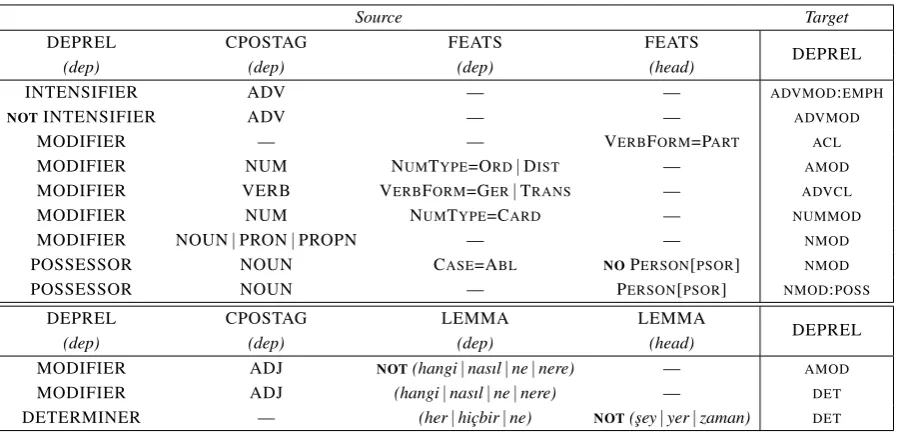
The mapping rules used in converting dependency relations are outlined in Tables 5, 6, 7, and 8. The conditions for these mapping rules are considerably more complex than for the parts of speech and the morphological features. More often than not, besides the original dependency relations, additional morphosyntactic and lexical data must be considered for an accurate mapping. Furthermore, the entire analysis of a given dependent may sometimes not suffice, and further data pertaining to the head token that governs that dependent must be considered as well (as specified under columns with(head)labels). Table 5 shows the mappings for dependency relations that are essentially types of modifiers and de-terminers. The mapping conditions are exactly as arranged on the table, except for the mapping to the ADVCL relation, where if the word had the feature VERBFORM=GER, it was also required to have an adpositional dependent with aCASEdependency. This means having aCASEdependent on a verbal head, which is incompatible with the UD guidelines for the moment. However, as this is an issue that will be discussed in the future, we decided to wait and see whether a change in the guidelines will be made. Table 6 displays the rules for dependencies that denote multiword expressions and other compounds. Multiword expressions (MWEs) were mapped to five different UD relations dependending on their con-text. The remaining MWEs were converted according to their syntactic role in the sentence. For both of the groups covered in Tables 5 and 6, certain cases were only distinguishable by their lemmas. These cases are given in additional rows below each table.
Source Target
DEPREL CPOSTAG FEATS FEATS DEPREL
(dep) (dep) (dep) (head)
INTENSIFIER ADV — — ADVMOD:EMPH
NOTINTENSIFIER ADV — — ADVMOD
MODIFIER — — VERBFORM=PART ACL
MODIFIER NUM NUMTYPE=ORD|DIST — AMOD
MODIFIER VERB VERBFORM=GER|TRANS — ADVCL
MODIFIER NUM NUMTYPE=CARD — NUMMOD
MODIFIER NOUN|PRON|PROPN — — NMOD
POSSESSOR NOUN CASE=ABL NOPERSON[PSOR] NMOD
POSSESSOR NOUN — PERSON[PSOR] NMOD:POSS
DEPREL CPOSTAG LEMMA LEMMA DEPREL
(dep) (dep) (dep) (head)
MODIFIER ADJ NOT(hangi|nasıl|ne|nere) — AMOD
MODIFIER ADJ (hangi|nasıl|ne|nere) — DET
[image:6.595.76.526.79.298.2]DETERMINER — (her|hic¸bir|ne) NOT(s¸ey|yer|zaman) DET
Table 5: Dependency mapping: Modifiers and determiners.
Source Target
DEPREL CPOSTAG CPOSTAG FEATS FEATS DEPREL
(dep) (dep) (head) (dep) (head)
POSSESSOR NOUN NOUN CASE=NOM NOPERSON[PSOR] COMPOUND
MWE|MODIFIER NUM NUM — — COMPOUND
MWE X X ECHO=RDP ECHO=RDP COMPOUND:REDUP
MWE PROPN PROPN — — NAME
DEPREL CPOSTAG CPOSTAG LEMMA LEMMA
DEPREL
(dep) (dep) (head) (dep) (head)
MWE|DETERMINER — — (her|hic¸bir|ne) (s¸ey|yer|zaman) MWE
MWE|MODIFIER — VERB — (bulun|et|ol|kıl) COMPOUND:LVC
Table 6: Dependency mapping: Multiword expressions and other compounds.
Source Target
DEPREL CPOSTAG POSTAG DEPREL
APPOSITION NOUN — APPOS
APPOSITION VERB — PARATAXIS
OBJECT VERB VERBFORM=GER CCOMP OBJECT — NOVERBFORM=GER DOBJ
PREDICATE — — ROOT
SUBJECT VERB VERBFORM=GER CSUBJ SUBJECT — NOVERBFORM=GER NSUBJ
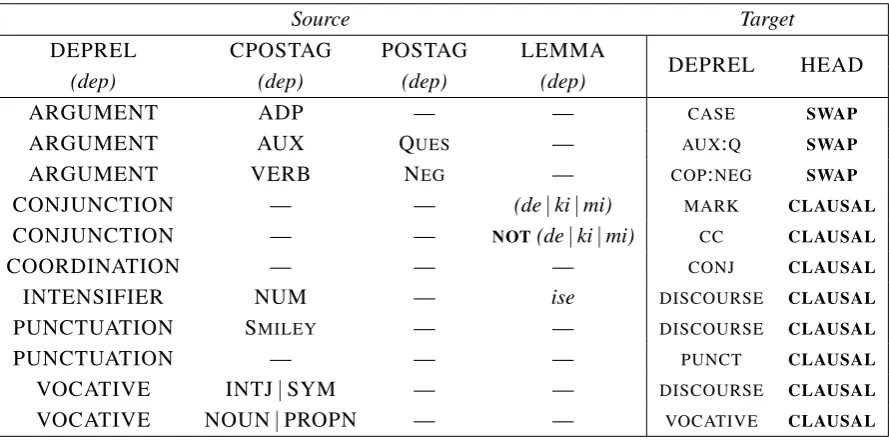
[image:6.595.138.461.577.720.2]along with their dependency relations. For the mappings marked SWAP in the HEAD column, the direction of the dependency was also reversed. The original dependent became the new head and vice versa, and the dependents of these tokens were swapped. For those markedCLAUSAL, the head of the dependency (usually the sentence root in the original IMST Treebank) was updated to the head of the clause in which the token occurs. If no such clause exists, the head of the sentence was assigned instead.
Source Target
DEPREL CPOSTAG POSTAG LEMMA DEPREL HEAD
(dep) (dep) (dep) (dep)
ARGUMENT ADP — — CASE SWAP
ARGUMENT AUX QUES — AUX:Q SWAP
ARGUMENT VERB NEG — COP:NEG SWAP
CONJUNCTION — — (de|ki|mi) MARK CLAUSAL
CONJUNCTION — — NOT(de|ki|mi) CC CLAUSAL
COORDINATION — — — CONJ CLAUSAL
INTENSIFIER NUM — ise DISCOURSE CLAUSAL
PUNCTUATION SMILEY — — DISCOURSE CLAUSAL
PUNCTUATION — — — PUNCT CLAUSAL
VOCATIVE INTJ|SYM — — DISCOURSE CLAUSAL
[image:7.595.78.523.144.364.2]VOCATIVE NOUN|PROPN — — VOCATIVE CLAUSAL
Table 8: Dependency mapping: Other dependencies, adjusting the typology.
For any remaining tokens whose dependencies were not updated by any of the given mapping rules, a catch-all UD relation was assigned according to its converted part of speech. Tokens with the part-of-speech tags ADP, CONJ, INTJ and PUNCT were respectively attached the dependency relationsCASE, CC,VOCATIVEandPUNCT. Those with the tags ADJ, ADV, DET and NUM were respectively given theAMOD,ADVMOD,DETandNUMMODrelations. Any other token was assigned theNMODrelation.
2.5 Postprocessing
After the adjustments to segmentation and the conversion of part-of-speech tags, morphological features and dependency relations, we applied postprocessing routines to each sentence to ensure they constitute valid dependency trees. This step was also necessary in order to circumvent some cases in the original IMST Treebank where sentences did not have a unique token with the sentence root as the head. These cases were often due to dependencies such as CONJUNCTION, PUNCTUATION and VOCATIVE, which depended on the sentence root in certain contexts as required by the dependency grammar. Oth-erwise, a small number of annotation errors which broke the unique root constraint were also present in the original treebank, and these warranted addressing as well.
3 The IMST Treebank
The IMST Treebank is a Turkish dependency treebank of well-edited sentences from a wide range of domains, fully annotated for morphological analyses and dependency relations. The treebank underwent substantial changes since its unofficial conception in 2014 and was at version 1.3 when it was officially released.4
(1) . . . devrim +siz +lik ve k¨ureselles¸ +me s¨ureci +dir .
CPOSTAG NOUN ADJ NOUN NOUN CONJ VERB NOUN NOUN VERB PUNC
POSTAG NOUN WITHOUT ZERO NESS CONJ VERB INF2 NOUN ZERO PUNC
FEATS A3SG A3SG A3SG A3SG A3SG PRES
PNON PNON PNON PNON P3SG A3SG
NOM NOM NOM NOM NOM COP
DERIV DERIV DERIV
COORDINATION
CONJUNCTION
DERIV POSSESSOR DERIV PREDICATE
PUNCTUATION
(2) . . . devrim +siz +lik ve k¨ureselles¸me s¨ureci +dir .
UPOSTAG NOUN ADP ADP CONJ VERB NOUN AUX PUNCT
XPOSTAG NOUN WITHOUT NESS CONJ VERB NOUN ZERO PUNC
FEATS CASE=NOM CASE=NOM ASPECT=PERF CASE=NOM ASPECT=PERF NUMBER=SING NUMBER=SING CASE=NOM NUMBER=SING MOOD=GEN
PERSON=3 PERSON=3 MOOD=IND NUMBER[PSOR]=SING NUMBER=SING NEGATIVE=POS PERSON=3 PERSON=3
TENSE=PRES PERSON[PSOR]=3 TENSE=PRES VERBFORM=GER
‘revolution’ ‘+less’ ‘+ness’ ‘and’ ‘globalization’ ‘process [of]’ [COP] CONJ
CASE CASE
CC NMOD:POSS ROOT
[image:8.595.73.528.167.462.2]COP PUNCT
Figure 1: An example of a partial sentence, “. . . devrimsizlik ve k¨ureselles¸me s¨urecidir.” (“. . . is the process of revolutionlessness and globalization.”), before(1)and after(2)the conversion, extracted from the IMST and IMST-UD treebanks.
The IMST Treebank was annotated using its own annotation framework, which is based on that of the METU-Sabancı Treebank and radically different from the UD framework. Figure 1 compares a partial sentence from the IMST Treebank before and after the conversion. The+sign is used for convenience as a suffix marker, and does not actually occur in the treebank. The token enclosures denote either IG sets (in the original treebank sentences) or multi-word tokens (in converted sentences). As shown in the example, these multi-word groups were converted to a head-first typology, whereas coordination structures remained head-final. This is because the final token in a coordination structure always retains all inflection, whereas suffixes shared by all the tokens may be dropped in the others.
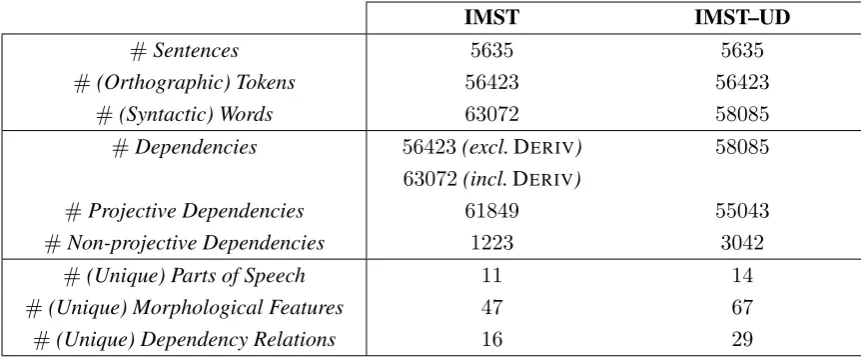
Table 9 presents a selection of comparative statistics, including the total numbers of sentences, tokens and dependency counts as well as the counts of unique part-of-speech tags, morphological features and dependency relations for the baseline and converted versions of the IMST Treebank, as a preamble to the parsing tests described in Section 4. We use the treebank’s version 1.3.1 as the baseline for the UD conversion. For this reason, the statistics provided in this section are slightly different from those given in the IMST Treebank’s original publication (Sulubacak et al., 2016).
IMST IMST–UD
#Sentences 5635 5635
#(Orthographic) Tokens 56423 56423
#(Syntactic) Words 63072 58085
#Dependencies 56423(excl.DERIV) 58085
63072(incl.DERIV)
#Projective Dependencies 61849 55043
#Non-projective Dependencies 1223 3042
#(Unique) Parts of Speech 11 14
#(Unique) Morphological Features 47 67
#(Unique) Dependency Relations 16 29
Table 9: Comparative statistics for the IMST Treebank and the IMST-UD Treebank.
4 Evaluation
In this section, we present our statistical analysis on the parsing performances of the original and con-verted versions of the IMST Treebank.
4.1 Preliminaries
For our parsing tests, we employ the same MaltParser (Nivre et al., 2007) configuration as in many previous studies on the METU-Sabancı Treebank (Eryi˘git, 2006; Eryi˘git et al., 2008; Eryi˘git et al., 2011; Sulubacak and Eryi˘git, 2013) and the IMST Treebank (Sulubacak et al., 2016). In compliance with the parsing procedures used in the cited studies, we eliminate non-projective sentences from each training set, as this practice was shown to boost overall performance5(Eryi˘git et al., 2008; Eryi˘git et al., 2011).
In further accordance with the cited studies, we use the conventional labeled and unlabeled attachment scores as our evaluation metrics. Although both scores are essentially based on the ratio of correct pre-dictions to all tokens, they differ in which prepre-dictions they accept as correct. While a correct prediction of the head token suffices for the unlabeled attachment score (UAS), the labeled attachment score (LAS) also requires the dependency relation to be correctly predicted. Furthermore, dependencies with the relation DERIV6are excluded from evaluation for the baseline version, as they are considered trivial.
4.2 Parsing Scores
IMST IMST–UD
LAS 75.4±0.2% 77.1±0.2%
[image:9.595.81.512.62.241.2]UAS 83.8±0.3% 83.8±0.2%
Table 10: Attachment scores. The parsing scores given in Table 10 were
calcu-lated via ten-fold cross-validation on the baseline
(left) and the UD (right) versions of the IMST Treebank. A comparison of the scores before and after the conversion to UD shows that there has been a noticeable improvement in the labeled
at-tachment score, despite the consequential increase in the number of unique POS tags, morphological features and dependency labels, as previously shown in Table 9. However, there has been no apparent progress in the unlabeled attachment score. Since head indices had also been adjusted as part of the map-ping procedure, the similarity in the scores is likely a favorable coincidence. Considering both scores, it is evident that the UD framework has been more accommodating for the IMST Treebank over the current parsing setup.
5We tested this on the UD version of the IMST Treebank as well, and including non-projective sentences in training indeed caused a drop of2.9percentage points in the average labeled attachment score compared to training without non-projective sentences.
5 Conclusion
In this paper, we described our procedure for converting the morphological and syntactic tagset of the IMST Treebank to comply with the UD standard. In doing so, we presented a specific application of the UD guidelines to the annotation of parts of speech, morphological features and dependency relations in Turkish. We also introduced the IMST-UD Treebank, which was automatically converted from the IMST Treebank and became the first Turkish treebank to be in a UD release. We also evaluated the parsing performances on the IMST and IMST-UD treebanks and found that there is a noticeable improvement in parsing performances after conversion, which suggests that the UD framework is at least as viable for Turkish as the original annotation framework of the IMST Treebank.
Acknowledgements
We would like to thank Birsel Karakoc¸, H¨uner Kas¸ıkara and Tu˘gba Pamay for their valuable insights and discussions, and the Uppsala University for kindly hosting a meeting for us during the initial stages of our effort. We would also like to offer our gratitude to our anonymous reviewers for meticulously proofreading our manuscript.
References
Nart B. Atalay, Kemal Oflazer, and Bilge Say. 2003. The annotation process in the Turkish Treebank.
Sabine Buchholz and Erwin Marsi. 2006. CoNLL-X Shared Task on multilingual dependency parsing. In Pro-ceedings of the 10th Conference on Computational Natural Language Learning (CoNLL), pages 149–164. As-sociation for Computational Linguistics.
C¸a˘grı C¸¨oltekin. 2015. A grammar-book treebank of Turkish. In Markus Dickinson, Erhard Hinrichs, Agnieszka Patejuk, and Adam Przepi´orkowski, editors, Proceedings of the 14th workshop on Treebanks and Linguistic Theories (TLT 14), pages 35–49.
C¸a˘grı C¸¨oltekin. 2016. (when) do we need inflectional groups? InProceedings of The 1st International Conference on Turkic Computational Linguistics, page (to appear).
Marie-Catherine De Marneffe, Bill MacCartney, Christopher D Manning, et al. 2006. Generating typed de-pendency parses from phrase structure parses. InProceedings of 5th International Conference on Language Resources and Evaluation (LREC), volume 6, pages 449–454.
Marie-Catherine De Marneffe, Timothy Dozat, Natalia Silveira, Katri Haverinen, Filip Ginter, Joakim Nivre, and Christopher D. Manning. 2014. Universal Stanford Dependencies: a cross-linguistic typology. InProceedings of the 9th International Conference on Language Resources and Evaluation (LREC), Reykjav´ık, Iceland, May. European Language Resources Association (ELRA).
G¨uls¸en Eryi˘git and Kemal Oflazer. 2006. Statistical dependency parsing of Turkish. InProceedings of the 11th Conference of the European Chapter of the Association for Computational Linguistics (EACL), pages 89–96, Trento, April.
G¨uls¸en Eryi˘git. 2006. Dependency Parsing of Turkish. Ph.D. thesis, Istanbul Technical University.
G¨uls¸en Eryi˘git, Joakim Nivre, and Kemal Oflazer. 2008. Dependency parsing of Turkish.Computational Linguis-tics, 34(3):357–389.
G¨uls¸en Eryi˘git, Tugay Ilbay, and Ozan Arkan Can. 2011. Multiword expressions in statistical dependency pars-ing. InProceedings of the 2nd Workshop on Statistical Parsing of Morphologically Rich Languages (SPMRL), Dublin, Ireland, October. Association for Computational Linguistics.
Dilek Zeynep Hakkani-T¨ur, Kemal Oflazer, and G¨okhan T¨ur. 2002. Statistical morphological disambiguation for agglutinative languages.Computers and the Humanities, 36(4):381–410.
Kemal Oflazer, Bilge Say, Dilek Zeynep Hakkani-T¨ur, and G¨okhan T¨ur. 2003. Building a Turkish treebank. In Anne Abeille, editor,Building and Exploiting Syntactically-Annotated Corpora. Kluwer Academic Publishers. Kemal Oflazer. 1999. Dependency parsing with an extended finite state approach. InProceedings of the 37th Annual Meeting of the Association for Computational Linguistics, pages 254–260, College Park, Maryland, USA. Association for Computational Linguistics.
Kemal Oflazer. 2003. Dependency parsing with an extended finite-state approach. Computational Linguistics, 29(4):515–544.
Slav Petrov, Dipanjan Das, and Ryan McDonald. 2012. A universal part-of-speech tagset. InProceedings of the 8th International Conference on Language Resources and Evaluation (LREC), pages 2089–2096.
Umut Sulubacak and G¨uls¸en Eryi˘git. 2013. Representation of morphosyntactic units and coordination struc-tures in the Turkish dependency treebank. In Proceedings of the 4th Workshop on Statistical Parsing of Morphologically-Rich Languages (SPMRL), pages 129–134, Seattle, Washington, USA, October. Association for Computational Linguistics.
Umut Sulubacak, Tu˘gba Pamay, and G¨uls¸en Eryi˘git. 2016. IMST: A revisited Turkish dependency treebank. In Proceedings of the 1st International Conference on Turkic Computational Linguistics (TurCLing), Konya, Turkey, 3 April.
Reut Tsarfaty. 2013. A unified morpho-syntactic scheme of Stanford Dependencies. In Proceedings of 51st Annual Meeting of the Association for Computational Linguistics (ACL), pages 578–584.