Volume 4, No. 9, July-August 2013
International Journal of Advanced Research in Computer Science
RESEARCH PAPER
Available Online at www.ijarcs.info
A Comparative Study of Image Restoration Algorithms using Images from different
areas of imaging
Sruti Sruba Bharali Assistant Professor
Computer Science and Engineering Dept. Royal Group of Institutions
Guwahati, India [email protected]
Daisy Das Assistant Professor
Computer Science and Engineering Dept Royal Group of Institutions
Guwahati, India [email protected]
Abstract: In this paper we consider a comparative study of different image restoration algorithms. The images are blurred by using both known and unknown degradation functions. The study emphases on restoration of blurred images by using both blind and non-blind restoration techniques like Lucy Richardson Algorithm (LRA), Weiner Filter Deconvolution (WFD), Regularized Filter Deconvolution (RFD) and Blind Image Deconvolution Algorithm (BIDA). Apart from regular images, images from different areas of imaging like medical images and satellite images are considered for this study. Experimental results for the four different image restoration techniques are compared on the basis of performance metrics like PSNR(Peak Signal to Noise Ratio), MSE(Mean Square Error) and RMSE( Root Mean Square Error).
Keywords: Image Restoration Algorithm, Lucy Richardson Algorithm, Weiner Filter Deconvolution, Regularized Filter Deconvolution, Blind Image Deconvolution Algorithm, Medical images, Satellite image
I. INTRODUCTION
Image restoration is the process of recovering back the original image from the degraded image. The original image may be degraded by adding noise, blur or may be due to camera miss-focus. Many medical diseases are predicted upon or even given medication by studying the test results based on images. Also, satellite images are used to gain knowledge of different features on earth such as forest analysis, weather forecasting etc. The analysis of such degraded images will hamper the investigation part and may lead to wrong solutions. Such images have to be restored back to its original form to get the correct results.
Image restoration algorithms can be broadly divided into blind and non-blind techniques where if the degradation function or point spread function (PSF) is known then the algorithm is said to be non-blind whereas if the PSF is unknown then the algorithm is a blind image restoration technique. The goal of this study is to compare and understand such image restoration algorithms for different images that are obtained from various different fields of imaging.
II. MATERIALS AND METHODOLOGY
DATA COLLECTION
The Landsat Imagery Database was used to acquire satellite images (at 30 m resolution) of different regions of earth by specifying the latitude and longitude coordinates [6]. Each
image covers a 10 km by 10 km square at each junction of one degree of latitude and longitude (approximately 100 km apart). The medical images were collected from the MedicalFinals Database and the MedPix Database [7, 8]. Also, general images divided into black and white and coloured category are also considered for this study. A total of 15 images are considered for each group of images. The medical database group consists of different varieties of images like chest x-rays and CT scan images.
\
Fig 1: Representative images forBlack and White, Colour, Satellite and Medical Images.
Working Principle
Once the image collection phase is over, the images are degraded using image degradation function. The original
images are then tried to be recovered using the image restoration model by applying both blind and non-blind image restoration algorithms.
In degradation model, the original image is degraded by using degradation function, also known as point spread function (PSF) and adding noise and can be expressed as
g = h * f + n
In the above equation, g is the degraded image, h is the degradation function, f is an original image and n is the additive noise.
The restoration model is then applied on the degraded image to get the restored image. The restoration algorithms considered for this study are Lucy Richardson Algorithm (LRA), Weiner Filter Deconvolution (WFD), Regularized Filter Deconvolution (RFD) and Blind Image Deconvolution Algorithm (BIDA).
1) Lucy Richardson Algorithm (LRA)
The Lucy–Richardson algorithm(LRA) is a non-blind technique for recovering an image that has been blurred by a known point spread function [1, 2].
Pixels in the observed image can be represented in terms of the point spread function and the image as di= ∑ pijuj
where
pij is the point spread function, uj is the pixel value at location j in the latent image, and di is the observed value at pixel location i. The basic idea is to calculate the most likely uj given the observed di and known pij. This leads to an equation for uj which can be solved iteratively according to
where
2) Weiner Filter De convolution (WFD)
The Weiner filter de convolution (WFD) is also a non-blind image restoration technique which helps in restoring the original image from the blurred image. Suppose we have a system as:
y(t) = h(t) * x(t) + n(t)
y(t) the degraded image at time t. The Weiner filter is used to find some g(t) to estimate x(t) as follows:
x’(t) = g(t) * y(t)
where x’(t) is an estimate of x(t) that minimizes the mean square error.
3) Regularized Filter De convolution (RFD)
\Regularized filter de convolution (RFD) is a non-blind image restoration algorithm and used to recover the restored image from the degraded image. The blurred and noisy image is restored by a constrained least square restoration algorithm and is similar to the wiener filter. In regularized filtering less prior information is required to apply restoration. The regularization filter is often chosen to be discrete Laplacian and can be understood as an approximation of a Weiner filter [3].
4) Blind Image De convolution Algorithm (BIDA)
Blind Image De convolution Algorithm (BIDA) restores the degraded image from the blurred image by using an unknown point spread function. It is a blind technique of image restoration and the first step is to evaluate the blurring factor or PSF value and then it uses this factor to de blur the image. This method can be done both iteratively and non-iteratively [3]. In the non-iterative method the algorithm is executed once and it extracts the PSF value and uses it to restore the original image, whereas in the iterative method, the algorithm iterates more than once and improves the PSF value at each run [4, 5].
III. IMPLEMENTATION
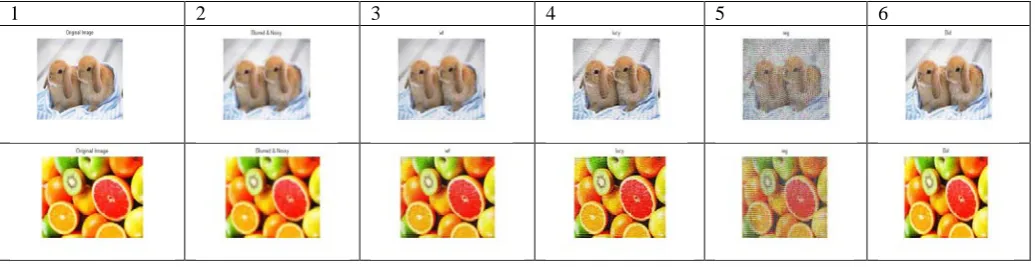
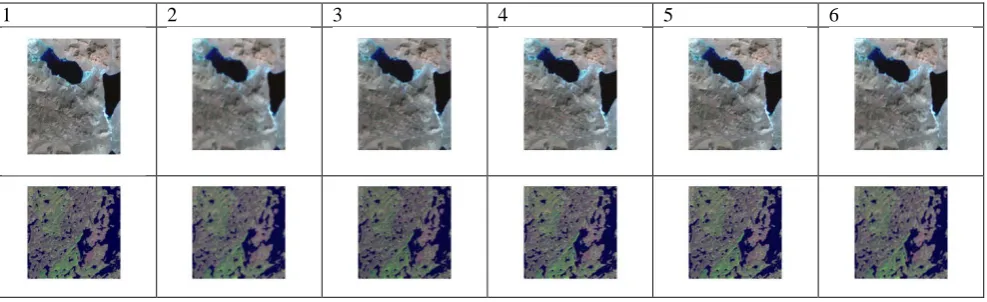
All the implementation work has been done in MATLAB 7.10. The original images were first degraded by using a degradation function of Gaussian blur having size 5 and standard deviation 5. The degraded images were then restored using theLucy Richardson Algorithm (LRA), the Weiner Filter Deconvolution (WFD), the Regularized Filter Deconvolution (RFD) and the Blind Image Deconvolution Algorithm (BIDA). The representative images are as follows:
[image:3.595.41.541.334.487.2]1 2 3 4 5 6
Fig 3: Representative restoration results for black and white images: (1) Original image, (2) Degraded Image using Gaussian blur of size 5 and standard deviation 5, (3) estimated image using Weiner Filter DE convolution, (4)
estimated image using Lucy Richardson Algorithm, (5) estimated image using Regularised Filer De Convolution and (6) estimated image using Blind Image De convolution Algorithm.
1 2 3 4 5 6
[image:3.595.41.559.563.696.2].
1 2 3 4 5 6
Fig 5: Representative restoration results for medical images: (1) Original image, (2) Degraded Image using Gaussian blur of size 5 and standard deviation 5, (3) estimated image using Weiner Filter DE convolution, (4) estimated image using
Lucy Richardson Algorithm, (5) estimated image using Regularised Filer De Convolution and (6) estimated image using Blind Image De convolution Algorithm.
[image:4.595.53.530.80.220.2]1 2 3 4 5 6
Fig 6: Representative restoration results for satellite images: (1) Original image, (2) Degraded Image using Gaussian blur of size 5 and standard deviation 5, (3) estimated image using Weiner Filter DE convolution, (4) estimated image using
Lucy Richardson Algorithm, (5) estimated image using Regularised Filer De Convolution and (6) estimated image using Blind Image De convolution Algorithm.
IV. RESULTAND DISCUSSION
This study makes a comparison between the four image restoration algorithms Weiner Filter De convolution (WFD), Lucy Richardson Algorithm (LRA), Blind Image De convolution Algorithm (BIDA) and Regularized Filter De convolution (RFD) on the basis of performance metrics like PSNR(Peak Signal to Noise Ratio), MSE(Mean Square Error) and RMSE( Root Mean Square Error). This comparison is done for all the four groups of images, each group having 15 images representing the different areas of imaging. The results are as followed:
A. For Black and White Images:
Table 1: Estimation results of all the 15 Black and White images for image restoration algorithms Weiner Filter De convolution (WFD), Lucy Richardson Algorithm (LRA), Blind Image De convolution Algorithm (BIDA) and Regularized Filter De convolution (RFD) on the basis of performance metrics like PSNR(Peak Signal to Noise Ratio), MSE(Mean Square Error) and RMSE( Root Mean Square Error).
BLACK ANDWHI TE IMAGE
PSNR
MSE
RMSE
WFD LRA BIDA RFD WFD LRA BIDA RFD WFD LRA BIDA RFD
BW1 25.49 25.84 25.79 12.93 183.60 169.64 171.51 3310.00 13.55 13.02 13.10 57.54
BW2 26.27 29.16 28.99 13.60 153.43 78.99 82.14 2840.00 12.39 8.89 9.06 53.29
[image:4.595.45.539.286.437.2]BW4 22.12 22.26 22.27 13.08 398.88 386.53 385.92 3200.00 19.97 19.66 19.64 56.53
BW5 25.58 25.91 25.84 13.56 180.06 166.95 169.47 2870.00 13.42 12.92 13.02 53.53
BW6 25.66 27.49 27.33 12.79 176.58 116.00 120.25 3420.00 13.29 10.77 10.97 58.50
BW7 27.58 27.86 27.79 13.18 113.60 106.43 108.15 3130.00 10.66 10.32 10.40 55.94
BW8 25.43 25.13 25.08 13.07 186.14 199.34 201.99 3210.00 13.64 14.12 14.21 56.64
BW9 24.07 23.87 23.84 12.91 254.50 266.83 268.80 3330.00 15.95 16.34 16.40 57.67
BW10 24.70 24.99 24.95 13.05 220.32 206.02 207.79 3220.00 14.84 14.35 14.41 56.75
BW11 21.55 22.75 22.74 12.43 454.77 345.04 346.07 3720.00 21.33 18.58 18.60 60.97
BW12 24.30 26.17 26.11 12.98 241.69 157.13 159.14 3280.00 15.55 12.54 12.62 57.25
BW13 26.54 28.59 28.47 14.27 144.34 90.03 92.45 2440.00 12.01 9.49 9.62 49.35
BW14 24.80 26.86 26.75 12.67 215.38 133.88 137.59 3520.00 14.68 11.57 11.73 59.30
BW15 27.38 27.33 27.21 13.38 118.96 120.14 123.72 2990.00 10.91 10.96 11.12 54.64
Table1 shows that the Lucy Richardson Algorithm (LRA) has the best values for PSNR, MSE and RMSE for 11 out of 15 images. The Weiner Filter De convolution (WFD) algorithm has the second best values for Black and White images followed by Blind Image De convolution Algorithm (BIDA). The Regularized Filter De convolution (RFD) algorithm has the worst PSNR, MSE and RMSE values for all the images in this category.
[image:5.595.50.564.403.669.2]B. For Colour Images:
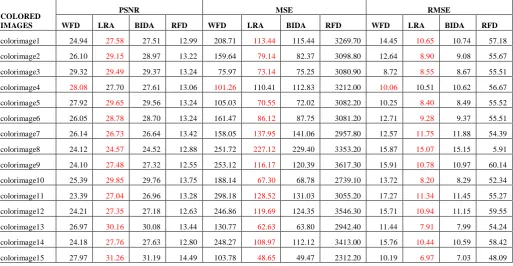
Table 2: Estimation results of all the 15 Coloured images for image restoration algorithms Weiner Filter De convolution (WFD), Lucy Richardson Algorithm (LRA), Blind Image De convolution Algorithm (BIDA) and Regularized Filter De convolution (RFD) on the basis of performance metrics like PSNR(Peak Signal to Noise Ratio), MSE(Mean Square Error) and RMSE( Root Mean Square Error).
COLORED IMAGES
PSNR MSE RMSE
WFD LRA BIDA RFD WFD LRA BIDA RFD WFD LRA BIDA RFD
colorimage1 24.94 27.58 27.51 12.99 208.71 113.44 115.44 3269.70 14.45 10.65 10.74 57.18
colorimage2 26.10 29.15 28.97 13.22 159.64 79.14 82.37 3098.80 12.64 8.90 9.08 55.67
colorimage3 29.32 29.49 29.37 13.24 75.97 73.14 75.25 3080.90 8.72 8.55 8.67 55.51
colorimage4 28.08 27.70 27.61 13.06 101.26 110.41 112.83 3212.00 10.06 10.51 10.62 56.67
colorimage5 27.92 29.65 29.56 13.24 105.03 70.55 72.02 3082.20 10.25 8.40 8.49 55.52
colorimage6 26.05 28.78 28.70 13.24 161.47 86.12 87.75 3081.20 12.71 9.28 9.37 55.51
colorimage7 26.14 26.73 26.64 13.42 158.05 137.95 141.06 2957.80 12.57 11.75 11.88 54.39
colorimage8 24.12 24.57 24.52 12.88 251.72 227.12 229.40 3353.20 15.87 15.07 15.15 5.91
colorimage9 24.10 27.48 27.32 12.55 253.12 116.17 120.39 3617.30 15.91 10.78 10.97 60.14
colorimage10 25.39 29.85 29.76 13.75 188.14 67.30 68.78 2739.10 13.72 8.20 8.29 52.34
colorimage11 23.39 27.04 26.96 13.28 298.18 128.52 131.03 3055.20 17.27 11.34 11.45 55.27
colorimage12 24.21 27.35 27.18 12.63 246.86 119.69 124.35 3546.30 15.71 10.94 11.15 59.55
colorimage13 26.97 30.16 30.08 13.44 130.77 62.63 63.80 2942.40 11.44 7.91 7.99 54.24
colorimage14 24.18 27.76 27.63 12.80 248.27 108.97 112.12 3413.00 15.76 10.44 10.59 58.42
colorimage15 27.97 31.26 31.19 14.49 103.78 48.65 49.47 2312.20 10.19 6.97 7.03 48.09
Table 2 shows that Lucy Richardson Algorithm (LRA) has the best value for PSNR, MSE and RMSE for 14 out of 15 images. The Blind Image De convolution Algorithm (BIDA) algorithm has the second best values for Coloured images followed by Weiner Filter De convolution (WFD). The Regularized Filter De convolution (RFD) algorithm has the
worst PSNR, MSE and RMSE values for all the images in this category.
C. For Satellite Images:
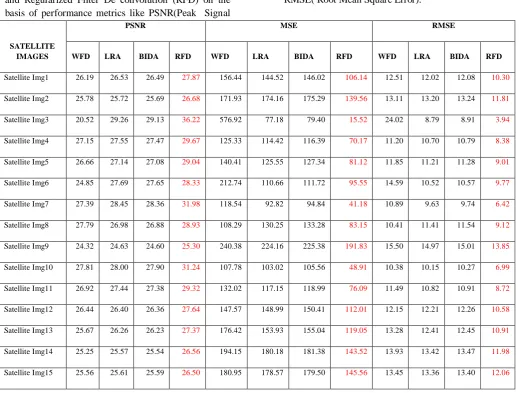
(LRA), Blind Image De convolution Algorithm (BIDA) and Regularized Filter De convolution (RFD) on the basis of performance metrics like PSNR(Peak Signal
to Noise Ratio), MSE(Mean Square Error) and RMSE( Root Mean Square Error).
SATELLITE IMAGES
PSNR MSE RMSE
WFD LRA BIDA RFD WFD LRA BIDA RFD WFD LRA BIDA RFD
Satellite Img1 26.19 26.53 26.49 27.87 156.44 144.52 146.02 106.14 12.51 12.02 12.08 10.30
Satellite Img2 25.78 25.72 25.69 26.68 171.93 174.16 175.29 139.56 13.11 13.20 13.24 11.81
Satellite Img3 20.52 29.26 29.13 36.22 576.92 77.18 79.40 15.52 24.02 8.79 8.91 3.94
Satellite Img4 27.15 27.55 27.47 29.67 125.33 114.42 116.39 70.17 11.20 10.70 10.79 8.38
Satellite Img5 26.66 27.14 27.08 29.04 140.41 125.55 127.34 81.12 11.85 11.21 11.28 9.01
Satellite Img6 24.85 27.69 27.65 28.33 212.74 110.66 111.72 95.55 14.59 10.52 10.57 9.77
Satellite Img7 27.39 28.45 28.36 31.98 118.54 92.82 94.84 41.18 10.89 9.63 9.74 6.42
Satellite Img8 27.79 26.98 26.88 28.93 108.29 130.25 133.28 83.15 10.41 11.41 11.54 9.12
Satellite Img9 24.32 24.63 24.60 25.30 240.38 224.16 225.38 191.83 15.50 14.97 15.01 13.85
Satellite Img10 27.81 28.00 27.90 31.24 107.78 103.02 105.56 48.91 10.38 10.15 10.27 6.99
Satellite Img11 26.92 27.44 27.38 29.32 132.02 117.15 118.99 76.09 11.49 10.82 10.91 8.72
Satellite Img12 26.44 26.40 26.36 27.64 147.57 148.99 150.41 112.01 12.15 12.21 12.26 10.58
Satellite Img13 25.67 26.26 26.23 27.37 176.42 153.93 155.04 119.05 13.28 12.41 12.45 10.91
Satellite Img14 25.25 25.57 25.54 26.56 194.15 180.18 181.38 143.52 13.93 13.42 13.47 11.98
[image:6.595.49.569.78.471.2]Satellite Img15 25.56 25.61 25.59 26.50 180.95 178.57 179.50 145.56 13.45 13.36 13.40 12.06
Table 3 shows that Regularized Filter De convolution (RFD) algorithm has the best value for PSNR, MSE and RMSE for all images. The Lucy Richardson Algorithm (LRA) has the second best values for Satellite images followed by Blind Image De convolution Algorithm (BIDA). The Weiner Filter De convolution (WFD) algorithm has the worst PSNR, MSE and RMSE values for most of the images in this category.
D. For Medical Images:
Table 4: Estimation results of all the 15 Medical images for image restoration algorithms Weiner Filter De convolution
(WFD), Lucy Richardson Algorithm (LRA), Blind Image De convolution Algorithm (BIDA) and Regularized Filter De convolution (RFD) on the basis of performance metrics like PSNR(Peak Signal to Noise Ratio), MSE(Mean Square Error) and RMSE( Root Mean Square Error). Table 4 shows that Regularized Filter De convolution (RFD) algorithm has the best value for PSNR, MSE and RMSE for all images. The Lucy Richardson Algorithm (LRA) has the second best values for Satellite images followed by Blind Image De convolution Algorithm (BIDA). The Weiner Filter De convolution (WFD) algorithm has the worst PSNR, MSE and RMSE values for most of the images in this category
MEDICAL IMAGES
PSNR MSE RMSE
WFD LRA BIDA RFD WFD LRA BIDA RFD WFD LRA BIDA RFD
[image:6.595.80.517.689.787.2]Med Image 5 26.96 28.69 28.55 33.52 130.91 87.82 90.78 28.92 11.44 9.37 9.53 5.38 Med Image 6 27.94 29.16 29.01 37.38 104.42 78.87 81.64 11.90 10.22 8.88 9.04 3.45 Med Image 7 28.79 29.38 29.24 38.99 85.83 74.94 77.39 8.20 9.26 8.66 8.80 2.86 Med Image 8 26.38 28.59 28.43 34.96 149.72 89.89 93.29 20.76 12.24 9.48 9.66 4.56 Med Image 9 25.16 25.90 25.81 26.77 198.27 167.15 170.73 136.90 14.08 12.93 13.07 11.70
Med Image 10 25.09 26.75 26.61 27.08 201.63 137.39 141.98 127.35 14.20 11.72 11.92 11.28 Med Image 11 24.97 26.56 26.42 26.79 207.22 143.70 148.31 136.09 14.40 11.99 12.18 11.67 Med Image 12 25.32 28.76 28.60 36.11 191.00 86.48 89.81 15.92 13.82 9.30 9.48 3.99
Med Image 13 25.65 28.73 28.55 37.08 177.02 87.17 90.80 12.74 13.31 9.34 9.53 3.57 Med Image 14 25.90 28.69 28.52 39.00 167.32 87.90 91.44 8.19 12.94 9.38 9.56 2.86 Med Image 15 26.14 29.07 28.89 38.73 158.11 80.55 84.06 8.71 12.57 8.97 9.17 2.95
V. CONCLUSION
Image restoration algorithms are used to restore a degraded image back to its original image form. We studied four image restoration algorithms in this study and performed a comparison analysis. Based on this study, it can be said that the Lucy Richardson Algorithm is the best image restoration algorithm to be applied to a degraded image it the image falls under the coloured or black and white category. Whereas, the Regularized Filter De convolution (RFD) algorithm is found to be the best image restoration algorithm when images fall in the medical image or satellite image category.
VI. REFERENCES
[1] W H Richardson, “Bayesian-Based Iterative Method of Image Restoration”, JOSA, vol. 62, Issue 1, pp. 55–59, 1972.
[2] L B Lucy,“An iterative technique for the rectification of observed distributions”, Astronomical Journal, vol. 79, Issue 6, pp. 745–754, 1974.
[3] AKaur, V Chopra, “A Comparative Study and Analysis of Image Restoration Techniques Using Different Images Formats”, International Journal for Science and Emerging Technologies with Latest Trends, vol. 2, Issue 1, pp. 7-14, 2012.
[4] O Michailovich, A Tannenbaum,“Blind Deconvolution of Medical Ultrasound Images: A Parametric Inverse Filtering Approach”, IEEE Transactions on Image Processing, vol. 16, Issue 12, Dec 2007.
[5] D Kundur, D Hatzinakos, ” Blind image deconvolution”, Signal Processing Magazine IEEE, vol. 13, Issue 3, pp. 43-64, May 1996.
[6]http://globalmonitoring.sdstate.edu/projects/fao/index.html. [7]http://www.medicalfinals.co.uk/xray.htm.