Finite-State Morphology
Anssi Yli-Jyr¨a
Department of General Linguistics HFST Research Group
University of Helsinki Finland
anssi.yli-jyra helsinki.fi
Abstract
This paper presents an efficient compila-tion algorithm that is several orders of magnitude faster than a standard method for context restriction rules. The new al-gorithm combines even hundreds of thou-sands of rules in parallel when the al-phabet is large but the resulting automa-ton is sparse. The method opens new possibilities for representation of context-dependent lexical entries and the re-lated processes. This is demonstrated by encoding complete HunSpell dictio-naries as a single context restriction rule whose center placeholder in contexts is re-placed with a new operation, called
un-derline operation. The approach gives
rise to new superposition-based context-dependent lexicon formalisms and new methods for on-demand compilation and composition of two-level morphology.
1 Introduction
The use of the context restriction rule of two-level morphology (Koskenniemi, 1983) has tradition-ally been limited to relatively simple phonological rules. The purpose of this paper is to make this op-eration more widely applicable in finite-state mor-phology, by improving its compilation methods and by developing new ways to encode morpho-logical processes with this operation.
1.1 Prior Art
Compilation of compound context restrictions is a problem that has inspired a series related solu-tions:
• Kaplan and Kay’s method (Karttunen et al., 1987; Kaplan and Kay, 1994) requires that the occurrences of the center in each string are bracketed. Then it applies double com-plementation (if-then idioms) to restrict the context of each bracket. The method needs separate brackets for each context.
• A related approach (Grimley-Evans et al., 1996; Kiraz, 1997; Kiraz, 2000) handles sim-ilar single-tuple rules directly with double complementation, being a special case a star-free compilation method of Yli-Jyr¨a (2003).
• Yli-Jyr¨a (2003) uses star-free regular opera-tions to show that the context restriction rule with overlapping multi-tuple centers is defin-able in first-order predicate logic.
• Yli-Jyr¨a and Koskenniemi (2004; 2006) and Hulden (2009) use first-order quantification over substrings in order to express the same semantics more abstractly and efficiently.
• Additional bracketing can express disjoint but not necessarily contiguous centers (Yli-Jyr¨a, 2008a; Yli-(Yli-Jyr¨a, 2008b). Kiraz (2000) uses it with contiguous centers.
The prior art suggests that complementation is an essential part of context restriction whereas brack-eting has a supplementary role.
1.2 The Problem
Complementation can be really difficult to imple-ment efficiently due to its transition complexity. This is illustrated in Fig. 1.
1 2 3
a,b
⋄
⋄
a
a,c
1 2 3
0
a,b
⋄
⋄
a
a,c
Σ′\{a,b}
Σ′\{a,⋄}Σ ′\{a,c}
Σ′
Figure 1: (a) A DFA and (b) its complement.
with respect to the universal languageΣ′∗ where
a,b,c,⋄ ∈ Σ′. By complementation, only one
state is added, but the number of transitions grows significantly. With an alphabet of e.g. 500 sym-bols and a deterministic automaton with 2 million states, we can easily end up with an automaton with 1 billion (109) transitions. Such a blow-up is not only a problem for complementation itself but also for further processing.
Finding an efficient compilation method for context restrictions is particularly important be-cause it would pave the way for a similar effi-cient solution for an even more general-purpose operation, generalized restriction (GR) (Yli-Jyr¨a and Koskenniemi, 2004; Yli-Jyr¨a, 2008a). GR ad-mits context restriction as one of its special cases. Other interesting uses of the GR operation include:
• conventional, partition-based and general-ized two-level grammars (Silfverberg and Lind´en, 2009; Barth´elemy, 2007b; Yli-Jyr¨a and Koskenniemi, 2006; Yli-Jyr¨a, 2008a)
• replace rules (Yli-Jyr¨a, 2008b) and tree lin-earization (Barth´elemy, 2007a).
The combinatorial properties of the GR oper-ation are parallel to a first-order predicate logic (Hulden, 2009). Thanks to these combinatorial properties, the double-arrow rules of two-level morphology (Karttunen, 1991) and some other rules can be reduced into context-restriction rules. This underlines the importance of the efficient compilation method for context restriction rules.
1.3 The Contributions of This Paper
The first significant contribution of this paper is an algorithm that compiles context restriction rules much more efficiently than the prior approaches to the underlying double complementation. The new algorithm has been inserted to a branch of SFST code base (Schmid, 2005) and it is in the process of migrating from there to the HFST API and the HFST family of tools (Koskenniemi and
Yli-Jyr¨a, 2009; Lind´en et al., 2009). The algo-rithm can be used to compile also other two-level operations such as prohibition and coercion rules. Furthermore, the algorithm can be embedded into a new operation, superposing composition. This operation compiles and composes the lexicon and the two-level grammar in parallel.
The second significant contribution of the cur-rent paper is to initially demonstrate that large context restrictions can be used to address a wide range of context-dependent morphological pro-cesses. In particular, we will show that it can be used for
• synthesis of cyclic lexicons
• context-dependent concatenation and trunca-tion for prefixing and suffixing
• context-dependent circumfixing (with aid of a postprocessing step).
Moreover, we have reasons to believe that this list could be extended with a number of other morphological and phonological processes. In particular, we propose underlined expressions and languages as a convenient means for repre-senting context-dependent processes through co-incidences and superposition. The current algo-rithm and other efficient implementations for such underlined languages give rise to superposition-based lexicon formalisms that are more gen-eral than concatenation-based LEXC (Karttunen, 1993) and truncation/concatenation-based Hun-Spell (N´emeth et al., 2004).
1.4 The Structure of the Paper
The paper is structured as follows: The definitions and notations are given in Section 2. Section 3 motivates the aimed semantics, simplifies its rep-resentation and generalizes it to capture a variety of rules. Section 4 presents the new algorithm that implements this semantics procedurally. Section 5 presents applications of the new algorithm to mor-phological processes. Section 6 evaluates the ef-ficiency using tiny examples and huge HunSpell dictionaries, and then discusses further optimiza-tions and generalizaoptimiza-tions. The paper is concluded by Section 7.
2 Preliminaries
alternatively with x. Let A and B be regular lan-guages and let k be a positive integer. Concate-nation AB, intersection A∩B, union A∪B, com-plement A, asymmetric difference A\B, Kleene’s closure A∗ and bounded iteration A≤k are defined as usual.
A deterministic finite automaton (DFA) is a tu-ple (A,Q,i,F, δ) where A is the finite input alpha-bet, Q is the finite set of states, i∈Q is the initial state, F⊆Q is the set of final states,δ: Q×A→Q is the transition relation. Extended transition rela-tion ˆδ : Q×A∗ → Q is defined in such a way that ˆδ(q, ǫ)=q and ˆδ(q,aw)=δˆ(ˆδ(q,a),w) for all q∈ Q, a∈Σand w∈Σ∗. The automaton accepts a string w ∈ Σ∗ if and only if ˆδ(i,w) ∈ F. The language recognized by the automaton is the set
{w|δˆ(i,w)∈F}.
Two-level systems (Koskenniemi, 1983; Kiraz, 2000) and their rules describe binary or n-ary reg-ular same-length relations between strings. How-ever, these systems and their rules can be viewed also as descriptions of languages over a tuple al-phabet. In this paper, two-level rules describe lan-guages over a set of tuples, Σ. For related con-ventions and the definitions of Id, Range, Domain, and composition◦, see (Kaplan and Kay, 1994).
2.1 Context Restriction
A (compound) context restriction (CR) rule (Koskenniemi, 1983; Kaplan and Kay, 1994) is conventionally written in the form
X ⇒#L1 R1#, . . . ,#Ln Rn#. (1)
where the center X and the left and right parts Li, ...,Ln,R1, ...,Rn of contexts are regular lan-guages over a known alphabetΣ. It is reasonable to assume thatǫ < X. For strings v,y ∈ Σ∗, de-note condition v ∈ Li ∧ y ∈ Ri by expression v y ∈ Li Ri. The semantics of the CR rule is a set of strings given by
{w|w∈Σ∗∧(∀v∈Σ∗)(∀x∈X)(∀y∈Σ∗)
w,vxy∨(∃Li Ri)v y∈Li Ri}.
2.2 Generalized Restriction
Generalized restriction (GR) (Yli-Jyr¨a, 2008a) is an operation whose operands consist of the uni-versal languageΣ∗, a set of markers M, a language W ⊆Σ∗(MΣ∗)≤kand a language W′ ⊆(Σ∪M)∗. Set M is such that M∩Σ = ∅ and it contains, conventionally, symbols⋄,⋄1,⋄2, ...that are called
diamonds. Languages W and W′are called
gener-alized precondition and genergener-alized postcondition, respectively. The relationship between the syntax and the semantics of GR is defined by equation
[WΣ,=k⇒,MW′]=[W =M⇒W′]= Σ∗\hM(W\W′)
where hM : (Σ∪ M)∗ → Σ is a morphism that deletes the markers from strings.
3 The Aimed Semantics
The GR operation (Yli-Jyr¨a and Koskenniemi, 2006) yields the semantics of a CR rule by
[X => #L1 R1#, . . . ,#Ln Rn#]
=[Σ∗⋄X⋄Σ∗ ⇒ ∪M ni=1Li⋄X⋄Ri] (2) =Σ∗\hM((Σ∗⋄X⋄Σ∗)\(∪ni=1Li⋄X⋄Ri)). (3)
While formula (2) looks elegant, it actually em-ploys, in (3), complementation of rather complex languages. In the following, we will simplify the representation of the centers and contexts and ar-rive at formula (13) that captures the meaning of a CR rule set. After this, we will add to this rule set two special CR rules that account for a restricted universe and prohibition rules.
3.1 Simplifications
3.1.1 Decomposition of Generalized Centers CR rule centers are, in general, subsets of Σ+ rather than subsets of Σ. In the GR semantics, CR rules can be reduced to a GR of more limited kind with a decomposition technique.1 The tech-nique expresses that every symbol in the restricted strings must have separately a valid context. By decomposition, (2) gives
[Σ∗f (X)Σ∗ ⇒ ∪M ni=1Lig(X) Ri]. (4)
employs two functions f,g : Σ+ → Σ∗⋄∗Σ+, that
are given by
f (x)=h−M1(x)∩Σ∗⋄Σ+ (5) g(x)=h−M1(x)∩Σ∗⋄∗Σ+. (6)
3.1.2 Combining Sets of Rules
In a set of context restriction rules, separate rules may induce right arrow conflicts. The right-arrow conflicts of two (or more) context restrictions can
1For related techniques, see (Yli-Jyr¨a and Koskenniemi,
be resolved using the coherent intersection oper-ation ⊎ (Yli-Jyr¨a, 2008a) of generalized restric-tions:
[W=M⇒W′] ⊎ [U ⇒M U′] (7)
=[(W∪U)⇒M ((W∩W′)∪(U∩U′))]. (8)
The same operation can be used to combine con-text restrictions that are not in conflict. Thus, co-herent intersection operation combines arbitrary many context restrictions and resolves also any right-arrow conflicts. This gives equation
m⊎
r=1[Xr
=> #Lr,1 Rr,1#, . . . ,#Lr,nr Rr,nr#]
=[∪mr=1Σ∗f (Xr)Σ∗ M
⇒ ∪mr=1∪nr
i=1Lr,ig(Xr) Rr,i]. (9) 3.1.3 Constrained Center Alphabet
Let S ⊆ Σ be the alphabet of centers of rules in such a way that ∪m
r=1Xr ⊆ S
∗. In fact,
tra-ditional two-level grammars admit S = ∪m r=1Xr. Even when ∪m
r=1Xr 1 Σ, it is reasonable to as-sume that S ⊆ ∪mr=1Xr. From this, it follows that Σ∗⋄SΣ∗=∪mr=1Σ∗ f (Xr)Σ∗. This equation (9) to
[Σ∗⋄SΣ∗⇒ ∪M mr=1∪nr
i=1Lr,ig(Xr) Rr,i] =[Σ∗g(S )Σ∗ ⇒ ∪M mr=1∪nr
i=1Lr,ig(Xr) Rr,i]. (10) 3.1.4 Rearranging the Contexts
The right hand side of (10) can be viewed in such a way that the contexts are arranged according to the symbol that follows the marker:
[Σ∗g(S )Σ∗ ⇒ ∪M a∈S∪in=a1La,ig(a) Ra,i ] (11)
3.1.5 The Underline Operator
For notational convenience, introduce an under-line operator X = g(X). With this operator, (11) can be rewritten as
[Σ∗SΣ∗ ⇒ ∪M a∈S
na
∪
i=1 La,i a Ra,i]. (12) 3.1.6 Underlined Expressions and Languages Regular expressions with the underline operator admit Boolean combinations between the right-hand sides. E.g. KiTaB∪KiTaB = KiTaB∩
KiTaB. The underline operator gives a compact representation for gapped centers. E.g.
[Σ∗{i,a}Σ∗ ⇒M ( KiTaB∪KiTaB )]
=[Σ∗{i,a}Σ∗ ⇒M KiTaB ].
Due to the closure properties of languages with underline, we view (12) more generally as:
[Σ∗SΣ∗⇒M C ] (13)
where C⊆(Σ∪ {⋄})∗and h(C)⊆C.
3.2 Additional Context Restrictions
3.2.1 Constraining the Universe
The prior two-level systems present two ap-proaches to the treatment of non-center symbols Σ\S :
• the alphabetΣgathered from the centers (Ki-raz, 2000); thusΣ\S =∅.
• the strings (Σ\S )∗ are not restricted by the rules (Koskenniemi, 1983).
There is an approach that can emulate both the prior approaches: in our approach, all strings are restricted by non-underlined contexts h(C) ⊆ C with an additional CR rule:
[Σ∗⇒M h(C)]
=[Σ∗⇒M C]. (14)
By combining formulas (13) and (14),2we obtain:
[Σ∗SΣ∗∪Σ∗⇒M C ]. (15)
3.3 Center Prohibition Rules
The rule operator of a center prohibition rule is
/<=(Karttunen, 1991). The semantics a set of in-tersected prohibition rules is given by
∩p
r=1[Xr /<= #Lr,1 Rr,1#, . . . ,#Lr,nr Rr,nr#] =[∪pr=1i∪nr
i=1 (Lr,iXrRr,i) M
⇒ ∅] (16)
Let P=∪p r=1i∪
nr
i=1 (Lr,iXrRr,i). Because the uni-verse is already restricted to h(C), we can assume that P ⊆ h(C) ⊆ C. Combining (16) with (15) gives
[Σ∗SΣ∗⇒MC]∩[Σ∗⇒MC]∩[P⇒ ∅M ]
=[Σ∗SΣ∗⇒MC] ⊎ [Σ∗⇒MC] ⊎ [P⋄2⇒ ∅M ]
=[(Σ∗SΣ∗∪Σ∗∪P⋄2) M ⇒C]
=Σ∗\h( (Σ∗⋄SΣ∗∪Σ∗∪P⋄2)\C). (17)
Observe that coherent intersection admits intersec-tion when both the precondiintersec-tions and the post-conditions are disjoint, or the postpost-conditions are equivalent.
2Formula (14) reminds us from a prior formula where no
4 The Algorithm
The algorithm to compute (17) is given in Fig. (2).
S((Σ⊎ {⋄,⋄2},Q,i,F, δ)∈DFA,S ⊆Σ)
1:assert{δ: Q×(Σ⊎ {⋄,⋄2})→Q} %1
2:I′← {(i,1)}∪{(q,2)|(i,⋄,q)∈δ}; Q′← {I′} %1%3
3:M← ∅; B← ∅ %1
4:for q∈ {q|(q,⋄2,q′)∈δ}do %2
5:| if{a|(q,a,q)∈δ}= Σ then %2
6:| | B←B∪ {q} %2
7:while∃P′(P′∈Q′\M) do %1
8:| M←M∪ {P′} %1
9:| P← {p|(p,r)∈P′} %1
10:| c← |{q| {(q,3)∈P′}| %4
11:| if P′∩(F× {1}),∅ then %1
12:| | ifδ∩(P×{⋄2}×Q)=∅ then %2
13:| | | if{q|(q,3)∈P′}\F=∅ then %4
14:| | | | F′←F′∪ {P′} %1
15:| for all a∈Σdo %1 16:| | C[a]←0;N[a]← ∅;L[a]←(a<S ) %1%3
17:| for all (q,a,q′)∈δ∩(P×Σ×Q) do %1
18:| | for all (q,1)∈P′do %1 19:| | | N[a]←N[a]∪ {(q′,1)} %1
20:| | if a∈S then %3
21:| | | for all (q,2)∈P′do %3
22:| | | | N[a]←N[a]∪ {(q′,3)} %3
23:| | | | L[a]←true %3
24:| | for all (q,3)∈P′do %4
25:| | | N[a]←N[a]∪ {(q′,3)} %4
26:| | | C[a]←C[a]+1 %4
27:| for all b∈Σs.t. N[b],∅do %1
28:| | for all (q,1)∈N[b]∧(q,⋄,q′)∈δdo %3 29:| | | N[b]←N[b]∪ {(q′,2)} %3
30:| | if N[b]∩(B× {1,2,3})=∅then %2
31:| | | if L[b] then %3
32:| | | | if C[b]=c then %4
33:| | | | | Q′←Q′∪ {N[b]} %1
34:| | | | | δ′←δ′∪ {(P′,a,N[b])} %1
35:return (Σ,Q′,I′,F′, δ′) %1
Figure 2: An algorithm that computes Σ∗\h( (Σ∗⋄SΣ∗∪Σ∗∪P⋄2)\C) from C∪P⋄2.
Theorem 1 When G is a DFA that recognizes the language C∪P⋄2, algorithm S(G,S ) in
Fig. 2 returns a DFA that recognizes the language Σ∗\h((Σ∗⋄SΣ∗∪Σ∗∪P⋄2)\C).
Proof. Basically, the algorithm performs a sub-set construction over the state space Q× {1,2,3}, using a transition functionδ2 : (Q× {1,2,3})×
(Σ∪ {⋄,⋄2})× (Q× {1,2,3}) defined in such a way thatδ2([q,1],⋄) = [δ(q,a),2],δ2([q,2],a) = [δ(q,a),3] andδ2([q,r],a)=[δ(q,a),r] for all a∈
Σand r∈ {1,3}. The lines marked with comment %1 copy a subautomaton Q×{1}whose transitions are labeled with ordinary symbolsΣ. This aspect of the algorithm computes Σ∗\h(Σ∗\C) = Σ∗ ∩
C. The lines marked with %2 subtract from this
subautomaton another deterministic subautoma-ton whose final states are those that have a leav-ing transition on⋄2. Line 13 alone performs the subtraction, but the other lines with comment %2 implement an optimization that prevents insertion of states that correspond to languageΣ∗ ∪Σ∗⋄2. This aspect of the algorithm computesΣ∗\h(P⋄2). Lines marked with %3 compute correct prefixes Σ∗\h((Σ∗⋄S )\(L
a,i⋄a)) by testing that every sym-bol a∈S is preceded by a diamond. Finally, the lines marked with %4 ensure that whenever the prefix v⋄of a context string v⋄ay∈C has provided a necessary and unique (since G is deterministic) di-amond for prefix va, the path accepting v⋄ay∈C will continue (lines 10, 26, and 32) and finally reach a final state (line 13) when the⋄-free string vay∈h(C) ends. Together with %3-lines, this as-pect ensures that if the resulting automaton accepts a string x ∈Σ∗, then x ∈Σ∗\h((Σ∗⋄SΣ∗)\C). The four aspects constrain one another. In sum, the al-gorithm computes the languageΣ∗\h((Σ∗⋄SΣ∗ ∪
Σ∗∪P⋄2)\C).¤
5 Applications to Morphology
The presented algorithm has several applications.
Two-Level Grammars The algorithm can be used to compile traditional two-level grammars (Koskenniemi, 1983) where left-arrow conflicts have already been resolved. For this purpose, (1) the center alphabet S is collected from the CR rules, (2) the centers of CR rules are moved to the contexts with the underline operator, (3a) the union of resulting languages and the universal lan-guageΣ∗is assigned to C, (4) all surface (and lex-ical) coercion rules are converted into prohibition rules, (5) the union of the prohibition rules be-comes P, (6) the union C∪ P⋄2 is converted to a minimal deterministic automaton G. The com-piled grammar automaton TG is returned by S -(G,S ).
Continuation Classes The superpose algorithm can be used to compile continuation classes that are an essential part of the widely used LEXC for-malism (Karttunen, 1993). Consider the following entry in a LEXC sublexicon:
LEXICON Verbs
talk V ; (18)
In order to compile the lexicon, (1) put the sub-lexicon names into the center alphabet: S =
{<Root>,<Verbs>,<V>, ...,<#>}, (2) compute the alphabetΣ as a union of S and the normal sym-bols occurring in the lexical entries, (3) convert each entry into a regular expressions with under-line, e.g. <#>Σ∗<Verbs> t a l k <V>Σ∗, (4) com-pute the union of these expressions, (5) add to the union the expression (Σ∗<#>)∪(<#><Root>Σ∗),
(6) this union, C, is converted to a minimal de-terministic automaton G. The compiled lexicon automaton TLis returned by S(G,S ).
This approach extends to HunSpell dictionary (.dic) format. For example, the entry
glossy/TSP (19)
corresponds to underlined regular expression
<#>Σ∗<Root> g l o s s y{<T>,<S>,<P>,<#>}Σ∗. In the terminology of LEXC, we could say that the .dic-file contains only the Root sublexicon, and its each entry has an implicit continuation to the word boundary class#.
Context-Dependent Affixation and Truncation The prefix and suffix rules of HunSpell work largely in a symmetrical way. A HunSpell (N´emeth et al., 2004) suffix rule,
SFX T y iest [ˆaeiou]y, (20)
specifies continuation class T, affix iest, trun-cation y, condition [ˆaeiou]y and the im-plicit continuation class #. The combina-tion of (19) and (20) is encoded as string
<#><Root>gloss<D>y<T><-D>iest<#> where
<D> and <-D> are additional center symbols that bracket the truncated part. The affix rule corresponds to an underlined expression:
<#>Σ∗[ˆaeiou]<D>y<T><-D>iest<#>Σ∗.3 To make the pieces to work together, the entry for
glossyis extended with optional<D>-brackets.
3This reminds of alternation rules that are triggered by
lexical features (Kiraz, 1997)
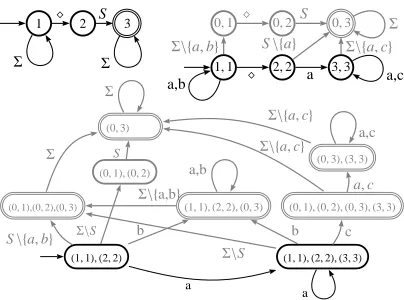
Figure 3: Minimal DFAs for languages W′ =
{a,b}∗a{a,c}∗and W′= Σ\({a,b}∗a{a,c}∗) are
dis-played in Fig. 1. Let S ={a,b,c}. The three DFAs in this figure (in clockwise order) recognize lan-guages (a) W = Σ∗⋄SΣ∗, (b) W\W′ = W ∩W′,
(c) h(W\W′). The shadowed states and
transi-tions do not contribute to the final result that is a∗ = Σ∗\h(W\W′).
Circumfixing The prefix-suffix pairun+iable
can be viewed, however, as a circumfix because the prefix cannot be attached alone to some stems. Our encoding for word unidentifiable is
<#>un<U-><Root>identif<D>y<U><D>iable<#>. In principle, each circumfix could be described as a gapped underlined expression, but because the superposition algorithm works from left to right, it does not see in the beginning of the word if suffixiable is encountered in the end of the word. This uncertainty generates alternative paths and slows down the algorithm. Often this effect is seen already during the determinization of the input DFA G. A practical solution is to compile prefixes and suffixes as separate entries and then check afterwards that for each bracket<U-> in a prefix there is a matching bracket<U>in a suffix.
6 Discussion
6.1 Efficiency
in O(|Q|+|E|). In sum, computing of (17) results in a DFA of size O(c|Q|).
In comparison to a standard step-wise approach (=the baseline method) in Fig. 3, the superpose algorithm avoids creating many useless transitions and states because it does not construct state sub-sets that contain states (0,1),(0,2),(0,3) ∈ (Q∪ {0})× {1,2,3}of Fig. 3b. These are reached only with strings w∈h(W\W′) none of which belongs to the aimed result.
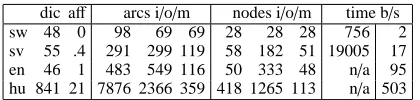
The algorithm was tested with some HunSpell lexicons.4The execution time of the superpose al-gorithm was roughly proportional to the sizes of the input and the output (Table 1) and several or-ders of magnitude faster than the baseline. With the superpose algorithm, the number of arcs did not typically grow, but the number of states would grow by a small factor before minimization.
6.2 Optimization
We can optimize the superpose algorithm in sev-eral ways.
When the automaton G recognizing C∪P⋄2is minimized, information about the prohibitive role of strings w ∈ P⋄2could be used. In particular, final states that have a transition on⋄2 could be turned non-final, which may cause more pruning to take place during minimization. Optionally, one could substitute C∪(h−1(P)⋄2) for C∪P⋄2, which would extend pruning even to strings in C\h(C), but this can actually make G bigger.
The data structures could be improved as well. For example, using failure transitions (Mohri, 1997) reduces the memory footprint of G and op-timizes the computation of accessible subsets dur-ing the subset construction.
During the two-level grammar compilation pro-cedure (Sect. 5), we could restrict the shared tape of TLand TGin the result TGas follows: (3b) Add markers to the tape that is extracted from TL i.e. U = Id(h−1(Range(TL))). (3c) Restrict the lexi-cal side of C with U: C ← U◦C. Continue the compilation procedure from (4).
6.3 Possible Extensions
Some generalizations to the semantics of the algo-rithm would be desirable.
4The Hungarian lexicon (hu) used 26 GB in the original
format and it had the total alphabet of 301 characters (letters and continuation class symbols). The induced underlined ex-pression took 83 GB and the minimized result automaton 3.2 MB in the SFST file format.
dic aff arcs i/o/m nodes i/o/m time b/s
sw 48 0 98 69 69 28 28 28 756 2
sv 55 .4 291 299 119 58 182 51 19005 17
en 46 1 483 549 116 50 333 48 n/a 95
hu 841 21 7876 2366 359 418 1265 113 n/a 503
Table 1: The total number of root dictionary and affix entries (in thousands), DFA transition and state set sizes (input/superpose output/minimized) (in thousands), and execution time of base-line/superpose algorithm (in seconds).
We would like to deal with infixes and inserted characters like<D>more abstractly without a need to add them to the root dictionary as optional char-acters. Such characters should emerge “out of the blue” when needed. The idea could be based on a simplified notion of multi-tape automata where multiple tapes are projected to a single tape.
The current algorithm and its deterministic in-put are not the most efficient ways to handle nested (Barth´elemy, 2007a) or crossing bracketing. A more efficient approach would be based on lay-ered, iterative construction of the result. A layer-ization method for bracketing constraints is given (Yli-Jyr¨a and Koskenniemi, 2004), but it assumes that all rules are compiled separately.
The current algorithm cannot compile two-level grammars that have left-arrow conflicts. There are ways to resolve the conflicts when the prohibition rules are combined into one automaton.
There exist already three other algorithms that generalize the idea of superposition to weighted automata (Yli-Jyr¨a, 2009).
7 Conclusions
The paper presents a new direct algorithm to com-pilation and combination of context restriction rules. It does not need to know the total alphabet and it is several orders of maginitude faster than a standard, stepwise approach. The presented so-lution has applications in computational morphol-ogy and phonolmorphol-ogy, predicate logic and in general-purpose finite-state calculus.
Acknowledgements
The HunSpell compilation problem was intro-duced to the author by Andr´as Kornai, P´eter Hal´acsy, Gy¨orgy Gyepesi, D´aniel Varga and Vik-tor Tr´on during his visit to BUTE in Hungary.
References
Franc¸ois Barth´elemy. 2007a. Multi-grain relations. In CIAA, volume 4783 of LNCS, pages 243–252. Springer.
Franc¸ois Barth´elemy. 2007b. Using Mazurkiewicz trace languages for partition-based morphology. In Proceedings of ACL 2007.
Edmund Grimley-Evans, George Anton Kiraz, and Stephen G. Pulman. 1996. Compiling a partition-based two-level formalism. In 16th COLING 1996, Proc. Conference, volume 1, pages 454–459.
Måns Hulden. 2009. Regular expressions and pred-icate logic in finite-state language processing. In Proceedings of FSMNLP 2008, pages 82–97. IOS Press.
Ronald M. Kaplan and Martin Kay. 1994. Regu-lar models of phonological rule systems. Compu-tational Linguistics, 20(3):331–378.
Lauri Karttunen, Kimmo Koskenniemi, and Ronald M. Kaplan. 1987. A compiler for two-level phonolog-ical rules. Report CSLI-87-108, Center for Study of Language and Information, Stanford University, CA.
Lauri Karttunen. 1991. Finite-state constraints. In Proceedings of the International Conference on Current Issues in Computational Linguistics, Uni-versiti Sains Malaysia, Penang, Malaysia.
Lauri Karttunen. 1993. Finite-state lexicon com-piler. Technical Report ISTL-NLTT-1993-04-02, Xerox Palo Alto Research Center.
Lauri Karttunen. 1994. Constructing lexical transduc-ers. In 15th COLING 1994, Proceedings of the Con-ference, volume 1, pages 406–411, Kyoto, Japan.
George Anton Kiraz. 1997. Compiling regular for-malisms with rule features into finite-state automata. In 35th ACL 1997, 8th EACL 1997, Proceedings of the Conference, pages 329–336.
George Anton Kiraz. 2000. Multitiered nonlinear morphology using multitape finite automata: A case study on Syriac and Arabic. Computational Linguis-tics, 26(1):77–105.
Kimmo Koskenniemi and Anssi Yli-Jyr¨a. 2009. Clarin and free open source finite-state tools. In Jakub Piskorski et al., editor, Finite-State Meth-ods and Natural Language Processing - Post-proceedings of the 7th International Workshop
FSMNLP 2008, volume 191 of Frontiers in Artifi-cial Intelligence and Applications. IOS Press.
Kimmo Koskenniemi. 1983. Two-level morphology: a general computational model for word-form recog-nition and production. Number 11 in Publications. Department of General Linguistics, University of Helsinki, Helsinki.
Krister Lind´en, Miikka Silfverberg, and Tommi Piri-nen. 2009. HFST tools for morphology – an effi -cient open-source package for construction of mor-phological analyzers. In Proceedings of SFCM 2009 (to appear), Zurich, Switzerland.
Mehryar Mohri. 1997. String-matching with au-tomata. Nordic Journal of Computing, 2(2):217– 231.
L´aszl´o N´emeth, Viktor Tr´on, P´eter Hal´acsy, Andr´as Kornai, Andr´as Rung, and Istv´an Szakad´at. 2004. Leveraging the open source ispell codebase for mi-nority language analysis. In Proceedings of the SALTMIL Workshop at LREC 2004, pages 56–59.
Helmut Schmid. 2005. A programming language for finite state transducers. In Pre-proceedings of FSMNLP 2005, pages 280–281.
Miikka Silfverberg and Krister Lind´en. 2009. Conflict resolution using weighted rules in HFST-TWOLC. In Proceedings of NODALIDA 2009 (to appear), Odense, Denmark.
Anssi Yli-Jyr¨a and Kimmo Koskenniemi. 2004. Com-piling contextual restrictions on strings into finite-state automata. In The Eindhoven FASTAR Days, Proceedings, Eindhoven, The Netherlands.
Anssi Yli-Jyr¨a and Kimmo Koskenniemi. 2006. Com-piling generalized two-level rules and grammars. In Proceedings of FinTAL 2006, LNAI.
Anssi Yli-Jyr¨a. 2003. Describing syntax with star-free regular expressions. In 11th EACL 2003, Proc. Con-ference, pages 379–386, Budapest, Hungary.
Anssi Yli-Jyr¨a. 2008a. Applications of diamonded double negation. In Finite-State Methods and Nat-ural Language Processing, 6th International Work-shop, FSMNL-2007, Potsdam, Germany, Septem-ber 14–16, Revised Papers, pages 6–30. Univer-sit¨atsverlag, Potsdam.
Anssi Yli-Jyr¨a. 2008b. Transducers from parallel re-placement rules and modes with generalized lenient composition. In Proceedings of FSMNLP 2007, Potsdam, Germany, forthcoming.