Binarization, Synchronous Binarization, and Target-side Binarization
∗Liang Huang
University of Pennsylvania 3330 Walnut Street, Levine Hall
Philadelphia, PA 19104 [email protected]
Abstract
Binarization is essential for achieving polynomial time complexities in pars-ing and syntax-based machine transla-tion. This paper presents a new binariza-tion scheme, target-side binarizabinariza-tion, and compares it with source-side and syn-chronous binarizations on both string-based and tree-string-based systems using syn-chronous grammars. In particular, we demonstrate the effectiveness of target-side binarization on a large-scale tree-to-string translation system.
1 Introduction
Several recent syntax-based models for machine translation (Chiang, 2005; Galley et al., 2006) can be seen as instances of the general framework of synchronous grammars and tree transducers. In this framework, decoding can be thought of as pars-ing problems, whose complexity is in general expo-nential in the number of nonterminals on the right hand side of a grammar rule. To alleviate this prob-lem, one can borrow from parsing the technique of binarizing context-free grammars (into Chomsky Normal Form) to reduce the complexity. With syn-chronous context-free grammars (SCFG), however, this problem becomes more complicated with the additional dimension of target-side permutation.
The simplest method of binarizing an SCFG is to binarize (left-to-right) on the source-side as if treating it as a monolingual CFG for the source-langauge. However, this approach does not
guaran-∗This work is partially supported by NSF ITR grants
IIS-0428020 (while I was visiting USC/ISI) and EIA-0205456. I also wish to thank Jonathan Graehl, Giorgio Satta, Hao Zhang, and the three anonymous reviewers for helpful comments.
tee contiguous spans on the target-side, due to the ar-bitrary re-ordering of nonterminals between the two languages. As a result, decoding with an integrated language model still has an exponential complexity.
Synchronous binarization (Zhang et al., 2006)
solves this problem by simultaneously binarizing both source and target-sides of a synchronous rule, making sure of contiguous spans on both sides whenever possible. Neglecting the small amount of non-binarizable rules, the decoding complexity with an integrated language model becomes polyno-mial and translation quality is significantly improved thanks to the better search. However, this method is more sophisticated to implement than the previous method and binarizability ratio decreases on freer word-order languages (Wellington et al., 2006).
This paper presents a third alternative,
target-side binarization, which is the symmetric version of
the simple source-side variant mentioned above. We compare it with the other two schemes in two pop-ular instantiations of MT systems based on SCFGs: the string-based systems (Chiang, 2005; Galley et al., 2006) where the input is a string to be parsed using the source-side of the SCFG; and the
tree-based systems (Liu et al., 2006; Huang et al., 2006)
where the input is a parse tree and is recursively converted into a target string using the SCFG as a tree-transducer. While synchronous binarization is the best strategy for string-based systems, we show that target-side binarization can achieve the same performance of synchronous binarization for tree-based systems, with much simpler implementation and100%binarizability.
2 Synchronous Grammars and Binarization Schemes
In this section, we define synchronous context-free grammars and present the three binarization
NP
PP
VP
Chinese−→
E
nglis
h
−
→
NP-PP
NP-PP
VP
contiguous
g
ap
NP
PP-VP
contiguous
contiguous
PP
N
P
-V
P
N
P
-V
P
gap
contiguous
[image:2.612.88.478.59.168.2](a) example rule (b) source-side (c) synchronous (d) target-side
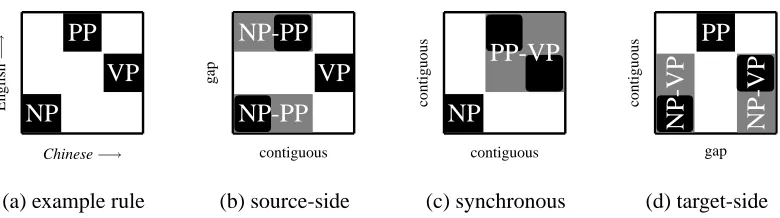
Figure 1: Illustration of the three binarization schemes, with virtual nonterminals in gray.
schemes through a motivational example.
A synchronous CFG (SCFG) is a context-free rewriting system for generating string pairs. Each rule (synchronous production) rewrites a nontermi-nal in two dimensions subject to the constraint that the sequence of nonterminal children on one side is a permutation of the nonterminal sequence on the other side. Each co-indexed child nonterminal pair will be further rewritten as a unit. The rank of a rule is defined as the number of its synchronous nonter-minals. We also define the source and target projec-tions of an SCFG to be the CFGs for the source and target languages, respectively.
For example, the following SCFG1
(1)
S → NP1
PP2
VP3
, NP1
VP3
PP2
NP → Baoweier, Powell
VP → juxing le huitan, held a meeting
PP → yu Shalong, with Sharon
captures the re-ordering of PP and VP between Chinese (source) and English (target). The source-projection of the first rule, for example, is
S→NP PP VP.
Decoding with an SCFG (e.g., translating from Chinese to English using the above grammar) can be cast as a parsing problem (see Section 3 for details), in which case we need to binarize a synchronous rule with more than two nonterminals to achieve polyno-mial time algorithms (Zhang et al., 2006). We will next present the three different binarization schemes using Example 1.
1An alternative notation, used by Satta and Peserico (2005),
allows co-indexed nonterminals to take different symbols across languages, which is convenient in describing syntactic diver-gences (see Figure 2).
2.1 Source-side Binarization
The first and simplest scheme, source-side
binariza-tion, works left-to-right on the source projection of
the SCFG without respecting the re-orderings on the target-side. So it will binarize the first rule as:
(2) S → NP-PP VP
NP-PP → NP PP
which corresponds to Figure 1 (b). Notice that the
virtual nonterminal NP-PP representing the
inter-mediate symbol is discontinuous with two spans on the target (English) side, because this binarization scheme completely ignores the reorderings of non-terminals. As a result, the binarized grammar, with a gap on the target-side, is no longer an SCFG, but can be represented in the more general formalism of Multi-Text Grammars (MTG) (Melamed, 2003):
(3)
S S
→⊲⊳ [1,2]
[1,2,1]
NP-PP VP NP-PP(2) VP
here[1,2,1]denotes that on that target-side, the first nonterminal NP-PP has two discontinuous spans, with the second nonterminal VP in the gap.
Intuitively speaking, the gaps on the target-side will lead to exponential complexity in decoding with integrated language models (see Section 3), as well as synchronous parsing (Zhang et al., 2006).
2.2 Synchronous Binarization
A more principled method is synchronous
binariza-tion, which simultaneously binarizes both source
[jinyibu]1 further
[ jiu on
zhongdong
Mideast
weiji
crisis
]2 [juxing]3 hold
[huitan]4 talk
‘[hold]3 [further]1 [talks]4 [on the Mideast crisis]2’
1 2
3 4
Chinese−→
Engli
sh
−
→
Figure 2: An example of non-binarizable rule from the hand-aligned Chinese-English data in Liu et al. (2005). The SCFG rule is VP→ADVP1
PP2
VB3
NN4
, VP→VB3
JJ1
NNS4
PP2
in the notatoin of Satta and Peserico (2005).
Chomsky Normal Form in synchronous grammars. The example rule is now binarized into:
(4) S → NP
1
PP-VP2, NP1 PP-VP2 PP-VP → PP1
VP2
, VP2
PP1
which corresponds to Figure 1 (c). This represen-tation, being contiguous on both sides, successfully reduces the decoding complexity to a low polyno-mial and significantly improved the search quality (Zhang et al., 2006).
However, this scheme has the following draw-backs. First, synchronous binarization is not always possible with an arbitrary SCFG. Some reorder-ings, for example, the permutation (2,4,1,3), is non-binarizable. Although according to Zhang et al. (2006), the vast majority (99.7%) of rules in their Chinese-English dataset are binarizable, there do ex-ist some interesting cases that are not (see Figure 2 for a real-data example). More importantly, the ra-tio of binarizability, as expected, decreases on freer word-order languages (Wellington et al., 2006). Sec-ond, synchronous binarization is significantly more complicated to implement than the straightforward source-side binarization.
2.3 Target-side Binarization
We now introduce a novel scheme, target-side bi-narization, which is the symmetric version of the source-side variant. Under this method, the target-side is always contiguous, while leaving some gaps on the source-side. The example rule is binarized into the following MTG form:
(5)
S S
→⊲⊳ [1,2,1] [1,2]
NP-VP(2) PP NP-VP PP
which corresponds to Figure 1 (d).
scheme s(b) t(b)
source-side 1 ≤n/2
synchronous 1 1
target-side ≤n/2 1
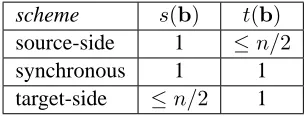
Table 1: Source and target arities of the three bina-rization schemes of an SCFG rule of rankn.
Although the discontinuity on the source-side in this new scheme causes exponential complexity in string-based systems (Section 3.1), the continuous spans on the target-side will ensure polynomial com-plexity in tree-based systems (Section 3.2).
Before we move on to study the effects of vari-ous binarization schemes in decoding, we need some formal machineries of discontinuities.
We define the source and target arities of a virtual nonterminal V, denoted s(V) and t(V), to be the number of (consecutive) spans ofV on the source and target sides, respectively. This definition extends to a binarizationbof an SCFG rule of rank
n, where arities s(b) and t(b) are defined as the
maximum source and target arities over all virtual nonterminals in b, respectively. For example, the
source and target arities of the three binarizations in Figure 1 are 1 and 2 for (b), 1 and 1 for (c), and 2 and 1 for (d). In general, the arities for the three binarization schemes are summarized in Table 1.
3 Theoretical Analysis
3.1 String-based Approaches
String-based approaches include both string-to-string (Chiang, 2005) and string-to-string-to-tree systems (Galley et al., 2006).2 To simplify the presentation we will just focus on the former but the analysis also applies to the latter. We will first discuss decoding with a pure SCFG as the translation model (hence-forth−LM decoding), and then extend it to include
ann-gram model (+LM decoding).
3.1.1 Translation as Parsing
The −LM decoder can be cast as a (monolin-gual) parser on the source language: it takes the source-language string as input and parses it using the source-projection of the SCFG while building the corresponding target-language sub-translations in parallel. For source-side and synchronous bina-rizations, since the resulting grammar has contigu-ous source spans, we can apply the CKY algorithm which guarantees cubic time complexity.
For example, a deduction along the virtual rule in the synchronously binarized grammar (4) is notated
(PPj,k) : (w1, t1) (VPk,l) : (w2, t2) (PP-VPj,l) : (w1+w2, t2t1) (6)
where i, j, k are free indices in the source string, w1, w2 are the scores of the two antecedent items, and t1, t2 are the corresponding sub-translations.3 The resulting translationt2t1is the inverted concate-nation as specified by the target-side of the SCFG rule.
The case for a source-side binarized grammar (3) is slightly more complicated than the above, because we have to keep track of gaps on the target side. For example, we first combine NP with PP
(NPi,j) : (w1, t1) (PPj,k) : (w2, t2) (NP-PPi,k) : (w1+w2, t1⊔t2) (7)
2Our notation of X-to-Y systems is defined as follows: X
de-notes the input, either a string or a tree; while Y represents the RHS structure of an individual rule: Y is string if the RHS is a flat one-level tree (as in SCFGs), and Y is tree if the RHS is multi-level as in (Galley et al., 2006). This convention also applies to tree-based approaches.
3The actual system does not need to store the translations
since they can be recovered from backpointers and they are not considered part of the state. We keep them here only for presen-tation reasons.
NP-PP
NP-PP
VP
three Chinese indices
i k l
E
nglis
h
tr
ans
la
tions
t1
t3
t2
PP
N
P
-V
P
N
P
-V
P
four Chinese indices
i j k l
t1
t2
[image:4.612.314.512.61.173.2](a): Deduction (8) (b): Deduction (10)
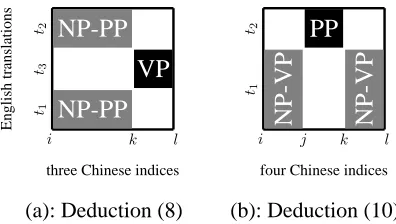
Figure 3: Illustrations of two deductions with gaps.
leaving a gap (⊔) on the target-side resulting item, because NP and PP are not contiguous in the En-glish ordering. This gap is later filled in by the sub-translationt3of VP (see also Figure 3 (a)):
(NP-PPi,k) : (w1, t1⊔t2) (VPk,l) : (w2, t3) (Si,l) : (w1+w2, t1t3t2)
(8) In both cases, there are still only three free indices on the source-side, so the complexity remains cubic. The gaps on the target-side do not require any ex-tra computation in the current−LM setting, but as we shall see shortly below, will lead to exponential complexity when integrating a language model.
For a target-side binarized grammar as in (5), however, the source-side spans are discontinuous where CKY can not apply, and we have to enumerate more free indices on the source side. For example, the first deduction
(NPi,j) : (w1, t1) (VPk,l) : (w2, t2) (NP-VPi,j⊔k,l) : (w1+w2, t1t2) (9) leaves a gap in the source-side span of the resulting item, which is later filled in when the item is com-bined with a PP (see also Figure 3 (b)):
(NP-VPi,j⊔k,l) : (w1, t1) (PPj,k) : (w2, t2) (Si,l) : (w1+w2, t1t2)
(10) Both of the above deductions have four free in-dices, and thus of complexityO(|w|4)instead of cu-bic in the length of the input stringw.
indices, then there ares+1spans, which contradicts the definition of arity (Huang et al., 2005).4
These deductive systems represent the search space of decoding without a language model. When one is instantiated for a particular input string, it de-fines a set of derivations, called a forest, represented in a compact structure that has a structure of a hyper-graph. Accordingly we call items like(PP1,3)nodes in the forest, and an instantiated deduction like
(PP-VP1,6)→(PP1,3)(VP3,6)
we call a hyperedge that connects one or more an-tecedent nodes to a consequent node. In this rep-resentation, the time complexity of−LM decoding, which we refer to as source-side complexity, is pro-portional to the size of the forest F, i.e., the num-ber of hyperedges (instantiated deductions) inF. To summarize, the source-side complexity for a bina-rized grammar of source aritysis
|F|=O(|w|2s+1).
3.1.2 Adding a Language Model
To integrate with a bigram language model, we can use the dynamic-programming algorithm of Wu (1996), which we may think of as proceeding in two passes. The first pass is as above, and the sec-ond pass traverses the first-pass forest, assigning to each nodeva set of augmented items, which we call +LM items, of the form(va⋆b), where aand bare target words and ⋆ is a placeholder symbol for an elided part of a target-language string. This item in-dicates that a possible translation of the part of the input spanned byvis a target string that starts with aand ends withb.
Here is an example deduction in the syn-chronously binarized grammar (4), for a+LM item for the node(PP-VP1,6)based on the−LM Deduc-tion (6):
(PPwith⋆Sharon
1,3 ): (w1, t1) (VP held⋆talk
3,6 ): (w2, t2)
(PP-VPheld⋆Sharon
1,6 ): (w′, t2t1)
(11)
4
Actually this is true only if in any binarization scheme, a non-contiguous item is always combined with a contiguous item. We define both source and target binarizations to be
in-cremental (i.e., left-to-right or right-to-left), so this assumption
trivially holds. More general binarization schemes are possible to have even higher complexities, but also possible to achieve better complexities. Full discussion is left for a separate paper.
where w′ = w
1 +w2 −logPlm(with | talk) is the score of the resulting +LM item: the sum of the scores of the antecedent items, plus a
combi-nation cost which is the negative log probability of
the bigrams formed in combining adjacent boundary words of antecedents.
Now that we keep track of target-side boundary words, an additional complexity, called target-side
complexity, is introduced. In Deduction (11), four
target words are enumerated, and each+LM item stores two boundary words; this is also true in gen-eral for synchronous and target-side binarized gram-mars where we always combine two consecutive target strings in a deduction. More generally, this scheme can be easily extended to work with anm -gram model (Chiang, 2007) wheremis usually≥3 (trigram or higher) in practice. The target-side com-plexity for this case is thus
O(|V|4(m−1))
whereV is the target language vocabulary. This is because each constituent must store its initial and final (m− 1)-grams, which yields four (m − 1)-grams in a binary combination. In practice, it is often assumed that there are only a constant number of translations for each input word, which reduces this complexity intoO(|w|4(m−1)).
However, for source-side binarization which leaves gaps on the target-side, the situation becomes more complicated. Consider Deduction (8), where the sub-translation for the virtual node NP-PP is gapped (t1⊔t2). Now if we integrate a bigram model based on that deduction, we have to maintain the boundary words of botht1andt2 in the+LM node of NP-PP. Together with the boundary words in node VP, there are a total of six target words to enumerate for this+LM deduction:
(NP-PPa⋆bi,k⊔e⋆f) : (w1, t1⊔t2) (VPc⋆dk,l) : (w2, t3) (Sa⋆fi,l ) : (w′, t
1t3t2)
(12) wherew′ =w
1+w2−logPlm(c|b)Plm(e|d). With an analysis similar to that of the source-side, we state that, for a binarized grammar with target arityt, the target-side complexity, denotedT, is
scheme string-based tree-based source-side |w|3+2(t+1)(m−1) |w|1+2(t+1)(m−1) synchronous |w|3+4(m−1) |w|1+4(m−1) target-side |w|(2s+1)+4(m−1) |w|1+4(m−1)
Table 2: Worst-case decoding complexities of the three binarization schemes in the two approaches (excluding theO(|w|3)time for source-side parsing in tree-based approaches).
because in the worst-case, there aret+ 1spans in-volved in a+LM deduction (tof them from one vir-tual antecedent and the other one non-virvir-tual), and for each span, there arem−1target words to enu-merate at both left and right boundaries, giving a total of 2(t+ 1)(m −1)words in this deduction. We now conclude that, in a string-based system, the combined complexities for a binarized grammar with source aritysand target aritytis
O(|F|T) =O(|w|(2s+1)+2(t+1)(m−1)).
The results for the three specific binarization schemes are summarized in Table 2. Although both source-side and target-side binarizations lead to ex-ponential complexities, it is likely that language model combinations (target-side complexity) dom-inate the computation, since m is larger than 2 in practice. In this sense, target-side binarization is still preferable to source-side binarization.
It is also worth noting that with the hook trick of Huang et al. (2005), the target-side complex-ity can be reduced to O(|w|(2t+1)(m−1)), making it more analogous to its source-side counterpart: if we consider the decoding problem as intersect-ing the SCFG with a source-side DFA which has
|S|=|w|+1states, and a target-side DFA which has
|T|=O(|w|m−1)states, then the intersected gram-mar has a parsing complexity ofO(|S|2s+1|T|2t+1), which is symmetric from both sides.
3.2 Tree-based Approaches
The tree-based approaches include the tree-to-string (also called syntax-directed) systems (Liu et al., 2006; Huang et al., 2006). This approach takes a source-language parse tree, instead of the plain string, as input, and tries to find the best derivation that recursively rewrites the input tree into a target
...
Sη :t1t3t2
NPη·1 :t1 ...
PPη·2 :t2 ...
VPη·3 :t3 ...
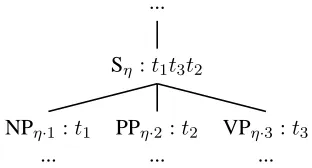
Figure 4: Illustration of tree-to-string deduction.
string, using the SCFG as a tree-transducer. In this setting, the −LM decoding phase is a tree-parsing problem (Eisner, 2003) which aims to cover the en-tire tree by a set of rules. For example, a deduction of the first rule in Example 1 would be:
(NPη·1) : (w1, t1) (PPη·2) : (w2, t2) (VPη·3) : (w3, t3) (Sη) : (w1+w2+w3, t1t3t2)
(13) where η and η ·i(i = 1,2,3) are tree addresses (Shieber et al., 1995), withη·ibeing theith child ofη (the address of the root node isǫ). The nonter-minal labels at these tree nodes must match those in the SCFG rule, e.g., the input tree must have a PP at nodeη·2.
The semantics of this deduction is the following: if the label of the current node in the input tree is S, and its three children are labeled NP, PP, and VP, with corresponding sub-translations t1, t2, and t3, then a possible translation for the current node S is t1t3t2 (see Figure 4). An alternative, top-down ver-sion of this bottom-up deductive system is, at each node, try all SCFG rules that pattern-match the cur-rent subtree, and recursively solve sub-problems in-dicated by the variables, i.e., synchronous nontermi-nals, of the matching rule (Huang et al., 2006).
With the input tree completely given, this setting has some fundamental differences from its string-based counterpart. First, we do not need to bina-rize the SCFG grammar before−LM decoding. In fact, it will be much harder to do the tree-parsing (pattern-matching) with a binarized grammar. Sec-ond, regardless of the number of nonterminals in a rule, building the−LM forest always costs time lin-ear in the size of the input tree (times a grammar constant, see (Huang et al., 2006, Sec. 5.1) for de-tails), which is in turn linear in the length of the input string. So we have:
[image:6.612.60.305.54.115.2]This fast −LM decoding is a major advantage of tree-based approaches.
Now in +LM decoding, we still need binariza-tion of the hyperedges, as opposed to rules, in the forest, but the analysis is almost identical to that of string-based approach. For example, the tree-based version of Deduction (12) for source-side binariza-tion is now notated
(NPη·1-PPη·2a⋆b⊔e⋆f) : (w1, t1⊔t2) (VPη·3c⋆d) : (w2, t3) (Sηa⋆f) : (w′, t
1t3t2)
(14) In general, the target-side complexity of a bina-rized grammar with target arity t is still T =
O(|w|2(t+1)(m−1))and the combined decoding com-plexity of the tree-based approach is
[image:7.612.317.524.60.205.2]O(|F|T) =O(|w|1+2(t+1)(m−1)).
Table 2 shows that in this tree-based setting, target-side binarization has exactly the same perfor-mance with synchronous binarization while being much simpler to implement and does not have the problem of non-binarizability. The fact that simple binarization works (at least) equally well, which is not possible in string-based systems, is another ad-vantage of the tree-based approaches.
4 Experiments
Section 3 shows that target-side binarization achieves the same polynomial decoding complexity as the more sophisticated synchronous binarization in the tree-based systems. We now empirically com-pare target-side binarization with an even simpler variant, on-the-fly generation, where the only dif-ference is that the latter does target-side left-to-right binarization during+LM decoding on a hyperedge-per-hyperedge basis, without sharing common vir-tual nonterminals across hyperedges, while the for-mer binarizes the whole −LM forest before the +LM decoding.
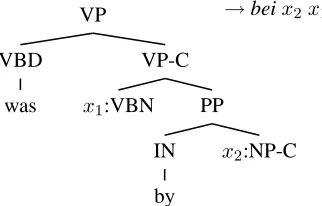
Our experiments are on English-to-Chinese trans-lation in the tree-to-string system of Huang et al. (2006), which takes a source-language parse tree as input and tries to recursively convert it to a target-language string according to transfer rules in a syn-chronous grammar (Galley et al., 2006). For in-stance, the following rule
0 100 200 300 400 500 600
5 10 15 20 25 30 35 40
number of nodes in the forest
length of the input sentence original forest
[image:7.612.349.510.284.387.2]target-side binarization on-the-fly generation
Figure 5: Number of nodes in the forests. Input sentences are grouped into bins according to their lengths (5-9, 10-14, 15-20, etc.).
VP
VBD
was
VP-C
x1:VBN PP
IN
by
x2:NP-C →beix2x1
translates an English passive construction into Chi-nese. Although the rules are actually in a syn-chronous tree-substitution grammar (STSG) instead of an SCFG, its derivation structure is still a hy-pergraph and all the analysis in Section 3.2 still applies. This system performs slightly better than the state-of-the-art phrase-based system Pharaoh (Koehn, 2004) on English to Chinese translation. A very similar system for the reverse direction is de-scribed in (Liu et al., 2006).
25 25.2 25.4 25.6 25.8 26 26.2
5 10 15 20
0 20000 40000 60000 80000 100000 120000
BLEU score
average # of +LM items per sentence
[image:8.612.75.298.58.217.2]beam size BLEU score on-the-fly generation target-side binarization
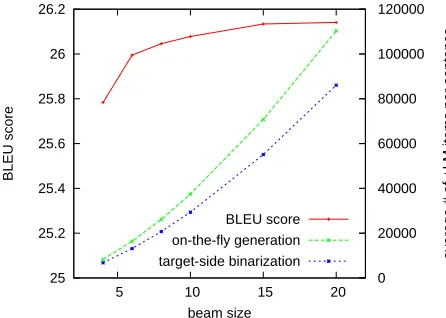
Figure 6: Decoding speed and BLEU scores under beam search.
duplicate nodes due to the lack of sharing, which is on average 1.85 times bigger than the target-side bi-narized forest. This difference is also reflected in the decoding speed, which is illustrated in Figure 6 un-der various beam settings and where the amount of computation is measured by the number of +LM items generated. At each individual beam setting, the two methods produce exactly the same set of translations (i.e., there is no relative search error), but the target-side binarization is consistently 1.3 times faster thanks to the sharing. In terms of transla-tion quality, the final BLEU score at the largest beam setting is 0.2614, significantly higher than Pharaoh’s 0.2354 as reported in (Huang et al., 2006).
5 Conclusion
This paper introduces a simple binarization scheme,
target-side binarization, and presents a systematic
study of the theoretical properties of the three bina-rization schemes in both string-based and tree-based systems using syncrhonous grammars. In particular, we show that target-side binarization achieves the same polynomial complexity as synchronous bina-rization while being much simpler to implement and universally applicable to arbitrary SCFGs. We also demonstrate the empirical effectiveness of this new scheme on a large-scale tree-to-string system.
References
David Chiang. 2005. A hierarchical phrase-based model for statistical machine translation. In Proceedings of
ACL.
David Chiang. 2007. Hierarchical phrase-based trans-lation. In Computational Linguistics, volume 33. To appear.
Jason Eisner. 2003. Learning non-isomorphic tree map-pings for machine translation. In Proceedings of ACL
(poster), pages 205–208.
Michel Galley, Jonathan Graehl, Kevin Knight, Daniel Marcu, Steve DeNeefe, Wei Wang, and Ignacio Thayer. 2006. Scalable inference and training of context-rich syntactic translation models. In
Proceed-ings of COLING-ACL.
Liang Huang, Hao Zhang, and Daniel Gildea. 2005. Ma-chine translation as lexicalized parsing with hooks. In
Proceedings of the Ninth International Workshop on Parsing Technologies (IWPT-2005).
Liang Huang, Kevin Knight, and Aravind Joshi. 2006. Statistical syntax-directed translation with extended domain of locality. In Proc. of AMTA.
Philipp Koehn. 2004. Pharaoh: a beam search decoder for phrase-based statistical machine translation mod-els. In Proceedings of AMTA, pages 115–124.
Yang Liu, Qun Liu, and Shouxun Lin. 2005. Log-linear models for word alignment. In Proceedings of ACL.
Yang Liu, Qun Liu, and Shouxun Lin. 2006. Tree-to-string alignment template for statistical machine trans-lation. In Proceedings of COLING-ACL.
I. Dan Melamed. 2003. Multitext grammars and syn-chronous parsers. In Proceedings of NAACL.
Giorgio Satta and Enoch Peserico. 2005. Some computa-tional complexity results for synchronous context-free grammars. In Proc. of HLT-EMNLP 2005.
Stuart Shieber, Yves Schabes, and Fernando Pereira. 1995. Principles and implementation of deductive parsing. Journal of Logic Programming, 24:3–36.
Benjamin Wellington, Sonjia Waxmonsky, and I. Dan Melamed. 2006. Empirical lower bounds on the com-plexity of translational equivalence. In Proceedings of
COLING-ACL.
Dekai Wu. 1996. A polynomial-time algorithm for sta-tistical machine translation. In Proceedings of ACL.