637
A note on
T
0Domination
Annie Sabitha Paul
1and Raji Pilakkat
21Assistant Professor in Mathematics,,
Government Engineering College, Kannur,
Affiliated to APJ Abdul Kalam Technological University, 670563, Kerala, India, Email: [email protected]
2 Professor, Department of Mathematics,
University of Calicut, Thenhippalm – 673635, Kerala, India, Email: [email protected]
Abstract- A set
D
V
of a graphG
(
V
,
E
)
is called a dominating set if every vertex inG
is either inD
or is adjacent to an element ofD
. A simple graphG
is said to beT
0, if for any two distinct verticesu
andv
of,
G
either one ofu
andv
is isolated or there exists an edgee
such that eithere
is incident withu
but not withv
ore
is incident withv
but not withu
. IfD
of a dominating setD
of the graphG
is aT
0 graph, then it is called aT
0 dominating set and ifD
is both connected andT
0, then it is called a connected0
T
dominating set. The minimum cardinality of allT
0 dominating sets and connectedT
0 dominating sets are respectively calledT
0 domination number and connectedT
0 domination number and are denoted respectivelyby
(
)
0
G
T
and(
)
0
G
cT
. In this paperT
0 domination number and connectedT
0 domination number are introduced and some results on these new parameters are established.Keywords- Domination number,
T
0 domination number, connectedT
0 domination number1 INTRODUCTION
Graphs
G
(
V
(
G
),
E
(
G
))
discussed in this paper are finite, simple and undirected. Any undefined term in this paper may be found in [1,4]. The degree [1] of a vertexv
in graphG
is denoted byd
G(
v
)
(or)
(
v
d
if no specification of the graphG
is needed), which is the number of edges incident withv
. The maximum degree ofG
is denoted by
(
G
)
. Thecomplement
G
of graphG
[5] hasV
(
G
)
V
(
G
)
and
uv
E
(
G
)
if and only ifuv
is not inE
(
G
)
. For a graphG
, the number of vertices is called the order [5] ofG
and is denoted byo
(
G
)
. An empty graph [1] is a graph with no edges. An isolated vertex [4] is one whose degree is zero. A vertex in a graph is called a pendant vertex [6] if its degree is one. Any vertex adjacent to a pendant vertex is called a support vertex. A simple graph in which each pair of distinct vertices is joined by an edge is called a completegraph [1]. A complete graph on
n
vertices is denoted byK
n. A bipartite graphG
is one whose vertex set can be partitioned into two subsetsX
andY
so that each edge has its ends inX
andY
respectively. Such a partition(
X
,
Y
)
is called a bipartition ofG
. A complete bipartite graph [1] is a simple bipartite graph with bipartition(
X
,
Y
)
in which every vertex ofX
is joined to every vertex of
Y
.The complete bipartite graph with
X
m
andn
Y
is denoted byK
m,n. The graphH
is said to be an induced sub graph [2] of the graphG
if)
(
)
(
H
V
G
V
and two vertices inH
are adjacent ifand only if they are adjacent inG
. A tree [1] is a connected acyclic graph. A cut edge [1] of a graphG
is an edge such that whose removal makes the graph disconnected. The open neighborhood [5] of
v
in)
(
G
V
consists of those vertices adjacent tov
inG
638 [5] of
v
isN
v
N
(
v
)
v
. A matching [1] ina graph is a set of pair wise nonadjacent edges. Let
)
,
(
V
E
G
be a graph. A setD
V
is called a dominating set [5] if every vertex inG
is either inD
or is adjacent to an element ofD
. The minimum cardinality of all dominating sets inG
is called the domination number and is denoted by
(
G
)
. Different types of dominating sets have been studied by imposing conditions on the dominating sets. A detailed survey can be found in [5]. A dominating setD
is called an independent dominating set [3] ifD
is the empty graph. A dominating setD
iscalled a connected dominating set [7] if
D
is connected. The corresponding minimum cardinality of independent dominating set and connected dominating set are respectively called independent domination number and connected domination number and are denoted respectively byi
(
G
)
and
c(
G
)
.In [8], V Seena and Raji Pilakkat defined the
0
T
Graph as follows. A simple graph G is said to be0
T
, if for any two distinct verticesu
and
v
of
G
, one of the following hold1. At least one of
u
and
v
is isolated.2. There exists an edge
e
such that eithere
is incident withu
but not withv
ore
is incident withv
but not withu
.In this paper, a new domination parameter,
T
0 domination number is introduced and some of its properties are studied. AT
0 dominating set is a dominating setD
V
such thatD
isT
0. Also itis proved that every independent dominating set in a graph is
T
0 dominating. So that every graph has aT
0 dominating set. Hence the property ofT
0 domination is applicable to all simple graphs.2
T
0Domination
0
T
domination is defined as follows.Definition 2.1. Let
G
be any finite undirected simple graph with vertex setV
. A dominating setS
V
is said to be
T
0 dominating ifD
is aT
0 graph. Theminimum cardinality of all such
T
0 dominating sets is calledT
0 domination number and is denoted by)
(
0
G
T
. Such aT
0 dominating set with cardinality)
(
0
G
T
is called a0 T
-set.Seena V and Raji P [8] proved that a graph G is
0
T
if and only ifK
2is not a component ofG
. A characterization property of aT
0 dominating set follows directly from this result.Theorem 2.1. Let
G
(
V
,
E
)
be any graph. A dominating setS
V
is aT
0 dominating set if and only if no component ofS
isK
2.Theorem 2.2. For any graph
G
, every independent dominating set isT
0 dominating.Proof. Let
I
V
be an independent dominating set of a graphG
(
V
,
E
)
. SinceK
2is not acomponent of
I
,I
is aT
0 graph.Corollary 2.3. For any graph
G
,(
)
(
)
0
G
G
T
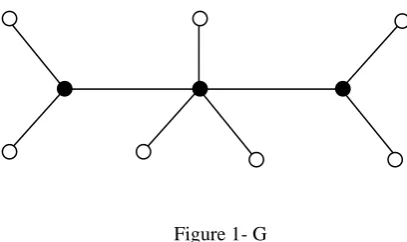
Remark 2.4. The converse of Theorem 2.2 need not be true. For example the set of all darkened vertices shown in figure 1 is
T
0dominating but not independent. Here(
)
3
0
G
T
andi
(
G
)
5
.Figure 1- G
Theorem 2.5. For any positive integer
k
, there exist a graphsG
such thati
(
G
)
T(
G
)
k
0
Proof. Consider the path
P
3. LetG
be the graph obtained fromP
3 by attaching exactlyj
pendant edges to each vertex ofP
3,wherej
2
. Then3
)
(
0
G
T
andi
(
G
)
3
(
j
1
)
whenj
2
,Therefore
(
)
(
)
1
0
G
j
G
i
T . Sincej
2
,3...
2,
1,
=
,
)
(
)
(
0
G
k
k
G
639 Theorem 2.6 characterizes graphs
(
)
1
0
G
Proof. (1) is obvious.
(2) Suppose that
(
)
2
D
is independent dominating. Also since)
independent dominating, contradicting i(G) = 2. Hence2
640 with two vertices is not
T
0,S
is an independentdominating set, a contradiction.
Remark 2.10. The converse of Theorem 2.9 need not be true. For example in figure.1,
(
)
3
Theorem 2.11. For complete bipartite graphs
K
m,n,
other vertex fromV
then these two vertices dominaten 2, which contain no
K
3as an induced subgraph, then2
G
and all vertices which are non adjacent to bothu
and
v
are dominated by bothu
andv
in G. SoG
. ThenD
consists of disconnected edges. That is,D
hasK
2as a component, a contradiction toD
is minimum cardinality of all connectedT
0dominating connected
T
0dominating set with cardinality641 Proof. Since
c(
G
)
2
, the graph induced by anyc
-set is notK
2and hence the
c-set is connected0
T
dominating. Also since(
)
(
)
0
G
G
cTc
, itfollows that
(
)
(
)
0
G
cG
cT
.Theorem 3.3. Let
a
andb
be two positive integers witha
2
andb
2
a
2
. Then there is a graph Gon
b
vertices with
(
G
)
c(
G
)
cT0(
G
)
a
and
i
(
G
)
a
1
.Proof. Consider the path
P
(
u
1,
u
2,...,
u
a)
on a vertices. Letb
2
a
r
,
r
2
.
LetG
be the graph obtained fromP
by attaching two or more pendant edges atu
1 andu
2and one pendant edge at each3
,
i
u
i . Letv
i,
i
3
be the pendant vertices attached tou
i,
i
3
. ClearlyD
=
u
1,
u
2,...,
u
a
is a
-set which is also a connectedT
0 dominating set. Hence
(
G
)
c(
G
)
cT0(
G
)
a
. Anyindependent dominating set of
G
of minimum cardinality will be one among the following.
u
i,
v
3,
v
4,...,
v
a
N
(
u
j)
whereu
i is the vertexof maximum degree among
u
1 andu
2 andN
(
u
j)
is the open neighborhood of
u
1 oru
2with minimum cardinality such thati
j
or
u
1,
u
3,
v
4,
u
5,
v
6...
N
(
u
2)
if
d
(
u
1)
d
(
u
2)
andN
(
u
2)
N
(
u
1)
or
u
2,
v
3,
u
4,
v
5,
u
6...
N
(
u
1)
if
d
(
u
2)
d
(
u
1)
andN
(
u
1)
N
(
u
2)
.In all these cases the cardinality of the i-set is (a − 1) + min
d
(
u
1),
d
(
u
2)
,where min
d
(
u
1),
d
(
u
2)
≥ 2.Therefore
i
(
G
)
a
1
.Theorem 3.4. Let
T
be any tree of ordern
,
n
4
. IfT
is not isomorphic toK
1,n1 then(
)
3
0
T
cT
.Proof. Since
T
is not isomorphic toK
1,n1 (a star graph),
(
T
)
n
2
. Consider the following cases.Case (i)
T
is not a path.Since
T
is not a path, it has at least three pendant vertices sayv
1,
v
2and
v
3. Therefore,)
(
iT
v
d
=n
2
,
i
1
,
2
,
3
. Also sinceT
is not a star, the support vertex of at least one of thev
iwill be different from support vertices of the other two. Therefore
v
1,
v
2,
v
3
forms a dominating set ofT
. InT
,
v
1,
v
2,
v
3
, the graph induced by
v
1,
v
2,
v
3
is eitherK
3 orP
3. Hence
v
1,
v
2,
v
3
is a connectedT
0 dominating set ofT
. So that
(
)
3
0
T
cT
. SinceT
has no isolatedvertices,
(
)
0
T
cT
cannot be one.Also since there are no connected
T
0 dominating sets of cardinality two,(
)
3
0
T
cT
. Hence it followsthat
(
)
3
0
T
cT
.Case (ii)
T
is a pathP
n onn
vertices,n
4
. Letv
1 andv
2 be the pendant vertices andv
3be any one of the support vertices.Then
d
T(
v
i)
=n
2
,
i
1
,
2
and
d
T(
v
3)
=n
3
.In
T
, the subgraph induced by
v
1,
v
2,
v
3
isP
3and it forms a connected
T
0 dominating set ofT
. Hence by the same reasoning as in case (i), it followsthat
(
)
3
0
T
cT
.Corollary 3.5. Let
T
be a tree of order > 1, thenT
has a connected
T
0 dominating set if and only ifT
is not a star.Proof. If
T
is a star on n > 1 vertices, thenT
is disconnected. HenceT
cannot have a connectedT
0 dominating set. Conversely, letT
be a tree, which is not a star. Thenn
4
. Therefore by Theorem 3.4,T
has a connectedT
0 dominating set.Proposition 3.6. Let G be a bi-star B(m, n) on
p
vertices, then cT
(
G
)
p
max
m
,
n
0
Theorem 3.7. [7] For any tree
T
of orderp
, the connected domination number ofT
p
e
, where642 Theorem 3.8. Let
T
be any tree. Then the
c-setand
0 T
-set are the same if and only ifT
is not a bi-starProof. Let
T
be a tree onp
vertices. Assume that thec
-set and0 T
-set are the same. Suppose if possible,T
is a bi-star.Then by Theorem 3.7,
c(
T
)
p
e
2
, where,e
is the number of pendant vertices. So that the graph induced by the
c-set isK
2, which is notT
0. By Proposition 3.6 and Theorem 3.7, ifT
is a bi-star,then
(
)
(
).
0
T
T
cTc
We conclude with a conjecture.
Conjecture 3.8. There are no simple graphs
G
forwhich
(
)
(
)
0
G
G
T
REFERENCES
[1] Bondy J. A, Murty U.S.R. (2008): Graph Theory ; Springer
[2] . G. Chartrand, P. Zhang (2009) Chromatic Graph Theory ; CRC Press, USA
[3] E.J. Cockayne and S.T. Hedetniemi (1974) Independence graphs. Congr. Numer..X : 471-491
[4] F. Harary, Graph Theory (1969) Addison Wesley
[5] W.Haynes, Stephen Hedetniemi, Peter Slater (1998) Fundamentals of Domination in Graphs ; Marcel Dekker Inc
[6] K.R Parthasararhy (1994) Basic Graph theory ; McGraw-Hill Pub., USA
[7] E. Sampathkumar (1979) The connected domination number of a graph ; J. Math. Phy. Sci. volume 13, 607-613