Available Online atwww.ijcsmc.com
International Journal of Computer Science and Mobile Computing
A Monthly Journal of Computer Science and Information Technology
ISSN 2320–088X
IJCSMC, Vol. 4, Issue. 6, June 2015, pg.1092 – 1097
RESEARCH ARTICLE
A Simulink Based Implementation Model for
MC-CDMA Under Channel Fading
Nisha
Student, M.Tech (ECE), BPSMV Khanpur Kalan, Sonepat, [email protected]
Krishan Kumar
Asstt. Prof, ECE Dept, BPSMV Khanpur Kalan, Sonepat
Abstract— MC-CDMA provides the muti carrier adaptive communication model is defined in real time scenario. This communication model is applied to provide optimized communication under different channel impurities. In this work, a robust model is presented under different modulation methods and in fading channel. The analysis of work shows that the proposed QAM integrated model has provided the effective and reliable outcome.
Keywords: MC-CDMA, Real Time, QAM, Fading Channel
I. INTRODUCTION
MC-CDMA is a high speed communication system defined on multiple carrier. This communication system is having the adaption to new era of communication features and defined specifically for wireless system. The wireless system is here configuring under the 3G and 4G constraints. The communication is here performed under high frequency spectral specification, communication delay reduction, multiple wavelength adaptive communication, reduction of associated ISI and immunity over the signal. Provides the fading adaptive high frequency signal so that the optimized communication will be performed over the channel. This communication system is defined under the specification high data rate for video communication. These kinds of communication systems are suitable for the high frequency and effective communication such as in case of WiFi or WiMAX network. As the signal is communicated on different frequency ranges, the communication system also suffers from the fluctuation in the frequency value. Such kind of fluctuation arises the impurities over the communication.
channel will be reduced. The reduction to the PAPR is here achieved under the signal specification. In case of MIMO adaptive MC-CDMA signal more critical and restricted constraints are defined. The PAPR reduction methods are defined under the specification of complementary cumulative distribution function (CCDF). There is the requirement of some probabilistic method to improve the signal strength under signal scrambling techniques so that more optimized and reliable signal will be transmitted over the channel. [4].
The MC-CDMA system provides the communication at high bandwidth, effective efficiency constraint under fading problem. The guards are applied over the signal to perform the signal adaptive analysis under associated noise problems. The problems considered in this work include signal noise, PAPR, channel noise, bit adaptive error etc. This communication system provides the solution under these critical issues so that more adaptive and reliable communication is formed.
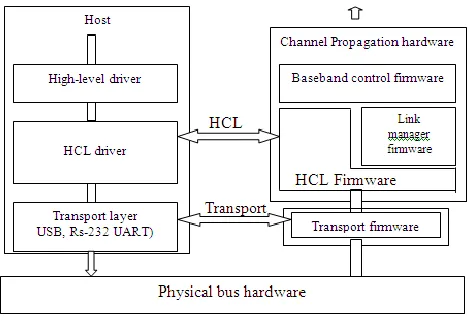
Figure 1 :CDMA Communication Architecture
In this paper, an exploration to MC-CDMA based model is defined to provide the equalize communication in real time scenario. The communication is applied under different modulation methods and in fading channel. In section II, the work defined by earlier researchers is discussed. In section III, the proposed work methodology is discussed. In section IV, the results obtained from work are presented. In section V, the conclusion of work is presented.
II. EXISTING WORK
that the symbol adaptive communication will be formed under inter carrier interference. Author[6] has presented a work on PAPR reduction model under SCCDMA modeling for uplink formation and tone reservation. Author provided the analytical modeling for partnership project derive communication formed for long term evaluation. Author provided the analysis on single carrier adaptive communication for SCFMDA. Author[7] has provided a work on PAPR reduction model for uplink communication and efficient model for MC-CDMA. Author provided the different modulation scheme specification so that the lowest PAPR reduction so that the uplink communication will be formed. Author provided the OCDMA adaptive communication under data rate analysis so that the analysis under delay adaptive communication will be formed. Author provided the limitation adaptive communication to optimize the OFDM system. Author[8] has provided a work on PAPR reduction model for SC CDMA system for link adaptive analysis under spectral analysis under frequency and shape formation. Author provided the PAPR signal analysis obtained from the single carrier system applied under LTE adaptive evaluation. Author[9] has provided a work on LTE adaptive communication under the optimization of physical layer. Author provided the key component analysis for LTE vector and provided the detailed description of communication under 3GPP system. Author provided the LTE adaptive communication under downlink communication system with different modulation vector. Author generated the optimized building blocks for communication system definition. The spectral analysis over the signal is performed to optimize the communication and provided the evaluation under the performance adaptation. Author[10] has provided a work on pulse shape adaptive communication for PAPR reduction for carrier CDMA optimization. Author provided the signal level optimization under frequency domain equalization. Author defined the performance adaptive communication to reduce the signal error and to improve the system performance under PAPR modeling. Author[11] has provided a work on gain optimization under optimization modeling for CDMA system for performance adaptive communication. Author achieved the correlated communication model for channel adaptive communication. This communication model is here analyzed under multipath communication with channel characterization and fading channel. Author achieved the communication for orthogonal system and provided the effective derivation in terms of PAPR reduction. Author[12] has provided a work on receiver adaptive algorithm generation for LTE formation for MC-CDMA system. Author provided the uplink analysis derived for MIMO communication system. Author provided the SINR adaptive communication with communication division analysis so that the multiuser communication system.
III. RESEARCH METHODOLOGY
In this section, an optimized communication model is defined to provide the significant model for optimize the communication in the network. The work is defined for simulink based model under different impurities and modulation vector is defined. The channel configuration is defined to provide the signal generation under signal vector and with channel acceptance. The basic model defined in this work is given here under
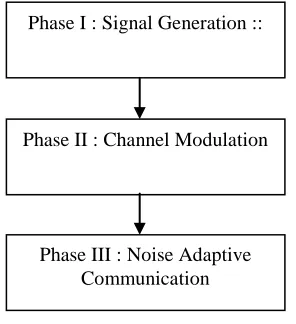
Figure 2 : Proposed Model
The figure shows that the work is divided in three sub stages. Each stage itself provide the effective communication modeling. The stages are defined here under
A) Signal Generation
Orthogonal Frequency Division Multiplexing method has been used for spectrum generation. The main reason of using CDMA spectrum is that is distributes the data over large number of carriers that are spaced apart at different precise frequencies. The spacing between the various sub-carriers provides orthogonality and prevents demodulators from seeing
Phase I : Signal Generation ::
Phase II : Channel Modulation
other frequencies. One major requirement of CDMA is that the signal must be liner because non-linearity can cause interference between the subcarriers. Along with this CDMA has following benefits:
It has higher spectral efficiency.
It saves bandwidth of the spectrum.
It has lower multipath distortion.
It has multimode modulation based on sub-carriers’ SNR which can maximize the channel throughput.
B) Modulation
Here, Firstly we would describe the number of Primary users and Secondary users for our scheme. We would use 5 Primary users and 16 Secondary users per channel. For transmission signals from different sub-carriers are converted into digital form before transmission and are send in the combination of 0’s and 1’s (bits) simultaneously. In digital form, these are represented as I-Waveform and Q-Waveform where I-waveform represent odd bits and Q-waveform represent even bits. I/Q waveforms show any change in magnitude or phase of the signal being send. These are more prevalent in Radio Frequency communication system and mainly where signal modulation is involved because of its efficient way of signal modulation while transmitting the signal. We are converting carrier sine waves into I/Q waveforms because signal modulator that manipulates amplitude and phase is much expensive and less flexible in sine waveforms as compared to circuit used for I/Q waveforms.
This is one of the most efficient modulation method. In this scheme modulation of data is performed by changing the phase of the particular signal. It uses finite number of distinct signals to represent digital data. It modulate 1bit/symbol. BPSK is most robust of all schemes as it takes highest level of noise or distortion.
C) Noise Adaptive Communication
In this work, we would include two factors: Noise and Randomness. We would include different intensity of noise in different sub-carriers and would show the change in error rate as the signal passes thorough the channels. Another factor included for variation is randomness. By adding randomness we can depict the variation occurring in the signal that can lead to distortion also. And in this case channel sensing becomes desirable. For showing randomness factor we are using Crammer Rao Bound method. In this method after modulation signal from different sub-carriers is verified against calculated MSE(Mean Square Error).In this way signal from each sub-carrier is verified w.r.t noise and the result shows parallel output for all the sub-carriers(gradually).
IV. RESULTS
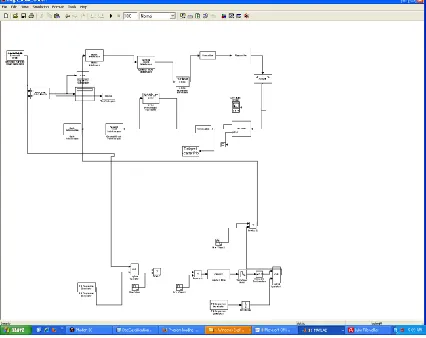
The work is here implemented in simuliink environment to provide the optimized signal. The work is defined without using any tool and by using the basic controls of simulink. According to this the random signal is generated under the parameter specifications. These parameters include the channel level parameters, communication level parameters and user adaptive parameters. The simulink model for this work is shown in figure 4
Here figure 4 is showing the main architecture of MC-CDMA in noisy channel. The signal is here generated randomly with communication level and architecture level parameters specification. The signal is here modulated using BPSK. Here figure shows all the architecture blocks including the signal generation, signal transmission, modulation, FFT transformation and Error recording. Complete model is divided in two main sub stages called transmitter side and the receiver side. These stages are designed in this figure.
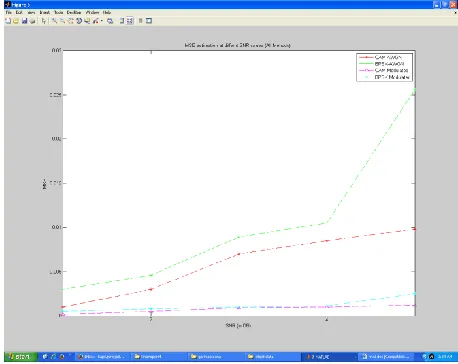
This work is applied on two different modulations called BPSK and QAM and also applied in noisy and noise free channel. The analysis of work is done in terms of BER analysis. The results obtained from the work are given here under
Figure 5 : BER Analysis
Here figure 5 is showing the SNR estimation of communication in MC-CDMA system under noise and noise free channel for two different modulation approach. The estimation is here performed for different SNR value which shows that increase in error respective to SNR. The results shows that the BPSK-AWGN provided the worst result.
V. CONCLUSION
In this paper, An adaptive communication model for MC-CDMA under different modulation methods and different noise adaptation. Author presented the work under noisy and noise free channel. The results shows that the QAM modulation provided more adaptive results.
REFERENCES
[1] KyunByoung KO, "Performance Analysis of Asynchronous MC-CDMA Systems with a Cyclic Prefix", 0-7803-7625-0102/@2002 IEEE.
[2] Kyunbyoung Ko, "Performance Analysis of Asynchronous MC-CDMA Systems With a Guard Period in the Form of a Cyclic Prefix", IEEE TRANSACTIONS ON COMMUNICATIONS 0090-6778 © 2006 IEEE.
[3] G. BRINDHA, "Performance Analysis Of Mc-Cdma System Using Bpsk Modulation", International Journal of Research in Engineering & Technology (IJRET) 2013.
[4] V.Jagan naveen, "Performance Analysis Of Mc-Cdma And Ofdm In Wireless Rayleigh Channel", International Journal of Advanced Science and Technology 2010.
[6] Syed M. Zafi S. Shah, "Performance Comparison of OFDM, MC-CDMA and OFCDM for 4G Wireless Broadband Access and Beyond", PIERS Proceedings 2011.
[7] Peter DROTÁR, "MC-CDMA Performance Analysis for Different Spreading Codes at HPA Saleh Model", 978-1-4244-2088-9/08©2008 IEEE.
[8] Rui Fa, "Performance Assessment of MC-CDMA Systems in Impulsive Noise", WCNC 2009, 978-1-4244-2948-6/09 ©2009 IEEE.
[9] Poonam Singh, "Performance analysis of MC-CDMA System in Multipath fading channel", 1-4244-0340-5/06@2006 IEEE.
[10] Henry Carvajal, "Performance Analysis of MC-CDMA Systems in Rayleigh Fading Channel with Inter-Cell and Co-Cell Interference", 978-1-4799-1148-6/13@ 2013 IEEE.
[11] DHANANJAY KUMAR, “Efficient Resource Allocation In Mc-Cdma Cellular Wireless Networks To Support Multimedia Traffic", Journal of Theoretical and Applied Information Technology .