Available online: https://edupediapublications.org/journals/index.php/IJR/ P a g e | 2502
Development Of Mix Design Of Concrete By Adding Admixture
With Resisting Sulphate Attack And Acid Attack
1Gubbala Yesha Moulika, 2Dr. D.Venkateswarlu , 3 Mr. D.S.V.S .Ram Sagar
1PG Scholar, Dept of Civil Engineering, Godavari Institute of Engineering &Technology (Autonomous),
Rajahmundry, A.P, India.
2Professor & Head of The Department of Civil Engineering, Godavari Institute of Engineering & Technology
(Autonomous), Rajahmundry, A.P, India .
3Assistant Professor, Dept of Civil Engineering, Godavari Institute of Engineering &Technology (Autonomous),
Rajahmundry, A.P, India .
ABSTRACT
This paper presents the result of mix design developed for high strength concrete with silica fume and High range water reducing admixture (HRWR). It involves the process of determining experimentally the most suitable concrete mixes in order to achieve the targeted mean strength. In this research work 53 grade ordinary Portland cement, the locally available river sand, 10 mm graded coarse aggregate were selected based on ASTM C 127 standard for determining the relative quantities and proportions for the grade of concrete M60. For this design ACI 211.4R-93 guidelines were followed. Totally 5 mixes were designed one mix was treated as basic mix with HRWR - 0.5% without silica fume, 4 mixes were designed with Micro silica quantities varied from 5 to 9 percent weight of cementations materials and
HRWR varies between 0.6% to 0.9%with increment of 0.1% . Each mix 2 numbers of 150mm x 300 mm cylinders were cast then kept in curing tank after 24 hours of time period. After 28 days of curing the specimens were tested and the appropriate mix proportions were obtained. The flow properties of resulting concrete is characterized in the fresh state by methods used for Self compacting concrete, such as Slump-flow, V-funnel and L- box tests
respectively. Further the durability properties
are examined for High performance Concrete mix of grade M60. The durability factors are also studied The effect of Na2So4 on these mixes is nil where as HCL and H2So4 had substantial impact.
Keywords: High strength concrete,
Aggregates, Admixtures, ACI Mix Design ,
Compressive strength.
INTRODUCTION
1.1 General theory
Available online: https://edupediapublications.org/journals/index.php/IJR/ P a g e | 2503
upper grade of concrete for additional severe conditions of exposure, for sturdiness issues. With advent of recent generation admixtures, it's doable to attain higher grades of concrete with high workability levels economically. Use of mineral admixtures like ash, slag, metakaolin and silicon oxide fume have revolutionized the concrete technology by increasing strength and sturdiness of concrete by several folds. Combine style of concrete is changing into additional relevant within the above-named state of affairs.
However, it ought to be borne in mind that blend style once adopted at web site
ought to be enforced with correct
understanding and with necessary precautions. Durocrete combine style manual is a shot to extend the notice among the users, regarding concrete combine style. It’s created with intention of serving as handbook for personnel, implementing combine style at web site. Benefits of combine style aims to attain sensible quality concrete at web site economically.
1.2
Economy
a) Economy in cement consumption:
It is doable to save lots of up to fifteen of cement for M20 grade of concrete with the assistance of concrete combine style of course higher the grade of concrete additional are the savings. Lower cement content conjointly leads to lower heat of association and thence reduces shrinkage cracks.
b) Best use of obtainable materials:
Site conditions usually limit the standard and amount of ingredient materials .Concrete combine style offers plenty of flexibility on form of aggregates to be employed in combine style will provide a cheap answer supported the out there materials
if they meet the fundamental IS necessities. This may result in saving in transportation prices from longer distances.
c) Alternative properties:
Mix style will facilitate USA to attain type finishes, high early strengths for early Diamond State shuttering, concrete with higher flexural strengths, concrete with pump ability and concrete with lower densities.
What is combine design?
Concrete is a particularly versatile artefact as a result of, it may be designed for strength starting from M10 (10Mpa) to M100 (100 Mpa) and workability starting from 0mm slump to 150mm slump.
In all these cases the fundamental ingredients of concrete are constant, however it's their relative proportioning that produces the distinction.
METHODOLOGY
Concrete in present days research area decides that totally 5 mixes were designed one mix was treated as basic mix with HRWR - 0.5% without silica fume, 4 mixes were designed with Micro silica quantities varied from 5 to 9 percent weight of cementations materials andHRWR varies between 0.6% to 0.9% with increment of 0.1% . Each mix 2 numbers of 150mm x 300 mm cylinders were cast then kept in curing tank after 24 hours of time period.
Available online: https://edupediapublications.org/journals/index.php/IJR/ P a g e | 2504
weight loss of high strength concrete mixes after immersing in 10 % H2So4 solution increases corresponding to the time. The percentage loss of compressive strength of high strength concrete mixes after immersing in 10% HCL solution increases corresponding to the time.
Certain acids like Oxalic acid and Phosphoric acids do not have any effect on concrete they are totally harmless. All most all aggregates are susceptible to acid attack but siliceous aggregates are more resistant than calcareous aggregates. The contents like Ca (OH)2 and C-S-H gel are more susceptible to chemical attack.
Material properties and the way they
have an effect on combine style
4.1 Cement
Strength/grade of cement:
Grade of cement e.g. 43 grade or 53 grade will influence the combination style. Grade of cement indicates minimum strength of cement in N/mm2 tested as per normal conditions set down by IS codes (OPC 43 grade – IS8112-1989, OPC 53grade – IS 12269 – 1987 e.g. a 43 grade cement ought to provide minimum strength of 43 N/mm2 at 28 days). Higher the strength of cement, higher is that the strength of concrete for constant water/cement magnitude relation. In alternative words the next strength of cement permits use of upper water/cement magnitude relation to attain constant strength of concrete. The IS 10262 - 1982 for combine style fig.2 (refer Annexure II page no. 60 one of Durocrete combine style Manual) provides the various curves of cement supported the particular strength of cement on 28 day. These cement curves give water/cement magnitude relation needed to attain a given target strength. Info on grade of cement might not be as helpful
because the actual 28 days strength of cement. This can be as a result of a number of the 43 grade cements much provides strengths over 53N/mm2. Once a 53-grade cement is hold on for a protracted time, its strength could deteriorate and become similar to 33 grade or 43 grade cement. Therefore 28days strength of cement is needed to pick out the cement curve before beginning the combination style. Finding the 28days strengths of cement consumes time. It’s not sensible in several cases to attend for 28days strength of cement to start out the combination style. In such cases 28days strength reports of the makers is also used and might be supplemented by accelerated strength of cement found by reference combine technique given in IS 10262 aside from strength of cement, the sort of cement e.g. standard Portland cement, pozzolona cement (blended cement) etc, is additionally necessary issue touching the gain of strength. Blended cements accomplish strengths later than standard Portland Cements and need extended natural action amount. However, use of those cements end in additional sturdy concrete by giving bigger resistance to salt and chloride attacks
4.2 Initial & Final setting time of
cement:
Available online: https://edupediapublications.org/journals/index.php/IJR/ P a g e | 2505
Natural action may be started when final setting of cement. The initial setting and also the final setting may be extended by use of retarders so as to avoid cold joints once lead-time for putting concrete is longer.
Fig.no 4.1 Initial and Final setting time
Gradation of fine aggregates:
The gradation of sand is given by sieve analysis. The sieve analysis is completed by passing sand through a group of ordinary sieves and sorting out additive passing proportion through every sieve. The IS 383 – 1970 -Table 4, clause 4.3 (refer Annexure I page no 57 of Durocrete combine style Manual) classifies fine aggregates in 4 zones ranging from zone I representing coarse sand, to zone IV representing the best sand the bounds of additive proportion passing for every sieve for on top of zones are given in table 4 of IS 383 (refer Annexure I Page 57 of Durocrete combine style Manual). The fineness of sand found by sieve analysis governs the proportion of sand in concrete .The overall fineness of sand is given by issue known as fineness modulus. Fineness Modulus is given by division of the summation of additive maintained fractions for normal sieves up to 150-micron sieve size by 100. The fineness modulus of sand varies from a pair of.0 to 4.0; higher the FM coarser is that the sand type of Sand - F M
Fine - 2.0 to 2.8
Medium - 2.8 to 3.2 Coarse - 3.2 and on top of
Specific gravity of fine aggregates:
This is the magnitude relation of solid density of sand particles to the density of water. Higher the precise gravity, heavier is that the sand particles and better is that the density of concrete. Conversely a lower relative density of sand can end in lower density of concrete. Relative density of sand is found with facilitate of pycnometer bottles. The precise gravity of fine aggregates found in Pune region varies from a pair of 0.6 to 2.8.
Silt Content by weight:
This is found by wet-sieving of sand and material passing 75micron sieve is assessed as silt. This silt affects the workability of concrete, leads to higher water/cement magnitude relation and lower strength. The higher limit for 75-micron sieve encase of sand is 3 by weight this limit has but been extended {to 15} just in case of crushed sand in IS 383 – 1970 Table 1. (Refer Annexure I page 59 of Durocrete combine style Manual)
5.3. Coarse combination
a) Most size of coarse combination: most
Available online: https://edupediapublications.org/journals/index.php/IJR/ P a g e | 2506
coat the particles and generate workability. Smaller most size of coarse combination would force bigger fine combination content to coat particles and maintain Cohesiveness of
concrete combine. Hence 40 mm down coarse
combination would force a lot of less water than 20 mm down combination. In alternative words for constant workability, 40mm down combination can have lower water/cement magnitude relation, therefore higher strength when put next to 20mm down combination. Due to its lower water demand, advantage of upper most size of coarse combination may be taken to lower the cement consumption. Most size of combination is commonly restricted by clear cowl and minimum distance between the reinforcement bares. Most size of coarse combination ought to be 5 mm lower than clear cowl or minimum distance between the reinforcement bares, in order that the aggregates will taste the reinforcement in full areas, to provide dense and homogeneous concrete. It’s advantageous to use bigger most size of coarse combination for concrete grades up to M 35where mortar failure are predominant. Lower water/cement magnitude relation can mean higher strength of mortar (which is that the weakest link) and can end in higher strength of concrete. However, for concrete grades on top of M40, bond failure becomes predominant. Higher most size of combination, which can have lower space of contact with cement mortar paste, can fail earlier due to bond failure. Hence for higher grades of concrete (M40 and higher) it's advantageous to use lower most size of combination to forestall bond failure.
Fig.no.4.2 Grading of coarse combination of air voids and aggregate ratio
Grading of coarse aggregate:
The coarse combination grading limits are given in IS 383 – 1970 - table a pair of, Clause 4.1 and 4.2 (Refer Annexure I page 57 of Durocrete combine style Manual) for single size combination moreover as hierarchal
combination. The grading of coarse
combination is vital to urge cohesive & dense concrete. The voids left by larger coarse combination particles are crammed by smaller coarse combination particles so on. This way, the amount of mortar (cement-sand-water paste) needed to fill the ultimate voids is minimum. However, in some cases gap hierarchal combination may be used wherever some intermediate size isn't used. Use of gap-graded combination might not have adverse result on strength .By correct grading of coarse combination, the chance of segregation is minimized, particularly for higher workability. Correct grading of coarse aggregates conjointly improves the compact ability of concrete.
Shape of coarse aggregate:
Coarse combinations will have
Available online: https://edupediapublications.org/journals/index.php/IJR/ P a g e | 2507
favour of angular aggregate with additional extended. Flaky and elongated coarse combination particles not solely increase the water demand however conjointly increase the tendency of segregation. Flakiness and elongation conjointly cut back the flexural strength of concrete. Specifications by Ministry of Surface Transport limit the combined flakiness and elongation to half-hour by weight of coarse aggregates.
4.4 Strength of coarse aggregate:
Material strength of coarse combination is indicated by crushing strength of rock, combination crushing price, combination impact price, and combination abrasion price. In {Maharashtra | geographical area | geographical region | geographic region} the coarse aggregates are made from volcanic rock that has strengths in way over a 100 N/mm2. Hence aggregates seldom fail is strength. The IS limits for on top of tests are given below:
•Combination crushing price
•Combination Impact price
•Combination abrasion price
4.5 Aggregate Absorption:
Aggregate will absorb water up to book by weight once in bone dry state, however, in some cases the mixture absorption may be as high as5%.combination absorption is
employed for applying a correction issue for aggregates in dry condition and crucial water demand of concrete in saturated surface dry condition.
Fig.no. 4.3 Aggregate Absorption
4.6 Variables in combine style
A. Water/cement magnitude relation B. Cement content
C. Relative proportion of fine & coarse aggregates
D. Use of admixtures
Procedure of combine style
1.Set of 12 Cube moulds of size 150 x 150 x
150 mm.
2.A slump cone, tamping rod and a scale.
3.Weighing machine of 5Kg. With accuracy
of a pair forms and corresponding weights up to 2 gram. Balance is extremely suggested.
4.Balance of 100Kgs.
5.Milk cans of 5,2 & one litter unit} capacity
for addition of water.
6.250 cubic centimetre activity cylinder for
silt check.
7.Set of sieves as under:
40mm, 25mm, 20mm, 12.5mm, 10mm together with a Pan & 4.75mm, 2.36mm, 1.18mm, 600, 300, 150, 75 along with a pan and lid.
8 cone-shaped cans of 5 lit and one lit capability for standardization.
9.If Weigh Batcher isn't out there at web
site, then following Foremast ought to be created available at site:
Capacity in litres Nos. L B H Size (in cm) 35 a pair of 40 x 25 x 35
Available online: https://edupediapublications.org/journals/index.php/IJR/ P a g e | 2508
20 a pair of 40 x 25 x 20 15 a pair of 40 x 25 x 15 10 a pair of 40 x 25 x 10
10.Hot plate
11.Compression testing machine.
12.A yield box of size 50cm x 50cm x 75 cm
made from soft-cast steel or laminate
5.1 Standard Corrections for implementing combine style
Correction for surface wet in sand
Sand contains some fraction of water as surface wet. This wet affects (increases) the water cement magnitude relation of concrete. Water cement magnitude relation takes into consideration the overall water out there for association of cement.
Water/ cement magnitude relation = (Water side per batch + Surface wet in sand)
Water to be side for each batch ought to be calculated solely when deducting the surface wet from the water amount of water cement magnitude relation
Water to be side per batch = (Water/ cement magnitude relation * 50) - (surface wet * wt of sand per batch)
If wet content = 4
Wt. Of sand = 135kgs.
Water / cement magnitude relation = 0.55
Water to be side per batch = 0.55 * 50 - 4% * 135
=27.5 - 5.4
=22.1 1trs
Wt. of sand per batch ought to be augmented correspondingly by wt. of surface wet in sand e.g. 5.4kgs.Moisture content in sand can vary
from day to day and conjointly with totally different numerous sand. It’s thus vital to create correction for wet in sand to keep up w/c magnitude relation. If slump on web site is unbroken in restraint, the w/c magnitude relation is mechanically controlled.
5.2 Correction for combination
absorption
For any combine style, the coarse combination is taken into account to be in saturated surface dry condition. Whereas the metal on the location is commonly in bone-dry condition (especially throughout summers). This dry combination usually absorbs the water side in concrete and reduces the workability of concrete. Correction for surface absorption is important to keep up the water cement magnitude relation. A correction of 1 Chronicles to book of wt. of course combination is also created just in case of bone-dry condition of combination.
For example if the mixture absorption is 200th
and total weight of aggregates is a 100 and 80 kilogram then
Aggregate absorption= 0.02 * 180 = 3.6 Litres
Hence amount of water side (From previous example) =22.1 + 3.6
Available online: https://edupediapublications.org/journals/index.php/IJR/ P a g e | 2509
Fig.no. 5.1 A Graph on free- water /cement ratio
5.3 Correction for bulk density
This correction is to be done solely just in case of volume batching. Each combine style is usually done considering weights of various ingredients. Just in case volume batching is completed on web site, the weights of aggregates got to be regenerate into volumes. This can be through with the assistance of bulk densities of aggregates.
Volume of sand per batch = wt. of combination per batch
Bulk density
For example, if wt. of sand per batch = 135kgs.
Bulk Density =1.66Kg/lit
Vol. Of sand = 135/1.66 = 81.3litrs. Say 80litrs.
Hence, use a pair of types of 25litrs and one kind of 30litrs. Bulk density of sand changes with bulk age. Hence correction for bulk density of sand ought to be created a day.
Bulk density of metal is between one.4 Kg/Lit to one.5 Kg/Lit wherever as bulk density of sand varies with bulk age and typically lies between one.6 to 1.8 Kg/Lit.
5.4 Correction for bulk age
This correction is completed solely just in case of volume batching of concrete. Once sand is damp it ‘bulks’ I. e. it occupies kitchen utensil volume. Hence, less weight of sand is taken within the given volume. In alternative words,
the majority density of sand changes. Otherwise, volume of sand has to be augmented in proportion of bulk age .If correction for bulk density is completed, result of bulk age is taken care of & correction for bulk age needn't be done.
Correction for silt
Excessive silt in sand affects the bond between cement and sand. Silt particles are finer than 75micrometer in size and have tremendous water demand. They increase the water cement magnitude relation needed for obtaining constant workability. Organic and inorganic impurities gift in silt conjointly have an effect on the sturdiness of concrete. This reduces the strength of concrete. This downside is sort of severe throughout monsoon. Since the result of silt is to scale back the workability, if clog at web site is found to be over that thought-about in combine style, then either constant combine ought to be used with reduced workability as found throughout standardization of water or workability ought to be augmented by creating field corrections.
5.5 Field corrections for increasing the workability of concrete.
a) Increase the workability by reducing the
precise surface of concrete (reducing the specter of sand, reducer of 10mm down metal if it's flaky etc.). However, this correction is to be done provided that sand is ok or coarse combination is flaky and done solely to the limit of not losing the cohesiveness of concrete combine.
b) Increase the workability by increasing the
Available online: https://edupediapublications.org/journals/index.php/IJR/ P a g e | 2510
combination cut back the sand by 4kg and reduced the coarse combination by 6 kilogram.
c) By adding softener – dose of softener is
also adjusted to urge the specified workability. However, it's necessary to see the compatibility of softener with cement and conjointly the utmost and minimum dose of plasticisers as specified by the makers.
5.6 Corrections for changes in gradation of sand
Sand shows heap of variation on sites due to modification in supply of provide. If the sand received at web site is finer than the one thought-about in combine style the surplus extended created by the fines can increase the water demand. This may either cut back the slump of concrete or increase the water cement magnitude relation. Hence correction ought to be done to scale back the precise surface of fine combination. This may be done by reducing the fine combination by 5 kilogram and increasing the wt. of course combination by 5 kilogram keeping the correction of over 10kg is needed for sand consult the combination style laboratory. Similarly, if sand received at web site is coarser than the one thought-about in combine style the combination is probably going to segregate due to lack of fines (Lack of cohesion). In such a scenario increase the fine combination by 5 kilogram and cut back the overall combination by 5 kilogram keeping the total weight of combination constant. This could be continued until the combination becomes cohesive and also the needed workability is obtained for the given water cement magnitude relation. If correction of over 10kg is needed for sand consult the combination style laboratory. Associate degree excessive correction could increase the water cement magnitude relation or cut back the workability of concrete. The fineness modulus of sand in Pune varies from
3.2 to 3.8 The IS specifies a limit of2.2 (fine sand) to 3.2 (coarse sand) for fine combination. This implies that sand out there in Pane is extraordinarily coarse. This can be pared due to absence of fines within the sand and 10%to 15 August 1945 is maintained on 4.75mm sieve as chalk or shingle gift within the sand. Just in case of coarse sand, a vicinity of sand is also replaced by fine crushed sand to extend the missing fines in concrete. Just in case crushed sand isn't out there fine stone dirt (600 passing over 60 %and150 passing less than 20%) is also accustomed replace a vicinity of sand. Such stone dirt mustn't replace over fifteen kilogram of sand below traditional circumstances. Strict management on water cement magnitude relation ought to be unbroken. Stone dirt reduces the workability; thence, the water cement magnitude relation is probably going to extend.
5.7 Correction for changes in size and form of coarse combination
If size of coarse combination is less than that used for combine style sand content can have to be compelled to be augmented to account
for augmented extended of coarse
Available online: https://edupediapublications.org/journals/index.php/IJR/ P a g e | 2511
5.8 Field Testing procedures
Finding surface wet of sand
Take 500 gram of sand and warmth it during a receptacle gently until sand is dry and starlets flowing freely.
Surface dry sand is weighed once more to seek out the loss in weight W
Surface wet = (500 - W)
NOTE: it's necessary to not over heat the sand, because it can build the sand bone dry. The sand particles ought to be in saturated surface dry condition when heating. To make sure this condition heats the sand solely to the purpose it becomes free flowing and there's a colour modification. Wet in sand leads to bulk age (increase in volume of sand) to urge a rough estimate of surface wet following thumb rule is also used once sand isn't extraordinarily wet.
5.9 Measuring Silt Content at web site
Take 50ml. of water in 250ml. beaker and add some salt to that. Add sand to that until 100ml.
Mare is reached. Once more add water up to 150ml. Stir the sand well to clean it in salt water.
Keep the beaker still for 3 hours. Observe the thickness of the silt layer.
Silt content = H8 of silt layer (ml) * 100
H8 of sand (ml) Sand with silt content bigger then V-E Day calculated by on top of technique mustn't be used for concreting. In laboratory the clog is calculated at any rate weight of particles finer than 75 micrometer. The limit is given as 3 in IS 383
5.10 Measuring Bulk density at web site
WEIGHT of fabric in kilogram Bulk density =Volume in litres
Bulk density may be measured on web site by filling a typical 35 litres type with combination and advisement the mixture crammed within the type. e.g. wt. of sand in 35 litres type = 58kg.
Bulk density =58/35 = 1.66kgs./ litres.
Measuring Bulk age on web site
Take 100ml. of sand in 250ml. beaker and add water therefore on fully submerge the sand. Shake the beaker well and also the keep it steady for a few time. Note the amount to which it settles.
Original level - New level
Bulk age yuletide = *100
New Level
5.11 The sieve analysis of fine aggregates and also the fineness modulus
Apparatus:
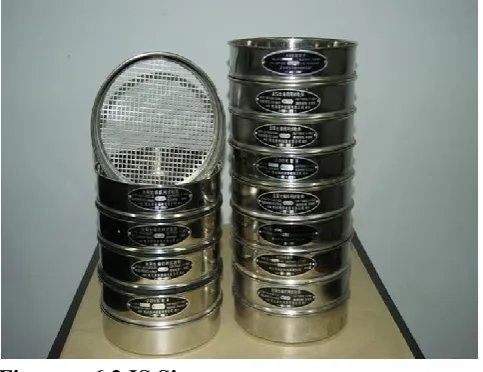
Set of sieves move 40 mm, 25 mm, 20 mm, 16 mm, 12.5 mm, 10 mm, 6.3 mm, 4.75 mm, 2.36 mm, 1.18mm, 600, 300, 150 weighing balance, heating pan and stove.
Procedure:
I. Heat 1Kg of sand on stove to get rid of all the wet. This may build the particles free from cohesion elicited due to physical phenomenon of free water in sand.
ii.Prepare all the sieves so as of size, with
largest sieve size on the highest.
iii.Place weighted material on the highest
Available online: https://edupediapublications.org/journals/index.php/IJR/ P a g e | 2512
jerking, in order that the fabric is kept moving over the sieve surface. Shaking ought to be done until all the particles are given an opportunity to taste the sieve.
iv.Weigh the fabric maintained on every sieve
on a weighing machine. The material retained on every sieve when shaking represents the fraction of combination coarser than the sieve size in question and finer than the sieve size on top of.
v. Calculate yuletide maintained and also the
election maintained on every sieve. The summation of the children additive wt maintained on all the sieve sizes up to 150 micron, divided by a 100 provides the fineness modulus.
The sieve analysis is recorded in following table :
Fig.no. 6.2 IS Sieves
Casting and testing of Concrete Cubes
Cubes of concrete ought to be forged for each shift of concreting work to estimate the strength of concrete. Concrete for filling the cubes ought to be taken from the centre discharge of cement mixer. Concrete from starting or at the top of discharge ought to be
avoided. Cubes ought to be crammed in 3 equal layers. every layer ought to be uniformly tamped a minimum of 35times with a16mm blunt rod. The tamping ought to be wiped out such a way that the rod penetrates through the layer up to the lower layer. Cubes ought to be properly levelled and finished exploitation hand trowel. Cubes ought to be unbroken in shadow properly coated with wet bagging baggage. Cubes ought to be Diamond State moulded when 24hours and immersed in water for natural action. It’s necessary to stay the cubes away type the shocks or vibrations particularly for initial 3 days of casting. We tend to suggest that minimum 6 cubes ought to be taken a day and also the batch of 3 cubes be tested for 7 days and 28days severally. As per IS 456 -2000 minimum frequency of sampling is as follows:-
Vol of concrete range of samples
00 - 5 money supply one
06 - 15 money supply a pair of
16 - 30 money supply 3
31 – 50 money supply 4
51 & on top of 4 and one further for every further 50 money supply 3 check specimens shall be created for every sample for testing at 28days .If 3 and 7day strengths are needed, further samples ought to be taken, over and on top of mentioned within the frequency of sampling.
5.12 Measuring Slump at web site
Slump test:
Available online: https://edupediapublications.org/journals/index.php/IJR/ P a g e | 2513
Procedure:
i. the inner surface of the slump cone shall be totally clean and may be free from any set concrete before commencing the check. The mould ought to be placed on swish horizontal, rigid and non – absorbent surface reminiscent of fastidiously levelled metal plate. The mould is firmly command in position whereas filling it.
ii. The mould ought to be crammed in 4 layers
every just about one quarter of the peak of mould. Every layer shall be tamped with 25 blows. The stroke ought to be distributed during a uniform manner over the cross section of mould. For the ordinal and resultant layers tamping rod ought to penetrate into underlying layer. The lowest layer ought to be tamped throughout its depth.
iii.When the highest layer has been rodded the
concrete shall be smitten off level with trowel or rod. The mortar, which can have leaked out between mould and base plate, shall be clean away.
iv. The mould shall be fare from concrete
directly by raising it slowly and thoroughly in vertical direction. This may enable the concrete to subside and also the slump shall be measured directly by crucial the distinction between height of mould which of highest purpose of slouching concrete specimen. The on top of operation shall be dispensed during a place free from shock or vibration
Fig.no. 5.3 Slump Cone Test
5.13 Trouble Shooting at web site
The mix segregates: -
a. Cut back the water cement magnitude relation – Higher workability usually leads to segregation thence cut back the workability by reducing the water side to combine.
b. Increase the blending time of mixer – Poor quality of blending usually leads to segregation.
Segregating combine may be a sign of poor quality of mixer machine.
c. Increase the sand proportion – lack of fines usually leads to segregation. If sand is extraordinarily coarse, a vicinity of sand could have to be compelled to get replaced by fine stone dirt.
d. Increase the cement content – Richer mixes have lesser tendency for segregation. This could be the expedient because it adds to the price.
Available online: https://edupediapublications.org/journals/index.php/IJR/ P a g e | 2514
a. Cut back the sand content – If sand out there at web site is fare finer than the one used in style, higher specific surface can end in lower workability. A 10-15 kilogram reduction in sand per batch can increase the workability. The reduction of sand ought to be remunerated by increasing quantity of metal by equivalent amount.
b. Check the silt content – loose sand can greatly cut back the workability of combine. The silt particles greatly enhance the precise surface and cut back the workability. strive replacement it by either non-salty sand or crushed sand. Sand laundry may be adopted if sand washer is on the market.
c. Check the mixer quality and combination time – Inadequate combination usually results in poor workability.
Strength of Cube Results is low
a. Check whether or not the water/cement magnitude relation employed in the concrete combine was high. This can be one in every of the foremost common reasons for low strength. This may be indicated by the slump reading of the concrete batch from that the cubes are forged. Were commending that a slump reading be taken for each batch from that cubes are forged. A slump reading in way over the slump given within the style combine indicates higher water cement magnitude relation.
b. Check whether or not the cubes are forged with correct compaction as mentioned in the weight of concrete cube lower than 8 kilogram could indicate poor compaction.
c. Check if dimensions of concrete cubes are inside tolerance of +/- 0.2 mm. If the scale of cubes doesn’t seem to be as specified on top
of, the faces of the cube being crushed might not be parallel to every alternative. This could end in reduced space of contact between cube and plate of CTM and conjointly eccentric loading.
d. Check if the raw materials used were satisfactory. Salty sand, flaky aggregates and cement with poor strength can end in low strength. If the on top of raw materials is out there, cubes ought to be forged and tested to rule out the on top of chance. A tiny low sample of cement must always be unbroken aside for later testing for each major casting. This sample may be tested for physical and chemical properties just in case of failure. In several cases it's seen that no firm conclusion may be drawn due to non-availability of cement for testing.
e. Check if combination was correct and variation amongst totally different cube samples is with within the tolerance limit of 15 August 1945 from the common. Improper combination could end in non uniform distribution of cement paste and lower strengths.
f. Check if the concrete cubes haven't been subjected to some vibration or shocks within the early age.
TAREGET STRENGTH CALCULATION
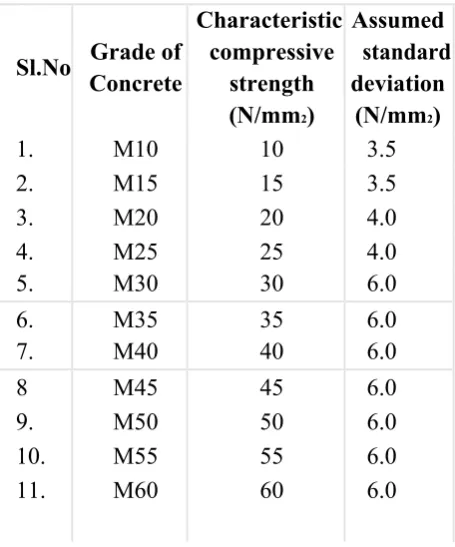
Calculate the target compressive strength of concrete exploitation the formula given below.
fck’ = fck + 1.65s
Where,
Available online: https://edupediapublications.org/journals/index.php/IJR/ P a g e | 2515
fck = Characteristic compressive strength at 28days in N/mm2. (Same as grade of concrete, see table below)
s = normal deviation The price of ordinary deviation, given within the table below, may be taken for initial calculation.
Sl.No Grade of
Concrete
Characteristic compressive
strength
(N/mm2)
Assumed standard deviation
(N/mm2)
1. M10 10 3.5
2. M15 15 3.5
3. M20 20 4.0
4. M25 25 4.0
5. M30 30 6.0
6. M35 35 6.0
7. M40 40 6.0
8 M45 45 6.0
9. M50 50 6.0
10. M55 55 6.0
11. M60 60 6.0
Table no. 6.2 target strength calculation
SORTING OUT VOLUME PROPORTIONS FOR COARSE combination & FINE combination
Sl.No. Nominal
Volume of coarse aggregate per unit volume of total
Maximu m
aggregate for different
zones of fine
aggregate
Size of Aggrega te
Zon e IV
Zon e III
Zon e II
Zon e I
(mm)
1 10 0.50 0.48 0.46 0.44
2 20 0.66 0.64 0.62 0.60
3 40 0.75 0.73 0.71 0.69
Table no. 6.8 Different sizes of aggregate in different zones
Volume of coarse combination such as unit volume of total combination for various zones of fine combination is given within the following table.
Rule: for each increase or decrease by 0.05 in water-cement magnitude relation, the on top of values are going to be remitted or augmented by 0.01, severally.
If the position of concrete is completed by a pump or wherever is needed to be worked around full reinforcing steel, it's going to be fascinating to scale back the calculate coarse combination content determined as on top of, up to 10 %.After shrewd volume of coarse combination, work out it from one, to seek out the amount of fine combination.
Test results
Specimens were tested to see the characteristic compressive strength of high strength concrete as per ASTM C -39/C39M - 99 The cylinders were loaded in a very 200T compression testing machine at the speed of 0.3 N/mm2 /s till failure as shown in Fig. 1. The results were tabulated as shown in Table No. 1, from the check results shows that the silicon oxide fume content exaggerated, the compressive strength conjointly exaggerated step by step up to 9 pace silicon oxide fume replacement.
Available online: https://edupediapublications.org/journals/index.php/IJR/ P a g e | 2516
Tri al Mi
x Cement
Sil ic
a Fine Coarse H R W R
W at
er 28days
K g .
Fu m
e Aggre rega Agg Kg. Kg. compressive K
g. gate te Kg.
streng th
Kg.
(N/m m2)
1 522.00 -
59 82
0 5.15 104 2.74 167.74 73.52
2 492.
41 31.2
3 59 82 0
104 5.15
3.5 8
169.
12 74.12
3 486.25 36.58
59 82
0 5.15 104 3.75 16812 75.12
4 47823 41.78
59 82
0 5.15 104 4.32 165.12 74.12
5 471.
25 47.1
2 59 82 0
104 5.15
4.7 8
1681
2 76.15
RESULTS AND DISSCUTIONS
6.1 This technique of concrete combine style comprises following 11 steps
1. Style specification
2. Testing of materials
3. Shrewd target strength for combine
proportioning
4. Choosing water/cement magnitude
relation
5. Shrewd water content
6. Shrewd cement content
7. Sorting out volume proportions for
coarse combination & fine combination
8. Combine calculations
9. Trial combination and
10. Workability activity (using slump cone
method)
11.Repetition step 9 & 10 till all necessities is
consummated
6.3 Resistance of high strength concrete to sulphate attack and acid attack
The aim of the present study is to identify and estimate the effect of H2 S04, HCL and Na2So4 on concrete made up of micro silica, water proofer and super plasticizer. The workability studies are also conducted and the durability of the concrete is studied against the attack of H2 So4, HCL and Na2So4.
Procedure for the Determination of Resistance of Concrete to Sulphate Attack
The effect of sulphate attack on concrete and resistance of concrete to the attack has been tested in the laboratory, by immersing specimens of concrete cubes in the solution which contains 5 % sodium sulphate. The effect of chemical attack has been estimated by taking change of mass in to consideration.
Available online: https://edupediapublications.org/journals/index.php/IJR/ P a g e | 2517
sulphate attack on performance and properties of concrete are identified. In order to speed up the test, specimens are subjected to alternate cycles of immersion and drying. The resistance of concrete to the sulphate attack has been estimated by considering changes in their dynamic modules of elasticity. Even from the visual observation also the intensity of sulphate attack on cracking and the impact of disintegration is noticed.
Test on sulphate resistance of high strength self compacting concrete using mineral admixtures
Sulphate resistance of concrete is determined by immersing test specimens of size 100 X100 X 100 mm cubes in 10% sodium sulphate. The deterioration of specimens is presented in the form of percentage reduction in weight and percentage reduction in compressive strength concrete of specimens at 28, 56, 90 days.
Test of Acid Attack on Concrete Specimens
In fact concrete is not fully resistant to acids. All acids will have their impact on concrete. The rate of speed of action may be different but certainly they disintegrate concrete. Certain acids like Oxalic acid and Phosphoric acids do not have any effect on concrete they are totally harmless. All most all aggregates are susceptible to acid attack but siliceous aggregates are more resistant than calcareous aggregates. The contents like Ca (OH)2 and C-S-H gel are more susceptible to chemical attack. The liquids, whose pH value less than 5.5 and 4.5 cause serious damage to the concrete, such liquids speed up the disintegration process and ultimately destruct the structures. The intensity of corrosion caused by HCL at equal concentration is more in comparison with sulphuric acid. Since sulphuric acid forms a less soluble Calcium Sulphate on reaction with lime in concrete, the solution fills the gaps of concrete and prevents permeability and offers resistance to corrosion
by acid. The present experimental study conducted on concrete specimens of size 10X10X10 cm. The specimens are immersed in 5 % H2 So4, HCL and Na2So4 solutions respectively. The deterioration of the specimens is estimated by finding out the percentage reduction in weight of the specimen. The reduction in compressive strength of the specimens when they are immersed in chemical solutions is also identified.
Test on sulphate resistance of high strength self compacting concrete using mineral admixtures
Sulphate resistance of concrete is determined by immersing test specimens of size 100 X100 X 100 mm cubes in 10% sodium sulphate. The deterioration of specimens is presented in the form of percentage reduction in weight and percentage reduction in compressive strength concrete of specimens at 28, 56, 90 and 180 days.
CONCLUSION
In view of the Investigation directed on the Mix outline of high quality cement by utilizing silica smoke and High range water
diminishing admixture (HRWR), the
Available online: https://edupediapublications.org/journals/index.php/IJR/ P a g e | 2518
miniaturized scale silica compressive quality likewise expanded up to 9% however the droop esteem was lessened. Supplanting of concrete with Micro silica 9%, HRWR 0.9 % gave the most extreme compressive quality. The percentage weight loss of high strength concrete mixes after immersing in 10 % HCL solution increases corresponding to the time. The percentage weight loss of high strength self Compacting concrete mixes after immersing in 10 % Na2So4 is observed to be nil for any period of time. This shows that high strength concrete mixes have the resistance against Na2So4 solution. The percentage weight loss of high strength concrete mixes after immersing in 10 % H2So4 solution increases corresponding to the time. The percentage loss of compressive strength of high strength concrete mixes after immersing in 10% HCL solution increases corresponding to the time.
REFERENCE
1. Normal Specification for Concrete
Aggregates: This specification defines the wants for coarse and fine combination employed in traditional weight concrete. Light-weight weight combination isn't coated in C33 it's instead coated in ASTM C330.
2. C94, normal Specification for
Ready-Mixed Concrete: This normal contains the specification for ready-mixed concrete factory-made and in freshly mixed and untendered state.
3. C109, normal check technique for
Compressive Strength of Portland cement Mortars (Using 2-in. or [50-mm] Cube Specimens): This check technique covers determination of the compressive strength of Portland cement mortars, using 2-in. or [50-mm] cube specimens.
4. C125, normal nomenclature concerning
Concrete and Concrete Aggregates: This normal may be a compilation of definitions of terms that are employed
in alternative ASTM concrete
standards below the jurisdiction of Committee C09.
5. C150, normal Specification for
Portland cement: This normal contains the quality specification for Portland cement, together with definition of every cement sort reminiscent of sort II, Type V, etc. C151, normal check technique for Autoclave growth of
Hydraulic Cement: This check
technique covers determination of the autoclave growth of Portland cement.
6. C157, normal check technique for
Length modification of Hardened
Hydraulic-Cement Mortared and
Concrete: This check technique covers the determination of the length changes in Portland cement mortar that are made by causes on the other hand
outwardly applied forces and