Volume 2010, Article ID 471842,10pages doi:10.1155/2010/471842
Research Article
A Genetic Algorithm Optimization Technique for
Multiwavelet-Based Digital Audio Watermarking
Prayoth Kumsawat
School of Telecommunication Engineering, Institute of Engineering, Suranaree University of Technology, 111 University Avenue, Muang District, Nakhon Ratchasima 30000, Thailand
Correspondence should be addressed to Prayoth Kumsawat,[email protected]
Received 15 February 2010; Revised 10 May 2010; Accepted 30 June 2010
Academic Editor: Srdjan Stankovic
Copyright © 2010 Prayoth Kumsawat. This is an open access article distributed under the Creative Commons Attribution License, which permits unrestricted use, distribution, and reproduction in any medium, provided the original work is properly cited.
We propose a new approach for optimization in digital audio watermarking using genetic algorithm. The watermarks are embedded into the low frequency coefficients in discrete multiwavelet transform domain. The embedding technique is based on quantization process which does not require the original audio signal in the watermark extraction. We have developed an optimization technique using the genetic algorithm to search for four optimal quantization steps in order to improve both quality of watermarked audio and robustness of the watermark. In addition, we analyze the performance of the proposed algorithm in terms of signal-to-noise ratio, normalized correlation, and bit error rate. The experimental results show that the proposed scheme can achieve a good robustness against most of the attacks which were included in this study.
1. Introduction
During the past few years, digital multimedia technology and Internet networks have made great progress and they are now becoming increasingly important in daily life. Consequently, intellectual property protection is a pressing concern for content owners who are exhibiting digital representation of the photographs, music, video, and original artworks through the Internet.
Digital watermarking is one of the most popular approaches considered as a tool for providing the copyright protection of digital contents. This technique is based on direct embedding of additional information data (called watermark) into the digital contents. Ideally, there must be no perceptible difference between the watermarked and original digital contents, and the watermark should be easily extractable, reliable, and robust against data compression or any signal manipulations [1]. The main requirements of digital watermarking are invisibility, robustness, and data capacity. These requirements are mutually conflicting, and thus, in the design of a watermarking system, the tradeoff has to be made.
According to the International Federation of the Phono-graphic Industry (IFPI) [2], audio watermarking should
have the following specifications: (1) audio watermarking should not degrade perception of original signal. (2) signal-to-noise ratio (SNR) should be greater than 20 dB and there should be more than 20 bits-per-second (bps) data payload for watermark. (3) watermark should be able to resist most common audio processing operations and attacks. (4) watermark should be able to prevent unauthorized detection, removal, and embedding, unless the quality of audio becomes very poor.
In general, digital audio watermarking can be performed in time domain and transform domain, where the properties of the underlying domain can be exploited. Currently, watermarking techniques based on transform domain are more popular than those based on time domain since they provide higher audio quality and much more robust watermark.
Typical schemes for digital watermarking were based on transform-domain techniques with discrete cosine transform (DCT) [3,4], discrete Fourier transform (DFT) [5,6], and discrete wavelet transform (DWT) [7–12].
(DMT) domain using successive subband quantization and a perceptual modeling.
Kumsawat et al. [14] proposed an image watermarking algorithm using the DMT and genetic algorithm (GA) applied to search for optimal watermarking parameters to improve the quality of the watermarked image and the robustness of the watermark. Ghouti and Bouridane [15] proposed a novel audio fingerprinting framework for robust perceptual hashing of audio content using balanced multi-wavelets. In [16], Kumsawat et al. proposed a multiwavelet-based audio watermarking scheme by utilizing the audio statistics characteristics and quantization index modulation (QIM) technique.
Improvements in performance of digital audio water-marking schemes can be obtained by exploiting the char-acteristics of the human auditory system in watermarking process. It is possible to embed perceptually inaudible watermarks with more energy in an audio, which makes watermark more robust [12,17].
Another way to improve the performance of watermark-ing schemes is to make use of artificial intelligence (AI) techniques. The watermarking system can be viewed as an optimization problem. Therefore, it can be solved by genetic algorithm [4,14, 18], adaptive tabu search (ATS) [10], or support vector machine (SVM) [11]. There has been little research in application of GA to digital audio watermarking problems.
In this paper, we propose an audio watermarking method based on the discrete multiwavelet transform for the application of copyright protection. In our algorithm, the watermark is embedded into the multiwavelet transform coefficients using quantization index modulation technique. The watermark can be not only detected but also extracted to verify the owner. We apply the GA to search for four optimal watermarking parameters in order to achieve optimum performance. Finally, we have compared the experimental results before and after optimization using GA with the results of previous works.
This paper is organized as follows. In Sections 2.1
and 2.2, the preliminaries of multiwavelets and GA are introduced, respectively. Watermarking in the DMT domain with GA optimization is described inSection 3. InSection 4, the experimental results and discussions are shown. The conclusions of our study can be found inSection 5.
2. Preliminaries
2.1. Multiwavelet Transform. In recent years, multiwavelet transformation has gained a lot of attention in signal process-ing applications. The main motivation of usprocess-ing multiwavelet is that it is possible to construct multiwavelets that simul-taneously possess desirable properties such as orthogonality, symmetry, and compact support with a given approximation order [14,19]. These properties are not possible in any scalar wavelet (wavelet based on one scaling function). One of the well-known multiwavelets was constructed by Donovan, Geronimo, Hardin, and Massopust (DGHM) [20]. DGHM multiwavelets simultaneously possess orthogonality, com-pact support, an approximation order of 2, and symmetry.
x Q(z) c0
Analysis H(1/z)
G(1/z) 2
2 c1
d1 2
2
Synthesis H(z)T
G(z)T
+ c0 P(z) x
Figure1: Multiwavelet filter bank.
Unlike scalar wavelet, even though the multiwavelet is designed to have approximation order p, the filter bank associated with the multiwavelet basis does not inherit this property. Furthermore, since the multiwavelets have more than one scaling function, the dilation equation becomes a dilation with matrix coefficients. Thus, in applications, one must associate a given discrete signal into a sequence of length −r vectors (where r is the number of scaling functions) without losing some certain properties of the underlying multiwavelet. Such a process is referred to as prefiltering or multiwavelet initialization.
The block diagram of a multiwavelet with prefilterQ(z) and postfilter P(z) is shown in Figure 1 where c1 is the approximation subband which mainly represents the low frequency component of the audio signal, and d1 is the detail subband which mainly represents the high frequency component of the audio signal. H(z) and G(z) are the z
transform ofh(n) andg(n), respectively. Two audio subbands are obtained from each level of decomposition; one detail subband and one approximation subband. For the next level of decomposition, the multiwavelet transform is applied to the approximation subband of the previous decomposition level. Thus,nlevels of decomposition result inn+1 subbands at the analysis filter bank.
2.2. Genetic Algorithm. Genetic algorithm is one of the most widely used artificial intelligent techniques belonging to the area of evolutionary computation. Genetic algorithm based on the mechanisms of natural selection and genetics, has been developed since 1975 [21] and has been applied to a variety of optimization and search problems [4,14,18,
22]. GA has been proven to be very efficient and stable in searching for global optimum solutions. Usually, a simple GA is mainly composed of three operations: selection, genetic operation, and replacement. A brief summary for implementing GA can be summarized as follows.
Population (chromosomes) Selection Fitness
Replacement Parents
Genetic operation
Offspring
Fitness
Phenotype
Objective function
Phenotype
Figure2: GA Cycle.
system performance index (e.g., an error). Next, a particular group of chromosomes is chosen from the population to be parents. The offspring is then generated from these parents by using genetic operations, which normally are crossover and mutation. Similar to their parents, the fitness of the offspring is evaluated and used in replacement processes in order to replace the chromosomes in the current population by the selected offspring. The GA cycle is then repeated until a desired termination criterion is satisfied, for example, the maximum number of generations is reached or the objective value is below the threshold. There are various techniques in designing GA that we have to take into account. These include encoding schemes, fitness evaluation, parent selection, genetic operations, and replacement strategies. The GA cycle is shown inFigure 2 where the phenotype is the coding scheme used to represent the chromosomes.
3. The Proposed Watermarking Algorithm
In this section, we first give a brief overview of the watermark embedding and watermark extracting algorithms in the DMT domain based on the concept of the quantization index modulation technique. We then describe our proposed opti-mization technique in watermarking scheme using genetic algorithm.
3.1. Watermark Embedding Algorithm. The watermark embedding algorithm is described as follows:
(1) Generate a seed by mapping a signature or text through a one-way deterministic function. The seed is used as the secret key (K) for watermarking.
(2) To increase security, perform a pseudorandom per-mutation in order to disperse the spatial relationship of the binary watermark pattern. Therefore, it would be difficult for a pirate to detect or remove the watermark. We useWandW
to denote the original watermark image and the permuted watermark image, respectively. The relationship betweenW
andWcan be expressed asW(i,j)=W(i,j), where (i,j) is permuted to the pixel position (i,j) in a secret order using the secret key (K).Since the audio signal is one-dimensional, we should transform the permuted watermark image into the one-dimensional sequence in order to embed it in the audio signal. Then, theWis transformed and mapped into a binary
antipodal sequenceW= {wi}fori=1, 2,. . .,Nw, whereNw
is the length of watermark andwi∈ {+1,−1}.
(3) Transform the original audio signal using the DMT. Five-level DMT is chosen because it was found in our experimental results that the higher levels do not yield significantly better results while they increase computational complexity. Since the approximation coefficients are sup-posed to be relatively stable and less sensitive to slight changes of the audio signal, they are ideal embedding area. In order to achieve a balance between robustness and fidelity, the coefficients at coarsest approximation subband are selected for watermark embedding based on artificial intelligent technique. Furthermore, the coefficients in high-frequency subband are not used for watermark embedding because of their low signal energy in this frequency band.
(4) Select the significant coefficients in the DMT domain which is the firstNwlargest coefficients at coarsest
approxi-mation subband to embed the watermark bits. The position of significant coefficients will be sent to the receiver as the side information.
(5) Based on the statistical values of the selected coeffi -cients, we have grouped them into 4 groups corresponding to their magnitudes. Each group will be quantizing with different quantization steps. To increase the watermarking security, we order the selected coefficients in a pseudoran-dom manner. The ranpseudoran-dom numbers can be generated using the same secret key (K) in generating the watermarkW.
(6) For watermark embedding, the sequence {wi} is
embedded into the selected coefficients by quantization index modulation technique. The quantization function is given as follows [16]:
ci= ⎧ ⎪ ⎪ ⎪ ⎪ ⎪ ⎪ ⎨ ⎪ ⎪ ⎪ ⎪ ⎪ ⎪ ⎩
ci
Sj ·Sj
+3Sj
4 , ifwi=+1,
ci
Sj ·Sj
+Sj
4, ifwi= −1,
(1)
where x rounds to the greatest integer smaller than
x,{ci}, and {ci} are the DMT coefficients of the original
audio data and the corresponding watermarked audio data, respectively. The variable Sj, for j = 1, 2, 3, 4, denotes the
quantization steps corresponding to 4 groups of the selected coefficients. The coarsest approximation subband of five-level multiwavelet decomposition and the 4 groups of the firstNw largest coefficients are shown in Figures3(a) and 3(b), respectively.
A large quantization step makes the watermark robust, but it will destroy the original quality of the audio signal. Thus, the value of quantization step should be as large as possible under the constraint of imperceptibility.
×104 4.5 4 3.5 3 2.5 2 1.5 1 0.5 0
−3
−2
−1 0 1 2
3 Coarsest approximation subband
(a)
Group1 Group2 Group3 Group4
1200 1000 800
600 400
200 0
1.4 1.6 1.8 2 2.2 2.4 2.6 2.8
3 1024 selected coefficients
(b)
Figure3: (a) The coarsest approximation subband of five-level multiwavelet decomposition and (b) the 4 groups of the firstNw(1024)
largest coefficients.
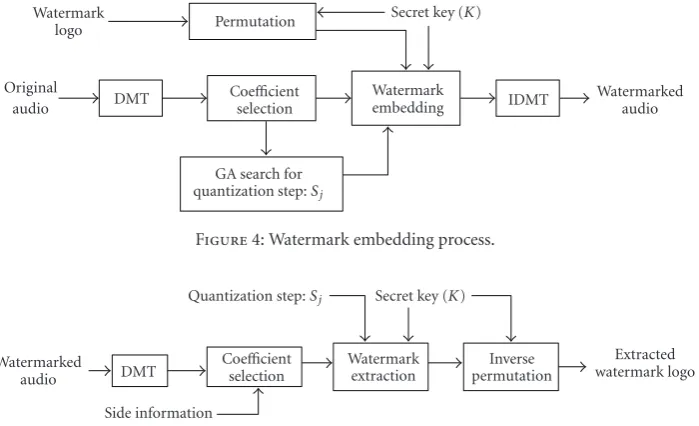
(8) Reorder the selected coefficients and inverse DMT to obtain the watermarked audio signal. The overall watermark embedding process is shown inFigure 4.
3.2. Watermark Extracting Algorithm. The watermark extracting algorithm is outlined as follows:
(1) Transform the watermarked audio signal into five-level decomposition using the DMT to obtain detailed coefficients and approximation coefficients. Then, we choose the firstNwlargest coefficients in the coarsest approximation
subband from position in the side information and group them into 4 groups. We further order them in a pseudoran-dom manner using the secret key (K).
(2) Letcidenote theNwlargest coefficients of the coarsest
approximation subband. The embedded watermark can be extracted fromciby using the following rule:
w∗i =
⎧ ⎪ ⎪ ⎪ ⎪ ⎪ ⎪ ⎨ ⎪ ⎪ ⎪ ⎪ ⎪ ⎪ ⎩
+1, ifci−
ci
Sj ·Sj≥
Sj
2,
−1, ifci−
ci
Sj ·Sj≥
Sj
2.
(2)
(3) Inverse the permutation of W∗ where W∗ = {wi∗,i = 1, 2,. . .,Nw} to obtain the extracted watermark
W.In our proposed method, the extracted watermark is a visually recognizable image. After extracting the watermark, we used normalized correlation coefficients to quantify the correlation between the original watermark and the extracted one. A normalized correlation (NC) betweenW andW is defined as
NCW,W=
Nw
i=1wiwi
Nw
i=1w2i
iw2i
, (3)
whereWandWdenote an original watermark and extracted one, respectively, andW = {wi}fori = 1, 2,. . .,Nw.The
watermark extracting process is shown inFigure 5.
3.3. Improving Performance Using Genetic Algorithms. In the design of digital audio watermarking system, there are three goals that are always conflicted. These goals are imperceptibility, robustness, and data capacity. In order to minimize such conflicts, this work employs the genetic algorithm to search for 4 optimal watermarking parameters. This allows the system to achieve optimal performance for digital audio watermarking.
For the optimization process, GA is applied in the water-mark embedding and the waterwater-mark extracting processes to search for quantization steps (Sj).The objective function of
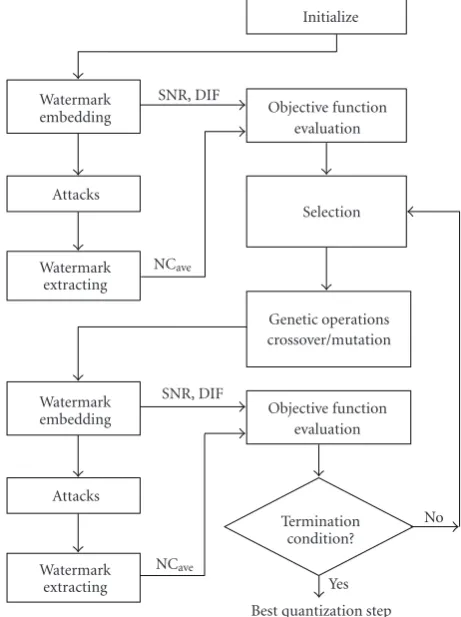
searching process is computed by using factors that relate to both imperceptibility and robustness of a watermark. A high quality output audio and robust watermark can then be achieved. The diagram of our proposed algorithm of applying GA is shown in Figure 6 and details of genetic algorithm optimization process are described as follows.
3.3.1. Chromosome Encoding. Chromosomes in GA rep-resent desired parameter to be searched. The population (chromosomes) size must be chosen carefully to give suf-ficient genetic diversity. A small-sized population reduces the evaluation cost but it may cause premature convergence. For a large-sized population, the higher computation time is required. Therefore, it is important to achieve a good or acceptable result within a reasonable computation time. In this paper, the proper population size is set to be 40 (as described in the next section). The encoding scheme is binary string with 32 bit resolutions for each chromosome. Hence, the parameterSjis represented by chromosome with length
Watermark
logo Permutation
Secret key (K)
Original
audio DMT
Coefficient selection
Watermark
embedding IDMT
Watermarked audio
GA search for quantization step:Sj
Figure4: Watermark embedding process.
Quantization step:Sj Secret key (K)
Watermarked
audio DMT
Coefficient selection
Watermark extraction
Inverse permutation
Extracted watermark logo Side information
Figure5: Watermark extracting process.
3.3.2. Objective Function Evaluation. The most critical step in the GA optimization process is the definition of a reliable objective function. Objective function is a fitness measure on solution represented by each chromosome. Its value tells how well the chromosome satisfies the final goal. In this paper, the objective function of GA is formed by combining two performance measures in digital audio watermarking, namely, average of the three normalized correlations (NCave)
and difference (DIF) between desired SNR and obtained SNR from each iteration as performance indexes. Hence, DIF is an imperceptibility measure, while NCave is a robustness
measure. The objective function (fobj) can be computed as follow:
fobj=δDIF×DIF +δNC×NCave, (4)
where δDIF and δNC are weighting factors of DIF and NCave, respectively. These weighting factors represent the
significance of each index used in GA searching process. If both indexes are equally significant, the values of these factors will be 0.5 each where the relationshipδDIF+δNC=1.0 must always hold. In this work, the weighting factorsδDIFand
δNCare equally set to 0.5.
According to the International Federation of the Phono-graphic Industry, the SNR of watermarked audio signal should be greater than 20 dB. Therefore, the value of desired SNR has been assigned to 24 dB in all experiments. During GA-based optimization processes, three attacks are chosen to evaluate the robustness of the embedded watermark. They are MP3 compression at 64 kbps (Attack1), Gaussian noise addition (Attack2), and requantization (Attack3). Details of these attacks will be thoroughly described in Section 4.3. After obtaining the SNR in the watermarked audio, the DIF value, and the average of the three normalized correlations (NCave) after attacking, we are ready to start the objective
function evaluation. An illustrative diagram is shown in
Figure 6.
Table1: Parameters of genetic algorithm.
Parameters Values
Population size 40
Chromosome length 128
Maximum number of generation 30
Crossover rate 0.7
Mutation rate 0.05
In order to gain the optimal performance of the quantization-based audio watermarking system, fobj should be optimized at GA processes. By using objective function
fobj above, the parameter Sj can be optimally searched to
achieve the best of both output audio quality and watermark robustness.
3.3.3. Selection, Genetic Operation, and Replacement. After evaluating fitness value of each chromosome based on the proposed objective function, chromosomes will be selected to produce offspring by crossover and mutation operations. In this work, a ranking selection is chosen for selection mechanism. The crossover is uniform, with probability of 0.7. Mutation is standard, with probability of 0.05. The chromosomes are then partially replaced by the best chromosome for each generation.
The GA will be iteratively performed on an input audio signal until a desired termination is satisfied. In this work, the maximum number of generations is set to 30 as our stopping criterion. Then the chromosome (the solution) with the best fitness value, that is, the quantization stepSj,
Table2: Average results for different population sizes.
Population sizes Normalized correlation (NC) fobj
Attack1 Attack2 Attack3
10 Average 0.999960 0.999970 0.999960 3.111 Stdev 0.000084 0.000483 0.000069
20 Average 0.999980 0.999970 0.999970 3.308 Stdev 0.000632 0.000674 0.000048
30 Average 0.999998 0.999960 0.999950 3.316 Stdev 0.000031 0.000843 0.000084
40 Average 0.999998 0.999998 0.999998 3.362 Stdev 0.000031 0.000004 0.0000042
50 Average 0.999960 0.999998 0.999998 3.368 Stdev 0.000484 0.000031 0.000004
4. Experimental Results and Discussions
In order to demonstrate the performance of the proposed algorithm, some numerical experiments are carried out to measure the audio quality of the watermarked audio and evaluate the robustness of the watermark under typical attacks.
A set of ten audio signals have been used as host signals, representing five general classes of music: classical, country, jazz, rock, and pop. This delineation has been chosen because each class has different spectral properties. Each audio signal has duration of 30 seconds in the WAV format and is mono, 16 bits/sample, with sampling rate of 44.1 kHz. A binary logo “SIP SUT” of size 32× 32 pixels (Nw = 1.024) is used
as the visually recognizable watermark. Consequently, the total watermark data rate is 34.14 bps which satisfies the IFPI requirement described in Section 1. Figures 7(a) and
7(b)show the original watermark and permuted watermark, respectively.
We use SNR, NC, and BER (Bit error rate) to analyze the performance of the proposed algorithm. The BER and SNR are defined as:
BER= Number of error bits
Number of total bits ×100%,
SNR=10 log10
i
f2
i
i
fi−fi
2
,
(5)
where fi and fi denote the original and modified audio,
respectively.
4.1. Results of Genetic Algorithm Optimization. The popula-tion size plays a crucial role in representing the solupopula-tions to the problem at hand. The results of varying the number of population are displayed inTable 2. The calculated average values (Average) and standard deviation (Stdev) values of the results of ten audio signals are also given in the tables. From the table, the objective value increase as the size of population. However, the differences between the objective values obtained from different population sizes are not very significant. Thus, the experiments were not carried out with the population size beyond 40.
Watermark embedding
SNR, DIF
Attacks
Watermark extracting
NCave
Watermark embedding
SNR, DIF
Attacks
Watermark extracting
NCave
Initialize
Objective function evaluation
Selection
Genetic operations crossover/mutation
Objective function evaluation
Termination condition?
No
Yes Best quantization step
Figure 6: Optimization diagram for digital audio watermarking using genetic algorithm.
(a) (b)
Figure7: (a) Original watermark and (b) permuted watermark.
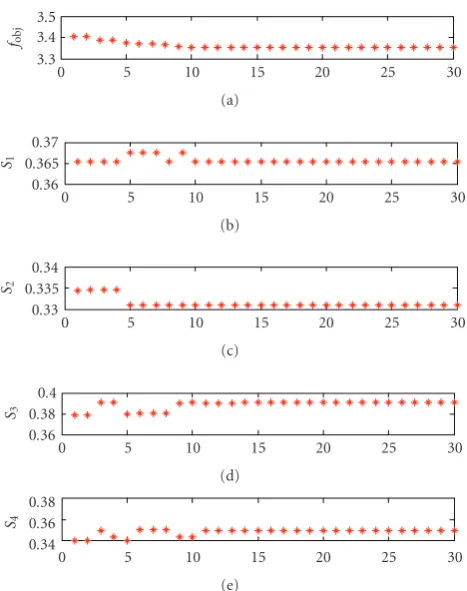
Figures8and9show the convergence of GA optimization at 30 generations of Classical1, and Rock1, respectively. It is obvious that as the number of generation increases, the objective function (fobj) gradually approaches to a saturation value. The resulting parameters, which are 4 quantization steps from GA optimization of 10 test audios, are shown
inTable 3. These parameters are optimally varied to achieve
the most desirable ones for original audios with different characteristics.
4.2. Imperceptibility Test Results. The watermarked audio quality is examined by watermarking the original audio signals with the resulting parameters from GA. Then, the SNR test is conducted, which serves as an objective measurement of audio signal quality. The SNR is measured by comparing the watermarked signal with the original one.
Figure 10 shows the original Classical1 audio signal
30 25 20 15 10 5 0 3.3 3.4 3.5
fobj (a) 30 25 20 15 10 5 0 0.36 0.365 0.37
S1 (b) 30 25 20 15 10 5 0 0.33 0.335 0.34
S2 (c) 30 25 20 15 10 5 0 0.36 0.38 0.4
S3 (d) 30 25 20 15 10 5 0 0.34 0.36 0.38
S4
(e)
Figure 8: fobj,S1,S2,S3, and S4 from GA optimization process
(Classical1). 30 25 20 15 10 5 0 0.34 0.36 0.38
fobj (a) 30 25 20 15 10 5 0 0.35
0.4
S1 (b) 30 25 20 15 10 5 0 0.32 0.34 0.36
S2 (c) 30 25 20 15 10 5 0 0.3 0.31 0.32
S3 (d) 30 25 20 15 10 5 0 0.3 0.32 0.34
S4
(e)
Figure 9: fobj,S1,S2,S3, and S4 from GA optimization process
(Rock1).
Table 3: Quantization steps from GA optimization of 10 test audios.
Host signal Quantization step
S1 S2 S3 S4
Classical1 0.3654 0.3309 0.3905 0.3497 Classical2 0.3482 0.3391 0.3100 0.3196 Country1 0.3311 0.3402 0.3005 0.3215 Country2 0.3425 0.3308 0.3772 0.3211 Jazz1 0.3482 0.3398 0.3074 0.3024 Jazz2 0.3311 0.3960 0.3022 0.3084 Rock1 0.3340 0.3391 0.3008 0.3200 Rock2 0.3426 0.3342 0.3313 0.3115 Pop1 0.3311 0.3952 0.3005 0.3091 Pop2 0.3473 0.3477 0.3015 0.3194
Table4: Signal-to-noise ratio of watermarked audio signals.
Host signals SNR (dB)
Without-GA With-GA
Classical1 25.31 26.04
Classical2 22.23 23.85
Country1 28.60 30.30
Country2 23.06 24.91
Jazz1 23.03 27.97
Jazz2 26.09 27.67
Rock1 26.73 28.30
Rock2 27.99 29.36
Pop1 21.82 24.90
Pop2 22.12 24.67
Average 24.69 26.79
waveform. Note that SNR is as high as 26.04 dB for watermarked audio signal. However, there is no obvious difference between original signal and watermarked signal by using informal listening test, and from Figures 10(a)
and10(b). It demonstrates that the proposed algorithm has
perfect insensibility in the sense of hearing.
The results of watermarked audio quality are shown in
Table 4. The results obtained from our proposed method
which is called with-GA (after optimization) are compared with the method without using Genetic Algorithm which is referred to as without-GA (before optimization). In the without-GA method, the quantization step is fixed at 0.4. We can see that the proposed method can improve the SNR of the watermarked audio about 2 dB.
×105 14 12 10 8 6 4 2 0
−0.8
−0.6
−0.4
−0.2 0 0.2 0.4 0.6
0.8 Original audio signal
(a)
×105 14 12 10 8 6 4 2 0
−0.8
−0.6
−0.4
−0.2 0 0.2 0.4 0.6
0.8 Watermarked audio signal
(b)
Figure10: (a) Original audio signal (Classical1), (b) watermarked audio signal.
(1) Resampling: the audio signal is first downsampled at 22.05 kHz, and then upsampled at 44.1 kHz.
(2) Requantization: the 16-bit watermarked audio signals have been requantized down to 8 bits/sample and back to 16 bits/sample.
(3) Low-pass filtering: low-pass filtering using a second-order Butterworth filter with cutoff frequency of 6 kHz, 12 dB/octave roll-off, is performed to the watermarked audio signals.
(4) Addition of noise: white Gaussian noise with 1% of the power of the audio signal is added.
(5) Cropping: two thousand samples of each testing signal are cropped out at 5 random positions.
(6) Low bitrate codec: the robustness against the low-rate codec was tested by using MPEG 1 Layer III compression (MP3) with compression rates of 56, 64, 96, and 128 kbps.
(7) Digital-to-analog/analog-to-digital (DA/AD) with same rate reacquisition: the output of audio signal from a sound card is connected to the analog input of another computer.
(8) Time-scale modification (TSM): time-scale modifica-tion between +5% and−5% of the total audio excerpt length is performed.
Detection results for the various attacks described above are shown in Table 5 which displayed the NC and BER from watermark extraction. The experimental results given
inTable 5show that the watermark is not affected by
resam-pling, requantization, additive noise, and MP3 compression at 64, 96, and 128 kbps. This indicated that the watermark is very robust to these attacks.
For low-pass filtering, cropping, MP3 compression at 56 kbps, DA/AD, and TSM (±5%) attacks, the BER val-ues of the recovered watermark sequence are 8.0133%, 5.2636%, 0.0977%, 17.2852%, 11.8164%, and 16.0616% for the Without-GA method and 6.9336%, 0.1953%, 0.0977%, 5.7619%, 2.2461%, and 2.1484% for the with-GA method, respectively. Although a lot of loss occurred in the audio
Table5: Robustness comparison of our algorithm (average values).
Attack type Without-GA With-GA NC BER (%) NC BER (%) Attack free 1.0000 0.0000 1.0000 0.0000 Re-sampling 1.0000 0.0000 1.0000 0.0000 Requantization 1.0000 0.0000 1.0000 0.0000 Low-pass filtering 0.9292 8.0133 0.9393 6.9336 Additive noise 1.0000 0.0000 1.0000 0.0000 Cropping 0.9031 5.2636 0.9983 0.1953 MP3-56 kpbs 0.9992 0.0977 0.9992 0.0977 MP3-64 kpbs 1.0000 0.0000 1.0000 0.0000 MP3-96 kpbs 1.0000 0.0000 1.0000 0.0000 MP3-128 kpbs 1.0000 0.0000 1.0000 0.0000 DA/AD 0.8486 17.2852 0.9488 5.7617 TSM +5% 0.8970 11.8164 0.9805 2.2461 TSM−5% 0.8660 16.0616 0.9814 2.1484
signal, the bit error rates are still acceptable. The results show that our proposed method yields better results than the method without-GA. Because GA search guarantees the global optimum solution, the proposed method can thus improve the quality of the watermarked audio and give almost the same robustness of the watermark.
Then, a rough comparison is given in Table 6based on embedding data payload and BER under MP3 compression with bit rates of 64 kbps and 128 kbps. It can be seen that the data payload of the proposed algorithm is significantly higher than those of [5,7,10]. As shown inTable 6, the detected BER values are all zero which indicates that compression and decompression have no effect on our algorithm.
Table6: Algorithm comparison.
Algorithms Data payload (bps) BER under MP3 compression (64 kbps) BER under MP3 compression (128 kbps)
With-GA 34.14 Approximately 0.00% Approximately 0.00%
[5] 8.54 Approximately 2.99% Not available
[7] 10.72 Not available Approximately 3.56%
[10] 21.00 Approximately 5.3722% Approximately 3.6133
Table7: Algorithm comparison.
Attack free Re-sampling Requantization Low-pass filtering Additive noise
[10]
BER (%) 0 0 0.1953 3.3203 2.6367
SNR (dB) 24.1209 23.5533 20.0936 10.3506 19.5607
With-GA
BER (%) 0 0 0 1.1719 0
SNR (dB) 24.5518 23.5052 20.9320 10.3884 19.5684
Cropping MP3 128 kbps MP3 96 kbps MP3 64 kbps MP3 56 kbps
[10]
BER (%) 5.3711 3.6133 4.1016 5.3711 5.7617
SNR (dB) 10.8289 19.5607 19.5537 18.5348 18.5400
With-GA BER (%) SNR (dB)
0.1953 0 0 0 0
16.3075 19.7552 19.5920 18.8265 18.6666
in a fair manner, parameters for each scheme should be adjusted so that watermarked audio signals of approximately close imperceptibility are produced. In these experiments, the SNR of watermarked audio in each scheme has been set to 24 dB. According to the experimental results, the value of the embedding capacity has been assigned to 34.14 bps in all experiments. The comparison results are listed inTable 7.
Table 7shows test results of Rock1 audio signal with no
attack, re-sampling, requantization, low-pass filtering, addi-tion of noise, cropping, and MPEG 1 Layer III compression with compression rates of 128, 96, 64 kbps and 56 kbps, respectively. The BER of watermark signal and the SNR of digital audio signal are also displayed.
According to these results, the extracted watermark images from our proposed method have some distortion for low-pass filtering and cropping attacks but they are still visually recognizable. In addition, the bit error rates of the extracted watermarks using our proposed method are always lower than the ones using method in [10]. The results demonstrate that our proposed method yields significantly more robust watermark than the method in [10] does.
5. Conclusions
watermarked signal inaudible, the watermark is embedded into low frequency part of the highest energy of audio signal by taking advantage of multiresolution characteristic of multiwavelet transform. The watermark insertion and watermark extraction are based on the quantization index modulation technique and the watermark extraction algo-rithm does not need the original audio in the extraction process. Performance improvement with respect to existing algorithms is obtained by genetic algorithm optimization. In our optimization process, we use genetic algorithm searching for optimal parameter which is the quantization step. This parameter is optimally varied to achieve the most suitable for original audios with different characteristics. The testing results of the watermarked audio quality and watermark robustness with various watermark attacks show that our proposed method can improve the performance of the water-marking process such that the better watermarked audio quality and watermark robustness are achieved. Further research can be concentrated on the development of our proposed method by using the characteristics of the human auditory system and psychoacoustic model.
Acknowledgments
This paper was supported by a grant from Suranaree Univer-sity of Technology, Thailand Research Fund and Commission on Higher Education. The author would like to thank anonymous reviewers for their comments and suggestions which have improved the readability and technical content of this paper.
References
[1] S.-J. Lee and S.-H. Jung, “A survey of watermarking techniques applied to multimedia,” in Proceedings of the IEEE Interna-tional Symposium on Industrial Electronics, vol. 1, pp. 272–277, Pusan, South Korea, June 2001.
[2] S. Katzenbeisser and F. A. P. Petitcolas, Information Hid-ing Techniques for Steganography and Digital WatermarkHid-ing, Artech House, Norwood, Mass, USA, 2000.
[3] I. J. Cox, J. Kilian, F. T. Leighton, and T. Shamoon, “Secure spread spectrum watermarking for multimedia,”IEEE Trans-actions on Image Processing, vol. 6, no. 12, pp. 1673–1687, 1997. [4] C.-H. Huang and J.-L. Wu, “Watermark optimization tech-nique based on genetic algorithms,” inSecurity and Water-marking of Multimedia Contents II, vol. 3971 ofProceedings of SPIE, pp. 516–523, San Jose, Calif, USA, January 2000. [5] J. W. Seok and J. W. Hong, “Audio watermarking for copyright
protection of digital audio data,”IEE Electronics Letters, vol. 37, no. 1, pp. 60–61, 2001.
[6] I. Orovi´c, P. Zogovi´c, N. ˇZari´c, and S. Stankovi´c, “Speech signals protection via logo watermarking based on the time-frequency analysis,”Annals of Telecommunications, vol. 63, no. 7-8, pp. 369–377, 2008.
[7] R. Wang, D. Xu, J. Chen, and C. Du, “Digital audio watermark-ing algorithm based on linear predictive codwatermark-ing in wavelet domain,” inProceedings of the 7th International Conference on Signal Processing (ICSP ’04), vol. 3, pp. 2393–2396, Beijing, China, August 2004.
[8] J. Huang, Y. Wang, and S. Wu, “Audio watermarking scheme robust against desynchronization based on the dyadic wavelet transform,”EURASIP Journal on Advances in Signal Processing, vol. 2010, Article ID 232616, 17 pages, 2010.
[9] S. Wu, J. Huang, D. Huang, and Y. Q. Shi, “Efficiently self-synchronized audio watermarking for assured audio data transmission,”IEEE Transactions on Broadcasting, vol. 51, no. 1, pp. 69–76, 2005.
[10] N. Sriyingyong and K. Attakitmongcol, “Wavelet-based audio watermarking using adaptive tabu search,” inProceedings of the 1st International Symposium on Wireless Pervasive Computing, vol. 1, pp. 1–5, Phuket, Thailand, January 2006.
[11] X.-Y. Wang, P.-P. Niu, and H.-Y. Yang, “A robust, digital-audio watermarking method,”IEEE Multimedia, vol. 16, no. 3, pp. 60–69, 2009.
[12] R.-D. Wang, D.-W. Xu, and Q. Li, “Audio watermarking algo-rithm based on wavelet packet and psychoacoustic model,” in
Proceedings of the 6th International Conference on Parallel and Distributed Computing, Applications and Technologies (PDCAT ’05), vol. 1, pp. 812–814, Dalian, China, December 2005. [13] K. R. Kwon and A. H. Tewfik, “Adaptive watermarking using
successive subband quantization and perceptual model based on multiwavelet transform,” inSecurity and Watermarking of Multimedia Contents IV, vol. 4675 ofProceedings of SPIE, pp. 334–348, San Jose, Calif, USA, January 2002.
[14] P. Kumsawat, K. Attakitmongcol, and A. Srikaew, “A new approach for optimization in image watermarking by using genetic algorithms,” IEEE Transactions on Signal Processing, vol. 53, no. 12, pp. 4707–4719, 2005.
[15] L. Ghouti and A. Bouridane, “A robust perceptual audio hashing using balanced multiwavelets,” inProceedings of the IEEE International Conference on Acoustics, Speech and Signal Processing (ICASSP ’06), vol. 1, pp. 209–212, Toulouse, France, May 2006.
[16] P. Kumsawat, K. Attakitmongcol, and A. Srikaew, “Digital audio watermarking for copyright protection based on mul-tiwavelet transform,”Lecture Notes in Computer Science, vol. 5376, pp. 155–164, 2008.
[17] F. Hartung and M. Kutter, “Multimedia watermarking tech-niques,”Proceedings of the IEEE, vol. 87, no. 7, pp. 1079–1107, 1999.
[18] S. Sedghi, H. R. Mashhadi, and M. Khademi, “Detecting hidden information from a spread spectrum watermarked signal by genetic algorithm,” in Proceedings of the IEEE Congress on Evolutionary Computation (CEC ’06), vol. 1, pp. 173–178, Vancouver, Canada, July 2006.
[19] K. Attakitmongcol, D. P. Hardin, and D. M. Wilkes, “Mul-tiwavelet prefilters—Part II: optimal orthogonal prefilters,”
IEEE Transactions on Image Processing, vol. 10, no. 10, pp. 1476–1487, 2001.
[20] J. S. Geronimo, D. P. Hardin, and P. R. Massopust, “Fractal functions and wavelet expansions based on several scaling functions,”Journal of Approximation Theory, vol. 78, no. 3, pp. 373–401, 1994.
[21] J. H. Holland,Adaptation in Natural and Artificial Systems, The University of Michigan Press, Ann Arbor, Mich, USA, 1975. [22] D. E. Goldberg, Genetic Algorithms in Search Optimization