R E S E A R C H
Open Access
Complexity adaptive iterative receiver
performing TBICM-ID-SSD
Salim Haddad
*, Amer Baghdadi and Michel Jezequel
Abstract
Flexible and iterative baseband receivers with advanced channel codes like turbo codes are widely adopted nowadays, ensuring promising error rate performances. Extension of this principle with an additional iterative feedback loop to the demapping function has proven to provide substantial error performance gain at the cost of increased complexity. However, this complexity overhead constitutes commonly an obstacle for its consideration in real implementations. This article illustrates the opposite of what is commonly assumed and proposes a complexity adaptive iterative receiver performing iterative demapping with turbo decoding (TBICM-ID-SSD). Targeting identical error rate, the article shows that for certain system configurations TBICM-ID-SSD presents lower complexity than TBICM-SSD (without iterative demapping). This original result is obtained when considering the equivalent number of iterations through detailed analysis of the corresponding computational and memory access complexity. The analysis is conducted for different parameters in terms of modulation orders and code rates and independently from the architecture for a fair comparison. Considering the proposed adaptive receiver which is able to perform both
TBICM-ID-SSD and TBICM-SSD modes, results demonstrate a reduced complexity with TBICM-SSD for high modulation orders. However, for low modulation orders as for QPSK, results show a reduction in arithmetic operations and read access memory up to 45.9% and 47%, respectively for using the TBICM-ID-SSD mode rather than TBICM-SSD performing six turbo decoding iterations over Rayleigh fading channel with erasures.
Introduction
Advanced wireless communication standards impose the use of modern techniques to improve spectral efficiency and reliability. Among these techniques, bit-interleaved coded modulation (BICM) [1] with different modula-tion orders and Turbo Codes with various code rates are frequently adopted.
The BICM principle currently represents the state-of-the-art in coded modulations over fading channels. The BICM with iterative demapping (BICM-ID) scheme pro-posed in [2] is based on BICM with additional soft feed-back from the soft-input soft-output (SISO) convolutional decoder to the constellation demapper. In [3], the convo-lutional code classically used in BICM-ID schemes was replaced by a turbo code. Only a small gain of 0.1 dB was observed. This result makes BICM-ID with turbo-like coding solutions (TBICM-ID) unsatisfactory with respect to the added decoding complexity.
*Correspondence: [email protected]
1Institut Mines-Telecom; Telecom Bretagne; UMR CNRS 3192 Lab-STICC Electronics Department, Technop ˆole Brest Iroise CS 83818, 29238 Brest, France
On the other hand, signal space diversity (SSD) tech-nique, which consists of a rotation of the constellation followed by a signal space component interleaving, has been recently proposed [4,5]. It increases the diversity order of a communication system without using extra bandwidth.
Combining SSD technique with TBICM-ID at the receiver side has shown excellent error rate performance results particularly in severe channel conditions (erasure, multi-path, real fading models) [6,7]. These results were behind the adoption of this system in DVB-T2 standard (using LDPC channel code). These results will also lead for further adoption discussions in the upcoming standards using turbo codes [6]. The TBICM and TBICM-ID modes applying the SSD technique are denoted by TBICM-SSD and TBICM-ID-SSD.
In fact, almost all related works using these techniques have focused only on error rate performance without considering the implementation perspective. This is due mainly to the commonly assumed impact in terms of complexity overhead. In this article, we demonstrate the
effectiveness of the iterative demapping even in terms of complexity for certain system configurations (modu-lation orders and code rates). In this context, a novel complexity adaptive iterative receiver, performing either in TBICM-ID-SSD mode or in TBICM-SSD mode, is pro-posed. This original proposal is based on a thorough analysis of the corresponding computational and memory access complexity.
It is worth to note that the article does not provide a comparison in terms of area, as one iterative receiver is considered to perform both modes (TBICM-ID-SSD and TBICM-SSD).
The rest of the article is organized as follows. Section System model and algorithms presents the system model with the associated parameters and gives a brief description of the underlined algorithms for iterative demapping and turbo decoding. Section Complexity eval-uation and normalization presents an evaleval-uation of the receiver complexity in terms of number and type of arith-metic operations and memory access. Section Number of iterations analysis for identical complexity analyzes the number of TBCIM-SSD and TBCIM-ID-SSD iterations for identical complexity. Section Complexity analysis for identical performance shows a complexity analysis for identical TBCIM-SSD and TBCIM-ID-SSD error rate performances. Finally, Section Conclusion concludes the article.
System model and algorithms
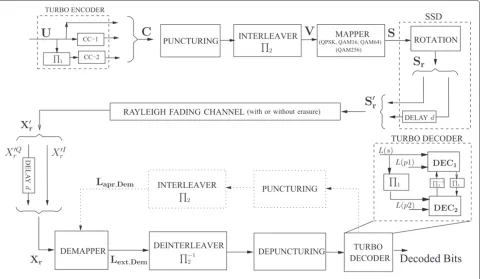
This section describes the system model and the considered parameters of the transmitter, channel, and receiver of Figure 1. In addition, it gives a brief pre-sentation of the underlined algorithms for the iterative demapping and decoding.
System model
On the transmitter side, information bits U which are called systematic bits are regrouped into symbolsui con-sisting of q bits, and encoded with an q-binary turbo encoder. It consists of a parallel concatenation of two iden-tical convolutional codes (PCCC). The output codeword Cis then punctured to reach a desired coding rateRc. We consider in this work the 8-state double binary (q=2) [8] turbo code adopted in the WiMax standard.
In order to gain resilience against error bursts, the resulting sequence is interleaved using anS-random inter-leaver2withS=√N/4. Punctured and interleaved bits denoted byvi are then gray mapped to complex channel symbolssqchosen from a 2M-ary constellationX, where
Mis the number of bits per modulated symbol.
Applying the SSD consists first of the rotation of the mapped symbols sq. The resulting rotated symbols are denoted as sr,q. The performance gain obtained when using a rotated constellationXrdepends on the choice of the rotation angle. The optimum rotation angle depends
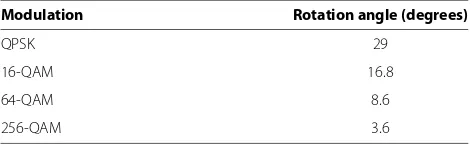
on the chosen modulation and channel type. In this regard, a thorough analysis has been done for the 2nd-generation terrestrial transmission system developed by the DVB Project (DVB-T2) which adopted the rotated constellation technique. A single rotation angle [7] has been chosen for each constellation size independently of the channel type. These angle values are presented in Table 1 and are adopted in this work.
The second step when applying SSD at the transmitter consists of signal space component interleaving. A simple delay is introduced between the transmission ofI andQ components. Mapped and shifted symbols sr,q are then transmitted over a noisy and Rayleigh fast fading channel with or without erasure. The erasure channel model has been used in the case of the DVB-T2 standard to model the destructive interferences caused by the existence of a single-frequency network (SFN). Each received symbol xr,qis affected by a different fading coefficient, an erasure coefficient, and an additive Gaussian noise.
The channel model considered is a frequency non-selective memoryless channel with erasure probability. The received discrete time baseband complex signal can be written as:
xr,q = hq.ρq.sr,q+nq
= hq.sr,q+nq (1) wherehqis the Rayleigh fast fading coefficient,ρqis the erasure coefficient probability taking value 0 with a prob-abilityPρ and value 1 with a probability of 1− Pρ. nq is a complex white Gaussian noise with spectral den-sityN0/2 in each component axes, andhqis the channel attenuation.
Max-log-map demapping algorithm
At the receiver side, the complex received symbols xr,q have theirQ-components re-shifted resulting inxr,q. An extrinsic log-likelihood ratio Lext,Dem(ck,q/xr,q) is calcu-lated for each bitck,qcorresponding to thekth bit of the received rotated and modulated symbol xr,q. After de-interleaving, de-puncturing and turbo decoding, extrinsic information from the turbo decoderLext,Dec(ck,q)is passed through the interleaver, punctured and fed back as a priori information Lapr,Dem(ck,q) to the demapper in a turbo demapping scheme. The extrinsic information
Table 1 Rotation angle values in DVB-T2, adopted in this work
Modulation Rotation angle (degrees)
QPSK 29
16-QAM 16.8
64-QAM 8.6
256-QAM 3.6
Lext,Dem(ck,q/xr,q)is the difference between the soft out-puta posteriori LDem(ck,q/xr,q)and the soft inputa priori
Lapr,Dem(ck,q)at the demapper side. It was originally com-puted in [9] and given by the expression below:
Lext,Dem(ck,q/xr,q) = LDem(ck,q/xr,q)−Lapr,Dem(ck,q)
= log
Z1 Z2
(2)
Zl(l=0,1)can be expressed as:
Zl(l=0,1)=
sr,j∈Xkr,l e−Aq.
M−1
i=0,i=k
P(ci,q) (3)
where Xrk,l, with l ∈ {0, 1}, are the symbol sets of the constellation for which symbols have theirkth bit equal to l. P(ci,q) is the probability of the ith bit of constella-tion symbolsr,qcomputed through a prioriinformation
Lapr,Dem(ck,q). Reducing the complexity of the expres-sions above can be performed by applying the max-log approximation. Thus, Equation (2) can be written as [9]:
Lext,Dem(ck,q/xr,q)= min sr,j∈Xrk,0
(Aq−Bk,q)− min sr,j∈Xrk,1
(Aq−Bk,q)
(4)
where
Aq=
h2 q
σ2|x I
r,q−sIr,j|2+
hq2−1
σ2 |x Q
r,q−sQr,j|2 (5)
and
Bk,q=
⎛ ⎝ M−1
i=0,ci,q=1
Lapr,Dem(ci,q)
⎞
⎠−Lapr,Dem(ck,q) (6)
All demapping equations are valid for erasure and no erasure channel. In fact, the channel coefficient hq will take into consideration the erasure coefficient given by the channel detector. These simplified expressions exhibit three main computation steps: (a) Euclidean distance computation referred by Aq, (b)a priori adder referred by Bk,q, and (c) minimum finder referred by the min operation of Equation (4).
Max-log-MAP decoding algorithm
equations, originally proposed in [10], are expressed as follows:
αk(s)=max (s,s)
(αk−1(s)+γk(s,s)) (7)
βk(s)=max (s,s)
(βk+1(s
)+γk+1(s
,s)) (8)
where
γk(s,s)=γkSys(s,s)+γkParity(s,s)+γkExt(s,s) (9)
Finally the soft outputso(dk = i) and extrinsic infor-mationz(dk = i)of thekth coded symbol are computed [10]:
so(dk=i)= max
(s,s)/d(s,s)=i
αk−1(s
)+γk(s
,s)+βk(s)
(10)
z(dk=i)=SF. max
(s,s)/d(s,s)=i
αk−1(s)+γkExt(s
,s)+βk(s)
(11)
where SF is the constant scale factor for the Max-Log-MAP decoding algorithm.
In case of iterative demapping and only by one SISO decoder, the bit-level extrinsic information of system-atic symbols dk = cpcp+1are computed using (12) and (13). Similar computations are needed for parity symbols cp+2cp+3.
Lapr,Dem(cp)=max[z(dk =11),z(dk =10)]
−max[z(dk =01),z(dk =00)] (12)
Lapr,Dem(cp+1)=max[z(dk=11),z(dk =01)]
−max[z(dk=10),z(dk =00)] (13)
These expressions exhibit three main computation steps: (a) branch metrics computation referred byγk, (b) state metrics computation referred by (αkandβk), and (c) extrinsic information computation referred by Lapr,Dem andz.
Complexity evaluation and normalization
In order to appreciate the complexity of the two itera-tive modes, an accurate evaluation of the complexity in terms of number and type of operations and memory accesses is required. In this section, we consider the two main blocks of the TBICM-SSD and TBICM-ID-SSD sys-tem configurations which are the SISO demapper and the SISO decoder. The proposed evaluation considers the low complexity algorithms presented in Section System model and algorithms.
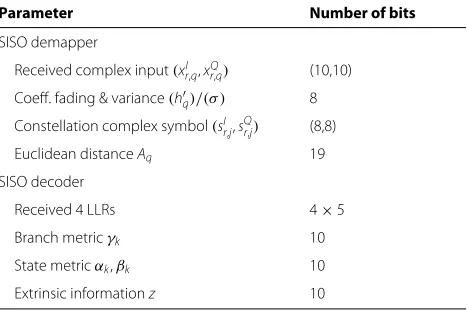
This evaluation will be presented independently from the architecture (serial, or shuffle, or parallel architecture). It will be based on counting operations without quoting prior SISO demapper and decoder implementation results. A typical fixed-point representation of channel inputs and various metrics is considered. Table 2
Table 2 Total number of required quantization bits for each parameter of the Max-Log-MAP algorithms
Parameter Number of bits
SISO demapper
Received complex input(xI
r,q,xQr,q) (10,10)
Coeff. fading & variance(hq)/(σ ) 8 Constellation complex symbol(sI
r,j,sQr,j) (8,8)
Euclidean distanceAq 19
SISO decoder
Received 4 LLRs 4×5
Branch metricγk 10
State metricαk,βk 10
Extrinsic informationz 10
summarizes the total number of required quantization bits for each parameter.
Complexity evaluation of SISO demapper
The complexity of SISO demapping depends on the modulation order (in the context of the above fixed parameters). In fact, for each received modulated sym-bol xr,q composed of M coded bits, 2M Euclidean dis-tances are computed. With iterative demapping,a priori information coming from the decoder should be added to the associated Euclidean distance. The minimum dis-tance finder is then applied to search for the closest symbol between the 2M constellation symbols. Thus, the SISO demapper complexity is composed of three princi-pal units: Euclidean distance,a prioriadder, and minimum finder functions. For each of these functions we will now consider the equations of Section Max-log-map demap-ping algorithm (1) the required number and type of arith-metic computations and (2) the required number of read memory access (load) and write memory access (store). The result of this evaluation is summarized in Table 3 and explained below. We use the following notation operation(NbOfBitsOfOperand1,NbOfBitsOfOperand2) for arith-metic operations, and load(NbOfBits)/store(NbOfBits) for read/write memory operations. Thus,add(8,10) indicates an addition operation of two operands; one quantized on 8 bits and the second on 10 bits. Similarly, load(8) indicates a read access memory of 8-bit word length.
(1) Euclidean distance computation
For each modulated symbol (input of the demapper):
• One load(8) to access the fading channel
coefficient normalized by the channel variancehq σ • Two load(10) to access the channel symbolsxI
Table 3 Complexity evaluation of the SISO demapper and SISO decoder in terms of number and type of arithmetic computations and memory access
SISO rotated demapper with a priori input
Computation units Number and type of operations per modulated symbol per demapping iteration Euclidean distance 2MAdd(18, 18)+2M+1Sub(8, 10)+2M+1Mul(18, 18)+2M+1Mul(8, 10)+2load(10)+
(1+2M+1)load(8)
A prioriadder (2
M − 2){E[M−1
2 ]Add(8, 8) + E[
M−1
4 ]Add(9, 9) + E[
M−1
8 ]Add(10, 10) + MSub(8, 11) + MSub(11, 19)} +Mload(8)+(2M−2)load(M)
For QPSKM(2M−2)Sub(11, 19)+Mload(8)+(2M−2)load(M)
Minimum finder MSub(8, 8)+M.2MSub(19, 19)+Mstore(8)
SISO double binary turbo decoder
Computation units Number and type of operations per coded symbol per turbo decoding iteration Branch metric 4Add(5, 5)+38Add(5, 10)+4Sub(5, 5)+8load(5)+6load(10)
State metric 64Add(10, 10)+48Sub(9, 9)+8store(10)
Extrinsic information 32Add(10, 10)+32Sub(9, 9)+9Sub(10, 10)+3Mul(4, 10)+8load(10)+5store(10)
• For each one of the2Msymbols of the constellation (sIr,j,sQr,j):
– Two load(8) to access the constellation symbolssIr,jandsQr,j
– Two Sub(8,10) to compute (xI r,q−sIr,j) and (xQr,q−sQr,j)
– Two Mul(8,10) to multiply with the
channel coefficientshq
σ and
hq−1 σ
– Two Mul(18,18) to compute the square of the results above
– One Add(18,18) to realize the sum of the two Euclidean distance terms
(2) A prioriadder
For each modulated symbol (input of the demapper):
• M load(8) to access the a priori information Lapr,Dem(ci,q)
• For each one of the2Msymbols of the constellation (sIr,j,sQr,j), except two symbols corresponding to all zeros and all ones:
– One load(M) to access constellation symbol bitsci,q.i=0, 1,. . .,M−1 – One addition ofM a priori information
to computeMi=−0,1ci,q=1Lapr,Dem(ci,q)of Equation (6).Lapr,Dem(ci,q)are quantized on 8 bits as shown in Table 2. This addition ofM operands is equivalent to the sum of the following 2-input addition operations:
∗ E[M2−1]Add(8,8) to realize the sum of the couples of
Lapr,Dem(ci,q). Results are quantized on 9 bits.
∗ E[M4−1]Add(9,9) to realize the sum of the couples of the results above. Results are quantized on 10 bits.
∗ E[M8−1]Add(10,10) to realize the final 2-input addition of the results above. Note thatE[M8−1] equals 0 except for QAM64 and QAM256 where it is equal to 1. The result is quantized on 11 bits. E[x]represents here the ordinary rounding of the positive number xto the nearest integer. Taking the example of QAM16 (M=4), E[M2−1]=2,E[M4−1]=1,
E[M8−1]=0.
– M Sub(8,11) to subtract the LLR of the specifick th bit and thus obtainBk,q – M Sub(11,19) to realizeAq−Bk,q
However, for the simple QPSK modulation the above operations can be simplified as only two LLRs exist for one modulated symbol. In fact, in Equation (6) there is no need to execute an addition followed by a subtraction of the same LLR. Thus, the total num-ber of required arithmetic operations in this case is 4 Sub(11,19).
(3) Minimum finder
For each one of theMbits per modulated symbol:
• 2MSub(19,19) to realize the two min operations of Equation (4)
• One Sub(8,8) to subtract the above found two minimum values
Complexity evaluation of SISO decoder
The SISO decoder complexity is composed of three prin-cipal units: branch metric, state metric, and extrinsic information functions. As for the SISO demapper, the result of the complexity evaluation is summarized in Table 3 and explained below. As stated before, the con-sidered turbo code is an 8-state double binary one. At the turbo decoder side, each double binary symbol should be decoded to take a decision over the four possible values (00, 01, 10, 11).
(1) Branch metrics (γ)
For each coded symbol (input of the decoder):
• 4 load(5) to access systematic and parity LLRs • 3 load(10) to access demapper normalized
extrinsic informations
• 2 Add(5,5) and 2 Sub(5,5) to compute systematic and parity branch metricsγ11Sys,γ10Sys,γ11Parityand γ10Parity
• 19 Add(5,10) to compute branch metricsγkand
γkSys+γkParity
Operations above should be multiplied by 2 to gener-ate forward and backward branch metrics.
(2) State metrics (α,β)
For each coded symbol (input of the decoder):
• 32 Add(10,10) to computeαk−1(s)+γk(s,s)for the 32 trellis transitions (8-state double binary trellis)
• 24 Sub(9,9) to realize the 8 max (4-input) operations of Equation (7). In fact, finding the maximum of N values can be implemented as N-1 max (2-input) operations
• 8 store(10) to store computed state metrics only for left butterfly algorithm
Operations above should be multiplied by 2 to gener-ate forwardαand backwardβstate metrics.
(3) Extrinsic information (z)
For each coded symbol (input of the decoder):
• 8 load(10) to access state metric values • 32 Add(10,10) to compute the second required
addition operation in Equation (10) for the 32 trellis transitions
• 28 Sub(9,9) to realize the 4 max (8-input) operations of Equation (10)
• 4 Sub(10,10) to subtract symbol-level intrinsic information from the computed soft value (generating symbol-level extrinsic information)
• 8 Sub(9,9) and 4 Sub(10,10) to realize the 8 max (2-input) operations and compute 4 bit-level (systematic and parity) extrinsic information as demappera priori information (Equations (12) and (13)). This computation is done only for one of the two SISO decoders
• 4 store(10) to store the computed bit-level (systematic and parity) extrinsic information • 3 Sub(10,10) to normalize symbol-level extrinsic
information by subtracting the one related to decision 00
• 3 Mul(4,10) to multiply the symbol-level extrinsic information by a scaling factor SF
• 3 store(10) to store the computedDEC1
symbol-level extrinsic information asDEC2a
priori symbol-level information
Complexity normalization
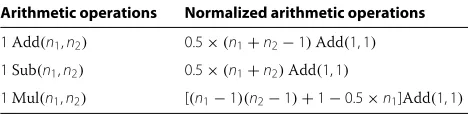
A fair comparison between the two modes (TBICM-SSD and TBICM-ID-SSD) requires arithmetic and memory access operations normalization. For arithmetic opera-tions, normalization has been done in terms of 2-input one bit full adders (Add(1,1)). Each one of the adders, subtractors, and multipliers can be converted into equiv-alent number of Add(1,1). For adders and subtractors, bit-to-bit half and full adders are used and generalized for operand sizesn1andn2. Obtained formulas are sum-marized in Table 4 with simple, yet accurate, analysis of all corner cases. Similarly, multiplication operations are normalized using successive addition operations. Memory access operation ofmword of sizenare normalized to one memory access operation ofm×nbits.
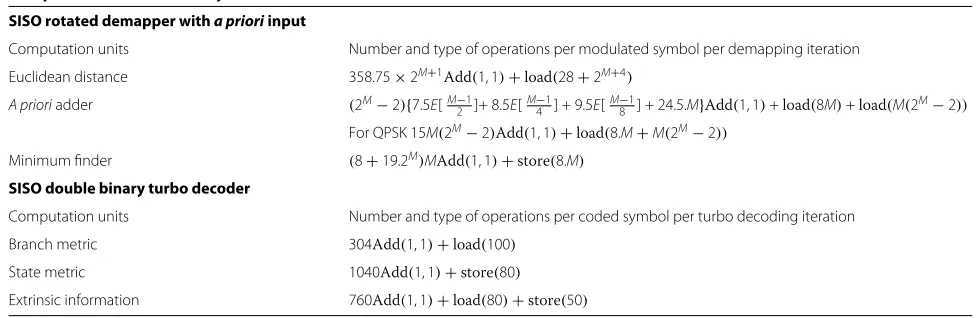
Applying the proposed complexity normalization approach to Table 3 leads to the results shown in Table 5. This table summarizes the number of normalized opera-tions required to process one modulated and one coded symbol per iteration for all the functional units of the SISO demapper and SISO decoder. Using this table, it becomes possible to compare the complexity of these heterogeneous components. As an example, the pro-cessing of one symbol by the SISO decoder incurs a complexity equivalent to 2104 Add(1,1), load(180) and store(130) operations per iteration. On the other hand, and considering a QPSK configuration (M=2), the com-plexity of the SISO demapper per modulated symbol per
Table 4 Normalization of basic arithmetic operations in terms ofAdd(1,1) whenn2>n1
Arithmetic operations Normalized arithmetic operations
1Add(n1,n2) 0.5×(n1+n2−1)Add(1, 1) 1Sub(n1,n2) 0.5×(n1+n2)Add(1, 1)
Table 5 Complexity evaluation of the SISO demapper and SISO decoder in terms of number and type of arithmetic computations and memory access after normalization
SISO rotated demapper witha prioriinput
Computation units Number and type of operations per modulated symbol per demapping iteration Euclidean distance 358.75×2M+1Add(1, 1)+load(28+2M+4)
A prioriadder (2M−2){7.5E[M−21]+ 8.5E[M−41] + 9.5E[M−81] + 24.5.M}Add(1, 1)+load(8M)+load(M(2M−2))
For QPSK 15M(2M−2)Add(1, 1)+load(8.M+M(2M−2)) Minimum finder (8+19.2M)MAdd(1, 1)+store(8.M)
SISO double binary turbo decoder
Computation units Number and type of operations per coded symbol per turbo decoding iteration
Branch metric 304Add(1, 1)+load(100)
State metric 1040Add(1, 1)+store(80)
Extrinsic information 760Add(1, 1)+load(80)+store(50)
iteration is equivalent to 1470 Add(1,1), load(116) and store(16) operations. This table will thus enable us in the following sections to compute and to compare the over-all complexity of the TBICM-SSD and TBICM-ID-SSD systems. It is worth noting from this table how the com-plexity of SISO demapping depends on the modulation orderMwhile that of SISO decoding is independent from the system configuration.
Number of iterations analysis for identical complexity
This section discusses and analyzes the complexity of the two iterative modes at different modulation orders and code rates. The first subsection defines the complexity of each mode, while the second subsection analyzes the required number of iterations assuming identical com-plexity.
TBICM-SSD and TBICM-ID-SSD complexity definition If the TBICM-SSD mode requires x iterations to pro-cess a frame composed of NMSymb modulated symbols (equivalent toNCSymb coded symbol), the complexityC1 for TBICM-SSD can be calculated as the sum of the complexity of one demapping process and x decoding processes.
C1=C−dem(M).NMSymb+xCdec.NCSymb (14)
whereCdem− (M) designates the complexity of processing one modulated symbol, which depends on the constella-tion size, without taking into consideraconstella-tion the a priori computation, andCdecdesignates the complexity of pro-cessing one coded symbol.
Regarding the complexity of TBICM-ID-SSD, we con-sider the work of [11] which proposes an original iteration scheduling by reducing two demapping iterations with reasonable performance loss of less than 0.15 dB for all
configurations. The authors have also shown that omit-ting only one demapping iteration will keep the error rate performance almost identical for number of iter-ations y > 3. This latter scheme is adopted in this work and we denote the required number of iterations byyIDem zEIDec, where z designates the extra decoding iterations.
Thus, the complexity C2 for TBICM-ID-SSD can be calculated as the sum of the complexity ofydemapping processes and (y+z) decoding processes.
C2=Cdem− (M).NMSymb+(y−1)
×Cdem+ (M).NMSymb+(y+z)Cdec.NCSymb (15) whereCdem+ (M)designates the complexity of processing one modulated symbol taking into consideration the a prioricomputation.
For the complexity evaluation ofCdecandCdem(M), the low complexity algorithms presented in Section System model and algorithms were thoroughly analyzed.
Considering the code rateRcand the number of bits per modulated symbolM, the relation between the number of double binary coded symbols (NCSymb) and the corre-sponding number of modulated symbols (NMSymb) can be written as follows.
NMSymb=
2.NCSymb M.Rc
(16)
Number of iterations for identical complexity
The final objective of this work is to illustrate for which system configuration it is more interesting to use TBICM-ID-SSD rather than TBICM-SSD. This means for which system configuration the complexity of TBICM-ID-SSD becomes lower than TBICM-SSD. Towards this objective, we analyze in this subsection the corresponding num-ber of iterations if both modes have identical complexity. Identical complexity can be expressed asC1= C2. Using this equality and replacing C1 and C2 by their expres-sions from equations (14) and (15) lead to the following equation:
xCdec.NCSymb=(y−1)Cdem+ (M).NMSymb
+(y+z)Cdec.NCSymb (17)
This last equation allows to obtain the number of TBICM-ID-SSD iterations y = yLim corresponding to identical complexity for both modes. In fact, by replacing NMSymbwith equivalent number ofNCSymb(as expressed in Equation (16)) and by simplifying, Equation (17) becomes:
yLim=
(x−z)Cdec+ M2.RcC + dem(M) Cdec+ M2.RcC
+ dem(M)
(18)
This equation can be used to compute individuallyyLim for identical arithmetic, identical read memory access or identical write memory access operations.
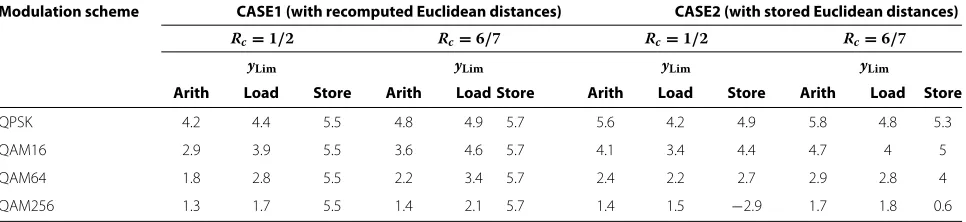
If we consider x = 6, and for different modulation orders and code rates, Table 6 shows the required number of iterationsyLimwith no extra decoding iteration (z=0). yLimcan have positive values as well as negative values. Negative values mean that for the chosen configura-tion, TBICM-ID-SSD has always a higher complexity than TBICM-SSD. The positive values represent the lim-its for which performing less demapping iterations will lead to a lower complexity than TBCIM-SSD, and the inverse is true. Hence, it might be possible to perform less y iterations (y < yLim) with less complexity while having the same error correction capability than TBICM-SSD. In fact, Table 6 shows that this last situation can
potentially happen for QPSK and QAM16 configurations where yLim varies in a higher range (between 2.9 and 5.8) than QAM64 and QAM256 configurations (mostyLim values are around 2 corresponding to identical arithmetic operations). This analysis will be extended in the next section taking into consideration error rate performance simulations.
Complexity analysis for identical performance The main motivation behind this analysis is to improve the receiver implementation quality by choosing the mode with the less complexity depending on each system con-figuration. In order to appreciate this study, an accurate evaluation of the complexity in terms of number and type of operations and memory access has been done in Section Number of iterations analysis for identical complexity.
TBICM-ID-SSD iterations, xIDec and yIDem respec-tively, iterative processing at the demapper side is shown to provide additional error correction [6]. Thus, for a considered number ofxiterations, identical error rate per-formance results can be reached by usingyiterations with y<x.
Complexity analysis for a chosen x
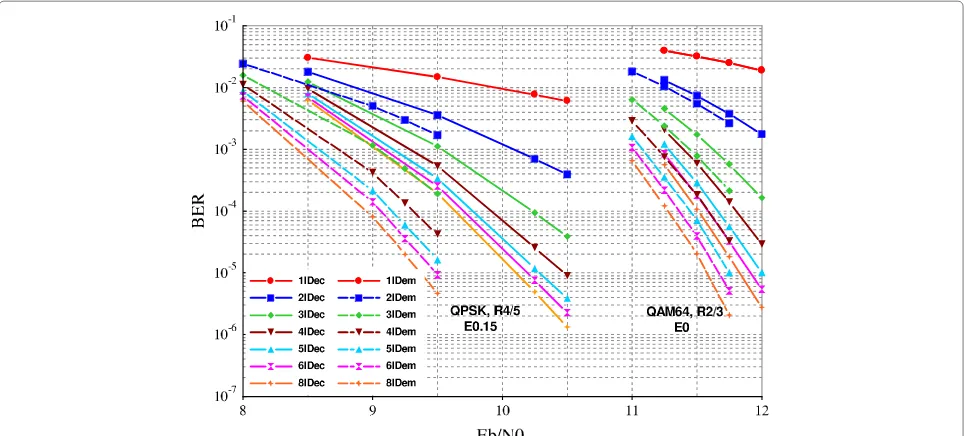
Figure 2 shows a BER comparison between the two iterative modes TBICM-SSD and TBICM-ID-SSD for two configurations: (1) QPSK, code rate 45, erasure probability 0.15 and (2) QAM64, code rate 23, non erasure. These parameters are chosen to represent clearly the two sets of curves in the same figure, the same behavior is seen for other configurations. The BER forx = 6 iterations and for different configurations, can be seen as the result of y = 3 andy = 4 iterations for erasure and non erasure channel respectively. However, using results in [11], the complexity of4IDemcould be reduced to 3IDem zEIDec withz=1.
On the other hand, Table 6 shows that for QPSK modu-lation, the minimum number of required TBICM-ID-SSD iterationsyLimfor all code rates and for identical required
Table 6 Required number of demapping iterationsyLimfor different modulation schemes and code rates to achieve identical complexity (arithmetic operations, or read, or write access memory) as forx=6 andz=0
Modulation scheme CASE1 (with recomputed Euclidean distances) CASE2 (with stored Euclidean distances) Rc=1/2 Rc=6/7 Rc=1/2 Rc=6/7
yLim yLim yLim yLim
Arith Load Store Arith Load Store Arith Load Store Arith Load Store
QPSK 4.2 4.4 5.5 4.8 4.9 5.7 5.6 4.2 4.9 5.8 4.8 5.3
QAM16 2.9 3.9 5.5 3.6 4.6 5.7 4.1 3.4 4.4 4.7 4 5
QAM64 1.8 2.8 5.5 2.2 3.4 5.7 2.4 2.2 2.7 2.9 2.8 4
Figure 2BER performance comparison between TBICM-SSD and TBICM-ID-SSD for the transmission of 1536 information bits frame over Rayleigh fading channel with and without erasure.Different modulation schemes and code rates are considered, for 1 to 8 iterations.
arithmetic operations as6IDecisyLim = 4.2 withz = 0. So usingy=3<4.2 iterations will lead to less arithmetic complexity, meanwhile it has the same error correction capacity as illustrated in Figure 2 for (1).
Complexity improvements have been computed and summarized in Tables 7 and 8. These tables resume the achieved improvements comparing 6IDec to 3IDem 1EIDecand 3IDem0EIDecrespectively for all configura-tions. In the following we will explain first how these val-ues are computed and then discuss the obtained results.
The complexity reduction ratio (G) is defined as the ratio of the difference in complexity between the two iterative modes to the complexity of TBICM-SSD. It cor-responds to the gain ratio of using TBICM-ID-SSD rather than TBICM-SSD.Gcan be expressed as follows:
G= C1−C2 C1
(19)
Using this equation and replacingC1 andC2 by their expressions from Equations (14) and (15) lead to the following equation:
G= (x−y−z)Cdec.NCSymb−(y−1)C +
dem(M).NMSymb xCdec.NCSymb+C−dem(M).NMSymb
(20)
By replacingNMSymbwith equivalent number ofNCSymb (as expressed in Equation (16)) and by simplifying, Equation (20) becomes:
G= (x−y−z)Cdec− 2
M.Rc(y−1)C + dem(M) xCdec+M2.RcCdem− (M)
(21)
This last equation has been used to obtain individu-ally the complexity reduction ratios of Tables 7 and 8
Table 7 Achieved reduction values in terms of number of operations, read/write access memory for considering “3IDem1EIDec” rather than “6IDec” for different modulation schemes, code rates and no erasure events
Modulation scheme
CASE1 (with recomputed Euclidean distances) CASE2 (with stored Euclidean distances)
Rc=1/2 Rc=6/7 Rc=1/2 Rc=6/7
Complexity reduction Complexity reduction Complexity reduction Complexity reduction
Arith Load Store Arith Load Store Arith Load Store Arith Load Store
QPSK 13.5% 16.8% 28.6% 21.4% 23.5% 30.6% 28% 14% 19.1% 30.1% 21.8% 25%
QAM16 −15.6% 9.3% 28.6% 2.7% 18.9% 30.6% 10.7% −3.5% 9.5% 19.2% 11.2% 19.3%
Table 8 Achieved reduction values in terms of number of operations, read/write access memory for considering “3IDem0EIDec” rather than “6IDec” for different modulation schemes, code rates and erasure events
Modulation scheme
CASE1 (with recomputed Euclidean distances) CASE2 (with stored Euclidean distances)
Rc=1/2 Rc=6/7 Rc=1/2 Rc=6/7
Complexity reduction Complexity reduction Complexity reduction Complexity reduction
Arith Load Store Arith Load Store Arith Load Store Arith Load Store
QPSK 28.9% 32.6% 45% 37.2% 39.6% 47% 43.3% 29.8% 35.4% 45.9% 38% 41.4%
QAM16 −1.6% 24.9% 45% 17.7% 34.9% 47% 24.7% 12.1% 25.9% 34.2% 27.2% 35.8%
QAM64 −78.8% −8.6% 45% −38.3% 13.7% 47% −25.1% −44.3% −5.9% −1.5% −8.5% 17.1% QAM256 −201.4% −97.2% 45% −150.4% −49.3% 47% −111.9% −184.4% −107.8% −79% −108.1% −42.8%
in terms of arithmetic, read memory access and write memory access operations. Positive values correspond to a decreasing in complexity, meanwhile negative values correspond to a an increasing in complexity.
In the following, we analyze the values of Table 7 which correspond to a no erasure channel. Similar behavior is seen in Table 8 for erasure channel.
For CASE 1, results show improvements in terms of number of arithmetic operations (up to 21.4%) and read access memory (up to 23.5%) for QPSK scheme. Higher modulation orders require the demapper to fetch symbols from higher constellation memory sizes, which lead to more complexity computations and memory accesses. An increasing in complexity is shown for QAM256 in terms of number of arithmetic operations (−207%) and read access memory (−108%). Moreover, Equation (21) shows that higher the code rate is, higher the benefits are. On the other hand, the improvements in write memory access
(28.6% forRc= 1/2 and 30.6% forRc=6/7) are positive for all modulations orders.
In fact, in the SISO demapper, write memory access is required only to store the extrinsic information which is composed of M × 8 bits. This term is required per modulated symbol and when converted to the equiv-alent number per coded symbol (Equation (16)) for a fixed code rate, a constant value independent fromMis obtained.
Similar behavior is shown for CASE 2, except for two points. The first one concerns the improvements in arithmetic operations and read memory access. In fact, compared to CASE 1, this configuration implies less arithmetic and more memory access operations in the SISO demapper which lead to more benefits for the former operations and less benefits for the latter (Equation (21)). The second point concerns the benefits in write memory access. In fact, besides the term M× 8 bits, a
Table 9 Equivalent number of TBICM-ID-SSD iterationsy
for a considered TBICM-SSDxiterations to achieve identical BER performances for QPSK, code rate45and erasure probability equals to 0.15
x 1 2 3 4 5 6 7 8
y 1 1.7 2.2 2.5 2.75 2.9 2.95 3
value of 19×2M is required to store the 2M Euclidean distances quantized on 19 bits each. Therefore the bene-fits in write access memory operations will be less for high constellation sizes.
Taking an example of QAM64 and code rate 67 for CASE 1 with no erasure. Table 8 shows an increasing in complexity in terms of arithmetic operations (−38.3%), meanwhile positive ratios are seen for read/write access memory. However, it should be noted that the num-ber of required memory access are much less than the arithmetic operations. Thus, those latter are considered as the primary criteria for choosing between the two modes.
We can conclude from the results above that using TBICM-ID-SSD rather than TBICM-SSD for QPSK and QAM16 orders will lead to a significant complexity reduc-tion for almost all code rates.
Finally, as the proposed adaptive iterative receiver targets to reduce the overall normalized processing com-plexity, this should lead a priori to improved power con-sumption, throughput and latency. However, analyzing the detailed gains in terms of throughput and latency depends on the heterogeneous architecture and the par-allelism degree of the considered demapper and decoder algorithms.
Complexity analysis for different values ofx
The second part of this study is to look to the gains for different values of x. To that end, and for presentation simplicity, we consider one system configuration which corresponds to QPSK, code rate45and erasure probability 0.15.
Figure 3 illustrates the BER performance for both modes as a function of the number of iterations atEb/N0=9.5 dB. From this figure, we obtain Table 9 which illustrates the equivalentyiterations for differentxvalues for identical error rate performances.
Using Table 9 and Equation (21), we obtain the complex-ity reduction curves of Figure 4. Only CASE 2 is consid-ered for presentation simplicity, however the results are similar for CASE 1. The curves of Figure 4 show the vari-ation of the benefits in number of arithmetic opervari-ations, read and write memory access as a function of the number of iterationsx. In fact, Table 9 shows that for TBICM-SSD number of iterations x = 1 the corresponding number of TBICM-ID-SSD iterationsy= 1. This corresponds to no feedback loop to the demapper, and thus, to identical complexity of the two modes SSD and TBICM-ID-SSD. This result is illustrated by Figure 4 where the complexity reduction ratioG=0 forx=1. Forx=2, the complexity reduction in terms of arithmetic operations and read access memory is about 10 and 2%, respectively. However, an increased need of write access memory is shown. This is due to the added complexity for storing the 2M Euclidean distances computed at the first iteration. In fact, the difference in equivalent number of iterations xandyis not big enough to recover this memory write access overhead. However, for x > 2, this difference becomes significant and the complexity reduction ratio
-10 0 10 20 30 40 50 60 70
0 1 2 3 4 5 6 7 8 9
G: Complexity
reduction ratio (%)
x:Number of TBICM-SSD iterations
Arith Read Write
increases almost linearly with xto reach between 50 to 60% forx=8. This can be explained from Table 9 where increasingxwill increaseybut with less speed to attain identical error rate performances.
Conclusion
In this article we have proposed a complexity adaptive iterative receiver performing TBICM-ID-SSD. For low and medium constellation sizes, feedback to the SISO demapper has shown to reduce the complexity in terms of computation and access memory at the receiver side for identical error rate performances. This constitutes a very interesting result as it demonstrates the opposite of what is commonly assumed. In fact, the number of normalized arithmetic operations is reduced in a range between 28.9 and 45.9% for QPSK configuration for using TBICM-ID-SSD rather than TBICM-SSD with 6 itera-tions over fading channel with erasures. Similarly, the number of read/write access memory is reduced in a range between 29.8% and 47%. This complexity reduction increases significantly for higher turbo decoding iterations and reduces consequently the power consumption of the iterative receiver. On the other had, for high modulation orders, as for QAM64 and QAM256, the TBICM-ID-SSD receiver should be configured in TBICM-SSD mode which provide less complexity for identical error rate perfor-mances.
Finally, it is worth to note that for very low error rates, TBICM-ID-SSD configuration should be used as it pro-vides more error correction in the error floor region. Future work targets the extension of this analysis to other baseband iterative applications and its integration into available hardware prototypes.
Received: 28 November 2011 Accepted: 16 May 2012 Published: 3 July 2012
References
1. G Caire, G Taricco, E Biglieri, Bit-interleaved coded modulation. inIEEE International Symposium on Information Theory, (1997)
2. X Li, J Ritcey, Bit-interleaved coded modulation with iterative decoding. IEEE Commun. Lett.1(6), 169–171 (1997)
3. I Abramovici, S Shamai, On turbo encoded BICM. Ann. des Telecommun. 54, 225–234 (1999)
4. N Kiyani, J Weber, Iterative demodulation and decoding for rotated MPSK constellations with convolutional coding and signal space diversity. in IEEE Vehicular Technology Conference, VTC’07-Fall, 1712–1716, (2007) 5. J Boutros, E Viterbo, Signal space diversity: a power- and
bandwidth-efficient diversity technique for the Rayleigh fading channel. IEEE Trans. Inf. Theory.44(4), 1453–1467 (1998)
6. C Nour, C Douillard, On lowering the error floor of high order turbo BICM schemes over fading channels. inIEEE Global Telecommunications Conference, GLOBECOM’06, 1–5, (2006)
7. CA Nour, C Douillard, Improving BICM performance of QAM
constellations for broadcasting applications. inInternational Symposium on Turbo Codes and Related Topics, 55–60, (2008)
8. Part 16: Air Interface for Fixed and Mobile Broadband Wireless Access Systems – Amendment for Physical and Medium Access Control Layers for Combined Fixed and Mobile Operation in Licensed Bands IEEE Std 80216e/D5-2004,Nov2004
9. S Ten Brink, J Speidel, RH Yan, Iterative demapping and decoding for multilevel modulation. inGlobal Telecommunications Conference, 1998. GLOBECOM 98. The Bridge to Global Integration. IEEE, vol. 1, 579–584, (1998) 10. P Robertson, P Hoeher, E Villebrun, Optimal and sub-optimal maximum a
posteriori algorithms suitable for turbo decoding. Eur. Trans. Telecommun. (ETT).8(2), 119–125 (1997)
11. S Haddad, A Baghdadi, M Jezequel, Reducing the number of iterations in iterative demodulation with turbo decoding. inThe 19th International Conference on Software, Telecommunications and Computer Networks (SoftCOM 2011), (Split and Adriatic Islands. Croatia, 2011)
doi:10.1186/1687-6180-2012-131
Cite this article as:Haddadet al.:Complexity adaptive iterative receiver performing TBICM-ID-SSD.EURASIP Journal on Advances in Signal Processing
20122012:131.
Submit your manuscript to a
journal and benefi t from:
7Convenient online submission 7Rigorous peer review
7Immediate publication on acceptance 7Open access: articles freely available online 7High visibility within the fi eld
7Retaining the copyright to your article