Abstract – To satisfy continuously growing customer requirements and to assure a competitive position over the long-term, manufacturing companies are nowadays forced to produce high-quality products and secure high productivity in day-to-day operations. Existing production structures and processes therefore often reach their limits. In many cases improving measures and intensifying quality during everyday operations can only be realized with an extensive input. This is where an approach currently being developed at the Institute of Production Systems and Logistics (IFA) of the Leibniz University of Hanover can play a role. In this method the requirements of high-quality products and processes are already considered at the factory planning stage. Based on these requirements, measures are deduced and integrated into the factory planning process.
Index Term – Evaluation Model, Factory Planning, Process Configuration, Process Management, Quality Management
I. INTRODUCTION
In the current environment for manufacturing companies, factors such as product configuration, sales figures, and available technologies are changing very fast and erratically [1], [2]. Further, growing individualization of customer requirements contributes to a complexity in production that is difficult to control. This “turbulent” environment often presents companies with new challenges [3], [4]. For Germany as a business location, product quality is an essential factor for ensuring continued success among intensive international competition. High product quality has risen to become one of the most important criteria for the customer’s buying decision (see [5]). For manufacturing companies, the development of product innovations and the assurance of high quality are indispensable nowadays [6], [7].
But high product quality can only be assured if the processes in companies and factories have a high process quality as well (see [8]). The development of new products and innovations calls for highly stable and robust activities. The basic configuration of processes and activities is already implemented during the factory planning process. It is at this point that the requirements are formed which define the
Manuscript received August 06, 2010. The authors wish to acknowledge the financial support of the German Research Foundation (DFG) within the research project under the registration number NY 4/30-1.
Dipl.-Wirtsch.-Ing. Benjamin Hirsch is a Research Associate at the Institute of Production Systems and Logistics of the Leibniz University of Hanover, An der Universität 2, 30823 Garbsen, Germany, phone 0049 511 762 18197, fax: 0049 511 762 3814, e-mail: hirsch@ ifa.uni-hannover.de.
Prof. Dr.-Ing. habil. Peter Nyhuis is the Managing Director of the Institute of Production Systems and Logistics of the Leibniz University of Hanover, An der Universität 2, 30823 Garbsen, Germany, e-mail: [email protected].
quality profile achievable in later factory operations. Therefore, an approach is being developed at the Institute of Production Systems and Logistics (IFA) of the Leibniz University of Hanover, within the framework of a research project funded by the German Research Foundation (DFG), which integrates the requirements of high process and product quality right from the factory planning stage.
To explain the concept, this paper begins with a review of some basic facts about quality management and factory planning. After that, further steps necessary to the creation of quality-oriented factory planning will be introduced. Apart from a basic descriptive model, the method contains an advanced checking and evaluation model for quality-oriented factory planning.
II. FUNDAMENTALS
A. Quality Management
Many companies have realized how important compliance with high quality standards is for their production in terms of the competitive position. Therefore, they pursue this idea in their strategic orientation [9]. It is necessary to realize that product- and process-based strategies cannot be developed independently. Usually, the high product quality aspired to for the future calls for improvements to the process capabilities level. Conversely, a lack of process-oriented quality strategies may restrict product quality.
Usually, companies try to raise the quality level through conventional quality management methods during the course of product development and during the later production. A multitude of tools and methods exists which can help to identify specific quality defects and repair them. Measures and approaches like Poka Yoke and Failure Mode and Effects Analysis (FMEA) enable faults in current operations to be identified and their numbers subsequently reduced [10].
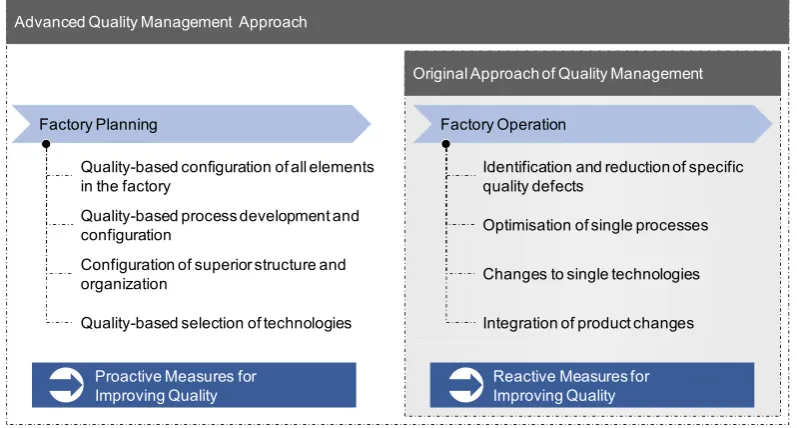
This original approach of quality management focuses mostly on single processes in factories and companies (see fig. 1). The operations are examined in terms of their faults and are afterwards optimized. In doing so it is possible that the products manufactured and the technologies used are affected by these changes, too. However, the majority of the quality management methods were developed at a time when the environment for manufacturing companies was still relatively stable. With the increasing dynamic in the markets and the competition, most of the methods are in many cases insufficient nowadays. Even very small quality improvements in current operations require a disproportionately high input.
Quality-Oriented Factory Planning
Due to the lack of integration of superior structures, improvement measures ignore the factory system as a whole. The results of specific improvement measures are limited and only partly transferable to other areas, so mistakes can happen once again [11].
An advanced quality management approach is necessary which establishes the requirements for high product and process quality early on, in the course of factory planning. Using this approach it is possible to configure all elements in a factory for checking and improving quality. The requirements deduced from the quality strategies also have to be considered during the development of processes, during the design of organizational structures, and during the selection of technologies. With this advanced approach it is possible to support reactive measures in current operations
with proactive measures before mistakes occur.
B. Factory Planning
Factory planning embraces the systematic planning of production facilities, production plant, transport, and logistic facilities as well as the configuration of the organization and the layout in line with the superior production operations. The Association of German Engineers (VDI) defines factory planning as a systematic, target-oriented process for configuring a factory, from the formulation of the targets to the ramp-up of the production [12]. In addition to the different planning cases (new planning, rescheduling, expansion, dismantling, and revitalization), the discipline of factory planning is also implemented in the several life cycle phases of a factory (factory planning, implementation, operation, and dismantling) [13], [14]. The target fields of factory planning such as changeability, transparency, employee orientation or logistical performance cannot be designed directly in the factory. They are reached indirectly by a target field-specific configuration of the elements of the factory. These so-called factory objects can be material or immaterial and might be directly influenced by the planning team. To systemize the factory objects they have to be allocated to the planning fields means, organization, and space as well as to the hierarchical levels workstation, system or cell, factory, and site [15], [16]. Changeability in particular
has been discussed in many cases and events (see [17], [18], [19], [20]).
Due to the high complexity of a factory planning project it is usually carried out step by step, or rather section by section (see [21]). In accordance with [12], the process is arranged in seven stages: In the definition of aims the project targets and a
work schedule are deduced based on the conditions of the company and the environment. During the basic evaluation
phase the information required is provided and clustered. The creative step of concept planning contains the development
of production structures as well as the specification of the approximate layout. The managerial functions necessary for dimensioning the manufacturing resources, the staff, and the space also form part of this stage. The approximate layout is concretized in the detailed planning phase. During the preparation for realization the tender documents are
produced and a transfer concept developed which will ensure trouble-free production ramp-up in the new factory.
Monitoring of realization includes the checking and
documentation of the current construction work, also the coordination of persons and disciplines involved in construction measures. All measures that contribute to stable running of the production on the planned performance level are carried out in supervision of ramp-up. The project conclusion covers the assessment of the factory regarding the
targets designated beforehand plus the analysis and evaluation of distinctive events.
III. AQUALITY-ORIENTED FACTORY PLANNING CONCEPT
[image:2.595.99.498.51.265.2]The target pursued within the quality-oriented configuration of the factory in line with the factory planning is to establish the basics for a high process quality in later factory operations (see fig. 2: specific target A). Therefore, the previous quality-oriented object configuration is an elementary condition for process optimization in later factory operations. It is indisputable that in later factory operations further adjustments and changes to the factory objects and operations can be made to assure adequate stability or continuous improvement of the process quality (specific
Fig. 1: The basic approaches of quality management
Factory Planning
Optimisation of single processes
Changes to single technologies
Integration of product changes Identification and reduction of specific quality defects
Factory Operation
Quality-based selection of technologies Quality-based configuration of all elements in the factory
Quality-based process development and configuration
Configuration of superior structure and organization
Advanced Quality Management Approach
Original Approach of Quality Management
Reactive Measures for Improving Quality Proactive Measures for
target B). The basics from the factory planning process are indispensable for arranging this with an appropriate effort. For example, designing the layout of the production plant in the building during the factory planning determines the later production process. In doing so, some factors like the length of the materials flow and influences between the production processes affects the ensuing product quality to a high degree. For example, the fabrication of products with high hygiene requirements cannot take place in an area with a low cleanliness level, and the vibration properties of the floor influence the maximum degree of the product quality attainable.
The basics of quality-oriented manufacturing have to be established during the factory planning process in order to implement the improvement measures subsequently. That is the only way to avoid expensive and extensive corrections during later everyday operations. If both specific targets of high process quality are fulfilled, the overall target of high output and high product quality can be reached, too.
IV. AQUALITY-ORIENTED FACTORY PLANNING
METHODOLOGY
A. Descriptive Model
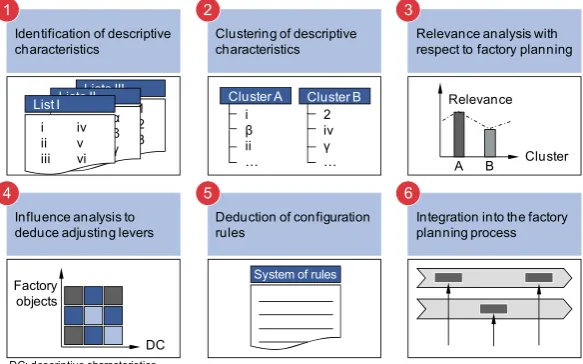
The development of a descriptive model for a quality-oriented factory planning process is based on a multi-stage procedure (see fig. 3). First of all, it is necessary to identify the characteristics with which high-quality
processes in the factory can be described or distinguished. In doing so, the method focuses only on those processes that apply to concrete order fulfillment. Therefore, only the company functions purchasing, production, and distribution are analyzed. The subsequent activities – service and maintenance – are included in the equation as well if they take place directly in the factory. In doing so, it is very important to analyze not only value-creation activities in the production but also non-value-creation processes such as storage and transport. For example, a factory layout may have short distances between the manufacturing facilities, but if the storage areas are far away, quality problems can occur because of incorrect and extensive or additional materials handling operations.
[image:3.595.128.468.49.205.2]The characteristics identified contain all the attributes of processes that determine the quality level through their specifications. Accuracy, production efficiency, delivery service, and quality of communications are just a few examples. The characteristics are compiled in an extensive catalog, which can be used as an open knowledge reservoir so that elements can be added depending on planning cases and project properties. The characteristics have to be clustered in a further step to improve the clarity of the catalog. The allocation of the characteristics to the process types information, production, logistics, and support processes can serve as an initial clustering. Thereupon, the characteristics are analyzed with respect to their relevance for factory planning in a multi-criteria assessment. For example, it is much more difficult for factory planners to influence the
Fig. 2: A quality-oriented factory planning concept
Factory Planning Factory Operation
Overall Target
High output and high product quality Configuration of factory objects
Process development and configuration
Adaption of factory objects
Process optimization
Development of a basis for process quality
Specific Target A Specific Target B
Continous improvement of process quality
Prerequisite for
Clustering of descriptive
characteristics Relevance analysis with respect to factory planning
Deduction of configuration rules
Integration into the factory planning process
2 3
Influence analysis to deduce adjusting levers 4
DC: descriptive characteristics
Factory objects
DC
Cluster A Cluster B i
β ii …
2 iv γ …
System of rules
Cluster
A B
Relevance Identification of descriptive
characteristics
1 2 3 Liste III Liste II
α β γ List I
i ii iii
iv v vi 1
[image:3.595.155.447.604.786.2]level of the qualifications of the employees involved in the processes than to create special areas that need a high degree of cleanliness. In the further course of the method, only the characteristics that have a high importance for the factory planning are considered.
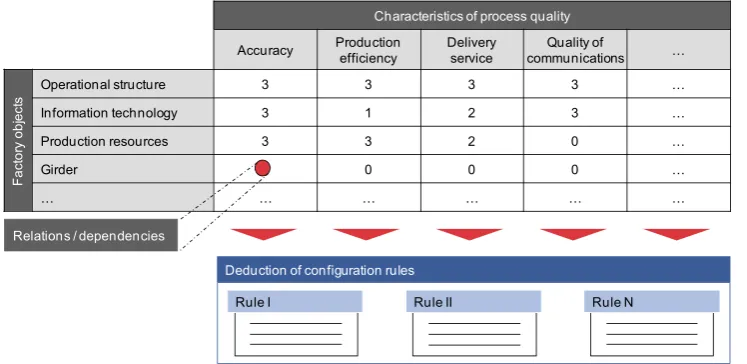
Once the essential characteristics are known, the individual factory objects are analyzed regarding their influence on those characteristics. An influence analysis helps to identify the objects that have a substantial influence on the process quality. The influence is evaluated with a cardinal scale, e.g. by interviewing experts or by taking experience into consideration, and is recorded in the influence analysis (see fig. 4). A scale from 0 (very low influence) to 3 (very high influence) is used for this.
For example, the configuration of the factory object information technology has a very high influence on the characteristic quality of communications. On the other hand, the production efficiency is influenced only indirectly by information technology. Moreover, the type and the intensity of the influence is collated on so-called influence characteristics cards. The interactions described in the influence analysis enable a targeted identification of so-called adjusting levers: The factory objects with a high influence on the characteristics will be chosen for further consideration in order to decrease the current complexity. That also affects those objects that indeed have a low influence value on most characteristics but an extreme influence on a certain object. In all this it must be remembered that one factory object can influence several characteristics, and negative correlations can appear, too. The organization of operations, for example, can be arranged in such a way that it raises the production efficiency but decreases the quality of communications.
Positive correlations can be considered as unproblematic. But if the correlations are negative, the factory planner has to choose a configuration version and might have to accept a worsening of another quality characteristic.
In order to use the knowledge gained in practice, the influence characteristics are assigned to configuration rules for quality-oriented factory planning. Rules are deduced for each object which indicate in which way they have to be configured in terms of a high process quality. In doing so, the positive interactions mentioned have to be maximized and
the negative ones minimized. In terms of the methodology, this is accomplished by setting up a morphology that allows a sensible combination of measures. Regarding the interactions, it is also possible to weight the configuration rules and therefore to prioritize them for the user.
Thereupon, the measures and rules of the quality-oriented configuration of the factory objects have to be integrated into the planning process. Firstly, the factory objects are analyzed to find the point in the planning process at which they are configured. Note that many factory objects are configured at several points in the process; for example, the size of the object building envelope is defined at an early stage, during the concept planning, but the detailed arrangement of windows, doors, etc. is carried out later, in the detailed planning phase. Therefore, the rules have to be considered at several points in the process. As a result, a quality-oriented system for the factory planning project can now be used.
B. Evaluation Model for Quality Support in Factories
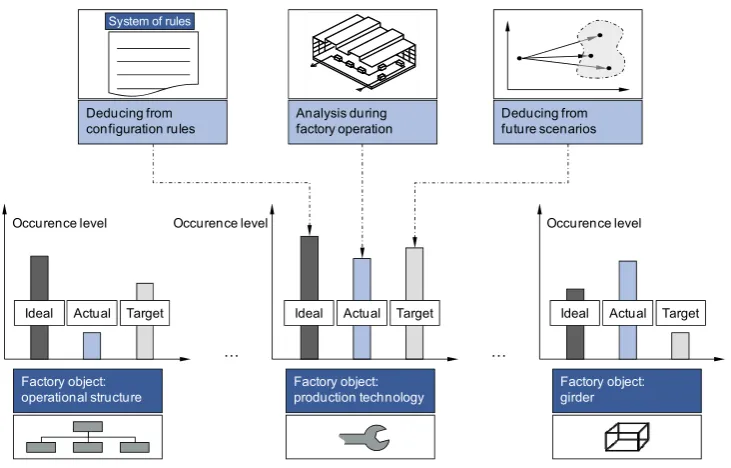
In order to design a quality-oriented factory it is also necessary to develop a checking and evaluation system that also works during everyday operations (see fig. 5). The model is based on practical operating figures that have to be assigned directly to the process quality characteristics. For example, production efficiency can be determined with operating figures such as throughput time or the number of flawless products manufactured per time unit. With these operating figures to hand it is possible to examine output and check the success of improvement measures. In contrast to characteristics that contain more of a general description of the process quality, operating figures can be measured directly in the process. The operating figures determined are compiled on so-called checking cards. They therefore enable an all-embracing operating figures system to be built up.
[image:4.595.114.488.55.237.2]For an evaluation of the quality support in everyday operations it is first necessary to determine the ideal status of the factory objects with respect to a quality-oriented configuration. Therefore, the configuration rules and the corresponding ideal specifications, which were drawn up in the descriptive model, are used. For analyzing the actual status, the information necessary is compiled in the factory and aggregated for the subsequent examination.
Fig. 4: Analysis of existing relations and dependencies
Characteristics of process quality
Accuracy Production efficiency Deliveryservice communicationsQuality of …
Operational structure 3 3 3 3 …
Information technology 3 1 2 3 …
Production resources 3 3 2 0 …
Girder 0 0 0 0 …
… … … …
Relations / dependencies
Rule I Rule II Rule N
Deduction of configuration rules
F
a
ct
o
ry ob
je
ct
A target profile is needed in order to adapt the existing factory to the actual quality requirements and the prospective changes. It is important to note that it may not be necessary nor reasonable to raise all factory objects to the ideal quality level. This might involve excessive costs and work, meaning that it would not be profitable. A corresponding costs-benefits ratio depends primarily on product and customer requirements and has to be checked in each individual case. Furthermore, prospective changes and scenarios (e.g. the customer’s quality awareness) have to be estimated and checked in terms of their effect on the ideal operating figures. At this point the application of scenario management could be helpful (see [22]). The totality of requirements is transferred to specific requirements profiles for the several characteristics. The known correlation between characteristics and factory objects enables a target profile of the factory, or rather its objects, to be established.
A comparison of the actual and target profiles enables deviations to be identified directly. A deviation can occur in two directions: Overfulfillment exists if the actual profile and the operating figures it contains exceed the characteristics of the target profile. In this case it is necessary to check whether those products with improved quality characteristics can be used for winning new market shares or entire markets to avoid possible waste. The possibility of reducing capabilities (e.g. for lowering costs) also has to be checked in every single case. If both profiles are equal, then no changes are necessary. However, continuous checking of the quality profile is certainly necessary. In the case of underfulfillment, the measures worked out and quality improvement rules for the processes have to be applied. Accordingly, the checking model developed is not used just for appraising the existing quality level, but can also be improved directly by introducing the measures worked out beforehand.
V. CONCLUSION
Fluctuating customer demands as well as shortened product and technology life cycles are only two of the challenges manufacturing companies are confronted with. In a turbulent environment and with intensive competition, the assurance of constant, high product quality is one of the key factors that help a company differentiate itself from its competitors. Corresponding process quality is necessary in order to manufacture high-quality products. Due to the fact that this process quality is essentially configured in the factory planning, quality requirements have to be considered even at this planning stage. The concept described is one possibility for conducting the quality-oriented add-on for factory planning. The procedure is based on a multi-stage approach that enables the quality level in later factory operations to be checked. In doing so, universally valid relationships can be supplemented by specific knowledge in the concrete case. The proactive configuration of process quality results in both cost- and time-savings.
REFERENCES
[1] Westkämper, E.: Digital manufacturing in the global era. In: 3rd International CIRP Seminar Digital Enterprise Technology. Setúbal, Portugal, 2006.
[2] Wiendahl, H.-P.; Reichardt, J.; Nyhuis, P.: Handbuch Fabrikplanung: Konzept, Gestaltung und Umsetzung wandlungsfähiger Produktionsstätten. Hanser, München, Wien, 2009.
[3] Wiendahl, H.-P.; ElMaraghy, H.; Nyhuis, P.; Zäh, M. F.; Wiendahl, H.-H.; Duffie, N.; Kolakowski, M.: Changeable Manufacturing – Classification, Design and Operation. In: Annals of the CIRP 56, vol. 2, pp. 783-809, 2007.
[4] Westkämper, E.: Wandlungsfähigkeit in der industriellen Produktion. TCW, München, 1999.
[5] Schmitt, R.; Betzold, M.: Die wahrgenommene Qualität. In: Management und Qualität 10, pp. 14-16, 2007.
[image:5.595.115.481.46.280.2][6] Westkämper, E.: Factory transformability: adapting the structures of manufacturing. In: Daschenko, AI (ed): Reconfigurable manufacturing systems and transformable factories. Springer, Berlin, pp. 372-381, 2006.
Fig. 5: Evaluation of quality support for factories
Ideal Actual Target
Factory object: operational structure
… …
Occurence level Occurence level Occurence level
Ideal Actual Target Ideal Actual Target
Factory object:
production technology Factory object: girder Analysis during
factory operation
Deducing from future scenarios Deducing from
[7] Wiendahl, H.-P.; Hernández, R.: The transformable factory - strategies, methods and examples. In: Daschenko, AI (ed): Reconfigurable manufacturing systems and transformable factories. Springer, Berlin, pp. 383-393, 2006.
[8] Goch, G.; Dijkman, M.: Holonic quality control strategy for the process chain of bearing rings. In: CIRP Annals – Manufacturing Technology 58, pp. 433-436, 2009.
[9] Chao, G. H.; Iravani, S. M. R.; Savascan, R. C.: Quality Improvement Incentives and Product Recall Cost Sharing Contracts. In: Management Science 55, vol. 7, pp. 1122-1138, 2009.
[10] Zollondz, H.-D.: Grundlagen Qualitätsmanagement: Einführung in Geschichte, Begriffe, Systeme und Konzepte. Oldenbourg, München, Wien, 2002.
[11] Pfeifer, T.; Tillmann, M.: In großen Sprüngen. Ganzheitliche Qualitätsverbesserung in der Produktion. In: QZ Qualität und Zuverlässigkeit 50, vol. 1, pp. 53-55, 2005.
[12] VDI Richtlinie 5200: Fabrikplanung. Planungsvorgehen. Verein Deutscher Ingenieure, 2009.
[13] Grundig, C.-G.: Fabrikplanung: Planungssystematik, Methoden, Anwendungen. München, Wien, 2000.
[14] Schenk, M.; Wirth, S.: Fabrikplanung und Fabrikbetrieb. Berlin, Heidelberg, 2004.
[15] Eversheim, W.; Schuh, G.: Betriebshütte: Produktion und Management, 7th ed., vol. 1 and 2, Springer, Berlin, Heidelberg, 1996. [16] Nyhuis, P.; Kolakowski, M.; Heger, C. L.: Evaluation of Factory
Transformability. In: 3rd International CIRP Conference on Reconfigurable Manufacturing, Ann Arbor, USA, 2005.
[17] ElMaraghy, H.: Changeable and Reconfigurable Manufacturing Systems. Springer, London, 2009.
[18] Nyhuis, P.; Heinen, T.; Brieke, M.: Adequate and economic factory transformability and the effects on logistical performance. International Journal of Flexible Manufacturing Systems, vol. 19, pp. 286-307, 2007. [19] Dashchenko, O. A.: Reconfigurable Manufacturing Systems and
Transformable Factories. Springer, Berlin, Heidelberg, 2006. [20] De Toni, A.; Tonchia, S.: Manufacturing flexibility: a literature review.
International Journal of Production Research, vol. 6, number 36, pp. 1587-1617, 1998.
[21] Nyhuis, P.; Elscher, A.: Process Model for Factory Planning. In 38th International CIRP Seminar on Manufacturing Systems, Florianopolis, Brazil, 2005.