A One-time Stegosystem and
Applications to Efficient Covert Communication
Aggelos Kiayias
∗1, Yona Raekow
†2, Alexander Russell
‡1and Narasimha Shashidhar
§31
Department of Computer Science and Engineering, University of Connecticut, Storrs, CT
{akiayias, acr}@cse.uconn.edu
2
Fraunhofer Institute for Algorithms and Scientific Computing, St. Augustin, Germany
[email protected]
3
Department of Computer Science, Sam Houston State University, Huntsville, TX
[email protected]
Abstract
We present the first information-theoretic steganographic protocol with an asymptotically optimal ratio of key length to message length that operates on arbitrary covertext distributions with constant min-entropy. Our results are also applicable to the computational setting: our stegosystem can be composed over a pseudorandom generator to send longer messages in a computationally secure fashion. In this respect our scheme offers a significant improvement in terms of the number of pseudorandom bits generated by the two parties in comparison to previous results known in the computational setting. Central to our approach for improving the overhead for general distributions is the use of combinatorial constructions that have been found to be useful in other contexts for derandomization: almostt-wise independent function families.
Keywords: Information hiding, steganography, data hiding, steganalysis, covert communication.
1
Introduction
Steganographic protocols enable one to “embed” covert messages into inconspicuous data over a public communication channel in such a way that no one, aside from the sender and the intended receiver, can even detect the presence of the secret message. The steganographic communication problem can be described using Simmons’ [12] formulation of the problem: In this scenario, prisoners Alice and Bob wish to communicate securely in the presence of an adversary, called the “Warden,” who monitors whether they exchange “conspicuous” messages. In particular, Alice and Bob may exchange messages that adhere to a certain channel distribution that represents “inconspicuous” communication. By controlling the messages that are transmitted over such a channel, Alice and Bob may exchange messages that cannot be detected by the Warden. There have been two approaches in formalizing this problem, one based on information theory [2,14,7] and one based on complexity theory [5]. Most steganographic constructions supported by provable security guarantees are instantiations of the following basic procedure (often referred to as “rejection-sampling”).
∗Earlier work supported by NSF CAREER grant CCR-0447808 and NSF grants CNS-0831304, CNS-0831306. Research
supported by ERC project CODAMODA.
†This work was done while the author was in the Department of Computer Science and Engineering, University of Connecticut. ‡Supported by NSF CAREER grant CCR-0093065, and NSF grants CCR-0121277, CCR-0220264, CCR-0311368, and
EIA-0218443.
The problem specifies a family of message distributions (the “channel distributions”) that provide a number of possible options for a so-called “covertext” to be transmitted. Additionally, the sender and the receiver possess some sort of private function indexed by the shared secret key (typically a keyed hash function, MAC, or other similar function) that maps channel messages to a single bit. In order to send a message bitm, the sender draws a covertext from the channel distribution, applies the function to the covertext and checks whether it happens to produce the “stegotext”mshe originally wished to transmit. If this is the case, the covertext is transmitted. In case of failure, this procedure is repeated. While this is a fairly concrete procedure, there are a number of choices to be made with both practical and theoretical significance. From the security viewpoint, one is primarily interested in the choice of the function that is shared between the sender and the receiver. From a practical viewpoint, one is primarily interested in how the channel is implemented and whether it conforms to the various constraints that are imposed on it by the steganographic protocol specifications (e.g., are independent draws from the channel allowed? does the channel remember previous draws? etc.).
The shared key between Alice and Bob can be an expensive resource; to focus on this parameter, we define a notion of overhead equal to the ratio of the length of the secret-key to the length of the message. Prior work in statistically-secure steganography either gives high overhead or considers restricted covertext distributions. For instance, in the information-theoretic model, Cachin [2] demonstrated a steganographic protocol that works on restricted covertext distributions where the channel is a stationary distribution produced by a sequence of independent repetitions of the same experiment. Under this uniformity assumption, he uses sequences of covertexts to encode the message and obtains optimal overhead. In the complexity-theoretic setting, Hopper et al. [5] provided a provably secure stegosystem that pairs rejection sampling with a pseudorandom function family to offer security for general (history-dependent) channel distributions with constant min-entropy. However, this protocol has a few drawbacks. First, casting their result in the information-theoretic setting, the length of the secret-key shared by Alice and Bob yields an overhead polynomial in the length of the message as this is the overhead required to share a suitable random function. In the complexity-theoretic setting, from an efficiency viewpoint, their construction required about 2 evaluations of a pseudorandom function per bit transmission. Constructing efficient pseudorandom functions is possible either generically [4] or, more efficiently, based on specific number-theoretic assumptions [9]. Nevertheless, pseudorandom function families are a conceptually complex and fairly expensive cryptographic primitive. For example, the evaluation of the Naor-Reingold pseudorandom function on an inputxrequiresO(|x|) modular exponentiations. Similarly, the generic construction [4] requiresO(k) PRG doublings of the input string wherekis the length of the key.
Our protocol remedies these shortcomings. We show how it is possible to attain constant overhead for general channel distributions with constant min-entropy. The only assumptions employed in our analysis are merely that the channel alphabet is polynomial in the length of the messagemand the security required is 2−|m|. Futhermore, our protocol in the computational setting is much more efficient: in particular, while
the Hopper, et al. stegosystem requires 2 evaluations per bit of a pseudorandom function, amounting to a linear (in the key-size) number of applications of the underlying PRG (in the standard construction for pseudorandom functions of [4]), in our stegosystem we require a constant number of PRG applicationsper bit. So the number of cryptographic operations per bit transmitted drops from linear to constant.
Central to our approach for improving the efficiency and overhead for general distributions is the use of combinatorial constructs such as almostt-wise independent function families given by Alon et al. [1]. Our protocol is based on the rejection sampling technique outlined above in combination with an explicit almost
2
Definitions and tools
The security of a steganography protocol is measured by the adversary’s ability to distinguish between “normal” and “covert” messages over a communication channel. To characterize normal communication we need to define and formalize the communication channel. We follow the standard terminology used in the literature [5,2,13]: Let Σ ={σ1, . . . , σs}denote an alphabet and treat thechannel as a family of random variablesC={Ch}h∈Σ∗; eachCh is supported on Σ. These channel distributions model a history-dependent
notion of channel data that captures the notion of real-life communication. Such a channel induces a natural distribution on Σn for anyn: σ
1is drawn from C, and each subsequentσi is drawn fromCσ1...σi−1. (Here
we letdenote the empty string.) Recall that themin-entropy of a random variableX, taking values in a set
V, is the quantity
H∞(X),min
v∈V (−log Pr[X=v]).
We say that a channelChas min-entropyδif for allh∈Σ∗,H∞(Ch)≥δ.
2.1
One-time stegosystems; the steganographic models
Steganography has been studied in two natural (but implicit up to now) communication models differing in Alice’s ability to sample from the channel.
Current History Model: The first model we study was that adopted by Hopper et al. [5]. In this model, Alice—and consequently the steganographic encoding protocol—has access to a channel oracle that provides samples from the channelfor the current history. Alice is given no means of sampling from Ch for other
histories. We call this thecurrent history model. In this case, one can imagine that the channel is determined by a complex environment: while Alice is permitted to sample from the channel determined by the current environment, she cannot simulate potential future environments. Naturally, the communication history is updated when a symbol is transmitted on the wire from Alice to Bob. Formally, ifh1, h2, . . . , h`∈Σ have
beentransmitted along the channel thus far, Alice may sample solely fromCh1◦···◦h` and send an element of
her choice.
Look-Ahead Model: The second model we study—the look-ahead model—was adopted by von Ahn and Hopper [13]. This model is a relaxation of the “current history” model: Alice is now provided with a means for sampling “deep into the channel.” In particular, Alice and, consequently, the steganographic encoding protocol, has access to a channel oracle that can sample from the channel forany history. Formally, during the embedding process, Alice may sample fromCh1◦...◦h` for any future historyh=h1◦. . .◦h` she wishes
(though Alice is constrained to be efficient and so can make no more than polynomially many queries of polynomial length). This more generous model allows Alice to transform a channelCwith min-entropyδinto a channelC(τ)with min-entropy τ δ. Specifically, the channelC(τ)is defined over the alphabet Στ, whose
elements we write as vectorsh= (h1, . . . , hτ). The distribution C
(τ)
h1,...,hn is determined by the channelC
with history h=h11◦ · · · ◦h1τ◦h21◦ · · · ◦hnτ: in particular, the distributionC
(τ)
h1,...,hn is determined by the
natural process whereh1 is drawn fromCh,h2is drawn fromCh◦h1, etc.
Below we give the definition of a one-time stegosystemthat works in either of the above models and is a steganographic system that enables the one-time steganographic transmission of a message provided that the two parties share a suitable key.
Definition 1. Aone-time stegosystem consists of three probabilistic polynomial time algorithms
S= (SK,SE,SD),
where:
• SE is theembedding procedure and has access to the channel;SE(κ, m;O) =s∈Σ∗. The embedding procedure takes into account the historyhof communication that has taken place between Alice and Bob thus far and begins its operation corresponding to this history. It takes as input the keyκof length
k, a messagemof length`=`(k) and a (probabilistic) oracleOthat allowsSE to draw independent samples repeatedly fromChin the current history model. In the look-ahead model, the oracleOaccepts
as input a (polynomial-length) history h0 ∈Σ∗and allowsSE to draw independent samples repeatedly fromCh◦h0. The output is the stegotexts∈Σ∗. Observe that in a one-time stegosystem, once a security
parameterk is chosen, the length of the message `is a fixed function ofk. As described above, the access thatSEhas to the channel is dictated by the model of communication.
• SDis theextraction procedure;SD(κ, c) =mor fail. It takes as input the keyκof length k, and some
c∈Σ∗. The output is a messagemor the tokenfail.
We next define a notion of correctness for a one-time stegosystem.
Definition 2 (Correctness). A one-time stegosystem (SK,SE,SD) is said to be (, δ)-correct provided that for all channelsCof min-entropyδ, it holds that∀h∈Σ∗
∀m∈ {0,1}`(k) Pr[SD(κ,SE(κ, m;O))6=m|κ←SK(1k)]≤ .
In general, we treat both=(k) andδ=δ(k) as functions ofk, the security parameter and the oracleOas a function of the historyh.
One-time stegosystem security is based on the indistinguishability between a transmission that contains a steganographically embedded message and a transmission that contains no embedded messages. The adversarial game discussed next is meant to model the behavior of a warden in the Simmons’ formulation of the problem discussed earlier.
An adversaryAagainst a one-time stegosystemS= (SK,SE,SD) is a pair of algorithmsA= (SA1,SA2), that plays the following game, denotedGA(1k):
1. A key κis generated bySK(1k).
2. Algorithm SA1 receives as input the security parameterk and outputs a triple (m,aux, hc)∈M`×
{0,1}∗×Σ∗, wherem is the challenge plaintext,h
c is the history of the channel that the adversary
wishes to use for the steganographic embedding to start, and aux is some auxiliary information that will be passed to SA2. Note thatSA1 is provided access toCvia an oracleO(h), which takes the historyh as input. O(·), on inputh, returns toSA1 an elementcselected according toCh. This way, the warden can learn about the channel distribution for any history.
3. A bitbis chosen uniformly at random.
• Ifb= 0 letc∗←SE(κ, m;O) whereOsamples covertexts fromChc.
• Ifb= 1 letc∗=c1◦ · · · ◦cu whereu=|SE(κ, m;O)| andci
r
←Ch◦c1◦···◦ci−1.
4. The input forSA2 is 1k,hc,c∗ and aux. SA2 outputs a bitb0. Ifb0 =b then we say that (SA1,SA2)
succeeded and writeGA(1k) = success.
Theadvantage of the adversaryAover a stegosystemS is defined as:
AdvAS(k) =
Pr
GA(1k) = success
−1
2
.
The probability includes the coin tosses of A and SE, as well as the coin tosses of GA(1k). The (information-theoretic) insecurity of the stegosystem is defined as
InSecS(k) = max
A {Adv A
S(k)},
Definition 3(Security). We say that a stegosystem is (, δ)-secure if for all channels with min-entropyδwe haveInSecS(k)≤.
As above, in general we treat both =(k) andδ=δ(k) as functions ofk, the security parameter.
Overhead. Theoverheadof a one-time stegosystem expressses the relation of the key lengthkand message length`variables; specifically, we adopt the ratioβ =k/`as a measure for overhead.
This paper is an extended version of a previous abstract that appeared in [6]. The work presented by Kiayias et al. [6] considers the scenario where the communication channel has min-entropy at least 1 in the current history model. In this paper, we present steganography protocols both in the current history and the look-ahead model. We also present explicit constructions of error-correcting codes using Forney [3] concatenation scheme. Furthermore, our protocols operate on any communication channel with min-entropyδ >0.
2.2
Error-correcting codes
Our steganographic construction requires an efficient family of codes that can recover from errors introduced by certain binary symmetric channels. In particular, we require a version of the Shannon coding theorem [11,10] that yields explicit control on the various parameters of the code as the rate approaches the capacity of the channel. We present this theorem in this section.
For an elementx∈ {0,1}n, we letBp(x) be the random variable equal tox⊕e, wheree∈ {0,1}n is a
random error vector defined by independently assigning eachei= 1 with probabilityp. (Herex⊕edenotes the vector withith coordinate equal toxi⊕ei.) The classical coding theorem [11] asserts that for every pair of real numbers 0< R < C≤1 andn∈N, there is a binary codeA⊂ {0,1}n, with log|A|/n≥Randθ∈R, so that for eacha∈A, maximum-likelihood decoding recoversafromBp(a) with probability 1−e−θ·n, where
pis determined from C as
H(p) =plogp−1+ (1−p) log(1−p)−1= 1−C .
The quantityC is called thecapacity of the binary symmetric channel and determines the random variable
Bp; the quantityR= log|A|/nis therate of the codeA. In this language, the coding theorem asserts that
at transmission rates lower than the capacity of the channel, there exist codes that correct random errors with exponentially decaying failure probability (in n, the length of the code).
We formalize our requirements below:
Definition 4. An error-correcting code of rate r is a pair of functions E = (Enc,Dec), where Enc :
{0,1}r·n → {0,1}n is the encoding algorithm and Dec : {0,1}n → {0,1}r·n the corresponding decoding
algorithm. Specifically, we say thatEis a (r, p, )-code if for allm∈ {0,1}r·n,
Pr[Dec(Enc(m)⊕e) =m]≥1− ,
wheree= (e1, . . . , en) and eachei is independently distributed in{0,1}so that Pr[ei= 1]≤p. We say that
Eisefficient if both Enc and Dec are computable in polynomial time inn.
We record the theorem below with the proof in AppendixA.
Theorem 1 (Based on Shannon [11, 10], Forney [3]). For any p ∈ [1 4,
1
2] and any R < 1−H(p), there
is an efficient (R, p, )-code for which there is θ ∈[0,1], n0 ∈ N such that ≤2−θn/logn for any n ≥n0.
Furthermore, it holds that θ−1= Θ(Z−1)andlogn
0= Θ(Z−2logZ−1)asZ→0where Z= 1−H(p)−R.
2.3
Function families and almost
t
-wise independence
Definition 5. A familyFof Boolean functions on{0,1}v is said to be-away from t-wise independent or
(v, t, )-independent if for anyt distinct domain elementsq1, q2, . . . , qt we have
X
α∈{0,1}t
Pr
f [f(q1)f(q2)· · ·f(qt) =α]−
1 2t
≤ , (1)
where f chosen uniformly fromF.
The above is equivalent to the following formulation quantified over all computationally unbounded
adversariesA:
Pr
f←rF[A
f[t](1v) = 1]− Pr f←rR[A
f[t](1v) = 1]
≤ , (2)
where Ris the collection ofall functions from{0,1}v to{0,1} andAf[t] is an unbounded adversary that is allowed to determine up tot queries to the functionf before it outputs its bit. The equivalence is formally stated (without proof) as follows.
Lemma 2. Fκ is0-away fromt-wise independence according to equation (1) if and only if Fκ is0-away
fromt-wise independence according to equation (2) above.
We employ the construction of almost t-wise independent sample spaces given by Naor and Naor [8], and Alon et al. [1]. The following theorem is a restatement of theorem 3 from Alon et al. [1].
Theorem 3 ([8], [1]). There exist families of Boolean functions Fv
t, on{0,1}v that are-away from t-wise
independent, are indexed by keys of length(2 +o(1))(logv+t/2 + log(−1)), and are computable in polynomial
time.
2.4
Rejection sampling
A common method used in steganography employing a channel distribution is that of rejection sampling, described below (cf., [2, 5]).
Rejection sampling in the current history model In the current history model, assuming that one wishes to transmit a single bitmand employs a random functionf :{0,1}d×Σ→ {0,1} that is secret from
the adversary, one performs the following “rejection sampling” process:
rejsamfh(m)
c←r Ch
iff(c)6=m
thenc←r Ch
Output: c
Here, Σ denotes the output alphabet of the channel,hdenotes the history of the channel data at the start of the process, andCh denotes the distribution on Σ given by the channel after historyh. The receiver (also
privy to the functionf) applies the function to the received messagec∈Σ and recoversmwith probability greater than 1/2. The sender and the receiver may employ a joint state (e.g., a counter), that need not be secret from the adversary. Note that the above process performs only two draws from the channel with the same history (more draws could, in principle, be performed). These draws are assumed to be independent. One basic property of rejection sampling that we will prove and is helpful for our construction is the following:
Lemma 4. If f is drawn uniformly at random from the collection of all functionsR={f : Σ→ {0,1} }and
Chas min-entropyδ, then
Pr
f←R[f(rejsam
f
h(m))6=m]≤p ,
Proof. Define the eventE to be
E= [f(c1) =m]∨[f(c1)6=m∧f(c2) =m] ;
thusE is the event that rejection sampling is successful form.
Herec1,c2 are two independent random variables distributed according to the channel distributionCh andhis determined by the history of channel usage. Recalling that Σ ={σ1, . . . , σs} is the support of the channel distributionCh, letpi= Pr[Ch=σi] denote the probability thatσi occurs. Asf is chosen uniformly at random,
Pr[f(c1) =m] = 1/2.
Then Pr[E] = 1/2 + Pr[A], whereAis the event thatf(c1)6=m∧f(c2) =m. To bound Pr[A], let D denote the event thatc16=c2. Observe that conditioned onD,Aoccurs with probability exactly 1/4; on the other hand,Acannot occur simultaneously withD. Thus
Pr[E] = 1
2+ Pr[A|D]·Pr[D] + Pr[A|D]·Pr[D] = 1 2 +
1
4Pr[D] .
To bound Pr[D], note that
Pr[ ¯D] =X
i
p2i ≤max
i pi
X
i
pi= max i pi
and hence that Pr[D]≥1−maxipi. Considering thatH∞(C)≥δ, we have maxipi≤ 21δ and the success
probability is
Pr[E]≥1
2 + 1
4·(1−pi)≥ 1 2 +
1 4
1− 1
2δ
= 1−p ,
from which the statement of the lemma follows.
The above lemma is a generalization of a similar result that appeared in [5] and dealt with the special case that the min-entropy is 1 bit.
The application of the rejection sampling procedure as described above in our stegosystem implies that a message bit transmitted over the communication channel can be flipped with a certain probabilityp. This can be viewed as an overlayed binary symmteric channel with a cross-over probabilityp. The error-correcting code is introduced to recover from these cross-over errors.
Rejection sampling in the Look-Ahead model In the look-ahead model, the rejection sampling procedure above can be coupled with the channel transformation described in Section 2.1. In particular, transforming a channelCwith min-entropyδinto a channelC(τ)with min-entropyδτ, one can carry out the rejection sampling process above with samples drawn from Στ. The binary symmetric channel cross-over
probability is thenp= 1 4(1 + 2
−δτ).
3
The construction
In this section we outline our construction of a one-time stegosystem as an interaction between Alice (the sender) and Bob (the receiver). First, we focus on the construction in the current history model and defer the discussion for the look-ahead model to Section3.2.
3.1
Our stegosystem for the current history model
In the current history model, Alice and Bob wish to communicate over a channel with distributionCover an alphabet Σ. We assume thatChas min-entropyδ, so that∀h∈Σ∗,H∞(Ch)≥δ.
As in the statement of Lemma 4, let p= 14(1 + 2−δ) whereδ is the min-entropy of the channel. The
An error-correcting code. LetE= (Enc,Dec) be an efficient (r, p, enc)-code of lengthnfrom Theorem1. The theorem asserts thatp, r determine a bound for the decoding error probabilityenc assuming that
nis suitably large.
A pseudorandom function family. Let F be the function family that is (logn + log|Σ|,2n, F )-independent indexed by keys of length kfrom Theorem3. Recall from the theorem thatF together with our choices ofv = logn+ log|Σ| and t = 2n determine the required key length k. We treat elements ofFas Boolean functions on {1, . . . , n} ×Σ and, for such a functionf we let fi: Σ→ {0,1}
denote the function fi(σ) =f(i, σ).
We will analyze the stegosystem below in terms of the parametersn, r, δ,F, relegating the discussion of how these parameters determine the overall efficiency, correctness and security of the system to Section3.3.
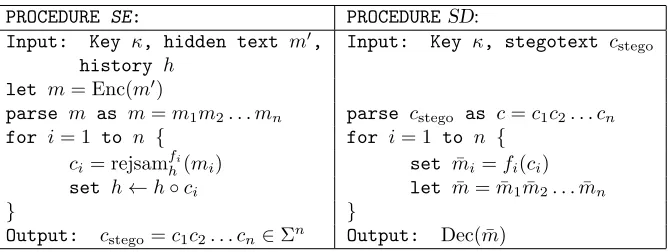
Key generation consists of selecting an element f ∈ F. This will be facilitated by sharing a random bitstringκof lengthk. Alice and Bob then communicate using the algorithms SEfor embedding andSDfor extracting as described in Figure1.
PROCEDURE SE: PROCEDURESD:
Input: Key κ, hidden text m0, Input: Key κ, stegotext cstego history h
let m= Enc(m0)
parse m as m=m1m2. . . mn parse cstego as c=c1c2. . . cn
for i= 1 to n { for i= 1 to n {
ci= rejsam fi
h(mi) set m¯i =fi(ci)
set h←h◦ci let m¯ = ¯m1m¯2. . .mn¯
} }
Output: cstego=c1c2. . . cn ∈Σn Output: Dec( ¯m)
Figure 1: Encryption and Decryption algorithms for the one-time stegosystem in the current history model.
In SE, after applying the error-correcting code E, we use rejsamfi
h(mi) to obtain an elementci of the
channel for each bitmiof the message. The resulting stegotextc1. . . cn is denotedcstego. InSD, the received stegotext is parsed block by block by evaluating the key functionfi atci; this results in a message bit. After performing this for each received block, a message of sizenis received, which is subjected to decoding via Dec. Note that we sample at most twice from the channel for each bit we wish to send. The error-correcting code is needed to recover from the errors introduced by this process.
The detailed correctness, security and overhead analysis for both models follow in the next sections.
3.1.1 Correctness
In this section we argue about the correctness of our one-time stegosystem in the current history model. We examine the minimum message length needed for achieving (, δ)-correctness for any choice of these parameters. We are particularly interested in the case whenδ is small (perhaps even approaching 0 as a function ofk) as the difficulty of parameter selection is amplified in this case (in contrast whenδis bounded away from 0 we have that the crossover probability pis bounded away from 1/2 and thus the parameter selection is simplified).
Theorem 5. For any , δ >0, consider the current history model stegosystem(SK,SE,SD) of Section3.1
under the parameter constraints r= Ω(1−H(p)) andF ≤/2 wherep= (1 + 2−δ)/4. Then the stegosystem
is(, δ)-correct so long as the message has length
Ω δ−2·log(−1) log log(−1)+ 2O(δ−4)
Proof. It is helpful to consider first the case that the functionf corresponding to the key shared between the two participants is a truly random function. In this case, in light of Lemma4 the underlying communication channel that is overlayed over the covertext distribution simulates a binary symmetric channel with crossover probabilityp= (1 + 2−δ)/4. Based on this fact and Theorem1, we have that the probability of error in
reception would be at most 2−θn/logn for sufficiently largen. Specifically, it should be thatn≥n
0for some
n0 that satisfies logn0 = Θ(Z−2logZ−1) where Z = 1−H(p)−r. Also recall thatθ= Θ(Z). Given the statement of the theorem we can postulate thatZ= Ω(1−H(p)) and as a resultZ−1=O((1−H(p))−1). Observe now that the choice ofp= (1 + 2−δ)/4 implies that
(1−H(p))−1=O((1−2−δ)−2)
in the light of Proposition15. It follows thatZ−1=O((1−2−δ)−2) and thusn
0= 2O((1−2
−δ)−4)
Z−1. From this we obtain that the minimum message length is of the form 2O((1−2−δ)−4) in order to attain an error correction bound of the form 2−θn/logn. To force this latter function to be below, say,/2 we need to select
n/logn= Ω(θ−1log(1/)) which implies a lower bound fornof the form Ω((1−2−δ)−2·log(1
) log log(
1
)).
The above guarantees an error of at most/2 when the functionf corresponding to the key shared between the two participants is a truly random function. Now we consider the case where the selection off is based on an-away fromt-wise independent family of functions. Given that the postulated distance of our function family from truly random functions is at most/2 it is easy to derive
∀m∈ {0,1}` Pr[SD(κ,SE(κ, m;O))6=m|κ←SK(1k)]≤
which establishes the correctness of the stegosystem for messages of length`that are suitably large as postulated since (1−2−δ)−2=O(δ−2) for small values ofδ≤1 while for largerδit holds that (1−2−δ)−2=O(1).
3.1.2 Security
In this section we argue about the security of our one-time stegosystem in the current history model.
Current history model First, we will observe that the output of the rejection sampling function rejsamfh, with a truly random function f, is indistinguishable from the channel distributionCh (this folklore result was implicit also in previous work—we prove it formally below). We then show that iff is selected from a family that isF-away from 2n-wise independent, the advantage of an adversaryAto distinguish between the output of the protocol andCh is bounded above byF. LetR={f : Σ→ {0,1}}. This will establish the following:
Theorem 6. For any , δ >0, consider the current history stegosystem(SK,SE,SD)of Section3.1 under
the parameter constraint F≤. Then the stegosystem is(, δ)-secure so long as the key has length
(2 +o(1)) 1
r ·`+ log log|Σ|+ log(
−1)
,
where` is the message length andris the rate of the error correcting code employed by the stegosystem.
Anticipating the proof of the theorem we start with some preliminary results. First, we characterize the probability distribution of the rejection sampling function:
Proposition 7. Fix some functionf : Σ→ {0,1}and channel history h∈Σ∗. The functionrejsamfh(m)is
a random variable with probability distribution expressed by the following function: Let c∈Σand m∈ {0,1}.
Let missf(m) = Prc0←C
h[f(c
0)6=m] andp
c= Prc0←C
h[c
0=c]. Then
Pr[rejsamfh(m) =c] = (
Proof. Let c1 and c2 be the two (independent) samples drawn from Ch during rejection sampling. (For simplicity, we treat the process as having drawn two samples even in the case where it succeeds on the first draw.) Note, now, that in the case wheref(c)6=m, the valuec is the result of the rejection sampling process precisely whenf(c1)6=mandc2=c; as these samples are independent, this occurs with probability
missf(m)·pc. In the case wheref(c) =m, however, we observec wheneverc1=corf(c1)6=mandc2=c. As these events are disjoint, their union occurs with probabilitypc·(missf(m) + 1), as desired.
Lemma 8. For anyh∈Σ∗, m∈ {0,1}, the random variablerejsamf
h(m) is perfectly indistinguishable from
the channel distribution Ch when f is drawn uniformly at random from the space of R.
Proof. Letf be a random function, as described in the statement of the lemma. Fixing the elementsc, and
m, we condition on the event E6=, thatf(c)6=m. In light of Proposition 7, for any f drawn under this conditioning we shall have that Pr[rejsamfh(m) =c] is equal to
Pr
c0←C
h
[c0 =c]·missf(m) =pc·missf(m) ,
where we have writtenmissf(m) = Prc0←C
h[f(c
0)6=m] and pc= Pr
c0←C
h[c
0=c]. Conditioned on E
6
=, then, the probability of observingc is
Ef[pc·missf(m)|E6=] =pc
pc+1
2(1−pc)
,
where the above follows from the fact that in the conditional space we can expandmissf(m) as
Pr
c0←C
h
[f(c0)6=m|c0=c∧E6=]· Pr
c0←C
h
[c0 =c|E6=] + Pr
c0←C
h
[f(c0)6=m|c06=c∧E6=]· Pr
c0←C
h
[c06=c|E6=].
LettingE=be the event thatf(c) =m, we similarly compute
Ef[pc·(1 +missf(m))|E=] =pc
1 + 1
2(1−pc)
.
As Pr[E=] = Pr[E6=] = 1/2, we conclude that the probability of observingc is exactly
1 2
pc
pc+
1−pc
2
+pc
1 + 1−pc 2
=pc ,
as desired.
Having established the behavior of the rejection sampling function when a truly random function is used, we proceed to examine the behavior of rejection sampling in our setting where the function is drawn from a function family that isF-away from 2n-wise independence. In particular we will show that the insecurity of the defined stegosystem is characterized as follows:
Proof of Theorem 6. Consider the following two gamesGA1 orGA2 that can be played with the adversaryA.
GA1(1k)
1. κ← {0,1}k
2. (m∗, s)←SA1O(h)(1κ, h),m∗∈ {0,1}`
3. b← {r 0,1}
4. c∗ =
c0, c1, . . . , cλ−1 ci= rejsam
fκ,i
h (mi), h=h◦c ifb= 0
from the channel ifb= 1
5. b∗←SA
GA2(1k)
1. f ←R
2. (m∗, s)←SA1O(h)(1κ, h),m∗∈ {0,1}`
3. b← {r 0,1}
4. c∗ =
c0, c1, . . . cλ−1 ci= rejsam f,i
h (mi), h=h◦c ifb= 0
from the channel ifb= 1
5. b∗←SA2(c∗, s) 6. ifb=b∗ then success
AdvAS(k) =
Pr
GA(1k) = success
−1
2
= Pr[GA1(1k) = success]−Pr[GA2(1k) = success] ≤F
and the theorem follows by the definition of insecurity. From Theorem3we get that the minimum key length required for security is (2 +o(1))(`/r+ log log|Σ|+ log(−1)), where`is the message length andris the rate of the error correcting code employed by the stegosystem.
3.2
Adapting to the look-ahead model
In this section we note the differences in the construction for the look-ahead model from the current history model. In this model, Alice and Bob agree to communicate over a channel with distribution Chτ over an
alphabet Στ where τ = δ−1. The min-entropy is now H∞(C(
δ−1)
h ) ≥1. The binary symmetric channel
cross-over probability isp= 3/8. To recover from the cross-over error, they use the error-correcting code
E= (Enc,Dec) which is an efficient (r,3/8, enc)-code of lengthnfrom Theorem 1.
For the look-ahead model, we record the corollary below which follows directly from Theorem 5.
Corollary 9. For any , δ >0, consider the look-ahead model stegosystem(SK,SE,SD)under the parameter
constraintsr= Ω(1−H(p))and F≤/2wherep= 3/8. Then the stegosystem is(, δ)-correct so long as
the message has lengthΩ(log(1) log log(1)).
In the current history model, asδ→0, the rejection sampling procedure has a high probability of failure. This is because the overlayed binary symmetric channel cross-over probability converges to a 1/2 very quickly since p= (1 + 2−δ)/4. Withpconverging to 1/2, the binary symmetric channel becomes informationless. Consequently, we would have to employ error correcting codes that can recover from very high error rates. This translates to a very high minimum message length requirement and explains the exponential dependence on δ−1. In the look-ahead model, we amplify the entropy of the channel upto 1, thereby removing the minimum message length’s exponential dependence onδ−1. In either model, if we want to transmit a message of length shorter than the minimum message length, this can be accomplished by padding the original message to attain the required length. The rejection sampling procedure in the two models only differ in the size of their domain space. Observe that this does not affect the security analysis. The corollary recorded below follows directly from the above Theorem6:
Corollary 10. For any , δ >0, consider the look-ahead stegosystem (SK,SE,SD) under the parameter
constraintF ≤. Then the stegosystem is(, δ)-secure so long as the key has length(2+o(1))(`/r+log log(|Σ|·
δ−1) + log(1)), where` is the message length andris the rate of the error correcting code employed by the stegosystem.
3.3
Putting it all together
that faithfully transmits each bit with crossover probabilityp= (1 + 2−δ)/4, the target rate that we may approximate is 1−H(p). In the case of the look-ahead model, we have the crossover probabilityp= 3/8 and the target rate that we may approximate is 1−H(3/8).
Indeed, as described below, the system asymptotically converges to the rate of this underlying rejection sampling channel. We remark that with sufficiently large channel entropy, there are ways for one to draw more samples during rejection sampling to reduce the error-rate without compromising security, but nevertheless this would not have any (asymptotic) bearing to our overhead objective.
Theorem 11. For any , δ >0, the stegosystem (SK,SE,SD) of Section3.1 in the current history model
under the parameter constraints r = Ω(1−H(p)) and F ≤ /2 where p = (1 + 2−δ)/4 is (, δ)-correct
and(, δ)-secure so long as : the message has lengthΩ(δ−2·log(1
) log log(
1
)) + 2
O(δ−2) asδ→0while the
dependency onδ vanishes forδ→ ∞. When the size of the channel alphabet is polynomial in the length of
the messagem and = 2−|m|, (SK,SE,SD) has overheadO((1−H(p))−1) =O(δ−2) as δ →0 while the
dependency onδ vanishes forδ→ ∞.
The above theorem implies that for any fixedδour stegosystem exhibitsO(1) overhead, i.e., the ratio of the key length over the message length is constant.
Theorem 12. For any , δ >0, the stegosystem (SK,SE,SD)of Section3.1in the look-ahead model under
the parameter constraintsr= Ω(1−H(p))andF ≤/2where p= 3/8is(, δ)-correct and(, δ)-secure so
long as : the message has lengthΩ(log(1) log log(1)). When the size of the channel alphabet is polynomial in
the length of the messagem and= 2−|m|,(SK,SE,SD)exhibitsO(1)overhead.
4
A provably secure stegosystem for longer messages
In this section we show how to apply the “one-time” stegosystem of Section3.1together with a pseudorandom generator so that longer messages can be transmitted.
Definition 6. LetUkdenote the uniform distribution over{0,1}k. A polynomial time deterministic algorithm Gis a pseudorandom generator (PRG) if the following conditions are satisfied:
Variable output For all seedsx∈ {0,1}∗ andy∈
N,|G(x,1y)|=y.
Pseudorandomness For every polynomialpthe set of random variables{G(Uk,1p(k))}
k∈Nis computation-ally indistinguishable from the uniform distribution{Up(k)}k∈N.
For a PRGGand 0< k < k0, ifAis some statistical test, we define the advantage of Aover the PRG as follows:
AdvAG(k, k0) =
Pr
w←G(Uk,1k
0
)
[A(w) = 1]− Pr
w←Uk0
[A(w) = 1]
.
The insecurity of the above PRG Gagainst all statistical testsA computable by circuits of size≤P is then defined as
InSecG(k, k0;P) = max A∈AP
{AdvAG(k, k0)}
where AP is the collection of statistical tests computable by circuits of size≤P.
It is convenient for our application that typical PRGs have a procedureG0 such that ifz=G(x,1y), it
holds thatG(x,1y+y0) =G0(x, z,1y0) (i.e., if one maintains z, one can extract they0 bits that follow the first
y bits without starting from the beginning).
Consider now the following stegosystem S0 = (SK0,SE0,SD0) that can be used for steganographic transmission of longer messages using the one-time stegosystemS = (SK,SE,SD) defined in Section 3.1.
players Alice and Bob, share a key of lengthk denoted by x. The function SE0 is given input xand the messagem∈ {0,1}ν to be transmitted of lengthν=p(k) for some fixed polynomialp. SE0 in turn employs
the PRGGto extractk0 bits (it computesκ=G(x,1k0),|κ|=k0). The lengthk0 is selected to match the
number of key bits that are required to transmit the messagemusing the one-time stegosystem of Section3.1. Once the keyκof lengthk0 is produced by the PRG, the procedureSE0 invokes the one-time stegosystem on inputκ, m, h. The function SD0 is defined in a straightforward way based on SD.
The computational insecurity of the stegosystem S0 is defined by adapting the definition of information-theoretic stegosystem security from Section2.1for the computationally bounded adversary as follows:
InSecS0(k, k0;P) = max
A∈AP
{AdvAS0(k, k0)},
this maximum taken over all adversaries A, where SA1 andSA2 have circuit size ≤P and the definition of advantageAdvAS0(k, k0) is obtained by suitably modifying the definition of AdvAS(k) in Section2.1. In
particular, we define a new adversarial gameGA(1k,1k0) which proceeds as the previous gameGA(1k) in Section2.1except that in this new gameGA(1k,1k0), algorithmsSA1andSA2receive as input the security parameterk0 andSE0 invokesSEas SE(κ, m;O) whereκ=G(x,1k0). This matches the model of [5] which
referred to such schemes as steganographically secret against chosen hiddentext attacks.
Theorem 13. The stegosystem S0= (SK0,SE0,SD0)is steganographically secret against chosen hiddentext
attacks. In particular employing a PRGG to transmit a messagem we get
InSecS0(k, k0;P)≤InSecG(k, k0;P) +InSecS0(k0)
whereInSecS0(k0)is the information-theoretic insecurity defined in Section 2.1and|m|=`(k0).
Performance comparison of the stegosystem S0 and the Hopper, Langford, von Ahn system.
The system of Hopper et al. [5] concerns a current history model where the min-entropy of all Ch is at least 1. In this case, we may select an (p,3/8, enc)-error-correcting code. Then the system of Hopper, et al. correctly decodes a given message with probability at least 1−enc and makes no more than 2ncalls to a pseudorandom function family. Were one to use the pseudorandom function family of Goldreich et al. [4], then this involves production of Θ(`·log(`· |Σ|)) pseudorandom bits, where`is the message length. Of course, the security of the system depends on the security of the underlying pseudorandom generator with parameterk. On the other hand, with the same error-correcting code, the steganographic system described in this work utilizesO(`+ log log|Σ|+ log(1/)) pseudorandom bits, correctly decodes a given message with probability 1−, while it possesses insecurity no more than. In order to compare the two schemes, note that by selecting= 2−k, both the decoding error and the security of the two systems differ by at most 2−k,
a negligible function in terms of the security parameterk. (Note also that pseudorandom functions utilized in the above scheme have security no better than 2−k with security parameterk.) In this case, the number of
pseudorandom bits used by our system is
(2 +o(1)) `+ log log|Σ|+k
= Θ(`+k+ log log|Σ|) ,
a non-trivial improvement over the Θ(`·log(`· |Σ|)) bits of the scheme above. In the look-ahead model, the number of pseudorandom bits used by our system is Θ(`+ log log(|Σ| ·δ−1) +k) as we operate on the channel
C(δ −1)
h .
References
[1] Noga Alon, Oded Goldreich, Johan H˚astad, and Ren´e Peralta. Simple construction of almost k-wise independent random variables. Random Struct. Algorithms, 3(3):289–304, 1992.
[3] G. D. Forney, Jr. Concatenated Codes. Research Monograph No. 37. MIT Press, 1966.
[4] Oded Goldreich, Shafi Goldwasser, and Silvio Micali. How to construct random functions. J. ACM, 33 (4):792–807, 1986.
[5] Nicholas J. Hopper, John Langford, and Luis von Ahn. Provably secure steganography. InCRYPTO, pages 77–92, 2002.
[6] Aggelos Kiayias, Yona Raekow, and Alexander Russell. Efficient steganography with provable security guarantees. In Mauro Barni, Jordi Herrera-Joancomart´ı, Stefan Katzenbeisser, and Fernando P´ erez-Gonz´alez, editors,Information Hiding, volume 3727 ofLecture Notes in Computer Science, pages 118–130. Springer, 2005. ISBN 3-540-29039-7.
[7] Thomas Mittelholzer. An information-theoretic approach to steganography and watermarking. In
Information Hiding, pages 1–16, 1999.
[8] Joseph Naor and Moni Naor. Small-bias probability spaces: Efficient constructions and applications.
SIAM J. Comput., 22(4):838–856, 1993.
[9] Moni Naor and Omer Reingold. Number-theoretic constructions of efficient pseudo-random functions. J. ACM, 51(2):231–262, 2004.
[10] C. E. Shannon. A mathematical theory of communication. Bell System Technical Journal, 27:379–423 and 623–656, July and October, 1948.
[11] C. E. Shannon and W. Weaver. The Mathematical Theory of Communication. University of Illinois Press, Urbana, Illinois, 1949.
[12] Gustavus J. Simmons. The prisoners’ problem and the subliminal channel. InCRYPTO, pages 51–67, 1983.
[13] Luis von Ahn and Nicholas J. Hopper. Public-key steganography. InAdvances in Cryptology Proceedings
of Eurocrypt 04, pages 323–341. Springer-Verlag, 2004.
[14] Jan Z¨ollner, Hannes Federrath, Herbert Klimant, Andreas Pfitzmann, Rudi Piotraschke, Andreas Westfeld, Guntram Wicke, and Gritta Wolf. Modeling the security of steganographic systems. In
Information Hiding, pages 344–354, 1998.
A
Error-correcting codes
In this section, we provide the proof for Theorem1from Section2.2.
Theorem 14. (based on Shannon [11, 10], Forney [3]) For any p∈[1 4,
1
2] and any R < 1−H(p), there
is an efficient (R, p, )-code for which there is θ ∈[0,1], n0 ∈ N such that ≤2−θn/logn for any n ≥n0.
Furthermore, it holds that θ−1= Θ(Z−1)andlogn
0= Θ(Z−2logZ−1)asZ→0where Z= 1−H(p)−R.
Proof. We provide the details below of the classic construction for such error-correcting codesEbased on
concatenated codes. In the standard notation used for codes,qstands for the alphabet size, nfor the block length,k for the message length (where|C|=qk) anddfor the minimum distance of the code. A code with
the above parameters is called an (n, k, d)q code and an [n, k, d]q code if it is linear. Thus, nk is the rate of
Here, we take advantage of the concatenation C1·C2 of two codesC1 andC2, called the “outer” and “inner” code respectively. The procedure is as follows:
Outer Code :C1= (N, K, D)Q
Inner Code :C2= (n, k, d)q
Such that :Q=qk .
The alphabet of the outer code is in one-to-one correspondence with the codewords of the inner code. Given a message inQK, first applyC1onto this message to get a strings∈QN. Then, on every symbol ofs, viewed as a message inqk, applyC
2and concatenate the results. The resulting codeword isC2(s1)·C2(s2)· · ·C2(sN)
and the resulting code hasQK = qkK
=qkKmessages. The length of the codewords isnN and the distance
of concatenation is at leastdD. Hence,
C1·C2= (N, K, D)qk·(n, k, d)q⇒(nN, kK, dD)q.
This operation was due to Forney [3]. We now show how we implement Forney’s code for constructing an asymptotically good code.
The inner code. In the inner code schema, we will be transmitting binary strings of lengthn1=c·logn over a binary symmetric channel with crossover probabilityp∈[14,12].
The encoding schema uses a setCof 2brn1c random codewords drawn from{0,1}n1 whereris a parameter
to be determined later that corresponds to the rate of the inner code. These codewords are mapped arbitrarily to the elements of{0,1}brn1c. The decoding procedure is a maximum likelihood decoder: given a received
word the message corresponding to the codeword closest to it, is determined and returned, with ties broken arbitrarily.
We next analyze the probability the decoding procedure fails. In what follows e∈ {0,1}n1 is selected
at random such that Pr[ei= 1] =p; we would like to bound the probability Pr[ci⊕eis closest toci] from below. Note that Pr[ci⊕eis closest toci] = Pr[d(ci⊕e, ci)< d(ci⊕e, cj)] for allcjwithj6=i, wheredis the Hamming distance. Without loss of generality, we can letci=0and proceed as follows. Pr[eis closest to0] = 1−Pr[Somec∈Cis closer to~ethan0]. To this end, let us first proceed to upper bound the probability Pr[Somec∈Cis closer to~ethan~0] which is the decoding error probability of the inner code.
Let|Bw(x)|be the set of wordsy withd(x, y)≤w. The setBw(x) is called the ball with radiuswand
centerx. |Bw(x)|=P0≤k≤w n1
k
. Letαbe a constant with 1/2> α > p.
Pr[ Somec∈Cis closer to~ethan0]
=
n1
X
i=0
pi(1−p)n1−i
n1
i
Pr[Somec∈Bi(~e)|~e]
≤ Pr[|e| ≥αn1] + Pr[Somec∈Bαn1(0)]
≤ Pr[|e| ≥αn1] +
2brn1c· |Bαn
1(0)|
2n1 .
Here, |Bi(x)| is the set of wordsywith d(x, y)≤i. Then, for 0≤α≤1/2,
|Bαn1(x)|= X 0≤k≤αn1
n 1
k
≤2n1H(α).
Thus,
Pr[Somec∈Cis closer to~ethan0]≤Pr[|e| ≥αn1] + 2(r−1+H(α))n1 < e
−n1 (α−p)2
Here the final inequality follows from the Chernoff bound.1 The above indicate that as long as we chooseα, r
such thatα > pandr <1−H(α) it holds that the error probability of decoding in the inner code is at most
1 provided that
n1≥max n
3pln(2−11)(α−p)−2,log(2−11)(1−H(α)−r)−1o.
The outer code. We next describe the outer code that is a Reed-Solomon code over the binary extension fieldGF(2n1). The code has lengthn
2<2n1 symbols and is of rateκ. We can correct a number of errors up to a rate of 1−2κ. We want to ensure that we can correct the message with probability 1−. Let u
be the number of errors of the inner code. The expected value ofuis 1n2. We would like to bound the probabiltyp0 = Pr[u >(1−κ)n
2/2]. Applying Chernoff bound and settingζ =1−1(1−κ)/2−1 we have thatp0< e−1n2(−11 (1−κ)/2−1)2/3≤provided that
n2≥ln(−1)−11·(
−1
1 (1−κ)/2−1)
−2.
We may decode the Reed-Solomon code using the Berlekamp-Welch algorithm and in the event that the error rate is greater than 1−2κ, the output of the decoding procedure will be a failure symbol⊥.
The concatenation construction. The objective is to transmit with a given transmission rate R <
1−H(p) for a transmission length ofnbits while having a decoding error probability of=e−θn/logn for
suitableθ (that is independent ofn). The recovery of theR·nbits of message should be achieved in time polynomial inn.
Given that we employ a concatenated code with r the inner-code rate and κ the outer code rate we can achieve our objective provided that r = 1−H(p)−f1, κ = 1−f2 as long as f1+f2 ≤ Z where
Z= 1−H(p)−Rfor some suitably chosen valuesf1, f2∈[0,1].
To account for the fact that the decoding of the inner code is done in a brute-force manner we need that
n1≤c1·1rlognfor some constantc1 (as in this case we maintain polynomial-time dependency innin terms of running time).
Letg1< f1 be some constant; we setα=H−1(H(p) +g1). Observe thatα > pandα <1/2, i.e., this is a valid choice for the selection ofαin the inner code design. Furthermore, we have that
1−H(α)−r= 1−H(p)−g1−(1−H(p)−f1) =f1−g1
and
α−p≥ g1
2.
This latter inequality follows from the fact thatH(p) +z≥H(p+z/2) for allp∈[1 4,
1
2] andz∈[0,1]. Based on the above we may restate the bounds onn1as follows:
n1≥max n
5·log(2−11)g1−2,log(2−11)(f1−g1)−1 o
.
We set g1=f1/2 andf1=Z/2 and we obtain the requirement thatn1= Ω(Z−2log−11). Next observe that (1−κ)/21−1 =f2/(21)−1, by settingf2= 21(1 +g2) for some constantg2, the bound onn2can be expressed as
n2≥ln(−1)−11g
−2 2 .
Note that assumingf2=Z/2 we obtain thatg2=Z/(41)−1, by setting1=Z/5 we obtain thatg2= 1/4. This results in the bound n2≥80·Z−1ln(−1), i.e., n2= Ω(Z−1log(−1)). Combining the above results with the fact that n1=O(logn),n=n1n2 we obtain that the error probability is 2−θn/logn where θ= Θ(Z) assuming thatn≥n0 wheren0 is such that logn0= Ω(Z−2logZ−1).
1Considere
1, . . . , eN random variables taking values in{0,1}with Pr[ei= 1] =pfori= 1, . . . , N. It holds that
Pr
"N X
i=1
ei>(1 +ζ)µ
#
< e−µζ2/3
for any 0< ζ <1 whereµ=PN
B
Lower bound on rate given upper bound on error
Proposition 15. Let0≤τ <1/4be a constant. LetR0= 1−H(1/2−τ). Then, R0 ≥τ2 . Here,H(·)is the Shannon entropy function.
Proof. We want to lower bound the rateR0 = 1−H 12−τ
. To this end, let us upper boundH(12−τ).
From the definition of Shannon entropy,
H(1
2 −τ) =−
1
2−τ
log2 1
2 −τ
+ 1
2 +τ
log2 1
2+τ
.
Rewriting the log terms as below,
log2
1 2 −τ
= log2(1 + (−2·τ))−1,
log2 1
2 +τ
= log2(1 + (2·τ))−1,
we get,
H(1
2−τ) = −
1
2−τ
log2 1
2 −τ
+ 1
2 +τ
log2 1
2 +τ
= −
1
2−τ
·log2(1 + (−2τ))−
1
2 −τ
−
1
2+τ
·log2(1 + (2τ))−
1
2 +τ
= −
1
2−τ
·log2(e)·ln (1 + (−2τ)) + 1
2+τ
·log2(e)·ln (1 + (2τ))−1
.
We now lower bound the terms ln (1 + (−2τ)) and ln (1 + (2τ)) using the natural logarithm power series:
ln(1 +x) =x−1
2x 2+1
3x 3−1
4x
4. . .(−1< x≤1).
In our case, we have 0≤τ < 14.So, −1
2 <−2τ≤0 and 0≤2τ < 1 2.
When−1
2 < x≤0,
ln (1 +x) =x−1
2x 2+1
3x 3−1
4x
4≥x−1 2x
2(1 +x+. . .)≥x−1 2x
2· 1
1−x ≥x−x
2.
When 0≤x < 1 2,
ln (1 +x) =x−1
2x 2+1
3x 3−1
4x
4≥x−1 2x
2.
Hence, we have
ln (1 +x)≥
(
x−x2
2 · 1
(1−x) ≥x−x 2 −1
2 < x≤0,
x−1 2x
2 0≤x < 1
2, and
H
1 2 −τ
= −
1 2 −τ
·log2(e)·ln (1 + (−2τ))
−
1 2 +τ
·log2(e)·ln (1 + (2τ))−1
≤ −
1
2 −τ
·log2(e)· −2τ−4τ2
−
1
2+τ
·log2(e)· 2τ−2τ2
−1
= 1−log2(e)· τ 2
+ 2·τ3≤1−log2(e)·τ 2
≤1−1.44τ2.
This gives us,
R0 = 1−H
1
2 −τ
≥1− 1−1.44τ2