IN
THIS
ISSUE
What Hope for Grazing on fhe Public Lands ___.___.___._____ _____ _____.____ I.,. A. Stoddart
Field Observations on Fallout Accumulation by Plants in Natural
Habitats _______________________~____________._ ._____ ______________ ____ _________ ____ . . . ..W. H. Rickard
Effects of Herbicides, Burning, and Seeding Date in Reseeding an Arid Range . . . ..W. C. Robocker, Dillard H. Gates, and Harold D. Kerr
Economic Evaluation of Sfockwafer Developments
N. Keith Roberts and E. Boyd Wennergren
Influence of Winter Supplemental Feeding of Cottonseed Cake on
Activities of Beef Cows . . ..Thadis W. Box, Gerald Brown, and John LiZes
Cattle Utilization and Chemical Content of Winged Elm Browse
R. L. DaZrympZe, Don D. Dwyer, and J. E. Webster
Undersfory Response Three Years After Thinning Pine
Burt R. McConnell and Justin G. Smith New Grazing Research Programs for Southern Forest Ranges
V. L. DuvaZZ and J. B. Hilmon
Fertilizer Experiments on Native Rangelands Using Increasing-Rate Spreader _...L. E. Lutwick, A. D. Smith, and A. Johnston
Use of Fecal Cellulose to Estimate Plant Tissue Eaten by Deer
Henry L. Short and Elmer E. Remmenga
Prediction of Weight Composition from Point Samples on Clipped Herbage
Harold F. Heady and George M. Van Dyne
Technical Noies:
Low-Cost Constant-Temperature Wafer Bath . . . ..Henry A. Pearson
A Further Note on Random Locations for Sample Unifs in Circular Plots . .._..._~___~..______~_~.__~._______~_.__George M. Van Dyne
Management Notes:
The Pinyon-Juniper Type of Arizona
Donald A. Jameson and Elbert H. Reid
Deterioration of Barbwire by Lightning E. H. McIZvain and M. C. Shoop
The Woodward Gate Latch . . . .._...._.C. G. Armstrong and E. H. McIZvain
Book Reviews:
Public Relations in Natural Resources Management
(DiZZard H. Gates) (A. G. Randall)
Current Literature _______________ _____ ______ ____ ___ __.__ ________...__________ _.___.__________.. _ _______ _ .____ _ ___._ _________ News and Notes .___________.____________________________..~.~.___~~ __._ ___ ______ ______.____ _____ __ ___________ _ ____ _.__ ____ _____
International News ._____._______________________ ____ _.__________________________________ ________.__ _____ _.__ ________________ 109 112 114 118 124 126
129
132 136 139 144
149
150
152 153 154
155 157 160 162 With the Secfions..._..._ ____ ____________________ ____ _______ ____ _____ ._____ ___ ____ _______ ________ ____ 163 Section Officers, ASRM, 1965 ____ _____.____ ____ ____ _._____ ____ ______ ____ _ .__________________ ___ _.__ __________ 164
Society Business:
ASRM Committees for 1965 _____________._________________________ __._ _._._____ ______ __________________________ 165 1965 Annual Meeting, ASRM ._._______________________ _____ ______________ _______ _ ____ _ ___. _.____ ______ ______ 166 Proposed Creed for Members of ASRM _____________________________ ____ ________________________ _____ 169
Cover Photo-Removing
Juniper to Increase Range Forage.
(U. S. Forest Service photo)
Journal
of
Volume 18, No. 3 May, 1965RANGE MANAGEMENT
What Hope for Grazing on the Public Lands
L. A. STODDARTHead, Department University, Logan.
Highlight
Ranchers need to modernize their use of public lands or face further restriction. Public range adminisfra- fors can be of real aid by cooperaf- ing to encourage sfockmen fo im- prove ranges and adjust fo changing times.
The objective of range man- agers is to maintain or improve production of forage on land which is used to support do- mestic livestock and big game animals. Yet records show that as management intensity on pub- lic lands has increased, total ani- mal production has steadily de- creased. Reduced numbers and reduced grazing season for do- mestic livestock have brought about this decreased production.
Naturally, those who are con- cerned in maintaining a healthy livestock industry in the West view this trend with alarm. Many are convinced that public land administrators are not in- terested in livestock grazing as a land use. Others conclude that range management is an ineffec- tive science.
The growing feeling that live- stock are discriminated against in multiple-use land planning and that range management is anti-livestock presents serious problems to our science. Nothing could be more unfortunate in our relationship to livestock pro- ducers.
Ranchers tend to defend their right to continue to graze public land on the basis of national
of Range Management, Utah State
meat needs, priority of use, moral principle, and the personal hardship which would result from reduction or elimination. Although each of these has a degree of validity, a stronger argument, often overlooked by livestock growers, is that grazing belongs as a part of the multiple use of land and that it can be included without detriment to other legitimate uses. The stock- man’s big challenge is to demon- strate the latter point.
Changes in the West
The West is going through a period of rapid transition. As with most people, ranchers have difficulty in accepting new situa- tions. Yet it is basic to maintain- ing their position on the public land that livestock growers be- come aware of the inevitable and permanent changes that face them and for which they must prepare.
Early in the history of the West, land was abundant, sparsely occupied by people, and free. The range livestock busi- ness was founded upon such con- ditions. Low costs and large numbers of livestock resulted in profitable ranching. The huge acreages of open, virgin range- lands furnished adequate feed, and livestock flourished. But land management and effective care of the animals were at a minimum. During these pioneer times, there was nothing wrong
109
with this. Indeed it is typical of wilderness land occupation. However, conditions of frontier America cannot be maintained forever. Inefficient and exploit- ive land use cannot continue and it is unreasonable to expect that it will (Table 1).
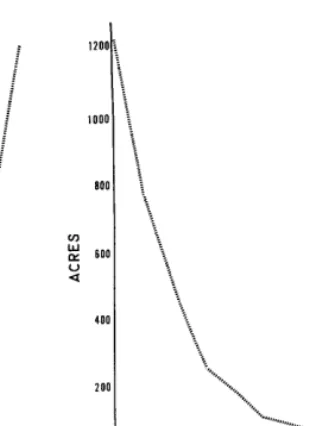
Figure 1 explains why land practices must change. Since the start of the livestock business in the West, human populations have increased about 3,000 per- cent. Even more important, in recent years the rate of increase is rising faster each decade. In the future, even more people will want even more land. We cannot ignore these facts.
Meanwhile more land is going into cities, roads, air fields, mili- tary installations, and other spe- cial uses. People are crowded into smaller and smaller areas
(Fig. 2). They have completely occupied all land not reserved by the government. The open range is gone. Free range is gone. People are land-hungry. This demand for land has created an artificial value, beyond eco- nomic justification. Because of
Table 1. Acreage and population dafa for fhe 11 conQJuous western siafes--fhe public range states.
Population, Acres millions per person
1860 .7 1218
1870 1.0 754
1880 1.7 443
1890 3.1 243
1900 4.1 184
1910 6.8 111
1920 8.9 85
1930 11.9 63
1940 13.8 55
1950 19.6 38
1860 1880 1900 1920 1940 1960
FIGURE 1. Human populations in the 11 contiguous western states of the United States. Not only is the curve rising each decade, but the rise is at a constantly increasing rate.
wild desire to own land, people are increasingly more aware of the value of public land and of their rights to use these lands.
But this is not all. The desire and need to use land is rising more rapidly than population data suggest because today’s peo- ple work fewer hours per day and fewer days. They have many more retirement years. They have fast highways and fast cars unknown a few decades ago. They are within a few hours of all but the most remote lands.
Today most of our population lives in large, crowded cities. Just as the formerly rural popu- lation went to the city for an exciting vacation change, mod- ern city people yearn for a vaca- tion in the quiet and peace of wildlands. There is great and increasing demand for parks, wilderness areas, camp grounds, and summer home areas. More people require more water, more game animals, and more areas to fish.
The desire to protect and con- serve land has become the inter- est of people in all walks of life, whereas, but a few years ago, only a handful of conservation-
1200
1000
800
2 [L: 600
2
400
200
E 1860
STODDART
1880 1900 1920 1940 1960
FIGURE 2. The space per person in the range states is decreasing rapidly. Peo- ple are becoming acutely aware of the shrinking natural resources available to them.
ists were concerned. This re- alignment of land values is fast changing people’s attitudes toward privileged use of public land by stockmen.
Stockmen seem to feel that government land administrators are somehow to blame for these new demands for land and land products. Actually administra- tors do not create demand. De- mand originates with the public. Changing federal land policy is a product of public demand-not a cause. Most administrators, and especially those born and trained in the West, make an honest effort to keep livestock grazing on the land despite the forces of millions of people demanding other land uses.
Fufure of Livesfock on Public Land
There is no need for calami- tous talk that changing federal land policy will wipe out the livestock business. True, a change is inevitable, but this need not mean elimination of the industry. But modernization is necessary. What happens in the future is largely up to the rancher.
Adapting to modern conditions will require hard work and re- organization of the thinking of many stockmen. More than any- thing else, stockmen must change their public image. Too often, ranchers seem to deliberately ag- gravate public opinion. Many oppose the game hunter, insist on grazing fees below market value, and demand monopolistic rights on the public land. They are inviting deadly opposition.
Stockmen can ill-afford public opposition. They are a minority group. They cannot hope to out- vote, outwit, or outpressure peo- ple who contest their place on public land. Any continued de- mand for exclusive rights or any abuse of the grazing privilege will surely increase the area of federal land that is legally re- served for exclusive use for rec- reation. The only apparent solu- tion to this problem involves an aggressive program of coopera- tion by stockmen whereby they work with other interests to solve mutual problems on the land.
Of real significance to ranchers is the growing trend toward large wilderness areas, recrea- tion reserves, and national parks which by law may specifically exclude livestock. This appears to be the alternative facing stockmen if they don’t learn to live with multiple use. The multiple-use concept is the live- stockman’s best friend and he should support legislation de- signed to encourage full and diverse use of public lands. Further, those public agencies whose objectives include multi- ple use deserve the stockman’s support.
an asset to recreation and need not interfere with other land uses. They must show that stock can safely graze watersheds, can live with deer, and be attractive to tourists. They must show that erosion, muddy s t r e am s , dirty camp grounds, and bare dusty ground are not necessarily ad- juncts to livestock grazing. Too many animals or too much con- centration of animals result in disturbance that fires the tourist to anti-livestock activities. Ad- mittedly some concentration is necessary around waterholes, corrals, driveways, and salt grounds, but these concentration areas must be kept away from public roads, fishing streams, lakes, and camp grounds. If the public see livestock damage on the land and develop this image of the livestock industry, the livestock grazing will cease on public lands. Stockmen must realize this. It will not be the public land agencies who will put an end to the grazing-it will be public opinion. Stockmen must accept this need to culti- vate public opinion as an emer- gency matter, because livestock already have been given a bad reputation as a result of careless management.
The rancher cannot stand by and hope someone else will pro- tect his place on the land. He, himself, must immediately and aggressively solve these prob- lems. Ranchers are not the land administrator’s only “clients,” and decisions cannot always favor the rancher. But surely they will favor him more often if he comes in a spirit of under- standing and a willingness to co- operate in putting together a workable multiple-use program on the land. This requires that the stockman have a positive plan of action to improve the range and to take his place, within reasonable bounds, among other land users. Stock- men must develop leadership in land management. There is no
GRAZING PUBLIC LANDS
reason to wait for others to de- velop the plans. Good range management is the price ranch- ers must pay for a place on the public lands.
BeHer Range Adminisfrafion
The great tragedy of the con- flict that seems to have devel- oped between technical land managers and stockmen is that the ranchers are creating in their minds an image of the range manager as an enemy to their cause. Actually, modern range management offers a tremendous wealth of new knowledge that will greatly aid the rancher in his business. The rancher loses if he does not take every oppor- tunity to get help from technical range managers.
But technical people, also, are partly to blame for this impasse. Too many land managers solve range problems by reducing or eliminating livestock. Too many are officious and rely on dicta- torial decisions based on bureau policy rather than on-the-ground facts. Unfortunately, many fed- eral land managers who are making important range deci- sions are trained in other phases of land management and really do not have the technical knowl- edge to manage ranges in a posi- tive way. The old idea of pre- serving resources by non-use is no longer acceptable to modern schools of range land manage- ment. Anyone who manages land in a negative way by preventing its use is living in the past.
The agency administrator plays a key role in adjusting land uses. It is his obligation to help ranchers make necessary progress. The manager should be proud of his role in increasing productivity of the land and in proving that multiple use is a real and functioning thing rather than a mere slogan. Too often, the impression is given that re- ducing grazing is an objective in land management.
111
Improving Range Lands
Ranchers should be able to look forward to increasing rather than decreasing their grazing permits. This can be done on a large majority of our public range if stockmen and adminis- trators really want it done. In 60 years of management on America’s public ranges we have not begun to exhaust the possi- bilities of increasing forage pro- duction. We have talked for years about getting this job done. It is time for action. Both stockmen and federal adminis- trators have been slow in putting to use known information about improving ranges.
Fortunately, ranchers have every reason to expect range im- provement and better manage- ment to benefit them economi- cally. Improvement of ranges, correct grazing intensity, and more careful husbandry of both stock and range can be made to pay. In the face of what we know today about good range manage- ment, there can be no excuse for the persistence of some stock- men in overgrazing and abusing land. Modern research shows conclusively that grazing capac- ity can be increased through range improvement and that with this increased capacity comes more calves and lambs and heavier animals. Ranchers must face the fact that improv- ing ranges requires money and that the stockman must pay his own way. The taxpayer should not be expected to improve ranges for private gain. But, in return, the administrator must meet the stockman half-way by guaranteeing either a reasonable permanency on the land or a re- imbursement for lost investment. Otherwise no prudent man can be expected to risk his capital on a venture as unstable as public land permits have been in the past.
112 STODDART
ranchers do not have access to technical range management knowledge. They need to take time to work with the rancher, explain the problems, and co- operate in working out solutions. A real aid to the stockman would be the encouragement of range
improvement as an alternate to reducing numbers. A rancher given sufficient warning about impending cuts and shown how he can avoid the reduction, will then be able to weigh costs and benefits of the proposed action program. He should be entitled
to know ahead of time what is required of him and to have full knowledge of alternate oppor- tunities. Sincere help more than any other thing will serve to break down this alarming atti- tude of distrust between rancher and range technician.
Field Observations On Fallout Accumulation By Plants
In Natural Habitatsl.
W. H. RICKARD Senior Research Scientist,
Biology Department, Battelle-Northwest, Richland, Washington.
Highlight
Fallout accumulation by above- ground plant paris was related fo differences in leaf and twig structure and time organs were exposed to af- mosphere. Trees appeared fo lessen i;lz; accumulation by understory
.
The accumulation of worldwide fallout by plants in natural habitats has been infrequently investigated. Mosses and lichens accumulated more fallout than vascular plants
(Gorham, 1959; Davis et al., 1963). The spring melt of snow increased the accumulation of fallout by alpine tundra plants (Osburn, 1963). Pu- bescent-leaved plants accumulated more fallout than glabrous leaved plants (Romney et al., 1963). Grasses growing on a flooded lowland habi- tat accumulated more fallout than grasses from a well drained upland habitat (Davis et al., 1963). Stron- tium-90 has been reported to ac- cumulate in the basal portions of perennial pasture grasses (Russell, 1958).
This paper reports the levels of gamma radioactivity of some com-
1 Work performed under Contract No. AT(45-1) -1350 between the Atomic Energy Commission and General Electric Company. The co- operation of the Washington State Game Department in allowing the collection of samples for this study is gratefully acknowledged. This study is a part of a study designed to evaluate the effect of climate on the uptake of fallout by browsing animals.
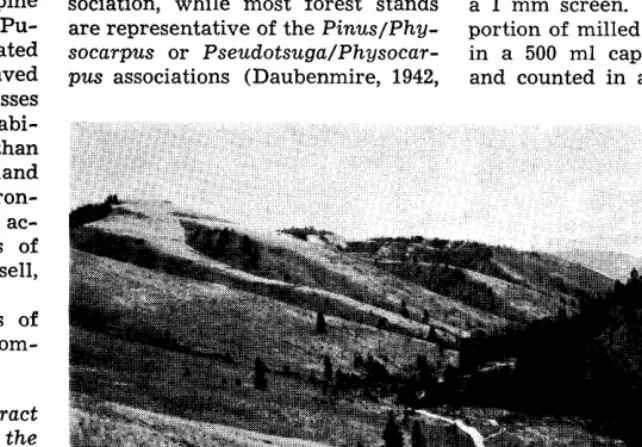
mon plants collected in 1963 with reference to phenology, leaf mor- phology and community structure, from the natural vegetation mosaic of the lower Cummings Creek Val- ley, Wooten Game Range, Columbia County, Washington. The Cummings Creek Valley is one of many deep, steep-walled valleys of the Blue Mountain region of southeastern Washington (Figure 1). Soils of the slopes consist of fine-textured loess intermingled with large quantities of basaltic stones. Surface soils in the valley tend to be less stony. The vegetation mosaic is composed of grassland and forest associations. Streamside vegetation consists of a narrow band of deciduous trees, mostly alder (A Znus tenuifolia),
birch (Betula spp.), and occasional tall cottonwoods (Populus tricho- carpa). Grassland stands are repre- sentative of the Agropyron/Poa as- sociation, while most forest stands are representative of the Pinus/Phy- socarpus or Pseudotsuga/Physocar- pus associations (Daubenmire, 1942,
1952). Grassland stands occupy the south-facing slopes and the exposed spur ridges on the north-facing slopes. Forest stands occupy por- tions of the valley floor, ravines and depressions on the north-facing slopes. Logging and forest fires have removed trees from some sites. The grassland vegetation is in good con- dition (Buechner, 1952) . Dominant grasses and forbs, bluebunch wheat- grass (Agropyron spicatum), lupine
(Lupinus serecius), and balsamroot
(Balsamorhiza sagittata) were har- vested by clipping near the ground from a stand representative of the
Agropyron/Poa association. The leafy twigs of ninebark, Physocarpus malvaceus were clipped more or less at random from stands with and without an overstory or trees.
All harvested material was sealed in plastic bags for delivery to the laboratory, dried, and milled to pass a 1 mm screen. A 100 to 200 gram portion of milled sample was placed in a 500 ml capacity plastic bottle and counted in a well-type, 9 x 11
112 STODDART
ranchers do not have access to technical range management knowledge. They need to take time to work with the rancher, explain the problems, and co- operate in working out solutions. A real aid to the stockman would be the encouragement of range
improvement as an alternate to reducing numbers. A rancher given sufficient warning about impending cuts and shown how he can avoid the reduction, will then be able to weigh costs and benefits of the proposed action program. He should be entitled
to know ahead of time what is required of him and to have full knowledge of alternate oppor- tunities. Sincere help more than any other thing will serve to break down this alarming atti- tude of distrust between rancher and range technician.
Field Observations On Fallout Accumulation By Plants
In Natural Habitatsl.
W. H. RICKARD Senior Research Scientist,
Biology Department, Battelle-Northwest, Richland, Washington.
Highlight
Fallout accumulation by above- ground plant paris was related fo differences in leaf and twig structure and time organs were exposed to af- mosphere. Trees appeared fo lessen i;lz; accumulation by understory
.
The accumulation of worldwide fallout by plants in natural habitats has been infrequently investigated. Mosses and lichens accumulated more fallout than vascular plants
(Gorham, 1959; Davis et al., 1963). The spring melt of snow increased the accumulation of fallout by alpine tundra plants (Osburn, 1963). Pu- bescent-leaved plants accumulated more fallout than glabrous leaved plants (Romney et al., 1963). Grasses growing on a flooded lowland habi- tat accumulated more fallout than grasses from a well drained upland habitat (Davis et al., 1963). Stron- tium-90 has been reported to ac- cumulate in the basal portions of perennial pasture grasses (Russell, 1958).
This paper reports the levels of gamma radioactivity of some com-
1 Work performed under Contract No. AT(45-1) -1350 between the Atomic Energy Commission and General Electric Company. The co- operation of the Washington State Game Department in allowing the collection of samples for this study is gratefully acknowledged. This study is a part of a study designed to evaluate the effect of climate on the uptake of fallout by browsing animals.
mon plants collected in 1963 with reference to phenology, leaf mor- phology and community structure, from the natural vegetation mosaic of the lower Cummings Creek Val- ley, Wooten Game Range, Columbia County, Washington. The Cummings Creek Valley is one of many deep, steep-walled valleys of the Blue Mountain region of southeastern Washington (Figure 1). Soils of the slopes consist of fine-textured loess intermingled with large quantities of basaltic stones. Surface soils in the valley tend to be less stony. The vegetation mosaic is composed of grassland and forest associations. Streamside vegetation consists of a narrow band of deciduous trees, mostly alder (A Znus tenuifolia),
birch (Betula spp.), and occasional tall cottonwoods (Populus tricho- carpa). Grassland stands are repre- sentative of the Agropyron/Poa as- sociation, while most forest stands are representative of the Pinus/Phy- socarpus or Pseudotsuga/Physocar- pus associations (Daubenmire, 1942,
1952). Grassland stands occupy the south-facing slopes and the exposed spur ridges on the north-facing slopes. Forest stands occupy por- tions of the valley floor, ravines and depressions on the north-facing slopes. Logging and forest fires have removed trees from some sites. The grassland vegetation is in good con- dition (Buechner, 1952) . Dominant grasses and forbs, bluebunch wheat- grass (Agropyron spicatum), lupine
(Lupinus serecius), and balsamroot
(Balsamorhiza sagittata) were har- vested by clipping near the ground from a stand representative of the
Agropyron/Poa association. The leafy twigs of ninebark, Physocarpus malvaceus were clipped more or less at random from stands with and without an overstory or trees.
All harvested material was sealed in plastic bags for delivery to the laboratory, dried, and milled to pass a 1 mm screen. A 100 to 200 gram portion of milled sample was placed in a 500 ml capacity plastic bottle and counted in a well-type, 9 x 11
FALLOUT ACCUMULATION 113
inch sodium-iodide (Tl) crystal connected to a 256 channel analyzer. Gamma-emitting fallout radio- nuclides measured were cesium-137, half-life 27 years; ruthenium, rho- dium-106, half-life one year; man- ganese-54, half-life 300 days, ce- rium-praseodymium-144, half -1if e 285 days; zinc-65, half-life 245 days; and zirconium-niobium-95, half-life 65 days. Cerium-praseodymium-144 was always the most abundant radionuclide measured. Zirconium- niobium-95 and ruthenium-rho- dium-106 were also abundantly rep- resented. Only small amounts of manganese-54 and cesium-137 were measured. Zinc-65 was infrequently detected.
Bluebunch wheatgrass contained more radioactivity than either bal- samroot or lupine (Table 1). The leaves of forbs had been aerially ex- posed for only about 60 days but some of green winter growth of grass had been exposed about 200 days. Some of the dead grass in- cluded in the harvest was a year or more old and also raised the average exposure time of the grass and in- dicates that persistence of above- ground organs is an important fea- ture in regard to the accumulation of fallout.
To further establish the role of persistence of aboveground organs and fallout accumulation, leaves and twigs of different ages, i.e., approxi- mately 4-month, 16-month, and 28- month-old age classes, were har- vested from the branches of a pon- derosa pine tree (Pinus ponderosa).
The new growth of pine contained less fallout than did the more aged tissues (Figure 2). This was espe- cially evident in regard to the long- lived radiocesium.
To compare the influence of leaf and twig morphologies on the ac- cumulation of fallout, shrubs with aboveground parts of similar age but different leaf morphology were sampled from the same location at the same time. On July 25, two kinds of shrubs of similar phenology and stature growing together were harvested of leaves and twigs. Leaves of mountain maple (Acer glabrum) are about twice the size and more glabrous than those of ninebark. The twigs of mountain maple are smooth-barked and the twigs of ninebark have shredded bark. Ninebark accumulated more
130
Age of leaves and Twigs 120
110
40
30
2P
10
n
_ VT?? 4 Months b-q 16 Months
”
cs-137 RuRh-106 Mn-54 CePr-144 Zn-65 ZrNb-95
Radionuclides
FIGURE 2. Accumulation of gamma emitting radionuclides by ponderosa pine leaves and
twigs of different age classes.
fallout than mountain maple (Table l), suggesting an effect of pubescent leaves and rugose stem morphology on increasing fallout accumulation. Two large perennial forbs of differ- ent leaf morphology were compared for radioactivity. Balsamroot has large, thick simple leaves in contrast to the thin, compound leaves (leaf- lets) of lupine. The surface area per gram of leaf was probably greater in lupine than in balsamroot, and correspondingly, the amount of total fallout accumulated by lupine was greater (Table 1).
The accumulation of fallout by leaves and twigs of understory nine- bark was evaluated by comparing shrubs growing on two closely simi- lar habitats with and without trees.
One site had an open tree canopy of Douglas fir (Pseudotsuga menzi- esii); the other was treeless because of a fire during the summer of 1961. The burned site occupied the lower portion of a 35” slope facing NNW at an elevation of about 2500 feet above sea level. The forested site occupied the same hillside at an elevation of about 100 feet higher. The slope angle here was 30”, north- facing. The ninebark growing in as- sociation with tall trees had lower total fallout-accumulation values than those plants growing without trees (Table 1). When the fallout content of ninebark twigs and leaves was compared with blue- bunch wheatgrass collected on the same day, ninebark contained less
Table 1. Gamma emitting radionuclides in plants collecfed from the lower Cummings Creek Valley, Washington, 1963. Results are expressed as picocuries (micromicrocuries) per gram dry weight.
Zr-Nb-95
Number of - -___---w Zn-65 Ce-Pr-144 Mn-54 Ru-Rh-106 cs-137 Total Grassland Association -p Date Samples Picocuries per Gram Dry Weight
Lupinus serecius 5115163 3 119 +, 4.4 0.77 ? 0.77 216 +- 29 15 t3.9 44+3.9 6.0+0& 400 Balsamorhiza sagittata 5115163 3 88: 7.5 0.47 +, 0.47 16D +. 2.2 9.6+_0.20 22t1.4 6.7 ? 0.21 2% Agropyron spicatum 5/15/63 3 2% ?31 3.7 +, 1.6 471 +, 33 19 : 1.2 7at5.4 18 to.aa a5o
Agropyron spicatum 7/25/63 3 167: 3.8 ND 465 +, 6.4 la + 0 109+.3.2 16 *,I.0 780 _-
Coniferous Forest Association
TPhysocarpus -- malvaceus 7125163 3 138: 2.2 ND 375 t 9.9 28 : 0.41 96t1.4 13 to.11 650
Physocarpus malvaceus 7/25/63 3 123: 4.4 ND 288 +-ii 18 to.91 ti+.L9 12 to.34 530 ~-
1Acer glabrum 7/25/63 2 58 ND 127 6.4 37 5.1 290
--
114
fallout than did the grass (Table 1). Although some of the twig material harvested was at least one year old, the leaves of ninebark had been ex- posed for much less time than were grass leaves.
Long-lived radionuclides such as cesium-137 and strontium-90 have the potential of cycling with other minerals in ecological systems. Only a small amount of radiocesium may be expected to enter plants from soil (Frere et al., 1963). Other modes of entry may be through foliar sur- faces with subsequent translocation and storage in persistent tissues. Re- gardless of the mode of fallout ac- cumulation, knowledge of plant fea- tures in conjunction with radio- chemical analyses can provide a means of comparing fallout accumu- lation in different plant communi- ties.
Summary
Fallout accumulation by above- ground plant parts was related to differences in leaf and twig mor-
RICKARD
phology and the amount of time plant organs were exposed to the atmosphere. The presence of trees appeared to lessen fallout accumu- lation by understory shrubs.
LITERATURE CITED BUECHNER, H. K. 1952. Winter-range
utilization by elk and mule deer in southeastern Washington. J. Range Manage. 5: 76-80.
DAUBENMIRE, R. F. 1942. An ecologi- cal study of the vegetation of southeastern Washington and ad- j acent Idaho. Ecol. Monogr. 12: 53-79.
DAUBENMIRE, R. 1952. Forest vegeta- tion of northern Idaho and adja- cent Washington, and its bearings on concepts of vegetation classifi- cation. Ecol. Monogr. 22: 301-330. DAVIS, J. J., D. G. WATSON AND W. C. HANSON. 1963. Some effects of en- vironmental factors upon accumu- lation of worldwide fallout in natural populations. In Radio- ecology. V. Schultz and A. W. Klement, Jr. (eds.), Reinhold Publ. Corp., N. Y., and A. I. B. S., Washington, D. C., p. 35-38.
FRERE, M. H., R. G. MENZEL, K. H. LARSON, R. OVERSTREET AND R. F. REITEMEIER. 1963. The behavior of radioactive fallout in soils and plants. Nat. Acad. Sci.-Nat. Res. Council, Publication 1092. Wash- ington, D. C. 32 p.
GORHAM, E. 1959. A comparison of lower and higher plants as ac- cumulators of radioactive fallout. Can. J. Botany 37:327-329.
OSBURN, W. S. 1963. The dynamics of fallout distribution in a Colorado alpine tundra snow accumulation ecosystem. In Radioecology, V. Schultz and A. W. Klement, Jr. (eds.) , Reinhold Publ. Corp., N. Y. and A. I. B. S., Washington, D. C., p. 51-71.
ROMNEY, E. M., R. A. LINDBERG, H. A. HAWTHORNE, B. A. BYSTROM AND K. H. LARSON. 1963. Contamination of plant foliage with radioactive fallout. Ecology 44: 343-349. RUSSELL, R. S. 1958. Deposition of
strontium-90 and its content in vegetation and in human diet in the United Kingdom. Nature 182: 834-839.
Effects of Herbicides, Burning, ‘and
Seeding Date in Reseeding an Arid Range’
W. C. ROBOCKER, DILLARD II. GATES, AND HAROLD D. KERRResearch Agronomist, Crops Research Division, Agri- cultural Research Service, U.S.D.A., Pullman, Washing- ton; Range Management Specialist, Oregon State University, Corvallis, Oregon (formerly Crops Research Division, Agricultural Research Service, U.S.D.A., PuZZ- man, Washington) and Research Agronomist, Crops Research Division, Agricultural Research Service, U.S.D.A., Beltsville, Maryland (formerly of Pullman, Washington).
Highlight
In a former sagebrush-bluebunch wheafglrass siie at Ephraia, Washing- ton, neither application of herbicides nor burning for control of downy brome and Sandberg’s bluegrass be- fore planting wheatgrasses were effective in increasing stands of wheafgrass seedlings. In this area of dry summers and approximately 8 inches annual precipitation, severe climatic stresses were primarily re- sponsible in determining the esfab- lishment or failure of seedlings.
Over seven million acres of
eastern Washington are grazing
lands. Vegetative cover on two
million acres or more of this
land is in poor condition. Im-
proper grazing and uncontrolled
burning have nearly eliminated
bluebunch wheatgrass
(Agro-pyron spicatum
(Pursh) Scribn.
and Smith) from much of the
depleted range. Such ranges are
now occupied by downy brome
(also called “cheatgrass” and
“downy chess”) (Bromus
tector-urn
L.) with an understory of
Sandberg’s bluegrass
(Poa se-cunda
Presl). On many ranges,
downy brome is rapidly being
replaced by medusahead (Ely-
mus caput-medusae
L., or as pre-
ferred by some researchers,
Taeniatherum asperum
(Simk.)
Nevski) .
Grazing management
alone would improve these de-
teriorated ranges slowly if at all.
Much of this land is not suitable
for reseeding by conventional
methods. Some areas are too
steep, some have shallow soil,
others are too rocky, and some
have combinations of these un-
desirable characteristics.
Environmental conditions in
the range area east of the Cas-
cade Mountains often restrict the
establishment of desirable for-
age grass seedlings. Precipitation
is low, especially during the hot
summer months. Air tempera-
114
fallout than did the grass (Table 1). Although some of the twig material harvested was at least one year old, the leaves of ninebark had been ex- posed for much less time than were grass leaves.
Long-lived radionuclides such as cesium-137 and strontium-90 have the potential of cycling with other minerals in ecological systems. Only a small amount of radiocesium may be expected to enter plants from soil (Frere et al., 1963). Other modes of entry may be through foliar sur- faces with subsequent translocation and storage in persistent tissues. Re- gardless of the mode of fallout ac- cumulation, knowledge of plant fea- tures in conjunction with radio- chemical analyses can provide a means of comparing fallout accumu- lation in different plant communi- ties.
Summary
Fallout accumulation by above- ground plant parts was related to differences in leaf and twig mor-
RICKARD
phology and the amount of time plant organs were exposed to the atmosphere. The presence of trees appeared to lessen fallout accumu- lation by understory shrubs.
LITERATURE CITED BUECHNER, H. K. 1952. Winter-range
utilization by elk and mule deer in southeastern Washington. J. Range Manage. 5: 76-80.
DAUBENMIRE, R. F. 1942. An ecologi- cal study of the vegetation of southeastern Washington and ad- j acent Idaho. Ecol. Monogr. 12: 53-79.
DAUBENMIRE, R. 1952. Forest vegeta- tion of northern Idaho and adja- cent Washington, and its bearings on concepts of vegetation classifi- cation. Ecol. Monogr. 22: 301-330. DAVIS, J. J., D. G. WATSON AND W. C. HANSON. 1963. Some effects of en- vironmental factors upon accumu- lation of worldwide fallout in natural populations. In Radio- ecology. V. Schultz and A. W. Klement, Jr. (eds.), Reinhold Publ. Corp., N. Y., and A. I. B. S., Washington, D. C., p. 35-38.
FRERE, M. H., R. G. MENZEL, K. H. LARSON, R. OVERSTREET AND R. F. REITEMEIER. 1963. The behavior of radioactive fallout in soils and plants. Nat. Acad. Sci.-Nat. Res. Council, Publication 1092. Wash- ington, D. C. 32 p.
GORHAM, E. 1959. A comparison of lower and higher plants as ac- cumulators of radioactive fallout. Can. J. Botany 37:327-329.
OSBURN, W. S. 1963. The dynamics of fallout distribution in a Colorado alpine tundra snow accumulation ecosystem. In Radioecology, V. Schultz and A. W. Klement, Jr. (eds.) , Reinhold Publ. Corp., N. Y. and A. I. B. S., Washington, D. C., p. 51-71.
ROMNEY, E. M., R. A. LINDBERG, H. A. HAWTHORNE, B. A. BYSTROM AND K. H. LARSON. 1963. Contamination of plant foliage with radioactive fallout. Ecology 44: 343-349. RUSSELL, R. S. 1958. Deposition of
strontium-90 and its content in vegetation and in human diet in the United Kingdom. Nature 182: 834-839.
Effects of Herbicides, Burning, ‘and
Seeding Date in Reseeding an Arid Range’
W. C. ROBOCKER, DILLARD II. GATES, AND HAROLD D. KERRResearch Agronomist, Crops Research Division, Agri- cultural Research Service, U.S.D.A., Pullman, Washing- ton; Range Management Specialist, Oregon State University, Corvallis, Oregon (formerly Crops Research Division, Agricultural Research Service, U.S.D.A., PuZZ- man, Washington) and Research Agronomist, Crops Research Division, Agricultural Research Service, U.S.D.A., Beltsville, Maryland (formerly of Pullman, Washington).
Highlight
In a former sagebrush-bluebunch wheafglrass siie at Ephraia, Washing- ton, neither application of herbicides nor burning for control of downy brome and Sandberg’s bluegrass be- fore planting wheatgrasses were effective in increasing stands of wheafgrass seedlings. In this area of dry summers and approximately 8 inches annual precipitation, severe climatic stresses were primarily re- sponsible in determining the esfab- lishment or failure of seedlings.
Over seven million acres of
eastern Washington are grazing
lands. Vegetative cover on two
million acres or more of this
land is in poor condition. Im-
proper grazing and uncontrolled
burning have nearly eliminated
bluebunch wheatgrass
(Agro-pyron spicatum
(Pursh) Scribn.
and Smith) from much of the
depleted range. Such ranges are
now occupied by downy brome
(also called “cheatgrass” and
“downy chess”) (Bromus
tector-urn
L.) with an understory of
Sandberg’s bluegrass
(Poa se-cunda
Presl). On many ranges,
downy brome is rapidly being
replaced by medusahead (Ely-
mus caput-medusae
L., or as pre-
ferred by some researchers,
Taeniatherum asperum
(Simk.)
Nevski) .
Grazing management
alone would improve these de-
teriorated ranges slowly if at all.
Much of this land is not suitable
for reseeding by conventional
methods. Some areas are too
steep, some have shallow soil,
others are too rocky, and some
have combinations of these un-
desirable characteristics.
Environmental conditions in
the range area east of the Cas-
cade Mountains often restrict the
establishment of desirable for-
age grass seedlings. Precipitation
is low, especially during the hot
summer months. Air tempera-
tures reach extremes of 112” F. in the summer and -23” F. in the winter (U. S. Department of Agriculture, 1941.) Bare soil temperature at the l-inch depth often exceeds 130” F. during the summer. The adverse climatic conditions plus the competition from downy brome and Sand- berg’s bluegrass make establish- ment of perennial grass seed- lings difficult.
The study reported herein was undertaken to further develop methods and procedures that would contribute to the success- ful revegetation of deteriorated rangelands.
Review of Literature
Downy brome is a winter annual under normal conditions, but it may also act as a summer annual if a cold period occurs after germination and stimulates flowering (Hulbert, 1955; Stein- bauer and Grigsby, 1957; Fin- nerty and Klingman, 1962). It produces seed even in dry years. Hulbert (1955) and Steinbauer and Grigsby (1957) found that almost all of the downy brome seed produced in the spring ger- minated in the following fall if moisture was adequate. These workers noted also that seed not germinating in the fall may ger- minate the following spring. Under favorable field conditions, germination of nearly all viable seed is likely to occur within a year after maturation, although enough usually remains unger- minated to produce a stand
(Chepil, 1946). Some ungermi-. nated seeds may remain viable for 10 years or more (Hulbert, 1955).
Downy brome generally ma- tures in early June, and dried plants constitute a potential fire hazard during the entire sum- mer. The seeds drop to the ground soon after maturity, and most escape lethal injury from fast-moving grass fires. An ex- tremely “hot” fire is necessary to impair the viability of seed on the ground. Dense stands of
HERBICIDES AND BURNING
downy brome are maintained year after year on Washington rangelands that are frequently burned during the summer months. Pickford (1946) ob- served that the density of annual grasses such as downy brome in- creased on burned ranges. He noted also that most big sage- brush (Artemisia tridentata
Nutt.) was destroyed by burn- ing. Furthermore, burning and heavy grazing reduced the stand of perennial grasses nearly 85 per cent and the grazing capacity over 50 per cent.
Hull and Stewart (1948) found in Idaho that burying downy brome seed by deep plowing and then drilling perennial grasses when moisture was adequate re- sulted in best grass stands. How- ever, the deep plowing was ex- pensive. Burning of the downy brome in June, soon after ma- turity, and drilling crested wheatgrass in the fall was an economical method of establish- ing the wheatgrass. Drilling crested wheatgrass directly into downy brome-infested range met with little success.
Rummel (1946) found in a greenhouse study that downy brome seedlings competed criti- cally with wheatgrass seedlings, although downy brome was less competitive under conditions of moisture stress.
Downy brome may be con- trolled with herbicides (Canode, et al., 1962; Klingman and Kerr, 1956; and Finnerty and Kling- man, 1962)) but little is known about the effects of such her- bicides on establishment of pe- rennial grasses planted after herbicide treatments.
Experimental Procedures
The study was conducted in a sagebrush-bluebunch wheatgrass site approximately 9 miles south- east of Ephrata, Washington, in cooperation with Mr. Tom Drum- heller, Ephrata, who provided land, fence, machinery, and la- bor. The soil was a stony phase of Ephrata sandy loam. Long-
115
time average annual precipita- tion is approximately 8 inches at the nearby Ephrata Airport.
An uncontrolled fire passed through the area during the summer of 1958. The fire line bisected the experimental area and provided an opportunity to compare the seeding and herbi- cide treatments on contiguous burned and unburned plots. No burning occurred after plots were established.
Applications of the sodium salt of 2,2-dichloropropionic acid
(dalapon) at 3 lb/A, an ester of dalapon at 3 lb/A, the sodium salt of 2,3,6-trichlorobenzoic acid
(2,3,6-TBA) at 4 lb/A, and iso- propyl N- (3-chlorophenyl) car- bamate (CIPC) at 8 lb/A were compared with an untreated check. Three rows each of Nor- dan crested wheatgrass (Agro-
pyron desertorum (Fisch. ex
Link) Schult.) , Whitmar beard- less wheatgrass (A. inerme
(Scribn. and Smith) Rydb.) , and Siberian wheatgrass (A. sibiri- cum (Willd.) Beauv.) were planted 18 inches apart and across each treatment. A Planet Jr. seeder with double-coulter openers, modified to function in the stony soil, was calibrated to plant approximately 25 live seeds per foot of row.
In 1958-59, the herbicides were applied and the grasses were seeded as follows:
Time of Time of herbicide grass treatment seeding Fall 1958 Fall 1958 Fall 1958 Spring 1959 Spring 1959 Spring 1959 Spring 1959 Fall 1959 _ Herbicides were applied in the fall after sufficient precipitation had fallen to germinate some of the downy brome seed. When herbicide treatments and seed- ings were made the same season, the grasses were seeded 2 weeks after the herbicide applications.
116
adjacent area in 1959-60. The
season of herbicide application
and grass seedings were identical
to those in 1958-59. The herbi-
cide treatments also were the
same except that CIPC at 4 lb/A
was substituted for the ester of
dalapon, and CIPC at 6 lb/A
was substituted for CIPC at 8
lb/A. The burned area was that
which was burned in 1958. All
treatments were replicated three
times on burned and unburned
areas in both experiments. Plots
were 10 by 20 feet.
The effects of the herbicide
treatments on vegetation were
evaluated in 1959 and 1960 after
spring growth had started but
before heading of downy brome.
A lo-foot steel tape was stretched
diagonally across each plot and
readings within a %-inch loop
were made at 2-inch intervals
with 60 readings (samples) thus
obtained per plot. Presence of
any part of a species within the
loop was counted as a “hit.”
Stands of planted grasses were
evaluated by counting the seed-
lings in the center 6 feet of the
middle row of each plot in the
spring prior to summer dor-
mancy. The percentage of ground
covered by broadleaf species was
measured each spring by means
of 10 samples per plot with a
20- by 50-cm sampling frame.
Results and Discussion
Precipitation during the sum-
mer months of the study was
characteristically low for this
area (Table 1). The fluctuation
which occurred in stands .was
associated with low soil moisture
during periods of seedling estab-
lishment .
The responses of downy brome
and Sandberg’s bluegrass
to
Table 1. Precipifafion in inches af Ephrafai Airporf, 1959-1961. Period 1958 1959 1960 1961 Jan.-March 4.59 4.18 2.57 3.75 April- June 1.84 0.68 2.58 1.86 July-Sept. 0.44 1.46 0.86 0.33 Oct.-Dec. 2.65 1.34 2.16 1.94 Total 9.52 7.66 8.17 7.88
ROBOCKER ET AL.
herbicides showed seasonal as
well as species variations (Table
2). The sodium salt of dalapon
caused little decrease in stand of
downy brome when applied in
the fall of 1958 or spring of 1959,
but was effective in the fall of
1959 and spring of 1960. Both
formulations of dalapon
gen-
erally reduced Sandberg’s blue-
grass. No consistent difference
between time of application was
evident, and no difference be-
tween effects of formulations
was noted. The following aver-
ages show little if any interac-
tion between season of treatment
and effect of the sodium salt of
dalapon:
Hits per
60 points,
treated
Treatment
Fall Spring
Check,
downy brome
33
38
Treated,
downy brome
20
26
Check, Sandberg’s
bluegrass
21
22
Treated, Sandberg’s
bluegrass
18
20
CIPC was not sufficiently ef-
fective on downy brome at low
rates to be considered for use
on rangelands at present. The
2,3,6-TBA at 4 lb/A was ineffec-
tive.
Inspection of the seasonal data
(Table 3) shows little advantage
from any of the herbicides used,
either spring or fall, as an aid
to increasing stands of planted
grasses. If the possibility of de-
stroying late germinating as well
as fall germinating downy brome
seeds is considered in addition
to destruction
of Sandberg’s
bluegrass (Table 2)) it appears
that an early spring application
of dalapon would be the most
promising herbicidal treatment.
The data on stands of wheat-
grasses as affected by interaction
of season of herbicide application
and season of planting are in
Table 4, and that on effects of
burning in Table 5. Because of
variations encountered
within
treatments, differences were not
evaluated on a basis of proba-
bility. However, the individual
species averages indicate a supe-
riority of Nordan crested wheat-
grass over the other two species.
Burning was the most beneficial
treatment in obtaining better
stands of wheatgrasses. No indi-
cation of differences in response
among species of wheatgrasses
to the herbicides was noted.
In general, burning markedly
reduced stands of downy brome,
Table 2. Effecfs of herbicides and fime of applicafion on sfands of downy brome (DB) and Sandherg’s bluegrass (SB).r
Herbicides applied in
Fall 19582 Spring 19592 Fall 19593 Spring 1960s Avg. Herbicide DB SB DB SB DB SB DB SB DB SB
Check 24 20 35 22 42 22 40 23 35 22
Dalapon salt,
3 lb/A 24 14 36 2 18 1 7 22 21 10
Dalapon ester,
3 lb/A 14 14 41 4 - - - - 28 9
2,3,6-TBA,
4 lb/A 21 20 26 26 26 33 40 26 28 26 CIPC, 4 lb/A - - - - 30 28 26 26 28 27 CIPC, 6 lb/A - - - - 22 26 22 26 22 26 CIPC, 8 lb/A 1 12 10 30 - - - - 6 21 Average,
treated 15 15 28 16 24 22 24 25 22 20
1 Average number of hits in 60 points per plot. 2 Readings in spring 1959.
--
HERBICIDES AND BURNING
117
but increased stands of Sand-
berg’s bluegrass (Table 5). The
effectiveness of the herbicides
on Sandberg’s bluegrass
or
downy brome apparently was
not greatly influenced by burn-
ing. Removal of litter and de-
struction of some seed probably
reduced the downy brome on
burned areas. In the Ephrata
area, Sandberg’s bluegrass forms
a sufficient cover to protect the
soil surface after burning, and
burning as a part of seedbed
preparation would be feasible.
Herbicide residues
are un-
predictable because
the low
amount of precipitation in the
area is not conducive to rapid
leaching or quick microbial
breakdown. The minimal yearly
precipitation, summer droughts,
and grasshoppers adversely af-
fect or further complicate estab-
lishment of wheatgrass seed-
lings.
The changes in coverage of
Table 5. Effect of burning on stands of downy brome, Sandberg’s blue- grass, and three species of wheafgrass.le 2
Species
Burned 1958, seeded Unburned, seeded 1958-59 1959-60 Avg. 1958-59 1959-60 Avg.
Downy brome 11 15 13 35 39 37
Sandberg’s bluegrass 18 33 25 15 13 14
---_--- ---
Wheatgrasses:
Beardless (Whitmar) 5 1 3 2 1 2
Siberian 8 3 6 2 3 2
Crested (Nordan) 8 8 8 2 7 4
1 Average number of hits in 60 points per plot for downy brome and Sand- berg’s bluegrass; seedlings per 6 ft. of row for wheatgrasses.
2Stand counts of downy brome and Sandberg’s bluegrass were for respective year of seeding (1959 and 1960); counts of wheatgrasses were 1 year after seeding (1960 and 1961).
broadleaf species
caused
by
herbicides and burning 2 years
after treatment were generally
negligible, possibly because the
initial coverage of most species
was only a trace, a large supply
of seed remained in the soil, and
the time of burning and applica-
tion of herbicides were not opti-
mum for killing
susceptible
Table 3. Effect of herbicides and time of application on average stand of three wheafgrasses per 6 ft. of row, 12 to 16 months after seeding.
Herbicides applied in Herbicide and rate
Fall Spring 19581 19591
Fall 19592
Spring
19602 Average
Check 2 7 6 5 5
Dalapon salt, 3 lb/A 2 11 7 4 6
Dalapon ester, 3 lb/A 3 9 - - 6
2,3,6-TBA, 4 lb/A T 5 6 3 4
CIPC, 4 lb/A - - 4 2 3
CIPC, 6 lb/A - - 2 2 2
CIPC, 8 lb/A 1 7 - - 4
Average, treated 2 8 5 3 4
1 Stand counts in spring 1960. 2 Stand bcounts in spring 1961.
Table 4. Effects of season of herbicide application and season of planting wheafgrasses 12 fo 18 months after seeding.1
species. Burning appeared to
have reduced the stands of tum-
ble mustard (Sisymbrium
altis-simum
L.) ,
tansy-mustard
(Des- curainia pinnata(Walt.)
Britt.) ,and whitlowwort (Draba
vernaL.). The herbicides
without
burning caused some reduction
of whitlowwort, but the greatest
reduction occurred as a result
of both burning and herbicides.
CIPC and 2,3,6-TBA accounted
for practically all of the effects
of herbicides on the broadleaf
species.
Summary
A study was initiated
in
1958 in the sagebrush-bluebunch
wheatgrass
association
near
Ephrata, Washington, to deter-
mine effectiveness both of burn-
ing and of several herbicides for
seedbed preparation when seed-
ing perennial grasses. Dalapon,
2,3,6-TBA, and CIPC were ap-
plied in spring and fall. Whitmar
on plank per 6 ft. of row of three
Herbicide applied: Fall 1958 Spring 1959 Fall 1959 Spring 1960
Seeded2 Seeded2 Seeded3 Seeded3 Avg. Avg.
Species of Fall Spring Spring Fall Fall Spring Spring Fall fall spring Genl. wheatgrass 1958 1959 1959 1959 1959 1960 1960 1960 seed seed Av.
Beardless (Whitmar) 2 1 7 4 T 1 T 3 2 2 2
Siberian 2 1 15 4 9 3 T 3 4 5 5
Crested (Nordan) 2 1 12 5 12 5 2 10 7 5 6
Average 2 1 11 4 7 3 1 5 5 4 4
1 Herbicide application preceded seeding the same season by 2 to 3 weeks. 2 Readings in spring 1960.
118
beardless, Siberian,
and Nor-
dan crested wheatgrasses were
seeded in spring and fall over
all other treatments.
Responses of downy brome and
Sandberg’s bluegrass to herbi-
cides varied. Burning substan-
tially reduced the amount of
downy brome present on the
plots the next year. However,
neither herbicidal treatment nor
burning were effective in in-
creasing the stands of planted
wheatgrasses. Nordan crested
wheatgrass appeared to provide
somewhat better stands than
either Whitmar beardless or Si-
berian wheatgrass.
Climatic factors exerted a pro-
found effect in determining suc-
cess of the reseeding, regardless
of other treatments imposed.
ROBOCKER ET AL.
LITERATURE CITED
CANODE, C. L., W . C. ROBOCKER AND T. J. MUZIK. 1962. Grass seed production as influenced by chem- ical control of downy brome. Weeds 10: 216-219.
CHEPIL, W. S. 1946. Germination of weed seeds. I. Longevity, perio- dicity of germination and vitality of seeds in cultivated soil. Sci. Agr. 26: 307-346.
FINNERTY, D. W., AND D. L. KLING- MAN. 1962. Life cycles and con- trol studies of some weed brome- grasses. Weeds 10: 40-47. HULBERT, L. C. 1955. Ecological
studies of Bromus tectorum and other annual bromegrasses. Ecol. Mono. 25: 181-213.
HULL, A. C., JR., AND G. STEWART. 1948. Replacing cheatgrass by re- seeding with perennial grass on southern Idaho ranges. Agron. J. 40: 694-703.
KLINGMAN, D. L., AND H. D. KERR. 1956. Promising herbicides for the control of annual bromegrasses. Proc. 13th NCWCC.
PICKFORD, G. D. 1946. The influence of continued heavy grazing and of promiscuous burning on spring- fall ranges in Utah. Ecology 13: 159-171.
RUMMELL, R. S. 1946. Some effects of competition from cheatgrass brome on crested wheatgrass and bluestem wheatgrass. Ecology 27: 159-167.
STEINBAUER, G. P., AND B. H. GRIGSBY. 1957. Field and laboratory studies on the dormancy and germination of the seeds of chess (Bromus secalinus L.) and downy brome- grass (Bromus tectorum L.). Weeds 5: l-4.
U. S. DEPT. OF AGRICULTURE. 1941. Climate and Man. U. S. Govt. Printing Office (Washington, D. C.). 1248 pp.
Economic Evaluation of
Stockwater Developments’
N. KEITH ROBERTS AND E. BOYD WENNERGREN
Professor and Associate Professor, Department of Agri- cultural Economics, Utah State University, Logan.
Highlight
Sfockwaier development offers
a
good possibility for favorable re-
turns on investment. By analyzing
proposed development projects as described here, a rancher can make sounder economic decisions concern- ing range improvement practices.