© 2015, IJCSMC All Rights Reserved
172
Available Online at www.ijcsmc.comInternational Journal of Computer Science and Mobile Computing
A Monthly Journal of Computer Science and Information Technology
ISSN 2320–088X
IJCSMC, Vol. 4, Issue. 4, April 2015, pg.172 – 178
RESEARCH ARTICLE
The Exact and BD Algorithm for Data-Gathering
Cluster-Based Wireless Sensor Network
Raghavendra P R
1, Mrs. Geetha N B
2, Dr. Mohamed Rafi
31Department of Computer Science, Visvesvaraya Technological University, India
2Department of Computer Science, Visvesvaraya Technological University, India
3Department of Computer Science, Visvesvaraya Technological University, India
1
[email protected], 2 [email protected], 3 [email protected]
Abstract— Wireless sensor networks provide the facility for collecting diverse types of data at frequent intervals, even multiple times per second and over large areas. Data-gathering wireless sensor networks (WSNs) areoperated unattended over long time horizons to collect data in severalapplications such as those in climate monitoring and a varietyof ecological
studies. The proposed system considers a LEACH model to optimally determine the sink and CH locations as well as the data
flow in the network. This model effectively utilizes both the position and energy-level aspects of the sensors while selecting
the CHs and avoid the highest-energy sensors that are well-positioned sensors with respect to sinks being selected as CHs
repeatedly in successive periods. The current work focuses on the development of an effective Benders decomposition (BD)
approach that incorporates an upper bound heuristic algorithm, strengthened cuts, and an optimal framework for
accelerated convergence for LEACH model. Computational evidence demonstrates the efficiency of the BD approach and
the heuristic in terms of solution quality and time.
© 2015, IJCSMC All Rights Reserved
173
I.
Introduction
A Wireless Sensor Network are spatially distributed autonomous sensors to monitor physical or environmental conditions, such as temperature, sound, pressure, etc. and to cooperatively pass their data through the network to a main location. Sensor node normally senses the physical event from the environment. A group of sensors communicating in a wireless medium form a wireless sensor network for the purpose of gathering data and transmitting it to a user (sinks). The main
purpose of the WSN is to monitor and collect data by the sensors and then transmit this data to the sinks. Clustering is a key
technique used to extend the lifetime of a sensor network by reducing energy consumption. Scalability of network increases
with the help of clustering techniques. This paper considers time-driven sensor network applications such as environmental
sensor networks for monitoring ecological habitats. WSN gives a great opportunity for monitoring ecology that was not possible
before due to the remoteness of areas of interest and/or infeasibility of in-person attendance in data collection. Use of WSNs
does not only make eco-monitoring possible, but also facilitates more frequent data collection. In addition, as habitat monitoring
can be very sensitive to human presence, an unattended WSN provides a non-invasive approach to obtain real-time
environmental data. The network operations of general framework of WSN of our interest can be outlined as follows. Initially, a
set of sensors, which are equipped with limited energy resource (e.g., battery) as well as sensing, processing, and
communication capabilities, is deployed in a geographical region. Data collected by the sensors are forwarded to specially
designated sensors, called cluster heads (CHs), which conduct some processing to aggregate their received data. CHs then
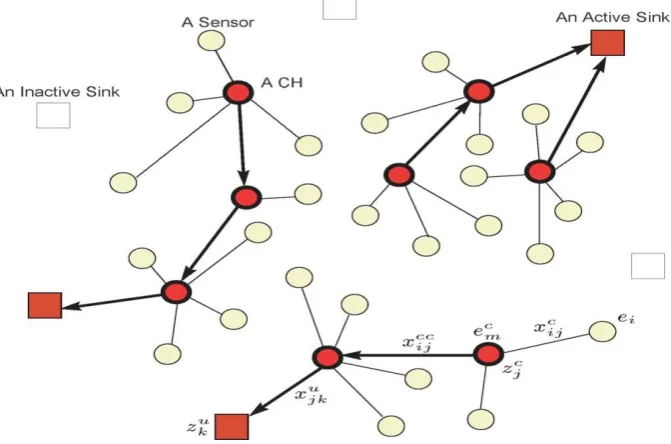
forward the data to specific locations, called sinks, either directly or through other CHs. In this underlying setting which is
depicted in Fig. 1, design of the network refers to the determination of CH and sink locations, while the operation decisions
refer to the routing of data from the sensors to the sinks in that network.
Fig. 1. Sample network, data flow, and notation
In many applications of WSNs network lifetime is one of the main concerns in network design and operation. Sensor
redeployments may be needed due to several reasons, e.g., having less than a critical number of operational sensors with enough
© 2015, IJCSMC All Rights Reserved
174
period, network design and operations decisions are made in a way that the number of periods in a deployment cycle is
maximized. Consequently, the network lifetime is defined as the number of periods that can be achieved with a deployment.
Topology control and routing are two fundamental problems in effective design and operation of WSNs. The close relationship
between these decisions and their relation to network lifetime are especially underlined by the WSN specific design include
energy efficiency and computation communication trade-off. Energy efficiency is a major concern since each sensor has finite
and non-renewable energy resource.
Communication computation trade-off refers to the fact that communication consumes more energy than performing
computations on board sensor. This is critical as it relates to the energy efficiency. Although the direct communication of a
sensor with a sink is suitable for the whole network, this is practically impossible or may require excessive energy may the
network lifetime get reduced. Therefore, routing schemes where the data size is decreased by in-network data aggregation where
energy is used for computation rather than communication along the paths from sensors to a sink (user) are usually preferred.
II.
Literature Survey
Clustering of sensors has been shown effectiveness in improving sensor network lifetime in the literature. The principle is to
organize WSNs into a set of clusters, and within each cluster, sensors transmit the collected data to their CHs. Each CH collects
its received data and forwards it to the sink either directly or via relaying through other CHs.
This is beneficial in three ways in terms of energy efficiency such as
1) Hierarchical structure provides facility to eliminate the quick energy drainage at the sensors that are away from the sink by a
multi hop sensor-to-sink data transfer scheme;
2) To reduce data redundancy the data aggregation is performed at the CHs so that energy in savings communications are
realized;
3) At frequent intervals re clustering can balance the energy consumption by reassigning the CHs and the sinks and adjusting
the routing in the network. This project discusses the works that are more closely related to this research in the context of
network topology and data routing.
Heinzelman et al. develop a data aggregating cluster-based routing protocol Low Energy Adaptive Clustering
Hierarchy (LEACH). In LEACH, they assume a single-hop CH-to-sink connection and adopt the randomized rotation of CHs to
ensure balanced energy consumption. But such assumptions may not guarantee network connectivity. The LEACH algorithm
proceeds in rounds. In each round, each sensor node independently decides whether or not to become a CH according to a
probability function. On average, this function makes each node become a CH for a similar period of time, assuring fair
balancing of energy consumption among all nodes. Although LEACH performs local data fusion to compress the cluster
information, it does not consider data correlation when forming optimal-sized clusters. Moreover, since the probability of
becoming a CH is fixed, LEACH results in clusters that are on average of the same size throughout the entire network.
Younis and Fahmy et al. propose a hybrid energy-efficient distributed clustering routing (HEED) protocol where the CHs are
probabilistically selected based on their remaining energy and the sensors join clusters such that the communication cost is
minimized. HEED assumes a multihop connection between the CHs and to the sink and assumes all nodes are of same
important.
In EAP, each CH is probabilistically selected based on its ratio of the remaining energy to the average remaining energy of all
© 2015, IJCSMC All Rights Reserved
175
remaining energy. For further improvement in network lifetime, EAP introduces the idea of intra cluster coverage‖ that allows a
partial set of sensors to be active within clusters while maintaining an expected coverage.
Specifically, in a multi hop cluster-based WSN, the CHs closer to the sink may have quick drainage due to their heavy load in
forwarding data to the sink. It notes that most of the above-mentioned studies do not explicitly take this factor into account. To
ensure balanced energy consumption, there are some studies, that consider an unequal cluster-based routing scheme, i.e., CHs
closer to the sink have smaller cluster sizes than those farther from the sink.
III.
System Design
In this paper the main purpose is to address the optimum design and operation of a WSN for a period within a deployment
cycle. This scheme consider an optimization approach to effectively integrate topology control and routing decisions in a
cluster-based hierarchical network structure in which in-network data aggregation is facilitated for better energy efficiency.
Specifically, proposed system considers two important extensions of this model.
1) First, in the model context, it incorporate a total fixed cost term associated with CH selection into the objective function. By
setting a higher fixed cost of usage for a sensor with low energy, the model try to avoid some well-positioned sensors from
being selected as CHs repeatedly in successive periods and to protect these sensors from quick energy depletion. This approach
also facilitates a uniform energy consumption profile at the sensors across the network. This is important because in a
hierarchical setting, where data flow from sensors to the sinks occurs via CHs, a CH not only functions to capture information in
its vicinity, but also as an aggregator/relay node to process and transfer the data generated by other sensors to the sinks. Thus,
CHs consume more energy than regular sensors, while the whole network operation enjoys taking advantage of the
computation– communication trade-off.
2) Second, observing that the model is amenable to exact solution via Benders decomposition (BD), in the methodological
context, we focus our efforts on devising an efficient BD Algorithm as a solution method. In particular, we develop a solution
approach that incorporates an effective. Heuristic algorithm and strengthened Benders cuts in an optimal BD framework.
Computational evidence demonstrates the efficient performance of the approach in terms of solution quality and time.
This heuristic algorithm provides a good initial upper bound and facilitates the generation of initial Benders cuts, while the
strengthened Benders cuts and optimal framework accelerate the convergence of the BD algorithm.
In each iteration of Benders algorithm, the master problem is resolved to optimality with the addition of a Benders cut. This
gives a lower bound for the original problem, and values for the integer variables are then substituted into the sub problem. The
dual sub problem is then solved to produce an upper bound for and a set of dual variables values that are used to generate a new
Benders cut for the master problem in the next iteration. This process is repeated until a termination condition, usually a small
optimality gap between the lower bound and the upper bound, is met. In Benders approach, it is known that if the iterations are
allowed to continue long enough, an optimal solution is obtained as the Benders cuts recover the complete feasible polyhedron
of the overall problem.
A. Network Model
In our problem of interest, sensors are deployed in a two-dimensional field, and the forwarding from a sensor to its CH. This
scheme considers a multilayer hierarchical setting where data flows from sensors to the sinks either directly or through other
© 2015, IJCSMC All Rights Reserved
176
topology control based on the solutions obtained candidate sinks, which have no energy limitations, are located around the
periphery of the sensor field. In the beginning of a deployment cycle each sensor is assumed to communicate its position,
obtained via triangulation to the user. As sensors collect data, they form packages to forward to their CH based on a schedule.
B. Communication Model
This scheme assumes that a sensor can communicate with any sensor or sink within its vicinity that is assumed to be a disk
centered at that sensor. It defines the radius of such a disk as the transmission range. Although this model is widely used in the
routing and topology control literature, it does not represent actual hardware capabilities in real applications. More importantly,
the model makes the assumption that a sensor can reliably communicate with any sensor within its transmission range. This
paper further observe an implication of link reliability on network performance is loss of data and/or delayed transmission of
data, which cause additional energy consumption due to changes in data transfer schedules and resends. While the link
reliability issues in the context of a data-gathering WSN can also be addressed through deployment of dense networks with
some level of redundancy. This comes at the expense of increased problem sizes as well as more involved operational planning
due to concerns such as interference, data aggregation, scheduling, etc.
C. Energy Consumption Model
This scheme employs a simple energy dissipation model that reflects the operational network characteristic of interest. To
estimate the energy dissipation for transmitting (bits) of data from node to node. To calculate the power requirement at a
receiver node, it use the model where (J/bit) is a constant. Therefore, transmitting (bits) of data from node to node dissipates,
and receiving the same amount of data dissipates. It assume that the radio dissipates n J/bit to run the transmitter or receive
circuitry and p J/bit/m for the transmit amplifier. In addition, it employs a dissipation rate of p J/bit for data
aggregation/processing efforts at a CH. A higher value is more appropriate to account for interference in uneven terrain, for
computational purposes, this assume a value which represents the ideal case in terms of the efficiency of communications. With
higher values, energy consumption levels are expected to increase due to increased path loss and, in turn, a reduced network
lifetime is expected.
IV.
Results
A framework of Network has been Created. In this network we are creating the number of nodes, number of cluster head,
number of sinks, Range of the network. We are sending the data from node to sink cluster head.
© 2015, IJCSMC All Rights Reserved
177
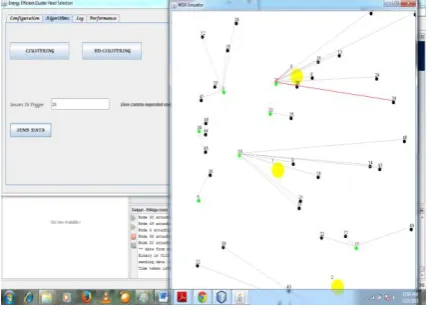
In fig 2 represents the number of nodes, cluster head, sinks deployed in the network. Cluster head selection by using bendor
decomposition algorithm & also sending data from node to cluster head then sink.
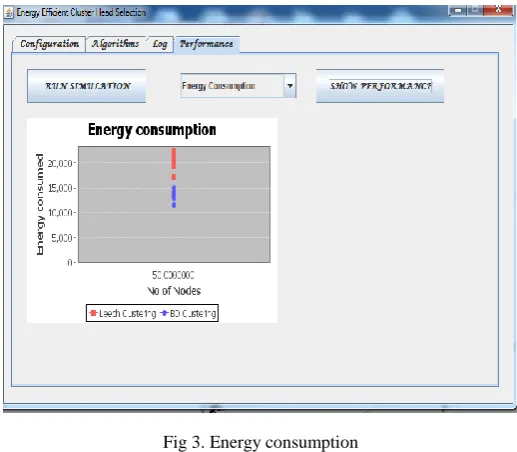
Fig 3. Energy consumption
In fig 3 represents the how much energy consumed by using LEACH & BD Clustering Algorithm.
V.
Conclusion
The CHs this scheme propose a new objective as the minimization of a weighted sum of the average energy usage, the range of
remaining energy distribution and the energy-based fixed cost. By doing so, this model avoids some well-positioned sensors
being selected as CHs repeatedly in successive periods to protect low-energy sensors from quick energy depletion while
facilitating a uniform energy consumption profile in the network. This scheme develops an effective –optimal BD approach that
incorporates an upper bound heuristic algorithm and strengthened cuts. Specifically, it devises a feasible heuristic algorithmic
solution so as to facilitate the generation of an initial Benders cut.
This study can be improved in several directions. One extension of this work is to incorporate the coverage problem into the
integrated topology control and routing problems with the high spatial redundancy of sensors by only allowing a subset of
sensors active for a given period of time, whereas all other sensors save energy being in inactive state. Since it currently focuses
on time-driven sensor networks applications pertaining to continuously monitoring ecological habitats such animals, plants,
micro-organisms, another interesting extension in the future is to reformulate the models to suit for the time-critical applications
REFERENCES
[1] S. Vasudevan, M. Adler, D. Goeckel, and D. Towsley, ―Efficient algorithms for neighbour discovery in wireless networks,‖ IEEE/ACMTrans.Netw., vol. 21, no. 1, pp. 69–83, Feb. 2013.
[2] E. Ever, R. Luchmun, L. Mostarda, A. Navarra, and P. Shah,―UHEED— An unequal clustering algorithm for wireless sensor networks,‖ in Proc. 1st SENSORNETS, Feb. 2012, pp. 185–193.
© 2015, IJCSMC All Rights Reserved
178
[4] R. Cohen and B. Kapchits, ―Continuous neighbor discovery in asynchronous sensor networks,‖ IEEE/ACM Trans. Netw., vol. 19, no. 1, pp. 69–79, Feb. 2011.
[5] F. Al-Turjman, H. Hassanein, and M. Ibnkahla, ―Optimized relay repositioning for wireless sensor networks applied in environmental applications,‖ in Proc. 7th IWCMC, Jul. 2011, pp. 1860–1864.
[6] C. Y. Chong and S. P. Kumar, ―Sensor networks: Evolution, opportunities, and challenges,‖ Proc. IEEE, vol. 91, no. 8, pp. 1247–1256, Aug. 2003. [7] K. Sohraby, D. Minoli, and T. F. Znati, Wireless Sensor Networks: Technology, Protocols, and Applications. Hoboken, NJ, USA:Wiley,2007.
[8] S. Tilak, N. B. Abu-Ghazaleh, and W. R. Heinzelman, ―A taxonomy of wireless micro-sensor network models,‖ Mobile Comput. Commun.Rev., vol. 6, no. 2, pp. 28–36, 2002.
[9] J. Porter, P. Arzberger, H. Braun, P. Bryant, S. Gage, T. Hansen, P. Hanson, C. Lin, F. Lin, T. Kratz, W. Michener, S. Shapiro, and T. Williams, ―Wireless sensor networks for ecology,‖ BioScience, vol. 55, pp. 561–572, 2005.