Anomalous phenomena in ECRH experiments at toroidal
devices and low-threshold parametric decay instabilities
E.Z. Gusakov1,2, A.Yu. Popov1,2, A.N. Saveliev1,21Ioffe Institute of RAS, 26 Polytekhnicheskaya st., St.-Petersburg 194021, Russia
2RLPAT, St. Petersburg State Polytechnical University, 29 Polytekhnicheskaya st., St .Petersburg 195251, Russia
Abstract. In the paper the possibility of total 3D trapping of electron Bernstein (EB) waves in the tokamak equatorial plane in the vicinity of the local density maximum produced by electron pump-out-effect is demonstrated. Thresholds and growth rates of the associated absolute (temporally growing) parametric decay instability (PDI) leading to anomalous absorption is predicted in the range of less than 100 kW. Its possible role in explanation of ion acceleration observed in ECRH experiments as well as in redistribution of the deposited power is discussed.
1 Introduction
Electron cyclotron resonance heating (ECRH) at power level of up to 1 MW in a single microwave beam is routinely used in present day tokamak and stellarator experiments and planed for application in ITER for plasma heating, current drive and neoclassical tearing mode island control. Parametric decay instabilities (PDI) leading to anomalous reflection and/or absorption of microwave power are believed to be deeply suppressed in tokamak megawatt power level electron cyclotron (EC) resonance fundamental harmonic ordinary mode and 2nd harmonic extraordinary mode heating experiments utilizing gyrotrons [1] – [3]. Therefore the wave propagation and absorption in these experiments are thought to be well described by linear theory and thus predictable in detail.
However during the last decade a number of observations have been obtained evidencing presence of anomalous phenomena that accompany ECRH experiments at toroidal devices.
First of all, non local electron transport was shown to accompany ECRH in some cases indicating that the RF power is not deposited in the regions predicted by standard theory, but is rather redistributed very quickly all over the plasma [4].
Secondly, the first observations of the backscattering signal in the 200 – 600 kW level second harmonic ECRH experiment at Textor tokamak were reported [5], [6], which can be explained in terms of an anomalous backscattering of the EC pump waves.
And finally, fast ion generation was observed during ECRH pulse under conditions when energy exchange between electrons and ions should be very low [7], [8].
It is worth noting here that the later two phenomena were observed at the non-monotonic plasma density profile, caused in each specific case by different physical mechanisms such as features of
C
plasma confinement in the magnetic island or so-called electron pump-out effect, originated due to the anomalous convective particle fluxes from the EC layer at the intensive ECRH.
The novel low threshold mechanism of the PDI excitation was proposed in [9] based on analysis of the actual Textor density profile. It was shown that the local maximum of the plasma density, which is usually observed in the O-point of magnetic island at Textor [10], can lead to localisation of the low frequency ion Bernstein (IB) decay wave and thus to suppression of IB wave convective losses in radial direction. A more complicated 2D analysis of the IB wave propagation accounting for the poloidal inhomogenuity of magnetic field in toroidal plasma have shown possibility of IB wave localization in the poloidal direction, as well [11], [12]. The threshold of the backscattering PDI was calculated in this case and shown to be more than four orders of magnitude lower than predictions of standard theory (in the range of 50 kW for the Textor experiment parameters).
Quite recently, the possibility of the IB wave 3D localization and the low-threshold absolute PDI excitation was reported in [13]. The analysis performed at fusion relevant parameters for the planned ECRH experiments in JET predicts the threshold of the absolute PDI in the range of 100 kW being approximately four orders of magnitude lower than that predicted by the standard theory [1] – [3] and an order of magnitude lower than the threshold of the fast convective PDI. Nevertheless, at low plasma density and temperature the growth rate of this instability appears to be too small to make the instability important for the energy budget.
It should be stressed however, that at these plasma parameters another scenario of the low-threshold absolute PDI of the extraordinary mode EC wave, leading to its anomalous absorption via decay into low frequency IB wave and high frequency electron Bernstein (EB) wave, may be realized at the non-monotonic density profile as well. The EB wave in this case is trapped in the equatorial plane near the density maximum in a 3D toroidal cavity that substantially decreases the threshold of instability, whereas the IB wave propagates to the nearest ion cyclotron harmonic layer and accelerates ions.
In the present paper the experimental conditions leading to the 3D EB wave trapping and substantial reduction of the threshold of the anomalous absorption in ECRH experiments are analyzed. The absolute PDI excitation is predicted and the corresponding threshold is shown to be much smaller than that provided by the standard theory [1-3].
2 Theoretical approaches
To elucidate the physics of the absolute PDI we analyze the most simple but nevertheless relevant to the experiment [8] three wave interaction model in which the extraordinary mode pump wave propagates almost perpendicular to the magnetic field H in the density inhomogeneity direction x
with its polarization vector being mostly directed along the poloidal directiony. We represent a wide microwave beam of the extraordinary mode pump wave propagating from the launching antenna inwards plasma along major radius in the tokamak mid-plane as
0y 0( , ) / 2 exp 0 0
E a y z q x i t с.c. (1)
where c.c. is complex conjugation, z stands for toroidal direction being periodic in tokamak,
2 2 2 2
0 8 / 0/( ) exp ( ) /(2 )
a c P w y z w is the amplitude, P0 is the pump wave power and w is the beam waist. The basic set of integral-differential equations describing the decay of the extraordinary mode pumping wave (1) into a daughter IB wave and EB wave: EI Iexp
i t
,
0
exp ( - )
E E
E i t , where 0, is given as:
0
0
ˆ , ; 4 ;
ˆ , ; - 4 ;
-I I
E E
D r r r r
D r r r r
(2)
3
ˆ , ; , ; exp ,
2 2
dqdr r r
D r r f r D q iq r r f r
(3)where
, -0
, D q r
, ;
q2e
q r , ;
i
q r , ;
, e and i being defined at a fixed coordinate r and consisting of the real and imaginary part are familiar expressions for electron and ion susceptibilities in homogeneous plasmas [14], [15]:
2 0 0 2 2 2 2 2 20 2 2 2 3
2
1 exp ;
2 2
pe ce te te pe
e m ei
m
te te te ce ce ce
m q q
Z I iq
q q
2 0 2 2 2 2 2 20
2 2 2 2
2
1 exp ;
2 2
pe te te pe ei
e
te te te ce ce ce
q q
Z I iq
q q
2 22pi 1 cot ci exp
2 2ci
2 ;i
m
ti ti ti ci ti ti
m i
X Y
q q q q
where q |q H| / | |H
, q q H H / | |
are components of the wave vector,
sin y cos z
H H e e is an external magnetic field composed of the toroidal and poloidal components, sinH Hy/ 1, Im is modified Bessel function of the first kind; and
0
0
i e
; Z
X
iY
exp
t2 dt t
.We have also introduced in (2) the nonlinear charge densities I
and E
0
generated bythe ponderomotive force and being responsible for coupling of low and high frequency waves [16]:
*
0
2
8
e E
B
I i a
q
,
0
0
28
i I B
E e a
q
, (4)
where 2
2 2
0 / / 0 0 /(3 )
B y ce ce y
a E H E H .
3 The reduced Bernstein wave equations
As it was shown in [9], [11-13], the PDI threshold decreases substantially when one of the daughter waves, IB wave in the particular case of these references, is trapped at least in x - direction.
Fig. 1: (Colour on-line) (a, left and bottom axes): EB wave 1D dispersion curves
EB
This is also possible for the EB wave if the turning point of its dispersion curve and the local maximum of the non-monotonous density profile are close one to another. Seeking a solution of the system
, 0- , |
qE, E,xE
, 0- , |
E 0;D q x D q x D q
,0- , /x
qx E| 0; D q
, - , /0 x
xE0, where the first equation is the dispersion relation of the EB wave, the second one is a condition of the turning point of its dispersion curve and the latter is the extremum condition for the dispersion function D q
,0 , |x
E over variable x, we can get frequency 0 E, wave number
,0,0
E E
q q q and coordinate x x E which, while additional constraints
2 2
0
, , / x E| 0
D q x q
, 2
2 2 20
, , / |E E/ 0
D q x x q L
hold, provide a global minimum of the dispersion function D q
, ,E x
over two variables (q x, ). This guarantees the existence of two nearby turning points (“warm” to “hot” mode) of the EB wave dispersion curve in plasma and EB wave trapping between them leading to entire suppression of the corresponding convective losses. The trapping of the EB wave is shown in Figure 1 where its dispersion curves at frequency
0
/ 2 / 2 76.4
EB I GHz
together with the density profile are depicted for the typical parameters of TCV ECRH experiments [18] (R087.5cm, a24cm, Te1.8keV, Ti350eV,
m 12.6H x kGs, ( ) 2.2 1013 3
m
n x cm ,
0/ 2 77GHz
and xm is a position of the density maximum). This figure also illustrates the possibility of three-wave interaction of the EB wave with the 2nd harmonic extraordinary mode pump wave and the IB wave at frequency / 2 0.6
I GHz
.
The dispersion curve for the latter is shown in Figure 1 up-shifted by the pump wave number 1
0 17.2 q cm .
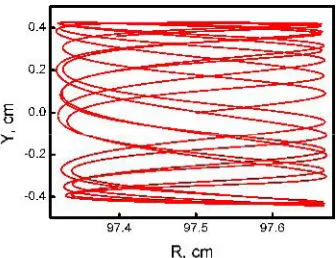
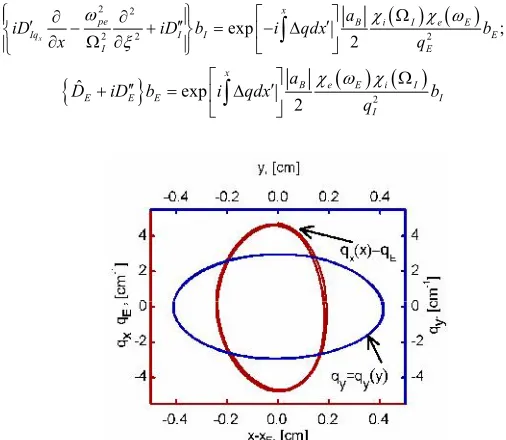
The poloidal dependence of the magnitude of the magnetic field can ensure the localization of the EB wave also in poloidal direction. As it is shown in Figure 2 by the results of the EB wave ray tracing analysis performed accounting for the tokamak equilibria for the same parameters and profiles as used in Figure 1, the ray trajectory is localised in the finite plasma volume. The phase portraits of the motion in radial and poloidal direction are represented by elliptic curves shown in Figure 3 that corresponds to the finite motion. Accordingly, in a vicinity of the turning point of the EB wave qxqE, the local maximum of the dispersion function in the radial direction x x E (further we will assume xE0) and the minimum of the magnetic field in the poloidal direction
0
y the system of integral-differential equation (2) with (3) and (4) reduces to
Fig. 2: (Colour on-line) Trajectory of the EB wave in the 118 1 E
q cm
2 22 2 exp 2 2 ;
x
x
pe B i I e E
Iq I I E
I E
a
iD iD b i qdx b
x q
(5)
ˆ
exp 2
2x
B e E i I
E E E I
I a
D iD b i qdx b
q
(6)where bI E,
r are slowly varying amplitudes of the potentials E I,
r defined as
exp
E r b rE iq x i tE E
, I
r b rI
exp
i q dx i t
x I I
; qI
q xI( ),0,0
is a solution of the IB wave dispersion relation D q
I, ,I x
0 and I 0 EB; DIqx D q
I, ,I xE
/qx;
, ,
;I I I E
D D q x q q q x q0 I
E is a small decay condition mismatch;
2 2 2 2 2 2 2 22 2 2 2 2 2
0
ˆ
2
E E E
E EB E
E x E
D D q q q
D x y
q x L q y
is a reduced differential form of the EB wave
integral operator; DED q
E, ,E xE
;
2 2 2 2 2
2 2 2 2 2 2
0 0 0
1 1 exp
2 2
pe E te E te
m m
E te m m ce ce
q I q
y q x R R
;2 2 2 2 2
2 2 2 3 2 2
0
1 1 exp
2 2
pe E te E te
m m
E m ce ce
q I q
q q
; m
x 1 mce
x / 0 0
and coordinates along andacross magnetic field on the magnetic surface are introduced by relations ycos sin ,
sin cos
z .
4 Threshold and growth rate of the absolute PDI
We perform the analysis of the EB wave toroidal cavity parametric excitation using the perturbation theory approach. Following approach of [17], at the first step of the perturbation procedure we assume that the trapped EB wave and IB wave propagating between two nearby IC harmonics are not interacting. Thus assuming the EB wave PDI pumping (r.h.s. of equation (6)) and its damping (see second term in l.h.s. of equation (6)) small, we neglect them in the zero order approximation and obtain equation which can be solved by separation of variables:
knl l
where k
n k n exp 222 222x y x y
x y x y
x y H H
, Hk are Hermitian polinomials, the sizes of the EB mode localization region in the radial and poloidal directions are 4 2 /(2 2) /
x DE qx E L qE
and y siny q0/ , accordingly. The exact value of the mode frequency EBEk n, is determined by following quantization condition
1 2 2
, 2
0
sin (2 1) (2 1)
2
E E E E
k n
E x E
D q n D q k
q y q L
.
At the next step of the perturbation theory procedure we take the EB wave damping and PDI pumping into account. Assuming the EBW is localized in x direction in a very narrow layer close to
0
E
x where the IBW damping is weak we neglect the last term DI in the l.h.s. of equation (5) describing nonlinear excitation of the IB wave, its damping as well as losses both along the magnetic field and in radial direction. We integrate equation (5) to obtain bI in the form
2 , exp , , , , , , ,
2 x
x x
i I e E
I B E
E Iq
dx
b d G x x i qdx a y z b x y z
iq D
(8)where
2 2 2 2 2 , exp 4 4 x x
Iq I Iq I
pe pe
i D D
G x x i
x x x x
and the inequalities q0q qI, E and
, k n E
were used. Substituting (8) into (6) and using the zero order solution (7) for the EB wave potential in the r.h.s. of (6) we can obtain the first order perturbation theory corrections to the localized EB wave eigen frequency. Namely, multiplying both sides of the equation by the complex conjugated zero order eigen function (7) and performing integration over coordinates we get for the EB eigen mode (k, n) a condition connecting its growth (decay) rate with the pump wave power:
2 2 2
* 4
0
/ 2 2 2 2
*
2 2 2
/ 2
1 1
4 2 2 ! 2 ! 2 2
exp exp , exp ,
4 2
x e E i I
E B
E k n k k
E E Iq E x y
s
n s
D D a ds d s s
q D R k n
u v v
i qdx d du dv G v y u
w w w
, 2n y u v
(9)
where RE stands for the major radius at xE0. We illustrate the above equation (9) in the most dangerous case of the fundamental EB mode (k0, n0) excitation, possessing the minimal PDI threshold. Neglecting for the sake of simplicity the mismatch of decay condition by putting q 0
we obtain for the growth (damping) rate of the PDI an expression
1 2 2 2
2
4 2 2
4 x 2
e E i I x
E
E B
E E Iq y E
w
D a J
q D w R
(10) where 1 /
E D E D E
is the EB wave damping rate, 2 0 Re exp 4 1 d J iT
(11)and T / is a coefficient equal to ratio of wave energy convective losses time in radial direction,
i.e. x ID D/ Iqx, and diffractive loss time along the magnetic field, i.e.
2/ 2 2
pe D wI
. In the case T1 when the convective losses of the IB wave in the radial direction dominate the
parametric decay by the factorRe
J
1/ 4 / 2
T
. Assuming in (10) the growth rate equal to zero 0 yields in the latter case the PDI threshold:
2 2 4
2 0
2 2 2 2
36 2 2
1/ 4
x y
E Iq
E E
E
e E i I x
th
w q D
E D R T
H w
(12)
This lengthy expression can be reformulated in the compact form resembling the homogeneous plasma PDI theory result
2 0
PDI damp E I th
V V
(13)
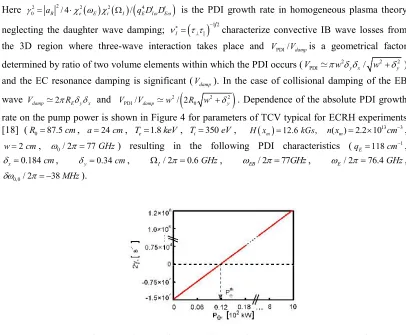
Here 2 2 2
2
4
0 aB / 4 e E i I / q D DE I E
is the PDI growth rate in homogeneous plasma theory neglecting the daughter wave damping; I
1 2
characterize convective IB wave losses from the 3D region where three-wave interaction takes place and VPDI/Vdampis a geometrical factor determined by ratio of two volume elements within which the PDI occurs ( 2 2 2
PDI y x/ y
V w w )
and the EC resonance damping is significant (Vdamp). In the case of collisional damping of the EB wave Vdamp2 RE y x and VPDI/Vdampw2/ 2
R w0 2y2
. Dependence of the absolute PDI growth rate on the pump power is shown in Figure 4 for parameters of TCV typical for ECRH experiments [18] (R087.5cm, a24cm, Te1.8keV, Ti350eV , H x
m 12.6 kGs, n x( ) 2.2 10m 13cm3,2
w cm, 0/ 277GHz) resulting in the following PDI characteristics (qE118cm1,
0.184
x cm
, y0.34cm, I/ 20.6GHz, EB/ 277GHz, E/ 276.4GHz,
0,0/ 2 38MHz
).
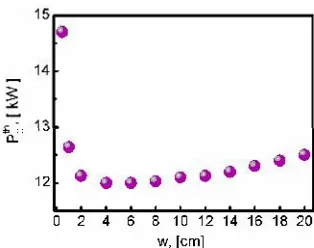
As is seen, the instability threshold is only 12 kW whereas the growth rate at the power level of 400 -600 kW usually used in tokamak ECRH experiments is high enough ( 105s1) to complicate quasi linear instability saturation by variation of plasma parameters due to MHD or transport phenomena. Dependence of the PDI threshold pump power on the microwave beam waist obtained from equation (10) and shown in Figure 5 deserves a few comments. At the small beam waist the inequality 1T holds so that the IB wave diffraction losses along the magnetic field line dominate over its radial convective losses, moreover the EB wave poloidal localization region is larger than the PDI pump region whenwy. As is shown in Figure 5, in this limit the PDI threshold is increasing P0th1/w as w decreases. In the opposite case when the beam waist is large so that the PDI pump region is
wider than the EB wave localization domain wy and moreover the radial losses of the IB wave dominate over those along the magnetic field ,i.e. T1, the PDI threshold is increasing P0thw. In the intermediate range the dependence possesses minimum as can be seen in Figure 5. The minimal threshold value is more than order of magnitude smaller than that calculated for the induced backscattering absolute PDI [13] for the same TCV parameters. The growth rate is an order of magnitude higher than in the later case, which makes the 2nd harmonic extraordinary mode decay into electron and ion Bernstein waves a main candidate for explanation of fast ion acceleration observed in experiment [8]. This mechanism, leading to the microwave power absorption far from the actual ECR layer position, can be to some extent responsible for the non-local electron transport effect often observed in the ECRH experiments [4].The saturation of the analysed absolute instability is provide by nonlinear effects among which one should mention the amplitude dependent stochastic damping of the IB wave or further decay of the weakly damped EB daughter wave into the EB mode of the toroidal cavity and IB wave. In both cases one may expect intensive interaction of the produced IB waves with the ion component and fast ion tail production. Investigation of the instability nonlinear saturation as well as description of the fast convective instability which takes place in the vicinity of the pump beam will be given in the further coming papers.
6 Conclusion
Summarizing we would like to stress the possible role of the low-threshold absolute PDI predicted in this paper in anomalous absorption of microwave power and, in particular, in fast ion production often observed in second harmonic ECRH in toroidal plasmas.
7 Acknowledgements
Work supported by RFBR grants 12-02-90003-Bel, 10-02-00887, NWO-RFBR Centre of Excellence on Fusion Physics and Technology (grant 047.018.002), the RAS Presidium program №12 and the RF government grant № 11.G34.31.0041
8 References
1. M. Porkolab and B.I. Cohen,Nucl. Fusion28, 239 (1988)
2. B.I. Cohen, R.H. Cohen, W.M. Nevins and T. D. Rognlien,Rev. Mod. Phys.63, 949 (1991) 3. A.G. Litvak, A.M. Sergeev, E.V. Suvorov et al.,Phys. Fluids B5
,
4347 (1993)4. V.F. Andreev, Yu.N. Dnestrovskij, M.V. Ossipenko et al.,Plasma Phys. Control. Fusion
46
,
319 (2004)5. J.W. Oosterbeek, A. Burger, E. Westerhof et al.,Rev. Sci. Instrum.79, 093503 (2008) Fig. 5: (Colour on-line) PDI threshold versus the microwave
6. E. Westerhof, S.K. Nielsen, J.W. Oosterbeek et al.,Phys. Rev. Lett.103, 125001 (2009) 7. D. Rapisadra, B. Zurro, V. Tribaldos et al.,Plasma Phys. Control. Fusion49, 309 (2007) 8. A.N. Karpushov, B.P. Duval, T.P. Goodman et al.,in Proceedings 33rd EPS Conference on
Plasma Phys. Rome, 19 - 23 June 2006 ECAvol. 30I, P-1.152 (2006) 9. E.Z. Gusakov, A.Yu. Popov,JETP Letters91, 655 (2010)
10. M. Kantor, A.J.H. Donne, R. Jaspers et al.,Plasma Phys. Control. Fusion51, 055002 (2009) 11. E.Z. Gusakov, A.Yu. Popov,Phys. Rev. Lett.105, 115003 (2010)
12. E.Z. Gusakov, A.Yu. Popov,Nucl. Fusion51, 073028 (2011) 13. E.Z. Gusakov, A.Yu. Popov,JETP Letters94, 277 (2011) 14. D.G. Swanson Plasma Waves (Boston: Academic Press) (1989)
15. A.D. Piliya, A.N. Saveliev,Plasma Phys. Control. Fusion36, 2059 (1994)
16. V. P.SilinParametric Action of High Power Radiation on Plasma [in Rus], Moscow (1973) 17. E.Z. Gusakov, V.I. Fedorov,Sov. J. Plasma Phys.5, 463 (1979)